Herzl and Zionism: from Basel to Balfour
In August 1897 about two hundred delegates gather in Basel to decide whether a people without a state has a road to a home of its own.
Decisions, questions and your own progress, in the app
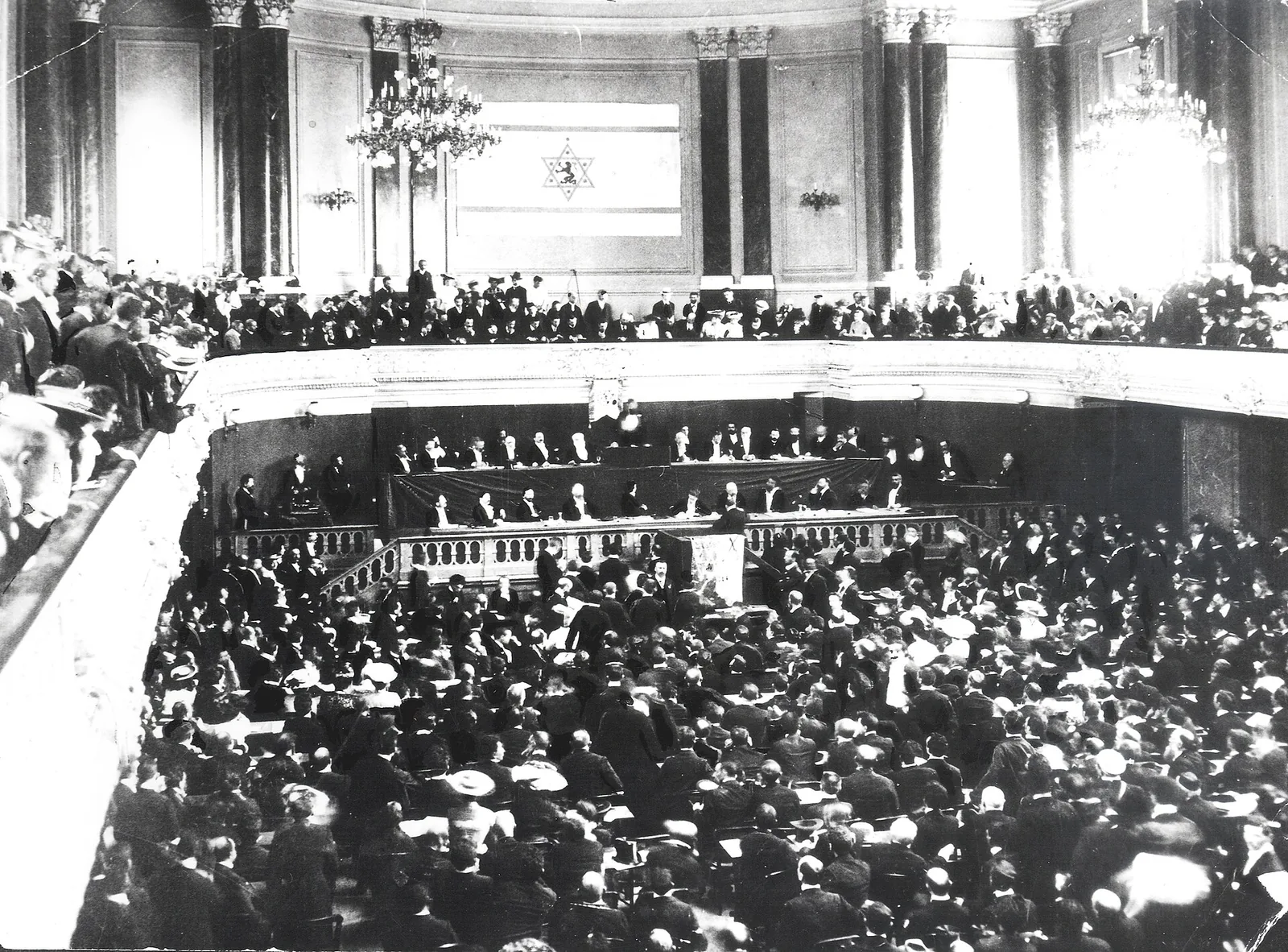
Photographer unknown, 1897–98. Copy in the Government Press Office, National Photo Collection of Israel (D131-028) · Public domain · Source page
Paris, 1895
A sword broken in Paris
Saturday, 5 January 1895. In a courtyard of the École Militaire, Paris's military academy, rows of soldiers stand in silence. Captain Alfred Dreyfus, convicted of treason two weeks earlier, is marched to the middle.
An officer tears the buttons and braid from his tunic and breaks his sword. Dreyfus shouts that he is innocent and cries, ‘Long live France!’
Among the journalists watching is a Viennese playwright and reporter, Theodor Herzl, Paris correspondent of the Neue Freie Presse. He is 34. In less than three years he will convene the First Zionist Congress.
A famous story says this morning is why. Is it true? We return to the question at the end.
Source: ‘The Traitor’: the cover that told France what to think
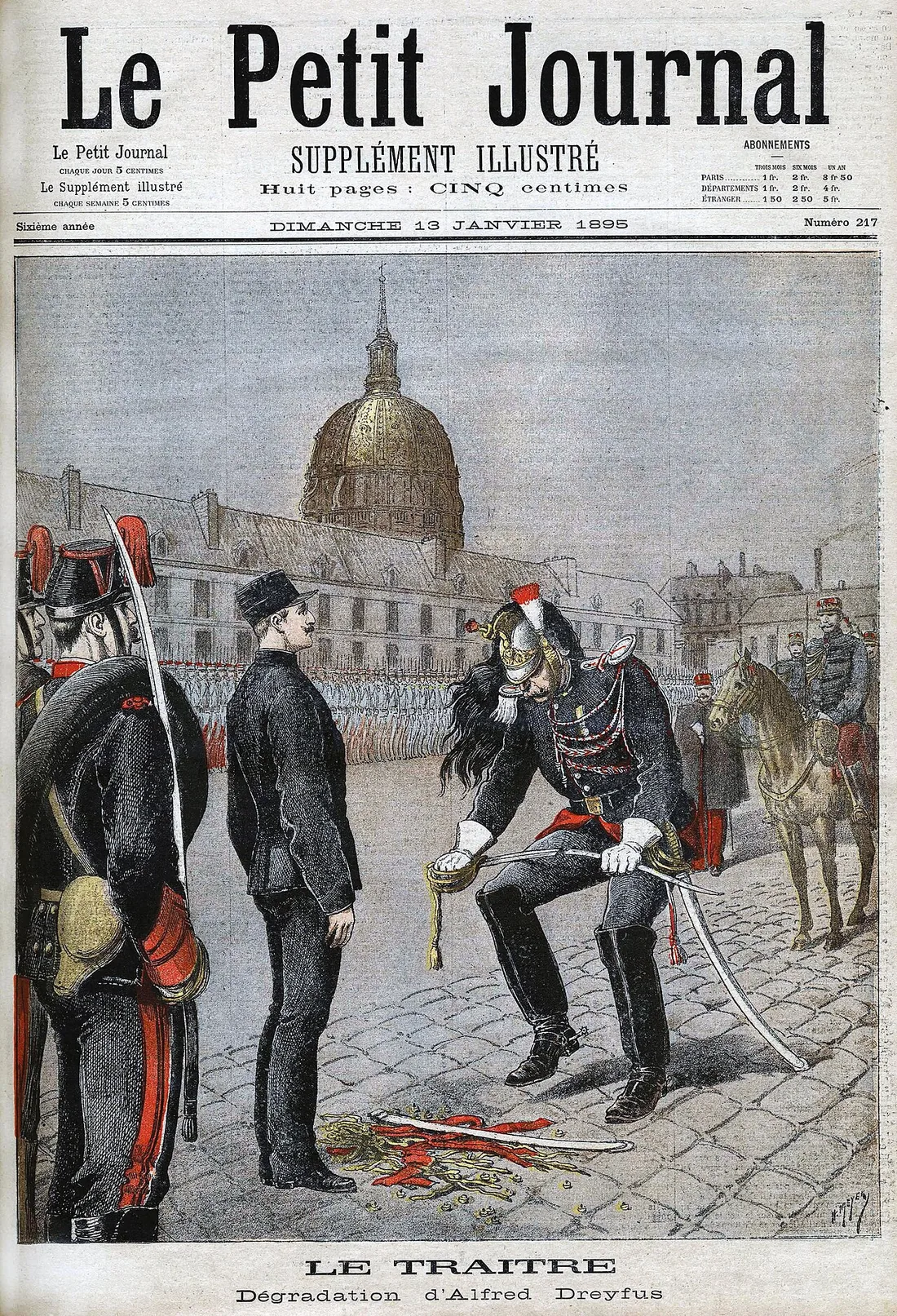
Henri Meyer, 'Le Traître: Dégradation d'Alfred Dreyfus', Le Petit Journal, Supplément illustré, 13 January 1895 · Public domain · Source page
Henri Meyer, Le Petit Journal, Supplément illustré, no. 217, 13 January 1895
A weekly picture supplement sold for five centimes. The artist draws what the paper wants its readers to feel.
- Read the caption before the picture. What does ‘The Traitor’ tell readers? That the verdict is settled, though the trial was largely secret and rested on a handwriting comparison; Dreyfus, as became clear years later, was innocent.
- Who is in the picture, and who is missing? An officer breaking a sword, Dreyfus upright, rows of soldiers, a golden dome. Missing: the crowd outside the gates and the journalists, the witnesses whose words we weigh later.
- Can an illustration prove what happened? It shows what the paper wanted to show: the broken sword. The artist may not have been there, and an illustration cannot tell us what the crowd shouted.
Background
An innocent captain
Alfred Dreyfus is an artillery officer from a Jewish family of Alsace, accused of passing military secrets to Germany. On 22 December 1894 seven officers convict him unanimously. The sentence: public degradation, then exile on Devil's Island, off South America. Years later he will be cleared. But in January 1895 almost nobody doubts the verdict, and antisemitic papers already cry that the traitor is a Jew.
Check yourself
Why can the cover of Le Petit Journal of 13 January 1895 not, on its own, tell us what happened in the courtyard of the École Militaire?
Answer: Because it shows what the paper wanted its readers to feel. The artist may not have been there, and a drawing cannot tell us what the crowd shouted.. Right. An illustration shows the moment the paper chose to present, so it is evidence of the opinion the paper wanted to create, not proof of what happened in the courtyard.
Before Herzl
Background
A promise that cracks
For a century Europe has been offering Jews a deal: become citizens. France begins in 1791, the German states follow, and by 1871 a united Germany grants equality on paper. This is emancipation. Many accept gladly: they study, serve in armies, sit in parliaments, and speak German or French at home.
But the offer is cracking. In the 1870s and 1880s a new hatred spreads, modern antisemitism: Jews are a ‘race’, it says, and no baptism changes that. In 1879 the German journalist Wilhelm Marr founds a League of Antisemites. Europe argues about the Jewish question. Some answer: assimilate. Some: revolution. Some: leave. A few: a state.
1881–1882
Storms in the south
On 13 March 1881 revolutionaries kill Tsar Alexander II, and rumour blames the Jews. From April mobs attack Jewish homes and shops in Elisavetgrad, Kiev, Odessa and dozens of other towns: more than 200 events are counted in 1881–82, mostly looting and wrecking, with dozens dead, not thousands. The authorities hardly stop the mobs, and in May 1882 the May Laws restrict Jewish life further. In the decades to 1914 about two million Jews will leave the Russian Empire, most for the United States.
A doctor in Odessa, Leon Pinsker, answers in a German pamphlet signed ‘by a Russian Jew’. Auto-Emancipation (1882) cries: ‘What a miserable role for a nation which descends from the Maccabees!’ Its goal: ‘not the “Holy Land,” but a land of our own.’ (D. S. Blondheim's English, 1916.)
1882–1903
Lovers of Zion
Other Jews act. Across Eastern Europe, Lovers of Zion societies send settlers to Palestine, then an Ottoman province. In 1882 students from Kharkov found BILU, and the first of them land at Jaffa. This is the First Aliyah, 1882–1903 (some count it from 1881). Estimates of the number of immigrants run from 25,000 to 60,000 (English Wikipedia, citing Anita Shapira; Hebrew Wikipedia gives 25,000–35,000), and many leave again. The colonies, Rishon LeZion among them, survive on money from Baron Edmond de Rothschild. For most Jews in the world this is a distant experiment.
Check yourself
Which of these followed the anti-Jewish riots of 1881–82 in the Russian Empire?
Answer: Pinsker publishes Auto-Emancipation, and Lovers of Zion societies send settlers to Palestine.. Right. Pinsker's pamphlet came out in 1882, and BILU and the First Aliyah began in those same years. These are direct Jewish responses to the riots.
Herzl
The outsider with a pen
Herzl is no rabbi and no organiser. Born in Pest in 1860, he moves to Vienna as a teenager, takes a law doctorate in 1884 and turns to plays and newspaper columns. In 1891 the Neue Freie Presse sends him to Paris. In autumn 1894 he writes a play, The New Ghetto; the first reports of the Dreyfus case reach him as he writes and, says his biographer Alex Bein, made ‘no particular impression’.
Theodor (Benjamin Ze'ev) Herzl
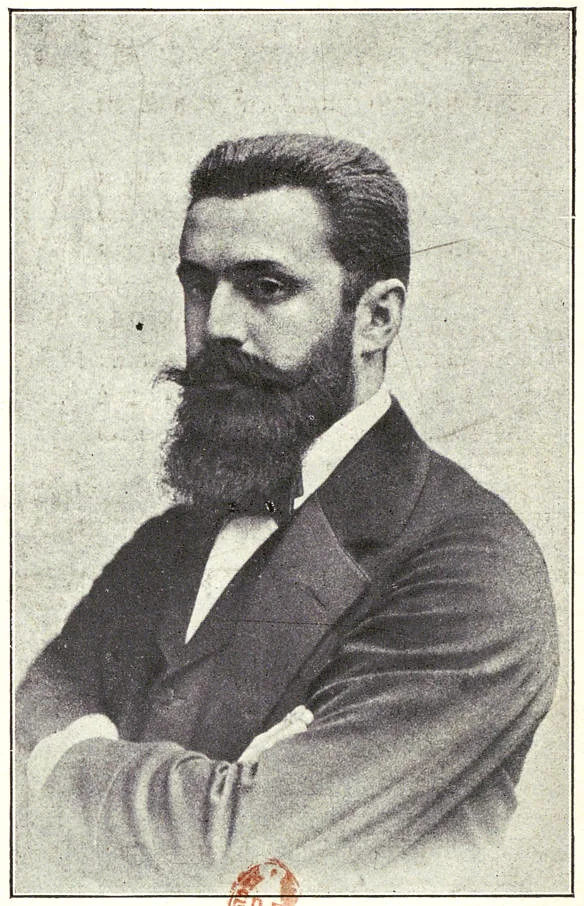
Carl Pietzner, about 1896–97 (this copy: L'État juif, Lipschutz, Paris 1926) · Public domain · Source page
A Viennese journalist who, in less than a decade, turned a scattered argument into an organised political movement.
- Born: 2 May 1860, Pest (now part of Budapest)
- Died: 3 July 1904, Edlach, Reichenau an der Rax, Austria, Pneumonia on top of a weak heart, aged 44. In 1949 his remains were brought to Mount Herzl in Jerusalem.
- Won: Der Judenstaat, 1896; The First Zionist Congress, 1897; The weekly Die Welt, 1897
- Lost: No charter from the Sultan or the Kaiser; The Uganda offer splits the movement, 1903
The Jews who wish for a State shall have it, and they will deserve to have it.
Myth
Herzl invented Zionism.
The truth
No. Pinsker published in 1882, the Lovers of Zion began in 1881, settlers were already farming, and Nathan Birnbaum coined the word ‘Zionism’ in 1890. Herzl did not know Pinsker's pamphlet when he wrote his own. What he added was a stage: congresses, diplomacy, a newspaper and money.
The evidence
Herzl, diary, 10 February 1896, after reading Pinsker: ‘A pity that I did not read this work before my own pamphlet was printed. On the other hand, it is a good thing that I didn't know it—or perhaps I would have abandoned my own undertaking.’ (Complete Diaries, tr. Zohn, vol. 1, p. 299.)
Check yourself
Which fact from the lesson best disproves the claim ‘Herzl invented Zionism’?
Answer: Pinsker published his pamphlet in 1882 and the Lovers of Zion began in 1881, and settlers were already farming in Palestine before Herzl wrote a word.. Right. The movement and the settlement came before Herzl. What he added was a stage: congresses, diplomacy, a newspaper and money.
The pamphlet
1895
No budget, no movement
Paris, early June 1895. Herzl asks Baron Maurice de Hirsch, banker and funder of Jewish farm colonies in Argentina, for an interview, and brings a plan for the whole people. Hirsch does not take it up. Herzl writes him a long letter anyway: a people moves, he argues, only through ‘imponderables floating high in the air’, dreams, songs and fantasies.
Soon he starts a diary and, in about five days, writes sixty-five pages, an Address to the Rothschilds. Max Nordau understands at once; in London Zangwill and the Maccabean Club listen. The plan has no budget, no members and no name.
A decision point
You are Theodor Herzl.
Winter 1895–96
You are 35, a journalist and playwright, and since June you have thought of nothing else. Baron de Hirsch was not persuaded; Bismarck never answered. In London, in November, Zangwill and other influential Jews heard you out, and none wanted to hear about Argentina: only Palestine was on the table.
You have sixty-five pages and a diary, and still nobody behind you. Whom do you try to convince?
What do you do?
- Keep working on the very rich, Hirsch and the Rothschilds. Money first, publicity later. Probably meetings and polite refusals. Hirsch already has his Argentine colonies, and Baron Edmond de Rothschild, when you do reach him, will call your plan impracticable. A plan for a whole people stays a favour for the rich to grant.
- Print the plan and appeal to the Jewish public and to governments. Probably ridicule from the assimilated press and a risk to your job. But it is the only way to reach ordinary Jews, students and the Jews of Eastern Europe, who may follow a man they have read.
- Go straight to the rulers, the Sultan and the Kaiser, with no noise beforehand. Probably closed doors. Rulers listen to a man with a public behind him, and you have none. Bismarck has already ignored you.
What really happened
Print the plan and appeal to the Jewish public and to governments.
You choose the public. Der Judenstaat, ‘The Jewish State’, appears in Vienna on 14 February 1896, in about 3,000 copies. Your own paper never mentions it, and, in Bein's words, a number of journalists allude to ‘the adventurer who would like to become Prime Minister or King of the Jews’. You knock on the rulers' doors too: in June a go-between fails to win you an audience with the Sultan, and in July Baron Edmond de Rothschild says no.
Alex Bein, Herzl's best-known biographer, writes that after his experiences in England ‘Herzl resolved to present his plan to the public at large’. Herzl had told Hirsch that a people moves only through imponderables, and for that he needed an audience. The book gave him one, and a name to argue about.
Source: ‘We are a people—one people’
“It is a national question, which can only be solved by making it a political world-question to be discussed and settled by the civilized nations of the world in council. … We are a people—one people. … Shall we choose Palestine or Argentine? We shall take what is given us, and what is selected by Jewish public opinion. The Society will determine both these points. … an outpost of civilization as opposed to barbarism.”
A thin pamphlet by a journalist with no movement behind him, addressed to educated Europeans and Jewish notables. In the preface Herzl warns that it depends on the Jews themselves whether it ‘remains for the present a political romance’. The English is a translation, revised in 1943 and 1946 from one of 1896.
- Does Herzl call the Jewish question religious, social or political, and who must settle it? Neither social nor religious: ‘national’, a political world-question for ‘the civilized nations of the world in council’. The Great Powers, not the Jews alone: hence the name political Zionism.
- Which land does he name? He asks ‘Palestine or Argentine?’ and leaves it to ‘the Society’ and Jewish opinion. The organisation is the point, not yet the land.
- Whom is he writing for, and what is missing from the passage? European governments and Jewish notables, in the language of the empires of 1896: an ‘outpost of civilization’. Not a word in this passage about the people already living in the land. It is a source of its time, not a modern one.
Check yourself
What does Herzl's Der Judenstaat (1896) say about where the Jewish state should be?
Answer: ‘Palestine or Argentine?’ It leaves the choice to Jewish public opinion.. Right. In 1896 the organisation is the point and the land is still open, though the Jews he met in London wanted Palestine only.
Basel
29–31 August 1897
A hall in Basel
≈200
Herzl planned the Congress for Munich, but local Jewish leaders, Orthodox and Reform alike, objected, so it moves to Basel. On Sunday 29 August 1897, in the concert hall of the town casino, about two hundred delegates and guests from sixteen or seventeen countries (the counts differ) take their seats in tails and white ties. The language is German. Seventeen women attend, without a vote.
Herzl presides, with Max Nordau among his vice-presidents. In three days the Congress founds the Zionist Organization, elects Herzl its president, and argues over a single sheet of paper.
A decision point
You are a delegate at the First Zionist Congress.
Sunday–Monday, 29–30 August 1897, the Stadtcasino, Basel
Herzl argues that the Zionists need no programme, since it is already in his book. But many of you come from the Lovers of Zion, and you did not travel from Russia, Romania and Galicia to applaud a pamphlet. You want a written aim.
A committee under Nordau is drafting one. The argument is about what to call the goal, and what law should secure it. Herzl fears that the Ottoman Sultan, who rules Palestine, will see any sharp wording as a threat.
What do you vote for?
- No programme. The leader's pamphlet is enough. Probably the Lovers of Zion, who came to build, feel unheard, and no written aim binds the movement. Critics can say that Zionism is whatever its leader says.
- A programme that demands ‘a Jewish state’ in so many words. Probably it unites the hall for one afternoon and hands the Sultan, the Tsar and rich anti-Zionist Jews a sentence to attack. The diplomacy Herzl needs would be badly damaged.
- A programme for a ‘home’ in Palestine, secured under public law, with four practical means. A compromise both wings can sign: vague enough not to alarm, clear enough to give a goal. Probably also a cause of later arguments about what ‘home’ means.
What really happened
A programme for a ‘home’ in Palestine, secured under public law, with four practical means.
The Congress adopts the third. Nordau's committee presents the text on 30 August. The great argument is over the law behind the home: Leo Motzkin wants ‘international law’, Herzl's compromise is ‘public law’. After the vote one word is added. The Basel Program is now the movement's aim.
Israel Zangwill credited Nordau with the formula ‘a home secured by public law’, chosen so as not to antagonise the Sultan too deeply; the Jewish Virtual Library credits Herzl with the compromise ‘public law’. Herzl saw something bigger in the result, as you will see.
Source: A home, not a state
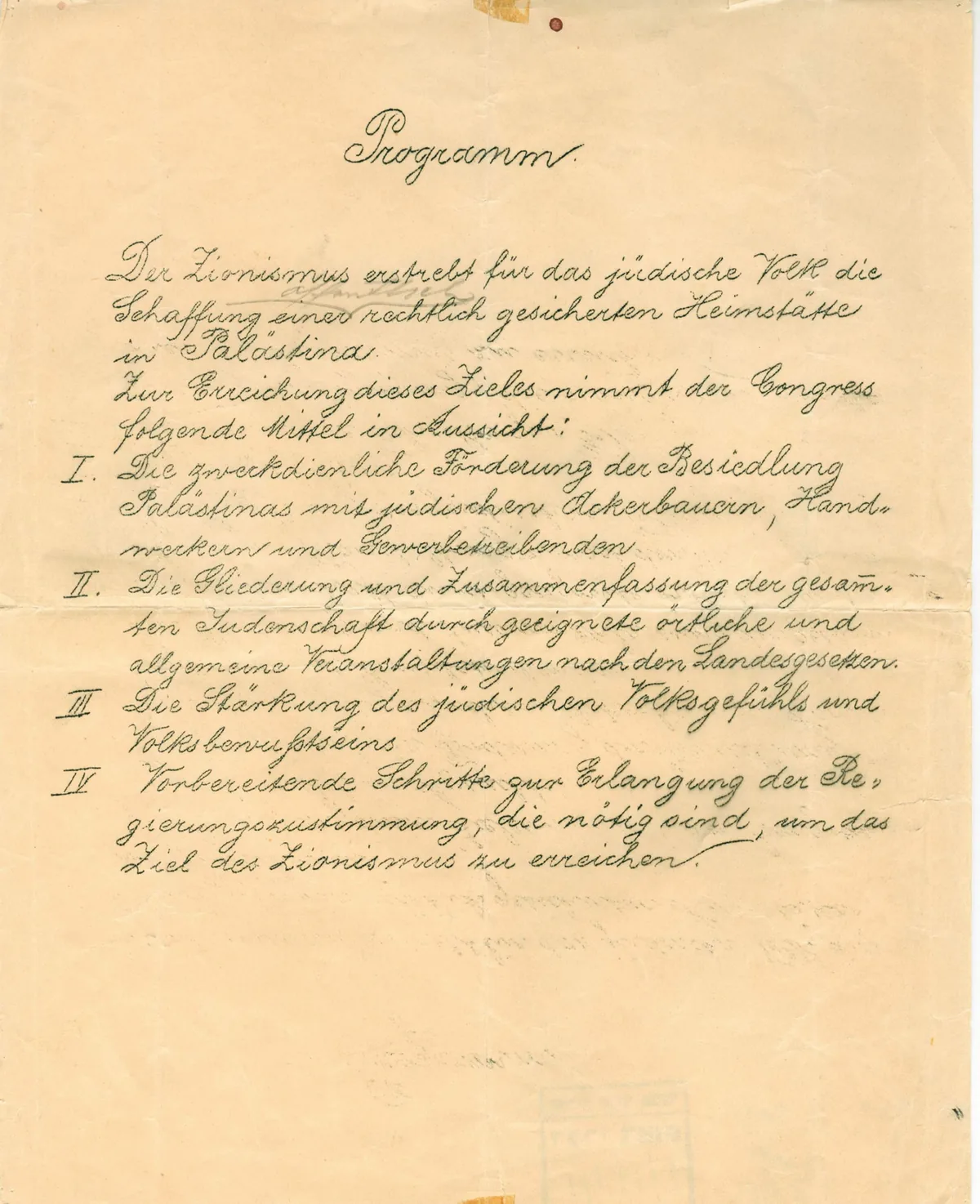
The Basel Program, 1897. Central Zionist Archives, Jerusalem · Public domain · Source page
“Zionism strives to create for the Jewish people a home in Palestine secured by public law. To reach this goal the Congress contemplates the following means: 1. The appropriate promotion of the settlement of Palestine by Jewish farmers, artisans and tradesmen. … 4. Preparatory steps toward obtaining the consent of governments that is necessary to reach the aim of Zionism.”
Three languages, three wordings. The Congress worked in German, and the original says Palästina; the Archives' Hebrew says ‘Eretz Israel’; the Jewish Virtual Library's English says Eretz-Israel.
- Find the place where you would expect ‘state’. What stands there, and why? ‘Home’ (German Heimstätte). The Ottoman Sultan ruled Palestine, and a demand for a state could have closed every door. According to Zangwill, Nordau chose the wording so as not to alarm him.
- ‘Secured by public law’: who has to agree? The Great Powers and the Sultan: means 4 speaks of the ‘consent of governments’. A guarantee, not force or quiet infiltration. The argument in the hall was between ‘international law’ and ‘public law’.
- What is missing? Any mention of the people already living in Palestine, of Hebrew, and of a state.
Check yourself
Which word does the Basel Program use for its goal, instead of ‘state’?
Answer: A home. Right: Heimstätte in German, ‘bayit moledet’ in Hebrew. According to Zangwill, the word was chosen so as not to antagonise the Sultan.
3 September 1897
‘In Basel I founded the Jewish State’
Three days later, in his private diary (published after his death), Herzl writes:
‘If I had to sum up the Basel Congress in one word, which I will take care not to say aloud, it would be this: in Basel I founded the Jewish State. If I said that today, universal laughter would be the answer. Perhaps in five years, certainly in fifty, everyone will see it.’
The word the Program avoided, the diary uses. Fifty years later the United Nations votes for partition (29 November 1947) and a state is declared (14 May 1948): a good guess, not a prophecy, with two world wars in between. Our translation, from the German as printed in the press; English and Hebrew versions of the diary differ slightly.
Uganda, and Herzl's death
1898–1903
Seven years of doors
Herzl spends his remaining years knocking on doors. In October–November 1898 he makes his only journey to Palestine and meets Kaiser Wilhelm II outside Jerusalem. In May 1901 Sultan Abdul Hamid II receives him; in February 1902 the Sultan offers settlement anywhere in his empire but Palestine, and only for Ottoman subjects: a charter without Palestine, Herzl notes in his diary, and he refuses at once. In May 1903 Egypt refuses a plan for settlement at El-Arish, in Sinai. Seven years of talks have brought no charter.
1903
Kishinev, and an offer from London
At Easter 1903, between 19 and 21 April, a mob in Kishinev, in the Russian Empire, attacks the city's Jews. About fifty are killed (early reports said more), hundreds are hurt, and homes and shops are wrecked. The world reads in horror.
In August Herzl meets Russia's interior minister, von Plehve, whom many blamed for Kishinev, and finds him open to Jewish emigration. Then, on 14 August, the British Foreign Office writes: Britain will consider a Jewish settlement with local self-government in East Africa, on a highland of about 13,000 square kilometres in today's Kenya. The newspapers call it ‘the Uganda scheme’, though the name is a misnomer.
Check yourself
What did Britain offer on 14 August 1903, and why is the name ‘the Uganda scheme’ misleading?
Answer: A Jewish settlement with local self-government on a highland in East Africa, in today's Kenya and not in Uganda.. Right. The British Foreign Office wrote of a settlement with local self-government, and the newspapers called it ‘the Uganda scheme’ though the name is a misnomer.
A decision point
You are Theodor Herzl.
Mid-August 1903, on the way to the Sixth Congress in Basel
You are 43. Seven years of talks have brought no charter. Kishinev has shown again what Russia's Jews endure. Now Britain offers autonomous Jewish settlement in East Africa. It is not Palestine.
Your aide Alexander Marmorek calls it a ‘death blow to Zionism’. The Russian Zionists, your most loyal base, will hate it. The Sixth Congress opens in a week.
What do you do?
- Refuse: Palestine or nothing. Probably the Russian Zionists stay united, but after seven years you have only conversations, and the refugees of Kishinev gain no new door. The British offer is lost.
- Put the offer to the Congress as an emergency shelter, and ask only for a commission to examine the land. Probably the offer stays alive and you can say that Palestine remains the aim. But the debate may split the movement on the floor.
- Accept at once and tell the movement afterwards. Probably you are accused of betraying the Basel Program, a home in Palestine. The Russians walk out for good, and the movement splits.
What really happened
Put the offer to the Congress as an emergency shelter, and ask only for a commission to examine the land.
You take the middle road. At the Congress, in late August, a vote of 295 to 178, with about a hundred abstaining, sends a commission to examine the land, not to accept it. Russian delegates walk out; reports say you spend hours persuading them back, and insist that Palestine remains the aim.
Herzl told the delegates the new land lacked ‘the same historic, religious-poetic and Zionist value’, that the offer was only ‘help through settlement’, and that the Jewish people could have ‘no final aim other than Eretz Israel’ (our translation of the Hebrew text of his speech printed by the Ministry of Education, itself a translation from German). Nordau called it a Nachtasyl, a night shelter. Historians differ on the motives: a humanitarian answer to Kishinev, or a bargaining chip with Britain.
1904–1905
After the Congress
Herzl does not live to see the end. He dies on 3 July 1904, aged 44. In December the commission reaches East Africa without him. In summer 1905 the Seventh Congress rejects settlement outside Palestine; Israel Zangwill and his followers leave to found the Jewish Territorial Organization. The movement Herzl built goes on, but it now passes to those who say: build in Palestine now.
Check yourself
What did the Sixth Zionist Congress decide in August 1903 about the British offer?
Answer: To send a commission to examine the land (295 to 178).. Right. The vote was to examine the land, not to accept it.
Many Zionisms
1897–1914
Five answers to one question
Zionists agree that the Jews need a home. About almost everything else they argue.
Political Zionism, Herzl's and Nordau's: win a charter from the powers first, mass settlement after.
Practical Zionism, the Lovers of Zion's: settle and build now, charter or none; after Herzl's death it prevails.
Spiritual Zionism, Ahad Ha'am's (Asher Ginsberg): a spiritual and cultural centre in Palestine to renew Hebrew culture, not merely a refuge.
Religious Zionism, the Mizrachi, founded in Vilna in 1902 under Rabbi Yitzhak Yaakov Reines: Torah and Zionism together.
Socialist Zionism, Poale Zion and, from 1905, Hapoel Hatzair: a just society built by Jewish hands.
A group around Chaim Weizmann tries to combine diplomacy and settlement. Many Jews oppose Zionism altogether: the Bund, and Orthodox and Reform leaders.
1904–1914
The Second Aliyah
After 1904 a new wave arrives, mostly young Russian Jews, many of them socialists: about 35,000 in the Second Aliyah (1904–1914) by the usual estimate; some give 40,000. In April 1909 Hashomer, a guard organisation for the colonies, is founded, and sixty-six families draw plots by lot, using seashells, for a new Jewish suburb north of Jaffa: Tel Aviv. Around 1910 young workers start a collective farm, Degania, near the Sea of Galilee. By 1914 about 85,000 Jews live in Palestine.
The road to Basel, and beyond
- 1881 Alexander II is killed; pogroms sweep the south of the Russian Empire.
- 1882 Pinsker's Auto-Emancipation, the May Laws, BILU; the First Aliyah begins.
- Nov 1884 The Lovers of Zion meet at Kattowitz under Pinsker.
- 5 Jan 1895 Dreyfus is degraded in Paris.
- 14 Feb 1896 Herzl publishes Der Judenstaat.
- 29–31 Aug 1897 The First Zionist Congress adopts the Basel Program.
- Aug 1903 The Sixth Congress votes to send a commission to East Africa.
- 3 Jul 1904 Herzl dies. The Second Aliyah begins.
- 1905 The Seventh Congress rejects settlement outside Palestine; Hapoel Hatzair is founded.
- 1909–10 Hashomer, Tel Aviv and Degania.
Check yourself
A Zionist says: ‘Don't wait for a charter. Settle and build now.’ Which current does he belong to?
Answer: Practical Zionism. Right. This is the way of the Lovers of Zion, and after Herzl's death it prevails.
Balfour and the Mandate
1914–1917
Promises that collide
In 1914 the Ottoman Empire, which rules Palestine, joins the First World War against Britain. In 1915–16 Henry McMahon, Britain's High Commissioner in Egypt, exchanges letters with Hussein, the Sharif of Mecca, about Arab independence after the war; in 1916 Britain and France secretly agree on lines for sharing the Ottoman lands, the Sykes–Picot agreement; and the chemist Chaim Weizmann lobbies ministers for a Jewish home. The promises overlap and clash, and historians have argued over them ever since.
By 1917 ministers think that Jews in Russia and America favour Zionism, and that a declaration may help the war effort. On 31 October the War Cabinet approves the text of the Balfour Declaration.
Source: One sentence, 67 words
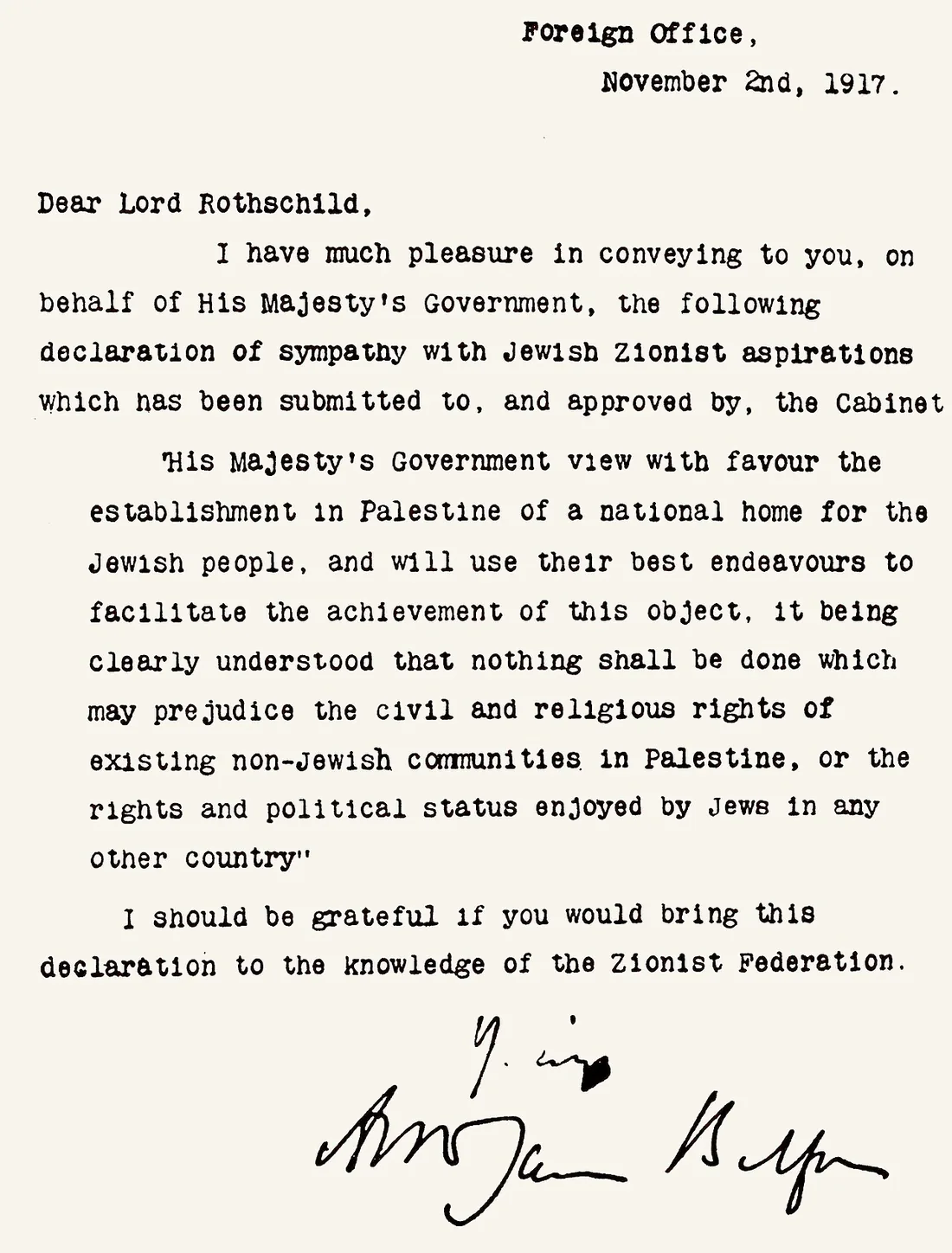
Arthur James Balfour to Lord Rothschild, 2 November 1917. British Library · Public domain · Source page
“His Majesty's Government view with favour the establishment in Palestine of a national home for the Jewish people, and will use their best endeavours to facilitate the achievement of this object, it being clearly understood that nothing shall be done which may prejudice the civil and religious rights of existing non-Jewish communities in Palestine, or the rights and political status enjoyed by Jews in any other country.”
The letter is addressed to Lord Rothschild, a leader of British Jewry, and closes: ‘I should be grateful if you would bring this declaration to the knowledge of the Zionist Federation.’ Written after months of drafts, approved by the Cabinet on 31 October, published on 9 November. ‘National home’ had no precedent in international law.
- What exactly does the government promise? To ‘view with favour’ and ‘use their best endeavours to facilitate’ a ‘national home’ in Palestine. Support, not a gift. A ‘home’, not a ‘state’; ‘in’ Palestine, not ‘of’ it. An earlier draft said Palestine ‘reconstituted as’ the national home (the drafts were published by Leonard Stein, 1961).
- Who wrote to whom, and why a peer? The Foreign Secretary to Lord Rothschild, a British Jewish leader, to pass on to the Zionists. The people of Palestine are not addressed, and are not named in it.
- What is vague? ‘National home’ has no legal meaning; no borders are given; the ‘existing non-Jewish communities’ are protected only in ‘civil and religious’ rights, not political ones. The 1922 census counted about 757,000 people in Palestine, about 84,000 of them Jews.
Myth
Britain promised the Jews a state, as thanks for Weizmann's chemistry.
The truth
The Declaration promises a ‘national home’ in Palestine and does not say ‘state’. The story that it paid Weizmann for his wartime chemistry comes from Lloyd George's memoirs, and historians reject it: the decision came from war politics, opinion in Russia and America, imperial interests and months of drafting.
The evidence
Lloyd George called his talks with Weizmann the ‘fount and origin’ of the Declaration. In 1922 Churchill's White Paper made clear the national home was not meant to cover all of Palestine.
Check yourself
Which wording is in the Balfour letter?
Answer: The establishment in Palestine of a national home for the Jewish people. Right. A ‘home’, not a ‘state’, and ‘in’ Palestine, not ‘of’ Palestine.
1917–1919
Who was heard, and who was not asked
Zionists welcome the letter warmly. Not all Jews do: in May 1917 leading bodies of British Jewry had protested in The Times against Zionist claims. The Arab majority of Palestine was not asked. On 3 November 1918 Muslim and Christian notables in Jerusalem petition the British against the Zionist programme, and Arab leaders say Britain's wartime letters to Hussein had promised them independence.
1920–1923
A Mandate
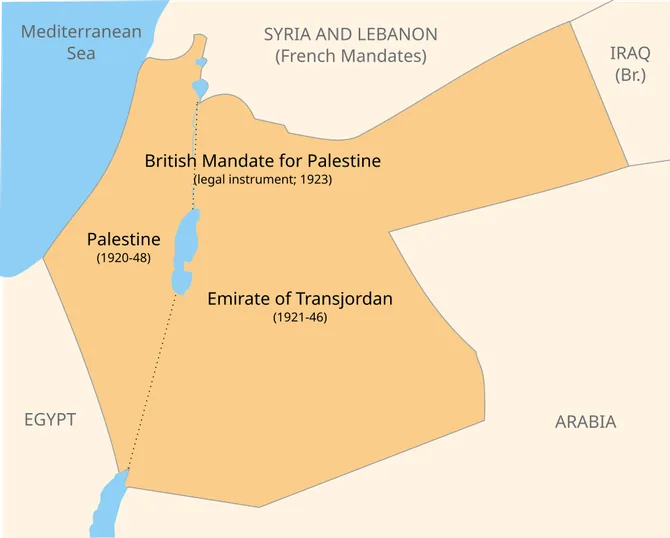
Map by Wikipedia users Aiden, Ramallite, Zero0000 and Pedroca cerebral, 2011 · Public domain · Source page
After the war the Allies share out the Ottoman lands. At San Remo in April 1920 they give Britain the Mandate for Palestine and write the Balfour Declaration into it. In July 1922 the League of Nations approves the Mandate, and it comes into force on 29 September 1923.
It promises two things. Britain must ‘secure the establishment of the Jewish national home’, and also safeguard ‘the civil and religious rights of all the inhabitants of Palestine, irrespective of race and religion’. An ‘appropriate Jewish agency’, in practice the Zionist Organization, is recognised to advise and cooperate. How Britain tried to square the two promises is told in the lesson on 1947–1948. Between this story and that one stands the Holocaust, in which about two of every three Jews in Europe were murdered.
The debate, then the test
Did Dreyfus really give birth to Herzl's Zionism?
Herzl was there on 5 January 1895. Did what he saw and heard turn him into a Zionist?
- Herzl in 1899, and Alex Bein Four years after the ceremony Herzl wrote that ‘the Dreyfus trial made me a Zionist’ (in German: Zum Zionisten hat mich nämlich der Prozess Dreyfus gemacht), and that the mob howled ‘Death to the Jews!’ outside the École Militaire. The essay was written for the North American Review and is, in Gil Troy's words, unpublished. Herzl's words reach us in a German passage (quoted by Malleier from Schoeps, 1995) and an English one (in Bein's biography) that do not match word for word. Alex Bein, Herzl's best-known biographer, is more careful: ‘In this sense Herzl could say later that the Dreyfus affair had made him a Zionist.’ Bein adds that the first reports had made ‘no particular impression’ on Herzl, and that at first no one had reason to doubt Dreyfus's guilt.
- Shlomo Avineri, Herzl's Vision (English 2013) Avineri argues that it was not the trial but Herzl's own long analysis of the failure of emancipation, and of the rise of antisemitism in Germany and Austria, that led him to his radical conclusions. He says Herzl's diaries for 1895–97 mention Dreyfus only twice; in a text search of the English Complete Diaries the name does appear just twice in those years, on 17 November 1895 and 14 November 1897. And according to Avineri and to Gil Troy, editor of Herzl's Zionist Writings, Herzl's own report to his paper of 6 January 1895 has the mob ‘shouted from time to time: “Death to the traitor!”’; the excerpt we saw has no ‘Death to the Jews’ (we did not see the German original).
- Jacques Kornberg (1993) and Derek Penslar (2020) Kornberg argues that the Dreyfus link is a myth which Herzl never bothered to deflate, and that Herzl at first believed Dreyfus guilty. Penslar writes that more important than Dreyfus were the Viennese municipal elections of April and May 1895, won by Karl Lueger's antisemitic party. The Emperor refused to confirm Lueger as mayor, and he took office only in 1897.
Herzl was a witness, and later the storyteller. Weigh the evidence. The New Ghetto was written in autumn 1894, before the degradation. The English text of Der Judenstaat (1896) never mentions Dreyfus. In 1902 Herzl told a British commission that the condition of the Jews in Paris had made a strong impression on him; in the excerpt the Ministry of Education prints, he does not name Dreyfus. He first stated the link outright in 1899, when he led a movement and the affair was world famous. But his diary of 17 November 1895 already has him ask a doubting acquaintance, ‘Why did you wince when Lueger was elected?’ and then, ‘Why did I suffer when Captain Dreyfus was accused of high treason?’ (Complete Diaries, tr. Zohn, vol. 1, p. 273): Dreyfus and Lueger side by side, ten months after the ceremony. And he was there, he saw it, and in 1899 he named the trial itself.
Israel's own Ministry of Education asks students to weigh Dreyfus's contribution. What would you want to see before you believe a witness whose later story helps his cause?
Check yourself
Why should we be careful with Herzl's 1899 account of the mob at the degradation?
Answer: It was written four years later, when he led a movement, and his original report to his paper is said to differ.. Right. A late account by someone the story serves needs checking against evidence from the time itself.
Terms
- Zionism The modern Jewish national movement that sought a home for the Jewish people in Palestine, the Land of Israel. The name comes from ‘Zion’, a name for Jerusalem, and the word ‘Zionism’ was coined in 1890 by Nathan Birnbaum.
- modern antisemitism Hatred of Jews based not only on religion but on ‘race’, economics and politics, which built parties, newspapers and movements. The word ‘antisemitism’ spread in the 1880s.
- emancipation The granting of equal civil rights to Jews. It began in France in 1791 and spread gradually across Europe.
- the Jewish question The 19th-century European argument over the place of Jews in society and the state after emancipation: assimilation, equality, emigration, or a state of their own.
- Hovevei Zion Jewish societies in Eastern Europe, founded after the 1881 pogroms, that promoted settlement in Palestine. They united at the Kattowitz conference of 1884 under Pinsker. ‘Lovers of Zion’ in English.
- political Zionism Herzl's approach: win international recognition and a charter by diplomacy first, mass settlement afterwards.
- practical Zionism Settling and building in the land now, even without a charter, as the Hovevei Zion did.
- spiritual (cultural) Zionism Ahad Ha'am's idea of a spiritual and cultural centre in Palestine that would renew Hebrew culture, not merely a political refuge.
- religious Zionism The Mizrachi movement, founded in Vilna in 1902, which tried to join Torah and Zionism.
- socialist (labour) Zionism Poale Zion and Hapoel Hatzair: the belief in building a just society through Jewish manual labour in the land.
- the Basel Program The platform of the Zionist movement, adopted on 30 August 1897: a ‘home’ in Palestine, secured under public law, with four means of reaching it.
- the Zionist Organization The body founded at the First Zionist Congress, with Herzl as its president. It became the home of the movement; since 1960 it has been called the World Zionist Organization.
- charter A ruler's formal permission, in practice from the Ottoman Sultan or a Great Power, for organised Jewish settlement with self-government.
- the Uganda scheme A British offer of 1903 for autonomous Jewish settlement in East Africa, in what is now Kenya. The Sixth Congress agreed to send a commission to examine the land; the Seventh rejected the scheme in 1905.
- the First Aliyah The wave of immigrants between 1882 and 1903, mostly from Eastern Europe, who founded farming colonies. Estimates of their number run from about 25,000 to 60,000, and perhaps half or more left again. ‘Aliyah’ means ‘going up’.
- the Second Aliyah The wave of about 35,000 immigrants between 1904 and 1914. Hashomer, Degania and Tel Aviv were founded in its years.
- the Balfour Declaration A letter of 2 November 1917 from the British Foreign Secretary, Arthur Balfour, to Lord Rothschild, supporting the establishment of a national home for the Jewish people in Palestine.
- national home A phrase of the Balfour Declaration and the Mandate, with no legal definition and no borders. It does not say ‘state’.
- mandate A League of Nations arrangement under which a Great Power governs a former Ottoman territory. The Palestine Mandate went to Britain at San Remo in 1920, was approved in 1922 and came into force in 1923.
- Alfred Dreyfus An artillery officer from a Jewish family in Alsace, convicted of treason in 1894. He was cleared years later.
- École Militaire Paris's military academy. Dreyfus was publicly degraded in its courtyard in 1895.
- Max Nordau A journalist and Zionist, one of Herzl's vice-presidents at Basel. A committee he led drafted the programme.
- Maurice de Hirsch A banker who funded Jewish farm colonies in Argentina. Herzl asked him for a meeting in 1895.
- Israel Zangwill A Jewish writer in London, who heard Herzl in 1895. In 1905 he founded the Jewish Territorial Organization.
- The Jewish State The pamphlet Herzl published in Vienna in 1896, calling for a state for the Jews.
- Leon Pinsker A doctor from Odessa, who wrote the pamphlet Auto-Emancipation in 1882.
- Auto-Emancipation Pinsker's 1882 pamphlet, which called on Jews to free themselves and win a land of their own.
- Nathan Birnbaum A Jewish writer who coined the word Zionism in 1890.
- BILU A group of students from Kharkov, founded in 1882. Its first members landed at Jaffa.
- Rishon LeZion A Jewish colony that survived thanks to money from Baron Edmond de Rothschild.
- Tel Aviv A new Jewish suburb north of Jaffa. Sixty-six families drew its plots by lot, using seashells.
- Kishinev A city in the Russian Empire, where a mob attacked its Jews in 1903.
- Ottoman Empire The state that ruled Palestine. In 1914 it joined the First World War against Britain.
- Abdul Hamid II The Ottoman sultan. He received Herzl in 1901, and in 1902 offered settlement outside Palestine.
- Kaiser Wilhelm II The German emperor. In 1898 he met Herzl outside Jerusalem.
- Chaim Weizmann A chemist and Zionist leader, who lobbied ministers during the war for a Jewish home.
- Lloyd George A British statesman and one of Britain's leaders in the war. In his memoirs he told the story linking Weizmann to the declaration.
- Sykes–Picot agreement A secret 1916 agreement between Britain and France on sharing the Ottoman lands.
- San Remo A town in Italy, where in 1920 the Allies gave Britain the Mandate for Palestine.
- League of Nations The international body that came before the United Nations. In July 1922 it approved the Mandate for Palestine.
- the Holocaust The murder of about two in every three Jews in Europe during the Second World War.
- Bund A Jewish socialist party founded in Vilna in 1897. It rejected Zionism.
- Degania A collective farm by the Sea of Galilee, started by young workers around 1910.
Sources
- Theodor Herzl, Der Judenstaat (Vienna: M. Breitenstein, 14 February 1896); English: The Jewish State, American Zionist Emergency Council (New York, 1946), revised from the Scopus 1943 translation, itself after Sylvie d'Avigdor (London, 1896), with introduction by Louis Lipsky, a condensed biography after Alex Bein and the Zionist Archives chronology
- Leon Pinsker, Auto-Emancipation: An Appeal to His People by a Russian Jew (Berlin, 1882), trans. D. S. Blondheim (Federation of American Zionists, 1916)
- The Basel Program, 30 August 1897: handwritten German copy for the delegates, Central Zionist Archives; Hebrew text and account of the drafting committee, Central Zionist Archives, ‘תכנית באזל’
- The First Zionist Congress and the Basel Program, Jewish Virtual Library (English text of the Program, the move from Munich, the attendance figures)
- World Zionist Organization, ‘היסטוריית הקונגרס הציוני’ (Hebrew account of the First Congress, with the 3 September 1897 diary entry in the WZO's Hebrew translation)
- Theodor Herzl, diary entries of 12 June 1895, 17 November 1895, 10 February 1896, 3 September 1897 and 17 February 1902. English: The Complete Diaries of Theodor Herzl, ed. Raphael Patai, trans. Harry Zohn (New York: Herzl Press / Thomas Yoseloff, 1960), continuous pagination: vol. 1, pp. 88, 273, 299; vol. 2, pp. 580–581 (entry ‘September 3. Vienna’; Zohn: ‘… I founded the Jewish State … Perhaps in five years, and certainly in fifty, everyone will know it.’); vol. 3, pp. 1219–1222 (17 February 1902: ‘A Charter without Palestine! I refused at once.’). German of the 3 September entry as printed in ‘Herzls Traum’, Jüdische Allgemeine, and in wissen.de (our translation); critical edition: Tagebücher 1895–1904 (Berlin: Jüdischer Verlag, 1922–23). The scans at archive.org (TheCompleteDiariesOfTheodorHerzl_201606) were used for checking only (הקטע של 3.9.1897 גם בעיתונות הגרמנית)
- Theodor Herzl, ‘Wendung zum Zionismus’ (1899), in Julius H. Schoeps (ed.), Theodor Herzl und die Dreyfus-Affäre (Vienna: Picus, 1995), pp. 73–77, as quoted by Elisabeth Malleier, L'Homme. Z.F.G. 10:1 (1999), pp. 91–92; English version in Bein's biography as condensed in The Jewish State (1946)
- The Uganda Proposal, 1903, Jewish Virtual Library (the Sixth Congress vote of 295 to 178)
- The Balfour Declaration: letter of Arthur James Balfour to Lord Rothschild, Foreign Office, 2 November 1917 (British Library); text at the Jewish Virtual Library, which spells ‘endeavors’
- The Mandate for Palestine, League of Nations, 1922 (Articles 2, 4, 22), Avalon Project, Yale Law School
- Ministry of Education (Israel), history question bank ‘לאומיות וציונות’, compiled O. Hizkiyahu 2023 and G. Radia, June 2026 (the Hebrew text of the Balfour Declaration, Herzl's 1903 speech to the Sixth Congress after S. Kolat (ed.), 1985, and Herzl's 1902 testimony)
- Ministry of Education (Israel), history bagrut topics, ‘נושאי לימוד בהוראה-היבחנות’
- The Shapell Manuscript Foundation, ‘The Alfred Dreyfus Degradation Ceremony’
- Mitchell First, ‘Some Thoughts on Theodor Herzl and the Dreyfus Trial’, The Jewish Link, 8 June 2023 (a columnist citing Avineri and Bein; secondary)
- Sean Durns, review of Derek Penslar's Theodor Herzl, ‘The Audacity of Herzl’, Algemeiner, 10 February 2020 (secondary)
- ‘The Dreyfus Pivot: Herzl Confronts Jew-Hatred on the March’, Jewish Journal, excerpted from Gil Troy (ed.), Theodor Herzl: Zionist Writings (the 6 January 1895 dispatch, as quoted; secondary)
- The Palestine-Israel Journal, ‘The American View’ (the King–Crane Commission report of 30 August 1919, as quoted; secondary)
- English Wikipedia, read in this work for dates and counts that the other sources do not give, always checked against a second page where it mattered: Dreyfus affair; Theodor Herzl; Der Judenstaat; First, Sixth and Seventh Zionist Congress; Basel Program; British Uganda Programme; Balfour Declaration; Mandate for Palestine; 1922 census of Palestine; Lovers of Zion; First Aliyah; Pogroms in the Russian Empire (the New York Times report of 28 January 1882 and Werner Bergmann, ‘Ethnic Riots in Situations of Loss of Control’, in W. Heitmeyer et al. (eds.), Control of Violence, Springer, 2011, pp. 487–516, as cited there); Ahad Ha'am; Jewish Colonization Association; Wikiquote, Theodor Herzl (secondary)
- Hebrew Wikipedia, for Hebrew names and forms and for cross-checks: תוכנית בזל; הקונגרס הציוני העולמי הראשון; בנימין זאב הרצל; יהודה לייב פינסקר; חובבי ציון; העלייה הראשונה; העלייה השנייה; תוכנית אוגנדה; פרשת דרייפוס (secondary)
- Derek J. Penslar, Theodor Herzl: The Charismatic Leader (New Haven: Yale University Press, Jewish Lives, 2020)
- Shlomo Avineri, Herzl's Vision: Theodor Herzl and the Foundation of the Jewish State, trans. Haim Watzman (BlueBridge, 2013); Hebrew original earlier
- Jacques Kornberg, Theodor Herzl: From Assimilation to Zionism (Bloomington: Indiana University Press, 1993); and ‘Theodor Herzl: A Reevaluation’, Journal of Modern History 52:2 (1980), 226–252 (מקור משני בלבד: מופיע בביבליוגרפיות ובתוצאות חיפוש; לא נקרא)
- Alex Bein, Theodor Herzl: A Biography (Philadelphia: Jewish Publication Society, 1940–41); German original (Vienna, 1934) (נקרא בעיבוד בלבד, בתוך מהדורת 1946 של ״מדינת היהודים״)
- Amos Elon, Herzl (New York: Holt, Rinehart and Winston, 1975)
- David Vital, The Origins of Zionism (Oxford: Clarendon Press, 1975) and Zionism: The Formative Years (Oxford: Clarendon Press, 1982)
- Walter Laqueur, A History of Zionism (London: Weidenfeld & Nicolson, 1972)
- Anita Shapira, Land and Power: The Zionist Resort to Force, 1881–1948 (New York: Oxford University Press, 1992)
- Leonard Stein, The Balfour Declaration (London: Vallentine Mitchell, 1961)
- Jonathan Schneer, The Balfour Declaration: The Origins of the Arab-Israeli Conflict (New York: Random House, 2010)
- Rashid Khalidi, The Hundred Years' War on Palestine (New York: Metropolitan Books, 2020)
- Robert G. Weisbord, African Zion: The Attempt to Establish a Jewish Colony in the East Africa Protectorate, 1903–1905 (Philadelphia: Jewish Publication Society, 1968)
- Arthur Hertzberg (ed.), The Zionist Idea: A Historical Analysis and Reader (New York: Doubleday / Jewish Publication Society, 1959)
- Jean-Denis Bredin, The Affair: The Case of Alfred Dreyfus (New York: George Braziller, 1986)
- Philip Earl Steele, On Theodor Herzl's encounters with Zionist thought and efforts prior to his conversion in the spring of 1895 (Berlin–Warsaw: Centre for Historical Research, Polish Academy of Sciences, 2023)
Image credits
- Photographer unknown, 1897–98. Copy in the Government Press Office, National Photo Collection of Israel (D131-028) · Public domain · Source page
- Henri Meyer, 'Le Traître: Dégradation d'Alfred Dreyfus', Le Petit Journal, Supplément illustré, 13 January 1895 · Public domain · Source page
- Carl Pietzner, about 1896–97 (this copy: L'État juif, Lipschutz, Paris 1926) · Public domain · Source page
- The Basel Program, 1897. Central Zionist Archives, Jerusalem · Public domain · Source page
- Arthur James Balfour to Lord Rothschild, 2 November 1917. British Library · Public domain · Source page
- Map by Wikipedia users Aiden, Ramallite, Zero0000 and Pedroca cerebral, 2011 · Public domain · Source page


