Zhukov: the marshal of the Eastern Front
He was the son of peasants, beat the Japanese in 1939, and later commanded the forces that took Berlin. How did he do it, and why did Stalin push him aside after the war?
Decisions, questions and your own progress, in the app
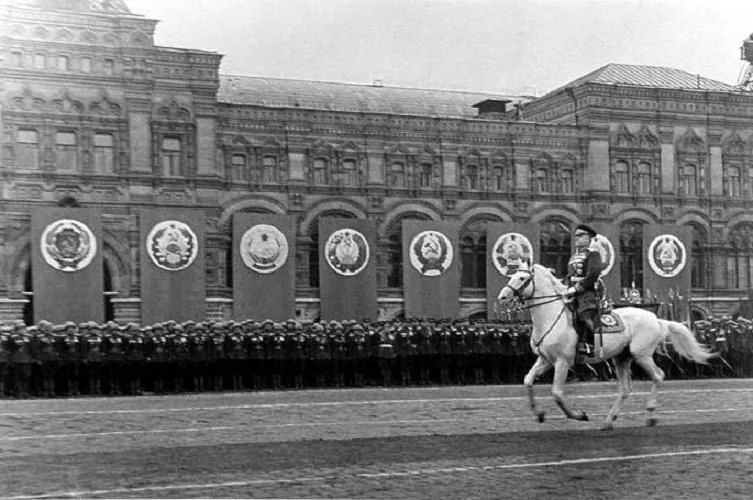
Marshal Zhukov at the Moscow Victory Parade, 24 June 1945. Photographer unknown; Soviet photograph · Public domain · Source page
The furrier's apprentice
A rider on a white horse in Red Square
24 June 1945. The Victory Parade in Red Square, Moscow. On a white horse, a marshal rides along the lines of troops.
Who is he? The picture is said to show Georgy Zhukov. The boy from a poor peasant family started as a furrier's apprentice, and by 1945 he commanded forces that fought for Berlin. How did he get there, and what happened to him afterwards? That is this story.
Background
Strelkovka, 1896
1896
Georgy Zhukov was born on 1 December 1896 in Strelkovka, in Kaluga province, about 100 kilometres from Moscow. By the old Russian calendar, still in use then, the date was 19 November. His father was a shoemaker and his mother a peasant labourer. It was a poor family of peasants, not of landowners.
He apprenticed to a furrier in Moscow and finished in 1912. Nothing about that apprenticeship pointed to a military career.
The First World War
A cavalryman in the tsar's army
In 1915 Zhukov was conscripted into the 10th Novgorod Dragoon Regiment, a cavalry unit of the tsar's army. In 1916 a mine explosion wounded him. He won the Cross of St George twice, a tsarist award for courage, and was promoted to NCO.
The Civil War
On the Bolshevik side
After the revolution of October 1917 he joined the Bolsheviks. In the Civil War he served in a cavalry unit led by Semyon Timoshenko, and later in Semyon Budyonny's 1st Cavalry Army. He finished an officers' course in 1920. In 1921, in the campaign against the peasant rising in Tambov, he received the Order of the Red Banner.
The road from there to the top of the army was still a long one.
The war-game he won
The 1930s
A cavalry officer
Through the 1930s Zhukov rose steadily in the cavalry. In 1933 he commanded the 4th Cavalry Division. He then led the 3rd and 6th Cavalry Corps, and in 1938 he became deputy cavalry commander of the Belorussian Military District.
The sources we read show a steady climb. They do not describe any threat to him in the purges of 1937–38, so this lesson does not claim one. The purges belong to the lesson on Stalin.
1939
The border in the Far East
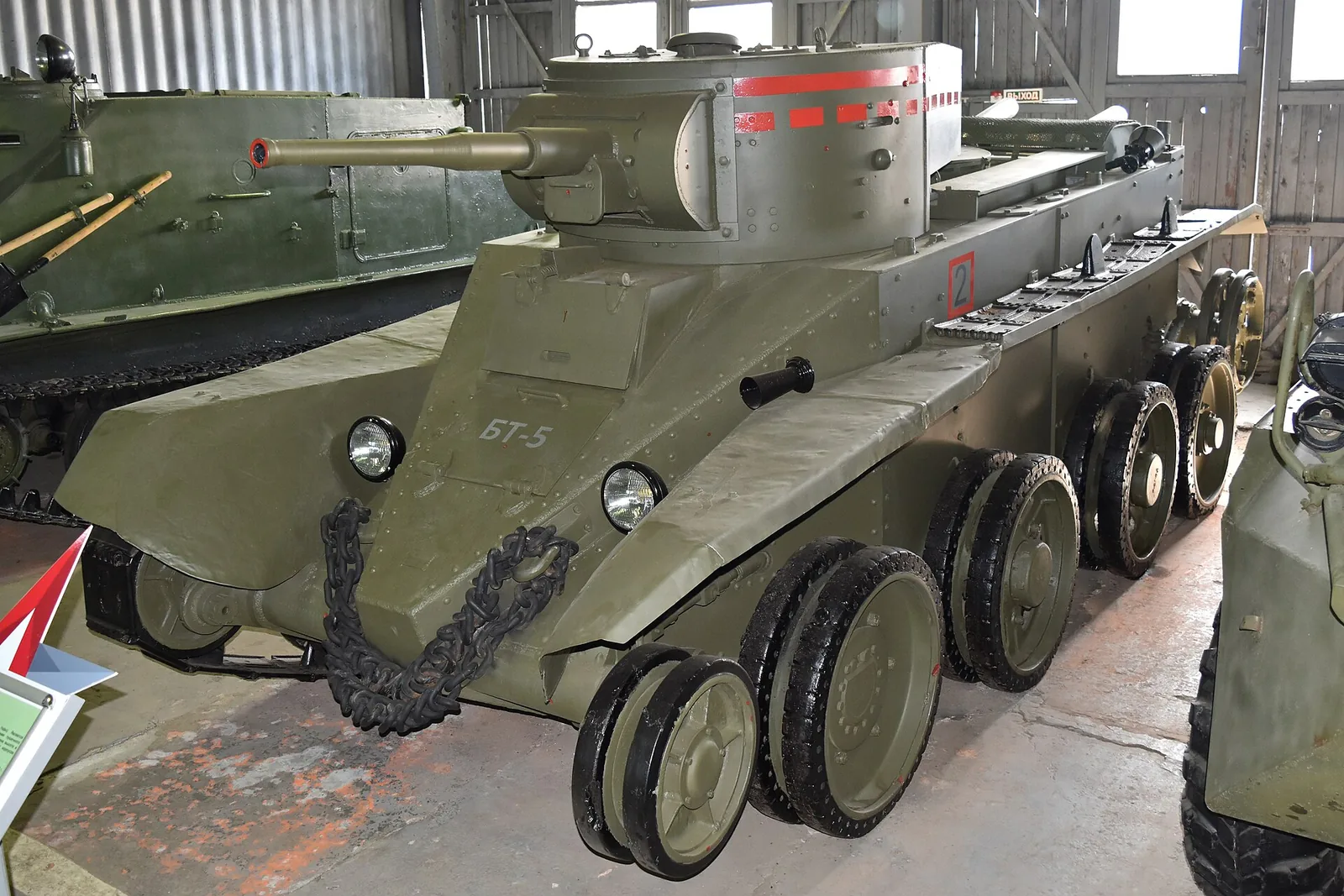
Photo: Alan Wilson, 2017 (CC BY-SA 2.0) · Alan Wilson from Stilton, Peterborough, Cambs, UK · CC BY-SA 2.0 · Source page
In the summer of 1939 Japanese forces, from the Japanese-controlled state of Manchukuo, faced Soviet and Mongolian forces along a disputed border by the Khalkhin Gol river. In June 1939 Zhukov was sent to command the Soviet forces at the front.
The tank in the picture is a BT-5, a fast tank of a type that, according to the Commons description, fought the Japanese in the Far East. The photograph was taken in a museum in 2017, not on the battlefield.
A decision point
You are Georgy Zhukov, the Soviet commander at the Mongolian front.
The front on the Khalkhin Gol river, July–August 1939
Since June you have built up your force. Tanks, guns and aircraft have been arriving by rail and by air. The Japanese hold the disputed ground. You have not attacked yet.
Do you attack now, with what is at the front? Or do you keep building, and attack only when you have enough tanks and aircraft?
What do you do?
- Attack at once, with the force already at the front Probably a quick attack, but with fewer tanks and aircraft than you could bring in a few weeks. If it failed, the Japanese would keep the ground, and the next attack would be harder.
- Build up for several more weeks, then attack in late August with tanks and aircraft Probably slower, but a stronger attack with a better chance of success. The risk is that the Japanese could strengthen their positions in the meantime.
- Hold the line and try to agree a border Probably the force is kept intact, and many casualties are avoided in the short run. But the Japanese stay on the disputed ground, and the question stays open.
What really happened
Build up for several more weeks, then attack in late August with tanks and aircraft
What happened: Zhukov built up for about two months, and attacked on 20 August. A southern armoured group reached the Japanese rear by 21 August. A northern group, with the 212th Airborne Brigade, crossed the Palets Heights two days later and linked up with it. The Japanese force was encircled. A ceasefire was signed on 15 September 1939.
The sources we read do not record his reasons in his own words. The build-up suggests a commander who would not attack before he had enough tanks and aircraft. The result shows why the wait worked, but it does not prove that the wait was right in every respect.
January 1941
Two war-games
In January 1941, a few weeks before he was named chief of the General Staff, the army ran two war-games: exercises on maps, in which commanders plan and fight a campaign against an imagined enemy. Zhukov commanded the Blue, or Western, side in both. The first ran on 2–6 January in the north-west, and the second on 8–11 January in the south-west.
According to the Russian historian Bobylev, as Wikipedia summarises him, Blue won both. Vasilevsky said that the Red defeat was not publicised, while the Blue victory was. Stalin asked why the Blue side had so many divisions. Accounts differ on the numbers, so this lesson gives none.
Source: An order to the Kiev district, 10 June 1941
Such action could provoke the Germans into armed confrontation fraught with all sorts of consequences. Revoke this order immediately and report who, specifically, gave such an unauthorised order.
The order cancels an earlier one, which had moved troops of the Kiev district into forward positions. Zhukov demands that it be revoked at once, and that the name of whoever gave it be reported.
- What does this order cancel? A move of troops into forward positions. The text's concern is that the move could provoke the Germans into a fight.
- What does the text say about an invasion? Nothing. It is about provocation and about who gave an unauthorised order. It does not warn of an invasion, and it should not be read as if it did.
- What is missing from the text? Who gave the earlier order. The order demands that name, but the text itself does not give it.
May–June 1941
A pre-emptive plan on paper
In the spring of 1941 the army had a plan for a pre-emptive strike that would open through southern Poland. According to Wikipedia, the plan was dated no later than 15 May 1941. It is not clear that Stalin approved it. In a 1965 interview Zhukov said that Stalin did not approve it.
Popular history books sometimes say that Zhukov warned Stalin of a German invasion. We found no such warning in the sources we read. What is documented is the plan, and the orders of 10 and 11 June to pull troops back from forward positions.
Forward positions
22 June 1941
Counter-offensive in the first days
On 22 June 1941 Zhukov signed Directive No. 3 of the Soviet defence ministry. It ordered a counter-offensive against the German forces, toward Suwałki and Lublin. The attack failed, and many of the units that went into it were destroyed.
Wikipedia reports that Zhukov later said Stalin forced him to sign. We could not check that claim in his memoirs, so we do not give it as fact.
Source: Directive No. 21: Operation Barbarossa
The German Wehrmacht must be prepared to crush Soviet Russia in a quick campaign (Operation Barbarossa) even before the conclusion of the war against England. It is of decisive importance, however, that the intention to attack does not become discernible.
The directive was written about six months before the attack on the Soviet Union. It does not fix the day of the attack. It asks for preparations to be complete by 15 May 1941, and it orders that the intention stay hidden.
- Who wrote it, and for whom? Hitler, for the commanders of the Wehrmacht. It is an internal military order, not a public speech.
- Had the date of the attack been fixed? Not yet. The directive says the date has not yet been determined. What it fixes is a deadline for the preparations: 15 May 1941.
- Why does it insist on secrecy? Because discovering the preparations could endanger the operation. Anyone who wanted to know German intentions had to look for signs, since no open statement would reveal them.
29 June 1941
Stalin arrives at headquarters
On 29 June 1941 contact was lost with the commanders of the Belarusian fronts. Stalin came to headquarters without warning. According to the English Wikipedia, he called Zhukov “useless”. That is a single account, and we give it as one.
It was the first of several tense moments between the two men.
July–September 1941
Out of headquarters
On 29 July 1941 Zhukov was removed as chief of the General Staff, after he proposed giving up Kiev. Within days he was given command of the Reserve Front. Its offensive at Yelnya, in late August and early September, reduced a German salient, and some accounts call it the first successful Soviet offensive of the war.
Autumn 1941
Leningrad, then Moscow
In September 1941 Zhukov was given command of the Leningrad Front. The sources differ on the date. The English Wikipedia says the appointment came on 10 September, while other accounts have him arriving on 13 September to replace Kliment Voroshilov.
On 6 October he was recalled from Leningrad. Four days later, on 10 October, he took command of the defence of Moscow, together with the Western Front and the Reserve Front, with Ivan Konev as his deputy.
The counter-attack that waited
October–November 1941
Three belts of defence
Moscow's defence was built on three belts of fortifications, and new reserve armies were formed. Stalin ordered several pre-emptive counter-offensives. Meanwhile troops from Siberia and the Far East began to arrive.
According to one account on Wikipedia, in November 1941 Stalin asked Zhukov whether Moscow could be held, and asked him to answer candidly. We could not check the exact words, so we give only the sense.
November 1941
Tanks on a Moscow street
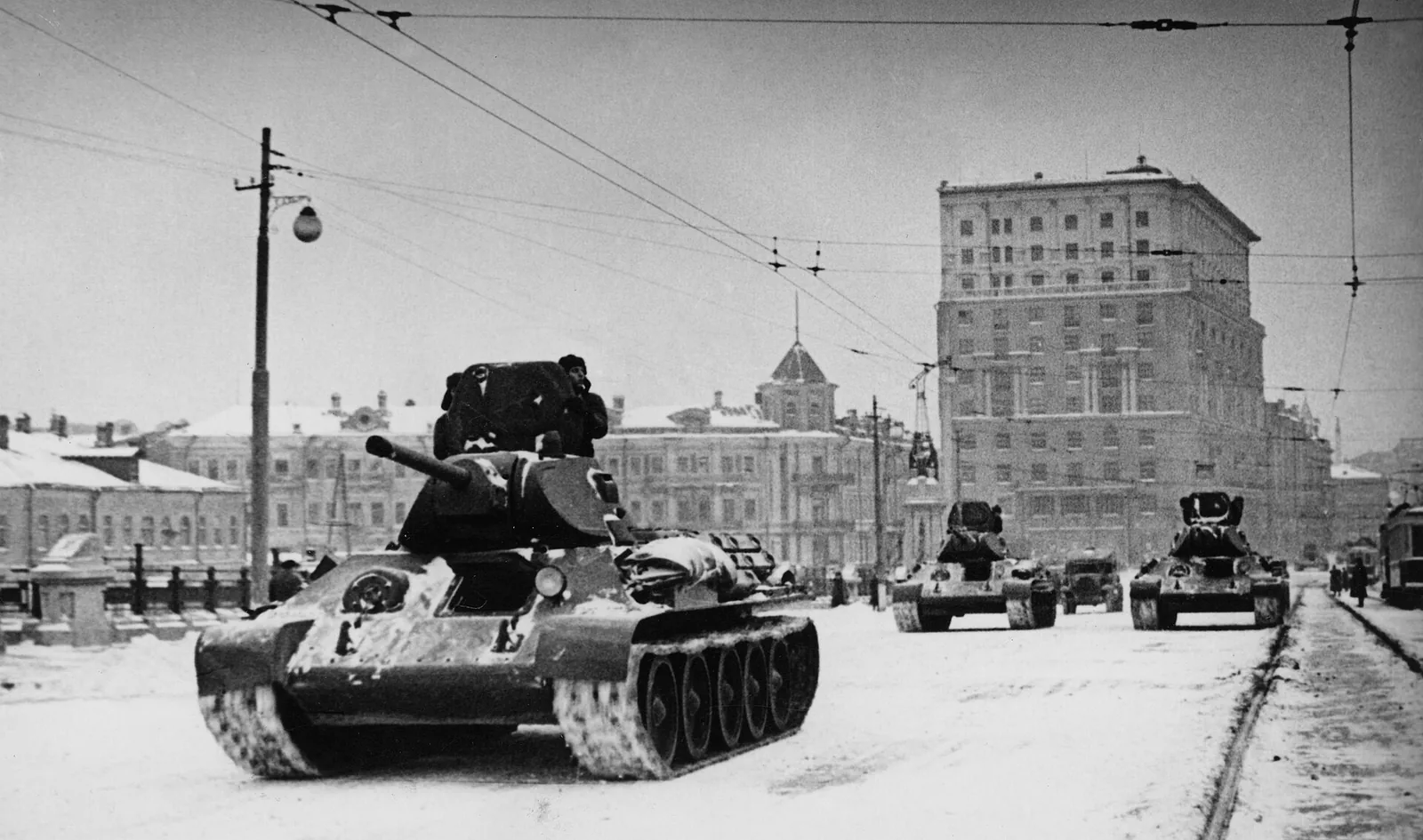
Photo: A. Ustinov, Moscow Main Archive (Главархив Москвы), November 1941 · CC BY 4.0 · Source page
In November 1941 Soviet tanks rolled down a Moscow street through the snow, with the tram wires still overhead. The picture shows the defence of the city, not the counter-attack.
It shows what was at stake.
A decision point
You are Georgy Zhukov, commander of the Western Front, which is defending Moscow.
Moscow, late November 1941
The Germans are very close to the city. The troops at hand are few, and the reserves have only partly arrived. Stalin wants an immediate counter-attack, and has ordered one again and again with what is available. You object, because troops with no reserves cannot take and hold ground.
Divisions from Siberia and the Far East are on their way. It is not clear how many will arrive, or when.
What do you do?
- Counter-attack at once with the troops at hand Probably it would fail, because there would be no reserves to hold any gain. After such a failure the Germans could come closer to the city.
- Hold the line and keep all reserves for defence alone Probably the city holds longer, but the initiative stays with the Germans, and the line could crack if they attacked again.
- Wait for the Siberian and Far Eastern divisions, then attack Probably it costs precious time, but the attack would be stronger. The risk: if the Germans attacked before the reserves arrived, the city would be in danger.
What really happened
Wait for the Siberian and Far Eastern divisions, then attack
What happened: the reserves arrived, and the counter-attack began in early December. According to Wikipedia, Guderian halted his armoured forces on 5 December. On 19 December Walther von Brauchitsch, commander of the German army, was dismissed.
The sources we read do not give Zhukov's own words on the decision. He did not oppose counter-attacks as such. The December counter-offensive was one that Zhukov and Vasilevsky proposed once the reserves had arrived. What he opposed was an attack made early, with no reserves behind the troops. Why Stalin wanted the early attacks remains an open question.
December 1941
The report from Tokyo
In September 1941 the Soviet spy Richard Sorge reported from Tokyo that a Japanese attack on the Soviet Union was no longer a real possibility. Soon afterwards, Siberian and Far Eastern divisions were moved west. Whether the report caused that move is disputed: Moscow may also have known from decoded Japanese messages that Japan would not attack.
If the link holds, the reserves that reached Moscow came from a region where, according to the report, no attack was expected.
Stalingrad, Mars and Kursk
September 1942
A plan to trap an army
In September 1942 Zhukov and Vasilevsky began planning a counter-offensive against the Germans at Stalingrad. The German Sixth Army was inside the city, and its flanks rested on Romanian troops along the Don. The aim was to break the flanks and close a ring around the Sixth Army: an encirclement.
A decision point
You are Georgy Zhukov, deputy supreme commander of the army.
Headquarters, 17 November 1942
The German Sixth Army is inside Stalingrad, and Soviet forces are waiting for the signal. The plan, Operation Uranus, is to break through the Romanian flanks and encircle the Sixth Army.
Vasilevsky, who was called to Moscow on 17 November, thinks the attack should be called off. You must decide whether to go ahead, and how.
Do you go ahead with the operation?
- Go ahead: break the Romanian flanks and encircle the Sixth Army Probably a ring closes around the Sixth Army, if the flanks break. If the Romanian forces hold firm, the operation stalls.
- Send the reserves into the city and fight the Sixth Army directly Probably a slow, costly street fight in which the Germans hold each building. Success is not assured, and the flank attack would be delayed.
- Call off the offensive and keep the reserves for defence Probably the Sixth Army stays in the city, and the Soviet army returns to defence. The Germans would have time to strengthen their position.
What really happened
Go ahead: break the Romanian flanks and encircle the Sixth Army
What happened: Uranus was launched on 19 November 1942, two days later than planned, because the air units were not ready. The Romanian flanks gave way, and the German Sixth Army was encircled in Stalingrad. Vasilevsky wanted to call the operation off. The other commanders and Stalin overruled him.
No source we read records Zhukov's own thinking on that day. The main dispute is about how much of the planning was his, and that question returns in the debate at the end of this chapter.
November–December 1942
Operation Mars
Six days after Uranus began, Zhukov coordinated another offensive, Operation Mars, against the Rzhev salient north-west of Moscow, where the German Ninth Army held the line. It ran from 25 November to 20 December 1942, with the Western and Kalinin fronts. On the first day fog grounded the air support.
The attack did not break the German defences, and the English Wikipedia calls it a military failure.
Myth
He never lost a battle.
The truth
Operation Mars failed. Wikipedia quotes Zhukov himself as writing that the front failed to break through the German defences. David Glantz's 1999 book on Mars is called Zhukov's Greatest Defeat.
The evidence
The book is by David Glantz, an American historian of the Soviet army, published by the University Press of Kansas in 1999. A book with that title shows how historians judge Mars.
1943
A marshal, and Kursk
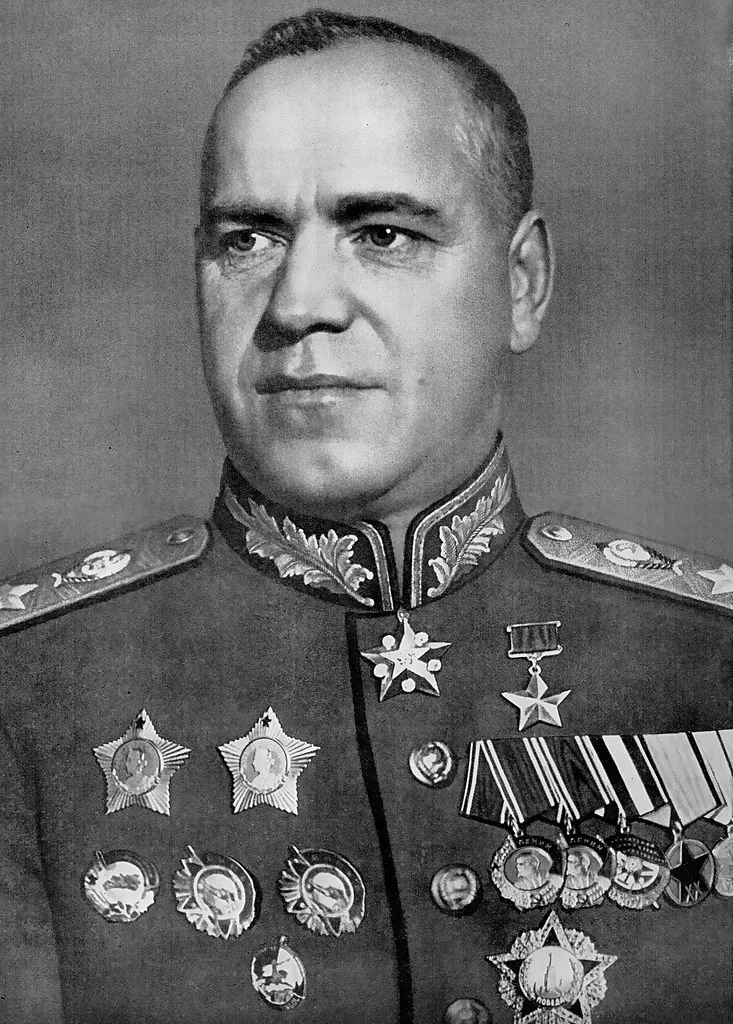
Grigory Vayl, LIFE, 1945. Public domain photograph · Public domain · Source page
In January 1943 Zhukov was made a Marshal of the Soviet Union. On 8 April 1943 he wrote to Stalin, arguing for defence at Kursk rather than an early attack. In the summer, when the Germans attacked, he served as the Stavka's coordinator there.
At about 2 a.m. on 5 July he ordered a pre-emptive artillery barrage. Konev objected, and a personal call from Stalin ended the argument.
Source: Rokossovsky's report on Zhukov
Absolutely cannot be used in staff or teaching jobs because constitutionally he hates them.
Rokossovsky was a fellow marshal with his own war record to defend. The report, as Wikipedia quotes it, is undated. According to the same account, Rokossovsky also wrote that Zhukov arrived at Kursk shortly before the battle and made no decisions there.
- Who wrote this, and what did he stand to gain? A fellow marshal with his own record to defend. He had reasons to shape how the victories were shared out. He was not a neutral witness.
- Why does it matter that it is undated? A date tells us what the author knew and when he wrote. Without one, we cannot tell whether the words came during the war or after it, when rivalries had settled or were still raw.
- Which claim here can be checked against other sources? Zhukov's role at Kursk. His memoirs give him a central part, while Rokossovsky says he made no decisions there. The sources do not settle it.
Who planned Operation Uranus?
Was the operation Zhukov's, Vasilevsky's, or both men's?
- David Glantz, an American historian of the Soviet army Uranus was Zhukov's operation as well as Vasilevsky's. Glantz said so, and Antony Beevor quotes him in a reply published in the New York Review of Books in 2000.
- Jason Epstein, writing in the same journal In a letter of 13 April 2000 he denied Zhukov the credit for the operation, as Beevor describes it in his reply of 25 May 2000.
What counts as planning an operation: the idea, the timing, the orders on the day, or the result? Each answer gives Zhukov a different share.
The gates of Berlin
June 1944
Operation Bagration
In June 1944 Zhukov coordinated the 1st and 2nd Belorussian fronts in Operation Bagration, a huge offensive against the German army in Belarus. He supervised the Rogachev sector, while Rokossovsky commanded the Parichi group. The two men raced each other.
Stalin put the start back by four days, after complaints from Zhukov and Vasilevsky about moving troops by rail.
The heights
The Seelow Heights
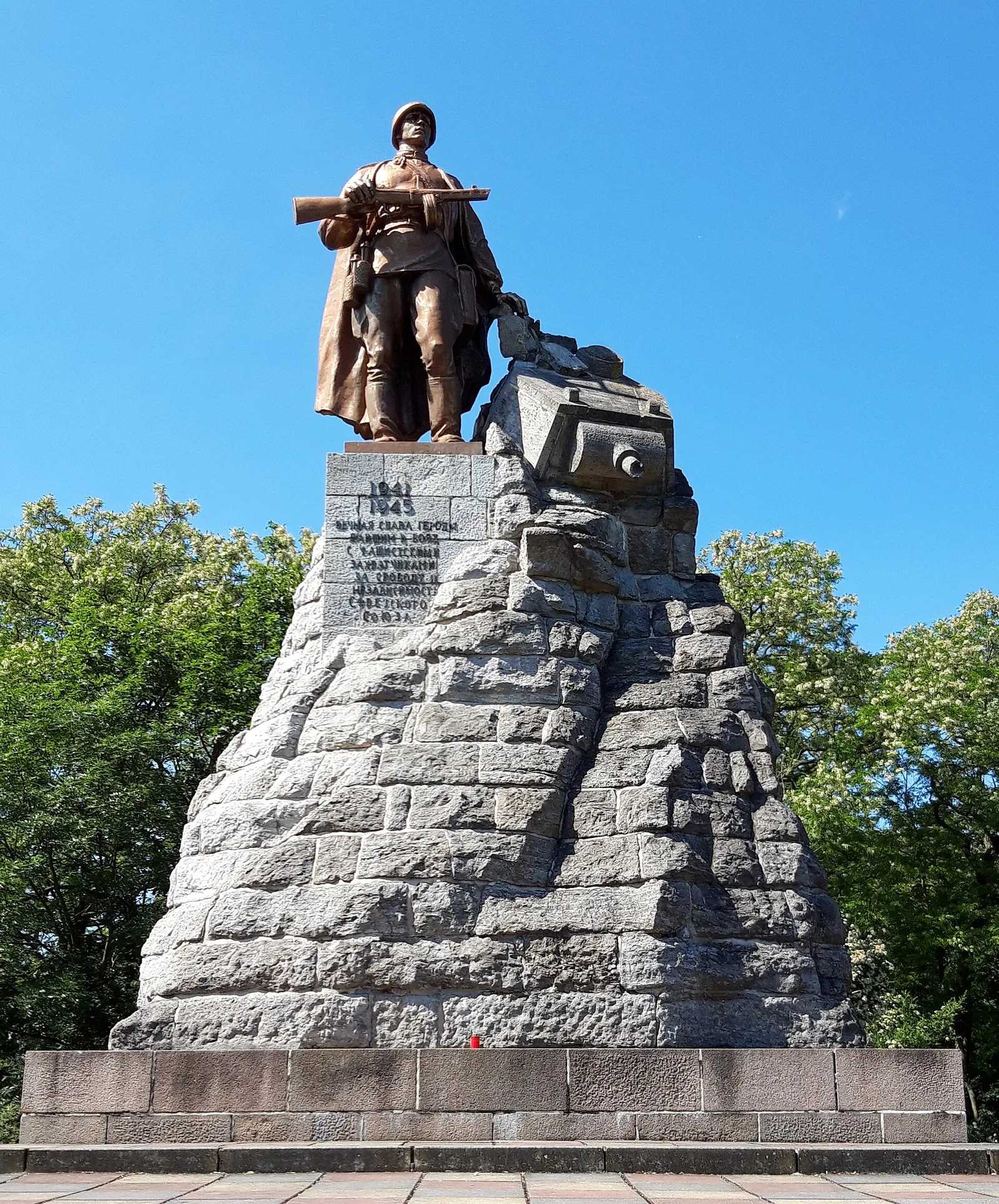
Seelow Heights memorial by Lev Kerbel. Photo: Dryhand58, 2019 (own work) · CC BY-SA 4.0 · Source page
The Seelow Heights are a ridge between the River Oder and Berlin. The Soviet armies had already crossed the Oder, and now they faced a German defence line on the heights. Depending on the source, between about 100,000 and 110,000 Germans held the area, in the Ninth Army under Theodor Busse.
The memorial in the picture was built after the war. It shows how the memory of the battle is kept, not how the battle looked.
A decision point
You are Georgy Zhukov, commander of the 1st Belorussian Front.
The heights near Seelow, 15 April 1945
The road to Berlin runs across these heights. The Germans are dug in on the high ground, and behind the first line they have a second. A direct assault will be costly, and every hour's delay gives them time to strengthen their positions.
You have three options. Attack before dawn, after a heavy artillery barrage and with searchlights, and climb the heights. Bypass the heights to the north. Or wait, and let Konev break through from the south with his tank armies.
How do you advance?
- Attack head-on: an artillery barrage before dawn, searchlights, and a climb up the heights Probably the fastest route to Berlin, at a high cost in lives. If the attack stalled on the slope, the line could hold for days.
- Bypass the heights to the north, over ground you know less well Probably slower, with days lost on rough ground. The Germans could regroup, and the link-up with Konev in the south would be delayed.
- Wait, and let Konev break through from the south before you attack Probably the Germans have time to strengthen and pull men out of the line. If Konev broke through quickly, the result would come early, but success would then depend on him.
What really happened
Attack head-on: an artillery barrage before dawn, searchlights, and a climb up the heights
What happened: Zhukov opened with a barrage and attacked before dawn on 16 April. According to Wikipedia, more than 500,000 shells were fired in the first thirty minutes. The dust from the barrage made the searchlights ineffective, and the advance was slow. Zhukov threw in reserves. The heights were broken on 19 April, the fourth day of the battle. Stalin told him that Konev had been allowed to turn his tank armies north toward Berlin, to spur him on.
Historians disagree. Critics argue that Zhukov should have bypassed the heights to the north. Defenders of the frontal attack answer that it was the quickest way to meet Konev and cut off the German Ninth Army. No source we read records Zhukov's own reasoning at the moment of decision, so we do not put reasons into his mouth.
Source: Zhukov's report to Stalin on the barrage, 16 April 1945
…with the use of searchlights to blind the enemy and light up the terrain ahead of the advancing troops.
Zhukov wrote this for Stalin. According to Wikipedia, the dust from the barrage made the mass of searchlights ineffective, so the plan did not work as the report describes it. The report describes the plan, not the outcome.
- Who was it written for, and what does it aim to show? For Stalin, the supreme commander. A report like this is meant to show the plan working. It is not a neutral account of the battle.
- What does it promise, and what do later accounts say happened? It promises searchlights that will blind the enemy. Later accounts say the dust from the barrage cancelled much of that advantage.
- What is missing from the report? The human cost. It gives no figure for casualties on the first day, so we cannot tell what the attack cost.
April–May 1945
The end in Berlin
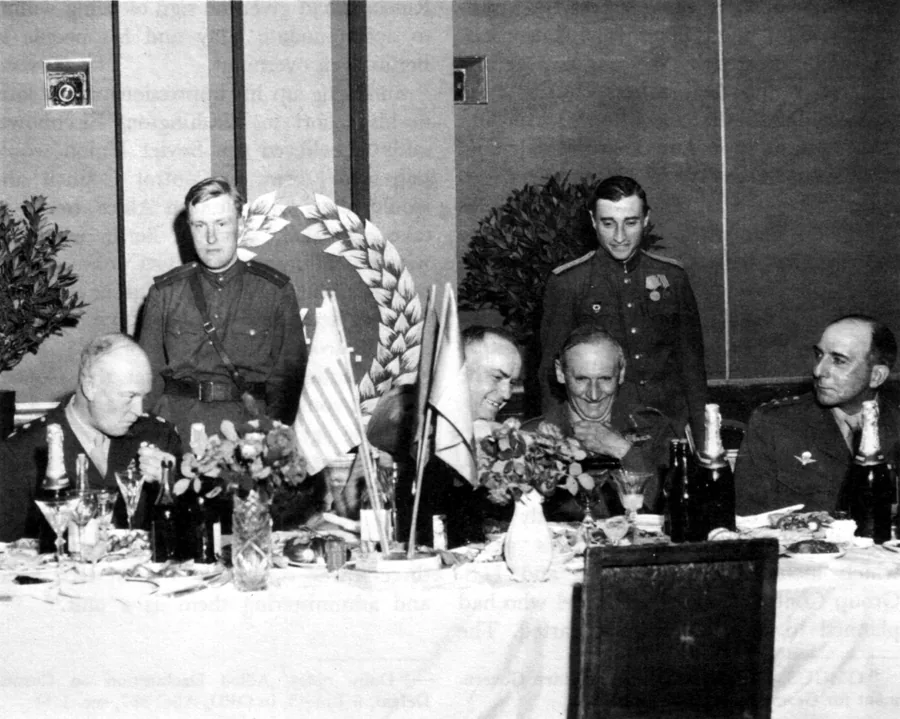
Zhukov, Eisenhower, Montgomery and de Lattre, Berlin, 5 June 1945. US Army, The U.S. Army in the Occupation of Germany, 1944–1946 · Public domain · Source page
On 19 April the heights were broken. On 20 April the Soviets began shelling Berlin. The Berlin garrison surrendered on 2 May. The German surrender was signed on 8 May, or 9 May in Moscow time, and Zhukov was chosen to accept it for the Soviet side.
The Soviet advance into Germany also brought looting and sexual violence against German civilians. Historians record this as a grave part of the story of 1945.
Myth
Zhukov sent soldiers through minefields without a thought.
The truth
The line is quoted on many websites with no primary source. Secondary accounts trace it to Eisenhower's account of a talk with Zhukov. Other writers argue the opposite: that Zhukov wanted infantry trained to clear simple mines and keep moving.
The evidence
We did not find the line in any primary text. The opposite view is put by the wargame designer Frank Chadwick and the historian Aleksey Isayev. We read only parts of their work, so this is a disputed claim, not a settled fact.
24 June 1945
The parade and the white horse
On 24 June 1945 the Victory Parade took place in Red Square. Stalin had ordered it on 22 June. Who commanded it? The English Wikipedia article on the parade says Konstantin Rokossovsky commanded it, citing Order No. 370, with Zhukov as inspector. The article on Zhukov says Stalin appointed him commander of the parade. The sources conflict, and we give both.
Many photographs show Zhukov on a white horse, but we found no source for the story that Stalin ordered the horse. According to Wikipedia, about 40,000 soldiers and 1,850 vehicles took part.
Fall, return and memoir
1946–1948
The fall
In April 1946 Zhukov was replaced as military governor of the Soviet zone in Germany, by Vasily Sokolovsky. That year he also lost his command of the ground forces. In June 1946 he was posted to command the Odessa Military District, far from Moscow.
In 1946 seven railway carriages of trophy goods from Germany were impounded. In 1948 his homes were searched, and many valuables were found. He had a heart attack in January 1948, and in February he was posted to command the Urals Military District.
1953
The arrest of Beria
Stalin died in March 1953. On 26 June 1953 the Politburo moved against Lavrentiy Beria, the head of the secret police. Zhukov ordered General Kirill Moskalenko to prepare a special force for the arrest, and the vehicles used had tinted windows. Khrushchev asked for Beria to be expelled from the party.
Zhukov sat on the military tribunal, headed by Ivan Konev. Beria was tried in December 1953 and sentenced to death. The terror of the 1930s is the subject of the lesson on Stalin, not this one.
Myth
Stalin always praised him.
The truth
No. In June 1941, according to the English Wikipedia, Stalin called him useless. In July 1941 he was removed as chief of the General Staff. In 1946 he was pushed out of his major posts, and only after Stalin's death was he returned to senior work.
The evidence
The pattern is one of rises and falls, not of steady praise. Stalin used Zhukov when he was needed, and pushed him aside when he was not.
1955–1957
Minister of defence, then retirement
In 1955 Zhukov was appointed minister of defence, and he held the post for about two years. On 4 October 1957 he left on an official visit to Yugoslavia and Albania. On 26 October he was removed from the party's Presidium, and on 2 November he was expelled from the Central Committee. He was forced to retire.
1958–1974
The memoirs
Zhukov began writing his memoirs in 1958. The first edition appeared in 1969, after the party's senior ideologist, Mikhail Suslov, demanded cuts. In 1989 the newspaper Pravda printed chapters that had been removed. Zhukov died in Moscow on 18 June 1974, aged 77, after a stroke. His ashes were placed in the Kremlin Wall Necropolis.
After the war: a timeline
- 1946 In April he loses the military governorship in Germany. In June he is posted to Odessa.
- 1948 His homes are searched, and he has a heart attack in January. In February he is posted to the Urals.
- 1953 In June he helps arrest Beria. In December a tribunal he sits on sentences Beria to death.
- 1955 He is appointed minister of defence.
- 1957 He is removed from the Presidium and then expelled from the Central Committee. He is forced to retire.
- 1974 He dies in Moscow after a stroke.
Check yourself
When was Operation Uranus launched?
Answer: 19 November 1942, two days after the planned date. Correct. Uranus was launched on 19 November 1942, two days late, because the air units were not ready.
Check yourself
When was the ceasefire at Khalkhin Gol signed?
Answer: 15 September 1939, almost four weeks later. Correct. The ceasefire was signed almost four weeks after the offensive opened.
Check yourself
On which dates did the battle for the Seelow Heights run?
Answer: 16–19 April 1945, four days of fighting. Correct. The attack began before dawn on 16 April, and the heights were broken on the fourth day, 19 April.
Check yourself
What was the outcome of Operation Mars?
Answer: It failed to break the German defences. Correct. Mars ran from 25 November to 20 December 1942, and fog grounded the air support on the first day.
Check yourself
What did Stalin call Zhukov on 29 June 1941, according to Wikipedia?
Answer: Useless, in the middle of the crisis. Correct. That is the word Wikipedia gives, after contact with the Belarusian front commanders was lost. It is a single account.
Check yourself
Where and when was Zhukov born?
Answer: Strelkovka, Kaluga province, 1 December 1896. Correct. The village is in Kaluga province. The date is 1 December 1896 on the Western calendar, and 19 November on the old Russian one.
Terms
- Stavka The Soviet supreme headquarters in the war. It gave orders to the fronts, and Stalin presided over it.
- front In the Soviet army a front was a group of armies under one commander, the largest field formation. Zhukov commanded several in turn.
- war-game A map exercise in which commanders plan a campaign against an imagined enemy. The result is not a battle, but it shapes the plans.
- pre-emptive strike An attack made to strike before the enemy does, when it looks as if he is about to attack.
- salient A part of a front line pushed out into the enemy's line. It is exposed to fire from more than one side.
- artillery barrage Heavy fire from many guns on a fixed area for a set time, before infantry or tanks advance.
- encirclement An operation in which forces attack from two sides and close a ring around an enemy force, cutting it off from supplies and escape.
- Operation Uranus The Soviet offensive that aimed to encircle the German Sixth Army at Stalingrad by breaking the Romanian flanks.
- marshal The highest rank in the Soviet army, held by very few men. Zhukov was made a marshal during the war.
- directive A formal order from a high command setting out the aim and preparation of an operation, such as Hitler's Directive No. 21 or the Soviet Directive No. 3.
- Strelkovka The village where Zhukov was born, in Kaluga province, about 100 kilometres from Moscow.
- Kaluga A province of Russia, south-west of Moscow, where Zhukov was born.
- Red Square A square in Moscow, where the 1945 Victory Parade took place.
- furrier A craftsman who works fur into clothing. Zhukov began as an apprentice to a furrier.
- Cross of St George A military award of tsarist Russia for courage.
- Novgorod An old Russian city, which gives its name to the dragoon regiment Zhukov joined.
- Semyon Timoshenko The commander of the cavalry unit in which Zhukov served in the Civil War.
- Semyon Budyonny The commander of the 1st Cavalry Army, in which Zhukov served after his first unit.
- Order of the Red Banner A Soviet award for courage. Zhukov received it in 1921.
- Tambov A region of Russia, where Zhukov fought a peasant rising in 1921.
- Khalkhin Gol A river on a disputed border. In summer 1939 Japanese and Soviet forces faced each other there.
- Manchukuo A state in East Asia, controlled by Japan. Forces from it faced Soviet troops in 1939.
- Palets Heights A line of hills that Soviet troops crossed in August 1939, during the fighting at Khalkhin Gol.
- Walther von Brauchitsch The commander of the German army, dismissed on 19 December.
- Guderian A German general. According to Wikipedia, he halted his armoured forces on 5 December 1941.
- Richard Sorge A Soviet spy in Tokyo, who reported in 1941 that a Japanese attack was no longer a real possibility.
- Yelnya A Russian town where Soviet forces reduced a German salient in late August 1941.
- Kliment Voroshilov A Soviet commander whom Zhukov replaced in command of the Leningrad Front.
- Rokossovsky A Soviet marshal who raced Zhukov during Operation Bagration.
- Seelow Heights A ridge between the River Oder and Berlin, where the Germans held a defence line until 19 April.
- Eisenhower An American general in the Second World War. His account of a talk with Zhukov is quoted on many websites.
- Victor Suvorov A writer who argued in his book Icebreaker (1990) that the Soviet Union was preparing to attack Germany.
Sources
- Adolf Hitler, Directive No. 21, “Case Barbarossa”, 18 December 1940; English translation by the US State Department, in Documents on German Foreign Policy, Series D, vol. 11, doc. 532 (Washington, 1957–1964)
- Georgy Zhukov, order to the Kiev Special Military District, 10 June 1941; quoted in the English Wikipedia, article “Georgy Zhukov” (translation not checked)
- Georgy Zhukov, report to Stalin on the barrage of 16 April 1945; quoted in the English Wikipedia, article “Battle of the Seelow Heights” (translation not checked)
- Konstantin Rokossovsky, report on Zhukov, undated; quoted in the English Wikipedia, article “Georgy Zhukov” (translation not checked)
- Georgy Zhukov, Memories and Reflections (Vospominaniya i razmyshleniya), first published 1969; chapters cut from the first edition were printed in Pravda in 1989
- David M. Glantz, Zhukov's Greatest Defeat (University Press of Kansas, 1999)
- David M. Glantz and Jonathan M. House, When Titans Clashed (University Press of Kansas, 1995)
- Victor Suvorov, Icebreaker (1990)
- Antony Beevor, letter in reply to Jason Epstein, New York Review of Books, 25 May 2000
- English Wikipedia, articles “Georgy Zhukov”, “Battle of Moscow”, “Operation Uranus”, “Operation Mars”, “Battle of the Seelow Heights”, “1945 Moscow Victory Parade” and “Battles of Khalkhin Gol” (checked for dates, figures and quotations)
- Hebrew Wikipedia, article on Georgy Zhukov (date of his appointment as chief of the General Staff)
- warhistory.org, article on the Battle of Khalkhin Gol, 1939 (the arrival of Zhukov and the double envelopment)
Image credits
- Marshal Zhukov at the Moscow Victory Parade, 24 June 1945. Photographer unknown; Soviet photograph · Public domain · Source page
- Photo: Alan Wilson, 2017 (CC BY-SA 2.0) · Alan Wilson from Stilton, Peterborough, Cambs, UK · CC BY-SA 2.0 · Source page
- Photo: A. Ustinov, Moscow Main Archive (Главархив Москвы), November 1941 · CC BY 4.0 · Source page
- Grigory Vayl, LIFE, 1945. Public domain photograph · Public domain · Source page
- Seelow Heights memorial by Lev Kerbel. Photo: Dryhand58, 2019 (own work) · CC BY-SA 4.0 · Source page
- Zhukov, Eisenhower, Montgomery and de Lattre, Berlin, 5 June 1945. US Army, The U.S. Army in the Occupation of Germany, 1944–1946 · Public domain · Source page


