Zhang Qian, 138 BC: the envoy who went west
Around 138 BC, more than a hundred men ride west out of Longxi, into lands the Han court has barely heard of. Their leader, a palace attendant named Zhang Qian, will be away for thirteen years, and only two of the original party will come home.
Decisions, questions and your own progress, in the app
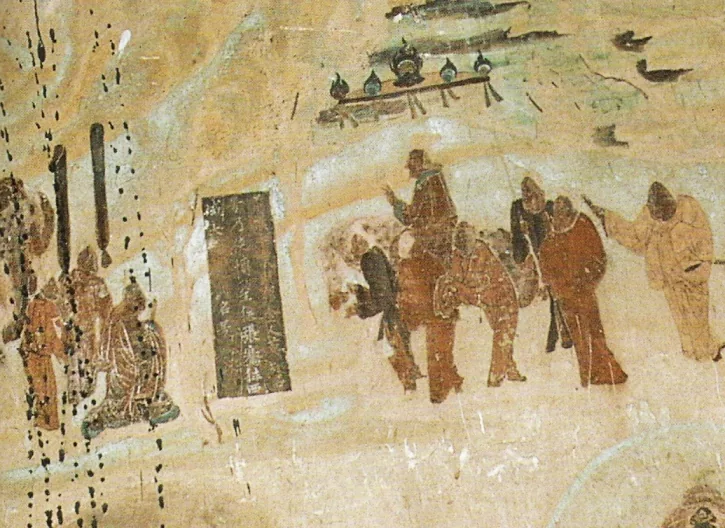
Mural, Mogao Cave 323, Dunhuang, high Tang period (about 8th century CE). Uploaded to Wikimedia Commons by PHG in 2005. · Public domain · Source page
The scene
Only two come home
Around 138 BC, more than a hundred men ride west out of Longxi, a frontier town of the Han empire, into lands the court has barely heard of.
Their leader is Zhang Qian, a palace attendant who volunteered for the job. He will be away for thirteen years. Of the original party, only two will come home.
What were they looking for, and what did they bring back?
Background
A palace attendant from Hanzhong
Zhang Qian comes from Hanzhong, in what is now Shaanxi province. He is not a general, and not yet a famous envoy. In the Jianyuan period, from about 140 BC, he serves as a gentleman of the court, a palace attendant of Emperor Wu.
When the court calls for volunteers to make contact with peoples in the west, Zhang answers. The court’s problem is the Xiongnu, horse-riding people on its northern border, and it wants allies who could strike them from the west.
The court knows very little about the lands beyond its western border. That is exactly why it needs a man like Zhang.
Zhang Qian
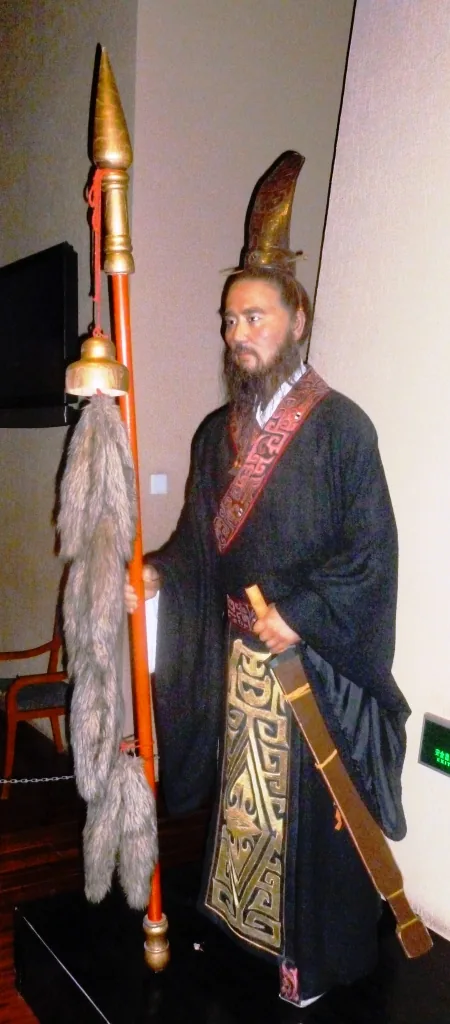
Statue of Zhang Qian, Shaanxi History Museum, Xi’an. Photo: John Hill, 2011 · CC BY-SA 3.0 · Source page
A palace attendant from Hanzhong who spent more than ten years in Xiongnu hands and came home with a report on the west.
- Born: Not recorded, Hanzhong
- Died: About 114 or 113 BC (sources differ)
- Won: Marquis of Bowang, 123 BC, for guiding an army through the desert
- Lost: An alliance with the Yuezhi: their leaders refuse
Zhang answered the call for volunteers as a gentleman of the court.
The road to it
Background
The enemy on the steppe
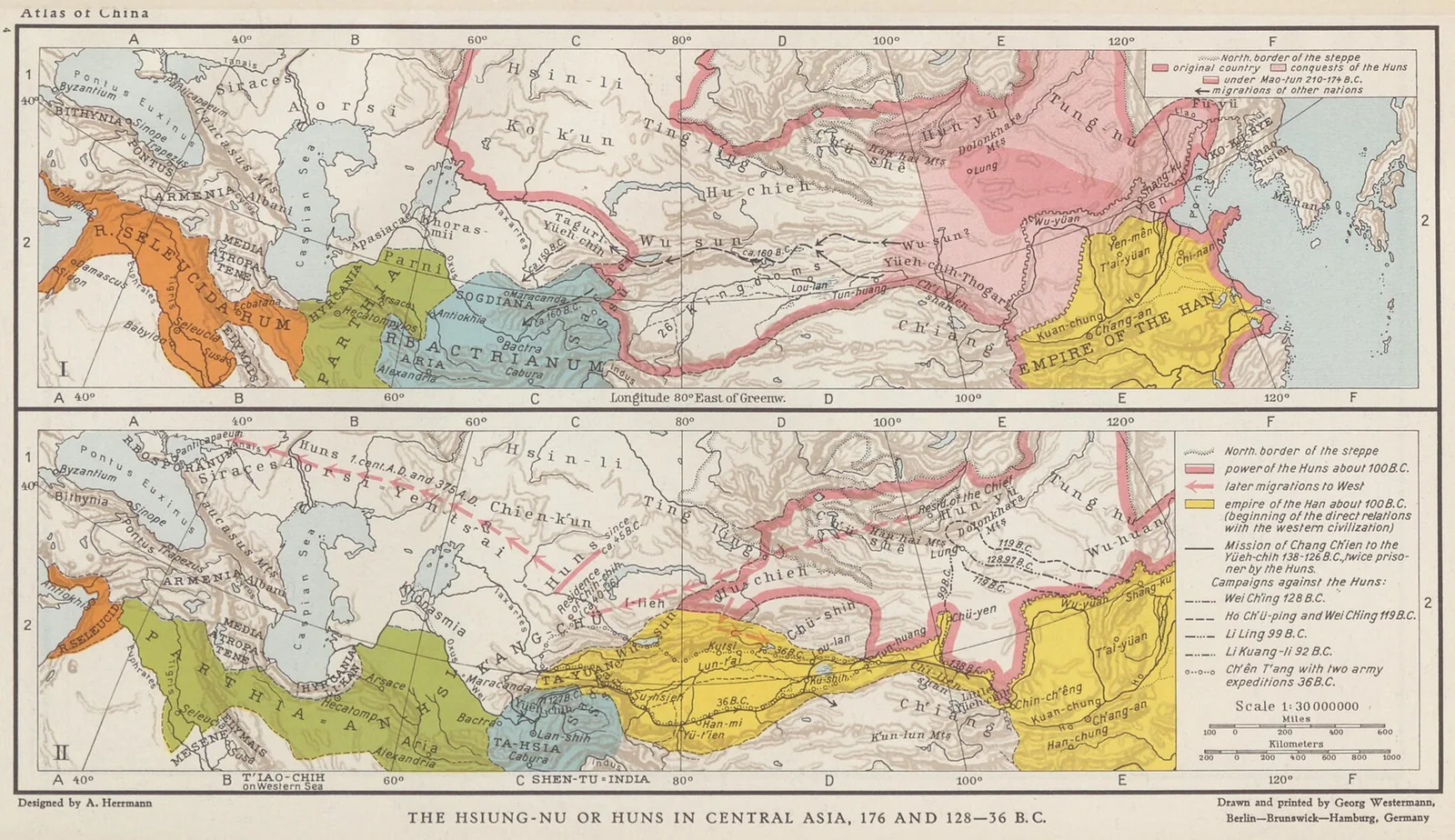
Albert Herrmann and Georg Westermann, ‘The Hsiung-nu or Huns in Central Asia, 176 and 128–36 B.C.’, 1935 (Westermann). Wikimedia Commons. · Public domain · Source page
North of the Han frontier stretches the steppe, a sea of grass where herders move from place to place with their animals. The great power there is the Xiongnu, and its ruler is called the shanyu.
The court would rather not fight them alone, on their own grass.
So it looks west. If a people in the west would fight the Xiongnu, the Han could strike them from two sides.
The report
A story about a skull
Where exactly are the Yuezhi? Nobody at court can say for sure. So the emperor’s men ask Xiongnu who have defected to the Han what they know.
The answer is a grim story. The Xiongnu, they say, defeated the king of the Yuezhi and made a drinking cup from his skull. The Yuezhi fled, and they remain bitter towards the Xiongnu.
The story may be exaggerated. But it gives the court a hope: a people who hate the Xiongnu might be willing to fight them.
A decision point
You are Zhang Qian, a palace attendant at Emperor Wu’s court.
About 138 BC, when the court calls for volunteers.
The court has heard the defectors’ story. It wants someone to travel west, find the Yuezhi and offer them an alliance against the Xiongnu.
The road is long and the lands are unknown. You do not know where the Yuezhi are, whether they would fight, or how long the journey will take.
You could stay at court and let someone else take the risk. You have heard the same stories as everyone else.
What do you do?
- Answer the call and lead the party west. The party sets out from Longxi, and the Xiongnu capture you. It will be years before the court hears from you again.
- Stay at court and let another man lead the party. Probably another man leads the party, and the court waits for news. You stay safe at court, and you hear the story later, like everyone else.
What really happened
Answer the call and lead the party west.
Zhang answered the call. The Shiji says he volunteered and was later honoured, but it gives no speech and no stated reason.
The sources give no personal reason, and we must not invent one. The court wanted allies, and the defectors’ story gave it hope. What Zhang felt is not recorded.
The journey
Captivity
Held in the north
More than ten years
The party from Longxi does not reach the Yuezhi. The Xiongnu capture Zhang Qian and hold him. The sources do not give the year of his capture.
He is held for more than ten years. The Xiongnu give him a wife, and they have a son. Zhang lives among the very people the court wanted to fight.
Ten years is a long time. Notice how he lives inside the enemy’s world, and what becomes of the men who left with him.
The west
No alliance
At last Zhang reaches the Yuezhi, and then Daxia, the Chinese name for Bactria, in today’s northern Afghanistan. The sources do not date this journey, or say how it fits with his years in captivity.
The Yuezhi leaders will not agree to an alliance. That was the whole purpose of the mission, and it fails.
In Daxia he sees goods that came from China: bamboo canes from Qiong and cloth from Shu, the Sichuan region. The people of Daxia tell him that their merchants buy such goods in Shendu, which is India. So goods from China have already travelled a long way, through many hands.
A decision point
You are Zhang Qian, in Xiongnu country.
After many years of captivity, when the Xiongnu ruler dies.
The shanyu has died. His people fall into strife, and the men around the throne fight over who will take his place.
You have a Xiongnu wife and a son. Tangyi Fu, also called Ganfu, a former Xiongnu slave of the Tangyi household who came with you from Longxi, is still at your side.
You do not know what the court thinks of you now. Chang’an is far away, and the road to it runs through enemy country.
What do you do?
- Stay with your wife and son and settle among the Xiongnu. Probably you live out your days in a Xiongnu household. The court hears nothing more from you, and what you know of the west stays with you alone.
- Leave with your wife and Tangyi Fu, and head for Han. You reach Han after a dangerous road, and you bring the court what you have seen and heard.
What really happened
Leave with your wife and Tangyi Fu, and head for Han.
Zhang escaped with his Xiongnu wife and Tangyi Fu and got back to Han. The sentence that tells of the escape names only his wife and Tangyi Fu, not his son. The sources do not date the escape.
The text gives no reason. The only clue is the moment: the Xiongnu were in disorder after their ruler died. The sources do not say what happened to the son, and we cannot know what he felt. Historians can only point to the confusion of that moment.
Return
Two who come back
123 BC
Zhang comes back to the court after thirteen years away. Of the original party, only two come home.
The sources give no year for his return. Estimates put it at about 125 BC, though some give 126 BC.
The court rewards him. In 123 BC he becomes Marquis of Bowang, for guiding an army through the desert.
What we really know
Source: What the court historian wrote
Paraphrase: The Han envoys brought a large sum in gold and a golden horse to ask Dayuan for its good horses. The king would not give them up. The envoys, angry and speaking rashly, smashed the golden horse and left.
This is the Han side of the story. Sima Qian was a court historian, and he wrote under the emperor whose wars he describes.
- Who wrote this, when, and for whom? Sima Qian, a court historian, in the 90s BC, for the Han court and for later readers. He wrote about forty years after Zhang’s journey.
- Whose side is the story told from? The Han’s. We hear the envoys’ anger, but not the king’s reasons. The Dayuan side is not recorded at all.
- Can a second text check this? Partly. The Hanshu, the next source, agrees on some numbers. But two Han books are not two independent witnesses.
Myth
The Silk Road is an ancient name, used by the people who travelled it.
The truth
The name is modern. The German scholar Richthofen made it popular in 1877, and historians still argue over who first used it. In Zhang’s time there was no such name, and traders moved goods along a web of routes.
The evidence
Hoyanagi (1962) says Richthofen popularised the name. Mertens (2019) argues he was not the first to coin it. One scholar suggests that Marinus of Tyre used a name for the route about 100 CE. Hansen (2012) describes a web of exchanges, not one planned road.
Source: What the later Han history says
Paraphrase: Zhang Qian was sent west to find the Yuezhi. The Xiongnu held him for more than ten years. He came back thirteen years after leaving, and only two of the original party came back.
Written by the Ban family, chiefly Ban Gu, more than two centuries after the mission, as part of the official history of the Han dynasty. It covers the same story as the Shiji.
- How far from the events was it written? More than two centuries. Nobody who had been on the journey was still alive, so the author relied on records written earlier.
- Does it agree with the Shiji? On the big points: more than ten years held, thirteen years away, and only two of the party coming back. Agreement between two Han books is not the same as two separate witnesses.
- Whose side is it on? The Han’s again. Like the Shiji, it sees the Xiongnu and Dayuan only through Han eyes.
A decision point
You are Emperor Wu of the Han, in 104 BC.
104 BC, at court, after your envoys have come home.
Your envoys have come back from Dayuan without the horses. They carried gold and a golden horse, and they went home angry.
A report by Zhang Qian, written years ago, is still on your desk. It says that Dayuan’s horses sweat blood, and that they are said to descend from heavenly horses.
An army sent west would carry men and supplies a long way. You do not know how long a siege would last, or what it would cost.
What do you do?
- Send an army to take the horses by force. The army reaches the city and the horses come home, at a cost in men and supplies that no one can yet count.
- Send envoys again, this time with more gold. Probably the king refuses again. The last envoys brought gold and a golden horse, and they went home empty-handed.
- Drop the matter and keep the peace. Probably the court saves its money and Dayuan stays out of the way. But you go without the horses you were told about.
What really happened
Send an army to take the horses by force.
The emperor sent an army. In 104 BC General Li Guangli set out with 6,000 cavalry from vassal states and tens of thousands of bad youths from the commanderies.
The Shiji gives the Han’s reasons: Dayuan had hidden its horses and, the Han side said, had killed Han envoys. It also says the emperor loved Dayuan’s horses, and wanted to make his favourite concubine’s family noble. Sima Qian wrote under this emperor, so read these as the reasons the Han stated, not as proven motives.
What followed, and the quiz
104–102 BC
The horse war
30,000 of 60,000
The emperor does not drop the matter. Around 102 BC a second, larger army leaves Dunhuang, a frontier town in the west: 60,000 men, about 100,000 oxen and over 30,000 horses. Among them, the Shiji says, are pardoned convicts, bad youths and frontier cavalry.
After a siege of more than forty days, 30,000 Han soldiers reach the city. The nobles kill their king, Wugua, and send his head to the Han commander.
The Han take several dozen superior horses and over 3,000 lesser horses and mares. The 3,000 are not the heavenly horses.
Of the 60,000 who left, about half reached the city. The text does not say what became of the rest.
What followed
- About 138 BC Zhang leaves Longxi with more than a hundred men.
- About 125 BC Zhang returns after thirteen years away. Only two of the original party come home.
- 123 BC He becomes Marquis of Bowang, for guiding an army through the desert.
- About 119 BC A second mission to the Wusun, with 300 men and two horses each.
- 104 BC Emperor Wu sends General Li Guangli to Dayuan with a first army.
- About 102 BC The second, larger army reaches the city. King Wugua is killed by his nobles (in 102 or 101 BC).
- 1877 Richthofen popularises the term Silk Road.
Was the road about trade, or about war?
What did the routes that Zhang’s journeys revealed grow out of: a network of trade, a Han project of expansion, or both?
- Valerie Hansen (2012) The Silk Road was a web of informal exchange, with shifting paths and no single plan. A review of her book describes it that way.
- Craig Benjamin (2018) His chapter is called “Zhang Qian and Han Expansion into Central Asia”. The title places the mission inside Han expansion.
- Yü Ying-shih (1967) His book is called Trade and Expansion in Han China. It studies the economic relations between the Han and non-Chinese peoples.
Trade had already reached Bactria in Zhang’s time, but the court sent him to make allies. Which side fits that evidence better, and what would settle it?
Check yourself
Why did the Han court send Zhang Qian west?
Answer: To find allies to fight the Xiongnu from the west.. Right. The court had heard that the Xiongnu defeated the Yuezhi, and it hoped that a people with a grudge would fight them from the west.
Check yourself
In Bactria, Zhang found bamboo canes from Qiong and cloth from Shu. What does that show?
Answer: That merchants already traded Chinese goods as far as India.. Right. Daxia’s people told him their merchants bought such goods in Shendu, which is India. Trade existed before any planned road.
Check yourself
Why must a reader be careful with the Shiji’s account of the Dayuan war?
Answer: Because its author worked for the emperor whose war he describes.. Right. This is the point of source criticism: a court writer, close to the power he describes, tells the story from the Han side.
Check yourself
The Shiji says 60,000 men left Dunhuang and 30,000 Han soldiers reached the city. What can we conclude?
Answer: About half reached the city. The text is silent on the rest.. Right. The two numbers allow that estimate, and no more. Saying the rest died goes beyond the text.
Check yourself
In the Shiji, how long was Zhang Qian held by the Xiongnu?
Answer: More than ten years, while he was held by the Xiongnu.. Right. The Shiji says he was held more than ten years, and that he took a Xiongnu wife and had a son. His whole absence was thirteen years.
Check yourself
Who popularised the name Silk Road?
Answer: Richthofen, a German scholar, in 1877.. Right. Richthofen made the name popular in 1877, though historians still argue over who used it first.
Terms
- Xiongnu A confederation of nomadic, horse-riding peoples on the steppe north of China. In the 2nd century BC they were the great enemy of the Han dynasty.
- shanyu The title of the supreme ruler of the Xiongnu.
- Yuezhi A people whom, according to reports the Han court heard, the Xiongnu had defeated and forced to flee. The Han court hoped they would fight the Xiongnu alongside it.
- Bactria The region north of the Hindu Kush, in today’s northern Afghanistan. Chinese sources call it Daxia.
- Dayuan The Chinese name for a state in Central Asia. It is usually identified with the Fergana Valley, in today’s Uzbekistan, Kyrgyzstan and Tajikistan, but this is not certain.
- heavenly horses The fine horses of Dayuan. Zhang Qian reported that they sweated blood and were said to descend from heavenly horses.
- Wusun A people of the Ili valley, today in Xinjiang (China) and Kazakhstan. Zhang Qian led a second mission to them.
- Shiji “Records of the Grand Historian”, the history of China written by Sima Qian in the 90s BC. Chapter 123 tells Zhang Qian’s story.
- commandery A large administrative district of the Han empire, run by officials sent from the capital.
- vassal state A state that owed loyalty and service to the Han, and sent men when called.
- Silk Road The modern name for the network of routes that linked China with Central Asia and beyond. The name was made popular by the German scholar Richthofen in 1877.
- Longxi A frontier town of the Han empire. Zhang Qian's party set out west from there.
- Han dynasty The dynasty that ruled China in this story. Its northern border faced the Xiongnu.
- Hanzhong A town in what is now Shaanxi province in China. Zhang Qian came from there.
- Shaanxi A province in north-central China today. The town of Hanzhong is in it.
- Emperor Wu An emperor of the Han dynasty. In his time the court asked for volunteers to contact peoples in the west.
- Dunhuang A frontier town in the west, from which a second and larger army set out.
- Chang’an The capital of the Han dynasty. The road to it runs through enemy country.
- Tangyi Fu A former Xiongnu slave of the Tangyi household. He escaped with Zhang Qian and returned with him to Han.
- Sima Qian A court historian of the Han dynasty who wrote the Shiji about forty years after the journey.
- Ban family The family behind the official history of the Han dynasty, chiefly through Ban Gu.
- Ban Gu A historian of the Ban family, who wrote the official history of the Han more than two centuries after the mission.
- Richthofen A German geographer. According to the text, in 1877 he made a later name popular.
- Daxia The Chinese name for Bactria, in today's northern Afghanistan. Zhang Qian reached it.
- Shendu The name, according to the people of Daxia, of where their merchants buy goods from China. It is India.
- Qiong A place in China, from which bamboo canes reached Daxia.
- Sichuan A region of south-west China today. Cloth from there reached Daxia.
- Wugua The king of Dayuan. According to the text, his nobles killed him and sent his head to the Han commander.
- Li Guangli A Han general. In 104 BC he set out at the head of an army against Dayuan.
- Marquis of Bowang A noble title the court gave Zhang Qian in 123 BC, for guiding an army through the desert.
Sources
- 司馬遷,《史記》卷一百二十三(大宛列傳,張騫傳)
- 班固等,《漢書》卷六十一(張騫李廣利傳)
- Friedrich Hirth, “The Story of Chang K’ien”, Journal of the American Oriental Society 37 (1917), pp. 89–152 (a translation of Shiji ch. 123)
- A. F. P. Hulsewé and M. A. N. Loewe, China in Central Asia: The Early Stage 125 BC–AD 23 (Leiden: Brill, 1979)
- Valerie Hansen, The Silk Road: A New History (New York: Oxford University Press, 2012)
- Craig Benjamin, “Zhang Qian and Han Expansion into Central Asia”, in Empires of Ancient Eurasia (Cambridge: Cambridge University Press, 2018), pp. 68–90
- Yü Ying-shih, Trade and Expansion in Han China: A Study in the Structure of Sino-Barbarian Economic Relations (Berkeley: University of California Press, 1967)
- Mutsumi Hoyanagi, “Geographical Riddles of the Old Silk Road (1)”, Journal of Geography 71, no. 5 (1962), pp. 203–214
- Matthias Mertens, “Did Richthofen Really Coin ‘the Silk Road’?”, The Silk Road 17 (American University, 2019)
Image credits
- Mural, Mogao Cave 323, Dunhuang, high Tang period (about 8th century CE). Uploaded to Wikimedia Commons by PHG in 2005. · Public domain · Source page
- Statue of Zhang Qian, Shaanxi History Museum, Xi’an. Photo: John Hill, 2011 · CC BY-SA 3.0 · Source page
- Albert Herrmann and Georg Westermann, ‘The Hsiung-nu or Huns in Central Asia, 176 and 128–36 B.C.’, 1935 (Westermann). Wikimedia Commons. · Public domain · Source page


