Zero: how a dot became a number
One of the most important signs in mathematics appears in early medieval Indian manuscripts. How did a sign for "nothing" become a number, and why is dividing by zero still forbidden?
Decisions, questions and your own progress, in the app
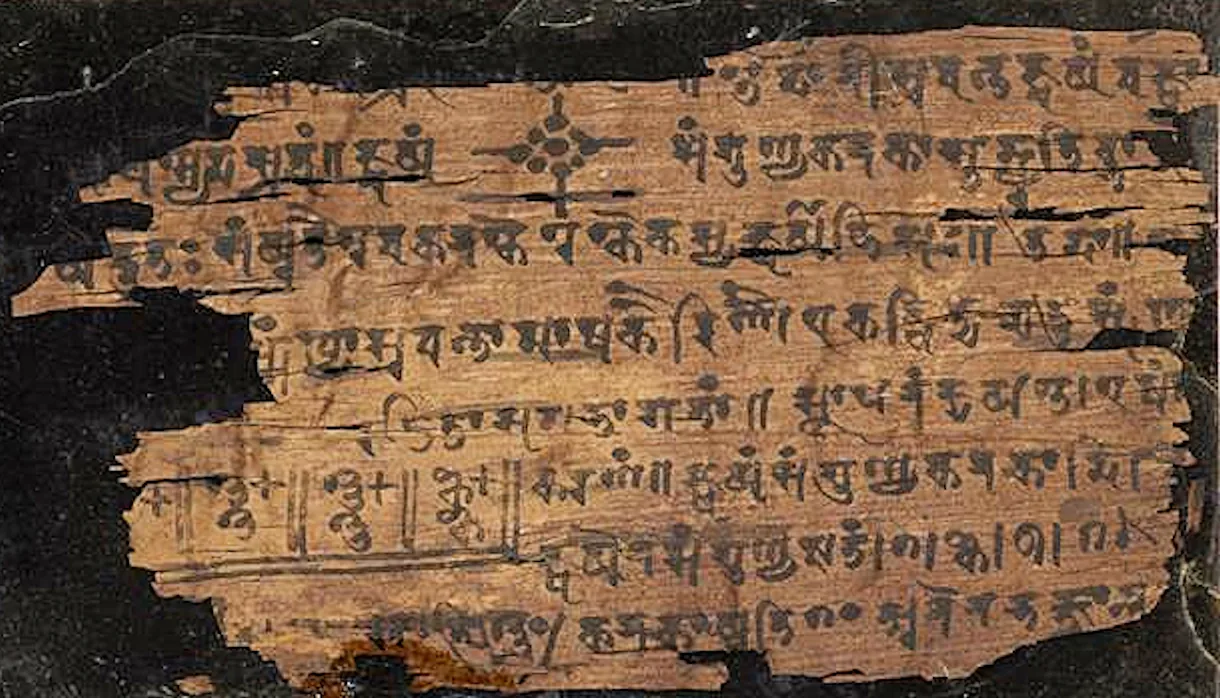
Bakhshali manuscript, a fragment of a leaf. National Geographic, 2018. Public domain (Wikimedia Commons). · Public domain · Source page
An empty place
Write one hundred and five
Write a 1, then a 5. Now write one hundred and five, with an empty place in the middle. Is it fifteen? A small gap in faded ink is easy to miss.
Fixing that gap took people centuries. The story of the fix is the story of zero.
Background
Place value
Our numbers rest on place value: a digit’s worth depends on the place where it stands. In 105 the 1 means one hundred. The system works only if the reader can tell which places are empty.
Background
The mathematician without a zero sign
Aryabhata lived in India from about 476 to 550 CE. Many books call him the father of the decimal system. Yet many historians note that his work has no written sign for zero.
On old bark
The find
A farmer’s find
70 leaves
In 1881 a local farmer found old leaves buried in a field in the village of Bakhshali, near Peshawar. Peshawar is now in Pakistan. The leaves are birch bark, and there are 70 of them. They carry lines of mathematics in an old Indian script. In 1902 the manuscript was given to the Bodleian Library in Oxford, where it has been kept since.
A decision point
You are a scribe, copying a book of sums.
An imagined scene. The manuscript’s date is disputed.
Your master’s book is full of sums with big numbers. Now you copy one number: one hundred and five.
You write the 1 and the 5. If the middle is left blank, a reader may see fifteen. On a worn leaf, an empty place is easy to miss.
What do you put in the empty place?
- Leave a gap. Probably the sum goes wrong. A reader who sees fifteen will do the wrong sum.
- Write out “hundred” in full. Probably it is clear but slow. Every big number needs a long word, and the leaf fills up fast.
- Draw a small dot in the empty place. Probably it is short and clear. The reader sees that the place is empty, and reads the number correctly.
What really happened
Draw a small dot in the empty place.
The manuscript does use a dot for an empty place. Oxford says the dot marked the order of magnitude of a number, which is the job of a placeholder.
The decision is imagined, but the sign is real. A dot is quick to write, and it sits in the place where a digit would stand.
A table from 1887
The number signs

Augustus Hoernle (1841–1918), On the Bakhshali Manuscript, 1887, page 9. Public domain (Wikimedia Commons). · Public domain · Source page
A table published in 1887 shows the number signs used in the manuscript. In the table, the sign for 0 is a plain dot, the same mark the scribes used for an empty place.
Source: The Bodleian’s claim, 2017
“the world’s oldest recorded origin of the zero symbol that we use today”
The statement announced the radiocarbon results by press release and video. Historians who dispute the claim say the results should have gone through peer review first.
- Who published this, and what do they gain? The library that owns the leaf. A famous oldest zero also makes its manuscript famous. That does not make the claim false, but it is a reason to read it with care.
- What does the statement leave out? It gives the oldest date the leaves reach: “as early as the 3rd or 4th century”. It does not say which leaves were dated, or show the numbers behind the dates.
What do you do with zero?
Background
A book from 628
In 628 CE the Indian astronomer and mathematician Brahmagupta wrote a book called Brahmasphutasiddhanta. In it he defines zero as the result of subtracting a number from itself. Take 7 away from 7, and nothing is left.
A decision point
You are Brahmagupta, writing in 628 CE.
628 CE. The choice is imagined.
You know zero as the sign for an empty place, and as the result of 7 minus 7. Now a harder question: does zero behave like other numbers?
Your readers work with debts and fortunes, which are negative and positive numbers. They ask what happens when you add zero, multiply by it, or divide by it.
Should zero follow the same rules as other numbers?
- No. Zero is only a sign for an empty place, with no rules of its own. Probably the sums with empty places still work, but questions about debts that cancel out have no clear answer.
- Yes. Adding zero changes nothing, and any number times zero is zero. Probably the calculations become clear and useful. Zero turns from a sign into a tool.
- Yes, and dividing by zero also gives zero, so every sum has an answer. Probably the book looks complete, but its rules start to clash, and some sums have no single answer.
What really happened
Yes. Adding zero changes nothing, and any number times zero is zero.
He did this. He wrote rules for zero: adding it changes nothing, and a number times zero becomes zero. He also tried to extend his rules to division by zero, and his answer for zero divided by zero was wrong.
The rules are the part that still matters. He gave rules for debts and fortunes too. Division by zero was the gap he could not close.
Source: A modern summary of the rules
A debt minus zero is a debt. A fortune minus zero is a fortune. Zero minus zero is a zero. A debt subtracted from zero is a fortune.
The rules come in the English of a modern site, written long after 628, which summarises his Sanskrit text. Its judgement on division follows: “He is certainly wrong when he then claims that zero divided by zero is zero.”
- Whose words are these, and how close are they to Brahmagupta’s? It is a modern English rendering, not his Sanskrit. A translation can change the wording, so read the rules as close to his meaning, not his exact text.
- Which part is the writer’s judgement, not the source’s? The line about zero divided by zero. The site calls Brahmagupta “certainly wrong”. That is a modern verdict, and a reader should say so.
Who got there first?
Background
Zero spreads
Zero also appears on stone. An inscription from Cambodia, dated 683 CE, may show zero, and historians debate whether it is the same kind. A stone inscription from Gwalior in India, dated 876 CE, uses zero, and for a long time it was considered the oldest zero in India.
How old is the leaf?
How old are the Bakhshali leaves, and what does a date prove?
- Bodleian Libraries, 2017 Radiocarbon dating puts some leaves as early as the 3rd or 4th century. Press reports gave rough dates for three leaves: about 300, 700 and 900 CE. The statement itself gives no such dates.
- Kim Plofker and colleagues, historians of Indian mathematics They dispute the claim, in a 2017 reply in History of Science in South Asia. They argue that the earliest dated leaf is unlikely to date the whole text, and that the latest datable leaf better shows when the scribal work was done. They also argue that the written zeros are numbers in their own right, not only placeholders. They regret that the results were announced by press release and video without peer review.
The leaves come from at least three periods. Were they written together, or were older bark sheets reused? And can one date tell us anything about the whole book?
A decision point
You are a member of a merchants’ guild in Florence, in 1299.
An imagined scene. Reports of a ban are disputed.
In 1202, Fibonacci’s Liber Abaci taught Europe the Hindu-Arabic numerals. Some merchants already use them, and some say they are quicker.
Your guild’s clerks still write sums the old way. Some members want the new signs. Others fear confusion and copying errors.
What does the guild decide about the new numerals?
- Allow them, but only beside the old numbers. Probably the books stay readable to older clerks. Writing two systems side by side makes errors easier.
- Allow them in all accounts. Probably sums get quicker to write. Clerks trained in the old way must learn again, and that takes time.
- Ban them from the guild’s account books. Probably the books stay in the old system, and the new one spreads more slowly among the guild’s own clerks.
What really happened
Ban them from the guild’s account books.
Some popular accounts say a Florentine guild banned the new numerals in 1299. They do not agree on which guild was bound, and they are later popular writing, not the guild’s own records. Over the following centuries, the new numerals spread across Europe.
The accounts give no clear reason for a ban. Historians note that the story reached us through later writing, which may reflect later views. The decision itself is imagined.
Myth
Zero was invented once, in one place, by one clever person.
The truth
Zero grew in stages. First came a sign for an empty place, like the Bakhshali dot. Then came rules for zero as a number, in Brahmagupta’s book of 628.
The evidence
The Bakhshali dots, Brahmagupta’s rules, and the inscriptions from Cambodia (683 CE) and Gwalior (876 CE) come from different places and times.
The number we use
From a dot to a number
- 628 CE Brahmagupta writes rules for zero as a number. His claim that zero divided by zero is zero is wrong.
- 683 CE A Cambodian inscription may show zero. Historians debate whether it is the same kind.
- 876 CE A stone inscription from Gwalior uses zero. For a long time it was considered the oldest zero in India.
- 1202 Fibonacci’s Liber Abaci introduces Europe to the Hindu-Arabic numerals.
- Today Dividing by zero still has no answer, because any number times zero is zero.
Check yourself
What job does a placeholder do in the number 105?
Answer: It marks the empty tens place, so the digits keep their values.. Yes. Without the mark, a reader may see fifteen. With it, the 1 means one hundred.
Check yourself
What did the dot in the Bakhshali manuscript mark?
Answer: An empty place in a number, showing its order of magnitude.. Yes. The Bodleian says the dot showed the order of magnitude of a number.
Check yourself
Which of these is one of Brahmagupta’s rules, according to the modern summary you read?
Answer: Multiplying any number by zero gives zero.. Yes. The site lists it: a number multiplied by zero becomes zero.
Check yourself
Why should you not treat the MacTutor page as Brahmagupta’s own words?
Answer: It is a modern English summary, so the wording may differ.. Yes. A translation or summary can change the wording and the emphasis.
Check yourself
Why does dividing by zero have no answer?
Answer: Because any number times zero is zero, no answer can be found.. Yes. If a divided by zero were some number c, then a would equal c times zero, which is zero.
Check yourself
Which statement best describes how zero developed?
Answer: It grew in two stages: a sign first, then rules for zero.. Yes. The lesson showed the dot first, then Brahmagupta’s rules, then later inscriptions.
Terms
- placeholder A sign that marks an empty place in a number, so the digits keep their values. Without it, 105 can be read as 15.
- place value The idea that a digit’s worth depends on its position. In 105, the 1 means one hundred.
- zero The number that adds nothing, and also a sign for an empty place. Today it is written 0.
- radiocarbon dating A way of estimating the age of organic material from the carbon-14 it still holds. Results come as ranges, and they can be challenged.
- Brahmagupta An Indian astronomer and mathematician, who lived about 598 to 668 CE. In 628 he wrote a book with rules for zero and for negative numbers.
- division by zero Dividing a number by zero. It has no answer, because any number times zero is zero.
- Hindu-Arabic numerals The digits 0 to 9 that we use today. Fibonacci’s book of 1202 introduced them to Europe.
- Bakhshali A village near Peshawar, now in Pakistan. A local farmer found old mathematical leaves there in 1881.
- Aryabhata An Indian astronomer and mathematician who lived in the 5th and 6th centuries CE. Many books call him the father of the decimal system.
- Peshawar A city in north-west Pakistan today, near the Afghan border. The Bakhshali leaves were found beside it.
- Pakistan A country in South Asia. Peshawar, near the Bakhshali village, is in it today.
- Bodleian Library The library of Oxford University in England. The Bakhshali manuscript was given to it in 1902 and has been kept there since.
- Oxford A city in England with an ancient university and the Bodleian Library.
- Fibonacci An Italian mathematician. His Liber Abaci taught Europe the Hindu-Arabic numerals.
- Liber Abaci Fibonacci's book that introduced Europe to the Hindu-Arabic numerals and to calculating with them.
- Gwalior A city in central India. A stone inscription from there uses zero, and for a long time it was thought to be the oldest zero in India.
- Cambodia A country in south-east Asia. A stone inscription from Cambodia, dated 683 CE, may show zero.
- Florentine guild A guild of Florence, in Italy. Later popular accounts say it banned the new numerals in 1299, but they do not agree which guild it was.
- press release An official notice a body gives to the media to announce something. The radiocarbon results were announced this way.
- peer review Checking of research by independent experts before it is published. Some historians said the dating results should have passed one.
- Sanskrit An ancient language of India, in which many books of mathematics and astronomy were written.
- Brahmasphutasiddhanta A Sanskrit book by Brahmagupta from 628 CE. In it he defines zero and writes rules for it.
- order of magnitude How big a number is, roughly, judged by its number of digits. The dot in the manuscript marked the order of magnitude.
- old Indian script An ancient writing system of India, in which the mathematical lines of the Bakhshali manuscript are written.
Sources
- Brahmagupta, Brahmasphutasiddhanta (Correctly Established Doctrine of Brahma), 628 CE
- Augustus Hoernle, On the Bakhshali Manuscript, 1887, p. 9 (plate of the number signs)
- Leonardo of Pisa (Fibonacci), Liber Abaci, 1202
- Bodleian Libraries, University of Oxford, "Carbon dating finds Bakhshali manuscript contains oldest recorded origins of the symbol zero", 14 September 2017
- MacTutor History of Mathematics archive, University of St Andrews, "Brahmagupta" biography
- Wujastyk, Plofker, Keller, Hayashi, Montelle, "The Bakhshālī Manuscript: A response to the Bodleian Library's radiocarbon dating", History of Science in South Asia 5(1), 2017, pp. 134–150
- ScienceDaily, press report on the Bodleian radiocarbon dates, 26 October 2017
Image credits
- Bakhshali manuscript, a fragment of a leaf. National Geographic, 2018. Public domain (Wikimedia Commons). · Public domain · Source page
- Augustus Hoernle (1841–1918), On the Bakhshali Manuscript, 1887, page 9. Public domain (Wikimedia Commons). · Public domain · Source page

