Yi Sun-sin, 1592–1598: thirteen ships
In October 1597 a Korean admiral sails into a narrow strait with twelve or thirteen warships, facing more than a hundred Japanese ships. Who was Yi Sun-sin, and how much of the legend about him is true?
Decisions, questions and your own progress, in the app
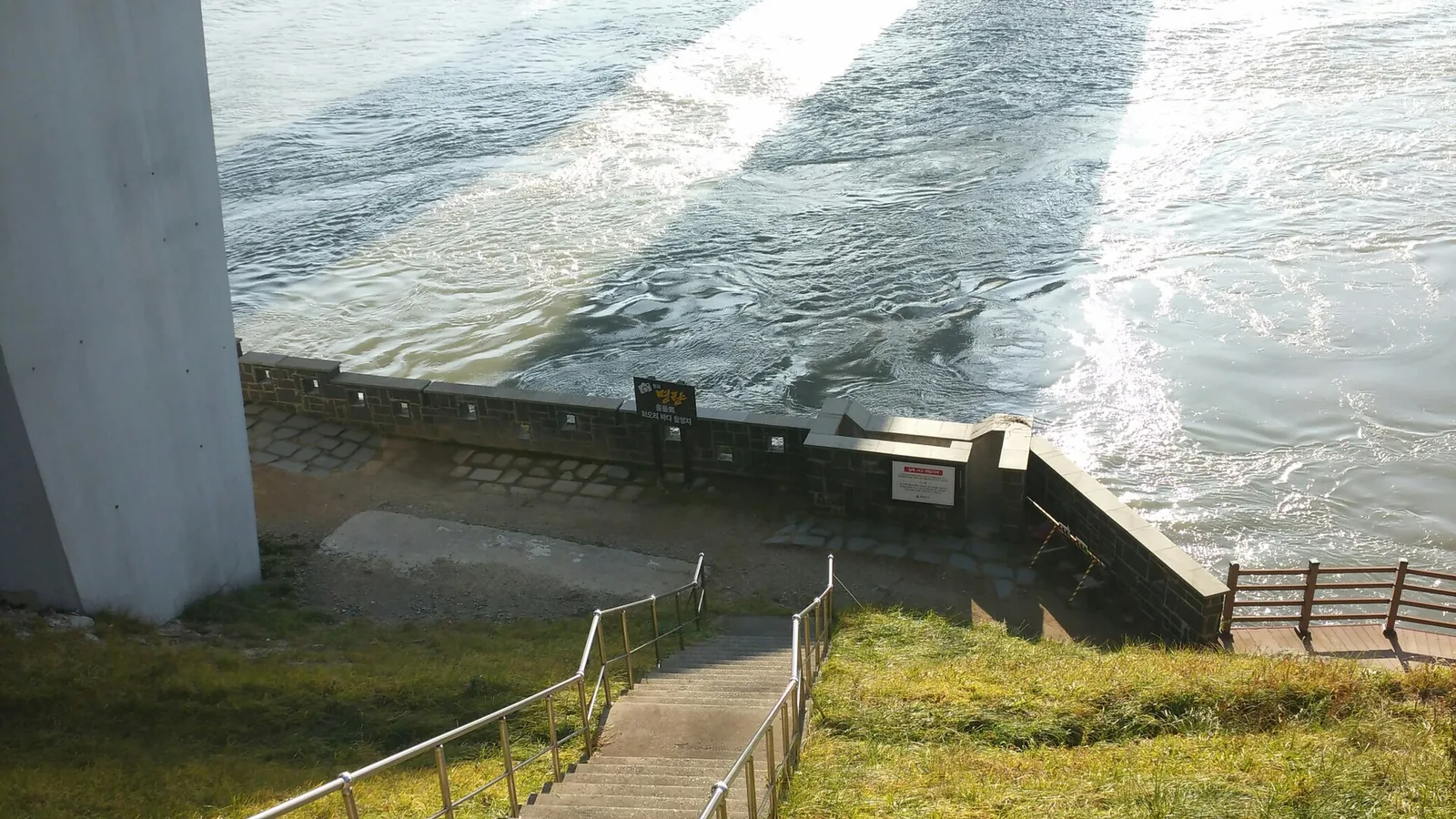
Jangg8962, Uldolmok, Jindo, 2017. Own work. · CC BY-SA 4.0 · Source page
The scene
The Myeongnyang Strait, October 1597
It is October 1597. A Korean admiral sails into a narrow strait with twelve or thirteen warships, facing more than a hundred Japanese ships.
The sources disagree on the numbers, but they agree on the result: Yi Sun-sin's small fleet won. Who was he, and how much of the legend is true?
Background
A naval officer from Seoul
Yi Sun-sin was born in Seoul in 1545. He passed the military examination in 1576, and in 1591 he became naval commander of Left Jeolla province, based at Yeosu.
Japan's ruler, Toyotomi Hideyoshi, planned to use Korea as the road to China. In spring 1592, that plan landed an army in Korea.
Yi Sun-sin
A Korean naval commander who fought Japan's invasion of 1592 to 1598, and died in his last battle.
- Born: 1545 (the day is disputed), Seoul
- Died: 16 December 1598 (one source says 14 or 15), Noryang, on the southern coast, Shot during the battle
- Won: Hansan, August 1592; Myeongnyang, October 1597; Noryang, December 1598 (he died in it)
- Lost: His command and rank, 1597 (arrested, then demoted)
Paraphrase: his reply says he still has twelve warships.
The road to war
1592
The landing, and the march north
In late May 1592, Japanese troops land at Busan. The sources give lunar dates, so 'late May' is the honest form.
About twenty days later, in mid-June, Seoul, the Korean capital, falls, and the Japanese push north.
An army from overseas needs a supply line, and whoever can cut it weakens the invader.
August 1592
The battle of Hansan
59 of 73
On 15 August 1592 (some sources say 14), Yi's 56 Korean warships meet 73 Japanese ships off Hansan Island.
Yi fights in a formation that, according to Samuel Hawley, looks like a crane spreading its wings. Some turtle ships stand in the centre.
59 Japanese ships are destroyed, and 14 escape.
A decision point
You are Yi Sun-sin.
Spring 1597, the third month of the lunar year
Five years of war have passed, and the peace talks have failed.
The court acts on intelligence from a Japanese double agent. The order: sail to a set point at sea and wait for a fleet the report says will come.
You suspect a trap.
What do you do?
- Sail to the point as ordered and carry out the plan. Probably you would wait at sea for a fleet that may never come. If the report is false, you have sent your ships into the trap.
- Refuse, and explain in writing why the plan is too dangerous. Probably the court would be furious, and you could be charged with disobedience. Your ships would stay safe, but your career would be at risk.
- Send scouts to check the report and the water, and decide after that. Probably you would lose several days, and the court might read the delay as disobedience. It works only if the scouts can check the report quickly.
What really happened
Refuse, and explain in writing why the plan is too dangerous.
Yi refused. He was arrested in April 1597, taken to Seoul in chains and sentenced to death. The sentence was later commuted to exile, and he lost his rank.
The sources do not give his own reasons. One account without a source says he pointed to hidden rocks and distrusted the plan.
The event
August 1597
The navy that was lost
about 190 ships
Won Gyun took over the navy from Yi. In late August 1597, at Chilcheollyang, his fleet met the Japanese and was almost wiped out.
About 190 ships were lost. Only twelve escaped, under Bae Seol. Won Gyun was reportedly killed; sources differ on how.
The court had to turn back to the man it had jailed.
September 1597
The man they had jailed
On 13 September 1597 Yi was given back his command. The sources do not say who decided.
In reply to an order to disband the navy, he wrote that he still had twelve warships.
It took him about two weeks to reach his fleet.
The strait
A narrow place
290 metres
The Myeongnyang Strait is narrow: by modern measurement, about 290 metres at its narrowest point.
Yi had twelve or thirteen warships. His letter before the battle says twelve; his report and the Annals of the court say thirteen.
Yi's scouts counted 133 Japanese ships. Estimates for the fight run from about 120 to 133, and some Korean accounts give far more.
Myeongnyang: who had what
26 October 1597
The Myeongnyang Strait, on the south-west coast of Korea
The Korean navy (Joseon)
- Commanders: Yi Sun-sin
- Strength: 12 warships (Yi's letter, before the battle); 13 warships (The court's Annals and Yi's report after the battle)
- Losses: No ships lost (Yi's report)
The Annals also list 32 scouting ships, which probably took no part in the fight.
The Japanese navy
- Commanders: Not named in the sources we read
- Strength: 133 ships (Yi's scouting report); over 130 in the fight (Korean Studies Quarterly, 2002); 120 to 133 in the fight; up to 330 in all (Hawley (2005), as summarised in an encyclopedia)
- Losses: 31 ships (Yi's own count); more than 30 (Hawley (2005))
The Japanese totals are disputed, and some Korean accounts give more than 330 in the fight.
Outcome: A Korean victory. Yi reported 31 Japanese ships lost and none of his own; modern writers give about 30.
The sources also differ on how many Japanese ships took part at all.
A decision point
You are Yi Sun-sin.
26 October 1597, at the strait
Won Gyun's fleet is gone. You have twelve or thirteen warships, and the navy depends on them.
Opposite you are more than a hundred Japanese ships. The strait is narrow, and the tide runs hard.
You can fight in the narrow water, or pull back to open sea.
What do you do?
- Fight in the strait, and use the tide and the narrow water. Probably you would face many ships at once in a small space. You would have to fight well, and luck would matter a great deal.
- Pull back into open water, where your ships can spread out. Probably the Japanese would surround your few ships, and that would be the end of the fleet.
- Hold back out of sight, and wait for a better moment. Probably the Japanese fleet would sail past you, and you would have to explain why you did not fight.
What really happened
Fight in the strait, and use the tide and the narrow water.
Yi fought in the strait. In his report he counted 31 Japanese ships lost and none of his own. Modern writers give about 30.
The sources do not record his reasons in his own words. A 2002 article in Korean Studies Quarterly argues that he used the strait and the turbulent tide.
After the fight
A fleet that survived
Yi's count was 31 Japanese ships lost and none of his own. Modern writers give about 30 for the Japanese losses.
The figures come mostly from his own report, and they are hard to check.
The sources agree that the fleet survived the battle. Yi fought his last battle at Noryang, more than a year later.
What we really know
Source: Yi's own war diary
Paraphrase, not a quotation: a day-by-day record in which the commander writes about the navy's needs and his own conduct.
A war diary written by Yi himself, almost daily from 1592 until November 1598, weeks before his death. Worldhistory.org says it was published after his death.
- Who wrote this, and when? Yi himself, during the war.
- What does the writer want us to believe about himself? That he acted properly. He is a commander defending his conduct.
- What is missing? The Japanese side, and other commanders' views.
Myth
The turtle ship was an ironclad: a warship covered in iron plates.
The truth
Korean accounts from Yi's lifetime do not call it an ironclad. One describes a roof of planks, and modern historians describe iron spikes on that roof.
Whether it also had iron plates is still disputed among historians.
The evidence
Yi's nephew, Yi Bun, describes planks in the Haengrok, an account of Yi's deeds. Some reference books still say ironclad.
Source: A minister's book of corrections
Paraphrase, not a quotation: a senior minister looks back at the court's mistakes during the war.
Written during the war, according to the translator. The exact dates are not confirmed.
- Who wrote it, and what was his position? The chief state councillor, the top minister, writing about his own court.
- What might he want to excuse? Perhaps his own part in the court's decisions. A minister is not a neutral judge of who was to blame.
- How sure is the date? Not exact. The translator places it during the war.
Source: The court's record of the battle
Paraphrase, not a quotation: the Annals record thirteen Korean warships for the battle, and list thirty-two scouting ships.
Compiled by court historians, not by Yi. It needs as much care as a diary.
- How many warships does this record give? Thirteen. Yi's letter, written before the battle, says twelve.
- Why might two records disagree? Some accounts say a thirteenth ship joined before the fight. Keep both figures.
- Who compiled the Annals, and when? Court historians, after the reign. The exact date is not confirmed.
A decision point
You are Yi Sun-sin, commanding the allied fleet.
16 December 1598, at Noryang
Japan's army is leaving Korea. Its fleet must pass the Noryang Strait toward Busan.
You command Korean ships with Ming ships under Chen Lin, who joined in August: about 150 warships.
The Japanese fleet is large, and you cannot count it exactly.
What do you do?
- Attack in the strait, and try to block the fleet's way out. Probably a fierce fight in narrow water, with heavy losses on both sides, and a chance to destroy much of the Japanese fleet.
- Let the Japanese fleet pass, and keep your own ships safe. Probably the Japanese fleet reaches Busan with most of its ships, and the war ends without a last sea battle.
- Wait for the Ming ships to take their places, and then attack. Probably you would have more ships in position, but the Japanese could pass the strait while you wait.
What really happened
Attack in the strait, and try to block the fleet's way out.
Yi attacked. He was shot during the battle and died. According to two accounts, he asked that his death be kept secret. One of them says until the battle ended. Korean records give large Japanese losses, but their figures disagree, and the size of the Japanese fleet is itself disputed.
The sources record no reasons in his own words. They agree on the outcome: he attacked, and was shot.
What followed - and the quiz
1598
The invasion ends
On 18 September 1598, Hideyoshi died at Fushimi castle. The invasion he had launched was now without its author.
By December the allied ships were closing in on the Japanese fleet. The last Japanese ships sailed around 24 December.
The invasion had failed: Japan had not conquered Korea or reached China. Yi did not live to see the last ships leave.
The last two years, in order
- August 1597 Won Gyun's fleet is destroyed at Chilcheollyang; about 190 ships are lost.
- 13 September 1597 Yi is given back his command.
- 26 October 1597 Myeongnyang: Yi's small fleet wins in the strait.
- August 1598 The Ming admiral Chen Lin joins him.
- 18 September 1598 Hideyoshi dies.
- 16 December 1598 Noryang: Yi is shot and dies.
- Late December 1598 The last Japanese ships leave Korea.
Did the navy decide the war?
How much of the war did Yi's navy decide? How much did the Ming court, the armies and the decisions of Japan's leaders decide?
- Samuel Hawley, The Imjin War (2005) According to a review of the book, Hawley argues that Korean naval and artillery technology was better than Japan's, and that Yi cut Japan's supply lines at sea. On this view, the navy mattered a great deal.
- Kenneth M. Swope, A Dragon's Head and a Serpent's Tail (2009) Swope treats the war as a conflict between several states. He uses Chinese sources as well as Korean and Japanese ones, and shows the Ming court as an active player. Yi was one part of that wider war.
Which sources would change this picture most? Ask yourself what each side would have to explain away.
Check yourself
Why do the sources give different numbers of Japanese ships at Myeongnyang?
Answer: The sources count different things: the fight, the whole fleet, or a scout's sighting.. Right: a count of the fight, a count of the whole fleet and a scouting count are different numbers.
Check yourself
Which statement about the turtle ship does the lesson best support?
Answer: It had iron spikes on its roof, but plating is disputed.. Right: the spikes are attested, and the question of plates is still open among historians.
Check yourself
What happened to Yi after he refused the order in 1597?
Answer: He was arrested, and his death sentence was later commuted.. Right: the arrest came first, and the death sentence was later commuted to exile.
Check yourself
Why should a reader treat Yi's own war diary with care?
Answer: It was written by Yi himself, who had reasons to defend his conduct.. Right: the diary is first-hand, but its writer is also a commander defending his conduct.
Check yourself
According to the lesson, what did Hawley argue about Yi's navy?
Answer: That it cut Japan's supply lines at sea, and that Korean technology was better.. Right: according to a review of the book, the navy cut the supply lines, and Korean naval and artillery technology was better.
Check yourself
What happened to Japan's invasion after Hideyoshi died on 18 September 1598?
Answer: The Japanese forces withdrew, and the last ships sailed in late December.. Right: the withdrawal came in stages, and the last ships left in late December.
Terms
- turtle ship A Korean warship with a roof over its deck. Sources mention iron spikes on that roof. Whether it also had iron plates is disputed.
- ironclad A warship covered in iron plates. The word is often used for the turtle ship, but whether it had such plates is disputed.
- double agent A spy who works for both sides, or pretends to. Here, a Japanese double agent convinced court officials that a plot existed.
- war diary A day-by-day record kept during a campaign. Yi's war diary, the Nanjung Ilgi, has entries almost every day from 1592 to 1598.
- annals An official record, kept year by year. Annals of a reign are compiled by court historians, usually after the period they describe.
- Ming dynasty The Chinese dynasty whose court sent troops and ships to help Korea in the war against Japan.
- lunar calendar A calendar that counts months by the moon. The Korean dates of this war are lunar, and sources give our equivalents, which can differ by a day.
- supply line The route by which food, weapons and new troops reach an army. Cutting a supply line can weaken an army without a large battle.
- to commute To reduce a sentence, for example from death to exile.
- Toyotomi Hideyoshi Ruler of Japan who planned to use Korea as the road to China. When he died, the invasion he started was left without its leader.
- Busan A port city in southern Korea. Japanese troops landed there at the start of the invasion.
- Seoul The capital of Korea. It fell to the Japanese in the middle of the invasion, and they pushed north.
- Yeosu A port in south-western Korea, where Yi Sun-sin had his naval base.
- Hansan Island An island off the coast of Korea. A great naval battle was fought near it, and the Korean fleet won.
- Myeongnyang Strait A narrow strait off the coast of Korea, where Yi Sun-sin fought the Japanese fleet.
- Noryang Strait A strait in Korea where Yi Sun-sin fought his last naval battle.
- Chilcheollyang A place on the Korean coast where Won Gyun's fleet was almost wiped out by the Japanese.
- Won Gyun A Korean naval commander who took over the fleet from Yi Sun-sin. His fleet was almost wiped out.
- Bae Seol An officer who led the twelve ships that escaped the battle where Won Gyun's fleet was lost.
- Chen Lin The commander of the Ming ships, who joined the Korean fleet in August.
- Samuel Hawley The author of a book on Yi Sun-sin, who describes his battle formation as like a crane.
- Korea The country where Yi Sun-sin fought against the Japanese invasion.
- Admiral A senior naval officer who commands a fleet of warships.
- Intelligence Secret information about the enemy, such as what it plans and where its forces are.
- Crane formation A battle formation of the fleet that looks like a crane spreading its wings.
Sources
- Yi Sun-sin, Nanjung Ilgi (War Diary of Admiral Yi Sun-sin), trans. Ha Tae-hung, ed. Sohn Pow-key. Seoul: Yonsei University Press, 1977.
- Yu Seong-nyong, The Book of Corrections (Jingbirok), trans. Choi Byong-hyon. Berkeley: Institute of East Asian Studies, 2002.
- “Admiral Yi Sun-Sin's Naval Battle at Myongryang”, Korean Studies Quarterly 25, no. 3 (2002).
- Samuel Hawley, The Imjin War: Japan's Sixteenth-Century Invasion of Korea and Attempt to Conquer China. Seoul: Royal Asiatic Society Korea Branch; Berkeley: Institute of East Asian Studies, 2005. Second edition, Lexington, KY: Conquistador Press, 2014.
- Kenneth M. Swope, A Dragon's Head and a Serpent's Tail: Ming China and the First Great East Asian War, 1592-1598. Norman: University of Oklahoma Press, 2009.
Image credits
- Jangg8962, Uldolmok, Jindo, 2017. Own work. · CC BY-SA 4.0 · Source page
