Yarmouk and al-Qadisiyya: two empires in fifteen years
In August 636 two armies faced each other in the Yarmouk valley, on today’s Syria–Jordan border. Within fifteen years both great empires of the region had lost large parts of their land, and a Persian king had been killed. Did one battle decide all of that? The sources disagree.
Decisions, questions and your own progress, in the app
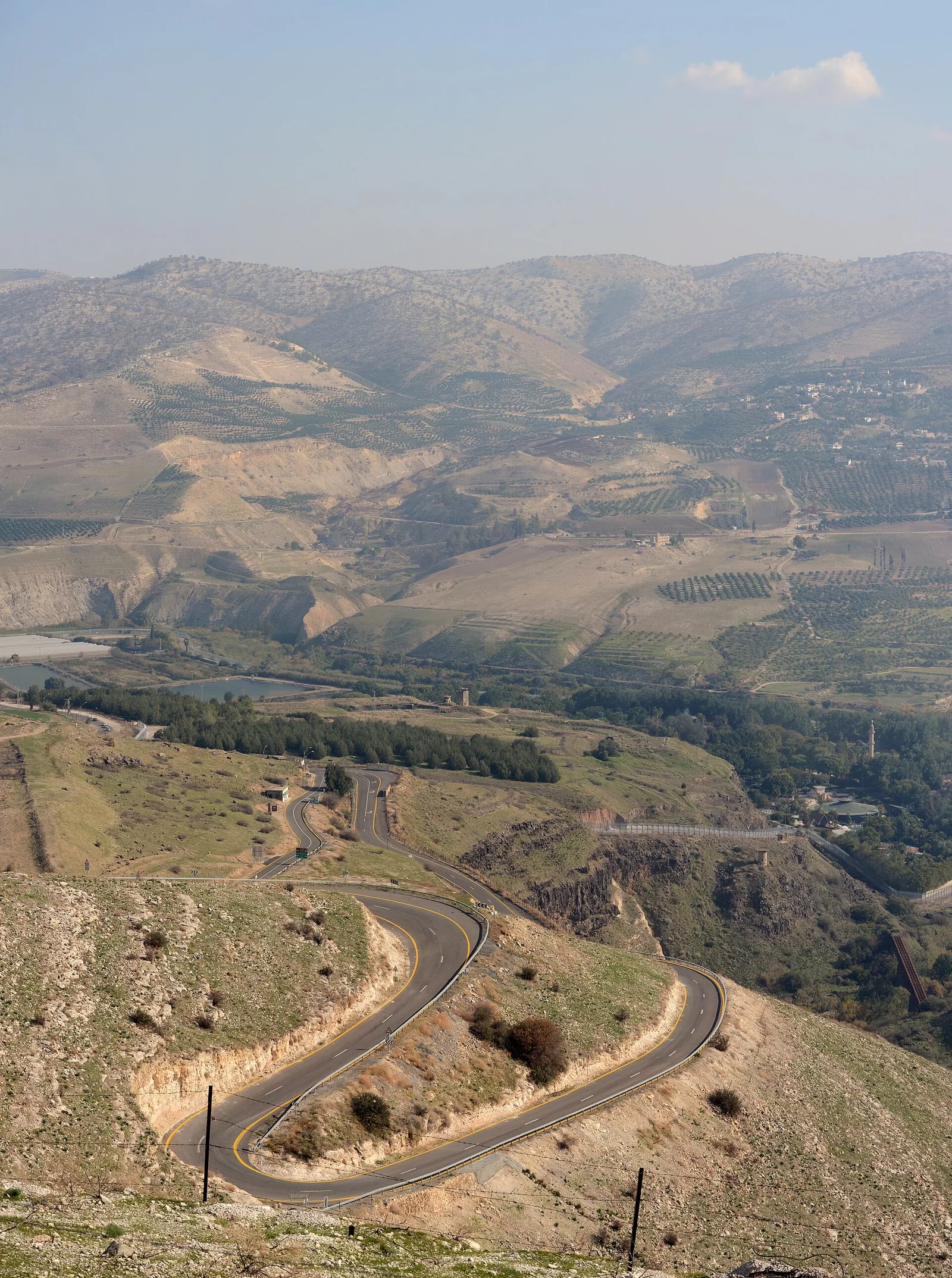
The Yarmouk River Valley, Golan Heights and Jordan. Photo: Staselnik, 2014. · CC BY-SA 3.0 · Source page
The scene
The Yarmouk valley, August 636
August 636. Two armies face each other in the valley of the Yarmouk river, where the borders of today’s Syria and Jordan meet, near the Golan Heights. One is the army of the Byzantine Empire, the Roman empire of the east, ruled from Constantinople. The other is an Arab army sent north by Caliph Umar.
The fighting goes on for days, and the sources disagree about how many. Within fifteen years, the two great empires of the region, the Byzantines and the Sasanian Persians, lose large parts of their land, and the Persian king is killed.
Did one battle decide all of that? The sources say it is more complicated. Let us look at what happened, and at what we really know.
Background
A war of twenty-six years
The Byzantine and Sasanian empires fought a long war between 602 and 628. It began after the Byzantine emperor Maurice was murdered.
In December 627, near Nineveh, the Byzantine emperor Heraclius beat the Persian army. It was the climax of the war.
In 628 the war ended. Both empires were drained by more than twenty-five years of fighting. Historians still argue about how much that exhaustion mattered later.
A new power
A new power from the desert
About eight
In June 632 the Sasanian throne passed to Yazdegerd III, a boy of about eight. Far to the south-west, in Arabia, the community founded by the Prophet Muhammad had chosen its own leaders after his death.
In August 634 Umar became caliph. His armies, drawn from the tribes of Arabia, turned north into Syria and east into Iraq and Persia.
Why does this matter? Because within a few years these armies had taken Syria, Jerusalem and Iraq from the two empires that had just finished fighting each other.
Heraclius
The Byzantine emperor who won the long war, and within about ten years had lost Syria.
- Born: c. 575
- Died: 641
- Won: Nineveh, 627
- Lost: Yarmouk, 636 (supervised from Antioch, not in the field)
Peace unto thee, O Syria, and what an excellent country this is for the enemy!
The road to it
Background
Umar’s armies move north
In 634 and 635 the Byzantines lost a series of battles in southern Syria. Damascus, the great city of the south, fell to the Arab armies in those years.
For the Byzantines this came only six years after the long war with Persia had ended.
By 636 the Arab forces were in the south of Syria, and the question was where to meet them.
The setting
The army at Antioch
Heraclius was in Antioch, the great city of northern Syria, where he had raised a new army.
Two roads lay before him. He could send the new army south, to meet the Arab forces in open country near the Yarmouk river. Or he could keep the army in the north, around Antioch, and give up the south.
He had to decide, and quickly.
A decision point
You are Heraclius, emperor of the Byzantines, in Antioch.
Summer 636.
The southern battles are lost and Damascus is in Arab hands. Your new army is ready; the Arab forces are in open country near the Yarmouk river.
You must choose before the armies meet.
What do you do?
- Send the new army south to meet the Arab forces in the open, near the Yarmouk river. Probably the army wins a battle that could stop the advance and save the south. But if it loses, you have no second army in the field.
- Keep the army in the north, around Antioch, and let the south go for now. Probably the cities of the north are safe for a while, and your army stays whole. But the south, with Damascus and the roads to Jerusalem, stays in Arab hands.
- Offer the Arab commanders a truce and money, and see whether they will stop. Probably they take the money and ask for more. A truce with armies that have won battles rarely holds for long.
What really happened
Send the new army south to meet the Arab forces in the open, near the Yarmouk river.
Heraclius chose to send the army south under other commanders, and he stayed at Antioch. The battle came in August 636, and the Byzantine army broke as it fell back. Heraclius then fled from Antioch to Constantinople.
No source we read gives his reasons in his own words. Historians can only infer them from what he did: he stayed in Antioch, and he sent the army into the open.
The days of battle
August 636
Yarmouk: a battle of days
The battle at Yarmouk was fought in August 636, in the valley of the river. It lasted several days. The accounts differ: some say one day, others say six.
The emperor was not in the field. Vahan is named as the field commander, though the sources do not agree on every name.
The numbers are the hardest part. The writer al-Baladhuri, more than two centuries later, gives about 200,000 Byzantines against 24,000 Muslims. Modern estimates are much lower, and the sources disagree.
Yarmouk: who fought whom
August 636
The Yarmouk valley, on today’s Syria–Jordan border
The Byzantine army
- Commanders: Vahan, field commander according to Wikipedia
- Strength: About 200,000 (al-Baladhuri (9th century)); 15,000–40,000 (Modern estimates (Wikipedia’s summary))
- Losses: Some 70,000, counting ‘the Greeks and their followers’ (al-Baladhuri); 70,000–120,000 (Arab sources (Wikipedia’s summary)); 30,000 or more (Modern estimates (Wikipedia’s summary))
Al-Baladhuri’s figure is for ‘the Greeks and their followers’, not for soldiers alone.
The Arab Muslim army
- Commanders: Khalid ibn al-Walid, according to one account
- Strength: 24,000 (al-Baladhuri); 15,000–40,000 (Modern estimates (Wikipedia’s summary))
- Losses: About 4,000 (worldhistory.org, no source given); 9,000 (Wikipedia infobox)
Outcome: A Muslim victory. The Byzantine army broke as it fell back. Heraclius, who was at Antioch, fled to Constantinople after the defeat.
Writers at different times and places give these figures. Modern estimates are far lower.
November 636
Al-Qadisiyya, in the east
In November 636, most likely between the 16th and the 19th, a Muslim army under Sa’d ibn Abi Waqqas met the Persian army at al-Qadisiyya, in Iraq. The Persian army was beaten.
The Persian commander, Rustam, was killed. The sources give four different accounts of how, including a sandstorm, a camel, and a duel with Sa’d.
The sources give the Persians between 50,000 and 100,000 men. Modern estimates are lower, and the sources disagree.
A decision point
You are Yazdegerd III, king of the Sasanian Persians. You are about twelve years old.
Late 636, after the defeat at al-Qadisiyya.
Your army has lost at al-Qadisiyya, and its commander Rustam is dead. The Arab armies are moving toward Ctesiphon, your capital in Iraq, where the royal court is.
Your nobles are watching. Some say hold the city to the end; others say leave while an army and a country remain.
What do you do?
- Defend Ctesiphon to the end, with the army that is left. Probably the city falls and the king and army are trapped. A king who dies in his capital is remembered, but the kingdom has no army left.
- Leave the capital, withdraw into the highlands and try to raise a new army. Probably you keep your life and the crown for longer, and you can call on the provinces of the east. But a king who has left his capital is weaker in the eyes of his nobles.
- Send envoys to the Arab commanders and offer tribute in return for peace. Probably the commanders accept payment for a while, then ask for more. Tribute buys time, not safety, against an army that has already won.
What really happened
Leave the capital, withdraw into the highlands and try to raise a new army.
Yazdegerd chose to leave the capital. He fled into Media, in the highlands of western Iran. The Arab army took Ctesiphon in early 637.
No source we read gives his reasons. Historians point out that the army had lost, the capital was in danger, and the king was still very young.
Early 637
The capital falls
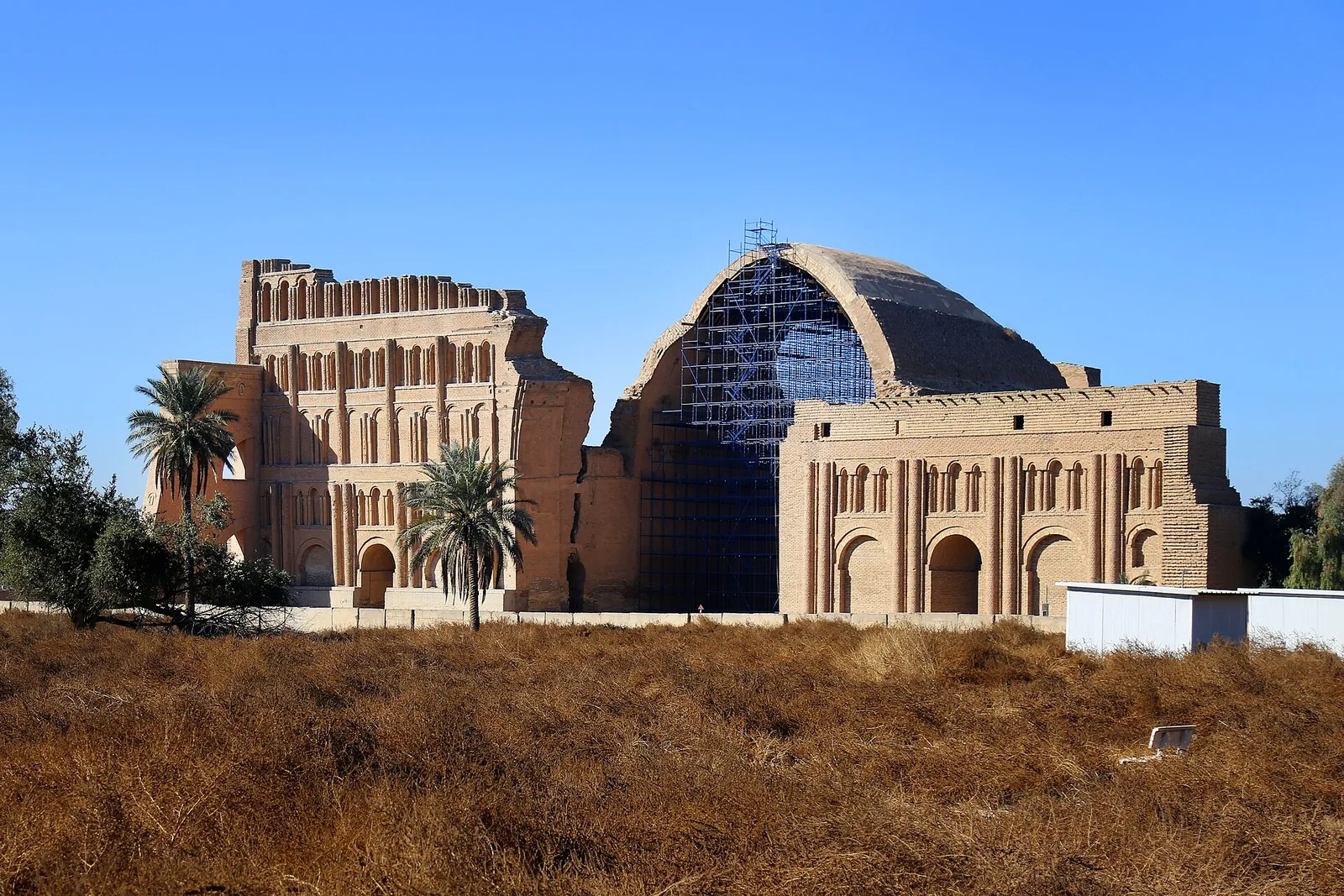
Taq Kasra, Ctesiphon, Iraq. Photo: Safa Daneshvar, 2022. · CC BY-SA 4.0 · Source page
Ctesiphon, the Sasanian capital in Iraq near today’s Baghdad, was taken by the Arab armies in early 637.
Yazdegerd was no longer there. He had fled into Media, the highlands of western Iran.
In 637 the Arab armies beat the Persians again, at Jalula. The last Sasanian king was now a fugitive.
What we really know
Source: A farewell that may not have been said
Peace unto thee, O Syria, and what an excellent country this is for the enemy!
Written more than two centuries after the battle by a compiler who gathered reports from named narrators. His sympathies lie mostly with the Muslim side. The line is about Heraclius leaving Syria, but the compiler had it from earlier narrators, not from his own eyes.
- Who wrote this, and when? Al-Baladhuri, more than two centuries after the battle. He collected stories; he was not an eyewitness.
- How did the story reach him? Through a chain of named narrators, each passing it on. A chain looks like proof, but every link can change the words.
- What is missing? The Byzantine side. The line comes down the Muslim tradition, and no Byzantine witness is named for it.
Myth
The emperor led his army at Yarmouk, and as he left Syria he bade the land a famous farewell.
The truth
No. He did not lead the army in the field. Modern accounts place him at Antioch, where he supervised from afar, and only after the defeat did he flee to Constantinople.
The evidence
Al-Baladhuri himself has him fleeing from Antioch. David Woods (2018) argues that the farewell began as a Greek call, “Save (yourself), Syria!”, which a translator misread. This is one scholar’s claim, not proven.
Source: A Greek debate with a Jew
Paraphrase: a Greek Christian text, a debate between a Christian and a Jew, speaks of a ‘prophet’ among the Saracens (the Greek name for Arabs) who claims the ‘keys of paradise’.
A Christian writer’s argument against the Jews, in the form of a dialogue. Its purpose is to win a debate, not to report news, and its date is disputed.
- Who wrote it, and for whom? An anonymous Christian in Palestine, arguing with Jews. Its aim is to win that argument, so it was probably written for Christian readers.
- When was it written? Most scholars say about 634; others argue for decades later. If they are right, the text tells us about later fears.
- Can we trust the ‘prophet’ detail? Only as a sign that a Christian writer had heard of a new movement among the Arabs. A dramatic claim, such as the ‘keys of paradise’, may be a literary device.
A decision point
You are Sophronius, Patriarch of Jerusalem.
Late 636 or 637.
Since November 636 Arab armies have besieged Jerusalem. The city is in your care, and the Christian community waits for your decision.
The emperor has left Syria for Constantinople, and no help is in sight.
What do you do?
- Surrender the city at once to the Arab commander at the gates. Probably the killing and storming stop at once. But the terms are set by a local commander, and a future caliph could change them.
- Hold out behind the walls and wait for help from the emperor. Probably a long siege, hunger, and no help. A city that refuses terms may be taken by storm, and then its people pay the price.
- Surrender the city only to the caliph himself, in person. Probably the surrender waits until the caliph arrives, and it carries a weight that a local commander’s word would not.
What really happened
Surrender the city only to the caliph himself, in person.
Sophronius chose to surrender the city only to the caliph himself. Muslim chronicles record that condition, and say that Umar declined an invitation to pray inside the Church of the Holy Sepulchre. Umar reached Palestine in early April 637. The city was handed to him in 637 or 638; the sources disagree on the year. A text called the Pact of Umar, written long after Umar and attributed to him, gives the terms: protection in return for a tax, the jizya. Its wording is disputed.
No source we read gives Sophronius’s reasons in his own words. The Muslim chronicles record the condition, but not why he set it.
What followed – and the quiz
Consequences
The two empires, afterwards
651
In 638 Umar removed Khalid ibn al-Walid from command. Umar’s public reason was that people had grown too attached to him. Ibn Kathir, a later writer, gives a money reason instead: that Khalid shared out the spoils too freely.
In 642 the Sasanian army was destroyed at Nahavand, in western Iran, and Yazdegerd escaped. Khalid died the same year.
Yazdegerd spent his last years on the run. The sources say a miller killed him near Merv in 651, and disagree on who sent the killer. The Byzantines lost Syria and Jerusalem, but kept Constantinople, where Heraclius had fled; it stayed their capital for centuries.
From the war to the last king
- 627 Heraclius beats the Persian army at Nineveh.
- August 636 The battle of Yarmouk. Heraclius is at Antioch, not in the field.
- November 636 The battle of al-Qadisiyya. The Persian army is beaten.
- Early 637 Ctesiphon is taken. Yazdegerd flees into Media.
- 637 or 638 Jerusalem is handed to Umar. The year is disputed.
- 642 The Sasanian army is destroyed at Nahavand. Khalid dies.
- 651 Yazdegerd is killed near Merv by a miller. Who sent the killer is disputed.
Why so fast?
Why did the Arab armies win so fast?
- Hugh Kennedy, The Great Arab Conquests (2007) The two empires were worn out by the war of 602–628, so they offered little resistance.
- Fred Donner, The Early Islamic Conquests (1981) The conquerors were not only raiders after plunder. Donner argues that the conquest was driven by a mobile community, united by religion and by tribe.
Both can be true. The sources were written by people who knew one side or the other, and we do not know how far local people welcomed the newcomers.
Check yourself
Who wrote the farewell line we read?
Answer: Al-Baladhuri, more than two centuries later. Right. He gathered reports through chains of narrators.
Check yourself
Where was Heraclius during the battle of Yarmouk?
Answer: At Antioch, supervising from there. Right. He stayed at Antioch and fled only after the defeat.
Check yourself
Why do the numbers for the battle of Yarmouk differ so much?
Answer: The writers were far apart in time and place. Right. Al-Baladhuri wrote more than two centuries after the battle.
Check yourself
According to the Muslim chronicles, what did Sophronius insist on before he surrendered Jerusalem?
Answer: That he surrender only to the caliph himself. Right. The chronicles record this condition, not his reasons.
Check yourself
When the Arab armies reached Ctesiphon, what did Yazdegerd do?
Answer: He left the capital and fled into Media. Right. He withdrew rather than defend the city to the end.
Check yourself
Which of these is offered in the debate as a reason for the speed of the conquests?
Answer: Both empires were drained by the 602–628 war. Right. This is the first explanation in the debate, from Hugh Kennedy.
Terms
- caliph The leader of the Muslim community after the death of the Prophet Muhammad, his successor in that role. The word means ‘successor’.
- Byzantine Of the eastern Roman Empire, ruled from Constantinople.
- Sasanian Of the Sasanian dynasty and the Persian empire it ruled, covering Iran and Iraq until the Arab conquests.
- patriarch The senior bishop of a great city in the church, such as Jerusalem or Antioch.
- chronicle A historical account written in time order, often year by year. Its writers were often far from the events.
- jizya A tax paid by non-Muslim subjects under Muslim rule, in return for protection.
- covenant A formal agreement between two sides, such as the terms on which a city is handed over.
- tribute A regular payment a weaker ruler makes to a stronger one so that he will not be attacked.
- Heraclius Byzantine emperor who fought Persia and then lost Syria to the Arabs. He fled from Antioch to Constantinople.
- Antioch A great city in northern Syria. Heraclius was staying there when he raised his new army.
- Damascus The great city of southern Syria. It fell to the Arab armies before the battle at Yarmouk.
- Constantinople Capital of the Byzantine Empire, which it ruled from. It stayed in Byzantine hands after Syria and Jerusalem were lost.
- Ctesiphon The Sasanian capital in Iraq, near today's Baghdad. Arab armies took it in early 637.
- Nineveh An ancient city in northern Iraq. Heraclius beat the Persian army near it in 627.
- Maurice Byzantine emperor who was murdered. His death opened the long war with Persia.
- Yazdegerd III The last Sasanian king. He came to the throne as a boy and fled the Arabs until he was killed.
- Nahavand A place in western Iran where the Sasanian army was destroyed in 642.
- Jalula A place where the Arabs beat the Persians in 637, after Ctesiphon fell.
- al-Qadisiyya A place in Iraq where a Muslim army beat the Persian army in autumn 636.
- Rustam The commander of the Persian army at al-Qadisiyya. He was killed there.
- Sophronius The bishop of Jerusalem. He chose to surrender the city only to the caliph himself.
- Theophilus of Edessa An early chronicler who gives 638 as the year Jerusalem surrendered.
- Ibn Kathir A later Muslim writer who gave a money reason for removing Khalid from command.
- Khalid ibn al-Walid A great Arab commander. Umar removed him from command in 638.
- Sa'd ibn Abi Waqqas A Muslim commander who beat the Persians at al-Qadisiyya.
- al-Baladhuri A Muslim writer who wrote more than two centuries after the battle and gave very large numbers.
- Baghdad A city in Iraq, near Ctesiphon, the Sasanian capital. It is a large city today.
- Vahan The Byzantine field commander at the battle of Yarmouk, according to the sources.
Sources
- Al-Baladhuri, The Origins of the Islamic State (Kitab Futuh al-Buldan), trans. P. K. Hitti and F. C. Murgotten (Columbia University Press, 1916), vol. 1
- Doctrina Iacobi, anonymous Greek text written in Syria Palaestina; dated to about 634 by most scholars, with the date disputed
- Hugh Kennedy, The Great Arab Conquests (Da Capo Press, 2007)
- Fred Donner, The Early Islamic Conquests (Princeton University Press, 1981)
- David Woods, “Heraclius’ Alleged Farewell Salute to Syria”, Byzantion 88 (2018), 423–433
Image credits
- The Yarmouk River Valley, Golan Heights and Jordan. Photo: Staselnik, 2014. · CC BY-SA 3.0 · Source page
- Taq Kasra, Ctesiphon, Iraq. Photo: Safa Daneshvar, 2022. · CC BY-SA 4.0 · Source page

