The Thirty Years' War and the Peace of Westphalia, 1648
Thirty years of war turned the heart of Europe into a ruin. In 1648 peace was signed, and the Holy Roman Empire was no longer what it had been. But it would live another 158 years.
Decisions, questions and your own progress, in the app
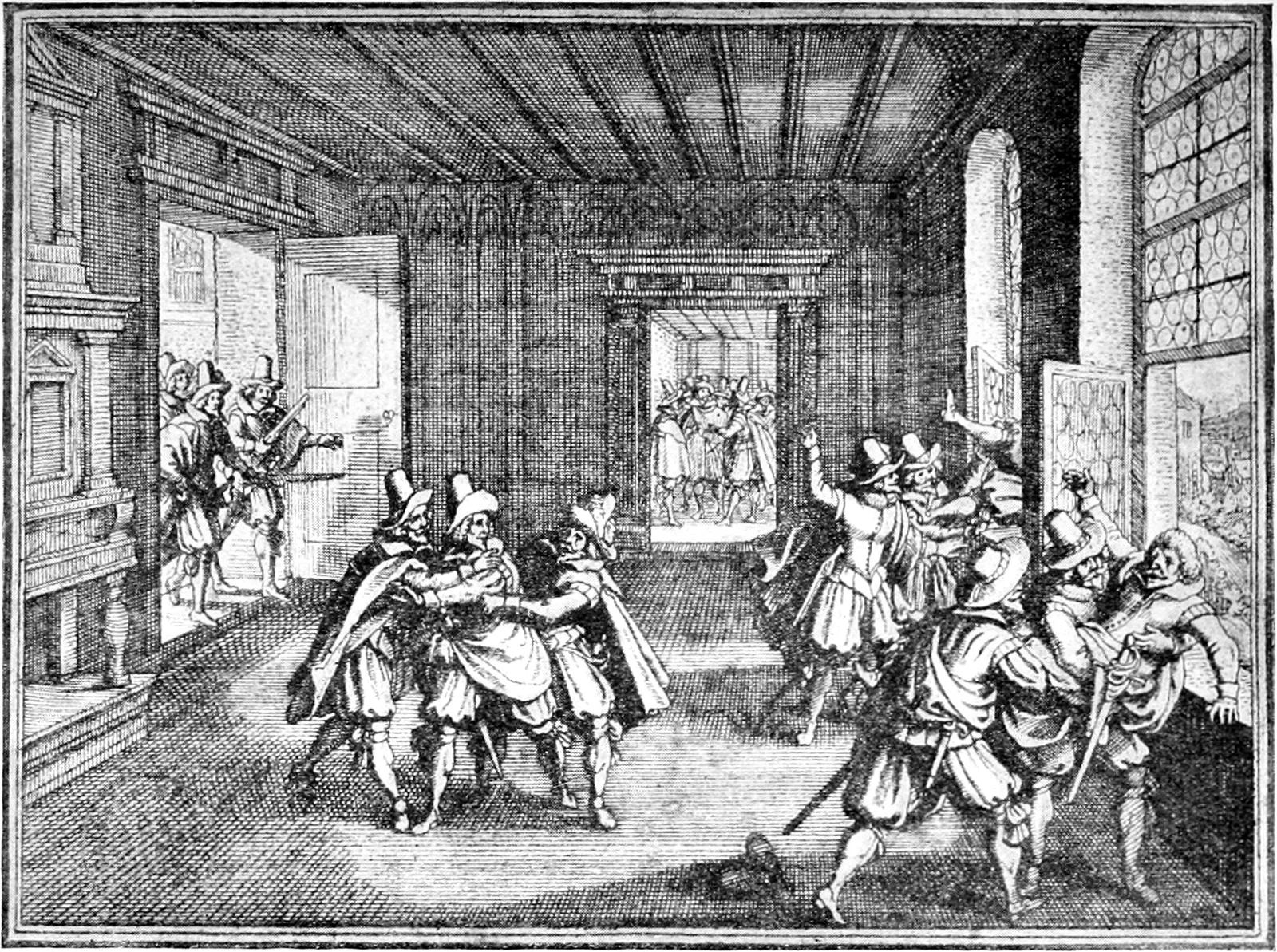
Matthäus Merian, engraving for the Theatrum Europaeum (copy dated 1662), reproduced in Francis Lützow, The Story of Prague (1920) · Public domain · Source page
A window in Prague
A window in Prague
On 23 May 1618 Protestant nobles of Bohemia walk into Prague Castle, lead two royal governors and their secretary to a window, and throw them out. The three fall about twenty metres and survive.
Nobody in that room was thinking of a thirty-year war. Yet it started there.
Background: a kingdom with its own rights
The right to build churches
Bohemia was a kingdom inside the Habsburgs’ lands, with its own nobles’ assembly and laws. In 1609 the emperor Rudolf II gave its Protestants a “Letter of Majesty”: the right to worship freely and build churches.
His successors did not like it. In 1617 the Bohemian estates chose Ferdinand, a Habsburg prince who would soon be emperor, as their next king. His officials began closing Protestant churches built on royal land, and the Letter was broken step by step.
23 May 1618
The window
Three fall
Protestant nobles, led by Count Thurn, marched into the castle and confronted the two royal governors, Jaroslav Bořita of Martinice and Vilém Slavata, and their secretary, Philip Fabricius. They threw all three out of a window. This was the Third defenestration of Prague, from the Latin for “window”.
All three survived. Catholics said angels or the Virgin Mary had caught them. Protestant pamphlets later claimed they landed on a dung heap, a story that contemporaries did not know.
1619
A Calvinist king for Bohemia
The estates did not stop at the window. They deposed Ferdinand as King of Bohemia and offered the crown to Frederick V, Elector Palatine and head of the Protestant Union, a Calvinist. He accepted. Ferdinand was elected emperor in August 1619. Frederick, crowned in Prague that November, now faced an emperor and a Catholic League that were both determined to fight.
8 November 1620
The White Mountain
One winter
The Catholic League, led by Duke Maximilian of Bavaria, sent its army to help the emperor. On 8 November 1620, on a hill called the White Mountain (Bílá Hora) outside Prague, that army beat Frederick’s in one short battle. Frederick fled. He had been king for about one winter, and his enemies called him the Winter King.
The White Mountain was a Habsburg victory. Bohemia’s Protestant nobles lost their lands, and many fled. The war was now the emperor against Protestant princes, though nobody knew how long it would last.
An empire that could not agree
Background: 1555
A peace with a hole in it
The Holy Roman Empire was a patchwork of hundreds of princes, bishops and free cities under an emperor. The princes made laws together with the emperor in the Reichstag, the imperial diet.
On 25 September 1555 the Peace of Augsburg ended a war between Emperor Charles V and the Lutheran princes. It let each prince choose Lutheranism or Catholicism for his lands: cuius regio, eius religio, “whose realm, his religion”.
The peace left two problems. It recognised only Lutherans and Catholics, and the Calvinists were left out. And its “ecclesiastical reservation” said that a Catholic bishop or abbot who turned Protestant must give up his post, while his lands stayed Catholic. Each side read the peace its own way.
1608–1609
Two armed camps
In 1608 Protestant princes formed the Protestant Union, led by Frederick IV of the Palatinate. In 1609 Catholic princes formed the Catholic League under Duke Maximilian of Bavaria.
The empire had no standing army of its own. Each league was a private army, with its own money and its own enemies. Both looked abroad for help: the Catholics to Spain, the Protestants to the Dutch Republic and, if it agreed, to France.
Myth
The Thirty Years’ War was a religious war from start to finish.
The truth
Religion was real, and it lit the fire: in Bohemia the quarrel was about worship and church buildings. But the war soon became a contest for power. Catholic France paid Protestant Sweden and the Dutch to fight the Habsburgs, and Protestant Saxony changed sides more than once.
Peter H. Wilson, in Europe’s Tragedy (2009), argues that the war was also a crisis in the empire’s constitution. He treats religion as important to those who fought, but not as the war’s cause.
The evidence
Peter H. Wilson, Europe’s Tragedy (2009).
The emperor’s war and the king from the north
1625–1628
An emperor with a general
The emperor winning
In 1625 King Christian IV of Denmark, who also held Holstein inside the empire, invaded northern Germany to defend the Protestant cause and his own lands. The emperor had no army to match him. So Ferdinand turned to Albrecht von Wallenstein, a Bohemian nobleman who raised an army at his own expense and rented it to the emperor.
On 27 August 1626 the League army under Tilly beat the Danes at Lutter. Wallenstein’s army swept north, and in 1628 it failed to take the Baltic port of Stralsund. The emperor seemed close to winning the war.
A decision point
You are Emperor Ferdinand II.
Vienna, March 1629
Your armies have won the north. You are a devout Catholic who believes the church has been robbed for seventy years.
Your lawyers have drafted an edict: church property taken by Protestants since 1552 would return to Catholic hands, including two archbishoprics, twelve bishoprics and over a hundred religious houses. The Protestant princes will protest; the Catholic princes want their land at once.
Do you sign?
- Sign it, and enforce it at once The Protestant princes would see it as war on them, and Saxony and Brandenburg would seek allies. The Catholic princes would press for their lands at once: probably a crisis in every diocese, and an excuse for any power that wanted to intervene.
- Keep it on paper, and offer the princes a deal You keep the princes’ loyalty for a while. But the price is time, and Wallenstein’s army, which the princes will want reduced.
- Sign, but first send Wallenstein away to calm the princes The princes would be reassured, but you would lose the one army that had won you the north. Enemies of the Habsburgs would find that very welcome.
What really happened
Sign it, and enforce it at once
Ferdinand signed on 6 March 1629 and had it proclaimed in Vienna. Where his armies could reach, it was enforced.
Ferdinand believed the church had been robbed. He also hoped princely support would help his son become King of the Romans. Historians read the edict as an attempt to enforce his own reading of the Peace of Augsburg.
Gustavus Adolphus
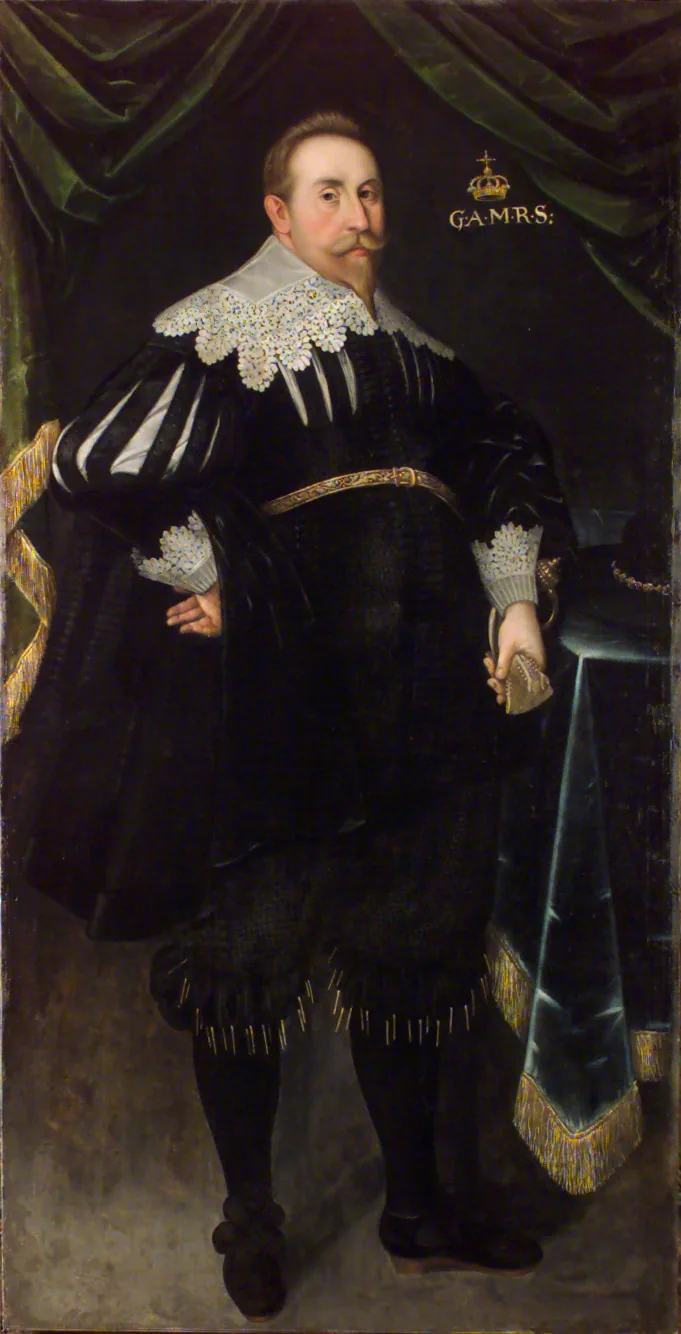
Jacob Heinrich Elbfas, about 1630. Skokloster Castle, Sweden (image from lsh.se, via Wikimedia Commons) · Public domain · Source page
The Swedish king who came to Germany in 1630 as champion of the Protestants, won at Breitenfeld, and died at Lützen aged 37.
- Born: 9 December 1594 (Old Style), Stockholm, Sweden
- Died: 16 November 1632 (New Style), Lützen, Electorate of Saxony, killed in battle, fighting with his cavalry
- Won: Breitenfeld, September 1631; Lützen, November 1632: the Swedes held the field, but their king was dead
- Lost: Magdeburg, May 1631: he could not save the city, which fell first
“no treaty can be concluded, unless a new religious peace over all Germany shall be acceded to”
A decision point
You are Gustavus Adolphus, King of Sweden.
Stockholm, spring 1630
Sweden is a small kingdom with a large army and a thin treasury, and a truce with Poland holds for now.
Across the Baltic Germany is in ruins. The Protestant princes have been beaten or bullied, and Wallenstein’s army holds the north coast. Your councillors warn that Germany is far and costly, and that a Swedish army there may never come home.
Do you take the army across the sea?
- Take the army across and land in Pomerania You would have a base on the German coast and a sea route for supplies. But you would be fighting in someone else’s country, and the emperor would probably turn his main army on you. Protestant princes might join you, or wait to see who wins.
- Stay home, and pay the Protestant princes to fight Cheaper and safer. But without a strong ally on the spot, the princes may make their own peace with the emperor, leaving Sweden to face Wallenstein’s army alone.
- First make a lasting peace with Poland, then decide A peace would free your army for later. But the delay could give Wallenstein time to take the Baltic coast, and the Protestant cause could lose its last chance.
What really happened
Take the army across and land in Pomerania
Gustavus landed in Pomerania in June 1630 (Old Style) with a small army. In January 1631, at Bärwalde, France agreed to pay him subsidies.
Historians argue about his motives: Swedish security and Baltic trade, his Lutheran faith, and the wish to lead Protestant Germany. Most agree that all three counted.
Summer 1630
The electors take a stand
August 1630
In the summer of 1630 the emperor called the electors to Regensburg. He wanted his son chosen as King of the Romans and wanted their support for the war. The Protestant electors of Saxony and Brandenburg refused to come. The others, led by Maximilian of Bavaria, had one demand: send Wallenstein away.
The emperor gave way. In August 1630 Wallenstein was dismissed, and his army was cut down. The emperor’s best army was gone just as Gustavus Adolphus reached the coast.
Magdeburg and Breitenfeld
March–May 1631
A city that would not yield
About 20,000 dead
Magdeburg, a wealthy Protestant city on the Elbe, refused Tilly’s demand to surrender. Tilly besieged it in the spring of 1631. Gustavus Adolphus did not come in time. On 20 May the attackers broke in, and for days the city was looted and burned. A wind-driven fire destroyed about 1,700 of its 1,900 buildings.
Most estimates say about 20,000 people died. The population before the siege is put at 25,000 to 30,000, and even that is uncertain.
Source: An engraving called “The sack of Magdeburg”
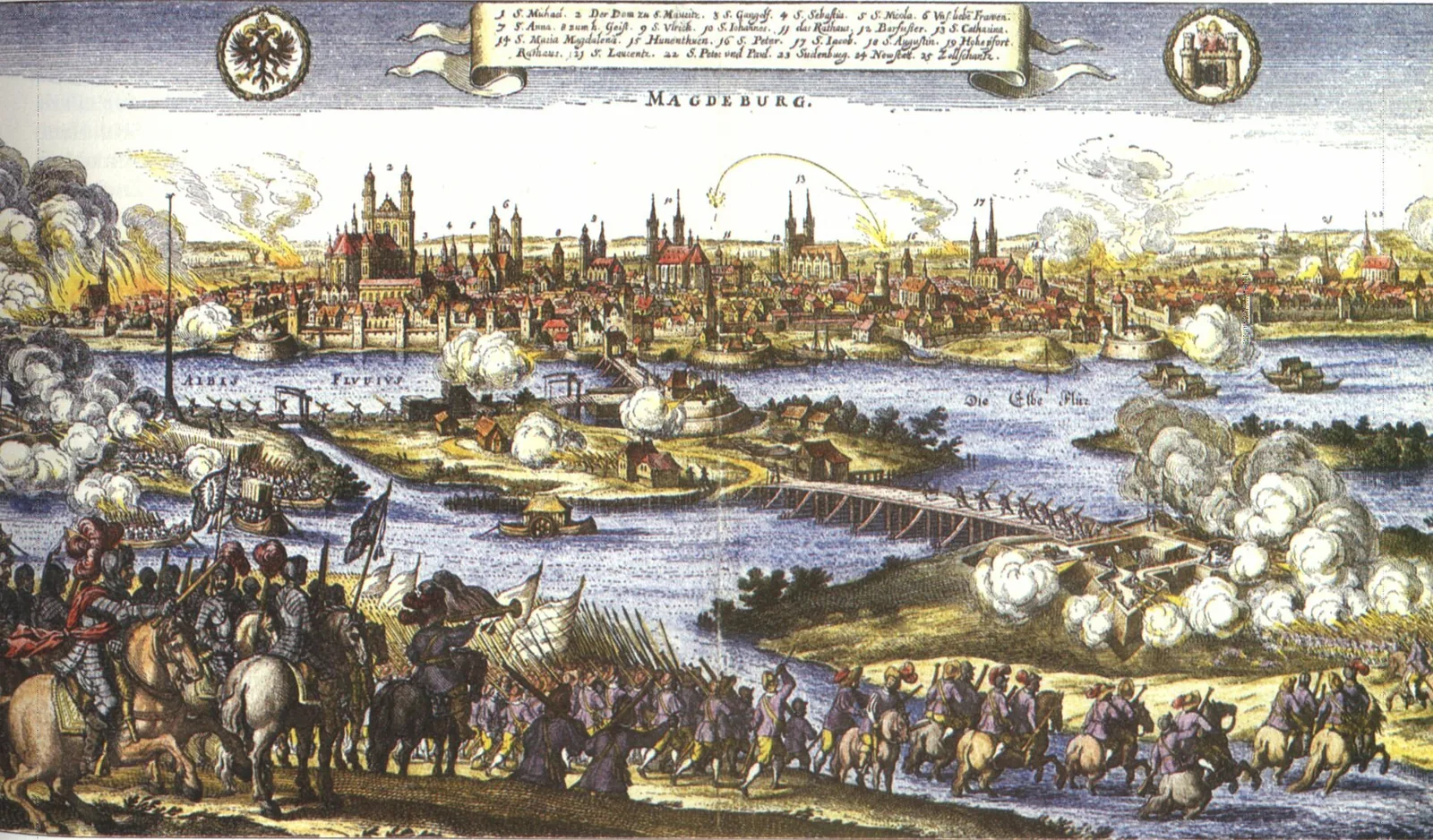
Attributed to the workshop of Matthäus Merian, engraving for a news book about the war · Public domain · Source page
Attributed to the workshop of Matthäus Merian, engraving for a news book about the war
Printed years after the event, in a news book about the war. It shows an attack on the city’s defences.
- What does the engraving actually show? A battle along the river: cannon smoke, a crowded bridge, and a city still standing. The picture shows an assault, not the looting that followed.
- Who made it, when, and for whom? A workshop around Matthäus Merian, for a news book printed years later for readers who wanted to know what had happened in Europe.
- What is missing? Flames at the far left, but no civilians, no refugees and no dead.
Breitenfeld: who fought whom
17 September 1631 (7 September, Julian calendar)
Breitenfeld, outside Leipzig, Saxony
Swedes and Saxons
- Commanders: Gustavus Adolphus, John George I, Elector of Saxony, Gustav Horn, on the Swedish left
- Strength: 40,150 (22,800 Swedes, 17,350 Saxons) (One estimate); About 42,000 (Other estimates)
- Losses: 5,550 killed or wounded (One estimate)
Imperial and League army, under Tilly
- Commanders: Johann Tserclaes, Count Tilly, Gottfried zu Pappenheim, the cavalry
- Strength: 31,400 (14,700 imperial, 15,700 League, 1,000 irregulars) (One estimate); Up to about 36,000 (Other estimates)
- Losses: About 7,000 killed (7,600 killed or wounded in one count) (Estimates); About 6,000 captured (Estimates)
Strengths differ between sources, and the Imperial losses depend on how killed, wounded and captured are counted.
Outcome: A Swedish and Saxon victory. Tilly was wounded, his army broke up by evening, and Pappenheim withdrew at night toward Halle. Gustavus was free to march west.
Usually seen as a turning point after years of Imperial victories: Tilly’s army lost a major battle in the field. The numbers are modern reconstructions.
Breitenfeld, 17 September 1631
From noon until dusk, one day in September 1631
On 17 September 1631, at Breitenfeld, Tilly holds the Galgenberg ridge with his guns on its crest, while the Swedes and Saxons advance toward him across the plain. Earlier Tilly had besieged Magdeburg, whose attackers broke in on 20 May, and Gustavus Adolphus did not come in time.
A schematic reconstruction from modern accounts of the battle. Villages, the Loberbach and the roads are approximate; the ridge and the Linkelwald are firm. North is not marked.
Phases of the battle
- Two armies face each other across the plain Tilly holds the Galgenberg ridge, guns on its crest. The Swedes and Saxons advance across the plain. The artillery duel begins around noon.
- Pappenheim attacks; the Saxons break Around two, Pappenheim charges Banér’s horse without orders and is driven back. On the north, Imperial horse hits the Saxons, who break before four.
- Tilly attacks; the Swedish left bends Around three, Tilly’s infantry comes down the ridge against Horn, who swings his flank round to meet it. Banér and Gustavus prepare to strike back.
- Gustavus breaks the centre; the Imperials fall back By about five, Gustavus breaks the Imperial centre and its guns. Tilly is wounded and his army collapses by evening. Pappenheim forms tercios in the Linkelwald and withdraws at night toward Halle.
The strategy
- Swedes and Saxons: The Swedes and Saxons advance across the plain toward the ridge. Horn swings his left flank round to meet Tilly’s infantry, while Banér and Gustavus prepare to strike back.
- Imperial and League army: Tilly means to hold the ridge with his guns on its crest, using the high ground and his artillery. When his infantry comes down from the ridge against Horn, it aims at the Swedish left. Pappenheim, without orders, charges Banér’s horse and is driven back.
What decided it: Gustavus broke the Imperial centre and its guns after Tilly’s infantry had come down from the ridge against Horn’s flank. With the centre and guns lost, Tilly was wounded and his army came apart by evening.
1631–1632
The road to the Rhine
Gustavus did not march on Vienna. He went west to the Rhine and then south into Bavaria, where the League had few troops left. Protestant princes who had waited to see a winner now joined him. The Catholics’ best general had lost much of his army in one afternoon.
Two deaths
16 November 1632
The king’s last charge
Lützen, 1632
In the autumn of 1632 Gustavus Adolphus went after Wallenstein, recalled to command the emperor’s army. Near Lützen, south-west of Leipzig, the armies met on 16 November. Gustavus led a cavalry charge on his wing and was killed.
The Swedes held the field, but their king was dead. Sweden’s war did not end. The chancellor Axel Oxenstierna took charge of Swedish policy in Germany.
1633–1634
A general who wanted his own peace
25 February 1634
Wallenstein wanted a settlement that protected his position. His rivals in Vienna watched him with suspicion. On 24 January 1634 the emperor signed a secret patent removing him; on 18 February a second patent accused him of conspiracy and condemned him to death.
On 22 February he left Pilsen (Plzeň) for Cheb (Eger), hoping to meet Swedish forces. On the evening of 25 February, officers who had seen the secret patent killed him and his closest followers.
A decision point
You are Albrecht von Wallenstein, commander of the emperor’s army.
Pilsen (Plzeň), January 1634
The emperor has secretly dismissed you, but your army is still loyal, and many of its colonels owe their commissions to you.
Your enemies in Vienna wait for a mistake. You still believe only you can end the war, on your own terms.
What do you do?
- Submit, and ask the emperor to restore your command You would probably be kept on a short leash. The court’s men would keep working against you, and the war would drag on under another general.
- Keep talking to Saxony and Sweden, and make your own peace Risky. The emperor would see treachery in every letter. The offers were vague, and you could end up with no army and no emperor.
- Lead the army to Vienna and force the court to obey you A civil war inside the empire. Your men might not follow you against their own emperor, and you would make enemies of every court in Europe.
What really happened
Keep talking to Saxony and Sweden, and make your own peace
In February he moved toward Cheb to meet Swedish forces. Officers who had seen the secret patent killed him there on 25 February 1634.
The sources tell little, and historians disagree about how far he meant to go. Some think he wanted a “just peace” on his own terms; others that he was ready to change sides. The record is thin, so the argument continues.
What followed
- 1632 Lützen: Gustavus Adolphus is killed. Oxenstierna takes over Swedish policy in Germany.
- 1633 Protestant princes of the south and west form the Heilbronn League under Swedish leadership.
- February 1634 Wallenstein is murdered at Cheb.
- September 1634 Nördlingen: the combined imperial and Spanish army beats the Swedes and their allies. The Protestant coalition begins to fall apart.
- 30 May 1635 The Peace of Prague: Saxony makes peace with the emperor and leaves the Swedish side.
France, hunger and the long war
May 1635
The Swedes on their own
The Peace of Prague (30 May 1635) took Sweden’s strongest German ally out of the war and banned alliances between princes. Sweden was left alone in the heart of Germany, with armies that had no money and no allies.
But the Habsburgs were not beaten. In Paris the question was now whether France would fight in its own name.
A decision point
You are Cardinal Richelieu, first minister of Louis XIII.
Paris, May 1635
For years France has paid Sweden and the Dutch to fight the Habsburgs, with money rather than soldiers. Spain holds the Spanish Netherlands on your northern border, and imperial and Spanish forces on the Rhine make France feel surrounded.
Saxony has just made peace with the emperor, and Sweden is weakened. The king has not agreed to open war.
Do you declare war openly?
- Keep paying subsidies, and fight through allies Cheap, and it keeps French troops at home. But with Saxony out, Sweden may be ground down alone, and Spain could then use the Rhine freely against you.
- Declare war on Spain and the emperor, openly It would be costly, and French armies would have to fight on several fronts. But France would stop being a paymaster and become a belligerent in its own right, able to press its terms at any peace.
- Make a separate peace with Spain now Peace would end French costs at once. But Spain and the emperor would be free to crush Sweden and the Protestants in the north, and then turn their power on France’s borders.
What really happened
Declare war on Spain and the emperor, openly
France declared war on Spain on 19 May 1635, eleven days before the Peace of Prague. It allied with Sweden at Compiègne, and the wider war went on for thirteen more years.
Richelieu wanted to break the Habsburg “encirclement” of France. Historians agree on the aim and argue about how far religion shaped it: the cardinal was a Catholic who allied with Protestants.
19 May 1643
The end of the tercios
Rocroi, 1643
Eight years after France entered the war, the French army under the 21-year-old Duke of Enghien defeated the Spanish army of Francisco de Melo at Rocroi. The Spanish infantry stood in tercios, the pike-and-musket blocks that had terrified Europe.
The tercios held and beat off two French cavalry charges. Then French artillery pounded the squares, the German and Walloon troops deserted, and the veterans fought on. Estimates of Spanish losses vary: about 7,000 killed or wounded and some 8,000 captured.
Historians often call Rocroi the end of the myth that the tercios could not be beaten. Enghien, later the Great Condé, won.
1635–1648
Living off the land
Soldiers were rarely paid on time. They lived by contributions: food, horses and money that officers demanded from villages and towns under threat of fire and violence. Whoever did not pay was robbed. The armies crossed the same lands again and again, and each left the land poorer. Hunger went with them, and so did plague, carried by soldiers and refugees.
Myth
A third of all Germans died in the war, everywhere.
The truth
The figure is repeated in textbooks, but it is a guess, not a count. Older estimates, beginning with Günther Franz in 1940, have been widely questioned. Estimates for the whole war range from 4.5 to 8 million, and historians differ on how to count them.
In some parts of Germany the population fell by more than half. Peter H. Wilson argues that the empire lost at least a fifth of its people, and that it took more than sixty years to recover.
The evidence
Günther Franz (1940); Geoffrey Parker (ed.), The Thirty Years’ War (1997); Peter H. Wilson, Europe’s Tragedy (2009).
Source: A novel that rings true
“Bedsteads, tables, chairs, and benches they burned, though there lay many cords of dry wood in the yard.”
Grimmelshausen served as a musketeer in the war. The novel is fiction, with an invented hero, though the war it describes is the one its author knew. It shows how the war felt, not how many died.
- Why burn furniture when there is firewood in the yard? The soldiers had fuel. Burning the household’s goods was deliberate destruction: the house no longer belonged to anyone.
- What kind of truth does a novel offer that a chronicle cannot? The feel of the war: petty destruction, boredom and fear. It cannot give a number of victims.
The peace at Münster and Osnabrück
1643–1648
Two towns, many envoys
From 1643 the envoys of almost every European power met in two Westphalian towns. At Münster the emperor and France negotiated; at Osnabrück, the emperor and Sweden. The talks dragged on for years.
On 30 January 1648 Spain and the Dutch Republic made peace at Münster, ending eighty years of war: Spain recognised Dutch independence. The two treaties that ended the war were signed on 24 October 1648.
A decision point
You are an envoy of Emperor Ferdinand III at Osnabrück.
Osnabrück, 1648
Sweden wants Pomerania, an indemnity and a seat in the Diet. France wants Alsace and three bishoprics. The Dutch are already at peace with Spain.
Church lands are the hardest question. The baseline year decides who keeps what. The emperor wants the Calvinists left out; the Swedes and Protestant princes want them in, and the edict abolished.
What do you propose?
- Keep the emperor’s baseline year, and exclude the Calvinists Sweden and France would not accept terms that undo what their armies had won. The war would go on, the Swedish and French armies would stay in Germany, and plunder with them.
- Accept 1 January 1624 as the baseline year, and recognise the Calvinists alongside Lutherans and Catholics Probably peace. Lands held in 1624 would stay where they were; the north would remain largely Protestant, and disputed church lands would be argued over in the courts for generations.
- Refuse any religious settlement, and fight on for a better date Likely a longer war, with the armies still in Germany. But the emperor would be bargaining from a weak position, and the outcome might only be harsher terms.
What really happened
Accept 1 January 1624 as the baseline year, and recognise the Calvinists alongside Lutherans and Catholics
The imperial envoys accepted 1 January 1624 as the normative year for church property, and recognised the Calvinists alongside Lutherans and Catholics. The treaty was signed on 24 October 1648.
Most historians see a bargain: a peace that could be lived with, not a victory for any confession. The emperor kept his authority; the Catholic princes kept the lands they held in 1624.
What was agreed
Who got what
Sweden received western Pomerania with Rügen, the archbishopric of Bremen and the bishopric of Verden, and a large indemnity. It also became an imperial estate with a seat in the Diet.
France received Metz, Toul and Verdun, and Upper and Lower Alsace with the Sundgau, which had belonged to the Habsburgs. Switzerland was declared free of the empire’s courts. Princes gained the right to make alliances, provided they were not aimed at the emperor, the Empire or the peace.
The Calvinists gained standing equal to Lutherans and Catholics, and 1624 became the normative year. The Diet was to meet within six months of ratification.
Source: A painting: the peace sworn at Münster
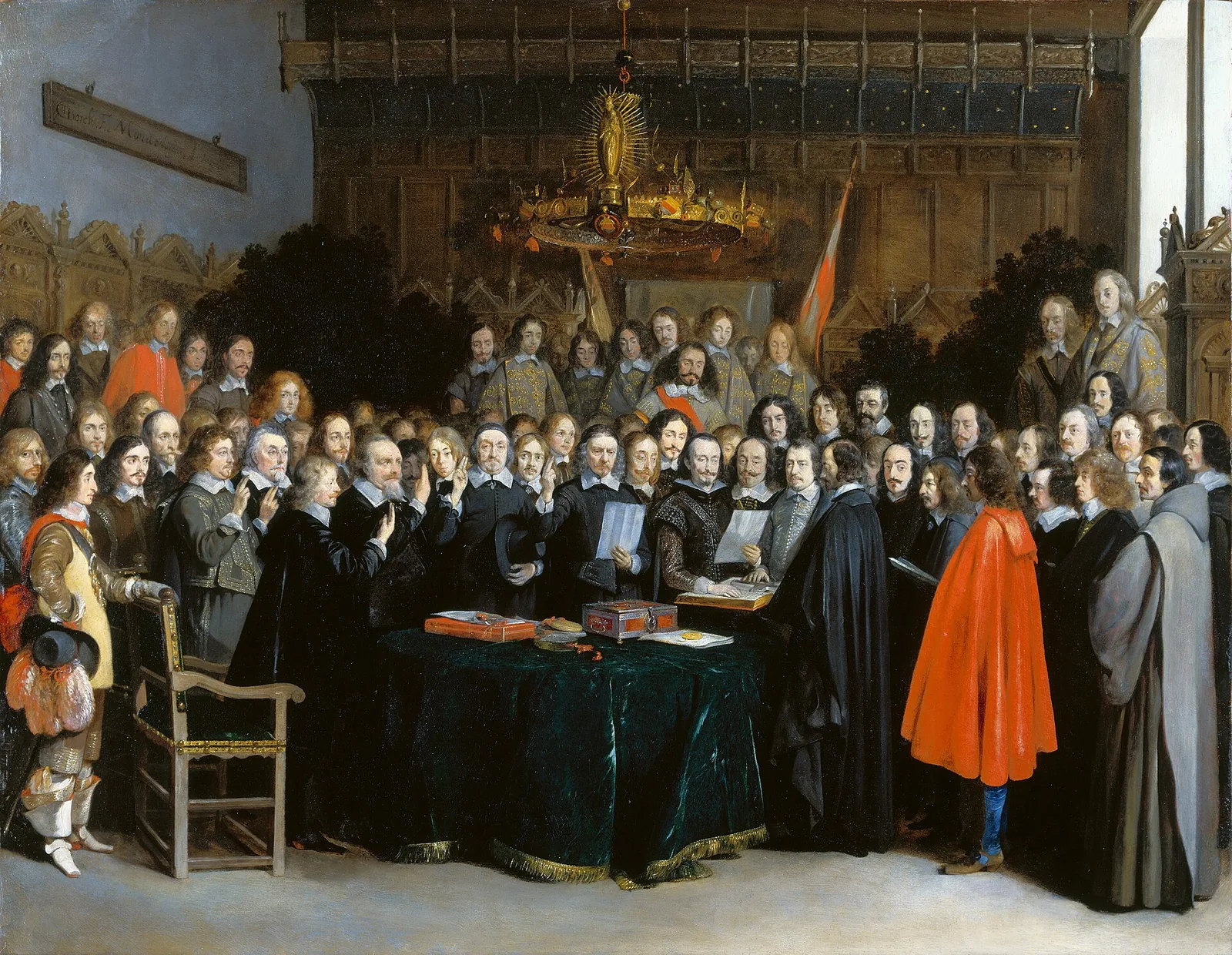
Gerard ter Borch, The Ratification of the Treaty of Münster, 1648. National Gallery, London (via Wikimedia Commons) · Public domain · Source page
Gerard ter Borch, The Ratification of the Treaty of Münster, 1648 (National Gallery, London)
The painting shows the oath to the peace between Spain and the Dutch Republic, in Münster’s town hall on 15 May 1648. It is not the imperial treaty of October. Yet it is the picture most often used to illustrate “Westphalia”.
- Who is shown, and what are they doing? Spanish and Dutch envoys swear to a peace in the town hall, in formal dress at a formal ceremony. The emperor is not in the room.
- Why would an artist paint a peace between two states? A Dutch painter shows a Dutch success: a free republic confirmed by the king of Spain.
- What does the picture not show? The war: no soldiers, no plunder, no dead. Peace is shown as a ceremony, and that is how it was meant to be remembered.
Myth
The Peace of Westphalia invented modern state sovereignty and the system of states.
The truth
This is the “Westphalian myth”: textbooks present 1648 as the birth of the sovereign state and of a system of equal, non-interfering states. Andreas Osiander (2001) argued that this picture was built much later, by writers reading the treaties through a later idea of the state. The treaties never use “sovereignty” for the princes’ powers.
Derek Croxton (1999) argued that the treaties confirmed the empire’s old constitution, in which princes owed obedience to the emperor and the Diet. The new right to make alliances was limited by the emperor’s rights.
Real change did happen: the Dutch, the Swiss and the French gained independence or land. The question is whether 1648 made a new order or confirmed an old one.
The evidence
Andreas Osiander, “Sovereignty, International Relations, and the Westphalian Myth”, International Organization 55 (2001); Derek Croxton, article in International History Review 21 (1999).
After the empire
1648–1683
The empire did not disappear
The peace did not make the empire a modern state. It went on, with its Diet, courts and princes, for another 158 years. Inside it grew Brandenburg, which became Prussia, and the Habsburg lands of Austria, whose emperor Leopold I ruled from 1658 to 1705.
In 1683 an Ottoman army besieged Vienna. The city was saved on 12 September by a relief army led by the Polish king John III Sobieski, with German princes’ troops among them.
1756
Neither holy, nor Roman, nor an empire
In his Essay on the Customs and Spirit of the Nations (1756), the French writer Voltaire mocked the empire as neither holy, nor Roman, nor an empire. The jibe stuck.
1804–1806
The last emperor
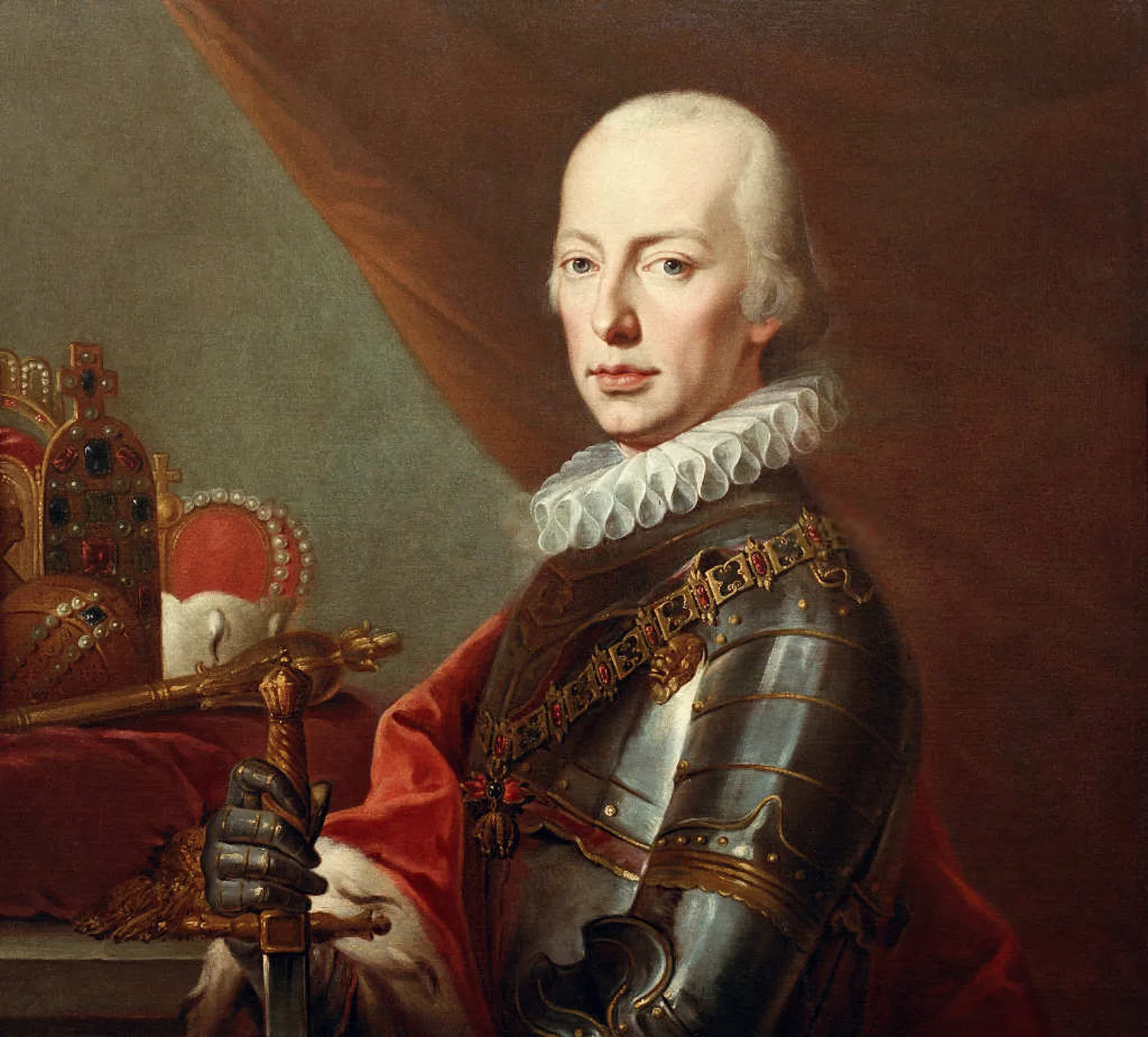
Joseph Kreutzinger, portrait of Francis II, 1805 (Wikimedia Commons) · Public domain · Source page
6 August 1806
Francis II, emperor since 1792, took the title Emperor of Austria in 1804, answering Napoleon’s imperial title. Napoleon beat Austria and Russia at Austerlitz in December 1805. In 1806 sixteen German states, led by Bavaria, left the empire for the Confederation of the Rhine.
On 22 July Napoleon gave Francis an ultimatum. Then the emperor gave way, and on 6 August 1806 he declared the bond that tied him to the states of the empire dissolved. The Holy Roman Empire had lasted about a thousand years, since Otto was crowned in Rome in 962.
A religious war, a struggle for power, or a turning point?
Was the war mainly a religious war, and was 1648 a turning point or a continuation?
- Peter H. Wilson, Europe’s Tragedy (2009) The war was a crisis in the empire’s constitution, which every European power used. Religion mattered to those who fought, but the war was not waged over religion.
- Andreas Osiander (2001); Derek Croxton (1999) 1648 is not the birth of modern sovereignty. The peace confirmed much of the old constitution, and the importance given to it was built later by writers who wanted a starting point.
What mattered more to the men who fought from 1618, and to those who signed in 1648: faith, or the question of who ruled whom?
Check yourself
What did the Peace of Augsburg (1555) decide?
Answer: Each prince chose Lutheranism or Catholicism for his lands, and Calvinism was left out. Right: “whose realm, his religion”. The Calvinists were not recognised.
Check yourself
What happened in Prague on 23 May 1618?
Answer: Protestant nobles threw two royal governors and their secretary from a window; all survived. Right: the Third defenestration of Prague; all three survived.
Check yourself
Why are the numbers at the battle of Breitenfeld (1631) disputed?
Answer: Because the sources give different strengths and losses, and each counts differently. Right: each figure is shown separately, with its source.
Check yourself
What do Osiander and Croxton argue about 1648?
Answer: That the treaties confirmed much of the old imperial constitution, and the idea of sovereignty was built later. Right: that is their central argument.
Check yourself
What was the normative year 1624 used for?
Answer: The baseline date for who kept church lands. Right: lands held on that date stayed with their holders.
Check yourself
Why did the Holy Roman Empire cease to exist in 1806?
Answer: Napoleon’s victories led many German states to leave, and Francis II gave up the crown. Right: on 6 August 1806 the emperor declared the bond dissolved.
Terms
- defenestration Throwing someone out of a window, from the Latin fenestra, window. Prague had three famous cases; the third, on 23 May 1618, started the Bohemian revolt.
- cuius regio, eius religio Latin for “whose realm, his religion”. Under the Peace of Augsburg (1555) each prince chose the official faith of his lands: Lutheranism or Catholicism.
- Calvinists Protestants who followed the teaching of John Calvin and other Swiss reformers; also called the Reformed churches. They were left out of the Peace of Augsburg and recognised only in 1648.
- Reichstag The imperial diet: the emperor with the princes, bishops and free cities, meeting to make laws and decide taxes for the Holy Roman Empire.
- Protestant Union A league of Protestant princes, founded in 1608 under Frederick IV of the Palatinate. It faced the Catholic League, founded in 1609.
- elector A prince with the right to choose the emperor. There were seven electors, and from 1623 eight.
- Winter King Nickname of Frederick V of the Palatinate, king of Bohemia for about one winter, 1619–1620. He was defeated at the White Mountain in November 1620.
- Edict of Restitution Ferdinand II’s edict of 6 March 1629, which ordered the return to the Catholic church of property taken by Protestants since 1552. It helped turn the princes against Wallenstein.
- tercio A Spanish infantry unit of about three thousand men, drawn up in a block of pikes and muskets. It was the core of Spanish power in Europe until Rocroi in 1643.
- contribution Money, food or goods that an army demanded from a district in return for not burning or looting it. It was the armies’ main means of supply in the war.
- sovereignty The idea that a state has supreme authority over its territory and no higher power above it. Historians argue that the 1648 treaties did not use the term for the princes’ powers.
- Bohemia A kingdom inside the Habsburg lands, with its own assembly of nobles and its own laws.
- Habsburgs The dynasty that ruled Austria and Bohemia and gave the empire many of its emperors.
- Letter of Majesty A document in which Emperor Rudolf II gave Bohemia's Protestants the right to worship freely and build churches.
- Ferdinand A Habsburg prince chosen as king of Bohemia in 1617. Bohemia's nobles later deposed him, and in August 1619 he was elected emperor.
- Thurn A Protestant count who led the nobles that threw the royal governors out of the window.
- Vilém Slavata One of two Catholic royal governors in Prague. He was thrown from the window in 1618 and survived.
- Maximilian of Bavaria Duke of Bavaria who led the Catholic League.
- Catholic League An alliance of Catholic princes, founded in 1609 under Maximilian of Bavaria.
- White Mountain A hill outside Prague where the Catholic army beat Frederick in 1620.
- Peace of Augsburg A peace signed in 1555 between Emperor Charles V and the Lutheran princes, letting each prince choose the religion of his lands.
- Holy Roman Empire A patchwork of hundreds of princes, bishops and free cities under one emperor.
- Ecclesiastical reservation A clause of the Peace of Augsburg: a Catholic bishop or abbot who turned Protestant had to give up his post, while his lands stayed Catholic.
- Gustavus Adolphus King of Sweden. He landed in Pomerania in 1630 to fight the emperor and was killed at Lützen in 1632.
- Christian IV King of Denmark. In 1625 he invaded northern Germany to defend the Protestants, and was beaten at Lutter.
- Albrecht von Wallenstein A Bohemian nobleman who raised an army at his own cost and rented it to the emperor. He was murdered in 1634.
- Tilly Commander of the Catholic League army. In 1626 he beat the Danes at Lutter, and in 1631 he took Magdeburg.
- Magdeburg A rich Protestant city on the Elbe. In 1631 it was taken, looted and burned.
- Lützen A town near Leipzig where Gustavus Adolphus was killed in battle in 1632.
- Axel Oxenstierna Sweden's chancellor. After Gustavus Adolphus died, he took charge of Swedish policy in Germany.
- Rocroi A town in northern France where the French beat the Spanish and broke the myth of the tercios.
- The Great Condé The name later given to the Duke of Enghien, who won at Rocroi.
- Grimmelshausen A musketeer who wrote a novel about the war he fought in. The hero is invented, but the war is the one he knew.
- Münster A town in Westphalia where envoys of the emperor and France met. In 1648 Spain and the Dutch made peace there.
- Pomerania A region on the Baltic coast of northern Germany. In the peace Sweden received its western part.
- Alsace A border region between France and Germany. In the 1648 peace France received it.
Sources
- Instrumentum Pacis Osnabrugensis (Treaty of Osnabrück), 14/24 October 1648, Articles V, VI, VIII and X, in German History in Documents and Images, “Peace Treaties of Westphalia”
- Hans Jakob Christoffel von Grimmelshausen, The Adventurous Simplicissimus (1668), Book I, ch. iv, trans. A. T. S. Goodrick (1912)
- Peter H. Wilson, Europe’s Tragedy: A History of the Thirty Years War (London: Allen Lane, 2009)
- Geoffrey Parker (ed.), The Thirty Years’ War (London: Routledge, 2nd ed., 1997)
- C. V. Wedgwood, The Thirty Years War (London: Jonathan Cape, 1938)
- Peter H. Wilson, The Holy Roman Empire 1495–1806 (Basingstoke: Macmillan, 1999)
- Günther Franz, Der Dreißigjährige Krieg und das deutsche Volk (Stuttgart, 1940)
- Andreas Osiander, “Sovereignty, International Relations, and the Westphalian Myth”, International Organization 55, no. 2 (2001): 251–287
- Derek Croxton, article in International History Review 21, no. 3 (1999)
Image credits
- Matthäus Merian, engraving for the Theatrum Europaeum (copy dated 1662), reproduced in Francis Lützow, The Story of Prague (1920) · Public domain · Source page
- Jacob Heinrich Elbfas, about 1630. Skokloster Castle, Sweden (image from lsh.se, via Wikimedia Commons) · Public domain · Source page
- Attributed to the workshop of Matthäus Merian, engraving for a news book about the war · Public domain · Source page
- Gerard ter Borch, The Ratification of the Treaty of Münster, 1648. National Gallery, London (via Wikimedia Commons) · Public domain · Source page
- Joseph Kreutzinger, portrait of Francis II, 1805 (Wikimedia Commons) · Public domain · Source page


