George Washington: commander, president and slave owner
On Christmas night 1776 his army waited on a frozen river bank, with one night to decide. What is true, what is legend, and what did Washington do about the people he enslaved?
Decisions, questions and your own progress, in the app
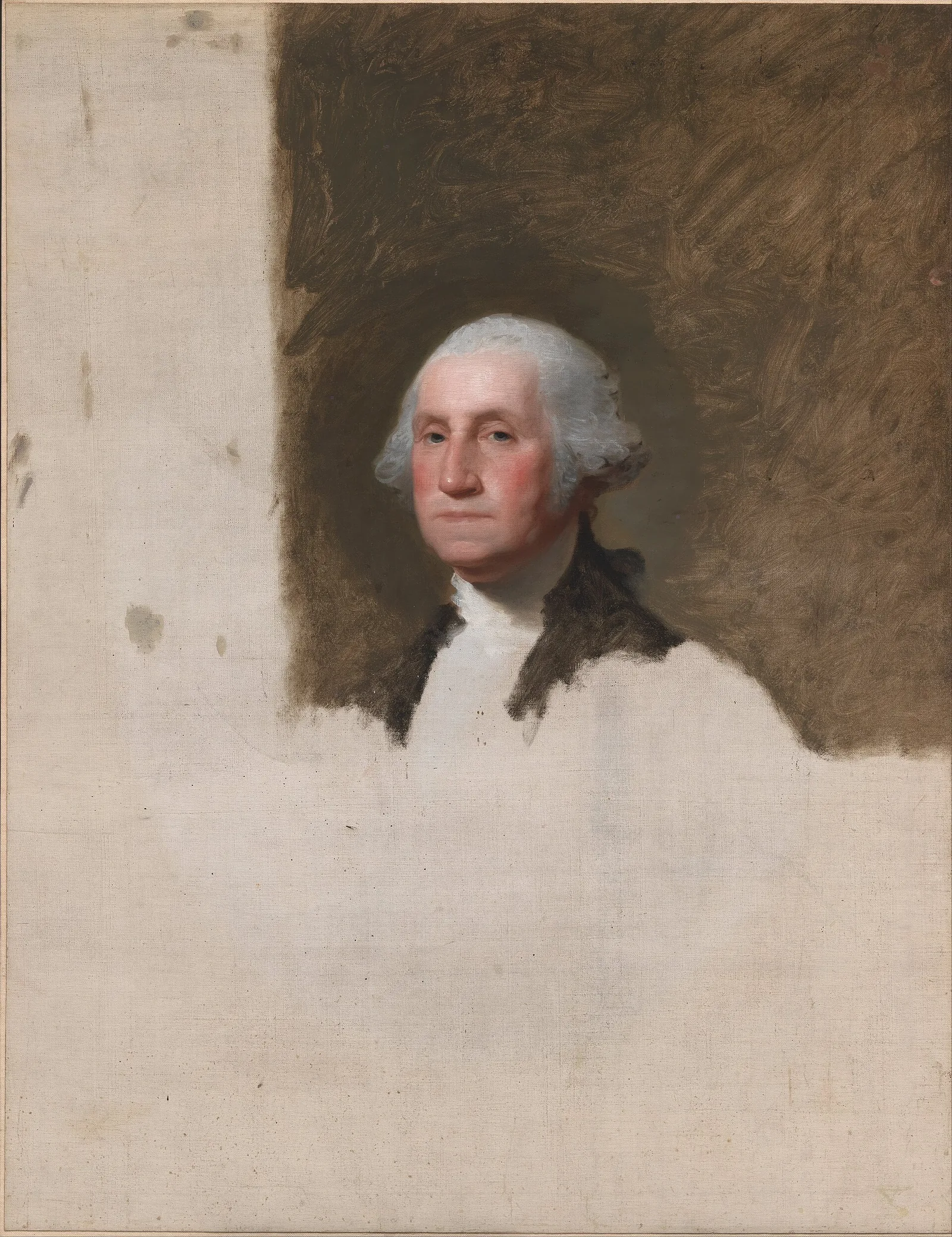
Gilbert Stuart, The Athenaeum Portrait (unfinished), 1796. Public domain · Public domain · Source page
Winter 1776
Christmas night, 1776
Christmas night, 1776. George Washington’s army stands on a frozen bank of the Delaware River, in Pennsylvania, and he must decide what to do.
The night will end within hours, but the argument about him has not ended. You will take the decision yourself, knowing only what he knew that night. Then you will meet the same man again, as president and as an owner of enslaved people, and judge for yourself.
Background
A war going badly
The war with Britain began in 1775. The Continental Army has been under Washington’s command since June of that year. In the autumn of 1776 the British took New York City, and the army retreated across New Jersey.
These men volunteered to serve, and many are tired and cold. The army shrinks from day to day, as men lose hope and walk home.
The clock
Terms running out
Many of the men had joined on an enlistment for a fixed term. Historians often say that for many of them the term ended at the end of December 1776. A soldier whose term ended could simply go home, and nothing held him in camp.
Across the river
Trenton
The Delaware separates New Jersey, where the enemy is, from Pennsylvania, where the army stands. In Trenton, New Jersey, a garrison of about 1,400 to 1,500 Hessians, depending on the source, sits waiting. They are German soldiers hired by Britain, and their commander is Colonel Johann Rall.
The night on the ice
A decision point
You are George Washington.
The Pennsylvania bank of the Delaware, 25 December 1776, in the evening
Your army is about 2,400 men. Since the autumn you have lost New York and retreated across New Jersey. Now you stand on the Pennsylvania bank, and the river is full of ice.
Across the water, in Trenton, a garrison of about 1,400 Hessians under Colonel Johann Rall is waiting. If you cross in the dark and attack at dawn, you may catch them unready. If the ice slows the boats, the attack fails, and your men are stranded on the wrong bank in the cold.
Historians often say that many of your men’s enlistments run out within days. A man who goes home will not come back at once, and without a small victory the army may come apart. You know that another defeat could decide the war.
What do you do?
- Cross the river that night and attack the garrison at dawn. Probably a surprise attack at dawn. If the ice holds up the boats, the attack fails, and the men lose both time and strength in the cold.
- Stay on the Pennsylvania bank and wait for better weather or reinforcements. Probably no victory this winter. Enlistments end, the army shrinks, and the British and Hessians keep control of New Jersey.
- Give up the attack, take the army into winter quarters and let the enlistments lapse. Probably the army melts away. The men go home, morale collapses, and there is little to show Congress at the end of the year.
What really happened
Cross the river that night and attack the garrison at dawn.
He crossed the river on the night of 25–26 December and attacked at dawn on the 26th. Colonel Rall was mortally wounded, and the garrison surrendered. About 900 Hessians were captured, including the wounded; estimates range from 890 to 920. By the usual accounts, American losses were very light: a few men died of exposure and a handful were wounded.
It was a small battle by the standards of the war. But it gave the army a reason to stay together.
He needed a victory if the men were to stay. The army was shrinking, and terms of service were about to end. The historian David Hackett Fischer, in Washington’s Crossing (2004), studies the crossing in fine detail, including the claim that the men would have stood in the boats to keep the icy water out.
Historians still argue about how bold the plan was.
Afterwards
The real boats
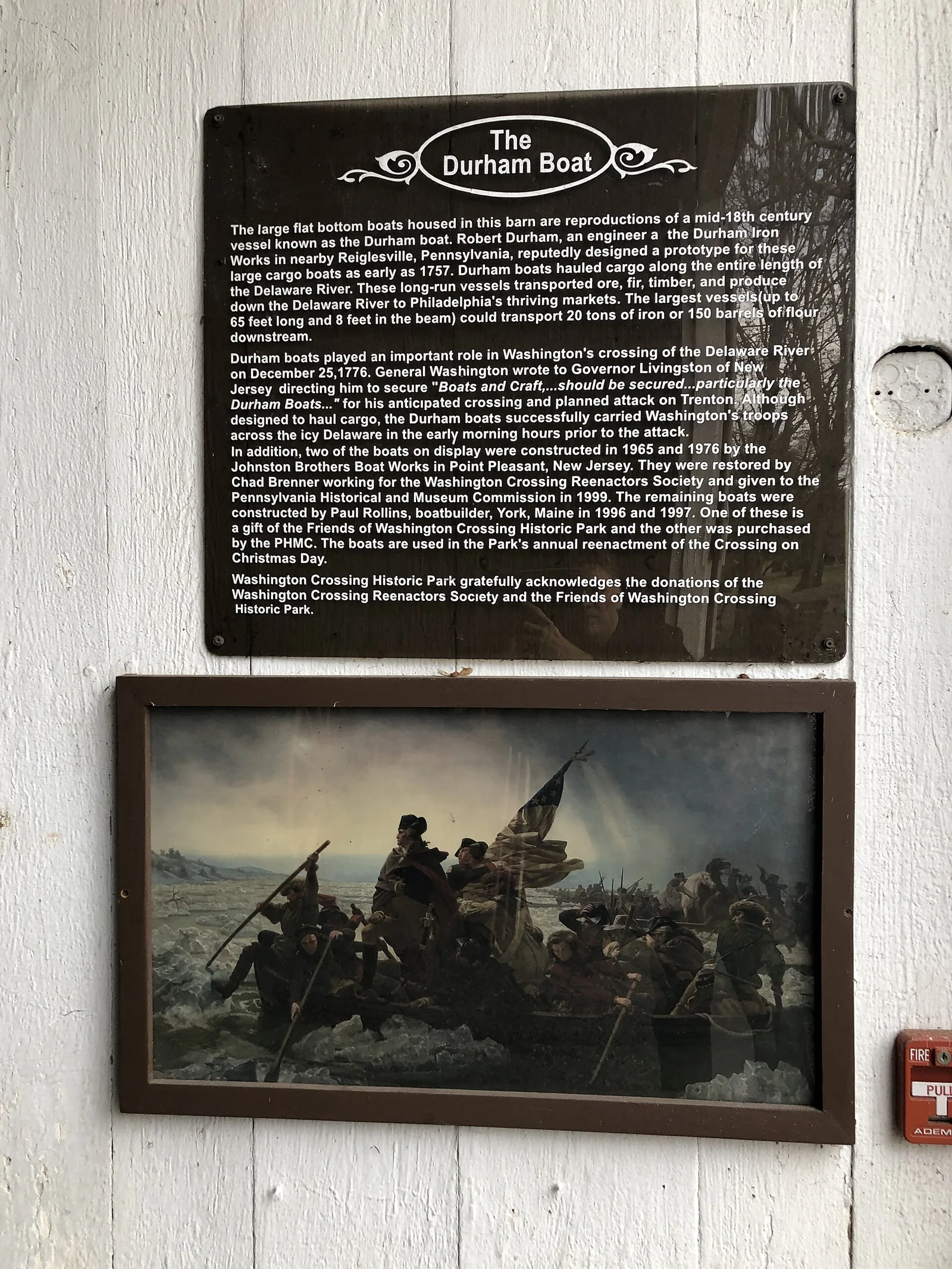
Sign ‘The Durham Boat’ and replica of the painting, Durham Boat Barn, Washington Crossing Historic Park. Photo: Famartin, 2023 · CC BY-SA 4.0 · Source page
Leutze’s painting shows a small rowing boat. The real crossing used larger, flat-bottomed boats called Durham boats. The photograph shows a sign about them, beside a replica of the painting at Washington Crossing Historic Park in Pennsylvania.
Source: Leutze’s painting, 1851
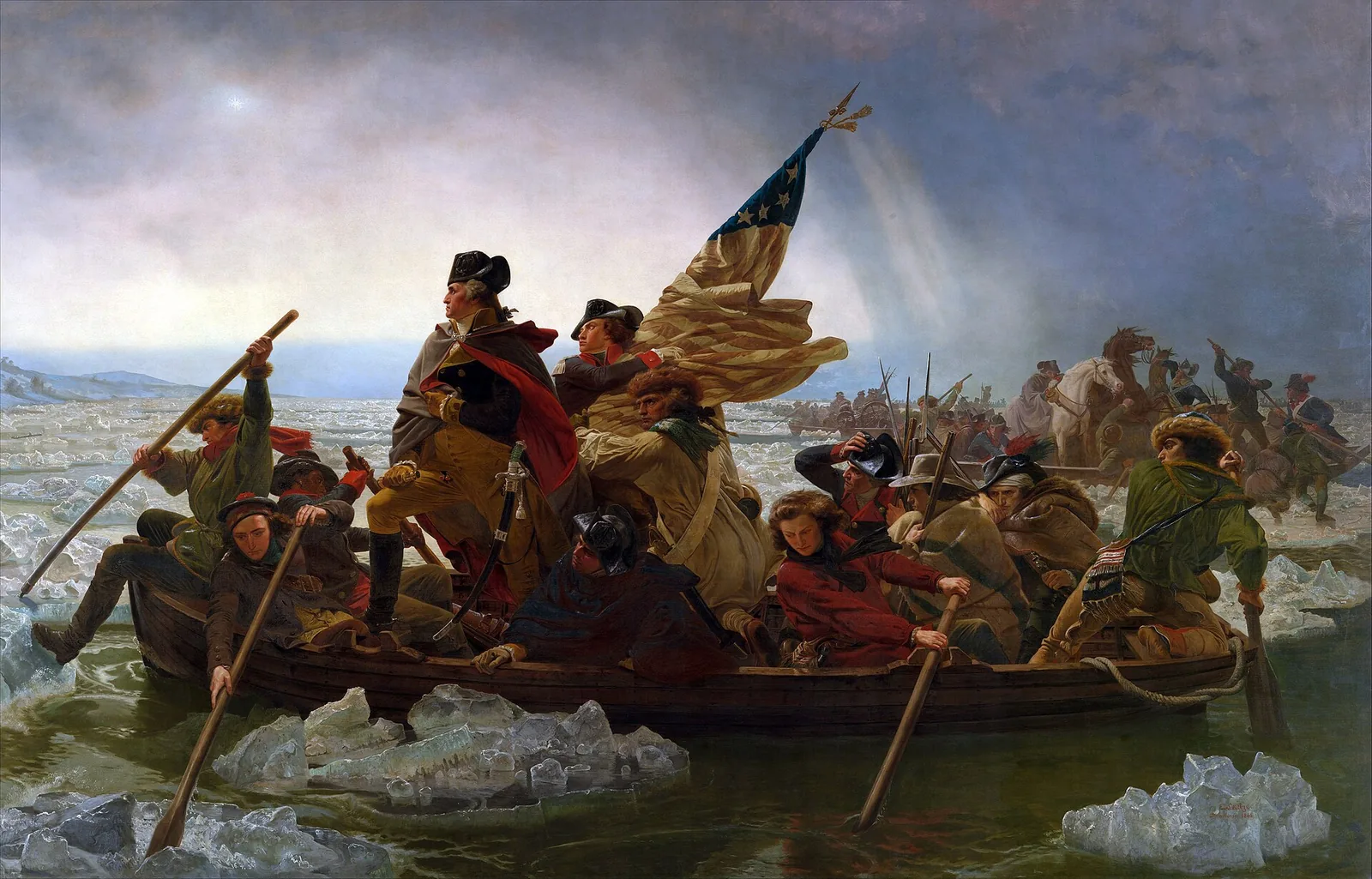
Emanuel Leutze, Washington Crossing the Delaware, 1851. Metropolitan Museum of Art, New York. Public domain · Public domain · Source page
Emanuel Leutze, Washington Crossing the Delaware, oil on canvas, 1851. Metropolitan Museum of Art, New York
Leutze painted it in Düsseldorf, Germany, in 1850–51, about seventy-five years after the crossing. He was not there. The first version, of 1850, was destroyed in a 1942 raid on Bremen. The version shown here is from 1851.
- Who painted the picture, where and when? Emanuel Leutze, in Düsseldorf, Germany, in 1850–51: about seventy-five years after the crossing, by a painter who was not there.
- What in the picture is wrong? The flag was fixed in June 1777 and first flown in September 1777, after the crossing. The boats are larger than the painted one. The river, the ice and the weather are shown wrongly, and Washington looks older than he was: about 44 at the time.
- Who is the picture for, and what does it want you to believe? A viewer who wants a hero standing firm in danger. The picture is meant to tell a story about courage, not to record a night. It is history painting, not an eyewitness account.
The army that must not fall ill
Winter camp
Morristown, January 1777
The army is camped for the winter at Morristown, New Jersey. Smallpox is spreading through the ranks.
The disease
Men inoculating themselves
Smallpox was among the deadliest diseases of the age. Those who survived it were immune, and that made a risky defence possible: variolation, a deliberate infection. Some soldiers were already inoculating themselves, in secret and without orders.
A decision point
You are George Washington.
Winter camp at Morristown, January 1777
Smallpox is spreading through the camp. A soldier who is sick cannot march, stand guard or fire his musket. Historians’ estimates put the death rate from variolation at about 5 to 10 in every hundred of those inoculated.
You can order the whole army inoculated. That means weeks of illness, and the operation must be kept secret, even from the British. Or you can wait, and the disease keeps moving between the tents.
What do you order?
- Order the whole army inoculated, in secret, and isolate the sick. Probably the disease is stopped within weeks. There will be serious illness and some deaths, but the army is protected for the coming campaign. The secret will be hard to keep.
- Ban self-inoculation and rely on isolation alone. Probably the disease keeps spreading through the camp. Isolation alone is slow, and people in the early stage can infect others without knowing it.
- Inoculate only some regiments and leave the rest until spring. Probably part of the army stays vulnerable into spring, and the campaign opens with an army that is half protected.
What really happened
Order the whole army inoculated, in secret, and isolate the sick.
On 6 January 1777 the order to inoculate was given. About three weeks later it was reversed, and it was reinstated on 5 February. The campaign was kept secret, including from the British.
In a February letter to John Hancock, president of Congress, Washington wrote that the disease had made “such Head in every Quarter” that it was impossible to keep it “from spreading thro’ the whole Army.”
He had watched the disease spread, and a sick army cannot take the field. The historian Elizabeth Fenn, in Pox Americana (2001), argues that this was the first large-scale immunization of an army carried out by a state. Encyclopedia Virginia reports her view.
That explains the choice, but it does not settle whether the risk was worth it.
A letter about a king
Background
Newburgh, spring 1782
In 1782 the army was camped at Newburgh, in New York State. The men had gone a long time without pay, and money from Congress was slow to come.
In March 1782 anonymous writings known as the Newburgh Addresses appeared, addressed to the officers and voicing their anger.
A letter
Lewis Nicola writes
Lewis Nicola, an army officer, wrote to Washington in May 1782. He described the army’s frustration, and he shared an idea he had kept to himself until then: a new state in the west, which might be ruled by a king.
Source: Nicola’s letter, May 1782
“if all other things were once adjusted I believe strong argument might be produced for admitting the title of king, which I conceive would be attended with some material advantages.”
Nicola writes about the army’s grievances and about a separate western state. He suggests that the title of king might be admitted there, and the letter hints that Washington might be the one to take it. He never offers a crown, and he has no power to give one.
- Who wrote the letter, and what did he want? Nicola, an officer who spoke for himself. He wanted the pay problem solved and proposed a new western state. The historian Robert Haggard (2002) concludes that he spoke only for himself.
- Does the letter offer Washington a crown? No. It is an idea about a king for a separate state, not a crown offered to a man. Nicola could not have offered one.
- Why would a letter like this be dangerous in 1782? Some Americans feared monarchy, and they had fought a king. Any hint that a monarchy might return could split the army and the country.
The answer
Washington replies
Washington answered Nicola at once. He wrote that no incident in the whole war had given him such painful feelings as hearing that ideas like these were circulating in the army.
Myth
Washington turned down a crown that was offered to him.
The truth
No crown was offered. Nicola floated a king for a separate western state and hinted that Washington might take the title. He had no crown to give, and Washington rejected the idea at once.
The evidence
Nicola’s letter contains no direct offer. Robert Haggard (2002) concludes that Nicola spoke for himself and never offered a crown. Grover Furr (2007, revised 2019) finds no evidence that such an offer was ever made. The March 1782 Newburgh Addresses contain no offer to Washington either.
Newburgh, March 1783
Pay that never came
The officers wait
By early 1783 the officers had been waiting a long time for their pay. Congress could not pay them, and the pensions promised to them had no money behind them.
An anonymous letter
10 March 1783
On 10 March 1783 an anonymous letter appeared in the Newburgh camp, in New York State. It urged the officers to press Congress with an ultimatum. Later the letter was attributed to Major John Armstrong Jr., an aide to General Gates. It started what became known as the Newburgh affair.
The meeting
A meeting is called
The officers called a meeting for 11 March. You have not been asked to lead it. You may come, or you may stay apart.
A decision point
You are George Washington.
Newburgh camp, New York, 11 March 1783
An anonymous letter is passing among the officers. It urges them to demand that Congress pay, and to threaten it if it does not. They have already called a meeting, and you have not yet decided whether to attend.
These officers are not fighting only for money. They have served for years, and the pay promised to them has no clear remedy. You understand their frustration, and you know this letter could be dangerous for the army and for Congress alike.
If you stay away, the meeting decides without you. If you come, everyone will see how you respond.
What do you do?
- Let the meeting go ahead without you and wait for its resolutions. Probably the officers decide among themselves, with no one to steady them, and the ultimatum reaches Congress in a sharper form. The risk of mutiny grows.
- Go to the meeting, condemn the anonymous letter, and ask the officers for patience and trust in Congress. Probably the officers hear you out. The pay problem remains, and the mood cools, but everything depends on whether they trust you.
- Side with the officers and press Congress directly with the ultimatum yourself. Probably Congress feels threatened, and the army looks as if it is in revolt. The chance of a split between army and government rises sharply.
What really happened
Go to the meeting, condemn the anonymous letter, and ask the officers for patience and trust in Congress.
He came. He condemned the anonymous letter and moved the meeting from 11 to 15 March. On 15 March, at New Windsor, he spoke to the officers. He took out a pair of new reading glasses, which few of the men had seen him wear, and said that he had grown grey and almost blind in his country’s service.
The army did not march on Congress. Congress agreed to give the officers five years’ full pay.
The officers’ grievances were real: they had gone a long time without pay, and that was no small matter. Washington understood that an ultimatum could break either the army or the government. He chose to speak to the officers himself, rather than let the letter speak for them.
Who was owned, and who would be free
Mount Vernon, 1799
317 people
When Washington died in 1799, Mount Vernon held 317 enslaved people. Of these, he owned 123 or 124 outright, and he rented about 40 from others. The rest, about 153, were dower slaves: they belonged to the estate of Martha’s first husband, and were due to pass to the Custis grandchildren. The figures differ a little between sources.
Source: Washington’s will, 1799
“Upon the decease of my wife, it is my will and desire, that all the slaves which I hold in my own right shall receive their freedom.”
“it not being in my power under the tenure by which the dower Negroes are held to manumit them.”
“I do hereby expressly forbid the sale or transportation out of the said Commonwealth of any slave I may die possessed of, under any pretense, whatsoever”
Washington dated the will 9 July 1799, about five months before he died. He freed the people he owned outright, but only after Martha Washington died. The will explains why he could not free the dower slaves: it was not in his power under the tenure by which they were held. The word “Negroes” is the will’s own, the common term of its day. We quote it to show the document’s language, not to adopt it.
- Who was to be free under the will, and when? Only the people Washington owned outright, and only after Martha’s death, not at once.
- Why could he not free the dower slaves? By the will’s own account, the terms on which they were held did not allow it. They belonged to Martha’s first husband’s estate and were due to pass to the Custis grandchildren.
- What does the will leave out? What the people themselves thought. The will divides people among heirs and treats slavery as property to be shared out. Not one voice from the enslaved people is heard in it.
Ona Judge, 1796
Escape from the President’s House
In 1796 a young woman named Ona Judge, enslaved by the Washingtons, was living and working in the President’s House in Philadelphia. On 21 May 1796 she slipped away. On 24 May a runaway advertisement appeared in the Philadelphia Gazette, calling for her return.
What followed
The chase and the refusal
The Washington household went after her. She reached Portsmouth, New Hampshire, and stayed free for the rest of her life. Her own account, given to interviewers in the 1840s, is one of the main sources for what happened next. It records that she was offered a return on condition that she would be freed when Martha died. She refused. Ona Judge died in 1848 in Greenland, New Hampshire.
Martha
A separate freedom
In 1801 Martha Washington freed the people she owned. It was a separate act from her husband’s will.
Did the will go far enough?
Washington’s will freed people, but only after Martha’s death, and not the dower slaves. Was it a brave act, a limited one, or both?
- Mount Vernon, the estate According to the estate, Washington was one of the few slaveholding founders who freed the people he owned. That claim matters. Critics ask what the will delays, and what it leaves untouched.
- Critics of the will Critics stress the delay until Martha’s death, the dower slaves the will could not free, and Martha’s own freeing of the people she owned in 1801.
What would you need to know to judge? What counts as a real change, and what stays on paper?
The farewell, 1796
Philadelphia, 1796
A second term drawing to a close
It is summer 1796. Your second term ends in March 1797, and you are 64. Parties have formed in Congress, and the quarrels between them are bitter.
No president has yet served a third term, and the Constitution sets no limit on how many terms a president may serve.
A decision point
You are President George Washington.
Philadelphia, summer 1796
Friends beg you to stay. Others say that no one else can hold the country together. The parties are tense, and their quarrels are getting worse.
You can run again and keep order. You can leave at once. Or you can leave after saying something public to the country.
What do you do?
- Run for a third term. Probably you win again, but the country grows used to a president who does not leave. The fight over the succession becomes harder.
- Decline, and publish a farewell address that warns the country against party spirit and foreign influence. Probably you are remembered as a president who left with dignity and gave advice to later generations. How far the message shaped politics is open to debate.
- Decline quietly, without a public statement, and back a successor. Probably the two-term habit still forms, but the country gets no public statement of its values. Your successor faces a divided party alone.
What really happened
Decline, and publish a farewell address that warns the country against party spirit and foreign influence.
He declined. His Farewell Address was published on 19 September 1796 in Claypoole’s American Daily Advertiser, in Philadelphia, about ten weeks before the electors voted. It was printed, not spoken.
He was 64, and his second term had been bruising. The address itself gives the reasons it offers: a determination to retire and a warning against the spirit of party. Historians point to his age and to the quarrels of his second term.
Whether the address helped set a two-term custom is an interpretation, not a settled fact.
Source: The Farewell Address, 1796
“you will not disapprove my determination to retire.”
“Observe good faith and justice towards all nations; cultivate peace and harmony with all. Religion and morality enjoin this conduct;”
“warn you in the most solemn manner against the baneful effects of the spirit of party generally.”
The address was printed in a newspaper, not delivered from a platform. James Madison drafted a version in June 1792. In 1796 Washington revised the draft with help from Alexander Hamilton, and historians disagree about how much of the final text is Hamilton’s.
- Who wrote the text, when, and for whom? Washington’s name is on it, but Madison wrote the first draft in 1792, and Hamilton helped revise it in 1796. It was printed in a newspaper, so it addressed readers rather than a listening crowd.
- What is the text trying to achieve? To announce that he is leaving, and to shape how Americans would argue about parties and foreign influence in the years ahead.
- Who is counted in the word ‘people’ in this text? The address speaks of the nation and its future. That same year Ona Judge had escaped from the President’s House itself. Ask who was counted in the word ‘people’ in this text.
George Washington
A Virginia planter who led the Continental Army and became the first president of the United States.
- Born: 22 February 1732
- Died: 14 December 1799
- Won: Commander of the army from June 1775
- Lost: New York City, 1776
“warn you in the most solemn manner against the baneful effects of the spirit of party generally.”
Myth
As a boy, Washington cut down a cherry tree and confessed, because he could not tell a lie.
The truth
The story is not true, and historians treat it as a myth. It comes from a popular life of Washington by Mason Weems.
The evidence
Mount Vernon’s digital encyclopedia treats the story as a myth. In the popular retelling the boy says that he cannot tell a lie.
Myth
Washington had wooden teeth.
The truth
No. His dentures contained no wood. They were made of brass, gold, lead, ivory (including hippopotamus ivory) and human teeth.
The evidence
Accounts of his dentures report that some of the human teeth in them were bought from enslaved people. Some of his sets did contain human teeth.
What came after
- March 1797 John Adams takes office as the second president.
- 9 July 1799 Washington’s will is dated. It frees the people he owned outright, after Martha’s death.
- 14 December 1799 Washington dies.
- 1801 Martha Washington frees the people she owned.
- 25 February 1848 Ona Judge dies, free, in Greenland, New Hampshire.
- 1850–51 Leutze paints the first version in Düsseldorf (1850) and the version now in New York (1851).
- 1942 The 1850 original is destroyed in a raid on Bremen.
Check yourself
On what date did the attack on the Hessian garrison at Trenton take place?
Answer: 26 December 1776. Correct. The attack came on the morning of 26 December 1776, after the crossing that night.
Check yourself
On what date did Ona Judge leave the President’s House in Philadelphia?
Answer: 21 May 1796. Correct. She escaped on 21 May 1796.
Check yourself
In which newspaper was Washington’s Farewell Address published in 1796?
Answer: Claypoole’s American Daily Advertiser. Correct. It was published on 19 September 1796 in Claypoole’s paper.
Check yourself
According to the will, when were the people Washington owned outright to be freed?
Answer: After Martha Washington’s death. Correct. The will says freedom comes after his wife’s death.
Check yourself
Where and when did Washington speak to the officers in the Newburgh affair?
Answer: New Windsor, 15 March 1783. Correct. He spoke at New Windsor on 15 March 1783.
Check yourself
On what date did Washington’s service as commander of the army end?
Answer: 23 December 1783. Correct. His service ended on 23 December 1783.
Terms
- Continental Army The army raised by the Continental Congress to fight Britain in 1775. Washington commanded it.
- Hessians German soldiers hired by Britain to fight in America. The garrison at Trenton was made up of them.
- enlistment An agreed term of military service. When it ended, the soldier could go home.
- variolation Deliberate infection with smallpox to produce immunity. It was risky: it caused real illness, and sometimes death.
- dower slaves Enslaved people who belonged to a dead husband’s estate. His widow had use of them for life, and they then passed to his heirs.
- Newburgh affair The crisis of March 1783 at the Newburgh camp, when officers angry over unpaid wages were urged by an anonymous letter to threaten Congress.
- Farewell Address Washington’s published announcement of his retirement, 19 September 1796. It warned against party spirit and foreign influence.
- electors The people each state chooses to vote formally for president. In 1796 they chose John Adams.
- Delaware River A river between New Jersey and Pennsylvania. Washington crossed it on Christmas night 1776.
- Trenton A town in New Jersey where a garrison of German soldiers lay. Washington attacked it on 26 December 1776.
- Johann Rall A German colonel serving Britain who commanded the garrison at Trenton. He was mortally wounded in the battle.
- Morristown A town in New Jersey where the army camped for the winter. Smallpox spread among the troops there.
- Newburgh Addresses Anonymous writings that appeared in March 1782 at the Newburgh camp, voicing the officers' anger over unpaid wages.
- Lewis Nicola An army officer who wrote to Washington in May 1782, proposing a separate western state that might have a king.
- Mount Vernon Washington's estate. In 1799 it held 317 enslaved people.
- Ona Judge An enslaved woman held by the Washingtons. In 1796 she escaped from the President's House in Philadelphia and stayed free.
- Philadelphia Gazette A newspaper in Philadelphia. On 24 May 1796 it printed an advertisement calling for Ona Judge's return.
- Portsmouth A town in New Hampshire. Ona Judge reached it and stayed free there.
- Custis The family of Martha Washington. The dower slaves were due to pass to her Custis grandchildren.
- Martha Washington George Washington's wife. In 1801 she freed the people she owned.
- Mason Weems A writer whose popular biography of Washington contains stories that historians treat as myths.
- James Madison An American politician. In June 1792 he drafted a version of Washington's Farewell Address.
- Alexander Hamilton An American politician who helped Washington revise the Farewell Address in 1796.
- The Constitution The constitution of the United States. It sets no limit on how many terms a president may serve.
- Congress The assembly of elected representatives of the young nation. In early 1783 it could not pay the officers.
- Ultimatum A firm demand backed by a threat: if it is not met, a harsh response follows.
- Smallpox A deadly disease of the age. Those who survived it became immune to it.
- John Hancock President of Congress. Washington wrote to him about the spread of smallpox in the army.
- Leutze A German painter. His famous picture of Washington crossing the Delaware was made about seventy-five years later, and he was not there.
- Durham boats Larger, flat-bottomed boats in which the army actually crossed the Delaware.
- Düsseldorf A city in Germany where Leutze painted the picture in 1850–51.
Sources
- George Washington, Last Will and Testament, 9 July 1799 (Wikisource transcription)
- Lewis Nicola to George Washington, May 1782; Grover Furr’s transcription of the Library of Congress manuscript
- George Washington, Farewell Address, 19 September 1796 (Avalon Project, Yale Law School)
- George Washington to John Hancock, February 1777, as quoted in Encyclopedia Virginia
- Encyclopedia Virginia, “How Washington Outflanked Smallpox”
- Elizabeth A. Fenn, Pox Americana: The Great Smallpox Epidemic of 1775–82 (New York: Hill and Wang, 2001)
- David Hackett Fischer, Washington’s Crossing (New York: Oxford University Press, 2004)
- Ron Chernow, Washington: A Life (New York: Penguin Press, 2010)
- Robert F. Haggard, “The Nicola Affair,” Proceedings of the American Philosophical Society 146, no. 2 (June 2002): 139–169
- Wikipedia, “George Washington’s teeth”
- Mount Vernon, “The Cherry Tree Myth” (digital encyclopedia)
Image credits
- Gilbert Stuart, The Athenaeum Portrait (unfinished), 1796. Public domain · Public domain · Source page
- Sign ‘The Durham Boat’ and replica of the painting, Durham Boat Barn, Washington Crossing Historic Park. Photo: Famartin, 2023 · CC BY-SA 4.0 · Source page
- Emanuel Leutze, Washington Crossing the Delaware, 1851. Metropolitan Museum of Art, New York. Public domain · Public domain · Source page


