Vlad the Impaler: the man behind the vampire
In 1462 the sultan who took Constantinople rode into Wallachia and, says one Greek historian, met a forest of impaled bodies. Who was the prince, and how much of the legend is true?
Decisions, questions and your own progress, in the app
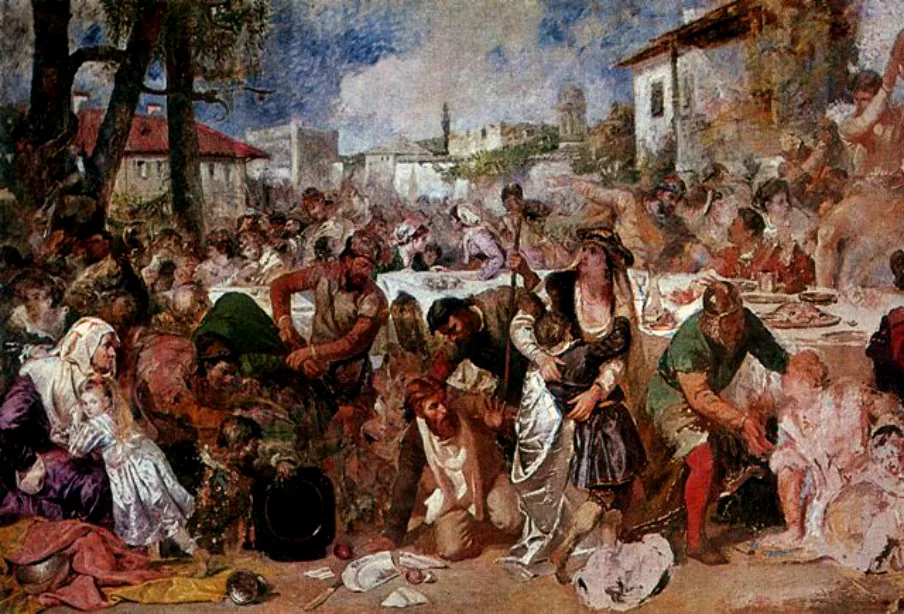
Theodor Aman, 'Boyars surprised at a feast by the envoys of Vlad Țepeș', 19th century. Museum not named on Commons. · Public domain · Source page
The Dragon's son
A forest of stakes
June 1462. A huge Ottoman army marches north into Wallachia. At its head is Sultan Mehmed II, who took Constantinople in 1453.
According to later accounts, near Târgoviște, the prince's capital, the soldiers find a forest of stakes, with people impaled on them. A Greek historian, writing a few years later and never there himself, speaks of about 20,000. The sultan is amazed, he says.
Who was this prince? And how much of the story is true?
Background
A land between two giants
Wallachia lies north of the lower Danube, between two giants. From 1417 its princes accepted Ottoman overlordship and paid the sultan tribute. The prince ruled from Târgoviște, but the boyars, the local nobles, and the neighbouring powers made and unmade princes. John Hunyadi, Hungary's great general, put one prince on the throne and pushed another off it. Between 1442 and 1456 there were about four or five rulers.
The name
What does the name mean?
Son of the dragon
In 1408 Sigismund, King of Hungary, founded the Order of the Dragon to fight the Ottomans. In 1431 Vlad II, father of Vlad III, joined it, and its dragon badge probably gave him the nickname Dracul, 'the dragon'.
His son bore the name Drăculea, 'son of Dracul'. In modern Romanian, drac means devil, and scholars argue whether 15th-century ears heard that too. So 'son of the devil' is not a settled fact.
1442
Two boys at the sultan's court
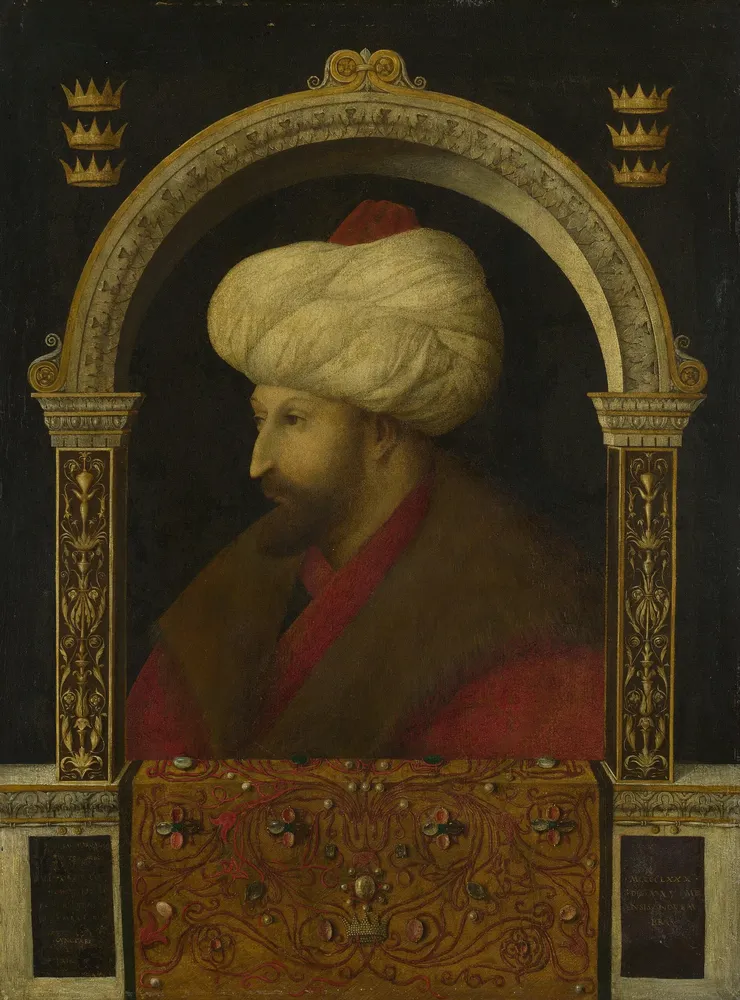
Gentile Bellini, Portrait of Mehmed II, 1480. National Gallery, London. · Public domain · Source page
Around 1442, after being forced to make peace with Sultan Murad II, Vlad II left his two younger sons, Vlad and Radu, at the Ottoman court as a guarantee of his loyalty. Where they were held is disputed, and some date the event to 1444.
Vlad was freed in 1448. Radu stayed and became a favourite at court. No source shows that Vlad and Mehmed, Murad's son and almost their age, were friends.
Vlad III (Vlad Țepeș, Dracula)
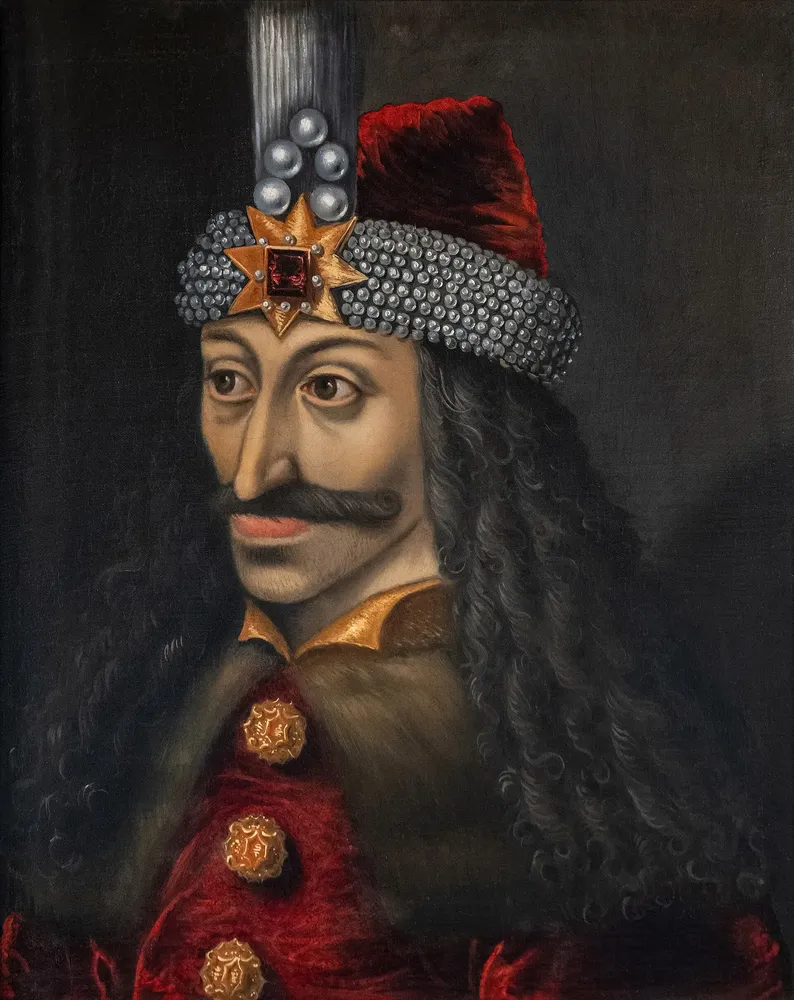
Portrait of Vlad III, 16th-century copy (about 1560) of a lost original. Ambras Castle collection, Innsbruck; Kunsthistorisches Museum, Vienna. · Public domain · Source page
A 15th-century prince of Wallachia who fought a sultan, was jailed by his own ally, and became a legend.
- Born: c. 1428–1431, Probably Sighișoara, Transylvania
- Died: December 1476 or January 1477, Near Snagov, north of Bucharest, Accounts differ: in battle, killed by mistake by his own men, or by an assassin
- Won: The crown, 1456; The raid across the Danube, winter 1461–62
- Lost: The crown, 1462; His freedom, 1462 to about 1474
The crown and the nobles
1447–1456
Blood first, then the crown
In late 1447 Hunyadi, Hungary's great general, invades Wallachia and puts Vladislav II on the throne. Vlad's father is killed in the marshes, and so is his brother Mircea. Vlad, still a teenager, is a hostage of the Ottomans.
In 1448 he returns at the head of an Ottoman army and holds the throne for a few weeks, then spends years in exile. Hunyadi dies on 11 August 1456, and that summer Vlad invades Wallachia. Vladislav II dies during the invasion; the sources disagree on how.
A decision point
You are Vlad, prince of Wallachia.
Autumn 1456, new on the throne.
The great lords come to show loyalty. You blame some of them for the killings of 1447.
The old council still holds the offices, and its men have made and broken princes.
What do you do?
- Forgive them all and rule with the men already in the council. Probably the court calms for a while. But the men tied to the killings keep their seats and their grudge, and they are still there when you are weak.
- Buy their loyalty with land and offices. Probably this works for a while, since greedy lords want land. But land you give away is land you no longer control, and a lord bought once can be bought again by your rivals.
- Break the old council's power: remove from office the men tied to the 1447 killings and anyone you suspect, and rule with a new circle. Probably within months most of the old council is gone, and the court is yours. But the families you remove have every reason to hate you, and a long memory.
What really happened
Break the old council's power: remove from office the men tied to the 1447 killings and anyone you suspect, and rule with a new circle.
Vlad chose the third. According to historian Kurt Treptow, he executed men tied to the 1447 killings and suspected plotters, and only two old councillors kept their posts from 1457 to 1461. The number of dead is hearsay: a Greek writer who was not there speaks of hundreds or thousands.
Historians tie the move to the murder of his family and to fear of plots. The biggest numbers come from writers far away.
The Saxons
Towns with long memories
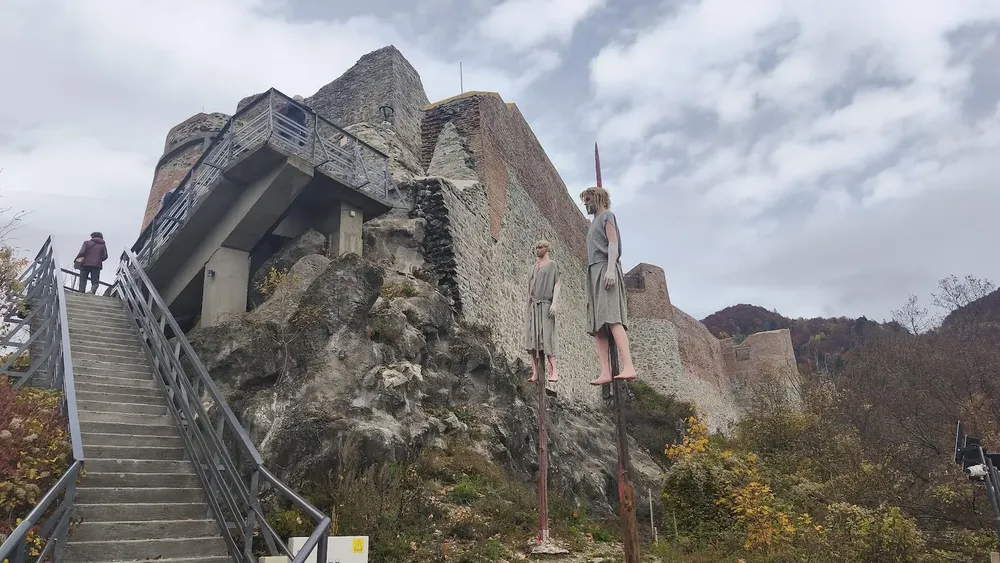
Photo: V.A. Zerva, 2025. Poenari Castle, Romania. · CC0 · Source page
Brașov and Sibiu are the Saxon towns of Transylvania. In December 1456 the rival claimant Dan III settles outside Brașov. Vlad executes him before April 1460 and, the sources say, burns Brașov's suburbs and impales captives.
Tradition says nobles were forced to build Poenari castle. No 15th-century text says so. Remember these towns: some historians suspect they helped shape the stories told about him.
War on the Sultan
1461
Tribute, and a summons
According to some sources, Vlad stopped paying tribute to Sultan Mehmed II. In 1461, back from conquering Trebizond, the sultan demands it. The sources say he also wants Vlad to come to him in person. How much money? No source we can check gives a figure.
A decision point
You are Vlad III, prince of Wallachia.
Winter 1461–62
The sultan wants the tribute and, in some sources, wants you to come to him in person. A Greek named Thomas Katabolenos brings the message. You know the sultan's court from your youth, and his strength is far greater than yours. King Matthias Corvinus of Hungary may help you, or may not.
What do you do?
- Pay, and go to the sultan yourself You would probably keep the throne as a prince under the sultan, at least for a while. But you would enter his court as a man who has given in, and the boyars at home would see weakness.
- Stall: gifts, excuses, an appeal to Hungary You would probably buy time, but gifts and excuses will not satisfy the sultan for long. Help from Buda would come slowly, if at all.
- Refuse, and strike first: cross the frozen Danube and raid Ottoman lands You would probably take prisoners and loot, and win back fortresses on the Danube. But it is a declaration of war, and the sultan will answer with a large force.
What really happened
Refuse, and strike first: cross the frozen Danube and raid Ottoman lands
Vlad chose the third. In the winter of 1461–62 he crossed the frozen Danube and raided Ottoman and Bulgarian lands. At Giurgiu, Hamza Bey, governor of Nicopolis, and Katabolenos were captured, and both were executed by impalement. The sources disagree on the details of the trap.
Historians note that he turned against the Ottomans while the sultan was far away at Trebizond. No source gives his reasons in his own words.
Source: A letter from Giurgiu
Vlad counts the Turks and Bulgarians killed in the raid: 23,884 in one copy, plus an unknown number burned in their houses. The count seems to rest on heads and on signs brought to his officers. The letter does not mention impalement.
- Who is it meant to impress? King Matthias, whose help Vlad needs.
- What is counted, and by whom? Vlad's officers, by heads and by signs.
- Can we check the total? Not really. The copies differ. Harai (2025) finds one copy's local figures add up to about 20,100.
1462
A great army
In early June 1462 the sultan's army crosses the Danube; the sources disagree on where. How big was it? The sources say 60,000 to 300,000; modern estimates say 25,000 to 39,000. Vlad avoids a big battle, burns the land along the army's path, and leaves about 6,000 men to slow it. Historians say they were beaten.
Popular versions add poisoned wells and plague victims. No source from the time mentions them.
A decision point
You are Vlad III, far outnumbered.
June 1462, near Târgoviște
The sultan's army is camped near Târgoviște, your capital. Your men have harassed it. A pitched battle is a gamble.
What do you do?
- Shut yourself in a fortified town You would probably save your lives and the town, but leave the land around it to plunder. Help from Buda would not come quickly.
- Keep avoiding battle: harass, burn, let hunger work The army would probably run short of food, but so would you. It works only if the sultan's army weakens before yours does.
- Attack the camp at night, aiming for the sultan's tent You would probably cause chaos and damage, but the great army would hold. If you reach the sultan's tent, the war could end within the hour. If not, you would lose most of your men.
What really happened
Attack the camp at night, aiming for the sultan's tent
Vlad chose the third, after harassing the army and burning the land. On the night of 16–17 June 1462 (the sources disagree on the date) his horsemen burst into the camp near Târgoviște to kill the sultan, but hit the tents of the viziers Ishak and Mahmud Pasha instead. The raid numbered 7,000 to 10,000 horsemen. Losses are disputed: one Venetian report says 5,000 Wallachians and 15,000 Ottomans. The raid decided nothing, and the army left Târgoviște around 22 June.
No source gives his reasons in his own words. A reasonable guess: with so few men, a night raid was the most direct way to reach the sultan.
After the night
The sultan survives
Mehmed survived. By 11 July the army was back in Adrianople. The sultan left Vlad's brother Radu at Brăila to claim the throne, and by mid-August 1462 Radu was prince: according to a Hungarian source, local boyars backed him because they were tired of Vlad's excesses. Vlad left for Transylvania, hoping Matthias Corvinus would help him.
The sources give hunger, burned land, heat and a Hungarian threat as the reasons for the withdrawal. No source we have says the stakes turned the sultan back.
Who wrote the legend?
The witnesses
Three witnesses, none of them neutral
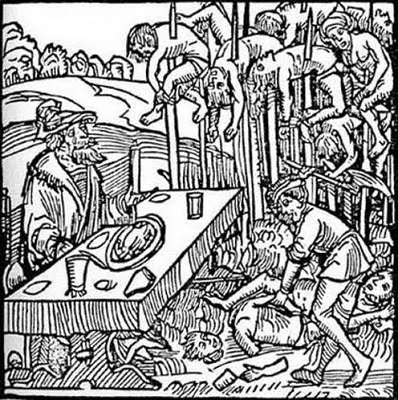
Woodcut from the title page of a German pamphlet, about 1499–1500 (Commons: Markus Ayrer, Nuremberg, 1499). Museum not named on Commons. · Public domain · Source page
Who told us the famous stories about Vlad? Three witnesses: German pamphlets, a Russian tale, and a Greek historian, Laonikos Chalkokondyles. All were written or printed far from Wallachia, years after the events.
The picture is a woodcut from a German pamphlet of about 1500: Vlad dines among the impaled. Who gained from such a story? The Saxon towns Vlad fought, or the Hungarian court that jailed him. And the numbers grow: Dan III, Vlad's rival, wrote in 1459 of 41 impaled merchants; according to Dénes Harai (2025), a German pamphlet says 600.
Game
Fact or legend?
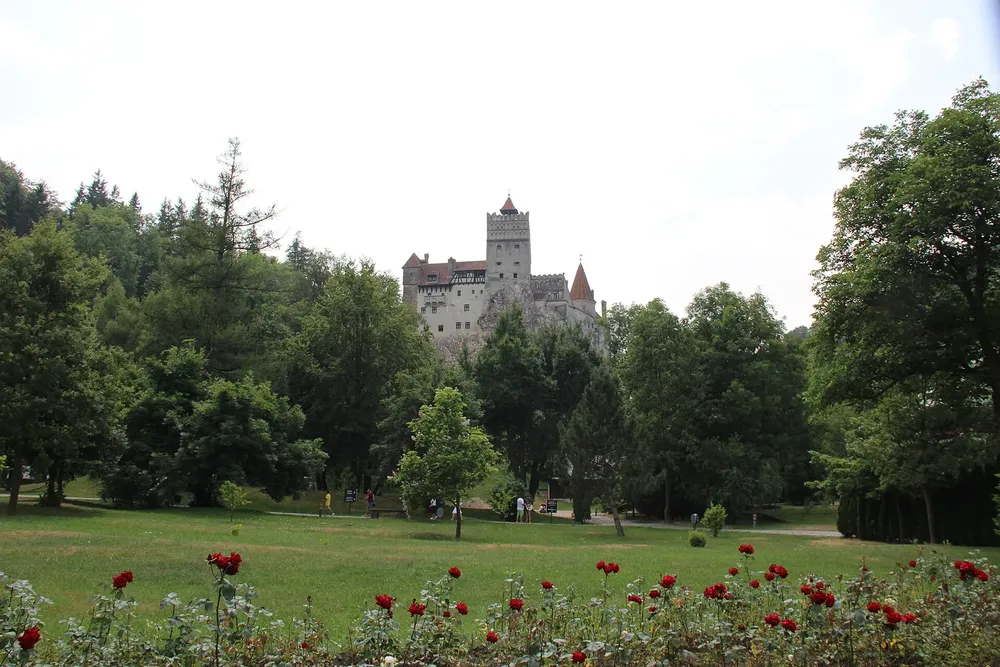
Photo: Gary Todd, 2016. Bran Castle, Romania. · CC0 · Source page
Tourist brochures call the castle in this photo, Bran, ‘Dracula’s castle’. Three claims come next. Fact or legend?
Check yourself
A golden cup stood by a well and no one dared steal it. Where does this story come from?
Answer: In the Russian Tale of Dracula, whose earliest surviving copy is from 1490. Right. It is a legend-type anecdote about punishing a thief. Scholars see a mix of fact and fiction.
Check yourself
Did the forest of the impaled make Mehmed II turn back?
Answer: No. The sources give other reasons: hunger, scorched land, heat and a Hungarian threat.. Right. Chalkokondyles says the sultan was amazed, but no primary text says he turned back because of the impaled. The reasons the sources give are practical.
Check yourself
Was Bran Castle ever Vlad’s castle?
Answer: No. In 1377 the Saxons of Brașov received the right to build it, and no document links it to Vlad.. Right. King Louis I of Hungary granted the right in 1377. Vlad passed through the Bran pass, but there is no proof he lived or was held there. The link to him comes from tourism.
Source: A footnote from 1820
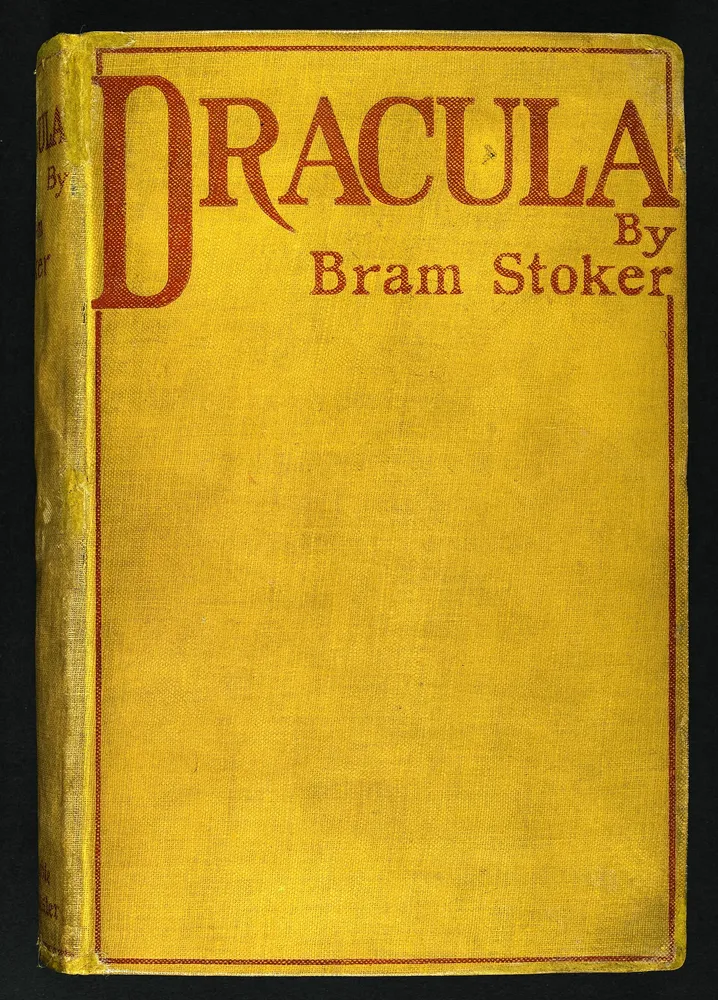
Bram Stoker, Dracula, first edition, 1897. Photo: British Library Board. · Public domain · Source page
“Dracula in the Wallachian language means Devil. The Wallachians were, at that time, as they are at present, used to give this as a surname to any person who rendered himself conspicuous either by courage, cruel actions, or cunning.”
The book mentions a Wallachian prince called "Dracula" in the 15th century, but never the name Vlad. Bram Stoker read it.
- Does it mention Vlad or vampires? No. It explains one word: Dracula.
- What is ‘Dracula’, per the footnote? ‘Devil’ in Wallachian, and a nickname for anyone who stood out. Not one prince’s name.
- So what did Stoker take? The name and the ‘devil’ note. Not the vampire or the prince. He never went to Transylvania.
Myth
In his own time Vlad was called a vampire.
The truth
No. Before Stoker’s 1897 novel, no source calls him a vampire. The name came from Wilkinson; the vampire came from elsewhere.
The evidence
One exception: a Romanian epic, written in the 1700s and published in 1875, has Vlad fight vampires among his foes. It does not call him one.
From prince to vampire
- 1488 The first dated German pamphlet about Dracula, printed in Nuremberg.
- 1490 The earliest surviving copy of the Russian Tale.
- 1820 Wilkinson’s footnote: ‘Dracula’ means ‘Devil’ in Wallachian.
- 1897 Bram Stoker publishes Dracula. He never visited Transylvania.
- 1922 The unauthorised film Nosferatu renames the count Orlok.
- 1931 Universal’s film Dracula, starring Bela Lugosi.
- 1972 McNally and Florescu’s book ties the novel to the real prince.
The end, and the verdict
1462-1475
Prisoner of the king
In late November 1462, King Matthias of Hungary has Vlad arrested. The pretext: letters dated 7 November, supposedly from Vlad to Sultan Mehmed II, offering him Transylvania. Some historians think they were forged to justify the arrest. Alexandru Simon (2020) says their origin is still open.
Matthias had received papal money for a crusade, yet he came east with few men. Historians suspect he needed a reason to jail a captain rather than fight beside him.
Vlad spends years in prison at Buda and Visegrád. Sources give 1473–74 or 1475 for his release.
1476
The return, and the end
In 1476 he fights on the Serbian and Bosnian frontier. At the end of the year he returns to Wallachia with Stephen the Great of Moldavia.
He dies near Snagov, north of Bucharest, in late December 1476 or early January 1477. The stories differ: killed fighting Ottoman and Wallachian enemies, killed by his own men by mistake, or killed by a disguised Turkish assassin. None is proven.
Some say his head went to Constantinople, but Matei Cazacu argues only the scalp and skin did. Tradition puts his grave at Snagov monastery, but Dinu Rosetti’s dig there in 1933 found no tomb under the stone attributed to Vlad, just many horse bones. Where he lies is unknown.
National hero, monster, or ruler of his time?
How should we judge Vlad?
- The Romanian national-hero tradition: 19th-century historians, and Mihai Eminescu’s poem Scrisoarea III (1881) Terror served justice and the state: it kept nobles and Ottomans in check. In the 1970s the state promoted him as a national hero, and 1976, the 500th anniversary of his death, was marked. In Eminescu’s poem, Țepeș is called on to come and seize the corrupt.
- The pamphlet tradition and the older popular picture: Radu Florescu and Raymond McNally, Dracula, Prince of Many Faces (1989) A cruel tyrant, as the pamphlets and the popular legend show him. Florescu and McNally describe a strong, cruel and somehow tormented man.
- Modern critical historians: Matei Cazacu, Dracula (2004; English 2017); Kurt Treptow, Vlad III Dracula: The Life and Times of the Historical Dracula (2000); Dénes Harai (2025) They test the sources by who wrote them, when and why. Cazacu: contemporary propaganda made him both a bloody tyrant and a great ruler. Treptow: a tyrant and a Christian hero at once, and communist and nationalist historians distorted the record. Harai: the numbers are inflated, but mass impalement was real.
Who tells you the story matters as much as the story itself.
Check yourself
What does Drăculea mean, and what links it to the Order of the Dragon?
Answer: ‘Son of Dracul’: his father was called Dracul, probably after the dragon on the badge of the Order of the Dragon, which he joined in 1431.. Right. Dracul means ‘the dragon’, so Drăculea is ‘son of Dracul’. His father was made a member of the order at Nuremberg in 1431, and the nickname probably came from there.
Check yourself
Vlad’s February 1462 letter to Matthias reports 23,884 killed. How should we read that number?
Answer: Vlad’s own count, sent to a king whose help he wanted. In one copy the local sums do not add up to the total, so it is a claim to test.. Right. Vlad counted the dead himself and sent the figure to Matthias, whose help he wanted. Dénes Harai found that in one copy the local sums come to about 20,100, not 23,884.
Check yourself
Who printed the German pamphlets about Vlad, and why does that matter?
Answer: German printers, from the 1480s on, in towns far from Wallachia, years after his death. The stories are probably exaggerated.. Right. The first dated edition came out in Nuremberg in 1488, and editions ran into the 1530s. A story printed in distant towns, years after his death, is not an eyewitness report. Scholars think the big figures are likely exaggerated.
Check yourself
What does William Wilkinson’s 1820 footnote really say about ‘Dracula’?
Answer: That in the Wallachian language ‘Dracula’ means devil, and the name was given as a nickname to anyone who stood out by courage, cruelty or cunning.. Right. The footnote translates the word as ‘devil’ and describes it as a nickname for anyone who stood out. It has no vampires, no Vlad and no impalement. Bram Stoker took the name and the ‘devil’ note from it.
Terms
- impalement Execution on a long stake. In the 15th century the Ottomans, German town law and other rulers all used it. Vlad is remembered above all for mass, public impalements.
- voivode In medieval eastern Europe, the title of a prince or war leader. In Wallachia, the ruler of the country.
- boyar A landowning noble in medieval Romania. Boyars sat on the prince's council and helped decide who would rule.
- tribute A yearly payment that a weaker ruler makes to a stronger one so that he will not be attacked.
- Order of the Dragon A knightly order founded in 1408 by Sigismund, king of Hungary, to fight the Ottomans. Vlad II, Vlad's father, became a member in 1431.
- Transylvanian Saxons German speakers who lived in trading towns such as Brașov and Sibiu. They did not come from Saxony: they settled in Transylvania in the Middle Ages at the invitation of Hungarian kings.
- pamphlet A cheap, short printed text sold to a wide public. Printing meant that, for the first time, one story could reach thousands of readers.
- crusade A war the Pope called against the enemies of Christendom. In the 15th century it meant the Ottomans, and money was collected for it across Europe.
- Mehmed II The Ottoman sultan who took Constantinople. In June 1462 he led a huge army into Wallachia.
- Constantinople A great city of the Byzantine Empire, taken by the Ottomans in 1453.
- Târgoviște The capital of Wallachia and the prince's seat. Near it the Ottoman soldiers found a forest of stakes.
- Ottoman The empire ruled by the sultans, which took Constantinople in 1453. The princes of Wallachia paid it tribute.
- Wallachia A region north of the lower Danube, between two giants. Its princes paid tribute to the Ottomans.
- John Hunyadi Hungary's great general. He put princes on the Wallachian throne and pushed others off it.
- Sigismund King of Hungary who founded the Order of the Dragon to fight the Ottomans.
- Vlad II Prince of Wallachia, father of Vlad III. He joined the Order of the Dragon, and the nickname Dracul probably comes from it.
- Radu The younger brother of Vlad III. He stayed at the Ottoman court and became a favourite there. By 1462 he was prince.
- Mircea Brother of Vlad, killed in the marshes together with their father.
- Vladislav II A prince whom John Hunyadi put on Wallachia's throne in 1447. He died during Vlad's invasion in 1456.
- Brașov A Saxon town in Transylvania. Vlad fought there, and according to the sources burned its suburbs.
- Sibiu A Saxon town in Transylvania, one of the towns that may have helped shape the stories about Vlad.
- Poenari A castle in Wallachia. Tradition says nobles were forced to build it, but no 15th-century text says so.
- Snagov A monastery north of Bucharest. Tradition puts Vlad's grave here, but a dig in 1933 found no tomb.
- Bucharest Capital of today's Romania. Snagov lies north of it.
- Trebizond A city on the Black Sea coast, conquered by Sultan Mehmed II shortly before he demanded tribute in 1461.
- Transylvania A region north-west of Wallachia under the Hungarian crown. Vlad fled there in 1462 hoping for help from Matthias.
- Adrianople An Ottoman city in the Balkans, where the army went back in 1462 after the campaign in Wallachia.
- Matthias Corvinus King of Hungary. He had Vlad arrested in 1462 and jailed him, even though he had papal money for a crusade.
- Katabolenos A Greek who carried the sultan's demand for tribute to Vlad. Captured at Giurgiu, he was executed by impalement.
- Chalkokondyles A Greek historian from Athens who wrote years later and never saw these events.
- Dinu Rosetti A researcher who dug at Snagov monastery in 1933 and found no tomb under the stone attributed to Vlad.
- Dénes Harai A scholar who wrote about Vlad in 2025. He argues that what sets Vlad apart is mass impalement, used more often than by other rulers.
- Bram Stoker A writer who wrote the novel Dracula in 1897. He took the name from a book about Wallachia that mentions a prince called Dracula.
Sources
- William Wilkinson, An Account of the Principalities of Wallachia and Moldavia (London: Longman, Hurst, Rees, Orme and Brown, 1820), footnote 5
- Die geschicht dracole waide (German pamphlet, Nuremberg, 14 October 1488), Wikisource
- The Tale of Dracula the Voivode (Efrosin copy, 1490), trans. Kimberly St. Julian-Varnon, Medieval Sourcebook, Stanford
- Dénes Harai, "Counting the Stakes: A Reassessment of Vlad III Dracula's Practice of Collective Impalements in Fifteenth-Century Southeastern Europe", Transactions of the Royal Historical Society (2025)
- Ioan-Aurel Pop, "Italian Reports Concerning the 1462 Wallachian Campaign of Sultan Mehmed II", Transylvanian Review 21/1 (2012)
- Alexandru Simon, "Propaganda and Matrimony: Dracula between Hunyadi and Habsburg", Transylvanian Review 20/4 (2011), pp. 80–90
- Alexandru Simon, "A Humanist's Pontifical Playground: Pius II and Transylvania in the Days of John Dragula", Transylvanian Review 29, Supplement 2 (2020), pp. 35–46
- Elizabeth Miller, interview, PBS Frontline World, "Romania: Dracula"
- Kurt W. Treptow, Vlad III Dracula: The Life and Times of the Historical Dracula (Iași: Center for Romanian Studies, 2000)
- Matei Cazacu, Dracula, ed. Stefan W. Reinert (Leiden: Brill, 2017)
- Radu Florescu and Raymond T. McNally, Dracula, Prince of Many Faces: His Life and His Times (Boston: Little, Brown, 1989)
- Elizabeth Miller, Dracula: Sense and Nonsense (Westcliff-on-Sea: Desert Island Books, 2000)
- Laonikos Chalkokondyles, The Histories, trans. Anthony Kaldellis (Cambridge, MA: Harvard University Press, Dumbarton Oaks Medieval Library, 2014)
Image credits
- Theodor Aman, 'Boyars surprised at a feast by the envoys of Vlad Țepeș', 19th century. Museum not named on Commons. · Public domain · Source page
- Gentile Bellini, Portrait of Mehmed II, 1480. National Gallery, London. · Public domain · Source page
- Portrait of Vlad III, 16th-century copy (about 1560) of a lost original. Ambras Castle collection, Innsbruck; Kunsthistorisches Museum, Vienna. · Public domain · Source page
- Photo: V.A. Zerva, 2025. Poenari Castle, Romania. · CC0 · Source page
- Woodcut from the title page of a German pamphlet, about 1499–1500 (Commons: Markus Ayrer, Nuremberg, 1499). Museum not named on Commons. · Public domain · Source page
- Photo: Gary Todd, 2016. Bran Castle, Romania. · CC0 · Source page
- Bram Stoker, Dracula, first edition, 1897. Photo: British Library Board. · Public domain · Source page


