The War of the Spanish Succession II: Ramillies to Utrecht
France loses battle after battle, its people starve in the terrible winter of 1709, and Louis XIV still refuses to make war on his own grandson.
Decisions, questions and your own progress, in the app
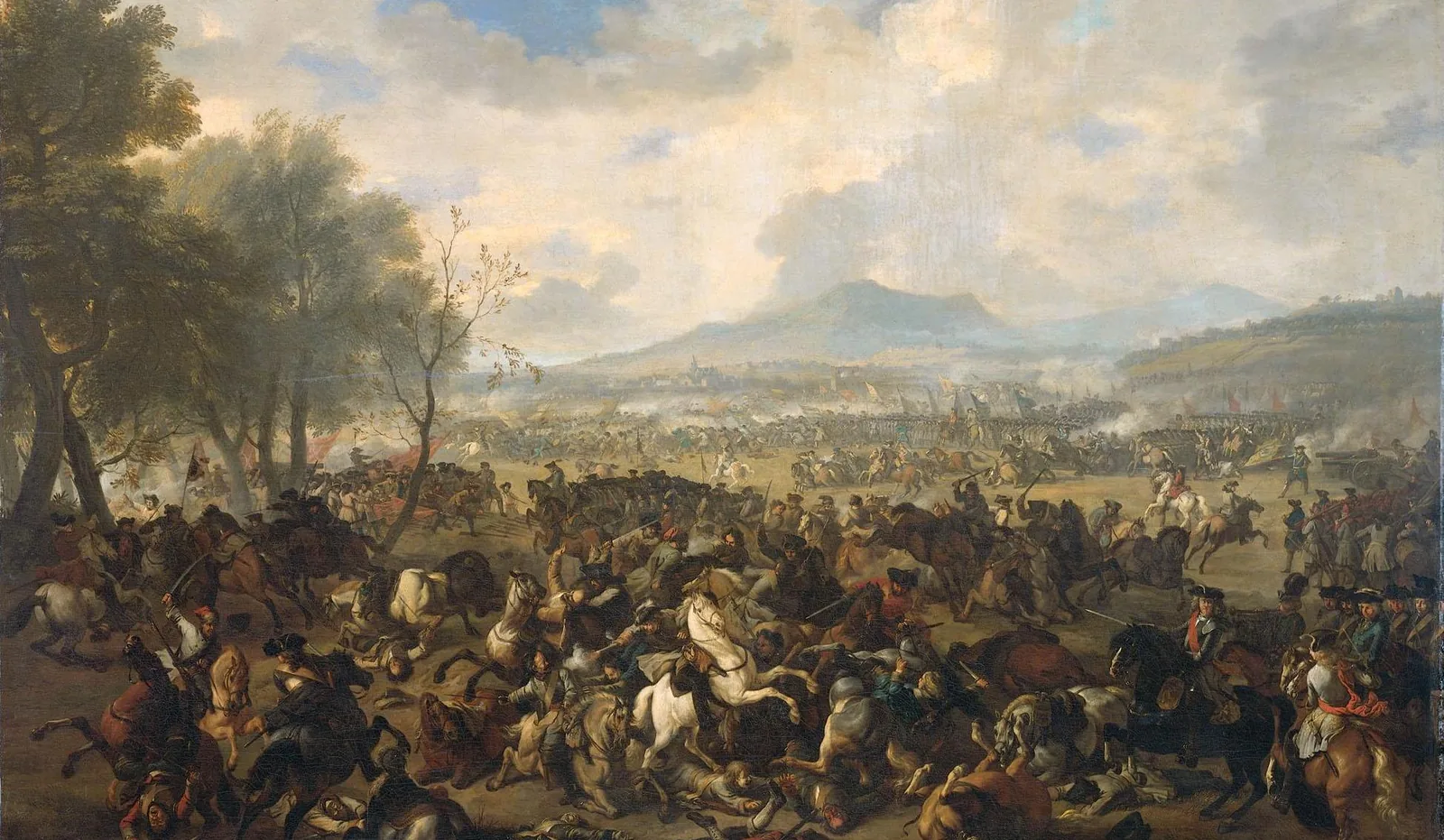
Jan van Huchtenburgh, The Battle of Ramillies, 23 May 1706, c. 1706–1710. Rijksmuseum, Amsterdam · Public domain · Source page
A Sunday in Brabant
One afternoon, one army broken
Sunday, 23 May 1706. On an open plateau in Brabant, in today's Belgium, two armies of some 60,000 men each face each other across a marshy stream. By nightfall one of them has fallen apart.
For France worse follows: defeat after defeat, a winter so cold that bottles burst beside lit fires, famine, and a king of 70 asking his enemies for peace. Yet when the war ends, Louis XIV's grandson is still king of Spain. How did France lose almost every battle and still keep what it had fought for?
Background
The story so far
In 1700 the childless Charles II of Spain died and left his whole empire, from Madrid to Milan, Naples, Brussels and the Americas, to Louis XIV's grandson Philip. Louis accepted, and Philip became Philip V of Spain.
Most of Europe saw a Bourbon France and a Bourbon Spain as one giant power. England, the Dutch Republic and the Habsburg emperor formed the Grand Alliance and backed a rival, the emperor's younger son, Archduke Charles. So began the War of the Spanish Succession.
As we saw in the last lesson, Marlborough and Prince Eugene of Savoy crushed a French army at Blenheim in 1704. France was on the defensive, but not beaten. In 1706 Louis wanted a victory.
Louis XIV
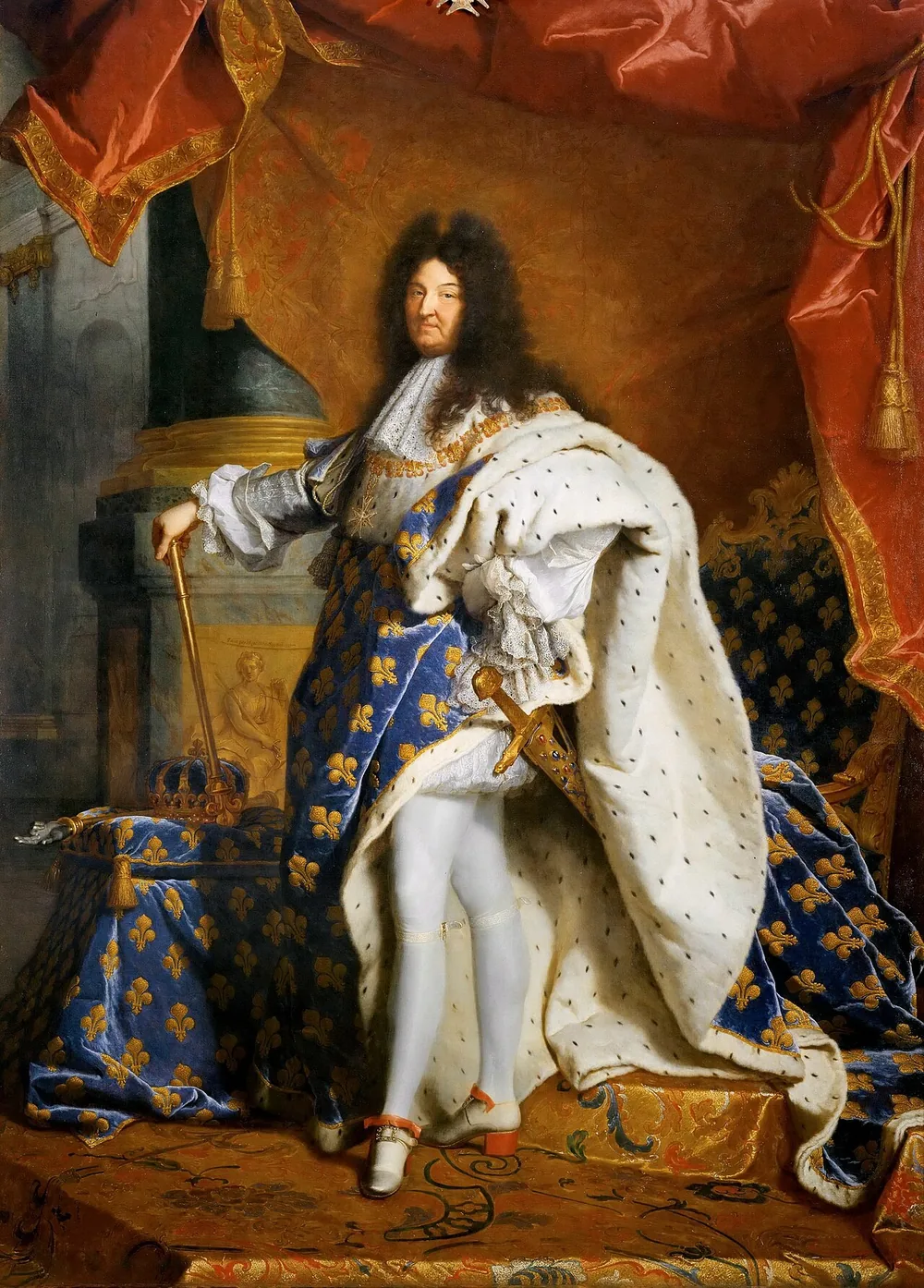
Hyacinthe Rigaud, Louis XIV in Coronation Robes, 1701. Musée du Louvre, Paris · Public domain · Source page
The Sun King: he made France the strongest power in Europe, and in old age staked it all on his grandson's crown.
- Born: 5 September 1638, Saint-Germain-en-Laye, near Paris
- Died: 1 September 1715, Versailles, of gangrene in the leg, four days before his 77th birthday
- Won: Spain and Spanish America kept for his grandson (Utrecht, 1713); The frontier held: Alsace and Strasbourg kept, Lille returned
- Lost: Ramillies, Turin, Oudenarde and the siege of Lille, 1706–1708; Malplaquet and Mons, 1709; Newfoundland, Acadia and Hudson Bay, ceded to Britain in 1713
“Since I must make war, I would rather make it on my enemies than on my children.”
Ramillies, 1706
23 May 1706
A marshal who wanted a battle
France's army was led by Marshal Villeroi, 62, a boyhood friend of the king: brave, proud and not very gifted. Both men wanted a battle to wipe out Blenheim. The king warned him to take particular care of the part of his line that would meet the first shock of the English.
Villeroi drew up near the village of Ramillies, in a six-kilometre curve: Taviers on the right by the marshy Mehaigne, Ramillies in the centre, Offus and Autre-Église on the left behind the marshy Little Gette. Between Ramillies and Taviers lay an open plain, perfect for cavalry, and there he placed 82 squadrons. Marlborough faced him from the east in a shorter, straighter line, along which he could shift troops faster.
Ramillies: who fought whom
23 May 1706, from about 1 p.m. to nightfall
Near Ramillies, Brabant (today's Belgium), about 20 km north of Namur
France and Bavaria
- Commanders: Marshal Villeroi, Max Emanuel, Elector of Bavaria
- Strength: 74 battalions, 128 squadrons (Marlborough, letter of the next day); 80,000 (Voltaire (1751): Villeroi's whole army in Flanders); about 60,000, with some 70 guns (Modern estimate (Chandler; Falkner))
- Losses: 12,087 killed and wounded, 9,729 prisoners (Millner, an Allied soldier (1733)); 7,000 killed and wounded, 6,000 prisoners, 2,000 deserters (French army records, cited by modern historians); 13,000–20,000, including prisoners (Modern estimate)
The losses mix the dead, the wounded, prisoners, and deserters who simply went home.
The Grand Alliance
- Commanders: The Duke of Marlborough, Field Marshal Overkirk (Dutch)
- Strength: 73 battalions, 123 squadrons (Marlborough, letter of the next day); about 62,000, with some 120 guns (Modern estimate (Chandler; Falkner))
- Losses: under 2,500 killed (Voltaire (1751)); about 1,100 killed and 2,600 wounded (Modern estimate)
Outcome: A crushing Allied victory. The French army fled in disorder, and within weeks most of the Spanish Netherlands went over to Archduke Charles.
Marlborough wrote that the armies were “near of a strength”, and modern figures agree. Voltaire's 80,000 is the whole French army in Flanders, not the men on the field.
A decision point
You are the Duke of Villeroi, Marshal of France.
Ramillies, 23 May 1706, about half past two in the afternoon
The guns have been firing for an hour and a half. On your right, Dutch Guards are attacking Taviers. On your left, what the king warned you about is happening: lines of English redcoats are wading the Little Gette and climbing towards Offus.
Behind your left wait the Elector of Bavaria's 50 squadrons, but the marsh is no ground for horses. You cannot see behind the Allied ridge. On the plain, your cavalry faces a growing mass of Dutch and Danish horse. Your reserves are few.
What do you do?
- Move infantry from your centre to the left, with the Elector's horse behind it Your left would probably stop the redcoats, as the king asked. But every battalion you move to the left will be missing from Ramillies and the plain, where the enemy can still strike.
- Trust the marsh to guard your left, and send your reserves to the plain Your cavalry would probably meet the Dutch and Danes in greater strength. But if the redcoats break through on the left, nothing stands behind it except your camp and baggage.
- Counter-attack the redcoats as they come out of the marsh You might throw them back into the stream with heavy losses. But your horse cannot charge through the marsh, and an attack that runs too far down the slope could be caught on the wet ground itself.
- Give up the outlying villages and pull in round Ramillies A shorter line would be harder to outflank and easier to reinforce. But pulling back under fire, in the middle of a battle, can turn into a rout, and the villages you leave become enemy strongpoints.
What really happened
Move infantry from your centre to the left, with the Elector's horse behind it
Villeroi reinforced his left. Then Marlborough called the British back. Their first line stayed on the ridge in full view, while the second slipped south behind a fold in the ground to the plain. There the Allies won the cavalry fight, and the French army collapsed.
The king had told Villeroi to fear the English, and after Blenheim he did. The attack looked real, and the historian David Chandler thinks it was: a serious probe, called off and then used as a decoy. Saint-Simon, writing decades later, mocked the French left as “utterly useless with its nose in the marsh, no enemy in front of it”.
The battle of Ramillies
23 May 1706, from 1 p.m. into the night
Marshal Villeroi has drawn up the French and Bavarian army in a six-kilometre curve by the village of Ramillies, with 82 squadrons on the open plain. Marlborough faces him from the east with a shorter, straighter line. Villeroi and the king want a battle that will wipe out the memory of Blenheim.
A reconstruction after David Chandler (1973) and James Falkner (2006) and Marlborough's letters, drawn on a modern map of the villages and streams. Whether the British attack across the Gette was a feint or a real attack called off is disputed; the exact places of the cavalry and the timings are approximate.
Phases of the battle
- A curve against a straight line About 1 p.m. the guns open fire. Villeroi's army stands in a six-kilometre curve, with 82 squadrons on the open plain. Marlborough's shorter, straighter line faces it from the east.
- Attacks on both flanks Dutch Guards storm Taviers on the French right. On the left, Orkney's British infantry wade the Little Gette and climb towards Offus. Remembering the king's warning, Villeroi sends his reserves to the left.
- The British called back Marlborough calls Orkney back. The British first line stays in view on the ridge; the second line and the horse slip south behind a fold in the ground. Allied infantry assault Ramillies, and Dutch horse charge on the plain.
- The Danes ride round Twenty-one Danish squadrons ride round the French right, reach the ancient mound of Hottomont and turn north into the French rear. The French cavalry breaks. Villeroi's attempt at a new front founders among his own tents and wagons.
- Rout Ramillies falls and the whole French army dissolves into flight towards Louvain, leaving guns and baggage. Allied horse pursue past midnight. Of some 60,000 French and Bavarians, 13,000 to 20,000 are lost, many as prisoners.
The strategy
- French and Bavarians: Villeroi wanted a battle that would wipe out Blenheim. He drew his army in a six-kilometre curve: Taviers on the right, by the marshy Mehaigne; Ramillies in the centre; Offus and Autre-Église on the left, behind the marshy Little Gette. The open plain between Ramillies and Taviers, good ground for cavalry, held 82 squadrons.
- Allies: Marlborough's shorter, straighter line lets him move troops quickly. The British cross the Little Gette towards Offus and are then called back; whether that was a feint or a real attack that was called off is disputed. Allied infantry assault Ramillies, and 21 Danish squadrons ride round the French right.
What decided it: Twenty-one Danish squadrons rode round the French right into the rear, and the French cavalry broke. Once Ramillies fell, the whole army dissolved into flight, and Marlborough's shorter line had let him move troops quickly from end to end.
May–September 1706
Towns like dominoes
Within weeks Louvain, Brussels, Antwerp, Ghent, Bruges and Ostend had fallen; many towns simply opened their gates to ‘Charles III’. Villeroi never commanded an army again.
In September Prince Eugene broke the French siege of Turin, and France lost northern Italy too. Saint-Simon summed up the year: “Ramillies, with a light loss, cost the Spanish Low Countries and part of ours: Turin cost all Italy.” His ‘light loss’ is wrong: at least 13,000 men. But about the land he was right.
The terrible years
1707–1708
Spain holds, Lille falls
Spain was different: at Almansa in April 1707 a Franco-Spanish army crushed the Allies, and most of Castile stood by Philip V.
In Flanders, 1708 brought new defeats. At Oudenarde the French commanders, the bold Duke of Vendôme and Louis's cautious grandson the Duke of Burgundy, quarrelled while half their army stood idle. Then Lille, one of France's largest and best-fortified cities, fell after a four-month siege that cost the Allies 12,000 to 16,000 men.
January 1709
The Great Winter
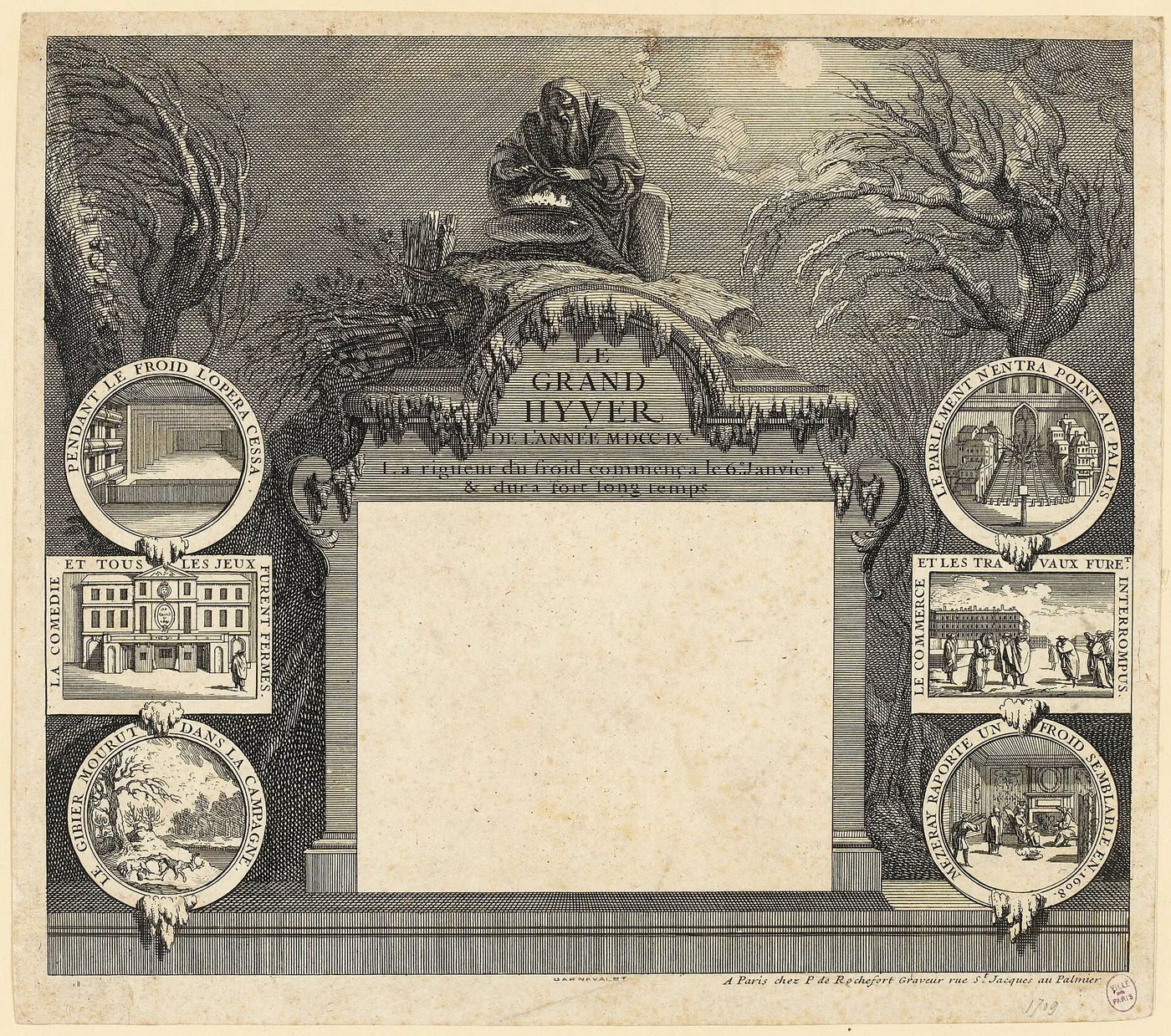
Pierre de Rochefort, Le Grand Hyver de l'année MDCCIX, etching, 1709. Musée Carnavalet, Paris · CC0 · Source page
about 600,000
On the night of 5 January 1709 the cold came. “In four days the Seine and all the other rivers were frozen,” Saint-Simon remembered; at Versailles, he wrote, strong spirits burst their bottles in rooms with fires lit.
A thaw and a second freeze killed the autumn wheat, the vines and the fruit trees. Bread prices tripled. By the historian Marcel Lachiver's estimate, about 600,000 more people died in 1709–10 than in normal years, out of some 22 million: far more than France lost in all the battles of the war. Hungry men joined the army for its bread, and often the army had none.
A decision point
You are Louis XIV, king of France.
Versailles, early June 1709
You are 70. Your people are starving, your soldiers unpaid, Lille lost. In May your foreign minister, Torcy, went to The Hague himself and offered almost everything: Spain for Charles, Strasbourg, Lille, and the razing of Dunkirk's fortifications.
The Allies took it all and asked more. Article 4 of their 40 preliminaries says that if your grandson Philip, 25, does not leave Spain within two months, you and they will “in concert take convenient measures” to make him; Article 37 ends the truce unless “the whole monarchy of Spain” is handed over in time. Meanwhile you must give up your frontier fortresses at once. Philip has written that he will die in Spain rather than leave.
What do you answer?
- Accept all 40 articles: your people need peace now The fighting would stop this summer. But if Philip refused to go, as he had promised, you would have to send French soldiers against your own grandson, or see the war resume with your fortresses already in Allied hands.
- Accept all but the clauses on Philip, and keep talking This is what Torcy tried at The Hague. The Allies, sure they were winning, would probably refuse again, and meanwhile the summer campaign would begin anyway.
- Reject the terms, and explain to your people why The war goes on, with a starving country and an army that has lost three years running. Everything depends on whether the French will fight for a cause their king has explained to them.
- Abandon Philip but refuse to fight him; offer the Allies money instead You would keep your honour as a grandfather and give the Allies something real. But they want a guarantee that Philip will go, and money is not a guarantee.
What really happened
Reject the terms, and explain to your people why
Louis refused, and on 12 June signed a letter to the governors of the provinces, read in churches across France, explaining why. A year later he even offered money towards removing Philip; the Allies insisted that France do it alone, and the talks failed.
War on his grandson seemed to Louis against nature, and Philip, with Castile behind him, would not go quietly. The historian John Lynn counts the Allied terms among the great mistakes of the war: they asked more than France could accept, and gave Louis a cause his people could share.
Source: A king explains himself
“…though my affection for my people is as sensible as that which I have for my own children; … yet I am persuaded that they themselves would be against receiving it, upon conditions equally opposite to justice and the honour of the French name.”
The letter told the French what the king had offered, and that the Allies wanted him to make war on his grandson: “shocking to humanity”, he wrote.
- Who was meant to hear this letter, and why is that unusual? Ordinary French people, in church and in the square. An absolute king was explaining himself to his subjects and asking for their support: one of the first royal appeals of its kind to public opinion.
- What does the letter leave out? How much Louis himself had offered. Stressing only the Allies' last demand makes the king look reasonable and the enemy cruel. Propaganda often works by choosing what to tell.
- Did it work? Recruits came forward that summer, though hunger counted as much as patriotism. Three months later that army fought at Malplaquet.
Myth
Louis XIV declared “L'État, c'est moi”: “I am the State.”
The truth
There is no evidence he said it. The line is placed in the Parlement of Paris in April 1655, but no record of that day has it, and it appears in print only long after his death. Louis did believe in his absolute power; yet in 1709 he was asking his people to understand him.
The evidence
The Parlement's registers and letters of April 1655 are silent. On his deathbed Louis reportedly said almost the opposite: that he was going, but the State would always remain.
Malplaquet, 1709
Claude-Louis-Hector de Villars
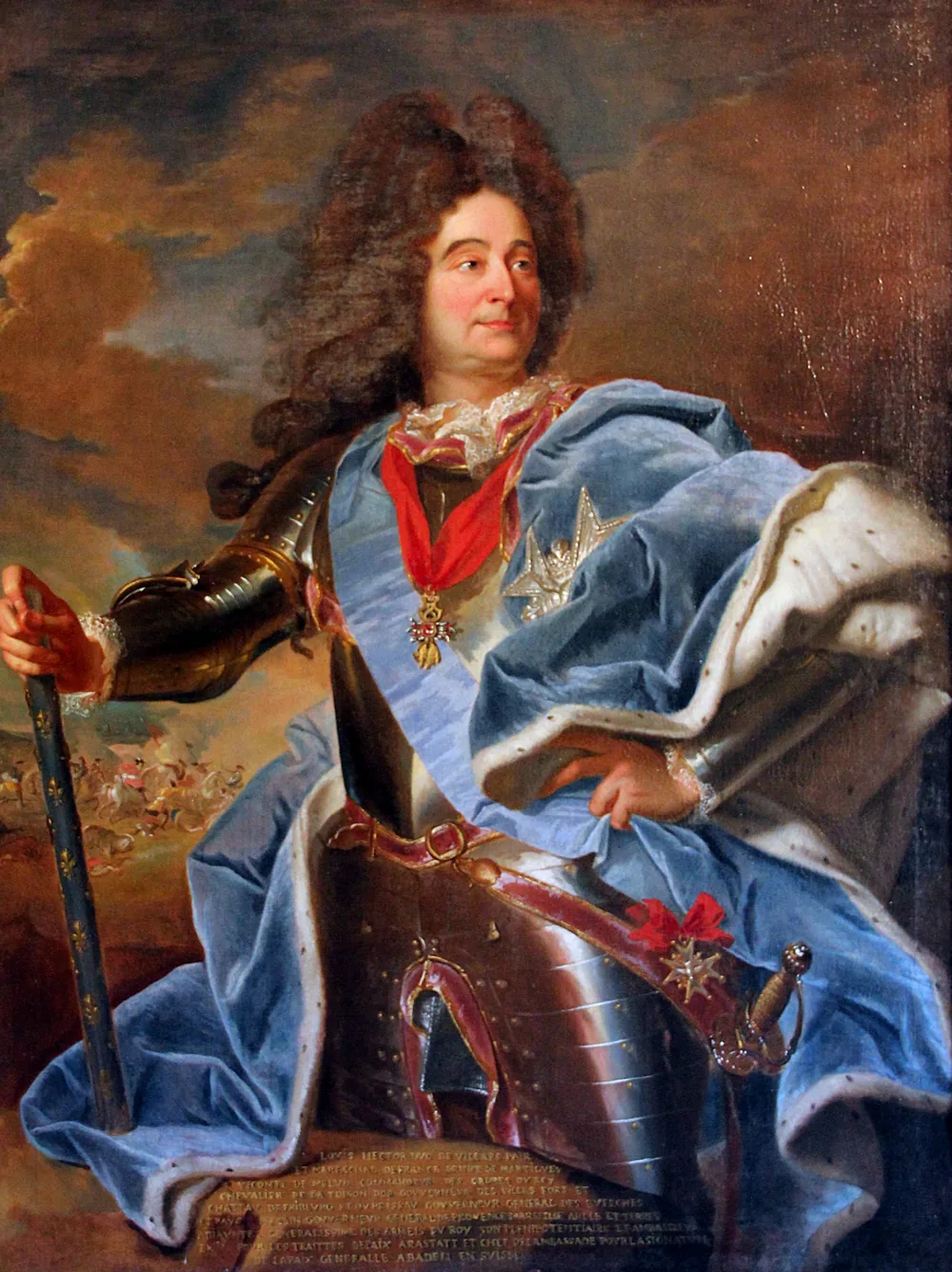
Hyacinthe Rigaud and studio, Marshal de Villars, composition of 1704, this version after 1714. Château de Vaux-le-Vicomte (photo: Jean-Pol Grandmont) · Public domain · Source page
A boastful, brave soldier from a poor noble family who held France's last army together in 1709; his victory at Denain let France make peace on better terms.
- Born: 8 May 1653, Moulins, central France
- Died: 17 June 1734, Turin, of illness, aged 81, while commanding in Italy in his last war
- Won: Friedlingen, 1702; Höchstädt, 1703; Denain, 1712
- Lost: Malplaquet, 1709 (wounded); The Ne Plus Ultra lines, 1711: outmanoeuvred by Marlborough without a battle
“If God grants us the grace of losing another such battle, Your Majesty may count on his enemies being destroyed.”
Summer 1709
The last army
Louis gave his last field army to Claude-Louis-Hector de Villars, 56, who had served under Turenne and Condé and beaten Imperial armies in Germany. Vain and talkative, he was mocked at court as a braggart; his soldiers liked him.
His army often had no bread. The Allies took Tournai and marched on Mons, and Louis allowed Villars to fight to save it. Marshal Boufflers, the defender of Lille and his senior, came to serve under him as a volunteer.
A decision point
You are Marshal Villars.
South of Mons, 9 September 1709
Your men are hungry, many are recruits, and the enemy is larger, by some 60 battalions as you reckon it, with more troops on the way from Tournai. Tonight their army is still spread out after its march.
You stand in a gap about two kilometres wide between two thick woods, Sars on your left and Lanières on your right. If your army retreats, or waits without bread, it may melt away.
How do you fight?
- Attack at once, before their reinforcements arrive You might catch the Allies before they are ready. But you would be attacking a larger army in the open with hungry recruits: the kind of battle that destroyed the French at Blenheim and Ramillies.
- Dig in across the gap and let them attack Earthworks and felled trees would make the Allies pay for every step, and raw troops fight best behind cover. But you leave the enemy free to choose the moment, and you may still lose Mons.
- Fall back behind the frontier fortresses and let Mons go Your army would survive to fight next year. But Mons would fall without a fight, the king's wish would be ignored, and an army that retreats without bread may desert on the way.
What really happened
Dig in across the gap and let them attack
Villars dug in: earthworks and an abatis of felled trees in the woods, and a chain of small forts across the gap. The Allies waited a day for their reinforcements and attacked on the morning of 11 September.
Villars trusted entrenchments to steady young soldiers. Saint-Simon and the officer-historian Quincy said he wasted the chance to strike first; Marlborough and Eugene, in turn, have been criticised for attacking such a position at all.
Malplaquet: who fought whom
11 September 1709, from about 7.30 a.m. to about 3 p.m.
The gap between the woods of Sars and Lanières, south of Mons, on today's French–Belgian border
France
- Commanders: Marshal Villars (wounded), Marshal Boufflers
- Strength: 130 battalions, 260 squadrons, 80 guns (Official figures, in Vogüé's edition of Villars (1887)); about 70,000; 80 guns (Voltaire (1751)); 75,000–90,000 (Modern estimate)
- Losses: only 5,500 dead (Villars's memoirs); 7,000 killed, 10,000 wounded (A French officer's intercepted letter, printed by the Dutch writer De Vryer (1738)); about 11,000–14,000 killed and wounded (Modern estimate)
Villars wrote down the smallest numbers for his own losses and the largest for the enemy's.
The Grand Alliance
- Commanders: The Duke of Marlborough, Prince Eugene of Savoy, The Prince of Orange (Dutch infantry)
- Strength: 162 battalions, 300 squadrons, 120 guns (Official figures, in Vogüé (1887)); 129 battalions, 252 squadrons, 101 guns (Coxe, from Allied records (1818–19)); about 80,000; 140 guns (Voltaire (1751)); 86,000–110,000 (Modern estimate)
- Losses: over 30,000 (Villars's memoirs); about 21,000–25,000 killed and wounded (Modern estimate)
The Dutch infantry alone lost about 8,500 men.
Outcome: The Allies held the field and took Mons, but lost about twice as many men as the French, who retreated in good order. Malplaquet is often called the bloodiest battle in 18th-century Europe.
Each side counted its own way; the total killed and wounded was well over 30,000.
The battle of Malplaquet
11 September 1709, from morning to mid-afternoon
Marshal Villars waits behind earthworks, with a chain of redans across a gap about two kilometres wide between the woods of Sars and Lanières. His men are hungry and many are recruits. Facing him is the larger Allied army of Marlborough and Eugene.
A reconstruction after Coxe's account and the plan Major Charles Hamilton Smith drew for him after walking the ground in 1814, and after John Lynn (1999), Richard Holmes (2008) and Simon MacDowall (2020), drawn on a modern map. The woods were larger in 1709 than their remnants today, and their edges here are approximate. Exactly how many battalions Villars took from the centre, and when, is disputed; positions and times are approximate.
Phases of the battle
- Two woods and a gap At dawn fog covers the field. Villars's army waits behind earthworks: the left in the wood of Sars, the right along the wood of Lanières, and a chain of redans across the gap. About 7.30 the fog lifts and the Allied guns open fire.
- The wood and the Dutch Eugene's infantry fight their way into the wood of Sars from north and east, tree by tree, for three hours. On the other wing the Dutch attack the French right; fire from the earthworks and a hidden battery cuts down thousands in about an hour.
- The centre emptied To save his left, Villars pulls battalions out of the redans and counter-attacks in the wood. Withers's troops appear on its far western edge. About 1 p.m. a musket ball shatters Villars's knee; Boufflers takes command.
- Through the redans Orkney's infantry walk into the almost empty redans, and the Allied cavalry pours through behind them. In one of the greatest cavalry fights of the century, Boufflers leads the Maison du Roi in charge after charge, and is stopped each time.
- Retreat in good order About 3 p.m. Boufflers orders the retreat. The French march off in good order with most of their guns. The Allies hold the field, too exhausted to pursue, having lost about twice as many men. Six weeks later Mons surrenders.
The strategy
- French: Villars holds a gap about two kilometres wide between two thick woods, with earthworks and a chain of redans across it, so the woods cover his flanks. To save his left he pulls battalions out of the redans to counter-attack in the wood; how many, and when, is disputed.
- Allies: The Allies, with more men and guns, attack both wings. Eugene's infantry cut their way into the wood of Sars from the north and east, tree by tree, while the Dutch hit the French right. Orkney's infantry then walk into the redans, and the Allied cavalry pours through behind them.
What decided it: The earthworks made the attack very costly: the Allies held the field but lost about twice as many men as the French. The French retreated in good order at about 3 p.m., and the Allies were too exhausted to pursue.
Myth
Malplaquet was a great Allied victory, or, as the French court told it, almost a French one.
The truth
For France it was both a defeat and a success. The Allies won the field and took Mons, but lost twice as many men, and the invasion of France never came. Saint-Simon wrote that the court was so used to defeats that “a battle lost as was Malplaquet seemed half a victory”. The historian Clément Oury calls it “the defeat that saved the kingdom”.
The evidence
Marlborough's and Villars's letters; Saint-Simon; modern estimates (Lynn, 1999; Oury, 2024).
Source: The victor's view
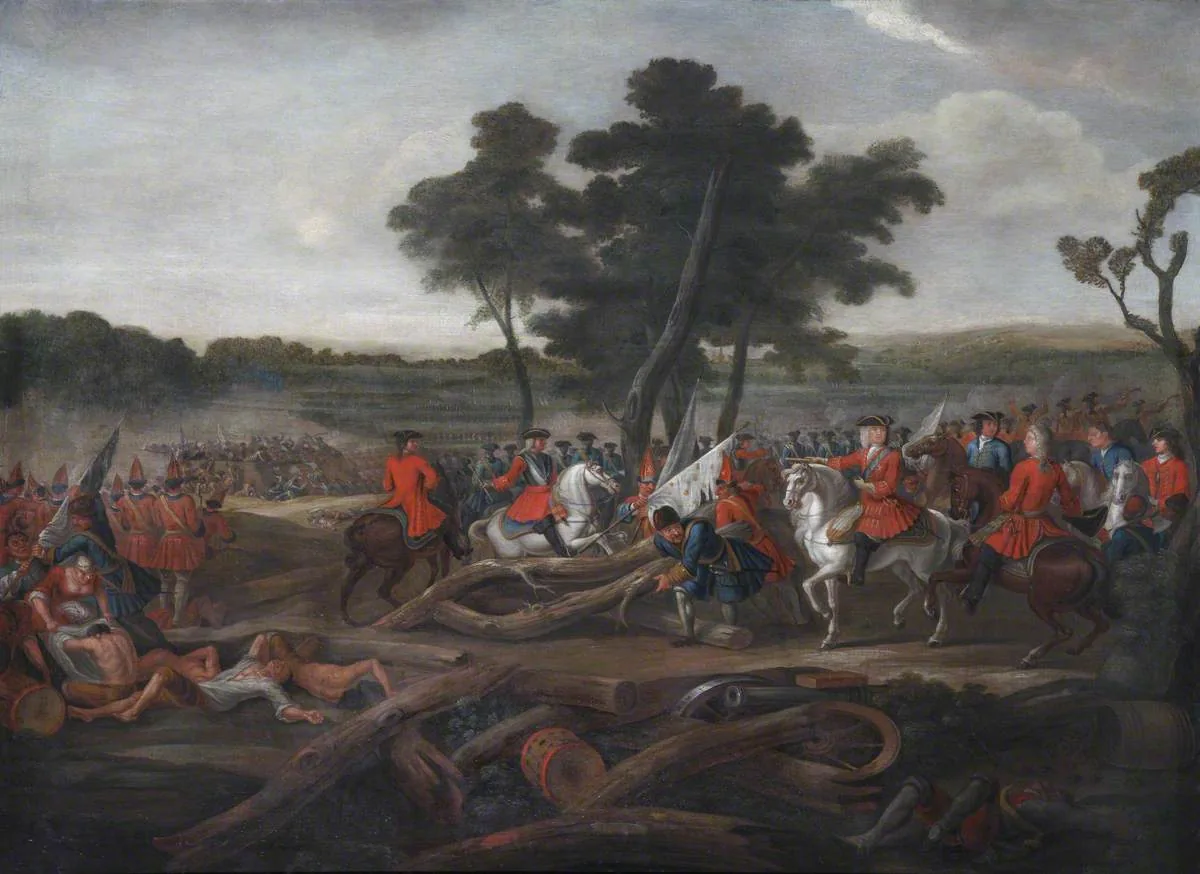
Louis Laguerre, The Battle of Malplaquet, 11 September 1709, c. 1713. National Army Museum, London · Public domain · Source page
“I am so tired that I have but strength enough to tell you that we have had this day a very bloody battle; the first part of the day we beat their foot, and afterwards their horse. God Almighty be praised, it is now in our power to have what peace we please…”
Marlborough wrote this to Sarah on the night of the battle. Three days later the wounded Villars told his king that one more such defeat would destroy the enemy.
- Marlborough won. Does he sound like a winner? Barely: he is exhausted and calls it “a very bloody battle”. A private note written that night is often more honest than the official reports that follow.
- “What peace we please”: what does that show about the Allies in 1709? That they thought France could be made to accept anything. The same confidence produced the terms Louis had just refused, and within three years the alliance was falling apart.
- What does the painting choose to show, and what not? Brave officers at the barricade, the dead arranged at the edge. It honours the Allied command and shows nothing of the hours of slaughter.
Britain changes course
1710–1711
The fall of Marlborough
Marlborough's power rested on Queen Anne's friendship with his wife, Sarah, and by 1710 it was gone: Anne had tired of Sarah's lectures and turned to a gentler favourite, Abigail Masham, and to the Tory politician Robert Harley.
Britain was tired of the war. The Tories, the party of the landowners who paid the land tax, won a landslide in 1710. Then, in April 1711, Emperor Joseph I died, and the Allies' candidate for Spain, Archduke Charles, became heir to Austria. Giving him Spain as well would build a new giant in place of the old one.
Source: A pamphlet that sold a peace
“But the common Question is, If we must now Surrender Spain, what have we been Fighting for all this while? … We have been fighting to raise the Wealth and Grandeur of a particular Family; to enrich Usurers and Stock-jobbers; and to cultivate the pernicious Designs of a Faction, by destroying the Landed-Interest.”
Swift, later the author of Gulliver's Travels, wrote this for Harley's government. It sold thousands of copies within weeks; soon after, Marlborough was dismissed.
- Who is the “particular Family”? The Churchills, made rich and powerful by the war. Swift never names them; he did not need to.
- Why attack “Usurers and Stock-jobbers”? The war ran on loans from the City of London, whose bankers backed the Whigs; the Tories' voters were landowners. Swift turns a quarrel about money into honest land against greedy finance.
- Swift was paid by the government. Is the pamphlet worthless as evidence? No. It is weak evidence of why the war was fought, but strong evidence of which arguments persuaded the British public in 1711.
A decision point
You are Henry St John, Secretary of State in Queen Anne's Tory government.
London, autumn 1711
You are 33, clever and ambitious. The war costs Britain millions a year and the debt keeps growing. The Whigs and the Allies still say ‘no peace without Spain’, but the Allies' man for Spain is now Emperor.
French agents are secretly offering a great deal: Gibraltar and Minorca, which British forces hold, trading rights in Spanish America, Dunkirk's walls razed, and recognition of the Protestant succession. The Dutch and the Emperor know nothing. Marlborough, still in command, will fight any peace that leaves Philip in Spain.
What do you do?
- Stay loyal to the alliance: no peace without Spain Britain would keep its word and its friends. But the war might last years more, to win Spain for a man who would then rule half of Europe, and the Tories' own voters would pay for it.
- Call all the Allies to a peace conference Honest and slow. The Dutch and the Emperor would demand far more than France would give, and Britain's special gains would be shared out or lost in the bargaining.
- Settle terms with France in secret, then bring in the Allies Britain would get the best deal and the war would end quickly. But your allies would call it betrayal, and Marlborough must be removed first.
What really happened
Settle terms with France in secret, then bring in the Allies
St John and Harley agreed secret preliminaries with France in October 1711. Then the queen dismissed Marlborough, accused of taking money from army contracts. In May 1712 St John ordered the new commander, the Duke of Ormonde, to avoid any siege or battle: the ‘restraining orders’. The French were told; the Allies were not.
The Tories believed the war no longer served Britain, and the Emperor's new crown made their case. The historian G. M. Trevelyan judged the terms good and the method dishonourable. The Dutch, abandoned mid-campaign, never forgot it.
24 July 1712
Denain
In 1711–12 Louis lost his son, then, to measles within a month, his grandson Burgundy, Burgundy's wife and their elder son. The heir was a boy of two. ‘God is punishing me; I have well deserved it,’ the king told Villars, by Villars's account.
In July the British marched away. Eugene, besieging Landrecies, fed his army along a fortified corridor through Denain on the river Scheldt. Villars feinted towards Landrecies, crossed the Scheldt by night and on 24 July stormed Denain with about 24,000 men; a bridge collapsed behind the fleeing defenders, and hundreds drowned. He then retook Marchiennes, with the Allies' stores, and Douai, Le Quesnoy and Bouchain. The Dutch and the Emperor could not win without Britain.
The Peace of Utrecht
1713–1714
A peace of balance
The treaties were signed at Utrecht, in the Dutch Republic, on 11 April 1713; the Emperor, fighting on alone, made peace at Rastatt in 1714, negotiated face to face by Villars and Eugene.
Philip V kept Spain and Spanish America but renounced the French throne for himself and his heirs. Spain's lands in Italy and the Netherlands went to Austria, and Sicily to Savoy. France kept Alsace, Strasbourg and Lille, and gave Britain Newfoundland, Acadia and Hudson Bay. Britain kept Gibraltar and Minorca and won the Asiento: the right to sell 4,800 enslaved Africans a year in Spanish America. The Catalans, who had fought for Charles, were abandoned.
The treaty named its aim: never one king for France and Spain, for “the security and liberties of Europe” could not bear it. The idea had a name: the balance of power.
Source: A medal for the peace
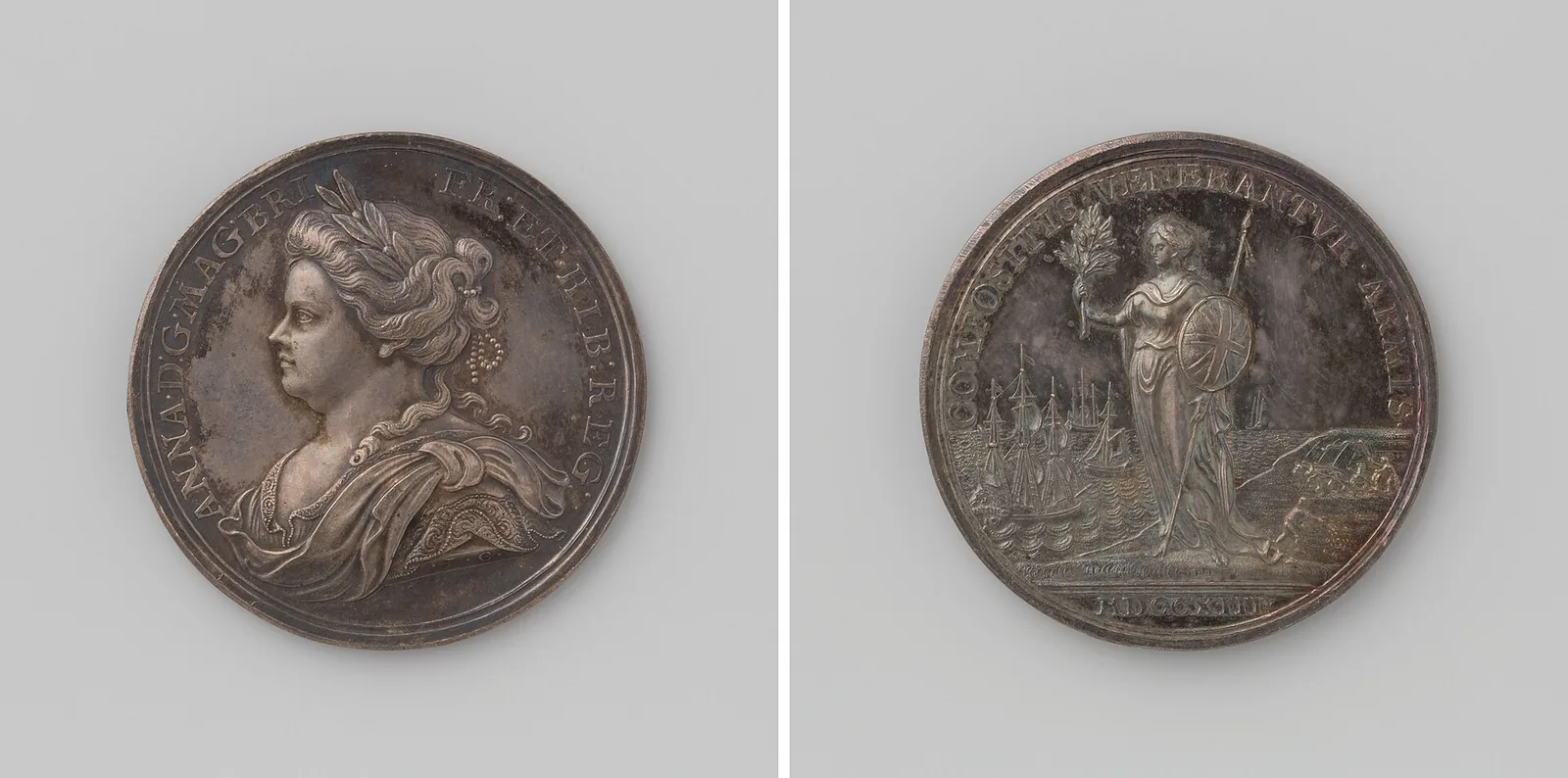
John Croker, medal for the Peace of Utrecht, silver, 1713. Rijksmuseum, Amsterdam · CC0 · Source page
John Croker, silver medal for the Peace of Utrecht, 1713. Rijksmuseum, Amsterdam
On the back, Britannia holds an olive branch, with the Latin COMPOSITIS VENERANTVR ARMIS, roughly ‘arms laid down, they honour her’.
- What does Britain gain from peace, according to the back of the medal? Ships on one side, a ploughman and a sower on the other: trade and farming. The Tory government was telling landowners and merchants that peace was good business.
- Read the queen's titles on the front. What is strange about them? ANNA … MAG BRI FR ET HIB REG: Queen of Great Britain, France and Ireland. English monarchs had claimed the French crown since Edward III and kept the title until 1801, even on a peace medal.
- Who is missing from this picture of peace? The allies Britain left behind, the abandoned Catalans, and the Africans whose sale was one of the treaty's prizes. A medal shows the peace its makers wanted remembered.
1 September 1715
“I have loved war too much”
In August 1715, his leg black with gangrene, Louis called his heir to his bedside: his great-grandson, the Dauphin Louis, aged five. Saint-Simon recorded his words:
“My child, you are going to be a great king; do not imitate me in the taste I have had for building, or in that I have had for war; try, on the contrary, to be at peace with your neighbours.”
Voltaire printed another text, which he said came from a paper Louis XV kept at his bedside: ‘I have loved war too much; do not imitate me in that, nor in the too great expenses I have made.’ These are reported words, polished for a moral, but the old king knew what his wars had cost. He died on 1 September 1715, after 72 years on the throne. As his coffin passed, some in the crowd jeered.
What came next
- 1713–1714 Utrecht, Rastatt and Baden end the war. Philip V's descendants still reign in Spain.
- 1714 Queen Anne dies and George I of Hanover succeeds. The Whigs return, and Marlborough is restored to command.
- 11 September 1714 Barcelona falls to Philip V; Catalonia soon loses its ancient laws. The date is now Catalonia's national day.
- 1715 Louis XIV dies. Louis XV is five; Philippe, Duke of Orléans, rules as regent over a crushing war debt.
- 1717 France and Britain, enemies for a generation, become allies: the balance of power at work.
- 1734 Villars, 81, dies at Turin, commanding in yet another war.
- Today Gibraltar is still British, and Spain still claims it.
Did France lose the war?
France lost almost every big battle from 1704 to 1709. Did it lose the war?
- John A. Lynn, The Wars of Louis XIV (1999) Louis's later wars were defensive. Judged by what he fought for, he won the main prize: a Bourbon on the throne of Spain, and France's frontiers held. But the price, in debt and in lives, was ruinous.
- Clément Oury, La guerre de Succession d'Espagne (2020) and Malplaquet 1709 (2024) 1709 was the turning point. An exhausted France refused humiliating terms, and its army and people held. Malplaquet was a defeat that saved the kingdom. The war ended France's ‘Great Century’ in tragedy: victory at a terrible price.
- The British school: G. M. Trevelyan (1930–34), Richard Holmes (2008) The Grand Alliance won on the battlefield, and Britain won the peace: Gibraltar, Minorca, new colonies, trade and a century of sea power. France kept Spain for Philip only because Britain chose to stop.
The answer depends on the question you ask. If the war was about who sat on the throne in Madrid, France won. If it was about whether France would dominate Europe, it lost. Which question would Louis XIV have asked?
What do you know now?
Check yourself
At Ramillies, why did Villeroi's reserves end up on the wrong part of the field?
Answer: He reinforced his left against a British attack that Marlborough then called off, while the real blow fell on the plain. Right. The British attack across the Gette drew French troops north; Marlborough called it off, kept his first line in view, and moved men south to the plain unseen.
Check yourself
In 1709 Louis XIV had already agreed to give up Spain. Which demand made him reject the Allies' terms?
Answer: That he help drive his own grandson out of Spain if Philip did not leave within two months. Right. Articles 4 and 37 in effect required him to fight his grandson, or see the war resume after he had already handed over his fortresses.
Check yourself
Who won the battle of Malplaquet?
Answer: The Allies held the field and took Mons, but lost about twice as many men as the French, whose army survived. Right. A victory on the field, at a price that helped persuade Britain and the Dutch that it was time to stop.
Check yourself
Why did Britain make a separate peace with France in 1711–12?
Answer: A Tory government was tired of the war's cost, and the Allies' candidate for Spain had become Emperor. Right. The 1710 election brought the Tories to power, and Joseph I's death in 1711 turned ‘no peace without Spain’ into a recipe for a giant Habsburg empire.
Check yourself
What did the Peace of Utrecht decide about Spain?
Answer: Philip V kept Spain and its American empire but gave up any right to the French throne. Right. That was how the balance of power was kept: a Bourbon in Madrid, but never the same king in Paris and Madrid.
Check yourself
The deathbed words attributed to Louis XIV, ‘I have loved war too much’: how have they reached us?
Answer: In several slightly different versions, reported by writers such as Saint-Simon and Voltaire. Right. Saint-Simon has ‘building’ and ‘war’; Voltaire gives a different text, which he said was copied from a paper kept at Louis XV's bedside. Words spoken to a five-year-old were written down and polished by others.
Terms
- War of the Spanish Succession The war of 1701–1714 over who would inherit the Spanish crown and empire after the childless Charles II: Louis XIV's grandson Philip, or the Habsburg Archduke Charles.
- Grand Alliance The alliance against Louis XIV signed at The Hague in September 1701 by England (Britain from 1707), the Dutch Republic and the Holy Roman Emperor. Most German states joined it, and later Portugal and Savoy.
- Marshal of France The highest military rank in France, given by the king to a few generals. A marshal could command a whole army; Villeroi, Boufflers and Villars all held it.
- battalion The basic unit of foot soldiers: about 500 to 700 men at full strength, usually fewer in practice. Armies of the time were counted in battalions and squadrons.
- squadron The basic unit of cavalry: about 120 to 160 horsemen at full strength.
- Maison du Roi ‘The King's Household’: the French king's guard units, the elite of his cavalry, among them the Gardes du Corps, the Gendarmes and the Musketeers.
- redan A small V-shaped field fort, its point towards the enemy, built of earth and timber. At Malplaquet a chain of redans closed the gap between the woods.
- abatis A barrier of felled trees laid with their branches, often sharpened, pointing at the enemy.
- preliminaries Draft terms agreed before a full peace treaty, setting out its main points. The Allies' preliminaries of 1709 had 40 articles.
- Tories and Whigs The two parties of British politics. Tories leaned to the landowners and the Church of England and wanted peace; Whigs leaned to the financiers of the City of London and backed the war and Marlborough.
- Asiento A Spanish contract granting a monopoly on supplying enslaved Africans to Spain's American colonies. At Utrecht it passed to Britain for 30 years.
- balance of power The idea that peace is safest when no single state can dominate the others. The Utrecht treaties named it as their aim.
- Villeroi A French marshal and childhood friend of King Louis. At Ramillies he led the French army, which collapsed.
- Saint-Simon A French courtier who wrote memoirs about the court of Louis XIV and the war. An important source, but not always reliable.
- Ramillies A battle in 1706 in today's Belgium. The French army was scattered and beaten, and the Allies won.
- Blenheim A battle in 1704 where Marlborough and Prince Eugene crushed a French army. It came before Ramillies.
- Berwick A commander, the illegitimate son of James II of England. He led the Franco-Spanish army at Almansa.
- Galway A Protestant commander from France, a refugee who served England. He led the Allied army at Almansa.
- Voltaire A French writer and philosopher. He reported words attributed to Louis XIV, though there is no proof he said them.
- Marcel Lachiver A historian who estimated from parish records about 600,000 extra deaths in 1709–10.
- Jamel Ostwald A historian who asked what made Ramillies different from other battles. In his view, the French army was scattered, not just beaten.
- Clément Oury A historian who called Malplaquet a defeat that saved the kingdom, because the invasion never came.
- Cormac Ó Gráda A researcher of the 1709 famine in France. With a co-author he found that the army's food needs made the harvest failure worse, but markets eased the crisis a little.
- Boufflers A French marshal who defended Lille. At Malplaquet he served under Villars as a volunteer, though he was senior to him.
- Malplaquet A battle the Allies won on the field, but they lost almost twice as many men as the French.
- Ostend A port in the Spanish Netherlands. It fell to the Allies after Ramillies, like many other towns in the area.
- Antwerp A large city in the Spanish Netherlands. It fell to the Allies after Ramillies, along with Brussels and Louvain.
- South Sea Company A British company that ran the Asiento, the right to sell enslaved Africans in Spanish America. Its shares collapsed in the South Sea Bubble.
- Archduke The younger son of the Habsburg emperor. The Allies backed him for the Spanish throne instead of Philip.
- Dunkirk A French port on the North Sea coast. In the peace talks France offered to tear down its fortifications.
- Gibraltar A rock fortress at the southern tip of Spain, which Britain kept after the peace.
- Minorca An island in the Mediterranean that Britain kept after the Peace of Utrecht.
- Swift A writer and pamphleteer who wrote a pamphlet for Harley's government. He is also known as the author of Gulliver's Travels.
- Gulliver's Travels A famous adventure book by Swift, full of satire about society and power.
- Ormonde The Duke of Ormonde, the new British commander after Marlborough. He was ordered to avoid any battle or siege.
- Prince Eugene of Savoy A prince of Savoy and commander in the Emperor's service. With Marlborough he won at Blenheim, and he broke the French siege of Turin.
- Charles II King of Spain who died childless and left his whole empire to Louis XIV's grandson.
Sources
- Louis de Rouvroy, duc de Saint-Simon, The Memoirs of Louis XIV, His Court and the Regency, trans. Bayle St John (London, 1857): Ramillies and Turin, the winter of 1709, Malplaquet, the death of Louis XIV
- Memoirs of the Marquis of Torcy, containing the history of the negotiations from the treaty of Ryswic to the peace of Utrecht, 2 vols (London, 1757), vol. 1: the preliminary articles of The Hague (1709) and Louis XIV's letter to the governors of 12 June 1709
- William Coxe, Memoirs of John Duke of Marlborough, with his original correspondence (London, 1818–19); revised by John Wade, Bohn's Standard Library (London, 1847–48), vols 1–2: Marlborough's letters of 24 May 1706 and 11 September 1709
- Mémoires du maréchal de Villars, ed. marquis de Vogüé, 6 vols (Paris: Société de l'histoire de France, 1884–1904), vol. 3 (1887): Malplaquet, the letter of 14 September 1709, Marly 1712, Denain
- Jonathan Swift, The Conduct of the Allies, and of the Late Ministry, in Beginning and Carrying on the Present War (London: John Morphew, 1711)
- Treaty of Peace and Friendship between France and Great Britain, Utrecht, 11 April 1713, art. VI; Treaty between Spain and Great Britain, Utrecht, 13 July 1713, art. X–XI (official English texts)
- Voltaire, Le Siècle de Louis XIV (Berlin, 1751), chapters 20–23 and 28
- John A. Lynn, The Wars of Louis XIV, 1667–1714 (London: Longman, 1999)
- Clément Oury, La guerre de Succession d'Espagne: la fin tragique du Grand Siècle (Paris: Tallandier, 2020)
- Clément Oury, Malplaquet 1709: la défaite qui sauve le royaume (Paris: Perrin, 2024)
- Jamel Ostwald, “The ‘Decisive’ Battle of Ramillies, 1706: Prerequisites for Decisiveness in Early Modern Warfare”, Journal of Military History 64:3 (2000), 649–677
- Jamel Ostwald, Vauban under Siege: Engineering Efficiency and Martial Vigor in the War of the Spanish Succession (Leiden: Brill, 2007)
- Lucien Bély, Espions et ambassadeurs au temps de Louis XIV (Paris: Fayard, 1990)
- Lucien Bély, L'art de la paix en Europe: naissance de la diplomatie moderne, XVIe–XVIIIe siècle (Paris: PUF, 2007)
- Claude C. Sturgill, Marshal Villars and the War of the Spanish Succession (Lexington: University of Kentucky Press, 1965)
- David Chandler, Marlborough as Military Commander (London: Batsford, 1973)
- James Falkner, Ramillies 1706: Year of Miracles (Barnsley: Pen & Sword, 2006)
- Simon MacDowall, Malplaquet 1709: Marlborough's Bloodiest Battle (Oxford: Osprey, 2020)
- Richard Holmes, Marlborough: England's Fragile Genius (London: HarperPress, 2008)
- Henry Kamen, Philip V of Spain: The King Who Reigned Twice (New Haven: Yale University Press, 2001)
- Marcel Lachiver, Les années de misère: la famine au temps du Grand Roi, 1680–1720 (Paris: Fayard, 1991)
- Cormac Ó Gráda and Jean-Michel Chevet, “Famine and Market in Ancien Régime France”, Journal of Economic History 62:3 (2002), 706–733
- G. M. Trevelyan, England under Queen Anne, 3 vols (London: Longmans, 1930–34)
- Anne Somerset, Queen Anne: The Politics of Passion (London: HarperPress, 2012)
Image credits
- Jan van Huchtenburgh, The Battle of Ramillies, 23 May 1706, c. 1706–1710. Rijksmuseum, Amsterdam · Public domain · Source page
- Hyacinthe Rigaud, Louis XIV in Coronation Robes, 1701. Musée du Louvre, Paris · Public domain · Source page
- Pierre de Rochefort, Le Grand Hyver de l'année MDCCIX, etching, 1709. Musée Carnavalet, Paris · CC0 · Source page
- Hyacinthe Rigaud and studio, Marshal de Villars, composition of 1704, this version after 1714. Château de Vaux-le-Vicomte (photo: Jean-Pol Grandmont) · Public domain · Source page
- Louis Laguerre, The Battle of Malplaquet, 11 September 1709, c. 1713. National Army Museum, London · Public domain · Source page
- John Croker, medal for the Peace of Utrecht, silver, 1713. Rijksmuseum, Amsterdam · CC0 · Source page


