Tutankhamun: the boy king and the tomb that was found
A king who died young and mattered less than most pharaohs became, about 3,250 years after his death, the most famous of them, when his tomb was found. What do we know, and what is the truth about the curse?
Decisions, questions and your own progress, in the app
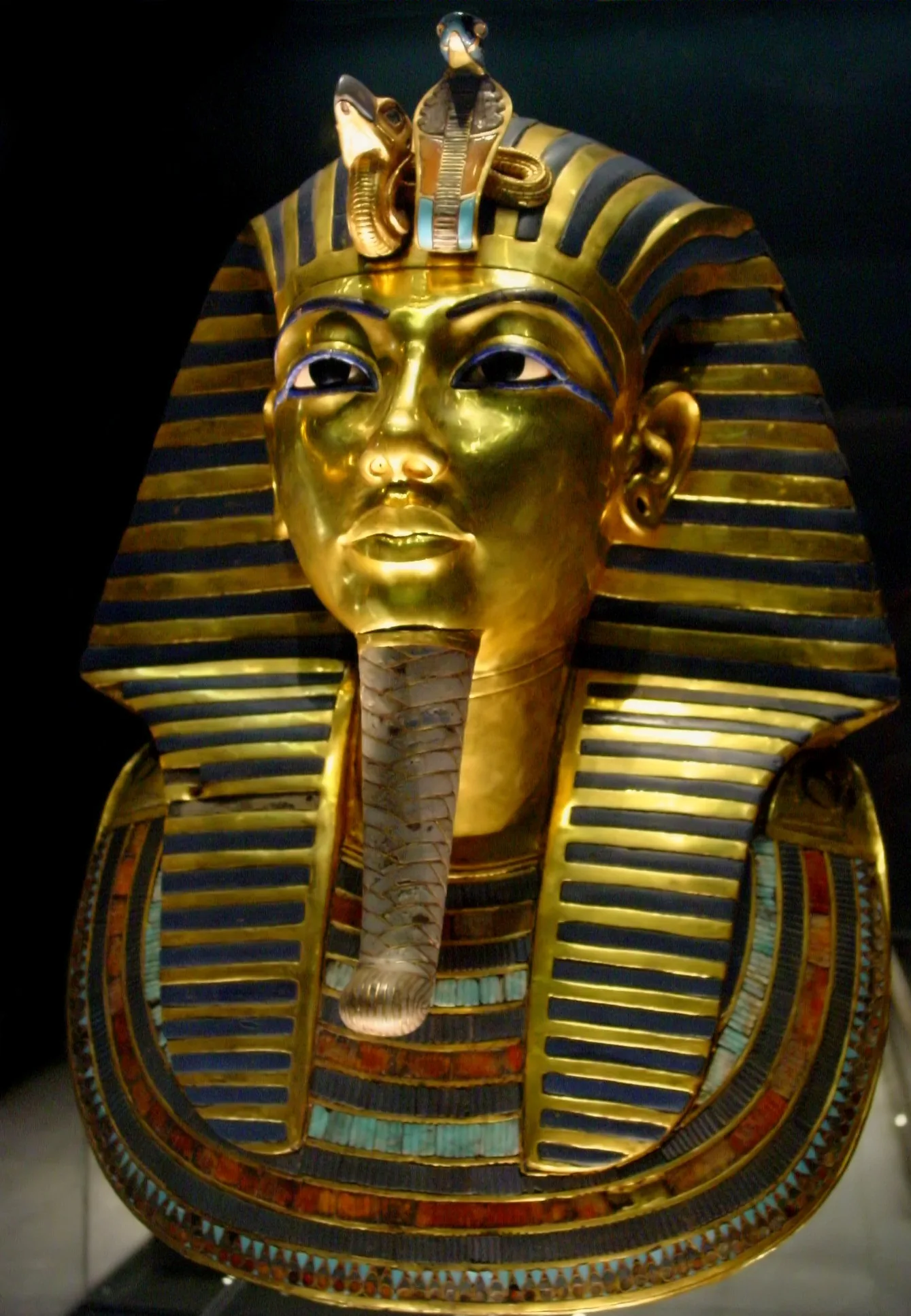
Funerary mask of Tutankhamun, Egyptian Museum, Cairo. Photo: Bjørn Christian Tørrissen, 2003 · CC BY-SA 3.0 · Source page
A boy named for Aten
The boy with the golden mask
A boy king ruled Egypt for about nine years and died at about eighteen or nineteen. In his own time he was not counted among the great pharaohs.
In 1922 a team led by Howard Carter found a tomb beneath rubble in the Valley of the Kings. Since then the boy has become probably the most famous of all the pharaohs.
Background
Akhenaten and the city in the desert
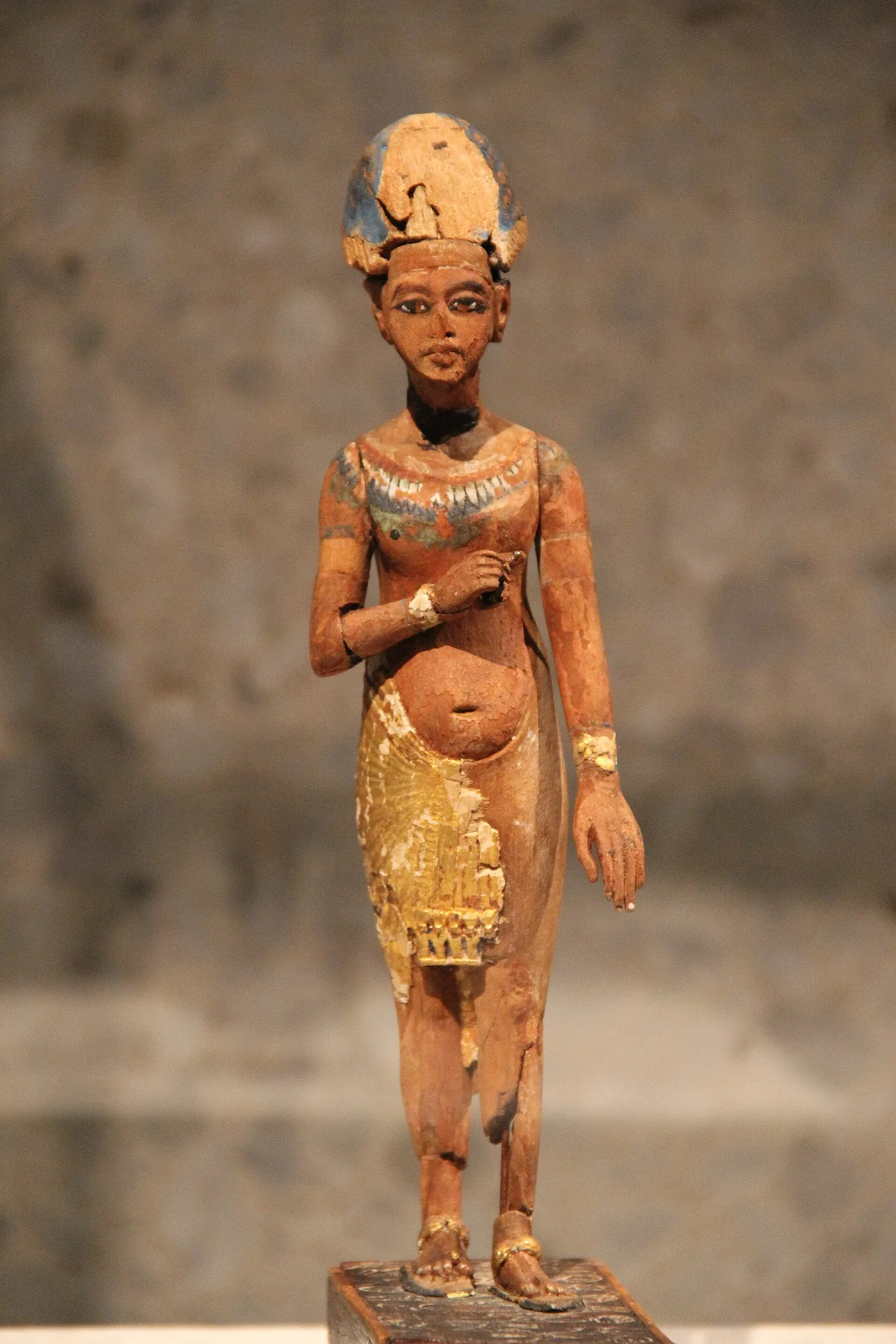
Standing statue of Akhenaten, 18th Dynasty, Egyptian Museum, Berlin. Photo: Gary Todd, 2016 · CC0 · Source page
Before the boy came to the throne, a king called Akhenaten changed Egypt's religion. He made Aten, the sun disk, the chief god of the state, and he moved the government to a new city he built in the desert: Amarna.
The old gods, above all Amun, were pushed aside.
The boy
A name that echoes Aten
The boy was born with the name Tutankhaten, meaning 'living image of Aten'. By the best estimate he came to the throne at about eight or nine.
Around him were advisers. The most senior of them named in the surviving texts is Ay, whose title was Fan-bearer on the Right Side of the King.
A decision point
You are one of the young king's advisers.
About 1328–1330 BC, in his third regnal year. The exact dates are disputed.
The king is about ten. The Aten has been the state's chief god for some years, and many say the temples of the old gods, above all Amun's, are neglected.
The court is divided. Some want to keep Aten, the names and the city of Amarna as they are. Others want to bring back Amun and the old priests. You must decide what to advise the king.
What do you advise the king to do?
- Restore Amun and the other old gods in full, and drop the Aten names from the king's name. Probably the quickest way to bring the old priests back. It would hurt the people of Amarna and the priests of Aten, and show the whole court that the old order was returning.
- Keep Aten as the chief god, but let the old temples reopen quietly beside him. Probably a compromise that satisfies neither side for long. The priests of Amun would stay second-rank, and the question would return.
- Keep Aten, the names and Amarna as they are, with only small changes. Probably a long struggle with the old priests, and a young king who depends on a court that wants nothing to change.
What really happened
Restore Amun and the other old gods in full, and drop the Aten names from the king's name.
In his third year the king changed his name from Tutankhaten to Tutankhamun. The new name dropped the ending -aten, restored Amun to the centre, and ended Aten's supremacy. The change was probably made on his advisers' advice.
A young king needs support, and his advisers want influence. The decision can be read as a return to tradition and to the old priesthood. Whether the boy himself wanted it, or the court decided in his name, is still an open question.
A stela: what the king said about himself
The stone
A stone that speaks for the king
Egyptian kings had their deeds cut into stone. A stela is an upright stone slab, carved with a text and often a picture, set up in a temple or a public place.
One of the most important stelae of the boy king is the Restoration Stela. It was found at Karnak and describes what the king did for the temples. We will read it the way we read a political document: who wrote it, why, and what it leaves out.
Source: The Restoration Stela, Karnak
(A paraphrase, not a translation.) The king says he restored the temples, gave them endowments and brought back their rituals. In his telling, the temples had fallen into ruin.
This is the king's own presentation, meant to show his restoration as a rescue. It exaggerates the decay and follows the conventions of royal praise.
- Who commissioned the text, and when? The king himself. The date is disputed: one reading gives his fourth year, others read his first. Murnane (1995) rejects the first year, because in it the king still used his old name.
- What does the king gain by describing the temples as ruined? A restoration that looks like a rescue. What he brings back looks like a great deed, and the old world looks as if it needed him. The description serves the man who wrote it.
- What evidence would you look for before trusting the text? Matching evidence: buildings put up or repaired in the same years, other texts from that period, and a question about who paid for the stone. One text written to persuade is not enough.
Discovery
Five pieces at Karnak
In July 1905 Georges Legrain found the stela in the north-east corner of the Great Hypostyle Hall at Karnak. A fallen column had smashed it into five pieces.
The text survives in those five pieces. It is one voice from the king's own time, which makes it hard to check against other voices.
The king who did not reach twenty
The end
A death at about eighteen
The king died after about nine years on the throne, at about eighteen or nineteen. The sources give a range, not an exact age.
On the conventional chronology he died about 1323 BC. The exact date is not known.
A small tomb
KV62, a small tomb in the Valley of the Kings
Four rooms
His tomb is KV62, in the Valley of the Kings. Beside the great royal tombs it is small: four rooms, and only one of them is painted.
According to Archaeology magazine, the burial was rushed, because the tomb planned for him was not finished.
The question
Who rules now?
When the king was buried, one question stayed open: who would sit on the throne, and who would run a court left without a young king.
The court had to answer it. In the next step, you are one of the people who must decide.
A throne without an heir
A decision point
You are the king's widow, most likely Ankhesenamun.
About 1324–1323 BC, shortly after the king's death. The dates are approximate.
The king has died without a son who can rule. You are his wife, a royal woman, and you are still at court.
Two important men are at court: Ay, the fan-bearer on the king's right side and the most senior courtier, and Horemheb, the commander-in-chief of the army. Either of them could back whoever is chosen. You know that Egypt needs a king.
What do you do?
- Accept Ay, the senior courtier, as your husband and king. Probably the throne passes to Ay at once, and the old court keeps its power.
- Write to the Hittite king, Suppiluliuma, and ask for one of his sons to come to Egypt and marry you. Probably a Hittite prince would come to Egypt, and a marriage would tie the two courts together. But part of the Egyptian court would oppose a foreigner on the throne, and the result would be a long political strain.
- Back Horemheb, the commander-in-chief, as your husband and king. Probably the army backs a strong new king, and the court changes completely. Older priests and officials might resist.
What really happened
Write to the Hittite king, Suppiluliuma, and ask for one of his sons to come to Egypt and marry you.
A letter from the king's widow, most likely Ankhesenamun, went to the Hittite king, Suppiluliuma, asking for a son. A Hittite prince, Zannanza, set out, but died on the journey. The Hittite king blamed Egypt for his death. Who was responsible is still disputed (see the next step).
The widow was not without options. She asked for a prince from outside as her husband, because she had no son who could rule. It is not known whether the idea was hers, or that of a court faction that backed her.
Source: The widow's letter, as the Hittites recorded it
(A paraphrase, not a translation.) The writer says that her husband is dead and that she has no son. She has heard that the Hittite king has many sons, and she asks for one of them to be sent to her as a husband.
We have no public-domain translation of the full text, so this is a careful paraphrase. The writer is named only as Dakhamunzu. Ankhesenamun is the most likely identification, but it is not certain. The letter does not name Zannanza.
- Who wrote this text, and who recorded it? The text sits in a Hittite archive, and it comes from a son's account of his father's victories. A son praising his father is not a neutral witness, and the text is written from the Hittite side.
- What does the letter leave out? The writer is named only as Dakhamunzu, and nothing in the text settles who she is. It does not say what happened to the prince.
- What other evidence would you want before you accepted that the writer was Ankhesenamun? Evidence from the same time that names the writer explicitly, such as an Egyptian inscription with the name and the title. Without it, the identification stays likely, not certain.
The prince
The prince who never arrived
Zannanza, a Hittite prince, set out for Egypt. He never arrived. He died on the way, around 1324 BC (the date is approximate), and nobody knows for certain how.
Suppiluliuma blamed Egypt. Ay denied killing him, but acknowledged the death. The prevailing view is that Ay was responsible, but that is still a theory, not a fact. Some suggest that a faction at court, not Ay himself, stood behind it.
After that Ay came to the throne for a very short time, and Horemheb, the senior commander of the army, followed him.
A sealed door in the sand
The money
The money behind the dig
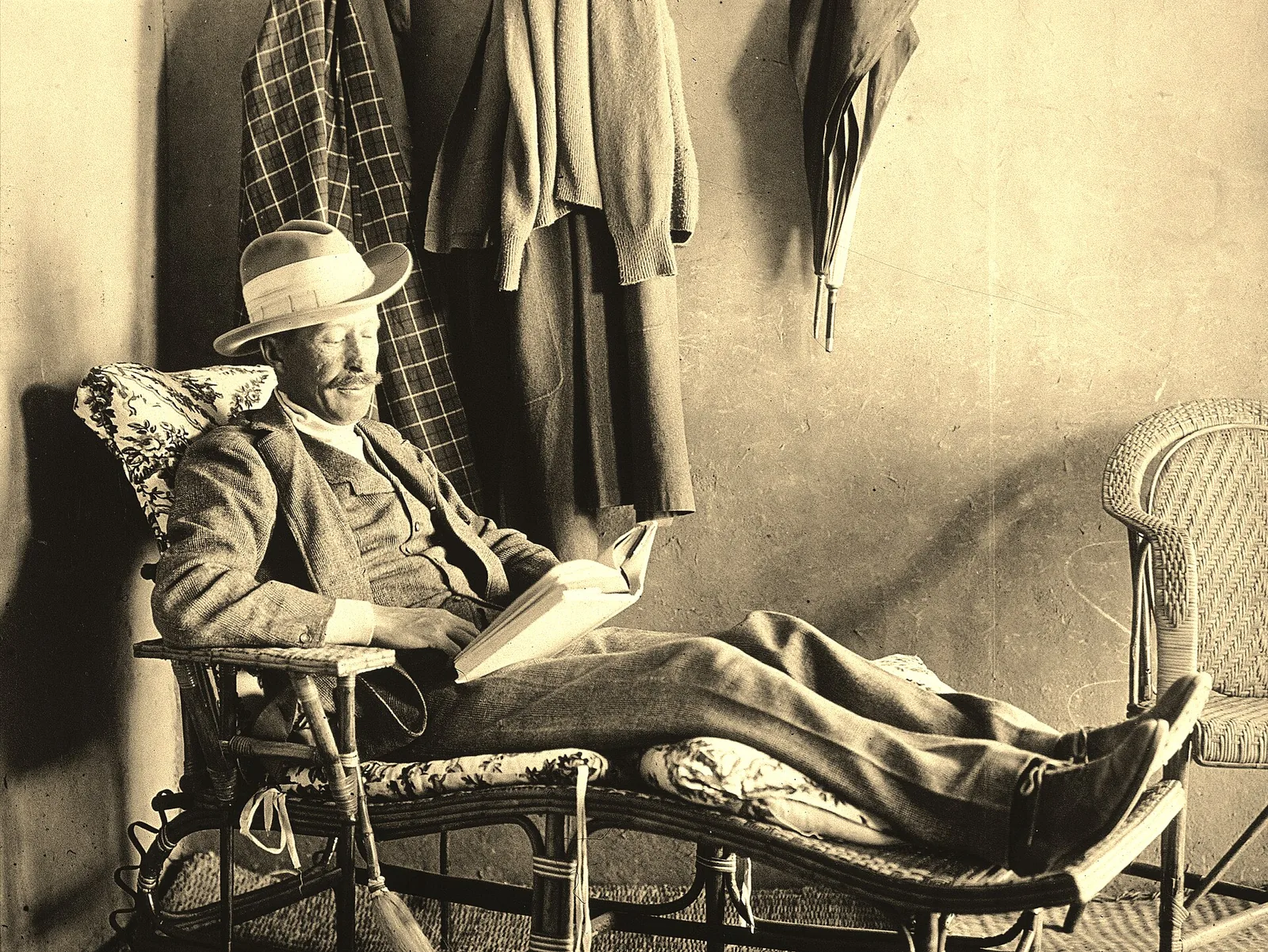
George Herbert, 5th Earl of Carnarvon, reading. Photo: Harry Burton, before 1923 · Public domain · Source page
Howard Carter, an English archaeologist, directed the dig. The money and the backing came from George Herbert, 5th Earl of Carnarvon, who was the patron of the dig. The Griffith Institute lists 1922–1923 as its first season.
Carnarvon did not dig himself. In the first weeks he also took photographs.
The first step
One step, and a seal
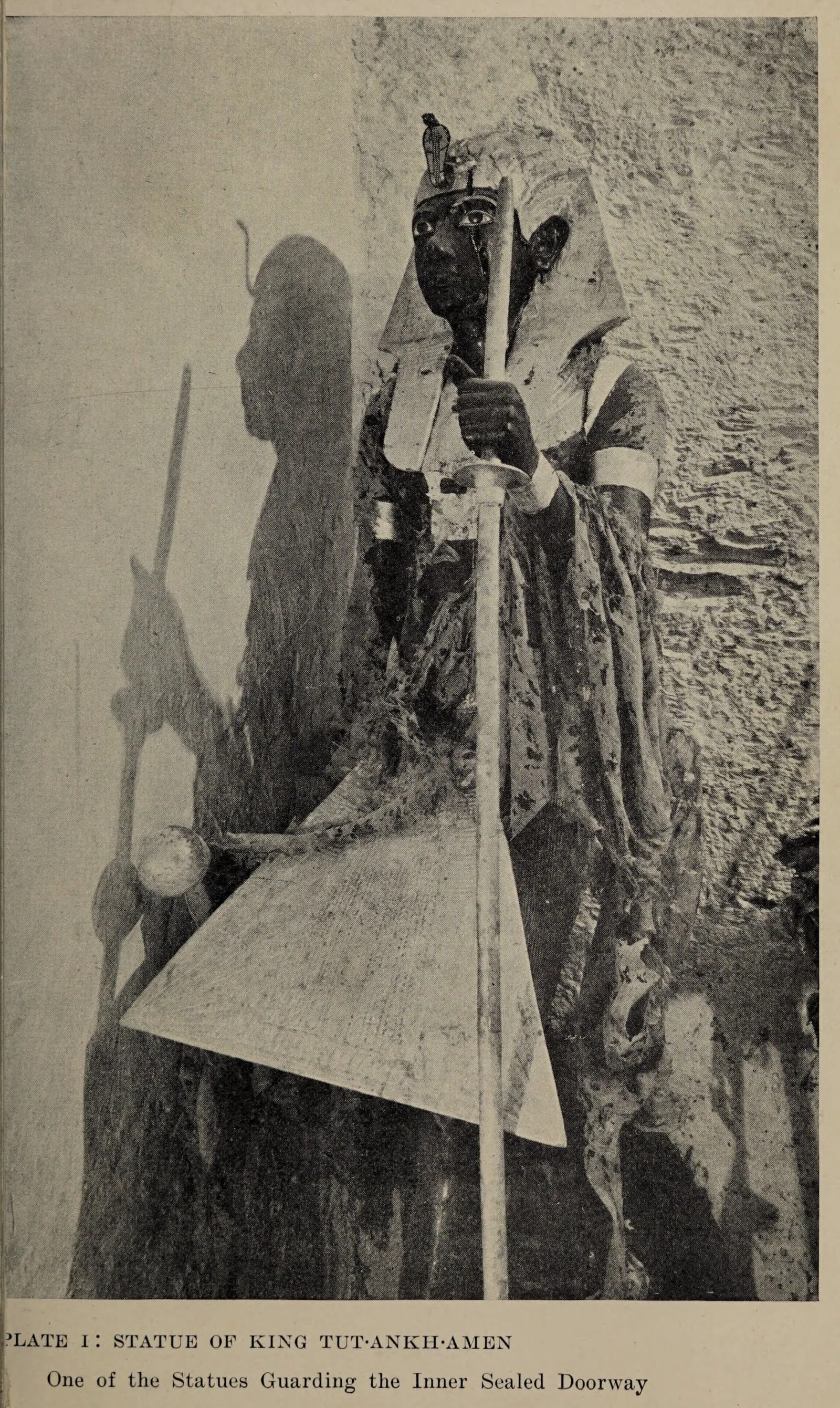
Howard Carter and A. C. Mace, The Tomb of Tut.ankh.Amen, vol. 1, Plate I. Harry Burton, 1923 · Public domain · Source page
On 4 November 1922 the team found a single step at the top of the entrance stairway. It was the first sign that there was more below.
Further down, the team reached a sealed doorway, its seals unbroken. What lay behind it could not yet be seen.
A decision point
You are Howard Carter, the director of the dig.
November 1922, at the sealed doorway.
The doorway in front of you is sealed, and its seals are whole. The sponsor, Carnarvon, is not here. You can send him a telegram, but he will need time to arrive.
Your decision will shape what is recorded, and who sees what lies behind the door first. You could open it now, wait for Carnarvon, or do something in between.
What do you do?
- Break the doorway open now, with your own team, and record everything. Probably a fast record, but the sponsor is shut out of the opening, and quarrels follow later.
- Send Carnarvon a telegram, and open nothing until he arrives and judges. Probably an orderly, shared opening, but only after a long wait while all work stands still.
- Send the telegram, wait for Carnarvon, then make a small hole, look inside, and decide the next step together. Probably a limited first look, with the sponsor beside the doorway, and then a joint decision about what comes next.
What really happened
Send the telegram, wait for Carnarvon, then make a small hole, look inside, and decide the next step together.
According to the usual account, Carter had the steps covered again and sent Carnarvon a telegram. On 26 November, with Carnarvon present, the two men made a small hole in the doorway and looked inside. The full opening came later.
Carter was not alone: Carnarvon's money and the dig's standing were at stake. A small hole let them look without opening the whole doorway at once.
The press
The paper that bought the story
Carnarvon sold the exclusive reporting rights to The Times. Only its correspondent, Arthur Merton, was allowed on the scene.
That made the paper the main outside witness, and what it printed shaped how the world saw the tomb. What the paper paid, and on what exact terms, is not known.
Yes, wonderful things
The moment
On 26 November 1922
Two men stand at a small hole in a sealed doorway. Behind them is a team, and far away a newspaper is waiting for news. One of the men, Carnarvon, asks a question.
What came next was written down by Carter himself, in the book he published in 1923. We will read his sentences.
Source: Carter's account, 1923
Carnarvon "inquired anxiously, 'Can you see anything?' it was all I could do to get out the words, 'Yes, wonderful things.'"
Written after the event by the man who ran the dig, whose sponsor had sold the press rights. Carter's own diary may read differently, and one secondary summary gives another wording. That wording could not be checked here, so the printed book is the basis.
- Who wrote this, when, and why? Carter, in 1923, after the event. It is the published account of the dig, written by the man who ran it, so it presents the moment as the peak of the excavation.
- What is the difference between a printed sentence and a diary? A printed sentence is built to be remembered. A diary is written as it happens, and may use other words. Without the diary we cannot judge how the line was shaped.
- Whose voice is missing from the story? No independent witness speaks here. The only outside reporter worked for a paper that had bought exclusive rights, so his account was not independent either.
The illness
One mosquito, then infection
In March 1923 a mosquito bit Carnarvon in the Valley of the Kings. The bite became infected. Erysipelas, a skin infection, spread into his blood, and pneumonia followed. He died in Cairo on 5 April 1923.
Some accounts give other details: a bite on the cheek, or a shaving cut that became infected. The version here follows the Griffith Institute's account.
The rumour
A curse in the headlines
Rumours of a curse on whoever disturbed the king spread through the British and American press. Carnarvon's death turned the rumour into a headline.
The curse is best read as a rumour that spread through the press and the public, not as evidence of anything.
Myth
The pharaoh's curse killed Lord Carnarvon.
The truth
Carnarvon died of an infection that began with a mosquito bite and spread to his blood and lungs. The curse was a rumour the press spread.
The evidence
The Griffith Institute's account: the bite in March 1923 in the Valley of the Kings, the infection, the pneumonia, and his death in Cairo on 5 April 1923.
How did the boy king die?
A decision point
You are Howard Carter, after Carnarvon's death.
February 1924.
The work in the tomb goes on, and the finds are very many. Under the old custom, a foreign excavation could receive a share of what it found, a practice called partage. The original sponsor is no longer alive.
The Egyptian government wants wider access to the dig. Many Egyptians, and the press above all, feel they get too little of it. The sponsors who remain want their share. The decision is yours.
What do you do?
- Stop the work until the government and the sponsors agree on terms. Probably a long delay and a legal dispute, but also an agreement that recognises every side's rights.
- Keep working under the old rules, with access and shares as agreed before. Probably faster work, but anger in the government grows, and the dispute comes anyway.
- Accept government control of access and of every find from the start. Probably a quick peace, but the sponsors lose the share they paid for, and the government sets the terms for the press.
What really happened
Stop the work until the government and the sponsors agree on terms.
Work stopped in February 1924. The legal dispute ran until January 1925. The settlement did not divide the finds between the government and the sponsors, as earlier practice had allowed, and most of the contents went to the Egyptian Museum in Cairo.
Carter and the sponsors relied on the old custom. The government wanted wider access. In the end the finds were not divided, which broke earlier practice. Both sides had a case.
Myth
Tutankhamun was murdered with a blow to the head.
The truth
A CT scan in 2005 found no evidence of a blow to the back of the skull. The cause of death is still disputed, and the scan did not settle it.
The evidence
NPR's headline of 9 March 2005 said that a blow to the head did not kill King Tut, according to a CT scan.
Source: The 2010 JAMA study, abstract
The authors write that they "speculated about individual causes of death."
The study examined eleven royal mummies dated to about 1410 to 1324 BC. The authors' affiliation line gives the Supreme Council of Antiquities in Cairo.
- Who wrote the study, and who stands behind it? A team of 17 researchers led by Hawass. Ask whether the body that runs Egypt's antiquities has a stake in the result.
- What do the authors themselves say about how sure they are? Their conclusion says they speculated about individual causes of death. Their results say that none of the conditions alone would have caused death.
- What does 'most likely cause' mean in a study like this? It is the team's best guess from partial evidence: malaria together with bone necrosis. It is a reasoned hypothesis, not a proof. Ask yourself what evidence would convince you.
Can we know what killed a king more than three thousand years ago?
Can genetic tests and studies of mummies establish what killed a king?
- The 2010 team (Hawass and co-authors) In their view, malaria together with bone necrosis is the most likely cause. Each factor alone, they say, would not have been fatal.
- Critics, among them Tyldesley (2012) They question the validity and reliability of the genetic data.
What would convince you: better genetic evidence, a different kind of evidence, or nothing at all?
Myth
The boy king was an important king in his own time.
The truth
He was a minor king. He came to the throne at about eight or nine, reigned about nine years, and his name change was probably made on his advisers' advice. His fame comes from the tomb, not from his reign.
The evidence
More than 5,000 objects were found in the tomb. That is why we know him today.
What followed, in order
- About 1323 BC The king dies at about eighteen or nineteen and is buried in the small tomb, KV62, in a rush, according to Archaeology magazine.
- After his death Ay takes the throne for a very short time, and Horemheb follows him. Dodson (2009) argues that Horemheb later had the names of the Amarna kings erased from many monuments, and Ankhesenamun's figure too.
- 4 November 1922 The first step is found. On 26 November a small hole is made in the doorway, with Carnarvon present.
- 5 April 1923 Carnarvon dies in Cairo, after a mosquito bite and infection.
- February 1924 Work stops, and the dispute over access and finds goes on.
- January 1925 The settlement: most of the contents stay in Egypt, in the Egyptian Museum in Cairo.
- 2005 A CT scan finds no evidence of a blow to the back of the skull.
- 2010 A study in JAMA suggests malaria with bone necrosis as the most likely cause. Critics question the genetic data.
Check yourself
What did Carter's team find on 4 November 1922?
Answer: The first step at the top of the entrance stairway. Right. It was a single step at the top of the stairs, the first sign that there was more below.
Check yourself
Where and when did Lord Carnarvon die?
Answer: In Cairo, on 5 April 1923. Right. After the bite, the infection and the pneumonia, he died in Cairo on 5 April 1923.
Check yourself
Which newspaper was given exclusive reporting rights on the tomb?
Answer: The Times. Right. Only its correspondent, Arthur Merton, was allowed on the scene.
Check yourself
Which cause of death did the 2010 JAMA study name as most likely?
Answer: Malaria with bone necrosis. Right. The study saw this as the most likely cause, while admitting that it speculated.
Check yourself
Who found the Restoration Stela, and where?
Answer: Georges Legrain, at Karnak, in July 1905. Right. Legrain found it in a corner of the great hall, where it had been broken into five pieces.
Check yourself
After the settlement of January 1925, where did most of the contents go?
Answer: To the Egyptian Museum in Cairo. Right. The Egyptian Museum in Cairo received most of the contents.
Terms
- Aten The sun disk. Akhenaten made it the chief god of the state, and the older god Amun was pushed aside.
- Amarna The city Akhenaten built in the desert as the centre of Aten's worship. His period is named after it.
- pharaoh The king of ancient Egypt.
- regnal year The count of years from the day a king came to the throne. 'Year 3' means his third year. The year number can be disputed.
- stela An upright stone slab, carved with a text and often a picture, set up in a temple or public place.
- patron A rich backer who pays for an excavation, and often expects a share of what it finds.
- partage The old custom by which a foreign excavation received a share of what it found.
- Hittites A great kingdom in Anatolia, in today's Turkey, and a rival of Egypt in this period.
- malaria A disease spread by mosquitoes, caused by a parasite, that brings recurring fever and can be fatal.
- bone necrosis The death of bone tissue when its blood supply is cut off.
- CT scan A computer X-ray scan that builds a picture of the body in slices.
- Akhenaten The king who changed Egypt's religion, made Aten the chief god, and built a new city in the desert.
- Amun The old chief god of Egypt. He was pushed aside under Akhenaten and restored to the centre afterwards.
- Ay The most senior adviser at the young king's court. He came to the throne for a very short time after the king's death.
- Fan-bearer on the Right Side of the King A court title in Egypt: the man who stood at the king's right side and carried a fan. Ay held it.
- Horemheb Commander-in-chief of the army at court, who became king after Ay. He is a possible suspect in Zannanza's death.
- Suppiluliuma The Hittite king. He received a letter asking him for a son, and blamed Egypt for the death of Prince Zannanza.
- Ankhesenamun The king's widow, who may have written to the Hittite king asking for a son. Her identity is not certain.
- Zannanza A Hittite prince who set out for Egypt and died on the way. Nobody knows for certain how.
- Dakhamunzu The name the letter gives its writer. The most likely identification is Ankhesenamun, but it is not certain.
- Murnane An Egyptologist who argued that year one on the stela is impossible, because the king still bore his old name then.
- Georges Legrain The man who found the Restoration Stela at Karnak in July 1905.
- Karnak A huge temple complex in southern Egypt. The Restoration Stela was found there.
- Restoration Stela A stela from the young king's time describing what he did for the temples. It is the king's own presentation.
- Great Hypostyle Hall A hall full of columns in the Karnak temple. A fallen column smashed the stela there.
- Valley of the Kings A valley in southern Egypt where the great pharaohs were buried.
- Griffith Institute An Egyptology research institute. It lists 1922–1923 as the dig's first season.
- Egyptian Museum in Cairo A museum in Cairo. After the settlement most of the tomb's contents went there.
- Supreme Council of Antiquities The Egyptian government body in charge of antiquities, based in Cairo.
- Erysipelas A skin infection that spread into the blood. It was part of Carnarvon's death.
- Howard Carter An English archaeologist who ran the dig in the Valley of the Kings. His team found the tomb in 1922.
- Dodson A scholar who holds that a court faction opposed the Hittite prince, and that no single plot is needed to explain the death.
- The Times A newspaper that bought the exclusive reporting rights to the tomb from Carnarvon.
Sources
- Howard Carter and A. C. Mace, The Tomb of Tut.ankh.Amen, vol. 1 (1923). Internet Archive copy
- Restoration Stela, Cairo, Egyptian Museum, CG 34183, from Karnak. The king's own inscription; quoted here only in paraphrase
- The Deeds of Suppiluliuma, as told by his son Mursili II, as cited by Guterbock
- Zahi Hawass et al., 'Ancestry and Pathology in King Tutankhamun's Family', JAMA 303, no. 7 (2010): 638–647
- Dodson, 'Amarna Sunset' (2009)
- Tyldesley (2012)
- Griffith Institute, 'Lord Carnarvon' (online)
- NPR, 'Head Blow Did Not Kill King Tut, CT Scan Suggests', 9 March 2005
- Archaeology magazine, 'Inside King Tut's Tomb', May–June 2019
Image credits
- Funerary mask of Tutankhamun, Egyptian Museum, Cairo. Photo: Bjørn Christian Tørrissen, 2003 · CC BY-SA 3.0 · Source page
- Standing statue of Akhenaten, 18th Dynasty, Egyptian Museum, Berlin. Photo: Gary Todd, 2016 · CC0 · Source page
- George Herbert, 5th Earl of Carnarvon, reading. Photo: Harry Burton, before 1923 · Public domain · Source page
- Howard Carter and A. C. Mace, The Tomb of Tut.ankh.Amen, vol. 1, Plate I. Harry Burton, 1923 · Public domain · Source page


