Turenne
He fought for the king, then against him, then for him again, and was killed by a cannonball while studying the enemy lines.
Decisions, questions and your own progress, in the app
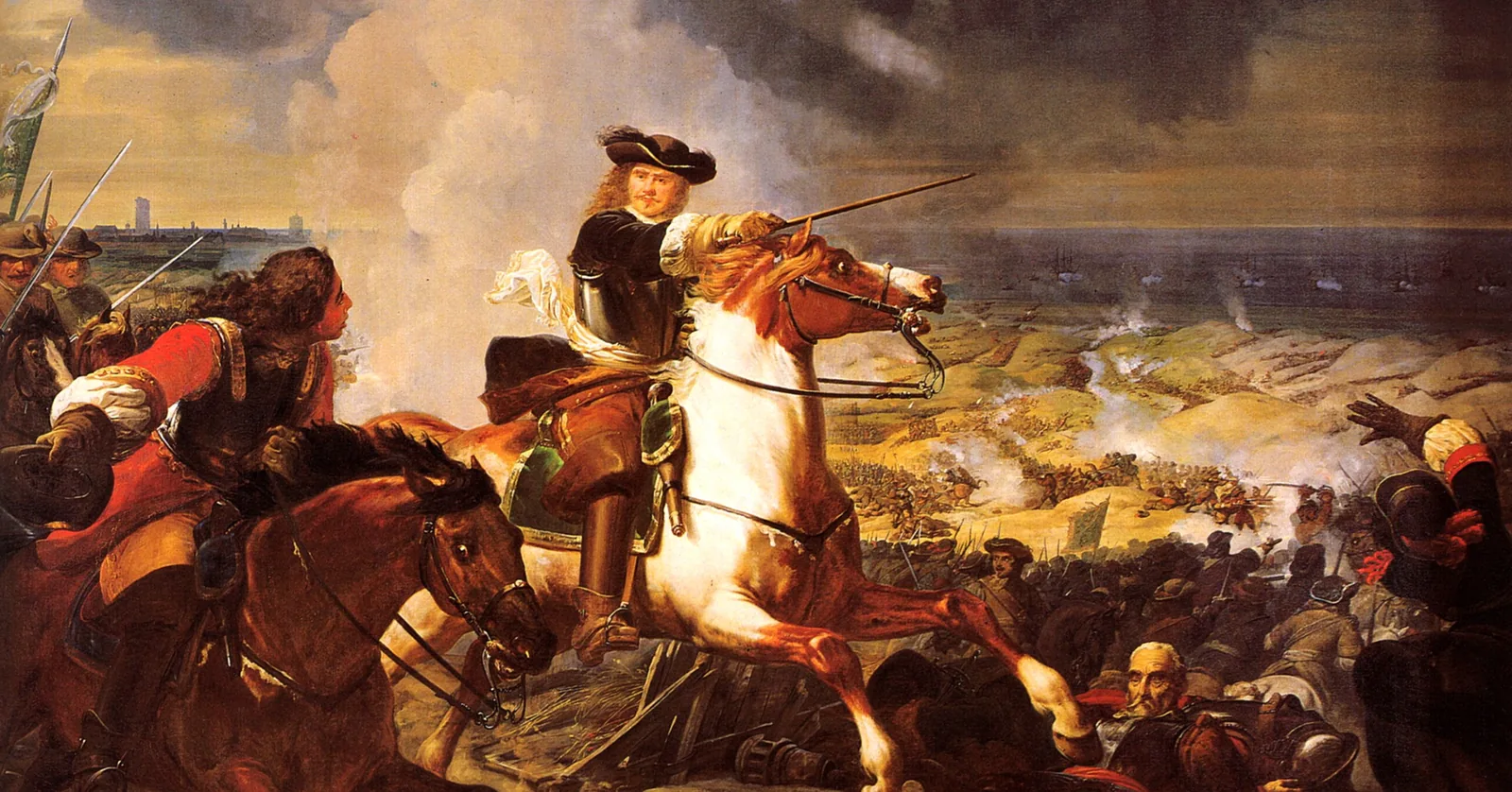
Charles-Philippe Larivière, The Battle of the Dunes, 1837 (detail). Palace of Versailles, Gallery of Battles · Public domain · Source page
One cannonball
A summer afternoon, a hill near Sasbach
Saturday afternoon, 27 July 1675, near Sasbach, east of the Rhine. A grey-haired man of 63 rides up a slope to look at the enemy's lines. An officer warns him that the enemy guns are firing at this very spot, and he moves a few paces.
A cannonball from a distant battery strikes him. He slides from his horse, opens his eyes twice, and dies. So, at least, his servants told it a month later.
He was Henri de La Tour d'Auvergne, vicomte de Turenne, the most admired general of Louis XIV. He had fought for the king, then against him, then for him again. He was born a Protestant prince's son and died a Catholic marshal. Napoleon told young officers to study his campaigns, and France buried him among its kings. Who was he?
Turenne (Henri de La Tour d'Auvergne, vicomte de Turenne)
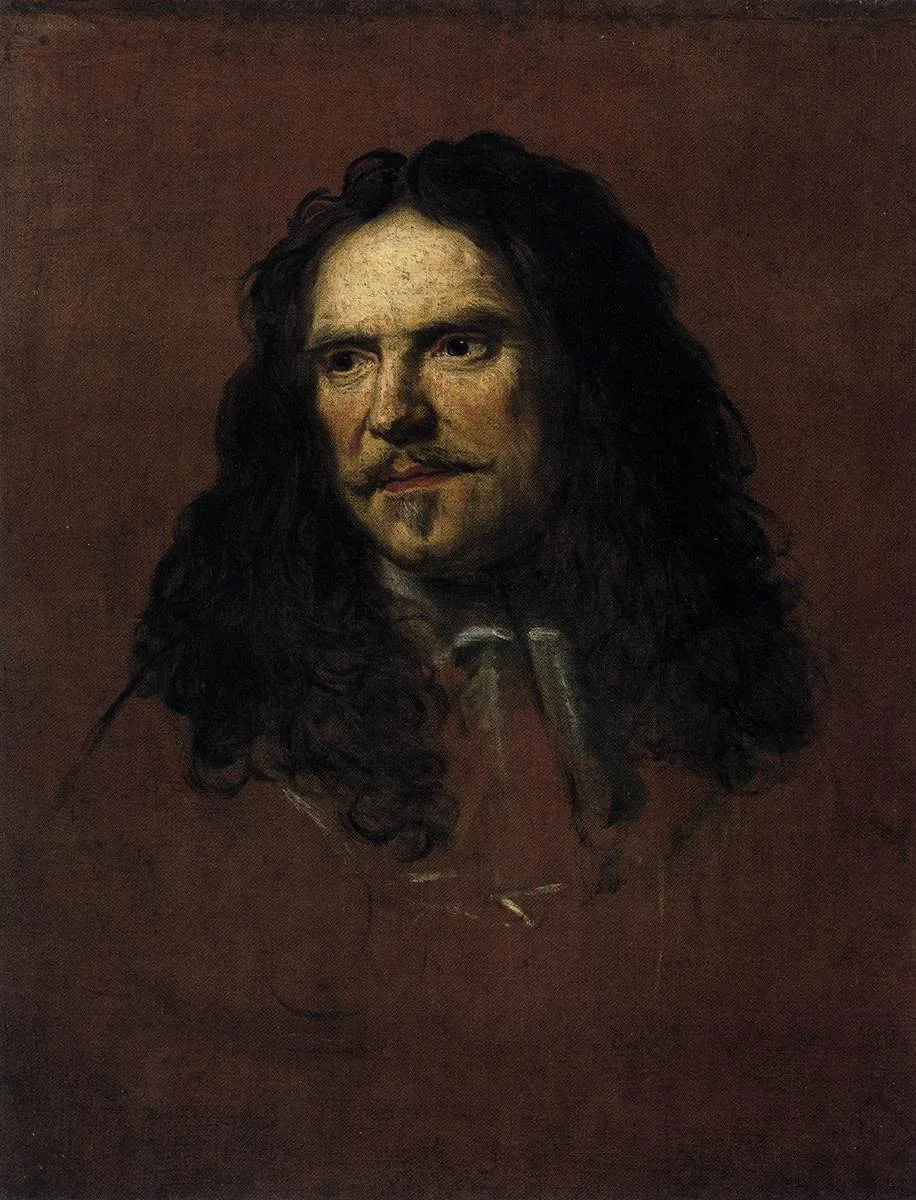
Charles Le Brun, Portrait of Turenne, c. 1665. Palace of Versailles · Public domain · Source page
A Protestant prince's younger son who rebelled against the crown, then saved it, and became the general Napoleon told officers to study.
- Born: 11 September 1611, Sedan, then an independent Protestant principality; second son of the duc de Bouillon and Elisabeth of Nassau
- Died: 27 July 1675, aged 63, Near Sasbach in Baden, east of the Rhine, struck by a cannonball while reconnoitring the enemy lines
- Won: Nördlingen, 1645 (with the duc d'Enghien); Zusmarshausen, 1648 (with the Swedes); Arras, 1654; The Dunes, 1658; Sinsheim, 1674; Turckheim, 1675
- Lost: Marienthal, 1645; Rethel, 1650 (as a rebel, with the Spanish); Valenciennes, 1656
“The enemy came to us and God be praised they have been defeated: I was pretty busy all day, which has fatigued me: I wish you good night: I am going to bed.”
A prince without a principality
Background
Sedan, 1611
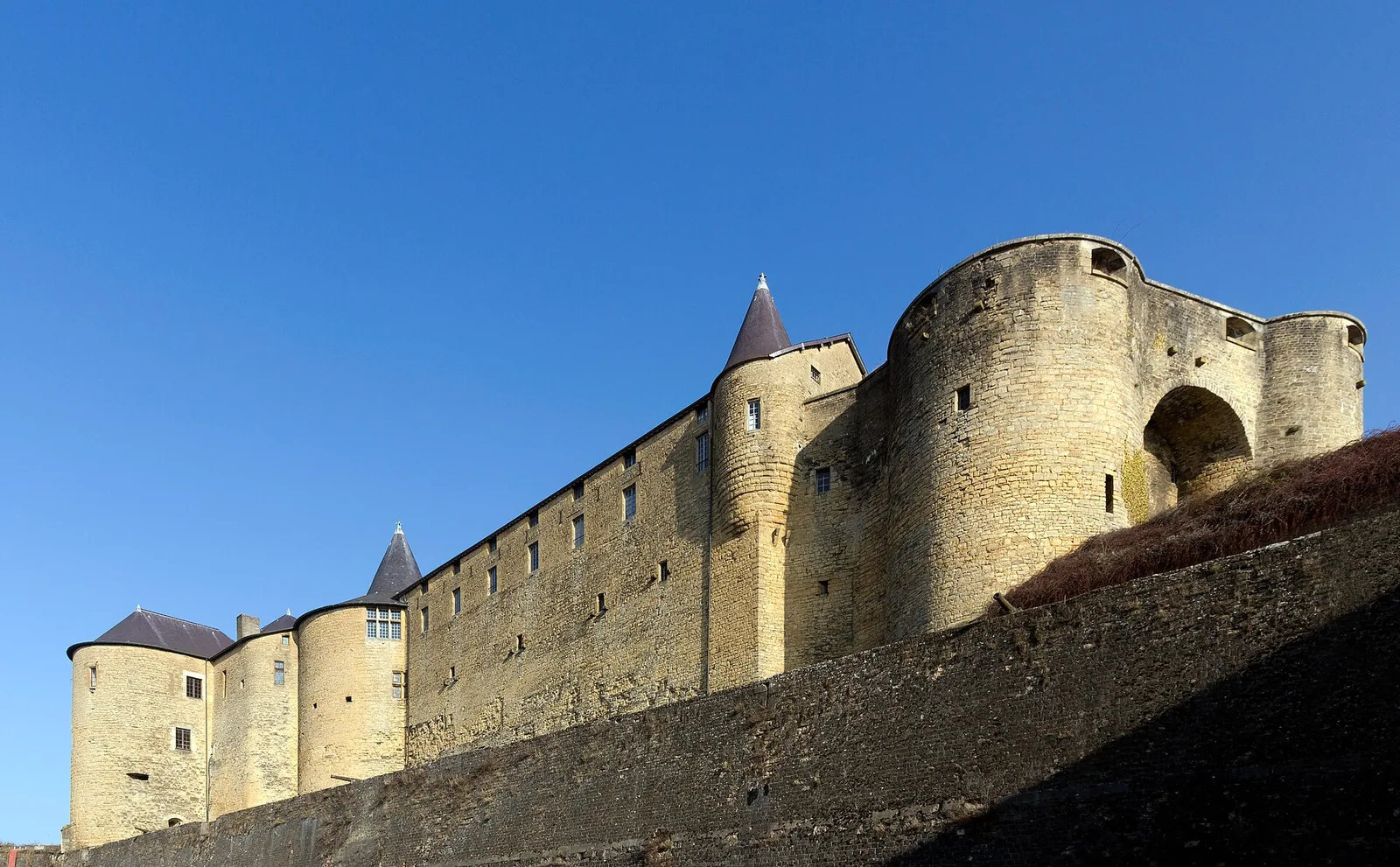
The château of Sedan, 2017. Photo: Dietmar Rabich, CC BY-SA 4.0 · CC BY-SA 4.0 · Source page
Turenne was born in this castle on 11 September 1611. Sedan was then a tiny independent principality on France's border and a refuge for the Huguenots, the Protestants of France. His father, the duc de Bouillon, was one of their leaders. His mother, Elisabeth of Nassau, was a daughter of William the Silent, Prince of Orange, the man who led the Dutch revolt against Spain.
He was a second son, with no inheritance of his own, and a sickly child, slow of speech and poor at Latin. A family story, written down only about a century later, says that at ten he spent a night on the ramparts to prove he could stand a soldier's life, and was found in the morning asleep on a gun carriage.
The apprentice
A private in his uncles' army
In 1625, at 13, Turenne was sent to the Dutch Republic, to the army of his uncles, Maurice and then Frederick Henry, Princes of Orange. It was the best school of war in Europe: drill, discipline, and the patient digging of trenches round besieged towns. He began as a private soldier and within a year was a captain.
In 1630 he entered the service of the King of France. That too was family business: Sedan's safety depended on the king's goodwill, and Cardinal Richelieu liked to keep the sons of great Protestant houses close. Turenne got a regiment, and never left the French army again, except twice, when he rebelled against the crown.
The Thirty Years' War
Twenty years of war in Germany
In 1635 France entered the Thirty Years' War openly, against Spain and the Emperor. Turenne fought on the Rhine, in Italy and in Flanders, and learned from Bernhard of Saxe-Weimar, a German general in French service. In 1638 he helped him take Breisach, the fortress that commanded a crossing of the Rhine.
In 1643, aged 31, he became a Marshal of France and took over the Army of Germany. With the young duc d'Enghien, later the Grand Condé (the subject of the next lesson), he fought the bloody battles of Freiburg (1644) and Nördlingen (1645). In between he lost on his own at Marienthal (1645). In 1648 he won at Zusmarshausen with the Swedes. The rearguard of the retreating Imperial army there was commanded by an Italian general named Montecuccoli. They would meet again.
The Peace of Westphalia that year gave France Breisach and most of the Habsburg rights in Alsace.
Rebel, then saviour
The Fronde
France against its cardinal
In 1648 Louis XIV is still a child. In his name rule his mother, Anne of Austria, and Cardinal Mazarin, an Italian-born minister whom many in France hate. In Paris the Fronde breaks out.
Turenne's family had a score to settle. In 1642 his elder brother, the duc de Bouillon, had been caught in a plot against Richelieu and saved his head only by handing Sedan to the crown. The family wanted it back, or fair compensation. Early in 1649 Turenne declared for the rebels. His army did not follow him: Mazarin had money, and the German regiments stayed with whoever paid. Turenne fled to Holland.
In 1650 Mazarin arrested Condé. Turenne joined Condé's sister, the duchesse de Longueville, in the fortress of Stenay, and in April signed a treaty with Spain, still at war with France. In December 1650, near Rethel, a royal army smashed his Spanish and French rebel force.
A decision point
You are Turenne.
February 1651, after the defeat at Rethel
You are 39, a general without an army, and your name is on a treaty with Spain. Now Mazarin has had to free Condé and the other princes and go into exile. But he still pulls the strings through the queen.
Condé, free and proud, is courted by every faction, and the queen distrusts him; your Spanish allies still expect you to fight on. Your brother is negotiating compensation for Sedan. The king, aged 12, will soon come of age.
What do you do?
- Stay with Condé and his Spanish allies You would probably have fought for Spain against the French army again, as Condé did, and lost any chance of returning to court for years.
- Make peace with the court and serve the king again Turenne made his peace with the court in 1651, and the next year he commanded the royal army against Condé.
- Leave politics and live quietly, perhaps in Holland You would probably have kept your honour but lost your career and your family's voice at court, just as it was fighting for Sedan.
What really happened
Make peace with the court and serve the king again
Turenne returned to Paris in May 1651 and made his peace with the court. When Condé rebelled again that autumn and called in the Spanish, Turenne commanded the royal army against him. His family received compensation for Sedan and the rank of 'foreign princes' at court.
In his memoirs Turenne says almost nothing about his rebellion. His admirers argued that he rebelled against Mazarin, not the king; his biographer Jean Bérenger stresses family interest. The historian Orest Ranum shows that the princes' revolt offered no programme, and once it became a war on Spain's side, a soldier like Turenne could not serve it.
2 July 1652
The guns of the Bastille
In the spring of 1652 Turenne commands the king's army and Condé the rebels'.
On 2 July Turenne traps Condé's army under the walls of Paris, in the Faubourg Saint-Antoine. The city shuts its gates. The 13-year-old king watches from the heights of Charonne. Then the king's cousin, the duchesse de Montpensier, 'La Grande Mademoiselle', has the gate opened and the guns of the Bastille fired on the king's troops. Condé's men escape into the city.
In October the king re-entered Paris. Condé went over to Spain.
The Dunes, 1658
Turenne against Condé
Old partners, new enemies
For six years the former partners Turenne and Condé fought each other on France's northern frontier and in the Spanish Netherlands. In 1654, at Arras, Turenne broke into the Spanish siege lines by night and saved the town. In 1656, at Valenciennes, Condé and Don Juan José of Austria surprised one of the French camps, and Turenne had to retreat.
Then Mazarin made an astonishing deal. In 1657 Catholic France allied with Oliver Cromwell's Puritan England: 6,000 English foot and a fleet, and in return England would get Dunkirk, the pirates' nest of the Channel. In May 1658 Turenne laid siege to Dunkirk, while the English fleet blockaded it from the sea.
A decision point
You are Turenne.
The evening of 13 June 1658, in the siege lines before Dunkirk
Your trenches are creeping towards the walls. Today a Spanish relief army, with some of Spain's best tercios, marched up the coast under Don Juan José and Condé and camped in the dunes, less than two kilometres away. It has not dug in. Whether it brought its heavy guns, you cannot be sure.
Your lines are long and thinly held, the English are impatient, and if you march out, the garrison may sally out behind you. The accepted rule of the age: a besieger stays behind his works and lets the relief army break its teeth on them.
What do you do?
- Stay behind the siege lines and wait for their attack The Spanish would probably have dug in, brought up guns and chosen when to strike the weakest point of your long lines. That is just how the French lines were broken at Valenciennes two years before.
- Raise the siege and pull back to safety The army would have been safe, but the whole campaign lost, and the alliance with Cromwell, built entirely round Dunkirk, would probably have fallen apart.
- Leave a force in the trenches, march out with the rest at dawn and attack in the dunes On the morning of 14 June the French and English marched out of the lines in two lines of battle, and by midday the Spanish army was broken.
What really happened
Leave a force in the trenches, march out with the rest at dawn and attack in the dunes
Turenne left about 6,000 men in the trenches and marched out to fight. The Spanish, hurrying to save Dunkirk, had indeed left their artillery and their entrenching tools behind. After a few hours of fighting in the sand they fled towards Furnes.
To wait was to give the enemy time to entrench and bring up guns. Napoleon thought the victory predictable, and historians stress the timing. Whether Turenne knew for certain that the Spanish had no guns is disputed: a later tradition tells of a deserter who told him in the night.
The Dunes: who fought whom
14 June 1658
The dunes between Dunkirk and Zuydcoote, on the North Sea coast
France and Cromwell's England
- Commanders: Turenne, The marquis de Créqui and the marquis de Castelnau, cavalry, Sir William Lockhart and Thomas Morgan, English foot
- Strength: about 14,000: 8,000 foot and 6,000 horse, 10 guns (Napoleon (1823), from Turenne's memoirs); 9,000 foot and 6,000 horse, plus 6,000 left in the trenches (T. A. Dodge (1895)); about 15,000, several thousand of them English (Modern estimate)
- Losses: about 400 killed and wounded, perhaps half of them English (Modern estimate)
Spain, Condé and the English Royalists
- Commanders: Don Juan José of Austria, The marquis de Caracena, Condé, with his French rebel horse, James, Duke of York (later James II), with the exiled English Royalists
- Strength: about 14,000: 6,000 foot and 8,000 horse, no guns (Napoleon (1823)); about 14,000–15,000, including some 2,000 English and Irish Royalists (Modern estimate)
- Losses: 3,000–4,000 prisoners, about 1,000 killed and wounded (Turenne's memoirs); about 1,000 killed, up to 3,000 wounded, 4,000–5,000 captured (Modern estimates (Tucker 2010; Clodfelter 2017))
Outcome: A decisive French and English victory by midday. Dunkirk surrendered ten days later and was handed to the English.
The memoirs give round figures, and 19th-century writers copied one another and sometimes swapped foot and horse. Part of the Spanish cavalry may have been out foraging.
The Battle of the Dunes
14 June 1658, from about eight in the morning to midday
14 June 1658, from the morning. Turenne's army, with Cromwell's English troops, besieges Dunkirk. A Spanish relief army, with some of Spain's best tercios, stands in the dunes between the sea and the canal, without entrenchments. At stake: Dunkirk.
One reconstruction, after Turenne's memoirs, the memoirs of James, Duke of York (who fought on the Spanish side), Napoleon's commentary (1823) and T. A. Dodge (1895), laid on the modern map of the coast between Dunkirk and Zuydcoote. The shoreline of 1658 lay somewhat inland of today's, so distances are approximate.
Disputed: the numbers, the exact timings, whether Turenne planned the attack around the falling tide (later accounts say so; the eyewitness passages used here do not), and whether part of the Spanish cavalry was away foraging.
Phases of the battle
- Two armies in the dunes The morning of 14 June. The Spanish army stands across the strip of dunes from the sea to the canal, without entrenchments and without guns. Turenne leaves about 6,000 men in the siege lines and draws up the rest in two lines.
- The advance through the sand The French line advances slowly through the soft sand, firing a few rounds from its guns. From the sea the English ships fire on the Spanish right, and Don Juan keeps his horse away from the beach.
- The high dune The English foot storm up the high dune held by Spain's best tercios and drive them off; the English commander, Fenwick, falls mortally wounded. The Duke of York charges them again and again, while the French horse ride along the beach and round the Spanish flank.
- Condé's charge By the canal Condé charges with his horse, throws Créqui's cavalry back several hundred paces and nearly breaks through. French foot and fresh squadrons brought up by Turenne stop him. On the other flank the Spanish are already breaking.
- Rout to Furnes By midday the Spanish army is fleeing east towards Furnes, leaving thousands of prisoners. Condé's horse is shot under him and he barely escapes. A sortie by the Dunkirk garrison is beaten back.
The strategy
- French and Cromwell's English: Turenne leaves about 6,000 men in the siege lines, so that the garrison cannot sally out behind him, and draws up the rest in two lines against an army with no entrenchments and no guns. The English ships fire on the Spanish right, and the French horse ride along the beach to turn the end of the line.
- Spanish and their allies: Don Juan José and Condé came to relieve Dunkirk and stood in the dunes without entrenchments or guns. Their tercios hold the high dune, and the horse is kept away from the beach, out of the ships’ fire. Part of the cavalry may have been out foraging, but that is disputed.
What decided it: The Spanish stood in the open with no entrenchments, so nothing stopped the French horse riding along the beach and round their flank. When the English drove the tercios off the high dune, the Spanish line broke.
After the Dunes
Dunkirk, the Pyrenees and a Marshal General
Dunkirk surrendered ten days after the battle. On 25 June Louis XIV rode in and handed its keys to Cromwell's ambassador. For four years Dunkirk was English, until King Charles II of England sold it to France in 1662. An exhausted Spain asked for peace.
In the Peace of the Pyrenees of 1659 France gained Roussillon and most of Artois, and Louis XIV married the King of Spain's daughter. Condé was pardoned and came home. In 1660 the king made Turenne Marshal General, above all the marshals of France. The king is also said to have offered to revive for him the old office of Constable of France, if only he became a Catholic. Turenne refused. In 1668, aged 57 and by then a widower, he became a Catholic all the same.
Source: The Dunes in a king's museum
Charles-Philippe Larivière, The Battle of the Dunes, 1837. Palace of Versailles
King Louis-Philippe turned the Palace of Versailles into a museum 'to all the glories of France' and filled its Gallery of Battles with huge paintings of French victories.
- When was it painted, and for whom? In 1837, 179 years after the battle, for a king's museum meant to unite the French round a glorious past. The painter saw nothing; he imagined the scene.
- Turenne waves a sword at the head of a charge. Is that likely? Not very. A commander-in-chief of 46 directed the battle from a vantage point and sent orders. The painting prefers personal heroics to what really won: timing, organisation, and guns against an enemy without any.
The last war
The Dutch War
Against his mother's country
In 1672 Louis XIV invaded the Dutch Republic, Turenne's mother's country, and Turenne marched with him. The Dutch flooded their own land to stop the French, and the war spread: the Emperor, Spain and German princes joined the Dutch.
In 1673 his opponent from Zusmarshausen, Raimondo Montecuccoli, the Emperor's best general, outmanoeuvred him and got through to Bonn, where he joined William of Orange. In 1674 Turenne was left on the Rhine with a small army against much larger forces. In June he crossed the river and beat the Imperial army at Sinsheim. Now he had to keep them away from Alsace.
Raimondo Montecuccoli
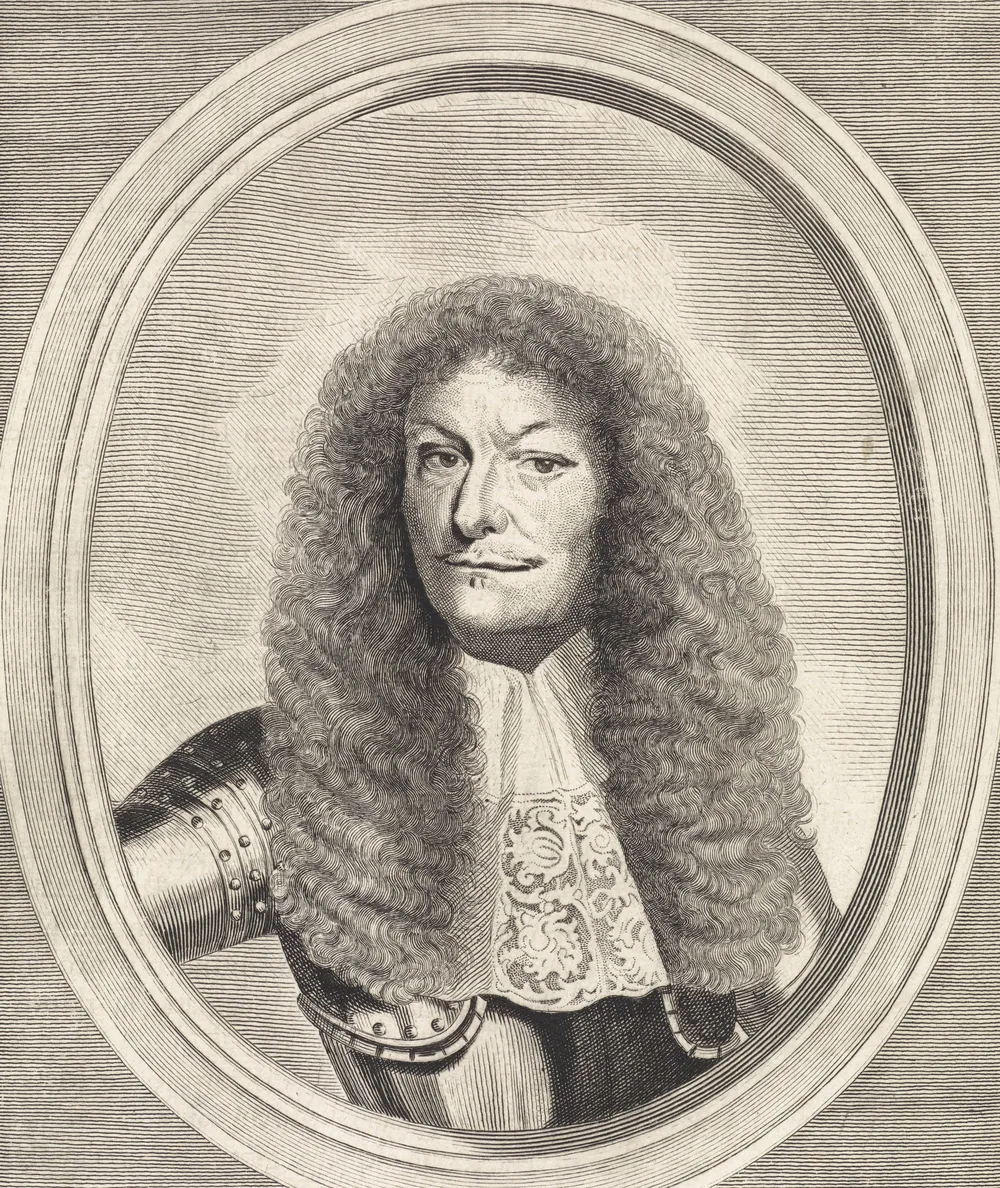
Franciscus van der Steen after Jan de Herdt, Portrait of Count Raimondo Montecuccoli, 1670–1674. Rijksmuseum, Amsterdam · CC0 · Source page
An Italian nobleman who served the Habsburg emperors all his life, wrote about war as a science, and was Turenne's last and most dangerous opponent.
- Born: 21 February 1609, The castle of Montecuccolo, near Modena
- Died: 16 October 1680, Linz, Austria, in an accident
- Won: Triebl, 1647; Saint Gotthard, 1664, against the Ottomans; The 1673 campaign against Turenne and the taking of Bonn
- Lost: Breitenfeld, 1631: captured by the Swedes; Mělník, 1639: captured again, for two and a half years
“A man has died today who did honour to mankind.”
A decision point
You are Turenne.
July 1674, in the Palatinate, north of the Neckar
You are 62, commanding a small army, perhaps 10,000 to 15,000 men. Your enemies are gathering much larger forces on the Neckar and the Main. The Palatinate, the rich land of the Elector Charles Louis, who has joined your enemies, feeds their armies and will be their base for an invasion of Alsace.
In the wars of the age an army lives off the land it occupies, and a country eaten bare will not feed an enemy. Peasants are murdering your stragglers, some of them cruelly, and your soldiers want revenge.
How do you treat the Palatinate?
- Take food and contributions in the usual way, and leave the country standing The enemy could probably have used the Palatinate as a base and a storehouse, but thousands of families would have kept their homes, and your name its honour.
- Strip the land between the Neckar and the Main so that no army can live there In late July the army ate the land bare and burned towns and villages. The enemy lost the Palatinate, and Turenne's name was stained for good.
- Punish only the villages where your men were murdered Probably fewer villages would have burned, but the land would have gone on feeding the enemy, and reprisals would still have struck families who had no part in the killings.
What really happened
Strip the land between the Neckar and the Main so that no army can live there
In the second half of July 1674 Turenne's army ate up the country north of the Neckar and burned towns and villages: between 25 and 30 of them, depending on the source. The Elector Charles Louis wrote Turenne a bitter letter and even challenged him to a duel; Turenne answered but ignored the challenge.
Wasting a frontier region was an accepted way to defend it: no army crosses a desert. Turenne claimed his soldiers burned villages in revenge, without his orders; most historians, as Longueville already noted in 1907, have held Turenne himself responsible. How much he ordered, and how much he let happen, is still argued.
Source: A prince writes to a marshal
The Elector: “I cannot see how the inhumanity of some private men … could have obliged you to ruin so many innocent families, and consume even the very churches of your own religion.”
Turenne: “the burning of some of your villages was without my order, and … the soldiers who found their comrades killed after a very strange manner, did it at hours when they could not be hindered.”
The Elector wrote after the fires. The two men had been on friendly terms before the war.
- What does each man want the reader to believe? The Elector: that he is an injured, law-abiding prince, and the guilt is all Turenne's. Turenne: that the fires were the soldiers' revenge, not his policy. Notice that he denies the order, not the burning.
- Turenne writes 'some of your villages'. What does 'some' do? It shrinks the scale. Other sources count 25 to 30 burned towns and villages, and Napoleon, an admirer, wrote that it was done by order of Louis XIV.
- Who preserved these letters, and why does it matter? Ramsay's biography was written for Turenne's family, and printed a reply that clears him. The English historian Macaulay, writing against Louis XIV in 1855, called the ravage 'a deep stain on his glory'.
A decision point
You are Turenne.
Late October 1674, at Dettwiller near Saverne, on the edge of Alsace
On 4 October you fought the Allied army at Entzheim, near Strasbourg. Nobody won. Since then Frederick William, the Elector of Brandenburg, has joined them with his army. Together they outnumber you, perhaps two to one.
Now they are spreading out into winter quarters across Alsace, in towns and villages from Mulhouse to Strasbourg. In Paris you are blamed for 'abandoning' Alsace. By custom your army too should now go into quarters until spring. Behind you rise the Vosges mountains, and beyond them roads run south through Lorraine.
What do you do?
- Go into winter quarters in Lorraine and guard the passes of the Vosges Probably safe, but the Allies would have wintered in Alsace, lived off it, and been ready in spring to push into Lorraine or Burgundy. Alsace might have been lost to France.
- Attack the Allied army in Alsace now, head-on Against an enemy twice your size and on its guard, probably a bloody defeat, and then nothing would have stood between the Allies and France.
- Pretend to go into winter quarters, march secretly south behind the Vosges and fall on their quarters from the south The army marched for weeks through snow and mud behind the mountains, came out near Belfort at the end of December and fell on Allied troops still scattered in their quarters.
What really happened
Pretend to go into winter quarters, march secretly south behind the Vosges and fall on their quarters from the south
Turenne sent his army south in separate columns, as if it were scattering into winter quarters. At the end of December it gathered near Belfort. On 29 December he scattered Allied troops near Mulhouse, and on 5 January 1675 he met their main army at Turckheim, near Colmar.
He had planned it in October, in a letter to the minister Le Tellier that the king read out at court. Winter campaigns were rare, because armies starved and froze; Turenne gambled that the enemy, scattered in its quarters, could not gather in time. Napoleon admired the plan but judged that Turenne showed 'more talent in the conception than in the execution': the march was slow.
Turckheim: who fought whom
5 January 1675
Between Turckheim and Colmar, Alsace
France
- Commanders: Turenne, The comte de Lorges, his nephew, on the right, Foucault, leading the flank column (killed)
- Strength: 40,000 (Napoleon (1823)); about 30,000, half of them foot (Ramsay (1735) and Dodge (1895))
- Losses: about 1,100 (G. Bodart (1908))
The Imperial and Brandenburg armies
- Commanders: The duc de Bournonville, Imperial army, Frederick William, Elector of Brandenburg
- Strength: 50,000 (Napoleon (1823)); about 30,000; not all were on the field on 5 January (G. Bodart (1916))
- Losses: about 3,400: some 900 killed and wounded and 2,500 captured (G. Bodart (1916)); about 3,000 wounded, sick and stragglers found in Colmar (Longueville (1907))
Outcome: A French victory. The Allies withdrew in the night and within two weeks had recrossed the Rhine. Alsace stayed French.
Only part of either army fought, and Napoleon's figures are round and high.
The Battle of Turckheim
5 January 1675, from morning to nightfall
5 January 1675, from the morning. Turenne's army comes up from the south past Eguisheim and faces north. The Imperial and Brandenburg troops wait behind the Logelbach, a mill stream that runs from the Fecht to Colmar. At stake: Alsace.
One reconstruction, after T. A. Dodge (1895) and T. Longueville (1907), who follow Turenne's dispatches, Ramsay (1735) and Napoleon's commentary, laid on the modern map round Colmar. The exact course of the Allied line, the route of the flank column through the hills and the numbers present are uncertain; positions are approximate.
Phases of the battle
- The French arrive The morning of 5 January 1675. Turenne's army comes up from the south past Eguisheim and forms a line facing north, beyond cannon range. The Allies stand behind the Logelbach, a mill stream that runs from the Fecht to Colmar.
- The feint Around eleven the French right under Lorges edges towards Colmar, as if the attack will fall there, and the Allies strengthen their left.
- Through the hills Meanwhile Turenne leads a column behind the vineyards and over a spur of the hills to Turckheim, which the Allies have left almost empty. Now the French stand on the flank of the whole Allied line.
- The fight for Turckheim Too late, the Allies send a strong force from their reserve to retake the town. About an hour before sunset the French attack across the stream. Their commander, Foucault, is killed and Turenne's horse is shot under him, but the French hold.
- Retreat in the night That night the Allies march away north, and within two weeks they recross the Rhine. In Colmar they leave some 3,000 wounded, sick and stragglers. Alsace is French again.
The strategy
- French: Lorges edges the French right towards Colmar as a feint, and the Allies strengthen their left. Meanwhile Turenne leads a column behind the vineyards and over the hills to Turckheim, which the Allies have left almost empty, and reaches the flank of their whole line.
- Imperial and Brandenburg troops: The Allies stand behind the Logelbach and strengthen their left as the French move towards Colmar, as if the attack will come there. They have left Turckheim almost empty, and they send their reserve to retake it.
What decided it: The Allies moved their strength to the left to meet the feint, and the French came over the hills onto their flank, while the reserve sent to Turckheim arrived too late. The lesson: a feint that draws strength to one side can leave the other flank open.
A cannonball, a tomb and a legend
The last summer
Sasbach, 27 July 1675
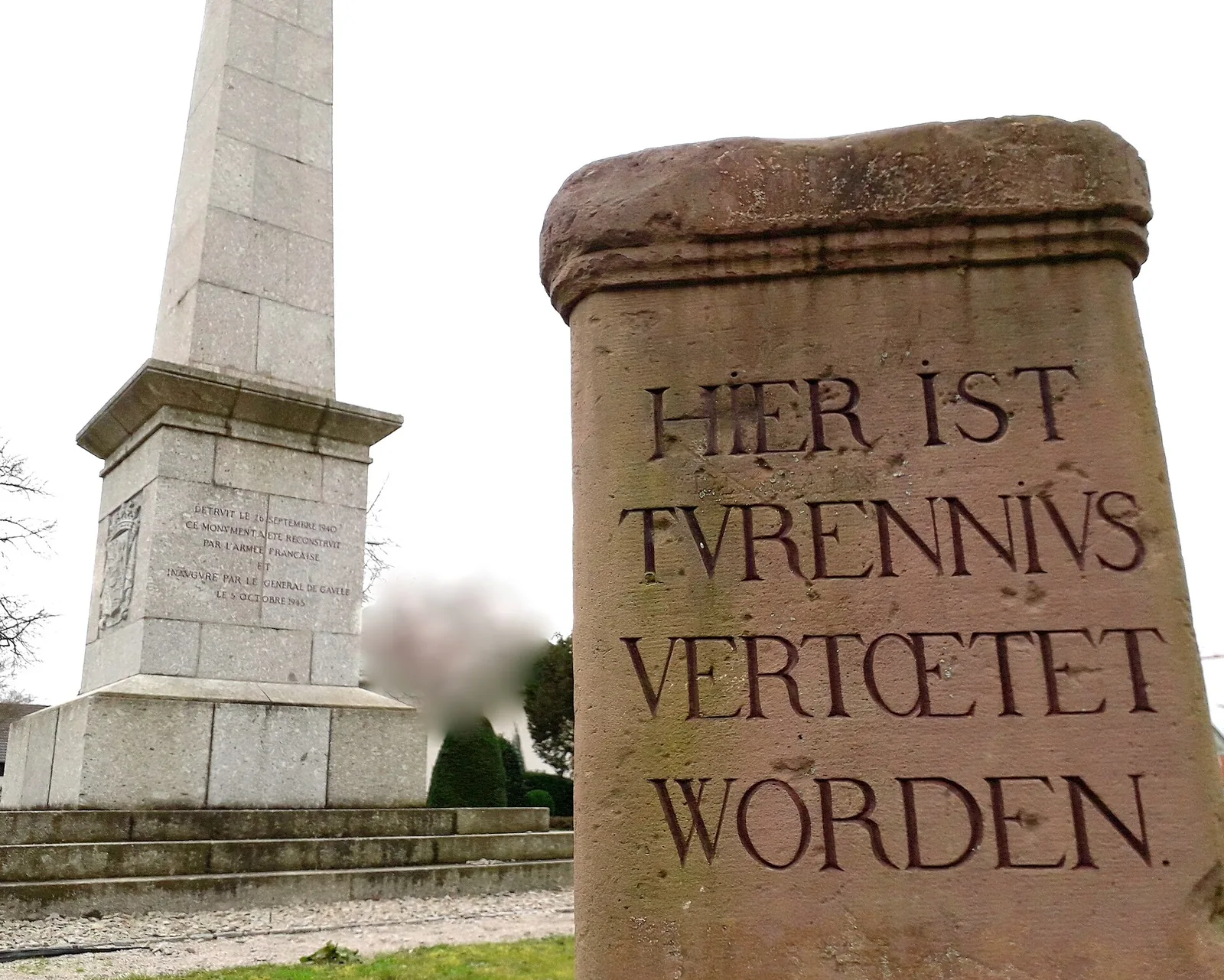
The Turenne memorial, Sasbach. Photo: Günther85, 2020, CC BY-SA 4.0 · CC BY-SA 4.0 · Source page
In the spring of 1675 Paris cheered Turenne. Then the king sent him back to the Rhine, against Montecuccoli. For two months the two old masters manoeuvred east of the Rhine. By late July, near Sasbach, Turenne believed he had his rival where he wanted him.
On the afternoon of 27 July he rode forward to look at a position for a battery, and the ball struck him. The same ball took off the arm of Saint-Hilaire, his general of artillery. Without Turenne the French army fought its way back across the Rhine. Louis XIV at once named eight new marshals and sent Condé to take his place. Condé, Madame de Sévigné reported, wished he could talk with Turenne's shade 'for two hours only', to learn his plans.
Source: A letter about a hero's death
“M. Hamilton … said to him, "Sir, come this way if you please, the enemy's fire is directed to the place in which you are." "You are right, Sir," replied M. de Turenne; "I would not willingly be killed to-day; this will do extremely well."”
Sévigné was not there. She wrote a month after the death, from what Turenne's servants told at the house of his nephew, Cardinal de Bouillon.
- How many links stand between the event and this page? At least three: what the servants saw, what they told at the cardinal's house a month later, and how Sévigné, a gifted writer, retold it to her daughter.
- Turenne's last words are a perfect, calm joke. Why be careful? Perfect last words are exactly what admirers remember and improve. They may be close to what was said, but they are polished: the hero stays calm and courteous to the end.
Myth
The enemy gunners aimed at Turenne and killed him on purpose: the ball was 'meant for him'.
The truth
No source of the time says the gunners knew he was there. A battery fired at long range at a group of horsemen on a hill, and one ball struck him. It was the risk any general ran who rode forward to see for himself.
The evidence
Madame de Sévigné, who loved the idea of fate, wrote of 'the cannon-ball shot at random, which singled him out from ten or twelve others', 'loaded from all eternity' by Providence, not aimed by a gunner. A 1685 life of Turenne, published under the name Du Buisson and usually credited to the novelist Courtilz de Sandras, blamed Saint-Hilaire's red cloak for catching the gunners' eye. 'Meant for him' turns chance into destiny.
Memory
Among the kings
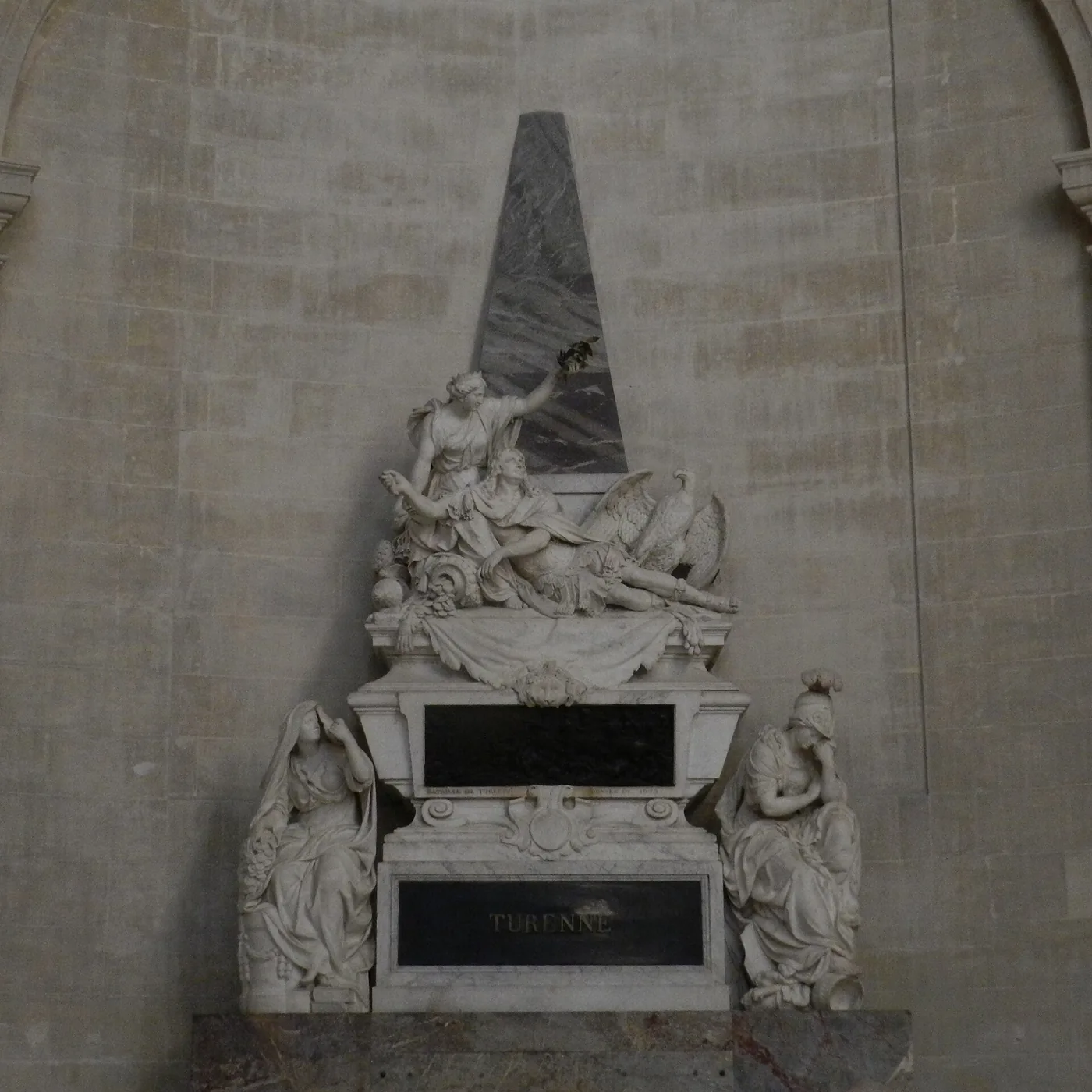
The tomb of Turenne, Les Invalides, Paris. Photo: couscouschocolat, 2013, CC BY 2.0 · CC BY 2.0 · Source page
Louis XIV had Turenne buried at Saint-Denis, the burial church of the kings of France: an honour almost no subject had received. The preacher Esprit Fléchier, later Bishop of Nîmes, preaching his funeral oration in January 1676, compared him to Judah Maccabee, the hero who fell defending his people.
In 1793 revolutionaries opened the royal tombs of Saint-Denis and threw the remains into a pit. Turenne's embalmed body was spared: he was a soldier of France, not a king, and for some years it was shown in Paris as a curiosity. In 1800 the First Consul, Napoleon Bonaparte, had him moved with great ceremony to the Invalides, the soldiers' church. Forty years later Napoleon's own remains were brought there. The two lie under the same dome.
Myth
Turenne was the gentle, humane general, the 'father' of his soldiers, who made war without cruelty.
The truth
He cared for his own men, and they loved him. But in 1674 his army burned 25 to 30 towns and villages in the Palatinate. He used devastation as a tool of war, like the other commanders of his age. The gentle image comes from funeral orations, admirers' letters and 19th-century biographies.
The evidence
The Elector's letter, Napoleon's own count of 'two towns and twenty-five villages', and Macaulay's 'deep stain', set against Fléchier's sermon and Ramsay's biography, written for the family.
What came next
- 1659 The Peace of the Pyrenees: France gains Roussillon and most of Artois, and Spain stops being the leading land power.
- 1675 Turenne is killed at Sasbach. Condé, his old partner and rival, takes over the Rhine army for his own last campaign: his story is the next lesson.
- 1678–1679 The Peace of Nijmegen ends the Dutch War. France gains Franche-Comté and towns in Flanders.
- 1681 France seizes Strasbourg, the great city of Alsace.
- 1688–1689 The Palatinate is devastated again, on a far larger scale, on Louvois's orders.
- 1800 Bonaparte moves Turenne's body to the Invalides.
A genius, or the great master of a cautious age?
Was Turenne a military genius who looked ahead to Napoleon, or the finest master of a slow, careful kind of war?
- Napoleon, in the commentary he dictated on St Helena (published 1823) and his recorded maxims Put Turenne on the list of great captains whose campaigns every officer should read again and again, and said his boldness grew with the years. But he criticised his slowness and his failure to follow up his victories, after the Dunes and in the winter campaign.
- Theodore Dodge, American military historian, Gustavus Adolphus (1895) Saw Turenne as a general ahead of his time, and the winter campaign of 1674–1675 as his masterpiece: a bold movement that decided a campaign almost without a great battle.
- John A. Lynn, The Wars of Louis XIV (1999) War in this age was mostly a slow business of sieges, supply and manoeuvre, not decisive battles. Turenne's greatness lay in mastering that kind of war: feeding an army, choosing ground, outmarching a rival. Not in anticipating Napoleon.
Perhaps both are true: a general can master the rules of his age and still break them when the moment comes, as Turenne did at the Dunes and behind the Vosges. In the next lesson: Condé, partner and rival, who won his battles in quite another way.
What do you know now?
Check yourself
Why did Turenne's army refuse to follow him into rebellion in 1649?
Answer: Its German regiments followed whoever paid them, and Mazarin had the money. Right. The Army of Germany was a mercenary force whose first loyalty was to its pay. Turenne learned that an army follows the paymaster, not the general.
Check yourself
What made attacking at the Dunes a good gamble?
Answer: The Spanish had come without their guns and had not dug in. Right. In their hurry to save Dunkirk the Spanish left their artillery and tools behind. Turenne struck before they could put it right.
Check yourself
What became of Dunkirk after the Battle of the Dunes?
Answer: It was handed to Cromwell's England; four years later Charles II sold it to France. Right. That was the price of the alliance: Louis XIV handed the keys to Cromwell's ambassador. In 1662 Charles II sold it to France.
Check yourself
What does Turenne claim in his reply to the Elector Palatine?
Answer: That the villages were burned without his order, by soldiers avenging their comrades. Right. Notice that he denies the order, not the burning, and speaks of only 'some' villages.
Check yourself
How did Turenne surprise the Allies in the winter of 1674–1675?
Answer: He pretended to go into winter quarters, marched south behind the Vosges and came out near Belfort. Right. The army marched in separate columns through the snow, gathered near Belfort at the end of December, and fell on Allied troops still scattered in winter quarters.
Check yourself
Which statement about Turenne's death is best supported by the sources?
Answer: A battery fired at a group of horsemen, and the ball struck him by chance. Right. No source of the time says the gunners recognised him. Even Sévigné, who saw the hand of Providence in it, wrote of a ball 'shot at random'.
Terms
- Huguenots The Protestants of France, followers of John Calvin's teaching. After long wars of religion they won limited freedom of worship in the Edict of Nantes (1598); Louis XIV revoked it in 1685.
- Thirty Years' War A series of wars that wrecked Germany from 1618 to 1648. It began as a war of religion between Catholics and Protestants and became a power struggle between France, Sweden, Spain and the Habsburg emperor. It ended with the Peace of Westphalia.
- Army of Germany The army France kept on the Rhine: mostly the veteran German regiments of Bernhard of Saxe-Weimar, which passed into French pay after his death in 1639. Their first loyalty was to their pay and their own officers.
- Marshal of France The highest military rank in France, given by the king to a few generals. A marshal could command a whole army.
- Marshal General A rare title that placed its holder above all the marshals of France. Turenne received it in 1660; only a handful of men ever held it.
- Fronde The wave of revolts in France from 1648 to 1653 against Cardinal Mazarin and the queen mother's regency: first the Parlement of Paris, then the great princes. The name comes from the fronde, the sling with which Paris children shot stones.
- tercio A Spanish infantry regiment of pikemen and musketeers who fought in deep blocks. For more than a century the tercios were thought the best infantry in Europe.
- siege lines Trenches and earth ramparts dug by a besieging army round a town. An inner ring faced the town; an outer ring, the line of circumvallation, faced outwards against an army coming to relieve it.
- winter quarters The custom of halting war in winter: armies spread out into villages and towns, ate and rested, and took the field again in spring.
- contributions Money, food and fodder that an army levied from occupied land under threat. A village that did not pay was burned.
- Elector One of the few German princes who chose the Holy Roman Emperor. The Elector Palatine ruled lands on the Rhine and the Neckar, with his capital at Heidelberg.
- Sedan A tiny independent principality on France's border, a refuge for the Huguenots. Turenne was born there.
- duc de Bouillon The title of a French noble. Turenne's father was one of the leaders of France's Protestants.
- William the Silent The Prince of Orange who led the Dutch revolt against Spain. Turenne's maternal grandfather.
- Mazarin An Italian-born minister who ruled France in the name of the young king. Many in France hated him.
- Richelieu The chief minister of France before Mazarin. He kept the sons of great Protestant families close to him.
- Anne of Austria The mother of Louis XIV. She ruled in his name while he was a child.
- Breisach A fortress that controlled a crossing of the Rhine. Turenne helped take it in 1638.
- Bernhard of Saxe-Weimar A German general in French service. Turenne learned from him. He died in 1639 and his soldiers lost their commander.
- Freiburg A bloody battle in 1644, which Turenne fought alongside the young duc d'Enghien.
- Marienthal A battle in 1645 that Turenne lost. He had spread his cavalry through the villages to feed it.
- Zusmarshausen A battle in 1648 where Turenne won with the Swedes against the retreating Imperial army.
- Peace of Westphalia The treaty signed in 1648 that ended the Thirty Years' War. It gave France Breisach.
- Condé A French prince of the blood and general. He rebelled against the king, then served Spain. Later called the Grand Condé.
- Montecuccoli An Italian general in the Emperor's service and Turenne's opponent in the wars of the age.
- Dunkirk A port in northern France on the Channel, once a pirates' nest. In 1658 Turenne besieged it.
- Oliver Cromwell Leader of Puritan England. In 1657 France made an alliance with him.
- Peace of the Pyrenees The peace treaty between France and Spain, signed in 1659.
- Palatinate A rich region in Germany ruled by the Elector Charles Louis. In 1688–1689 it was laid waste.
- Louvois The war minister of Louis XIV. In 1688–1689 he ordered the Palatinate laid waste.
- Saint-Denis The burial church of the kings of France, near Paris. Louis XIV ordered Turenne buried there.
- Invalides The soldiers' church in Paris. In 1800 Turenne was moved there, and later Napoleon's remains were brought there too.
- Judah Maccabee A Jewish leader who fell in battle defending his people. He appears in the Book of 1 Maccabees.
- 1 Maccabees A historical book about the Maccabean revolt. It tells of the death of Judah Maccabee.
- Madame de Sévigné A French letter-writer. She wrote about Turenne's death, though she was not there.
Sources
- Henri de La Tour d'Auvergne, vicomte de Turenne, Mémoires du maréchal de Turenne, ed. Paul Marichal, 2 vols (Paris: Société de l'histoire de France, 1909–1914)
- Madame de Sévigné, letters of 6, 9, 21, 26 and 28 August 1675, in Letters of Madame de Sévigné to her Daughter and her Friends (London, 1811); revised in The Letters of Madame de Sévigné, Carnavalet edition, vols II–III (Philadelphia: J. P. Horn, 1927)
- The Elector Charles Louis and Turenne, letters of 1674, in A. M. Ramsay, The History of Henri de La Tour d'Auvergne, Viscount de Turenne (London, 1735)
- Napoleon, Précis des guerres du maréchal de Turenne, dictated on St Helena, in Mémoires pour servir à l'histoire de France sous Napoléon (Paris, 1823)
- The Officer's Manual: Napoleon's Maxims of War, trans. G. C. D'Aguilar (1831), maxim LXXVIII
- James, Duke of York (James II), memoirs of his campaigns, 1652–1660, in J. S. Clarke (ed.), The Life of James the Second, King of England (London, 1816)
- Anne Marie Louise d'Orléans, duchesse de Montpensier, Mémoires de Mlle de Montpensier, ed. A. Chéruel, 4 vols (Paris, 1858–1859)
- Esprit Fléchier, Oraison funèbre de Henri de La Tour d'Auvergne, vicomte de Turenne (Paris, 1676)
- Thomas Babington Macaulay, The History of England from the Accession of James II, vol. III, ch. XI (London, 1855)
- Jean Bérenger, Turenne (Paris: Fayard, 1987)
- John A. Lynn, The Wars of Louis XIV, 1667–1714 (London and New York: Longman, 1999)
- John A. Lynn, Giant of the Grand Siècle: The French Army, 1610–1715 (Cambridge: Cambridge University Press, 1997)
- Orest Ranum, The Fronde: A French Revolution, 1648–1652 (New York: W. W. Norton, 1993)
- Peter H. Wilson, Europe's Tragedy: A History of the Thirty Years War (London: Allen Lane, 2009)
- David Parrott, Richelieu's Army: War, Government and Society in France, 1624–1642 (Cambridge: Cambridge University Press, 2001)
- Thomas M. Barker, The Military Intellectual and Battle: Raimondo Montecuccoli and the Thirty Years War (Albany: State University of New York Press, 1975)
- Thomas Longueville, Marshal Turenne (London: Longmans, Green, 1907)
- Theodore Ayrault Dodge, Gustavus Adolphus: A History of the Art of War from Its Revival after the Middle Ages to the End of the Spanish Succession War, 2 vols (Boston and New York: Houghton Mifflin, 1895)
- Gaston Bodart, Militär-historisches Kriegs-Lexikon (1618–1905) (Vienna and Leipzig: C. W. Stern, 1908)
- Gaston Bodart, Losses of Life in Modern Wars: Austria-Hungary; France (Oxford: Clarendon Press, 1916)
Image credits
- Charles-Philippe Larivière, The Battle of the Dunes, 1837 (detail). Palace of Versailles, Gallery of Battles · Public domain · Source page
- Charles Le Brun, Portrait of Turenne, c. 1665. Palace of Versailles · Public domain · Source page
- The château of Sedan, 2017. Photo: Dietmar Rabich, CC BY-SA 4.0 · CC BY-SA 4.0 · Source page
- Franciscus van der Steen after Jan de Herdt, Portrait of Count Raimondo Montecuccoli, 1670–1674. Rijksmuseum, Amsterdam · CC0 · Source page
- The Turenne memorial, Sasbach. Photo: Günther85, 2020, CC BY-SA 4.0 · CC BY-SA 4.0 · Source page
- The tomb of Turenne, Les Invalides, Paris. Photo: couscouschocolat, 2013, CC BY 2.0 · CC BY 2.0 · Source page


