Tsushima, 1905: 18,000 nautical miles to a two-day battle
Before dawn on 27 May 1905, a Japanese scout ship finds the Russian fleet in the Tsushima Strait, after a voyage of about 33,000 kilometres from the Baltic. Within two days most of that fleet is sunk or captured. What happened here, and what do we really know about it?
Decisions, questions and your own progress, in the app
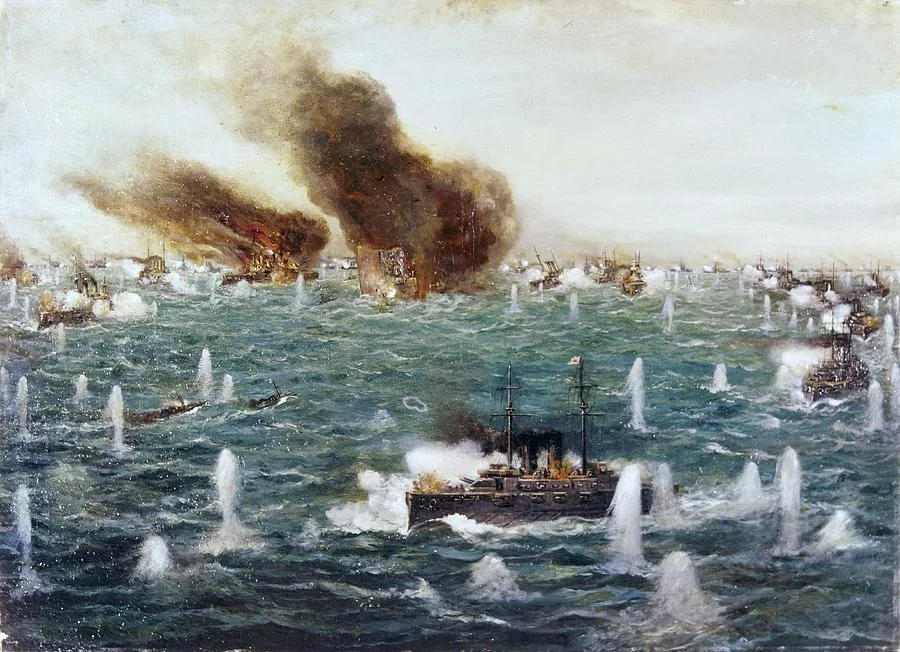
Tōjō Shōtarō, ‘Battle of Tsushima, 1905’, painting, 1905. Museum not named on Commons. · Public domain · Source page
The scene
Before dawn, 27 May 1905
Before dawn on 27 May 1905, a Japanese scout ship sights the Russian fleet in the Tsushima Strait, between the island of Tsushima and Japan.
The Russians have come about 33,000 kilometres from the Baltic. Their ships are worn, and the sources describe the coal as short. Within two days most of the fleet will be sunk or captured.
What happened here, and how much of the story do we really know?
Background
A war far away
In 1904 Japan and Russia are at war. Port Arthur, a Russian fortress and naval base on the Liaodong Peninsula in China, is under siege.
The Russian fleet leaves the Baltic in October 1904. Port Arthur falls in early January 1905, while the ships are still on their way.
So the fleet sails on, towards a war that has changed while it was at sea.
The two admirals
Two men, one strait
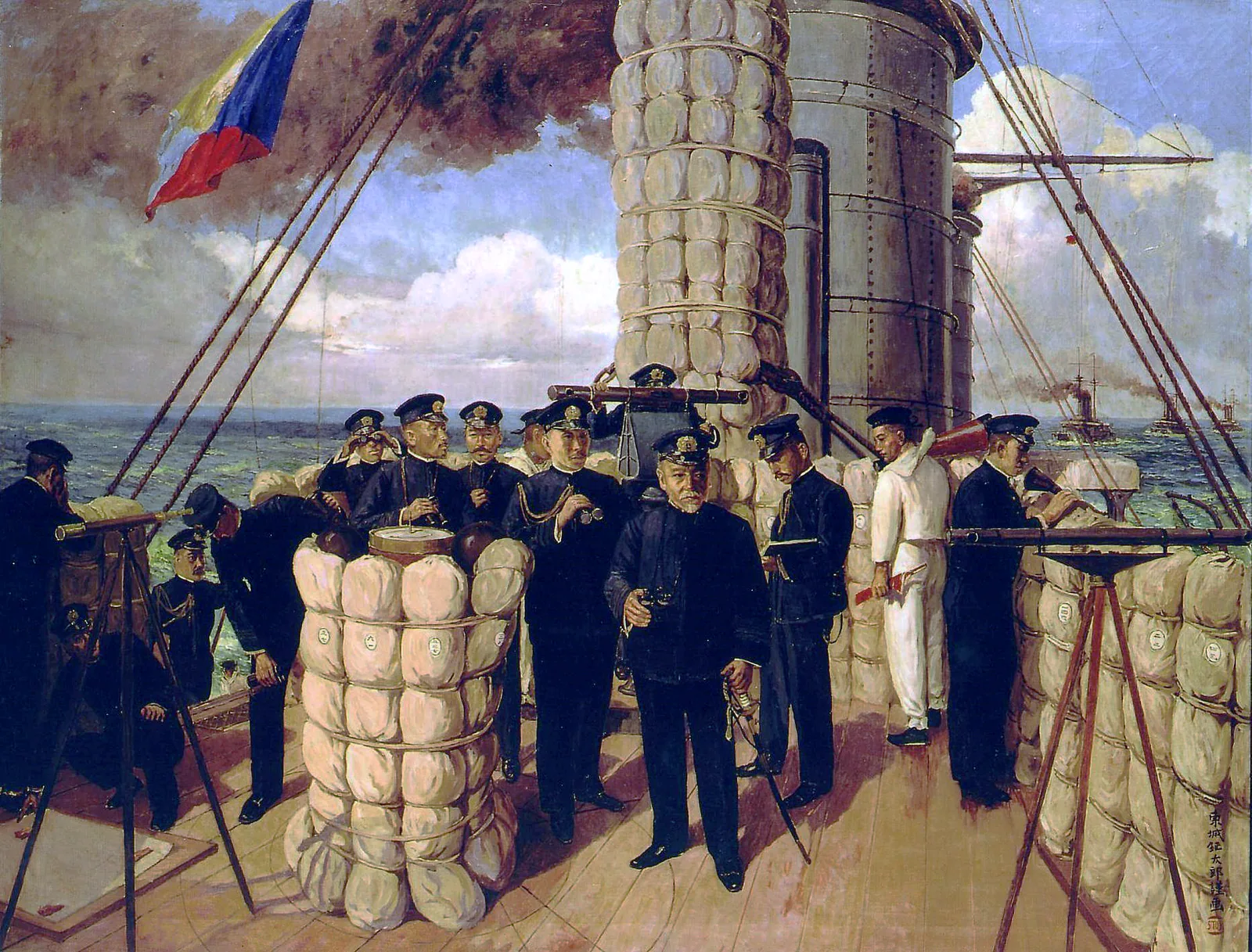
Tōjō Shōtarō, ‘Admiral Tōgō Heihachirō on the bridge of the Battleship Mikasa’, 1906. Museum not named on Commons. · Public domain · Source page
Two men command the fleets at Tsushima. Admiral Heihachirō Tōgō leads the Japanese Combined Fleet from his flagship, the Mikasa. Vice Admiral Zinovy Rozhestvensky leads the Russian Second Pacific Squadron.
We know their orders far better than their thoughts. Most of the evidence comes from official records and later memoirs, and their writers had reasons of their own.
The road to it
October 1904
Eighteen thousand nautical miles
18,000 nautical miles
On 15 October 1904 the Russian fleet leaves Libau, today Liepāja, a port on the Baltic. The route is about 18,000 nautical miles, or about 33,000 kilometres. It goes round Africa and stops at Madagascar.
On 14 April 1905 the ships reach Cam Ranh Bay, in French Indochina, now Vietnam. The sources describe the fleet as worn out and short of coal long before it reaches the strait.
October 1904
Fog on the Dogger Bank
On the night of 21–22 October 1904 the fleet passes the Dogger Bank, a shallow stretch of the North Sea. Fog lies on the water. The Russian ships open fire on a group of British fishing trawlers, believing they are Japanese torpedo boats.
One trawler, the Crane, sinks. Two fishermen are killed and six injured, according to the record of the international inquiry. On 25 November 1904 Britain and Russia agree to that inquiry, and Russia later pays compensation, though the sources give different sums.
A decision point
You are Vice Admiral Zinovy Rozhestvensky, commander of the Second Pacific Squadron.
About 25 May 1905, at sea near the Japanese islands.
You have brought the fleet almost 33,000 kilometres. The ships are worn, and the coal is short. The shortest way to Vladivostok, your target port, runs through the Tsushima Strait. Two longer routes go round Japan.
You do not know exactly where Tōgō’s ships are, or whether he will wait for you at his base in Korea.
Which strait do you take the fleet through?
- Take the Tsugaru Strait, the longer way round the north of Japan. Probably a longer voyage on the same short supply of coal, giving the Japanese more days to find you. The battle would probably still come, somewhere else.
- Take the La Pérouse (Sōya) Strait, another long way round Japan. Probably the same problem: a long voyage on short coal, and a long time at sea for the Japanese to choose their moment.
- Take the Tsushima Strait, the shortest way to Vladivostok, your target port. Probably the fastest route, with the least coal used, and a meeting with the Japanese fleet sooner rather than later.
What really happened
Take the Tsushima Strait, the shortest way to Vladivostok, your target port.
Rozhestvensky takes the Tsushima Strait, the shortest route. The Japanese fleet meets him there on 27 May 1905.
What he knows: the fleet is worn and short of coal, and the shortest route runs through the strait. What he does not know: where Tōgō’s ships are, or whether they will wait for him. The sources do not record his reasons in his own words.
The event
27 May, before dawn
First contact
Before dawn, the Japanese scout ship Shinano Maru sights the Russian fleet.
On paper, the Russians have more battleships: eight to Japan’s four, by one count.
27 May, early afternoon
The message on the Mikasa
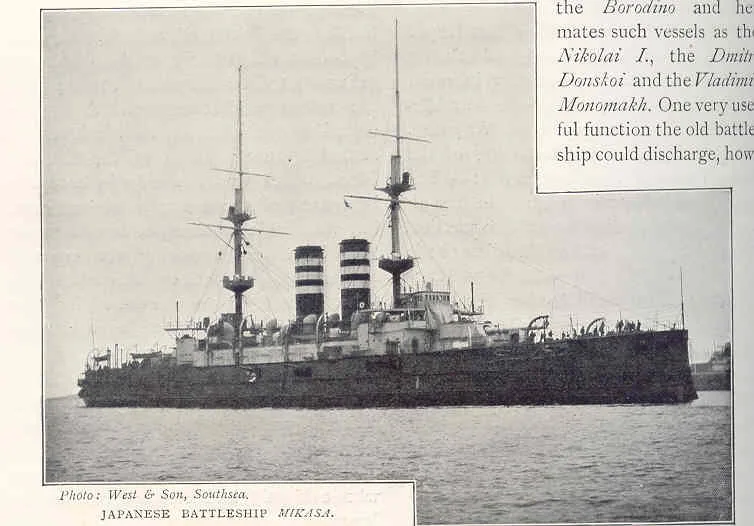
Photo: West & Son, Southsea, 1905–06, from Cassell’s History of the Russo-Japanese War. · Public domain · Source page
In the early afternoon the Z flag goes up on the flagship, the Mikasa. It is a signal flag, and it carries a message to the whole fleet.
In translation, the message says that the fate of the Empire rests on the outcome of this battle, and that every man must do his utmost. The Japanese wording is known, but the English versions differ, and the time when the flag went up is disputed.
A decision point
You are Admiral Heihachirō Tōgō, commander of the Japanese Combined Fleet.
Afternoon of 27 May 1905, in the Tsushima Strait.
You have seen the Russian fleet since before dawn. The sea is running high, and the Russians are heading for Vladivostok, their target port.
In a battle line, one long line of ships, every ship can bring its guns to bear on the enemy. The Russians are coming closer.
What do you order?
- Hold your line and wait for the Russians to come closer. Probably the Russians keep their course and pass close, with much of their fleet intact. The sea and the distance would work against you.
- Turn your ships at once and cross the Russian line. Probably the Russian line breaks, and the battle is fought at close range, on your terms. But in high seas a turn risks losing order, and the Russian guns could hit your ships as they turn.
What really happened
Turn your ships at once and cross the Russian line.
Togo turns his ships to cross the Russian line. The Russian line breaks, and most of the Russian fleet is lost in the battle that follows.
What he knows: the Russians were seen before dawn, and the sea is running high, as his own telegram says. What he does not know: what the Russians intend. The message to the fleet stresses the stakes. It is a message to his men, not a record of his reasoning.
The afternoon and the night
The line breaks
Most of the fleet
The fight that follows goes against the Russians. Their line falls apart, and their ships are hit one after another.
Through the night, Japanese destroyers and torpedo boats attack the Russian ships. By the end of the battle the Russian fleet has lost most of its ships. Japan loses three torpedo boats.
The forces: who fought whom
27–28 May 1905
The Tsushima Strait
The Japanese Combined Fleet
- Commanders: Heihachirō Tōgō
- Strength: 4 battleships, 29 cruisers, 4 gunboats, 21 destroyers, 45 torpedo boats, 22 auxiliaries; no total given (English Wikipedia, strength box)
- Losses: 117 dead, 583 wounded, 3 torpedo boats sunk (English and Japanese Wikipedia, overviews); about 110 dead, about 580 wounded (Japanese Wikipedia, main text)
Second Pacific Squadron
- Commanders: Zinovy Rozhestvensky
- Strength: 38 ships in the battle; 48 ships and auxiliaries at departure (English Wikipedia, the battle)
- Losses: 5,045 dead; 6,016 captured (English Wikipedia, infobox); 4,830 dead; 6,106 captured (Japanese Wikipedia, main text)
Outcome: A Japanese victory. Most of the Russian fleet is sunk or captured. Japan loses three torpedo boats. By the English and Japanese Wikipedia articles, three Russian ships reach Vladivostok.
The numbers come from two Wikipedia articles, English and Japanese, which disagree on several counts. We have not checked them against a scholarly study, so treat them as estimates.
What we really know
Source: Semenoff’s book on the battle
Paraphrase, not a quotation: the book is built from notes the author kept during the fighting, and from what other men told him.
Semenoff was a naval officer aboard the Suvorov, without an official post. The English translation came out in 1913, eight years after the battle. It is a memoir, written after the events.
- Who wrote it, and where was he in the battle? A naval officer on a ship that was lost, with no official post. He writes about his own side, so the book is testimony, not a neutral view.
- When was it written, and for whom? Years after the battle. The English translation came out in 1913.
- What is missing? The text alone cannot show which parts he saw himself and which he heard from others.
Myth
Tsushima was the first time an Asian power defeated Europeans.
The truth
Not true. The Mongols beat the Hungarian army at Mohi in 1241, and Ethiopia beat the Italian army at Adwa in 1896. A narrower claim, which some historians argue, is that Tsushima was the first naval victory of an Asian power over a major European power.
Source: Togo’s telegram to Tokyo
Paraphrase, not a quotation: the weather is clear today, but the waves are high.
Tōgō is reporting to his government, and he has reason to present the day in a good light. The telegram was sent before the battle, so it cannot tell us how the day went.
- Who wrote it, and to whom? The admiral, reporting to his government. His words also serve his standing.
- Can we check the sea from this message? Not from this message alone. Sources describe the sea differently, so there is no single clear answer.
- What is missing? It reports the enemy’s appearance, not what happened next.
Source: The Japanese official account
Paraphrase, not a quotation: the account gives times for the ships’ movements, the state of the sea, and a ship-by-ship list of losses, which is incomplete. It gives the message to the fleet, but no time and no flag.
This is the winning state’s own official history. The victor has reason to tell the story its own way.
- Who wrote it, and what did they want? The staff of the winning state, writing an official history. Its purpose is to record the victory.
- What does it leave out? The time of the signal and the flag it was raised on. Its casualty lists are incomplete.
- Which details can we rely on most? The times of the ships’ movements are useful, but the sources do not agree on the minutes. So we write ‘before dawn’, not an exact time.
What followed, and the quiz
28 May
The morning after
On the morning of 28 May, what is left of the Russian fleet surrenders. Rozhestvensky, wounded, is taken off his ship. The surviving Russian sailors become prisoners.
The sea battle is over, but the war is not.
A decision point
You are Theodore Roosevelt, president of the United States.
Summer 1905.
Japan has asked you to mediate its war with Russia. Japan has won at sea, and Port Arthur has fallen. Most of the Russian fleet was lost at Tsushima.
Any peace will need a neutral host, and the talks could take place in your own country. Whether you take part yourself is your decision.
What do you do?
- Decline, and leave the two governments to find their own way to talks. Probably the two sides would find it harder to meet, and the fighting could go on for longer. This is a guess: the sources do not say what the two governments would have done.
- Accept the role. Host the talks on American soil, and stay out of the room. Probably the talks go ahead, with a neutral host, and the terms are argued out by the two delegations.
- Accept the role, and go to the talks yourself to press your own terms. Probably you would have more say over the terms, and more blame if they failed. Your own aims would become part of the bargaining.
What really happened
Accept the role. Host the talks on American soil, and stay out of the room.
Roosevelt accepts the role. He mediates the talks, held at the Portsmouth Naval Shipyard, in Kittery, Maine, but he does not attend the sessions himself.
According to the US State Department’s history of the treaty, Roosevelt wanted both empires to keep a role in north-east China. Japan had asked him to mediate. The sources do not say how much pressure he put on either side.
August to September 1905
Peace in a shipyard
The talks open in August 1905 at the Portsmouth Naval Shipyard, in Kittery, Maine. The sea battle lasted two days; about three months pass between the battle and the peace.
On 5 September 1905 the Treaty of Portsmouth is signed in the same place, and it ends the war between Japan and Russia.
After the battle: a treaty, and books
- 5 September 1905 The Treaty of Portsmouth is signed at the shipyard in Kittery, Maine.
- 1913 Semenoff’s book appears in English, translated by A. B. Lindsay and published in New York.
- 1958 Richard Hough publishes The Fleet That Had to Die, a popular account of the battle.
- 2002 Constantine Pleshakov publishes a history of the fleet’s journey to Tsushima.
- 2017 Dmitrii Likharev’s article on the shells and the armour appears in a journal.
What decided it: the shells, or the men and the orders?
What explains the Russian defeat?
- Constantine Pleshakov, 2002 His book follows the fleet’s commander, his officers and the government in St Petersburg. Reviews say it stresses the coal shortages, the orders from home and the commander’s character.
- Dmitrii Likharev, 2017 His article, titled ‘Shells vs Armour’, studies how Russian memoirists and historians have explained the shells and the armour at Tsushima.
Both views look at the Russian side. Which explanation weighs more? The sources do not give one clear answer, and historians still argue over it.
Check yourself
On the Dogger Bank in October 1904, what did the Russian ships take the British trawlers for?
Answer: Japanese torpedo boats. Right. In fog, the Russian ships fired on the trawlers, believing them to be Japanese torpedo boats.
Check yourself
Which strait did Rozhestvensky choose?
Answer: The Tsushima Strait, the shortest route. Right. Tsushima is the shortest route from Indochina, and it is the route the fleet takes.
Check yourself
What can we say for certain about the message on the Z flag?
Answer: Its Japanese wording is known, its English versions differ, and the time is disputed.. Right. The Japanese sense is clear, but the English wording varies, and the time is given differently in different accounts.
Check yourself
Which of these is true, according to this lesson?
Answer: Non-European armies beat European ones at Mohi and Adwa.. Right. Both examples are land battles. The Mongols are an Asian power, but Ethiopia is not Asian, so the claim is ‘non-European’.
Check yourself
Why should a reader be careful about trusting Togo’s telegram on the sea?
Answer: Because its author reports to his government, and sources disagree.. Right. Tōgō has reason to present the day well, and the sources do not agree on the state of the sea.
Check yourself
What role did Roosevelt take in the Portsmouth talks?
Answer: He mediated the talks, but did not attend them.. Right. He mediated, and kept himself out of the room. That is the choice the lesson records as the one actually made.
Terms
- battleship A large, heavily armoured warship with big guns. In 1905 it was the core of any navy’s strength.
- destroyer A fast, lightly built warship. Destroyers guarded the fleet against torpedo boats and could attack with torpedoes themselves.
- torpedo boat A small, fast boat that carries torpedoes: self-propelled weapons that run through the water to their target.
- flagship The ship that carries a fleet’s commander and flies his flag. Tōgō’s flagship was the Mikasa.
- Z flag A signal flag, one of the flags ships used to send orders to one another. On 27 May 1905 it was raised on the Mikasa.
- Combined Fleet The main fleet of the Japanese navy at the time. Tōgō commanded it at Tsushima.
- Second Pacific Squadron The Russian fleet that sailed from the Baltic in October 1904 to fight Japan in the Far East.
- battle line Warships sailing in one long line, so that every ship’s guns can be brought to bear on the enemy.
- Treaty of Portsmouth The peace treaty between Russia and Japan, signed on 5 September 1905 at the Portsmouth Naval Shipyard, in Kittery, Maine, USA.
- Tsushima Strait The strait between the island of Tsushima and Japan, where the sea battle was fought.
- Mikasa Japan's flagship under Tōgō. The Z flag went up on it during the battle.
- Heihachirō Tōgō The Japanese admiral who commanded the Combined Fleet at Tsushima.
- Zinovy Rozhestvensky The Russian vice admiral who led the Second Pacific Squadron.
- Port Arthur A Russian fortress and naval base in China, on the Liaodong Peninsula. It fell in 1905.
- Liaodong Peninsula A peninsula in north-east China, where Port Arthur stood.
- Libau A port on the Baltic Sea, today Liepāja in Latvia. The Russian fleet sailed from it.
- Madagascar A large island off the east coast of Africa. The Russian fleet stopped there on its way.
- Cam Ranh Bay A bay in French Indochina, now Vietnam. The Russian fleet reached it in 1905.
- Dogger Bank A shallow stretch of the North Sea, near where British fishing boats were fired on.
- the Crane A British fishing trawler that sank under Russian fire on the night of 21–22 October 1904.
- International Inquiry A commission set up to look into the firing on the British fishing boats. Russia later paid compensation.
- Vladivostok A Russian port on the Pacific coast. It was the target port of the Russian fleet.
- Shinano Maru The Japanese scout ship that sighted the Russian fleet before dawn.
- Suvorov A Russian battleship. Semenoff served aboard her as a naval officer.
- Semenoff A Russian naval officer who wrote a memoir of the battle. The English translation came out in 1913.
- Battle of Mohi The battle in which the Mongols defeated the Hungarian army in 1241.
- Adwa The battle in which Ethiopia beat the Italian army in 1896.
- Portsmouth Naval Shipyard A US Navy shipyard in Kittery, Maine. The peace talks were held there.
- Kittery, Maine A town in the north-east of the United States, in the state of Maine. The peace talks were held there.
- Roosevelt The US president who mediated between Japan and Russia.
Sources
- Vladimir Semenoff, The Battle of Tsu-shima between the Japanese and Russian Fleets, fought on 27th May 1905, trans. A. B. Lindsay, preface Sir George Sydenham Clarke, New York: E. P. Dutton, 1913
- Richard Hough, The Fleet That Had to Die, New York: Viking, 1958
- Constantine Pleshakov, The Tsar’s Last Armada: The Epic Journey to the Battle of Tsushima, 2002
- Dmitrii Likharev, ‘Shells vs Armour: Material Factors of the Battle of Tsushima in the works of Russian Memoirists and Historians’, War & Society, 2017, doi:10.1080/07292473.2017.1356589
Image credits
- Tōjō Shōtarō, ‘Battle of Tsushima, 1905’, painting, 1905. Museum not named on Commons. · Public domain · Source page
- Tōjō Shōtarō, ‘Admiral Tōgō Heihachirō on the bridge of the Battleship Mikasa’, 1906. Museum not named on Commons. · Public domain · Source page
- Photo: West & Son, Southsea, 1905–06, from Cassell’s History of the Russo-Japanese War. · Public domain · Source page


