Toussaint Louverture: the enslaved man who became a general of a revolution
He was born into slavery, was freed, and then led a revolution that made freedom law in the colony regarded as the richest of France. Who was Toussaint Louverture, and what is fact and what is legend in his story?
Decisions, questions and your own progress, in the app
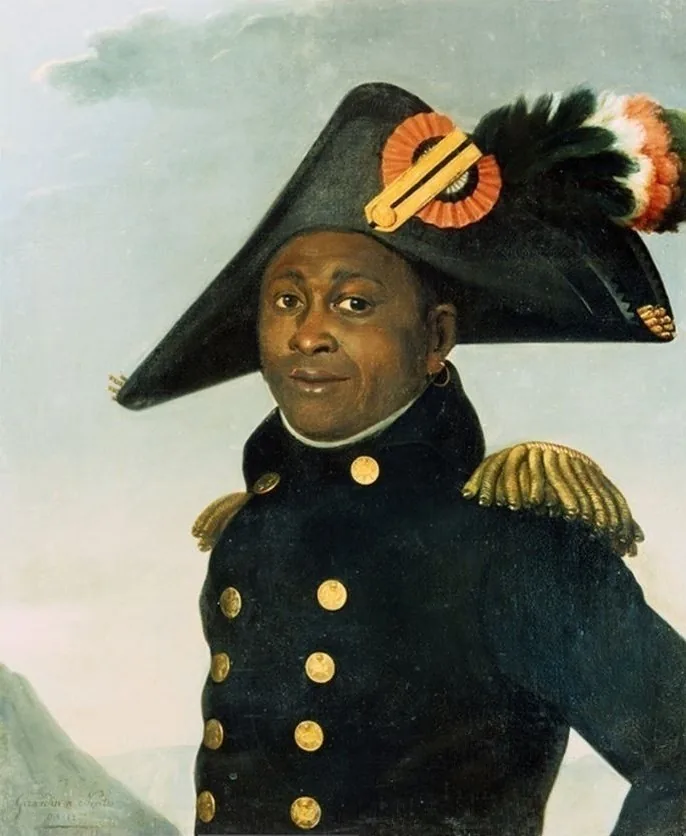
Alexandre-François-Louis, comte de Girardin, oil portrait, Year XIII (1804–1805). Photograph of the painting on Wikimedia Commons; the holding collection is not identified · Public domain · Source page
Bréda, 1743–1791: the richest colony
He was born enslaved, and became a general of a revolution
Around 1743, on the Bréda estate near Cap-Français, in the French colony of Saint-Domingue, a boy was born who belonged to an owner. He was named Toussaint.
By the end of his life he had left slavery, led armies, and become one of the central figures of the revolution in Saint-Domingue.
This is the story of Toussaint Louverture. In the 1790s he faced four decisions. Each could change the fate of the colony, and his own. We follow them one at a time, the way they looked to him then.
Background
A colony built on slavery
500,000
Saint-Domingue was often called the richest French colony in the Caribbean. In the 1780s its plantations grew a large share of the sugar and coffee that Europe bought, and their owners grew very rich.
That wealth rested on slavery. An estimate for 1789 gives about 556,000 people in the colony, of whom about 500,000 were enslaved. Many had been brought from Africa in ships. The rest were white colonists and free people of colour.
Before the revolution
Rising step by step
Toussaint was born on the Bréda estate, and he was known as Toussaint Bréda, after the estate. He handled livestock and worked as a healer. Later he drove his owner's carriage, and finally he became the steward, the man who ran the estate day to day.
In the 1770s he gained his freedom. Sources give 1774 or 1776, and they do not agree.
1791
August 1791: the revolt begins without him
In August 1791 the enslaved people of the northern plain rose in a great revolt. It spread quickly from estate to estate.
Toussaint was not among the leaders of the first stage. No record from those weeks places him there. He joined the revolt later, when the war had begun to change.
Bois Caiman: a legend and its sources
The legend
A night in one forest
In many books, and in Haitian memory, one night in the north of the colony counts as the starting point of the great revolt. The legend tells of a forest called Bois Caiman, and of a ceremony there that set the revolt going. It names Boukman, a leader of the early revolt, as the man who led it.
The question is not only what happened that night. It is whether it happened at all, as the story tells it.
The sources
Who wrote it down, and when?
No document from those days describes the night. The earliest printed account is by Antoine Dalmas, a white colonist who had fled the colony. He wrote it in 1793–94, and it was printed only in 1814, more than twenty years after the events.
Later versions were written decades after the revolt, when the story had become part of the national memory. When you read any version, ask three questions: who wrote it, how many years after the events, and for whom.
Myth
Bois Caiman was the night the revolution began, with Toussaint present.
The truth
No record from that time confirms the ceremony, or Toussaint's presence at it. He took no part in the first stage of the revolt. So the revolution cannot be dated to one night at which he was present.
The evidence
Historians treat the ceremony as a contested story. Something like it may have happened, but its details are not known, and no document from the time confirms them.
The Spanish side
In the war, on the Spanish side
Toussaint joined the revolt later. By 1793 he was serving with the Spanish side, which held the eastern part of the island as the colony of Santo Domingo.
Spain offered protection to the rebel leaders who fought on its side. At that time Toussaint was a commander in the rebel army, and his rank on the Spanish side is not documented with certainty.
Decision 1: the King's general, or the Republic's?
Late August 1793
Two offers of freedom
In late August 1793 the colony is fought over, and so are its promises of freedom.
The French commissioner Sonthonax, sent to govern the North in the name of the Republic, proclaims freedom for the enslaved in his province. The French government had not yet abolished slavery in all its colonies, so the promise rests on one commissioner's decision. On the Spanish side, by contrast, protection is promised to those who stay loyal to the King.
A decision point
You are Toussaint Louverture, a rebel commander who fights on the Spanish side.
Late August 1793, the north of the colony
You are a rebel commander, and you fight on the Spanish side. The Spaniards offer protection to those who stay loyal to the King. In the north the French commissioner Sonthonax proclaims freedom for the enslaved.
The enslaved are waiting to see what you do. Around you are people who still live on the estates, wondering what will happen to them and their families. You want to send a call to the rebels. The call will be both a promise and a declaration of sides.
What do you write in your call, and in whose name?
- Stay loyal to Spain: a call to the rebels in the King's name, with no talk of freedom. Probably you keep the Spanish protection and any rank you hold. But the call leaves the great question, freedom, unanswered, and the enslaved stay outside the promise you make.
- Switch to the Republic now: accept Sonthonax's offer and break with Spain. Probably the French commissioners welcome you. But the French promise is not yet law across the colony, and it rests on one commissioner. With the Spanish protection you also lose a shield for your people.
- Write a call for liberty and equality, and sign it in the name of the King of Spain. Probably the call draws many rebels, and the Spanish protection stays. But the promise depends on a decision that is not yours, and the French may see the move as opportunism.
What really happened
Write a call for liberty and equality, and sign it in the name of the King of Spain.
On 29 August 1793, at Camp Turel, Toussaint issued a proclamation calling for liberty and equality, and signed it as “general of the King's armies”. He chose to stay in the alliance with Spain, but he spoke to the enslaved in the language of freedom.
We do not know exactly what Toussaint thought. The clearest reason in the sources is that Spanish protection was real, and that France had not yet abolished slavery in all its colonies. The call itself speaks of liberty and equality, and historians disagree about how far it was sincere and how far it was a recruiting message.
Source: The Camp Turel proclamation, 29 August 1793
Brothers and friends, I am Toussaint Louverture. My name may have reached you. I have undertaken vengeance. I want liberty and equality to reign in Saint-Domingue, and I am working to make them exist. Join us, brothers, and fight with us for the same cause.
Signed: Toussaint Louverture, General of the King's armies, for the public good.
This proclamation survives under Toussaint's name, and it is dated 29 August 1793, the day Sonthonax proclaimed freedom in the North. The sources do not show whether Toussaint knew of that proclamation when he wrote his own.
- Who is he speaking to? To “brothers and friends”: to the rebels, and perhaps to the enslaved who are still on the estates. Notice that the proclamation does not address the owners.
- Why does he sign as “general of the King's armies” and “for the public good”? The two phrases hold each other in balance: he speaks of the public and of liberty, and in the same breath signs in the name of a foreign king. Historians disagree on whether this was real loyalty to the King, or a frame that let him appeal to the masses.
- What does the proclamation leave out? It does not explain how liberty and equality would be made to exist, does not name the Spanish alliance, and offers no plan for government. It is a call to action, not a plan for a state.
After the decision
Several months in the Spanish camp
From late August 1793 Toussaint served in the Spanish camp. It was a war over the whole colony, with France, Spain and Britain fighting one another, and the rebel leaders were rivals as well as allies.
Inside that rivalry he built a name as a commander. One of his rivals was Georges Biassou, another rebel leader, and the two men fell into open feud.
A decree from Paris, and a switch of sides
February 1794
A decree from Paris
On 4 February 1794, which was 16 Pluviôse, Year II of the Revolutionary calendar, the Convention, the elected assembly that ruled France, decreed that slavery was abolished in all the colonies.
The decree did not reach the colony all at once. By spring it was known there, and it changed what the struggle was about. Toussaint's own letter of 1797 gives the same date.
A decision point
You are Toussaint Louverture, in the spring of 1794.
Spring 1794, the north of the colony
You are still in the Spanish camp, and the decree from Paris is known in the colony. The Spaniards offer you the same deal as before: stay loyal to the King, and keep your protection and rank. The French commissioners in the north say that freedom is law, and that it will stay law.
Your relations with rivals such as Biassou are poor. Some of the men around you are weighing their own futures, and each of them is watching you.
What do you do?
- Stay with Spain: protection and rank matter more to you than the French promise. Probably you keep your protection for a while. But the French decree goes unprotected on the ground, and the enslaved in your area keep waiting.
- Switch to France now, and bring your own men with you. Probably the French take you and your men, and the decree is enforced in the north in practice. But the commitment to Spain is broken, and your families are exposed to a Spanish response.
- Wait until the French commissioners confirm freedom on the ground, and only then switch. Probably the French would accept a cautious switch more readily, and your people would be safer. But waiting gives Spain time to win you back, and rivals time to gain the advantage.
What really happened
Switch to France now, and bring your own men with you.
In early May 1794 Toussaint switched to the French side. Accounts give different days: one has the French flag raised at Gonaïves on 4 May, and another gives 6 May as the day of the switch. By 18 May he was writing to the French general Laveaux as a man in French service.
Historians disagree about why he switched, and about the date. Toussaint himself later said that he switched only after the commissioners left, in June 1794. That conflicts with the May dates above. The debate near the end of this lesson looks at the readings.
Gonaïves
A few days before the switch
On 29 April 1794, troops who fought for the French attacked the Spanish garrison at Gonaïves. According to the account we used, about 150 men were killed.
We do not describe the fighting in detail, because the details we could check are thin.
Myth
Toussaint abolished slavery in Saint-Domingue.
The truth
No. The French commissioners Sonthonax and Polverel proclaimed freedom in their areas between late August and late October 1793, and the Convention abolished slavery in all the colonies in February 1794. Toussaint defended that decree in his own letter of 1797.
The evidence
The first proclamations of freedom came from French commissioners, not from a rebel leader. Toussaint defended the decree once it existed, and his letters show that.
After the switch
A general in the French army
He was named a brigadier general in the French army. In May 1797 he became commander of all the forces in the colony.
Three fronts at once
1797
Several fronts at once
In 1797 Toussaint faces several fronts at once. The British still hold ports on the island. In the south a rival named André Rigaud holds power with his own forces. And in Paris the Directory wants to know who controls the colony, and on what terms.
Source: Letter to the Directory, November 1797
No, the hand that broke our chains will not enslave us again.
But if, to restore slavery in Saint-Domingue, one did that, then I declare to you: it would be attempting the impossible.
The Directory ruled France from 1795 to 1799. This is a general in French service writing to the government he serves, defending the decree of 1794.
- Who is writing, and to whom? A general in French service, writing to the French government. He writes as someone who owes it loyalty, but he also makes a claim: he treats the government as the body that will decide the colony's fate and the fate of the decree.
- What does “our chains” refer to? It is his claim about the colony's people, not a record of what happened to every enslaved person after 1794. Ask who is included, and who is left out.
- Why does he name the date? Because the decree was a law that the government could honour or revoke. Naming its date and its official name makes it harder to deny, and reminds the government of what it had decided.
1798
An armistice with the British
On 30 March 1798 Toussaint signed an armistice with the British commander Thomas Maitland. The British agreed to withdraw from the colony, and they left in the summer or autumn of 1798. The sources do not agree on the month.
With the British gone, one front closed. The other two stayed open.
1799–1800
The War of the Knives
In June 1799 war broke out between Toussaint and André Rigaud, who led the south. The war is known as the War of the Knives. It lasted into 1800, and Rigaud went into exile.
Both sides fought with great brutality, and reprisals killed many people. Later traditions give very large numbers for the reprisals in the south. The sources we checked do not confirm them, so this lesson gives no figure.
Decision 3: a constitution without Paris
January 1801
The island under one rule
In January 1801 Toussaint's army took the Spanish part of the island, which then came under his rule.
In Paris Napoleon Bonaparte had been First Consul since 1799, and the future of the colony was still open.
A decision point
You are Toussaint Louverture, commander-in-chief of the colony, in the spring of 1801.
Spring 1801, Saint-Domingue
You rule the colony in fact. Paris has given it no constitution, and has not said what its status will be. An assembly in the colony has drafted a constitution, and asks you to proclaim it and put it into force.
In Paris Napoleon is First Consul. Nothing guarantees that he will approve a text written without him. If you proclaim now, you do so without his approval, and you set facts on the ground.
Do you proclaim the constitution, or wait for Paris?
- Proclaim the constitution now, and ask Paris to approve it afterwards. Probably the local law holds, and the abolition stays in force. But Paris may see the proclamation as defiance, and the dispute may end in force.
- Wait for a constitution from Paris, and keep the existing law in the meantime. Probably quiet holds. But the status of the freed people stays unclear, and opponents inside and outside the colony can use the gap.
- Send an envoy to Paris, and negotiate the colony's status before you proclaim anything. Probably you get a clearer answer, but the envoy may be held or delayed, and the delay gives Paris time to prepare a force.
What really happened
Proclaim the constitution now, and ask Paris to approve it afterwards.
On 3 July 1801 the constitution was proclaimed. It said that there could be no slaves on the colony's territory, and that slavery was abolished there for ever. It made Toussaint governor for life, and kept the colony within the French Republic.
On 16 July Toussaint sent the text to Napoleon and asked for his approval. Napoleon did not approve it.
In his letter to Napoleon, Toussaint presented the text as something he sent to win the First Consul's approval, and his government's. He was asking for legal recognition, not a break with France. Historians disagree about how far he wanted to keep that link, and how far he saw the constitution as a step towards independence.
Source: The 1801 constitution, articles 3 and 28
Article 3: There can be no slaves on this territory, and slavery is abolished here for ever.
Article 28: The leadership of the colony is entrusted to him for the rest of his glorious life.
The constitution was drafted in the colony and proclaimed in July 1801. A modern online edition, with notes, describes it as keeping the colony within the French Republic. Napoleon did not approve it.
- What does article 3 say, and why does it matter? It turns the end of slavery into a constitutional rule in the colony. From now on it no longer depends on one commissioner or a decision from Paris, at least on paper.
- Who is named in article 28, and for how long? Toussaint himself, for the rest of his life. That is personal rule with no time limit. Keep this in mind when you ask whether he wanted to keep the link with France.
- Whose approval is missing from the document? Paris's. In his letter of 16 July Toussaint asked the First Consul for approval, and did not receive it.
Myth
Toussaint wanted independence from France from the start.
The truth
The sources do not show that. In 1793 he served the King of Spain. In 1797 he asked France to keep the decree of abolition. In 1801 he sent his constitution to Napoleon for approval, and kept the colony within the French Republic. Independence came under Jean-Jacques Dessalines, on 1 January 1804.
The evidence
The argument is real. Some readers see the 1801 constitution as a step towards separation, and others see a request for French recognition. The text itself asks Paris for approval, and that is the clearest evidence in the sources.
The decision in Paris
Napoleon sends a force
Napoleon did not approve the constitution. Instead he sent his brother-in-law, Charles Leclerc, with a large force to restore order in the colony. The sources give between about 20,000 and 25,000 men, and the figures differ.
The fleet sailed at the end of 1801 and reached the island in early 1802. We do not quote Napoleon's written instructions to Leclerc, because we could not check their exact wording.
Decision 4: amnesty, or the mountains?
1802
The French fleet reaches the coast
In early 1802 the French fleet reached the coast of Saint-Domingue, carrying Leclerc's army. The sources give between about 20,000 and 25,000 men.
Some of Toussaint's generals had already gone over to the French for rank. Henri Christophe went first, and according to the sources Dessalines followed.
A decision point
You are Toussaint Louverture, governor-general of the colony, in early 1802.
February to May 1802, the north of the colony
Leclerc's fleet is off the coast, and his force is very large. Several of your generals have already gone over to the French side. You do not know exactly what Paris plans, but you know it sent this army to settle the colony's future.
There are three broad courses. What you decide will affect not only your own fate, but that of the soldiers, families and civilians who depend on you.
What do you do?
- Fight Leclerc's army in the field, wherever you can make a stand. Probably a costly war on the coast and in the hills. The French force is large, and the generals who went over may damage morale. You might hold out for a while, but a quick win does not look likely.
- Negotiate: accept Leclerc's authority, in return for an amnesty for yourself and your generals. Probably the fighting stops for now, and your soldiers are spared. But the promise rests on Leclerc's word, and you have no guarantee that it will be kept.
- Withdraw to the mountains, and resist in a long guerrilla war. Probably the war drags on, and the cost falls on families and civilians on every side. But you keep your force, and the option to negotiate later.
What really happened
Negotiate: accept Leclerc's authority, in return for an amnesty for yourself and your generals.
On 6 May 1802 Toussaint rode into Cap-Français and accepted Leclerc's authority. In return, he and his generals were promised an amnesty.
Toussaint later wrote that Leclerc had given him his word. Historians disagree on whether he trusted that word in good faith, or weighed the options that remained and found few of them good.
June 1802
The meeting that ended in arrest
In the weeks after the agreement the colony stayed under French troops. In June General Brunet invited Toussaint to a meeting, and there he was arrested. One account dates the arrest to 6 June.
In his letter of 20 July Toussaint wrote that Leclerc had ordered him to act together with Brunet, that he obeyed, and that he was then arrested. He added that his house was looted the next day, and that his wife and children were taken into custody.
Source: Letter from the Minister of the Marine to the commandant of Fort de Joux, 27 October 1802
The minister tells the commandant that he will answer with his own life for the prisoner.
This is a letter from the French government to the officer in charge of the fort where Toussaint was held. It is written from the enemy's side and does not contain Toussaint's own words. Read it as a document of the government, not as a description of what happened in the fort.
- Who is speaking, and to whom? A minister of the government, writing to the officer in charge of the fort. The government sent Toussaint there, and the tone is that of someone holding a prisoner who is also a political enemy.
- What is the tone of the letter? Hostile. It orders that Toussaint be called by his name alone, without his title, and it makes the commandant personally answerable for keeping him. The effect is to deny his rank in the eyes of his guards.
- What is missing from the letter? Toussaint's own voice. The letter shows what the government wanted, not what happened in practice at the fort. For that you need other sources, such as Toussaint's own letters.
Fort de Joux
In the fortress in the mountains
Toussaint was taken to Fort de Joux, a fortress in the mountains of eastern France, in August 1802. In a letter to the commandant he wrote that he had been searched, and that his watch had been taken.
The war in the colony went on without him. An essay in The Nation describes a letter from Leclerc dated 2 October 1802, which says that most adults in the mountains and on the plain should be killed, and that children under twelve should be spared. We did not check the French original. The essay's author argues that France planned to destroy much of the population, and we do not check the other side of that argument here.
Toussaint Louverture
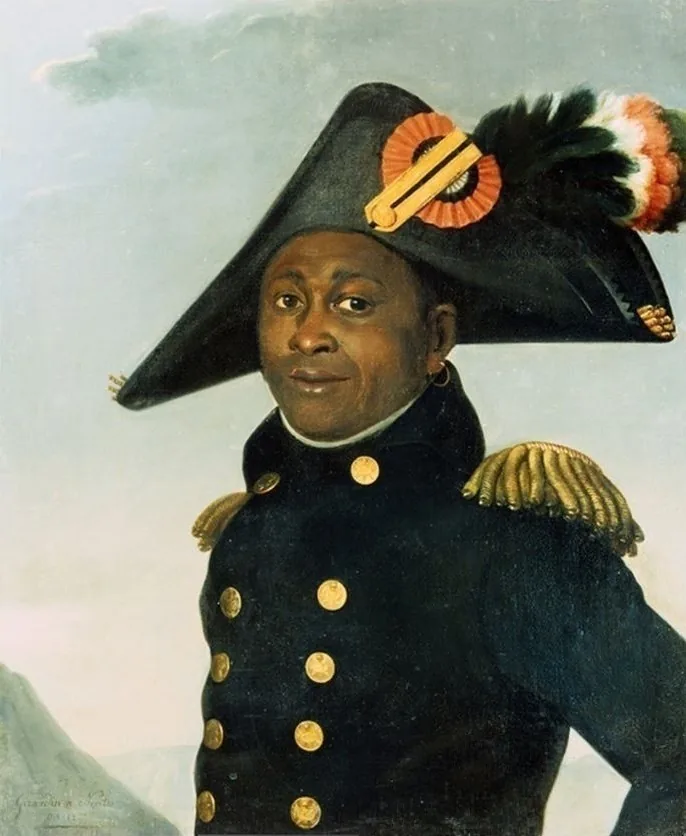
Alexandre-François-Louis, comte de Girardin, oil portrait, Year XIII (1804–1805). Photograph of the painting on Wikimedia Commons; the holding collection is not identified · Public domain · Source page
Born enslaved on an estate, he became one of the revolution's leading generals, and the French took him prisoner.
- Born: c. 1743, Bréda estate, near Cap-Français
- Died: 7 April 1803, Fort de Joux, eastern France, The cause is not certain: the sources do not agree on it.
No, the hand that broke our chains will not enslave us again.
What came next
- 6 May 1802 Amnesty at Cap-Français, and acceptance of Leclerc's authority.
- June 1802 Arrest, after the meeting with General Brunet.
- August 1802 Toussaint is taken to Fort de Joux.
- 7 April 1803 Toussaint dies at Fort de Joux. The cause of death is not certain.
- 1 January 1804 Jean-Jacques Dessalines proclaims Haiti's independence.
- 17 April 1825 An ordinance of Charles X demands 150 million gold francs from Haiti, to compensate former slaveholders.
1825
Haiti's debt
About twenty-one years after independence, France demanded an indemnity from Haiti. Charles X's ordinance of 17 April 1825 set a payment of 150 million gold francs, to compensate former slaveholders for the property they had lost.
According to an article by the French human-rights league LDH, the sum was more than ten years of Haiti's total tax revenue in 1825. The first instalment, of 30 million francs, had to be borrowed from French banks. Whether the payment was justice, a settlement or extortion is still disputed today.
Why did Toussaint switch sides?
Was the switch a matter of principle, or of calculated power?
- C. L. R. James (1938) James dates the switch to June 1794, after the Convention's decree. On his reading, Toussaint changed sides when freedom was already law, not when it was still only a promise.
- Beaubrun Ardouin (19th century) Ardouin, a 19th-century Haitian historian, argued that Toussaint was indifferent to freedom and resented Spain's position over him. In his account the switch came on 4 May 1794, and it was a calculation of power.
- Thomas Ott (1973) Ott describes Toussaint as a man both seeking power and sincerely opposed to slavery. He dates the switch to 6 May 1794. On his reading, the two motives did not cancel each other out.
Can principle be separated from interest when the person deciding is also the one who builds the law? Note that part of the disagreement comes from the different dates.
Check yourself
When did the Convention decree the abolition of slavery in all the colonies?
Answer: On 4 February 1794. Correct. This is the decree's date, 16 Pluviôse Year II, which Toussaint himself gives in his letter of 1797.
Check yourself
How was the Camp Turel proclamation of 29 August 1793 signed?
Answer: “General of the King's armies, for the public good”. Correct. Toussaint signed as general of the King's armies, the Spanish King's, and “for the public good”. This combination is what occupies historians.
Check yourself
What did the 1801 constitution say about slavery and about Toussaint?
Answer: Slavery was abolished for ever, and Toussaint was made governor for life.. Correct. Article 3 abolishes slavery for ever, and article 28 gives Toussaint the leadership for life.
Check yourself
Where and when did Toussaint Louverture die?
Answer: At Fort de Joux, on 7 April 1803. Correct. This is the fortress in the mountains of eastern France, and the death date given in the sources we checked. The cause of death is not certain.
Check yourself
Who proclaimed Haiti's independence on 1 January 1804?
Answer: Jean-Jacques Dessalines, once Toussaint's lieutenant. Correct. Dessalines, once Toussaint's lieutenant, led the last war against the French and proclaimed independence.
Check yourself
What did Charles X's ordinance of 17 April 1825 require?
Answer: A payment of 150 million gold francs from Haiti to former slaveholders. Correct. Charles X's ordinance of 17 April 1825 imposed this payment, to compensate former slaveholders.
Terms
- Saint-Domingue One of France's richest colonies in the Caribbean, in the western part of the island of Hispaniola; today Haiti. Before the revolution about half a million people there were enslaved.
- plantation A large farm that grew one crop for sale, such as sugar or coffee, worked by many enslaved people. In Saint-Domingue the estates were run by owners or managers.
- manumission The freeing of an enslaved person by the owner's decision, usually by legal act. It is different from escape or revolt.
- the Convention The elected assembly that ruled France from 1792 to 1795. It declared the Republic, and in 1794 it abolished slavery in the colonies.
- the Directory The government of France from 1795 to 1799: five “Directors” and two elected councils.
- armistice An agreement to stop fighting between sides at war, before a final peace.
- amnesty A promise that a person or group will not be punished for certain acts. It is usually given within an agreement.
- governor-general The highest office of civil rule in the colony. The 1801 constitution gave it to Toussaint for life.
- indemnity A payment demanded to compensate a party for losses. Here, the 1825 payment that France demanded from Haiti for former slaveholders.
- Spartacus The leader of a revolt of enslaved people against Rome in 73–71 BC. His name became a byword for an enslaved rebel.
- Bréda The estate near Cap-Français where Toussaint was born. He was known as Toussaint Bréda, after it.
- Cap-Français A port city in the north of Saint-Domingue, the French colony in the Caribbean.
- Santo Domingo The colony Spain held on the eastern part of the island, where Toussaint served on the Spanish side.
- Sonthonax A French commissioner sent to govern the north of the colony. He proclaimed freedom for the enslaved in his area.
- Polverel A French commissioner who worked with Sonthonax and also proclaimed freedom in his area.
- Boukman An early leader of the great revolt in the colony. According to the legend, he led a ceremony one night.
- Bois Caiman A forest in the north of the colony. According to the legend, a ceremony there started the revolt, but no document from those days confirms it.
- Antoine Dalmas A white colonist who fled the colony. He wrote the earliest printed account of the night of the ceremony.
- Cécile Fatiman A Vodou priestess whom some modern historians name alongside Boukman at the ceremony.
- Vodou A folk religion with roots in Africa, practised in Haiti.
- Dessalines A commander in the revolution, who led the colony to independence.
- Henri Christophe A general in Toussaint's army who was the first to go over to the French for rank.
- Charles Leclerc A French general, Napoleon's brother-in-law, sent with a large army to restore order in the colony.
- Brunet A French general who invited Toussaint to a meeting, where he was arrested.
- Georges Biassou A rebel leader and rival of Toussaint. The two men fell into open feud.
- Gonaïves A town in the colony, where troops fighting for France attacked the Spanish garrison.
- Camp Turel The camp where Toussaint issued his proclamation for liberty and equality in August 1793.
- André Rigaud Toussaint's rival, who led the south of the colony and fought him in the War of the Knives.
- Thomas Maitland The British commander who signed an armistice with Toussaint and agreed the British withdrawal from the colony.
- Laveaux A French general to whom Toussaint wrote once he was in French service.
- Napoleon Bonaparte The ruler of France from 1799. He did not approve the colony's constitution, and sent a large force to rule it.
- First Consul The title under which Napoleon ruled France, from 1799.
- Charles X King of France, who signed the decree demanding compensation from Haiti.
- Pluviôse A month of the French Revolutionary calendar. Its name comes from the word for rain.
Sources
- Proclamation of Camp Turel, 29 August 1793 (French text quoted in the Fondation pour la mémoire de l'esclavage's press dossier for the Panthéon homage, 7 April 2023)
- Toussaint Louverture, letter to the Directory, November 1797 (French text, quoted in the same dossier)
- Constitution of the colony of Saint-Domingue, 3 July 1801 (14 Messidor, Year IX), articles 3 and 28, with editorial notes; Université de Perpignan
- Toussaint Louverture, letter to Bonaparte, 20 July 1802 (1 Thermidor, Year X), in Victor Schoelcher, Vie de Toussaint Louverture (Paris, 1889); English translation by Abidor (2004)
- Minister of the Marine to the commandant of Fort de Joux, 5 Brumaire, Year X (27 October 1802), in Victor Schoelcher, Vie de Toussaint Louverture (Paris, 1889); English translation by Abidor (2004)
- C. L. R. James, The Black Jacobins: Toussaint Louverture and the San Domingo Revolution (London: Secker & Warburg, 1938)
- Thomas O. Ott, The Haitian Revolution, 1789–1804 (Knoxville: University of Tennessee Press, 1973)
- Beaubrun Ardouin, Études sur l'histoire d'Haïti (Paris, published in parts in the 1850s)
- The Nation, essay on Haiti and the question of French reparations (on Leclerc's letter of 2 October 1802; French original not checked)
- LDH (Ligue des droits de l'Homme), article on the 1825 indemnity, reprinted by CADTM
Image credits
- Alexandre-François-Louis, comte de Girardin, oil portrait, Year XIII (1804–1805). Photograph of the painting on Wikimedia Commons; the holding collection is not identified · Public domain · Source page
- Alexandre-François-Louis, comte de Girardin, oil portrait, Year XIII (1804–1805). Photograph of the painting on Wikimedia Commons; the holding collection is not identified · Public domain · Source page
