Thutmose III: one of the earliest battles recorded in detail
According to the inscriptions at Karnak, the pharaoh chose the narrow, dangerous road to battle against the advice of his generals. It is one of the earliest detailed accounts of a battle. What happened at Megiddo, and what is left of the story?
Decisions, questions and your own progress, in the app
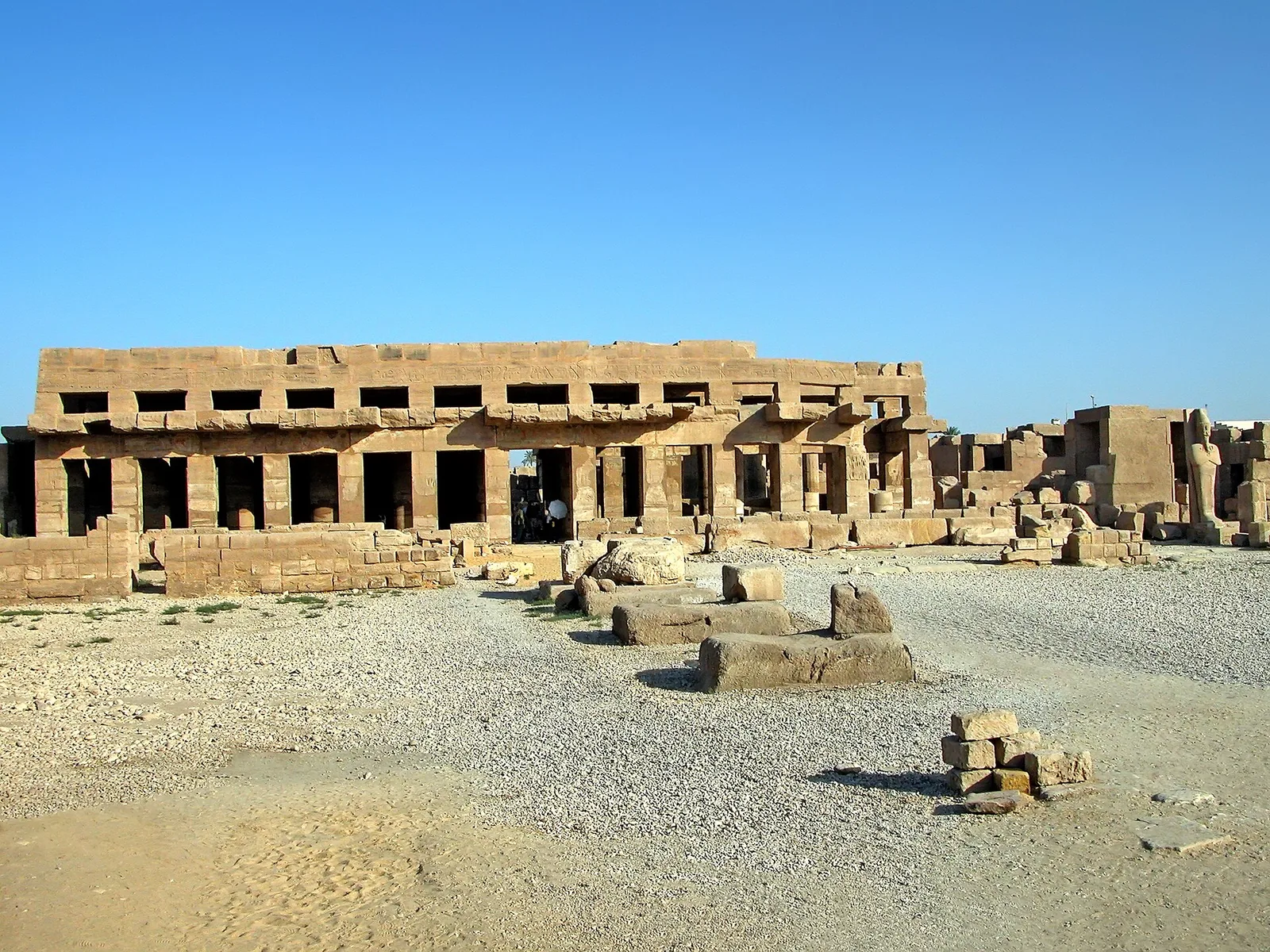
Dennis G. Jarvis, Festival Hall of Thutmose III, Karnak, 2004. Wikimedia Commons · CC BY-SA 2.0 · Source page
The shadow of the queen
A name cut out of the stone
At the temples of Karnak and Thebes, the great city of Egypt’s New Kingdom, some royal names were cut out of the stone on purpose. In places the cartouche that framed the name is still on the wall, and the name inside it has been chiselled away.
Who did it, and when? The leading suspect is pharaoh Thutmose III, a soldier-king. The same walls at Karnak tell the story of his campaigns, and one of them, against a coalition of cities gathered at a place called Megiddo, is one of the earliest battles recorded day by day.
Background
A queen who became king
Thutmose III was the son of the pharaoh Thutmose II and a secondary wife. When his father died the boy was still young. Estimates of his age vary: some give two years, others thirteen.
His father’s chief wife was Hatshepsut. At first she ruled in the boy’s name. Later she took the full titles of a king, including the male ones. For about twenty-two years the two ruled together, she in front and he beside her, as co-regents.
The end of the shared rule
A death, and the dates
Hatshepsut died around 1458 BC. One text dates her death to the tenth day of the sixth month of Thutmose III’s twenty-first regnal year; some scholars count it as his twenty-second. From then on Thutmose ruled alone.
Every date in this lesson is an estimate, and it is worth knowing why. Egyptian years are counted from each king’s reign, and scholars link them to our calendar in different ways. This lesson follows the low chronology, the scale most scholars use today, which puts the battle of Megiddo at about 1457 BC, in the twenty-third year of his reign. Older scales put the same events some decades earlier.
The wider world
Egypt’s reach
In the days of Thutmose III, Egypt’s reach was wide. In the lands the Egyptians called Canaan and Syria, to the east, Egypt did not put an official in every town. It ruled through agreements with local rulers, who kept their thrones and paid tribute to the king of Egypt, for as long as they kept their promises.
Among the important cities were Megiddo, Taanach and Kadesh. Kadesh stood on the Orontes river in northern Syria, and its king was the leader of the revolt against Egypt that the Annals describe. Megiddo commanded the way from the coast into the plain, and we shall see why that matters.
The source
Carved in stone, year by year
The Egyptians wrote a king’s deeds on the walls of his temples. The long record of Thutmose’s campaigns, year by year, is called the Annals by historians. It is carved at Karnak, on the walls of a hall known as the Hall of Annals. Parts of the wall are damaged, and those who have read it have had to fill in lost words.
The Annals are the king’s own version. They were carved after the events, and the king is the hero of every battle. A careful reader asks two questions: what the text says, and what it chooses to leave out.
Myth
This is the first battle ever recorded in detail.
The truth
Not quite, and the claim is more careful than it sounds. Popular books repeat it. Historians say that the Annals of Thutmose III are one of the earliest battle accounts with a day-by-day record. Earlier kings recorded wars too, usually on monuments that celebrated a victory rather than on a sequence of days.
The evidence
Whether a record is detailed enough to be trusted is a historian’s judgement, not a number anyone can count. What can be said with confidence is that the record for Megiddo gives days and months, which is unusual for its age.
The chiefs at Megiddo
The enemy
A coalition gathers
According to the Annals, the enemy had already reached Megiddo. The king of Kadesh had gathered the chiefs of the lands that were subject to Egypt, as far as Naharin. The text repeatedly calls him the ‘wretched enemy’, which tells you whose story this is.
This was a serious revolt. The cities that joined were not one army of one nation. Each had its own ruler, and each had decided to stand against Egypt together with the others. Megiddo was the place they chose to make their stand.
The city
Megiddo on its mound
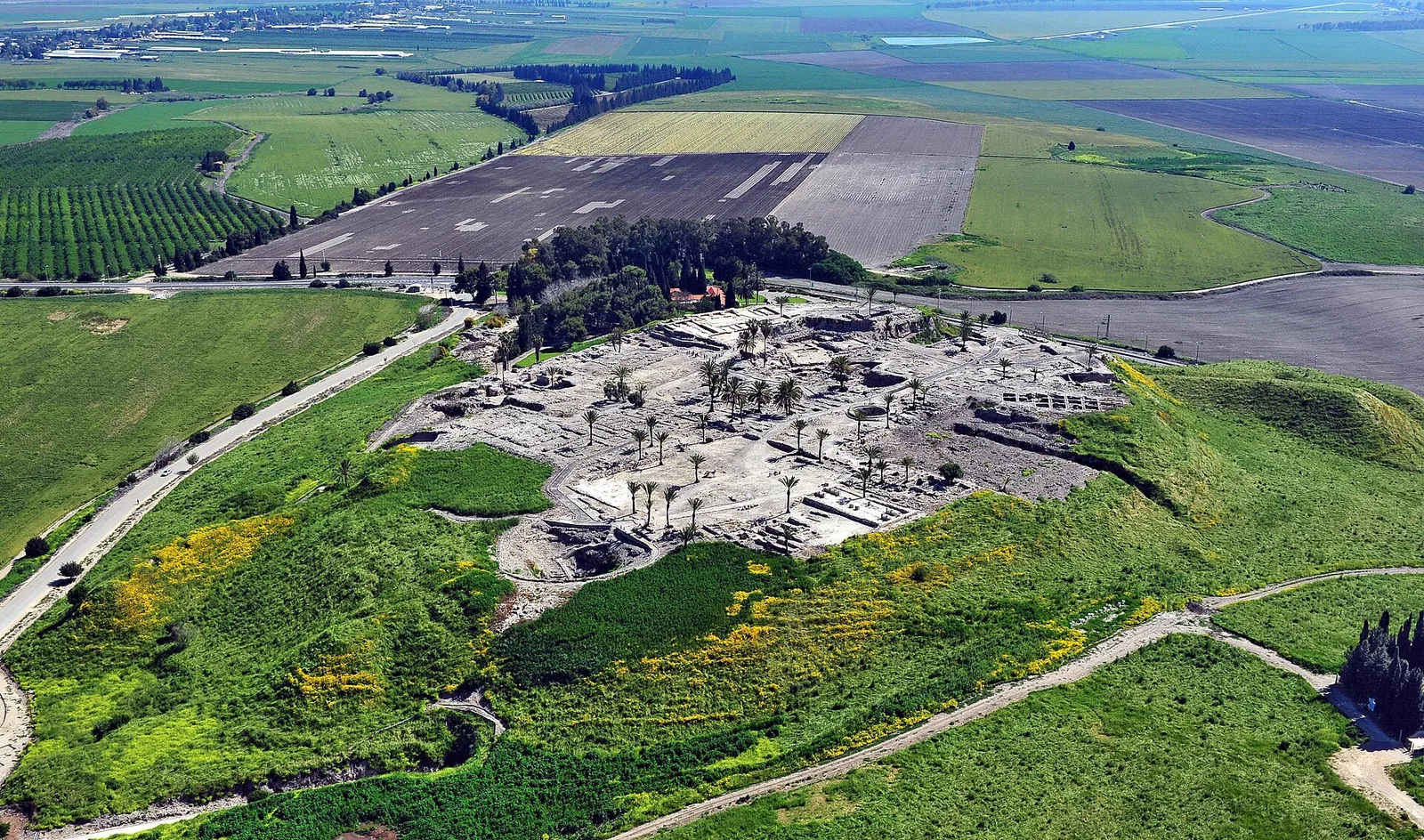
Avram Graicer, Tel Megiddo, 2011. Wikimedia Commons · AVRAM GRAICER · CC BY-SA 3.0 · Source page
Megiddo stood on a mound, a tell built up in layers over thousands of years of settlement. It sat at the edge of the Jezreel plain, where the routes from the coast came down into it.
Nelson calls its position one of the most commanding in the land. Excavations at the mound have found the remains of many cities, and show that Megiddo was strongly fortified.
The march
From the frontier to Yehem
The army marched out of Egypt from the frontier fortress of Tharu. The first important town it reached in that land was Gaza. From there it moved north to Yehem, a place on the southern slope of the Carmel ridge whose exact position is still debated.
No army list survives. Nelson estimated that each side had between 10,000 and 15,000 men. On both sides part of the army was chariots and the rest infantry, armed mostly with bows and spears. Other estimates differ, and none can be checked against a count.
The ridge
The ridge and three roads
Yehem lies on the southern slope of the Carmel ridge, which cuts across the coastal plain. Three roads cross it. The first is the narrow Aruna pass, where the road grows narrower as the army goes along it. The second comes out at Taanach. The third runs north of Zefti and comes out to the north of Megiddo.
The enemy is at Megiddo, and nobody in the army knows what waits on any of these roads. Tomorrow the king has to decide which road the army will take.
Three roads
A decision point
You are Thutmose III.
Yehem, on the southern slope of the Carmel ridge. About 1457 BC, in the twenty-third year of your reign.
Your army is camped at Yehem. Your scouts report that the enemy is waiting for you at Megiddo, where the chiefs of the coalition have gathered.
Your officers have studied the three roads. They reject the narrow Aruna pass. They call it an impassable road, and ask how the army can march along a road that grows narrower. They point to the other two roads: one comes out at Taanach, and the other runs north of Zefti and comes out north of Megiddo.
The decision is yours. Whichever road you take, the army will follow you.
Which road do you take?
- The road that comes out at Taanach Probably the army comes out onto the plain near Taanach, away from Megiddo. The enemy has time to see it coming and to choose its ground. The surprise is lost.
- The road north of Zefti Probably the army comes out north of Megiddo and can cut off the enemy’s flight to the north. But such a move is seen from afar, and the enemy can change its position.
- The narrow Aruna pass, where the road grows narrower Probably the army comes out of the pass in a long and exposed column, and if there is an ambush, it will be inside the pass. But the army reaches the plain before the enemy knows where it came from. Surprise is the great asset of this road.
What really happened
The narrow Aruna pass, where the road grows narrower
Thutmose chose the Aruna pass. Before the army moved he swore an oath, and the Annals keep his words. He told his officers that whoever wished could march along the other roads, while he himself would go by the pass. The officers gave way and followed him. The army came through the pass and out onto the plain, and the battle opened close to Megiddo.
The reason the king gives is the official one, in his own words: he did not want the enemy to think he was beginning to fear them. Many historians have admired the nerve of the choice, and Nelson sets the king’s boldness against the caution of his officers. But the Annals are the king’s own story, written after the victory, so this is the reason he wanted believed. No source records what he thought when nobody was listening.
Source: The king’s oath before the march
“I [swear] as Re loves me, as my father Amon favors me, as my nostrils are renewed with satisfying life, my Majesty proceeds upon this ‘Aruna road.’”
“Do not let them think among these enemies whom Re detests, ‘Does his Majesty proceed upon another road (because) he is beginning to fear us?’ (So) they will think.”
The passage is carved on the wall of the Hall of Annals at Karnak. Where the stone is worn, Nelson restored the missing words; ‘swear’ in square brackets is his restoration.
- Who wrote this, and when? A scribe working for the court, after the victory. Nelson describes it as excerpts from the daily records of the campaign, so the scribe had diaries to work from. It was written to show the king at his best.
- Whose reason does the text give? The king’s, in his own words. The officers appear in the text, but the reason it gives for the choice is his.
- What is missing? The text is damaged where the officers describe the road to Taanach, so we do not know what they said about it. Nothing records what the king said in private.
The rout and the walls
The battle
The king at the head of his troops
The battle opened on the plain, not far from Megiddo. According to the Annals, the king did not stay behind. He stood at the centre of the line, and the text says he prevailed over the enemy at the head of his troops.
Nelson writes that the enemy fled after offering very little resistance, and that it is not clear to him why. The Annals describe the fight as the king’s victory, and say little about the men who fought it.
The fugitives
The flight into the city
The enemy fled to Megiddo, the Annals say, with faces full of fear. They left behind their horses and their chariots of gold and of silver. Inside the city the gates were shut against them, and the people let down garments from the wall to haul the fugitives up.
The battle was over in the field. The city still stood, walled and closed, and beside it lay the enemy’s camp.
The camp
The camp between the army and the city
Between the army and Megiddo lay the enemy’s camp, with tents, horses, chariots and all the goods that an army brings to war. Your troops have already reached its edge.
The city’s walls are strong and its gates are shut. What comes next is either an assault on the walls or a siege, and the choice has to be made while the army stands in the camp.
A decision point
You are Thutmose III, on the day of the battle.
Megiddo, straight after the battle.
The army stands at the edge of the enemy camp. The city into which the beaten fighters fled is shut, and the camp lies between your men and its gates.
You can order an immediate assault on the walls, let the troops go into the camp first, or close the city in and wait. A quick attack may be hard, but if it succeeds the city falls that same day.
What do you order?
- Let the troops plunder the enemy camp first Probably the men grow rich at once, but the time gives the enemy the chance to prepare its defence. After that, a quick attack is no longer possible.
- Order an immediate assault on the walls Probably the assault is hard and costly, because the walls are strong and the men are tired from the battle. The result is not certain.
- Close the city in and starve it out Probably the city yields only when its food runs out. That takes time and discipline, and in the meantime the towns nearby can choose which side to join.
What really happened
Let the troops plunder the enemy camp first
The troops fell on the camp and seized its horses, chariots and goods. According to the Annals, had the troops not given their hearts to plunder, they would have taken Megiddo at that moment. Nelson remarks that apparently no effort was made to storm the city. The army began a siege instead.
The text blames the soldiers for their greed. It does not say whether the king gave any order about the camp. Nelson suggests that the king saw the city was not prepared for a long siege, and chose to let hunger do the work rather than risk a failed assault. That is Nelson’s reading, not a fact recorded in the text.
Source: Why the city was not taken at once
“Now had the troops of his Majesty only not given their hearts to plunder the possessions of the enemy, they would [have plundered] Megiddo at this moment…”
The sentence comes straight after the flight and before the list of booty. It is the scribes’ explanation for why the city was not taken, and it blames the soldiers. The bracketed words are Nelson’s restoration.
- What does the text admit? That the city could have been taken at once, and was not. An official record that praises the king admits a failure here, and puts the blame on the troops.
- Who is blamed, and who is not? The soldiers are blamed for giving their hearts to plunder. The king is not named as making a decision, and the text does not say whether he gave any order about the camp.
- What would you check with a historian? Whether the king gave an order, and whether the spoils were the main reason the army stopped. The text answers neither question.
Walls and lists
The siege
A rampart around the city
The army did not take the city in an assault. It built a rampart around it, and the siege began with the work on that wall. According to Nelson’s reading of the Annals, no one was allowed out of the city except to come out and surrender.
The Annals do not say how long the siege lasted. This lesson calls it several months, and the seventh chapter shows that even this is disputed.
Water and hunger
Hunger, not thirst
Megiddo was well supplied with water, Nelson notes, so thirst was not the problem. He thinks it was lack of food rather than of water that probably forced the surrender. The Annals say that no one could leave except to come out and submit, and so the siege went on until hunger made the people give in.
After the surrender
Chiefs bringing tribute
After Megiddo fell, the Annals say, the chiefs of the land came bearing their tribute, and the king appointed new chiefs for the cities. Egypt was now deciding again who ruled each town, and who answered to whom.
Source: The list of booty
“340 living captives, 83 hands, 2,041 mares, 191 female colts, 6 stallions … 892 chariots of his wretched army: total 924 … 1,929 cattle, 2,000 small cattle, 20,500 small white cattle.”
This is the list of spoils after the surrender. It names captives, horses, chariots, armour, bows, cattle and small livestock. The hands are the scribes’ count of the enemy dead. Nelson notes that 83 is the number recorded, which may not be the full count.
- What does the list count? Spoils: captives, horses and chariots, armour and bows, cattle and small livestock. It records what the king gained. It does not record what the city lost.
- Why does the list count hands? Egyptian records counted enemy dead by their hands, and the count is written in with the spoils. It is a count, not a description, and it carries no names.
- What is missing from the list? The families and homes of Megiddo, and the cost of the siege to its people. A list of spoils is written to show success, not to tell what happened to people.
Myth
Megiddo is Armageddon, the place of the last battle in Revelation, so Thutmose’s battle is the first chapter of the same story.
The truth
No. Armageddon is a Greek spelling of the Hebrew phrase ‘mountain of Megiddo’. The word appears once in the Greek New Testament, in Revelation 16:16, some 1,500 years after Thutmose. No text links that verse to his battle.
The evidence
The link is only in the name. The Egyptian record says nothing about Revelation, and Revelation says nothing about Thutmose.
Seventeen campaigns
The campaigns
Seventeen campaigns
The Annals describe many campaigns by Thutmose III. Historians usually count seventeen, though their counts run from sixteen to twenty, depending on what each one treats as a separate campaign.
Tribute and hostages
The hostages
The king did not hold these lands by force alone. Local rulers paid tribute, and some had to send members of their families to the Egyptian court. These were hostages: the sons of local nobles, sent to Egypt as a guarantee of loyalty. According to later summaries, the heirs among them were educated at the Egyptian court, far from home.
The river
The wide river
In his thirty-third year, according to historians’ summaries, Thutmose campaigned against Mitanni, a kingdom on the upper Euphrates. The river lies far from the sea, and the army had no boats fit for a river so wide.
Later historians, Nicolas Grimal and R. O. Faulkner among them, wrote about this campaign in brief summaries. The next step asks how you would reach the river.
A decision point
You are Thutmose III, in your thirty-third year.
Byblos, on the Lebanon coast. About 1447 BC.
Your army stands at Byblos, the old port on the Lebanon coast. The Euphrates lies far to the east, beyond the mountains and the land of the Syrian cities, and your army has no boats fit for a river so wide.
You can build boats here and carry them overland to the river. You can turn back to Egypt and accept whatever tribute is sent after you. Or you can look for a place to cross the river without boats.
What do you order?
- Build boats here at Byblos and carry them overland to the river Probably the work is heavy: timber, sawing and hauling boats over hill roads. But the army reaches the river with the means to cross it, on terms it has set itself.
- Turn back and accept whatever tribute is sent Probably the rulers keep paying as long as they fear you. But power that never reaches the river is hard to see, and your hold on the neighbours weakens.
- Look for a place to cross the river without boats Probably there is no reliable information about such a place. If the river is deep where the army reaches it, the army halts on the bank, in view of the enemy. The gamble is large.
What really happened
Build boats here at Byblos and carry them overland to the river
The army sailed to Byblos, built boats there and carried them overland to the Euphrates, and the king crossed the river. According to the usual summaries, he set up a monument on the bank.
The accounts present the crossing as a sign of the king’s reach: his power extends to the river itself. Why he chose the hard road is not stated in the sources. Grimal and Faulkner describe how it was done, but not the king’s reasoning.
The name on the wall
Years later
The walls still stand
About twenty-five years after Hatshepsut’s death, you walk through the temples she built: at Karnak, and at Deir el-Bahari, her mortuary temple on the western cliffs of Thebes. Her names and figures are still on the walls, close to your own.
Anyone who wants them removed would have to do the work by hand, chisel by chisel. Whatever is cut away is visible at once, and nobody can avoid the question of what remains and what is gone.
A decision point
You are Thutmose III, many years after Hatshepsut’s death.
Karnak and Deir el-Bahari, about twenty-five years after her death.
Hatshepsut has been dead for about twenty-five years. Her names and figures stand on the temples she built, close to your own names.
Your son Amenhotep will one day take the throne, and whatever you decide now will stay on those walls long after you have gone. Temples like these record who built what, and who is remembered for it.
You can have all of her names and figures cut out, leave everything as it is, or do something in between.
What do you order?
- Erase all her names and figures from the temples Probably the temples would show one king where there were two. The work would be large, and every priest and visitor who knew the old inscriptions would notice the gap.
- Leave everything as it is, untouched Probably the temples stay as they are, with her names beside yours, and no gap needs explaining. The question of who built what stays open for those who come after you.
- Erase some of her names and leave others Probably some names vanish and others remain, which is hard to read from outside. Later generations would have to guess what you meant to achieve.
What really happened
Erase some of her names and leave others
The erasure of her names was partial. The damage that can be dated begins in year 46 or 47 of Thutmose, about twenty-five years after her death, a dating that comes from Egyptologists’ study of the monuments. Many of her names and figures survive on the walls to this day.
No text states the reason. The explanations range from revenge to a wish to secure the succession for his son, and that disagreement returns at the end of this chapter. The walls themselves are the main evidence, and they can be read in different ways.
Myth
Thutmose hated Hatshepsut from the day he became king, and that is why he erased her names.
The truth
No source says he hated her from the start. The erasure that can be dated began about twenty-five years after her death, in his year 46 or 47. The idea that this was revenge born at his accession does not fit those dates.
The evidence
The dates rest on scholars’ study of the walls, not on any document that reports the king’s feelings.
The tomb
The tomb in the Valley of the Kings
Thutmose III was buried in the Valley of the Kings, on the west bank of the Nile, across from Karnak. The tomb is marked KV34 by scholars, and it was found in 1898.
The tomb lies among the royal tombs of the New Kingdom, where many of Egypt’s kings chose to be buried.
What followed
- c. 1458 BC Hatshepsut dies. Thutmose III rules alone.
- c. 1457 BC The battle of Megiddo, then a siege of several months. The city surrenders for lack of food.
- c. 1447 BC In his thirty-third year the army crosses the Euphrates in boats built at Byblos.
- c. 1438 BC The record of his campaigns on the walls of Karnak ends in his forty-second year. It began in year 22, and Megiddo is recorded in year 23.
- c. 1434–1433 BC The datable erasures of Hatshepsut’s names begin, about twenty-five years after her death.
- c. 1425 BC Thutmose III dies after a reign of about fifty-four years.
- 1898 The tomb KV34 is found in the Valley of the Kings.
How long did the siege last?
The Annals do not give the length of the siege. How do historians fill the gap?
- H. H. Nelson, 1913 Nelson reads the dates in the Annals. On his reckoning the siege began on 15 May, and the king was back in Thebes by 11 October. The whole operation, including the siege, the march into southern Lebanon and the return to Egypt, fits in under five months. He thinks a month would be enough between the building of the rampart and the surrender, but he calls this conjecture.
- Later reference works Later reference works give the siege as about seven months, and some say seven to eight. These are estimates, not counts of days.
Nelson’s figure is worked out from dates in the Annals, and the other is an estimate. No text gives the length of the siege. Change the way the dates are placed and the length changes too. The question remains open.
Check yourself
Which road did the king choose at Yehem?
Answer: The narrow Aruna pass. Correct. The king swore to march the Aruna road, and his words are kept in the Annals. This was the road the officers rejected.
Check yourself
How did the fugitives get into Megiddo?
Answer: Hauled up over the wall on garments. Correct. The text says the people inside let down garments from the wall to haul them up.
Check yourself
Why did the Egyptians not take Megiddo at once?
Answer: Troops stopped to plunder the enemy camp. Correct. The text blames the troops who gave their hearts to plunder, instead of storming the city.
Check yourself
How many campaigns do historians usually count for Thutmose III?
Answer: Seventeen. Correct. This is the usual count, though counts run from sixteen to twenty.
Check yourself
Where was Thutmose III buried?
Answer: In tomb KV34, in the Valley of the Kings. Correct. The tomb marked KV34 lies in the Valley of the Kings, and was found in 1898.
Check yourself
Where does the word Armageddon come from?
Answer: The Hebrew phrase ‘mountain of Megiddo’. Correct. Armageddon is a Greek spelling of ‘mountain of Megiddo’, and the word appears once in the New Testament, in Revelation.
Terms
- pharaoh The title of the kings of Egypt. The word first meant ‘great house’, that is, the palace.
- cartouche An oval frame with a rope-like border that encloses a king’s name in hieroglyphs.
- Annals A year-by-year record of a king’s deeds. The Annals of Thutmose III are carved at Karnak.
- regnal year A year counted from a king’s accession. Year 23 of Thutmose III is the twenty-third year of his reign.
- co-regent A ruler who governs alongside another. Thutmose III ruled alongside Hatshepsut for about twenty-two years.
- tribute A payment that a ruler gives a stronger ruler, as a sign of submission and loyalty.
- hostage A person held to guarantee that a family or people will keep faith. Sons of local nobles were sent to Egypt.
- siege A situation in which an army surrounds a city or fortress and tries to break its resistance by assault, by hunger, or both.
- plunder Taking goods by force, often from an enemy camp or a captured city, during or just after a battle.
- Mitanni A powerful kingdom on the upper Euphrates, in northern Mesopotamia and northern Syria. Thutmose III campaigned against it in his thirty-third year.
- low chronology One of the scales that fit Egypt’s regnal dates to our calendar. Its dates are later than those of the high chronology, and most scholars use it today.
- Armageddon The name that appears once in the Greek New Testament, in Revelation 16:16. It is a Greek spelling of the Hebrew ‘mountain of Megiddo’.
- Karnak A vast temple complex at Thebes in Egypt. Royal names were cut into its stone.
- Thebes A great city in Egypt in the New Kingdom period. The Karnak temples stand there.
- Hatshepsut His father's chief wife. She ruled alongside him and later took the full titles of a king.
- Megiddo A fortified city on a mound at the edge of the Jezreel plain, in the north of Canaan. Thutmose fought a famous battle there.
- Kadesh A city in northern Syria on the Orontes river. Its king led the revolt against Egypt.
- Orontes A river in northern Syria, on which the city of Kadesh stood.
- Taanach An important city in Canaan, named alongside Megiddo and Kadesh.
- Gaza A coastal city on the Mediterranean. It was the first important town Thutmose's army reached.
- Tharu The frontier fortress of Egypt, where Thutmose's army set out on its march.
- Yehem A place on the southern slope of the Carmel ridge, whose exact position is still debated.
- Carmel A ridge of hills in the north of the land that cuts across the coastal plain.
- Aruna A narrow mountain pass on the Carmel ridge, which Thutmose chose for his army.
- Zefti A place that the third road passes north of, coming out north of Megiddo.
- Euphrates A great river far to the east, far from the sea. Mitanni sat on its upper course.
- Nile Egypt's great river, on whose banks its cities and temples stood.
- Canaan The name Egyptians gave to the lands east of them, including Syria.
- Naharin An Egyptian name for a distant eastern land, whose rulers once answered to Egypt.
- Valley of the Kings A valley on the west bank of the Nile, across from Karnak, where many Egyptian kings were buried.
- Nicolas Grimal A scholar of ancient Egypt who wrote a short summary of the campaign to the Euphrates.
- James Henry Breasted An American historian to whom the nickname Napoleon of Egypt is usually traced.
- Napoleon of Egypt A nickname given to Thutmose III. The comparison says more about the writer's century than about the king.
- Nelson A scholar who wrote about Megiddo and restored the words worn away on the wall at Karnak.
- New Testament The second part of the Christian Bible, written in Greek.
- Amenhotep Thutmose III's son, who inherited his throne. Later scholars link the erasure of Hatshepsut's names to securing his succession.
Sources
- Annals of Thutmose III, year 23 and following (Hall of Annals, Karnak). Egyptian text: Urkunden des ägyptischen Altertums IV, ed. Kurt Sethe, pp. 649–664
- James Henry Breasted, Ancient Records of Egypt, vol. II: The Eighteenth Dynasty (Chicago, 1906), pp. 421–431. English translation, public domain
- H. H. Nelson, The Battle of Megiddo (Chicago: University of Chicago Press, 1913). Translation and commentary, public domain
- Eric H. Cline, The Battles of Armageddon: Megiddo and the Jezreel Valley from the Bronze Age to the Nuclear Age (Ann Arbor: University of Michigan Press, 2000)
- Nicolas Grimal, A History of Ancient Egypt (Oxford: Blackwell, 1992)
- R. O. Faulkner, ‘The Euphrates Campaign of Tuthmosis III’, Journal of Egyptian Archaeology 32 (1946)
- Revelation 16:16, Greek New Testament: the only place the word Armageddon appears in it
Image credits
- Dennis G. Jarvis, Festival Hall of Thutmose III, Karnak, 2004. Wikimedia Commons · CC BY-SA 2.0 · Source page
- Avram Graicer, Tel Megiddo, 2011. Wikimedia Commons · AVRAM GRAICER · CC BY-SA 3.0 · Source page

