The Thirty Years' War
Decisions, questions and your own progress, in the app
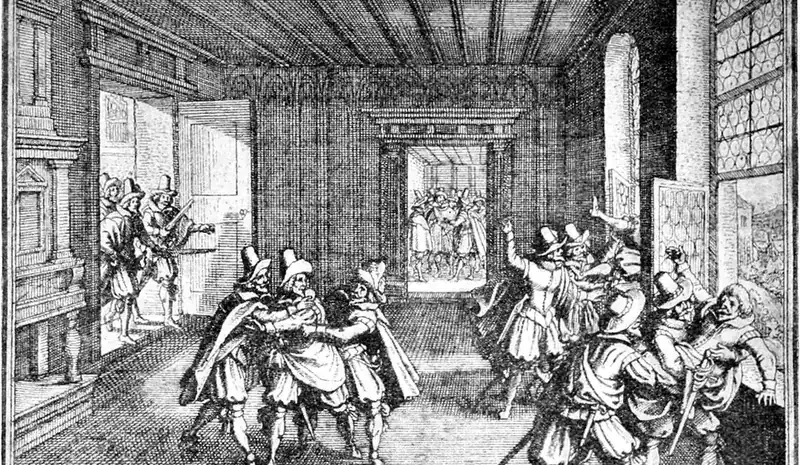
The Defenestration of Prague, 1618, engraving by Merian · Matthäus Merian · Public domain · Source page
A spark in Prague
In 1618, Protestant nobles in Bohemia threw two royal officials out of a castle window in Prague. The officials survived, but the revolt grew into a war across the Holy Roman Empire.
Everyone joins in
Catholic and Protestant rulers fought, but so did kings who just wanted more power. Denmark, Sweden and France joined, and armies from Spain, Austria and the German states marched back and forth for thirty years.
Millions dead
4 to 8 million
Armies lived off the land. Hunger, plague and burning towns killed far more people than battles did. Historians estimate that 4 to 8 million people died, and some regions of Germany lost a third of their people or more.
Wallenstein
Albrecht von Wallenstein raised a huge private army for the emperor. He was one of the war's greatest commanders, and in 1634 officers who feared he would change sides murdered him.
Peace at Westphalia
In 1648 the sides signed treaties in Münster and Osnabrück, together called the Peace of Westphalia. The German princes gained the right to run their own states and make their own alliances, and the emperor lost power over them.
Why it still matters
The war left Germany split into hundreds of small states for more than two centuries. The idea that states are independent and equal, which people link to Westphalia, still shapes how countries deal with each other.
Review question
How did the Thirty Years' War begin?
Answer: Protestant nobles threw royal officials out of a window in Prague. The Defenestration of Prague in 1618 started a revolt that spread across the Holy Roman Empire.
What did the Peace of Westphalia do?
Answer: It gave German princes more power over their own states. The emperor lost much of his authority, and Germany stayed split into many states. A single German state came only in 1871.
Image credits
- The Defenestration of Prague, 1618, engraving by Merian · Matthäus Merian · Public domain · Source page
