Luther's 95 Theses, 1517
A monk writes a letter about money and sin. Europe splits in two.
Decisions, questions and your own progress, in the app
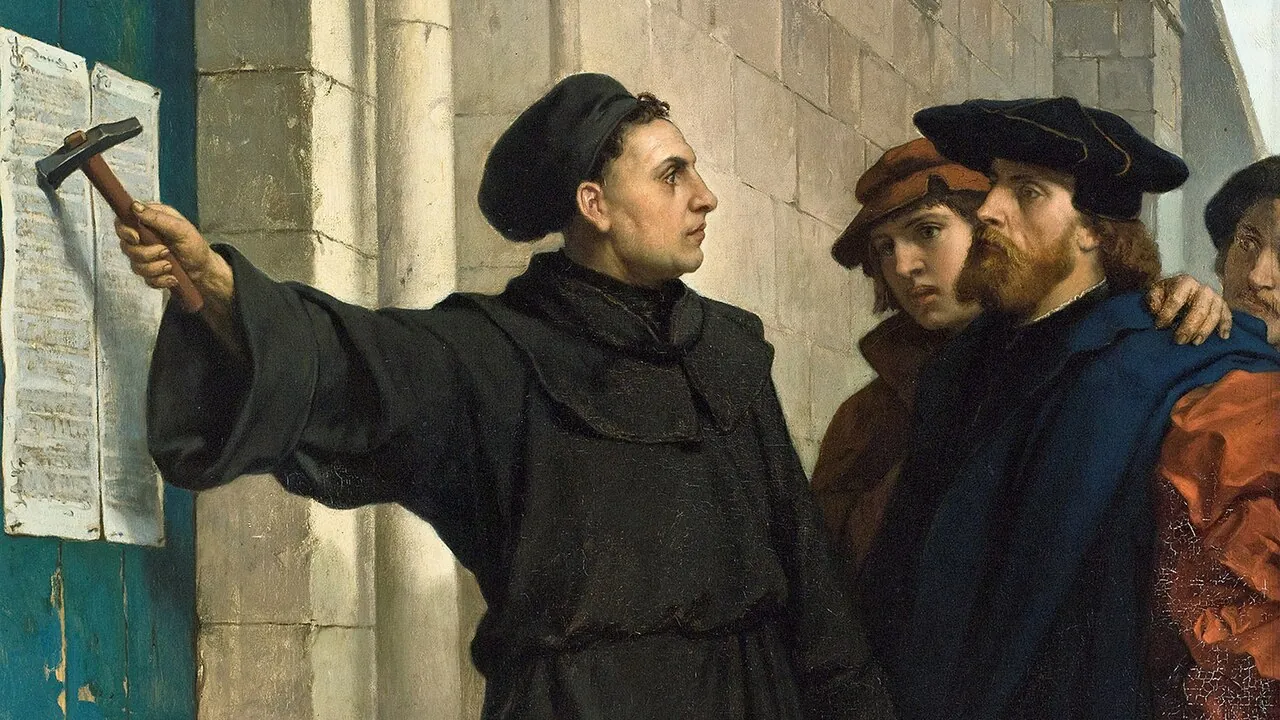
Ferdinand Pauwels, Luther posting the 95 Theses, 1872 · Public domain · Source page
A hammer, a door, a letter
31 October 1517. You know the picture: a monk with a hammer, nailing a sheet to a church door. It may never have happened.
What we know for sure is quieter. That day Martin Luther, a monk who teaches at Wittenberg's small university, writes to Germany's most powerful churchman. He encloses 95 theses in Latin. He wants a debate.
Background
Forgiveness, for a price
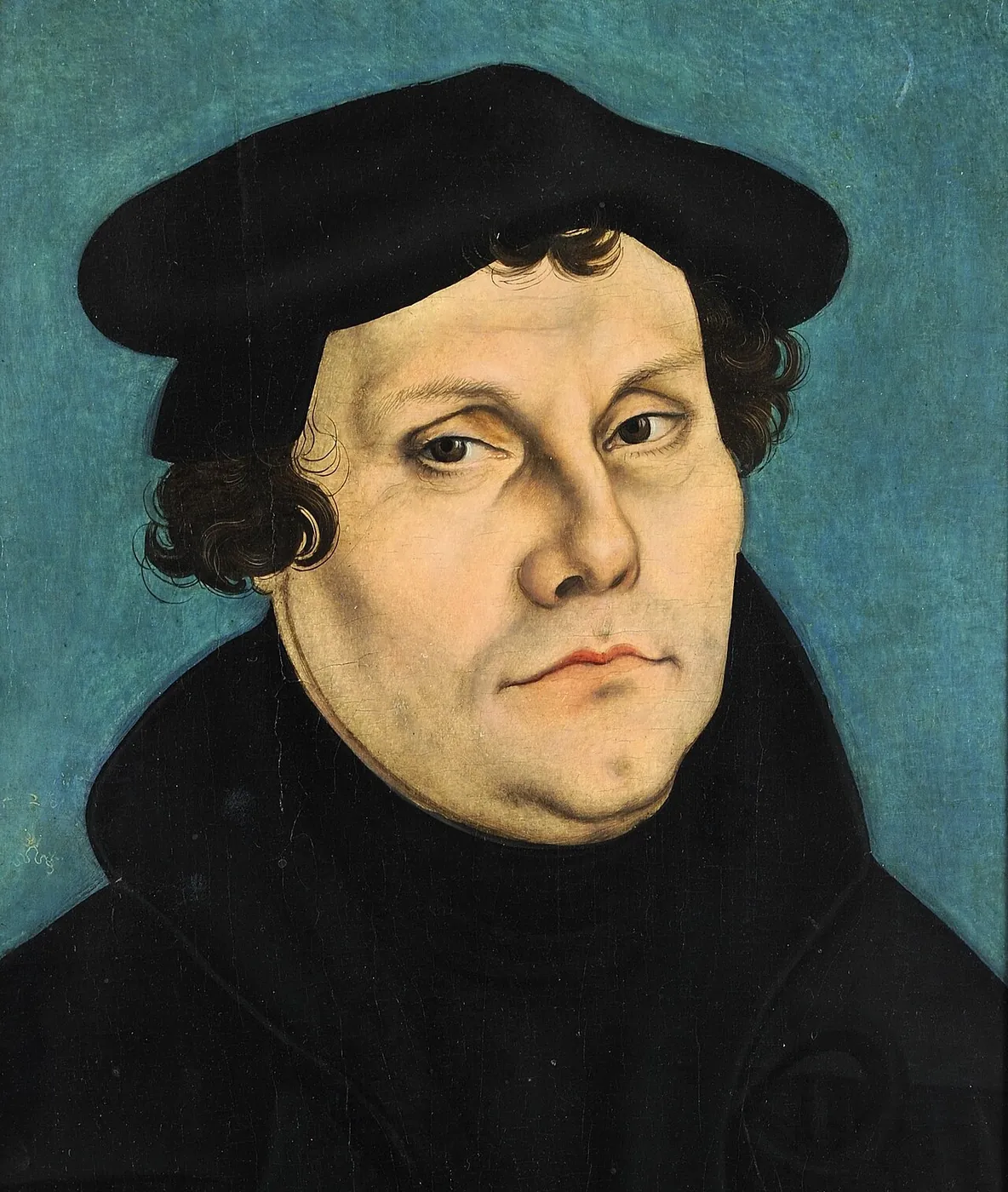
Lucas Cranach the Elder, Martin Luther, 1528. Kunstsammlungen der Veste Coburg · Public domain · Source page
Confession wiped away a sin's guilt, the Church taught, but punishment remained, in this life or in purgatory. An indulgence cancelled some or all of it. Prayer, pilgrimage or a gift of money could earn one, even for the dead.
In 1517 a friar, Johann Tetzel, is selling a new indulgence just over the border; Luther's prince has banned it in his lands. The money is for rebuilding St Peter's Basilica in Rome.
Behind it lies a deal Luther probably knows nothing about. Archbishop Albrecht of Mainz owes the Fugger bank a fortune he paid Rome for his posts. Half the takings go to Rome, half to Albrecht, who uses it to repay the bankers.
A decision point
You are Martin Luther.
Wittenberg, October 1517
You are 33: a friar, a doctor of theology, a preacher in the town church. Some townspeople come home from Tetzel sure their salvation is paid for.
The preachers' instructions, issued in the archbishop's name, promise more than any theologian you respect would dare. You vowed obedience to the Church, and swore as a doctor to teach the truth.
What do you do?
- Keep preaching against the sale, but only from your own pulpit Probably safe, and probably little changes. Your congregation hears you, but the preaching across the border goes on, and no one with power has to answer you.
- Write to the archbishop and your bishop, enclosing theses for a learned debate The proper way: scholars may question, and bishops must judge. But the archbishop never answers you. He asks theologians whether your theses are heresy and sends them to Rome. Meanwhile the copies you gave friends begin to travel.
- Write a German pamphlet so ordinary people can judge for themselves Probably a bigger, faster echo. But going over the bishops' heads to the crowd looks like stirring up the people against the Church, and your enemies get an easy charge. Luther did this later: his German Sermon on Indulgences and Grace of 1518 became a bestseller.
- Say nothing: you vowed obedience, and the pope approved this indulgence Safe for you: you keep your post and your quiet life. But your people go on buying letters in place of true repentance, and you are their confessor. Others may speak up instead: complaints about indulgences are not new.
What really happened
Write to the archbishop and your bishop, enclosing theses for a learned debate
On 31 October 1517 Luther wrote humbly to Archbishop Albrecht, enclosing his theses. He says he wrote to his own bishop too. Albrecht never answered. By December he had sent the theses to Rome.
Thesis 50 says that if the pope knew how his preachers fleeced his sheep, he would rather see St Peter's burn. Luther wanted the abuse stopped, not the Church overturned.
What really happened
From a polite letter to an outlaw
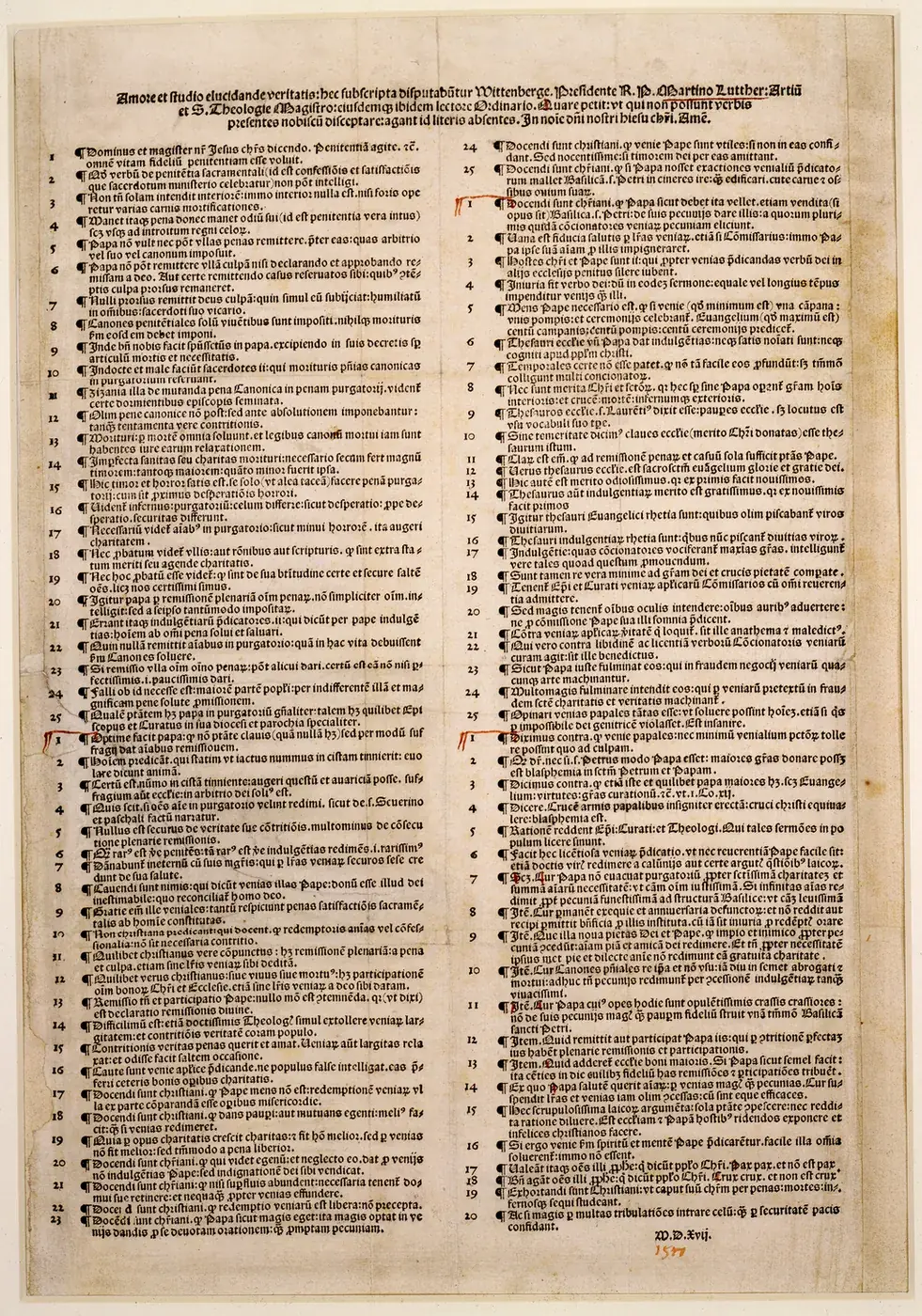
Martin Luther, Disputatio pro declaratione virtutis indulgentiarum, Nuremberg printing, 1517. Via the World Digital Library · Public domain · Source page
4 years
Luther sent copies to friends. By early 1518 the theses were in print in Leipzig, Nuremberg and Basel, and translated into German. Luther wrote that he never meant them to spread so far.
In a debate at Leipzig in 1519 he went further: even church councils could be wrong. In 1521 the pope excommunicated him. At the Diet of Worms, before Emperor Charles V, he refused to take back his writings. The printed report has him say “Here I stand, I can do no other”, perhaps not his exact words. His prince hid him in a castle; the emperor declared him an outlaw.
Printing was the engine.
Source: Christ or Antichrist?
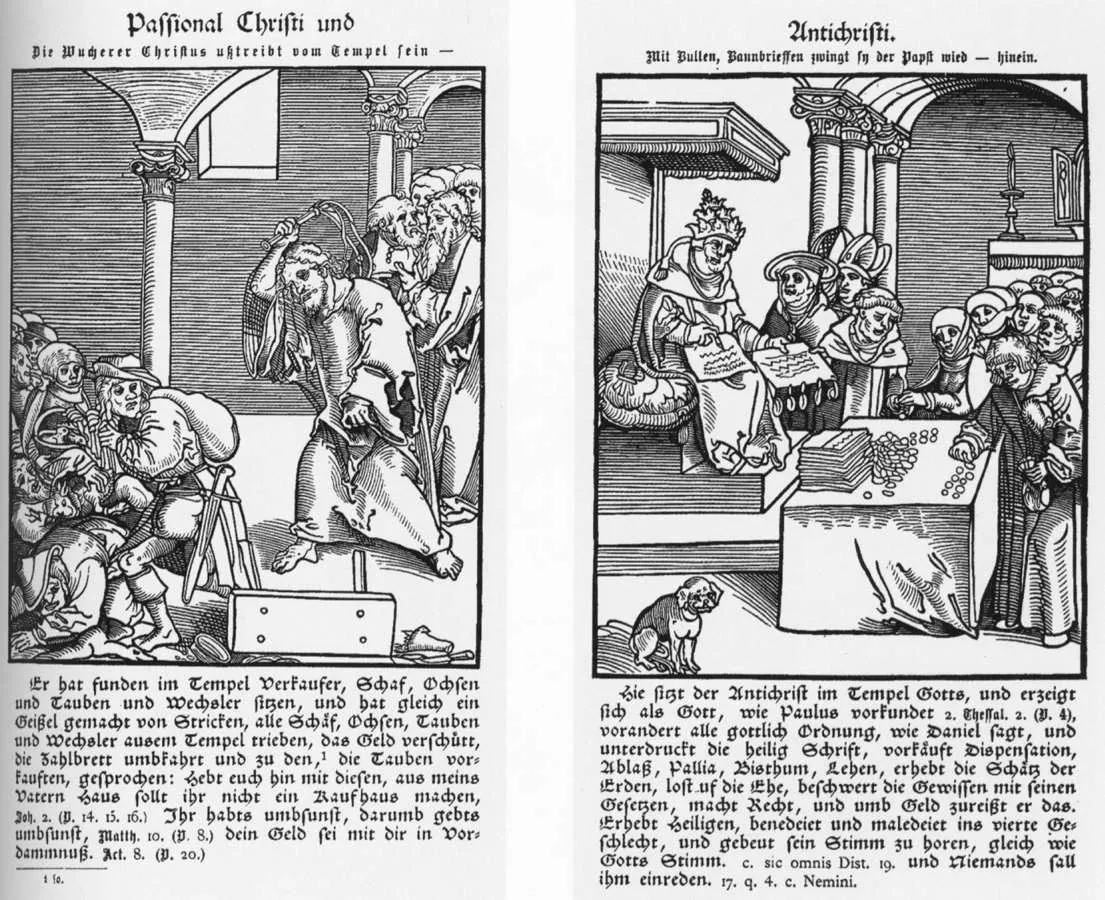
Lucas Cranach the Elder, Passional Christi und Antichristi (Passion of Christ and Antichrist), 1521 · Public domain · Source page
Workshop of Lucas Cranach the Elder, Passional Christi und Antichristi, Wittenberg, 1521
Left: Christ drives the money-changers from the Temple. Right: the pope, in his triple crown, sits among coins and sealed documents as people pay. The caption lists what he sells, indulgences included.
- Who made this, and when? Lucas Cranach, Luther's friend, in Wittenberg in 1521, months after Luther's excommunication. The captions are usually credited to Luther's colleague Philip Melanchthon. One side of a fight.
- Who was it for? Ordinary Germans. The captions are in German, not Latin, and the pictures speak to people who cannot read, as most could not.
- What does it want you to believe? What is missing? That the pope is the Antichrist, selling what Christ gave free. Under Christ, the caption quotes him: “freely ye have received, freely give.” Missing: the Church's case, and Catholics who also attacked the abuses.
Myth
An angry Luther hammered his 95 Theses to the Castle Church door, declaring war on the Church.
The truth
No early source mentions a hammer, and we do not know that anything was posted. The first account is Melanchthon's, from 1546, after Luther's death; he reached Wittenberg only in 1518. Luther himself never mentions a door. And war on the Church? In 1517 he wanted a debate and reform.
The evidence
In 1961 the Catholic historian Erwin Iserloh argued the posting never happened. In 2006 a note by Luther's secretary Georg Rörer turned up: the theses were posted on Wittenberg's church doors. But Rörer too wrote decades later. If it happened, it was routine: church doors were the university's notice board. The debate is open.
Check yourself
What certainly happened on 31 October 1517?
Answer: Luther sent his theses with a letter to Archbishop Albrecht. Right. The letter bears that date. Whether anything was also posted on a door that day is still debated.
Check yourself
How did 95 statements in Latin reach so many people so fast?
Answer: Printers in several cities published them, and a German translation followed. Right. By early 1518 they were in print in Leipzig, Nuremberg and Basel, and going round in German too. Luther had not planned it.
Check yourself
What did Luther want in October 1517?
Answer: A debate, and an end to the abuse of indulgences within the Church. Right. He wrote to the bishops and proposed a debate among scholars. Thesis 50 even defends the pope against his own preachers. The break with Rome came later, step by step.
Terms
- theses Short statements a scholar offers to defend in a formal university debate, called a disputation. Luther wrote his 95 in Latin.
- indulgence A grant from the Catholic Church that cancelled some or all of the punishment still owed for sins already confessed and forgiven. It was earned by prayer, pilgrimage or payment, and could be gained for the dead too.
- purgatory In Catholic teaching, a state after death where the souls of those bound for heaven are cleansed of the punishment they still owe, before they enter it.
- Fugger A family of merchant bankers from Augsburg, among the richest in Europe in the early 1500s. They lent money to popes, princes and emperors.
- excommunication The Church's heaviest penalty: cutting a person off from the sacraments and from the community of believers.
- Diet of Worms A diet was an assembly of the princes and cities of the Holy Roman Empire, called by the emperor. In 1521 it met in the city of Worms, on the Rhine.
- Philip Melanchthon Philip Melanchthon (1497–1560), a brilliant young scholar who came to teach Greek at Wittenberg in 1518 and became Luther's closest colleague.
- Antichrist In Christian belief, a great deceiver who will rise before the end of the world and pass himself off as holy. Luther's camp came to give this name to the papacy.
- Wittenberg A town in Germany. Luther taught at its small university.
- Leipzig A German city where Luther held a debate. The theses were printed there early.
- Nuremberg A German city where Luther's theses were printed early.
- Basel A city in Switzerland where Luther's theses were printed early.
- Magdeburg A German city. Archbishop Albrecht held it, and wanted Mainz too.
- Mainz A German city. Archbishop Albrecht wanted to hold it too, and paid Rome for that.
- Crassus One of the richest men in ancient Rome, in the days of Julius Caesar.
- Julius Caesar A famous Roman general and ruler, who lived before the Christian era.
- Johann Tetzel A friar who sold a new indulgence just over Luther's border. Luther's prince banned its sale in his lands.
- Gutenberg The man who developed movable-type printing in Europe. His workshop printed indulgence forms early on.
- Albrecht A young archbishop who paid Rome for church posts and for a special permit. He still owed the bankers.
- Charles V The emperor before whom Luther refused to take back his writings, at Worms.
- St Peter's Basilica The great church in Rome. Indulgence money was meant for rebuilding it.
- Nazis The racist party that ruled Germany and led to the murder of Jews in the Holocaust.
- On the Jews and Their Lies A book by Luther in which he urged rulers to burn synagogues and destroy Jewish homes.
- Evangelical Lutheran Church in America A Protestant church in the United States that formally rejected Luther's anti-Jewish writings in 1994.
- church councils Formal meetings of Church leaders that decided questions of belief.
- doctor of theology A top academic degree in theology, the study of the Christian faith.
- pope The head of the Catholic Church, based in Rome.
- archbishop A senior bishop who oversees a large region of churches.
Sources
- Martin Luther, Disputation on the Power and Efficacy of Indulgences (the Ninety-five Theses), 1517, trans. C. M. Jacobs, in Works of Martin Luther, vol. 1 (Philadelphia: A. J. Holman, 1915)
- Martin Luther, letters to Archbishop Albrecht of Mainz (31 October 1517) and to Christoph Scheurl (5 March 1518), in Preserved Smith, ed. and trans., Luther's Correspondence and Other Contemporary Letters, vol. 1 (Philadelphia: Lutheran Publication Society, 1913)
- Passional Christi und Antichristi, woodcuts by Lucas Cranach the Elder (Wittenberg: Johann Rhau-Grunenberg, 1521)
- Philip Melanchthon, preface to volume 2 of Luther's Latin works (Wittenberg, 1546)
- Martin Brecht, Martin Luther: His Road to Reformation, 1483–1521, trans. James L. Schaaf (Philadelphia: Fortress Press, 1985)
- Andrew Pettegree, Brand Luther: 1517, Printing, and the Making of the Reformation (New York: Penguin Press, 2015)
- Lyndal Roper, Martin Luther: Renegade and Prophet (London: Bodley Head, 2016)
- Erwin Iserloh, The Theses Were Not Posted: Luther Between Reform and Reformation, trans. Jared Wicks (Boston: Beacon Press, 1968)
- Volker Leppin and Timothy J. Wengert, "Sources for and against the Posting of the Ninety-Five Theses", Lutheran Quarterly 29 (2015)
- R. W. Scribner, For the Sake of Simple Folk: Popular Propaganda for the German Reformation (Cambridge University Press, 1981)
- Thomas Kaufmann, Luther's Jews: A Journey into Anti-Semitism, trans. Lesley Sharpe and Jeremy Noakes (Oxford University Press, 2017)
Image credits
- Ferdinand Pauwels, Luther posting the 95 Theses, 1872 · Public domain · Source page
- Lucas Cranach the Elder, Martin Luther, 1528. Kunstsammlungen der Veste Coburg · Public domain · Source page
- Martin Luther, Disputatio pro declaratione virtutis indulgentiarum, Nuremberg printing, 1517. Via the World Digital Library · Public domain · Source page
- Lucas Cranach the Elder, Passional Christi und Antichristi (Passion of Christ and Antichrist), 1521 · Public domain · Source page


