Thermopylae and Artemisium
A few thousand Greeks block a narrow pass between mountain and sea. Marching at them is the largest army Greece has ever seen.
Decisions, questions and your own progress, in the app
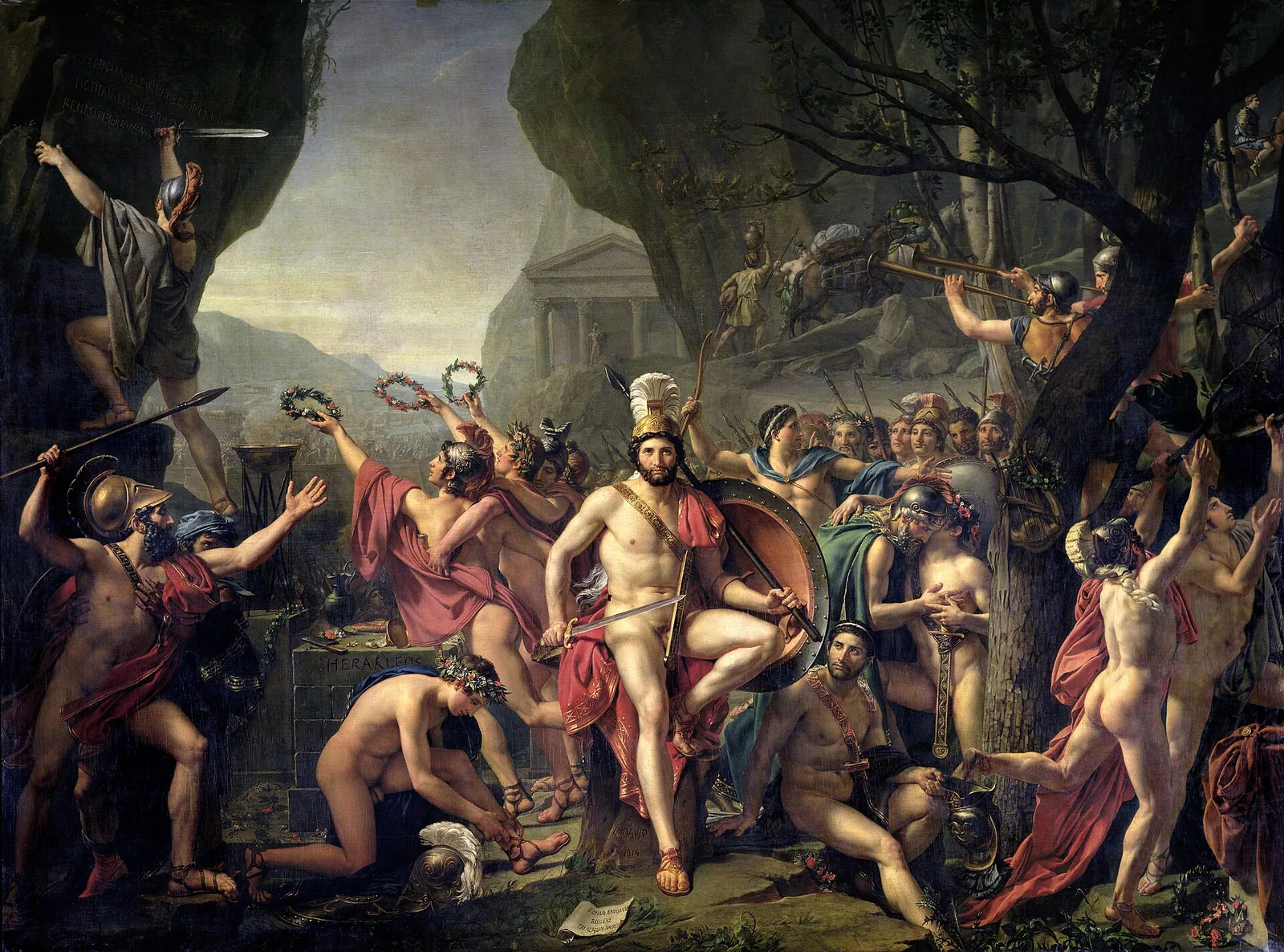
Jacques-Louis David, Leonidas at Thermopylae, 1799–1814. Musée du Louvre, Paris · Public domain · Source page
The Hot Gates
A horseman at the wall
Late summer, 480 BC. A Persian horseman rides along a narrow road between a mountain and the sea. Across the road stands an old stone wall. In front of it men are exercising; others sit combing their long hair.
He counts them, and nobody bothers to chase him off. Back in camp, Xerxes, king of Persia, laughs at his report. He has brought the largest army the Greeks have ever seen, and a few thousand men mean to stop him here, at the pass the Greeks call Thermopylae: the Hot Gates.
Where the story comes from
Almost all from one man
As at Marathon, almost everything we know about the coming days comes from one writer: Herodotus, a Greek born around 484 BC in Halicarnassus, then a city under Persian rule. He wrote some fifty years after the battle, from the stories of Spartans, Athenians, priests and veterans’ sons.
He often tells us when he doubts a tale. But he composed speeches himself, and his numbers are often impossible. No Persian account survives.
Ten years earlier, at Marathon, Athens had beaten a Persian landing force. This time the king came himself.
The king’s revenge
Background
A new king, an old score
After Marathon, Herodotus writes, Darius was angrier than ever, and for three years he raised a far larger army. Then Egypt revolted, and in 486 BC Darius died. His son Xerxes, a grandson of Cyrus the Great through his mother Atossa, took the throne.
Xerxes first crushed the revolt in Egypt, and soon afterwards one in Babylonia. His cousin Mardonius, who had already led one expedition towards Greece, pressed him to punish Athens. This time, Xerxes decided, the king himself would lead.
Xerxes I
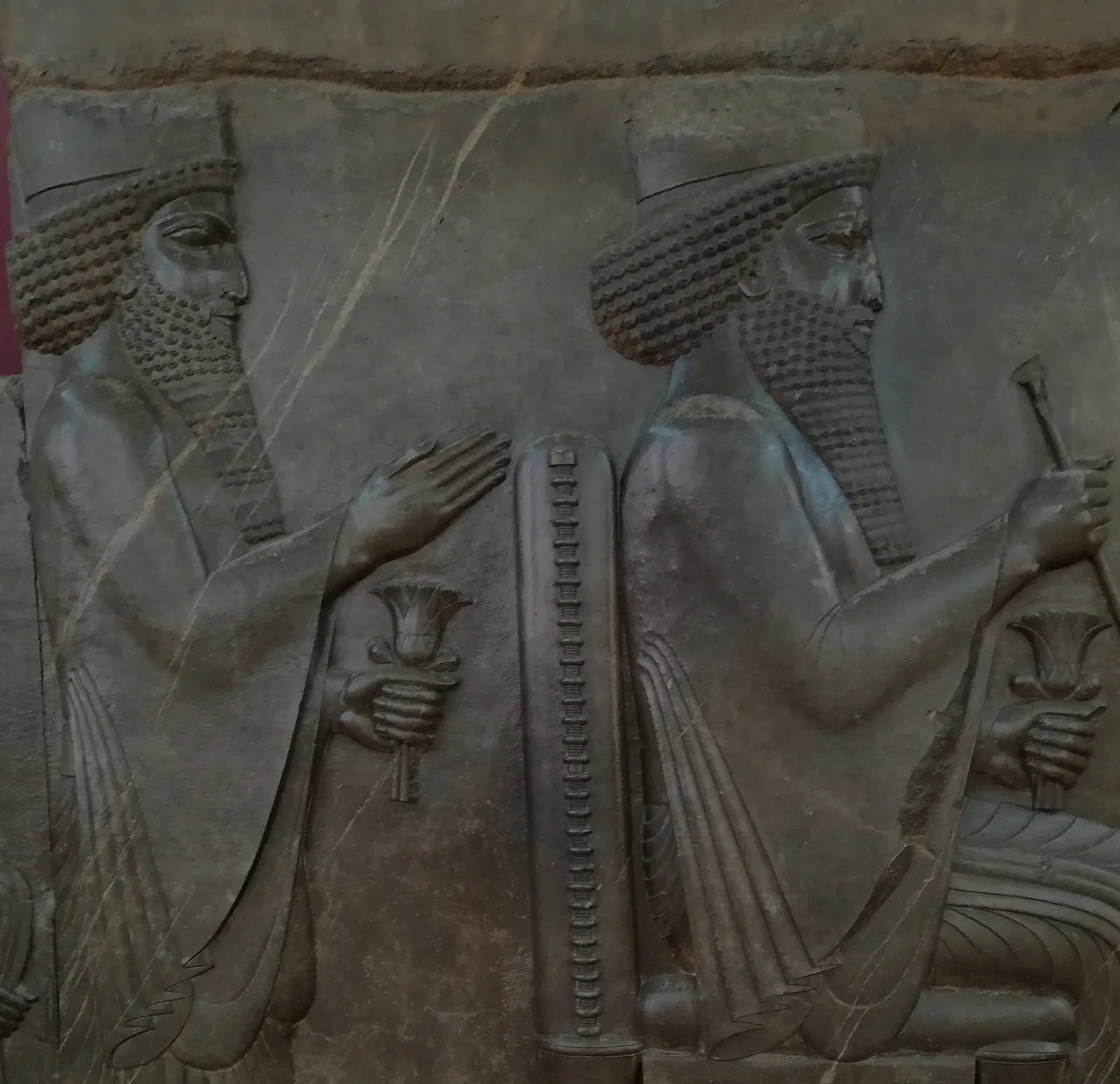
Audience relief from the Treasury at Persepolis (detail), now in Tehran or still at the site. Photo: Arashk rp2 · CC BY-SA 4.0 · Source page
The Great King who cut a canal through a mountain and bridged the sea to punish Athens, took it and burned it, and went home beaten.
- Born: c. 518 BC, Persia; son of Darius I and Atossa, daughter of Cyrus
- Died: 465 BC, murdered in a palace plot
- Won: Revolt in Egypt crushed, 484 BC; Thermopylae, 480 BC; Capture of Athens, 480 BC
- Lost: Salamis, 480 BC; Plataea and Mycale, 479 BC (his generals)
“For I was moved to compassion, when I considered the shortness of all human life, seeing that of all this multitude of men not one will be alive a hundred years hence.”
Preparations
A canal through a mountain, a bridge over the sea
The preparations took four years. Near Mount Athos, where a storm had wrecked a Persian fleet in 492 BC, labourers spent three years digging a canal about two kilometres long. Food was stored in depots along the coast of Thrace.
At the Hellespont, the strait between Asia and Europe, engineers lashed boats together into two bridges about 1.3 km long. A storm smashed them. Herodotus says Xerxes had the strait given 300 lashes, with these words: “Thou bitter water, our master thus punishes thee, because thou didst him wrong albeit he had done thee none.” In spring 480 BC the army crossed on new bridges, seven days and seven nights without a break.
Source: Herodotus counts the army
“…the number of those whom Xerxes son of Darius led as far as the Sepiad headland and Thermopylae was five millions, two hundred and eighty-three thousand, two hundred and twenty.”
At Doriscus in Thrace, Herodotus says, the army was counted by filling a fenced space that held 10,000 men, again and again. To the result he adds the fleet, the cavalry and the allies, then doubles everything for servants.
- How did Herodotus arrive at such an exact number? By arithmetic, not counting: ships times the crews he assumed, his own estimates, then the whole doubled on the assumption that the followers were as many as the soldiers, “neither more nor fewer”. An exact number can still be a guess.
- What does Herodotus himself doubt? The food. He works out the daily grain ration and wonders that it was enough. One road and a few springs could not feed and water millions.
- Why would Greek listeners welcome a huge number? A bigger enemy makes a greater victory. Most historians today put the army at roughly 100,000 to 300,000, and some lower still.
Athens
Silver, ships and a wooden wall
In 483 or 482 BC Athenian miners struck a rich vein of silver at Laurion. Instead of sharing it out, ten drachmas a citizen, Themistocles persuaded the Athenians to build warships: 200 triremes, says Herodotus. Athens now had the largest fleet in Greece.
Then the Delphic oracle told the Athenians to flee to the ends of the earth. Begged for a second answer, it promised that a “wooden wall” would not fall, and named the island of Salamis. Themistocles said the wooden wall meant the ships. Some historians suspect the second oracle was polished after the war.
The alliance
The Greeks who said no
Xerxes sent heralds demanding “earth and water”, the signs of submission. Thessaly, Thebes and many others gave them: the Greeks called this medizing. Athens and Sparta were not asked; years before, they had killed Darius’s heralds.
In autumn 481 BC the cities that refused met at the Isthmus of Corinth, the narrow neck of land joining the Peloponnese to the rest of Greece, and formed the Hellenic League, under Spartan command. In spring 480 a first army of 10,000 hoplites went north to the vale of Tempe, but withdrew after a few days, and Thessaly went over to Persia.
The new plan: an army at Thermopylae, a narrower pass nearer home, and the fleet at Artemisium, at the northern tip of Euboea, close enough for each to hear the other’s news.
Holding the gates
The place
A road between cliff and sea
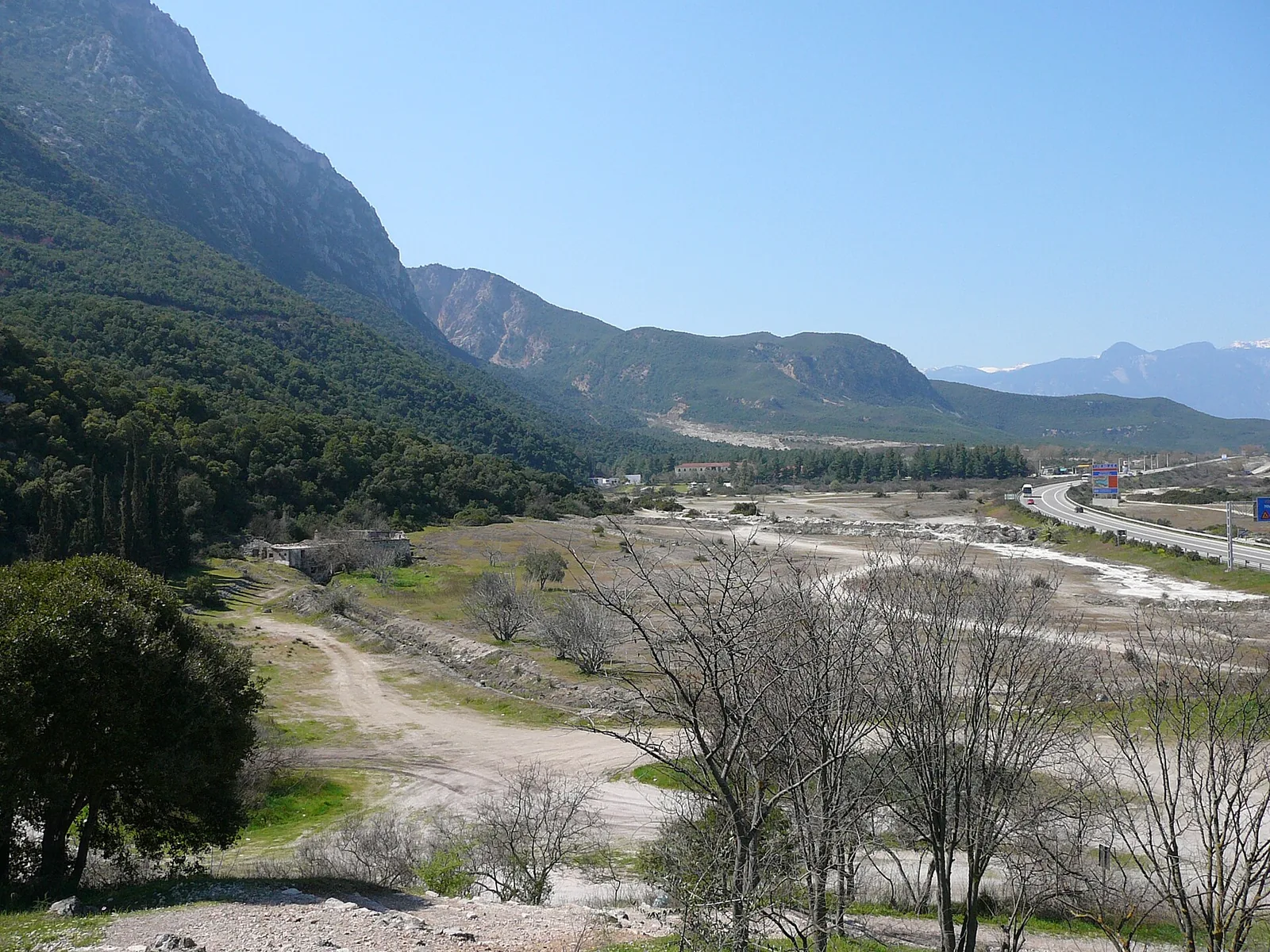
The pass of Thermopylae near the Phocian wall, 2011. Photo: Fkerasar · CC BY-SA 3.0 · Source page
Thermopylae means “Hot Gates”, after its hot springs. The road squeezed between Mount Kallidromos and the sea at three narrow points. At the middle one, where the Greeks stood, it was only some 15 to 20 metres wide, and an old wall built by the Phocians ran across it. The Greeks rebuilt it.
Today you see a wide plain there. Since 480 BC rivers and springs have laid down so much earth that the coast is now kilometres away. And the pass had a weak point: a path over the mountain behind it. The Greeks only heard of it when they arrived.
Who was there
Not three hundred
about 7,000
Herodotus lists 300 Spartans, about 2,800 men from other cities of the Peloponnese, 700 Thespians, 400 Thebans, 1,000 Phocians, and the Locrians, without a number. Modern reckoning puts the total at about 7,000, plus the helots who served the Spartans.
Why so few? It was the time of the Carneia, a festival when Sparta did not march, and the other allies were held back by the Olympic Games, under way at the same time. Leonidas led an advance guard; the main armies were to follow. Many historians suspect the Peloponnesians also preferred to hold the Isthmus, nearer home. The 300 were Spartiates with living sons, so that no family line would die out.
Leonidas
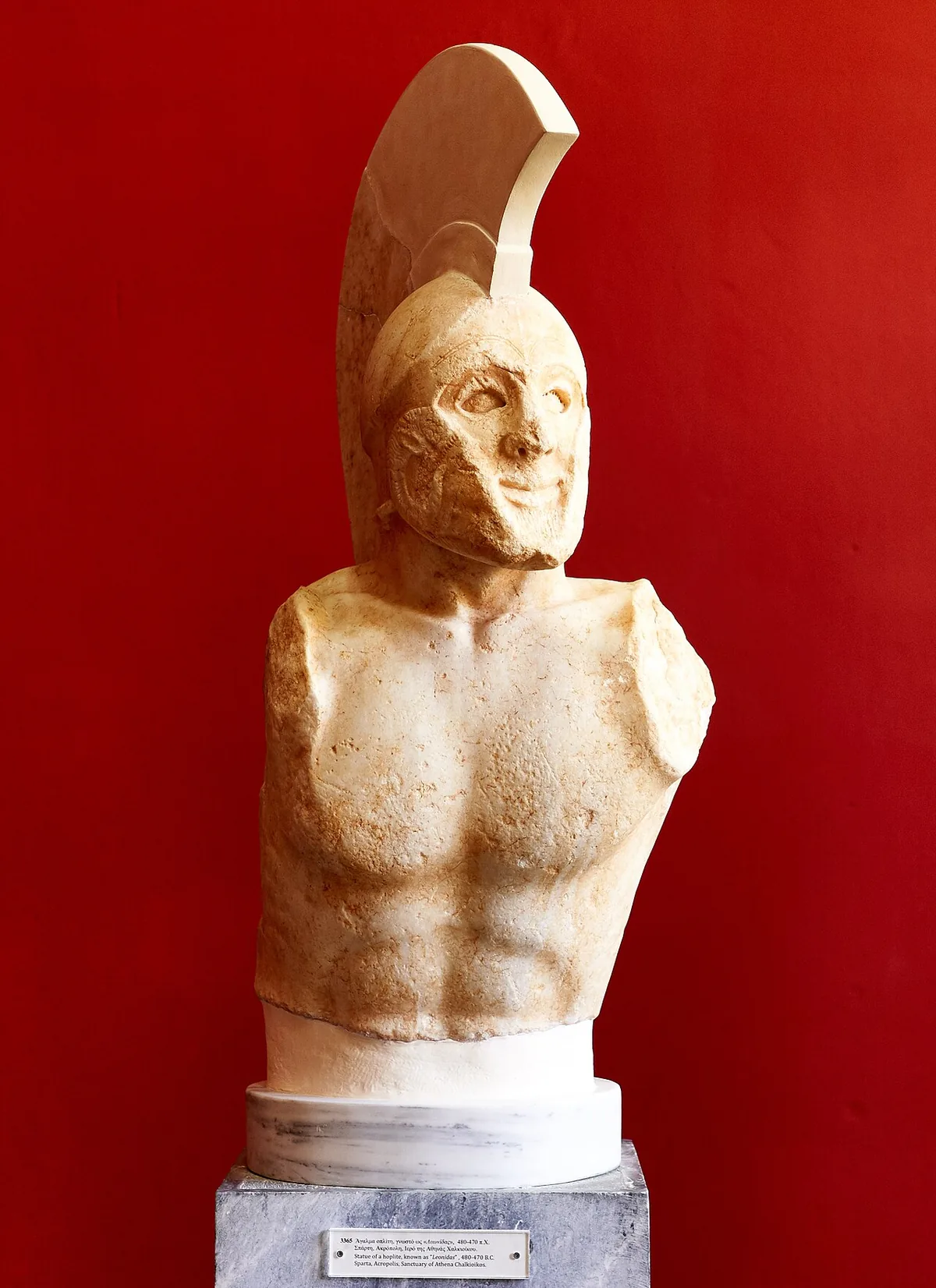
Statue of a hoplite, known as “Leonidas”, 480–470 BC. Archaeological Museum of Sparta. Photo: George E. Koronaios · CC BY-SA 4.0 · Source page
A king’s third son who never expected the throne, sent north with an advance guard, and remembered for staying when the pass was already lost.
- Born: Unknown; perhaps around 540 BC, Sparta, into the Agiad royal house, which claimed descent from Heracles
- Died: Late summer 480 BC, Thermopylae, in the fighting on the third day; Xerxes had his head set on a stake
- Won: Thermopylae, days one and two: every attack thrown back
- Lost: Thermopylae, day three, 480 BC
“If he remained, he would leave a name of great renown, and the prosperity of Sparta would not be blotted out.”
A decision point
You are Leonidas, king of Sparta.
Late summer 480 BC, at the Phocian wall
The Persian army fills the plain of Trachis, a few kilometres west of your wall. You have about 7,000 men; the main armies are at home for the festivals. The fleet waits at Artemisium.
Your Peloponnesian officers want to fall back and hold the Isthmus, which shields their own cities. The Phocians and Locrians, whose homes lie just behind the pass, are furious. A thousand Phocians guard the mountain path.
What do you do?
- Hold the wall, and send messengers asking for reinforcements The pass stays shut and the fleet’s flank stays safe. But you are betting that help will come before the Persians find a way round, and that your allies will stay with you until then.
- Fall back to the Isthmus, as the Peloponnesians want Your army would probably survive. But Phocis, Locris and Boeotia would go over to Persia at once, the fleet at Artemisium would have enemies behind it, and Athens would be left open. Herodotus argues that without the Athenian ships a wall across the Isthmus was useless: the Persian fleet could land troops behind it.
- Leave a rearguard at the wall and send the rest to fortify the Isthmus A compromise that weakens both. Seven thousand are already few for the pass; a smaller force would wear out sooner, and the men at the Isthmus would be too few to matter.
What really happened
Hold the wall, and send messengers asking for reinforcements
The Peloponnesians wanted to retreat, Herodotus says, but Leonidas, seeing the anger of the Phocians and Locrians, voted to stay, and sent to the cities for help.
Holding the pass kept the plan alive: the army shielded the fleet, and the fleet shielded the army. Retreat would have handed central Greece to Persia without a fight, with Sparta’s northern allies watching. The historian J. A. S. Evans pointed out the bind: Sparta’s old Peloponnesian allies and its new allies north of the Isthmus wanted different things, and Leonidas had to keep both with him.
A decision point
You are Xerxes, King of Kings.
Late summer 480 BC, in your camp on the plain of Trachis
Your scout reports Spartans in front of a wall, some exercising, others combing their long hair; whatever stands behind the wall he could not see. Demaratus, once a king of Sparta and now at your court, warns you that this is what Spartans do before they risk their lives.
At its narrowest points the road is barely wider than a cart. Your fleet, battered by a storm, is still on its way to its anchorage at Aphetae, opposite the Greek fleet.
What do you do?
- Attack at once: no army can stand against such numbers You might break them on the first day. But on a strip this narrow only a few hundred of your men can fight at once, and your fleet is not yet ready to strike at the same time.
- Wait a few days: they may lose their nerve, and your fleet can come up If the Greeks run, you win the pass for nothing. If not, you have lost only days, and the attacks by land and sea can go in together.
- Look for another way: question the locals and search the mountain for a route A good idea, and in the end it will decide the battle. But no guide has come forward yet, and a few defenders can block a mountain path.
What really happened
Wait a few days: they may lose their nerve, and your fleet can come up
Herodotus says Xerxes waited four days, expecting the Greeks to run. On the fifth, angry at their insolence, he sent the Medes and the Cissians to bring them to him alive.
Herodotus tells a story about pride. Many historians see better reasons: the army was still coming up, the fleet needed time, and the land and sea battles were in fact fought on the same days, as if by plan.
Source: Free, but not wholly free
“So is it with the Lacedaemonians; fighting singly they are as brave as any man living, and together they are the best warriors on earth. Free they are, yet not wholly free; for law is their master, whom they fear much more than your men fear you.”
Demaratus, a Spartan king deposed around 491 BC, fled to Persia and marched with Xerxes. Herodotus stages several talks between them; in this one Xerxes asks whether the Greeks will dare to fight.
- Who could have overheard this private talk? Only Xerxes and Demaratus. Demaratus’s descendants still held lands in Asia Minor in Herodotus’s day and may have told family stories, but the words are Herodotus’s own: his “wise adviser” scene, where the adviser warns, the king laughs, and events prove the adviser right.
- What contrast is Herodotus drawing? Free men who obey a law they accept, against subjects who obey a master out of fear. At Thermopylae, Persian officers whip their own men forward.
- Is it fair to the Persians? It is a Greek ideal written for Greeks. Persian soldiers attacked bravely for three days, and Herodotus himself praises their courage elsewhere.
Days one and two
Few men among them
The Medes and Cissians attacked first, and many of them fell. They made it plain, Herodotus writes, “that for all their number of human creatures there were few men among them.”
Then came Xerxes’ best troops, the Immortals. They did no better: their spears were shorter, and against a phalanx in the narrows numbers were no use. The Spartans would turn as if to flee, then wheel round on their pursuers. Three times, says Herodotus, the king leapt from his seat in fear for his army. The second day went the same way.
The path over the mountain
Betrayal
A man from Malis
Then a local man came to Xerxes: Ephialtes, from Malis, the land around Trachis. Hoping for a great reward, he offered to lead the Persians over the mountain to the Greeks’ rear.
At the hour when lamps were lit, Hydarnes and the Immortals set off up the gorge of the river Asopus, and climbed all night through oak woods. Near the top, the thousand Phocians were waiting.
A decision point
You command the thousand Phocians on the mountain.
Dawn, the third day, near the top of the mountain path
You volunteered to guard this path, which also leads into your own land, Phocis. The night was still, without a breath of wind. Now, at first light, you hear many feet trampling dry oak leaves.
Your men leap up and arm. Suddenly the enemy is among the trees, far more of them than you, and arrows are falling. You do not know who they are, or where they are going.
What do you do?
- Stand where you are and block the path Your men would fight bravely, but a thousand hoplites cannot hold a broad wooded upland against a much larger force with archers. You would probably be surrounded and killed, though you might buy Leonidas a few hours.
- Fall back to the peak, where you can make a stand Your men are safer and can still fight. But if the enemy is not after you, it can simply walk past you and on down the path.
- Send runners to Leonidas at once and fall back towards the pass Leonidas would get the clearest possible warning. But retreating downhill in front of an enemy with archers is dangerous, and it leaves the path open.
What really happened
Fall back to the peak, where you can make a stand
The Phocians ran to the peak, sure that they were the target, and prepared to die. The Persians ignored them and marched on down. At daybreak lookouts ran to the pass with the news.
Herodotus does not blame them outright. Some historians see a failure of nerve or of planning; others think a thousand men could never hold a wide upland at night. The Phocians thought first of their homeland, which the path led into.
A decision point
You are Leonidas.
Early morning, the third day, at the Phocian wall
At dawn the lookouts came running down from the heights: the Persians are over the mountain, and within hours will reach the road behind you. Deserters said the same in the night.
Some allies want to leave at once. A whole army retreating along the coast road could be ridden down by cavalry. The fleet still needs the pass held. And an oracle, people say, foretold that Sparta would fall unless a king of Heracles’ line died.
What do you do?
- Retreat with everyone, at once Some might slip away before the road closes, but a whole army strung out along a narrow road, with cavalry behind it, could be cut to pieces. And the fleet would be left alone at Artemisium.
- Send most of the allies away and stay with a rearguard The rearguard would almost certainly die. But it would hold the Persians for a few more hours, so that the others could get clear and the fleet hear the news in time.
- Stay and fight with everyone who is left Seven thousand could hold out longer than a few hundred, but all of them would be trapped between two Persian armies. Greece would lose an army it badly needed for the battles still to come.
What really happened
Send most of the allies away and stay with a rearguard
Most of the allies marched away. Leonidas kept the Spartans, the 700 Thespians, who chose to stay, and the 400 Thebans, held, Herodotus claims, as hostages. The seer Megistias sent his only son home, and stayed.
Herodotus knows two versions: the allies left of their own accord, or Leonidas sent them away. He prefers the second: Leonidas saved their lives but stayed himself, for glory and because of the oracle. Others suggest a rearguard covering the retreat. The argument goes on today.
The third day
Fighting in the shade
At mid-morning Xerxes attacked. This time the Greeks went out beyond the wall into the wider part of the road. Persian officers drove their men on with whips; many were pushed into the sea and drowned.
When their spears broke, the Greeks fought with swords. Leonidas fell; so did two of Xerxes’ brothers. Then the Immortals appeared behind them. The Greeks fell back to a low hill behind the wall, and the Thebans broke away and surrendered. The rest fought on, says Herodotus, “with their swords, as many as yet had such, ay and with fists and teeth”, until arrows buried them.
Before the fighting, a man from Trachis told a Spartan named Dienekes that the Persian arrows would hide the sun. “Our friend from Trachis,” quoth he, “brings us right good news, for if the Medes hide the sun we shall fight them in the shade and not in the sunshine.”
Thermopylae: who fought whom
Late summer 480 BC (August or September), three days of fighting
The pass of Thermopylae, between Mount Kallidromos and the Malian Gulf
The Greek allies under Sparta
- Commanders: Leonidas, king of Sparta, Demophilus, leading the Thespians, Leontiades, leading the Thebans
- Strength: about 5,200, plus the Locrians (Herodotus); about 7,400 (Diodorus (centuries later)); 11,200 (his own sum, guessing 6,000 Locrians) (Pausanias); about 7,000, plus helots (Modern estimate)
- Losses: about 4,000 dead, helots included (Herodotus, all three days); all but two of the 300 Spartans (some fell on days one and two), and the Thespians who stayed; most Thebans captured (Herodotus)
Herodotus’s list leaves out the numbers of the Locrians and the helots.
The Persian Empire’s army
- Commanders: King Xerxes, Hydarnes, commander of the Immortals, Ephialtes of Malis, as guide
- Strength: 2,641,610 fighting men; 5,283,220 with servants (Herodotus); 800,000 (Ctesias); about 70,000 to 300,000 (Modern estimates)
- Losses: 20,000, a figure no one can check (Herodotus)
Outcome: A Persian victory after three days. The road south lay open: Phocis, Boeotia and Athens were next.
Why the gap? Herodotus had no muster rolls. He multiplied guesses, then doubled the total for servants. Most historians today think of roughly 100,000 to 300,000 men in the land army, and even that was a huge feat of supply.
The battle of Thermopylae
480 BC, three days of fighting after four days of waiting
In late summer 480 BC King Xerxes waits on the plain of Trachis, facing a narrow pass between mountain and sea that commands the road south into Greece. Leonidas, king of Sparta, and his Spartans stand in front of the rebuilt Phocian wall, and a thousand Phocians guard the path over the mountain.
The map follows Herodotus 7.175–233 and the geological study by Kraft and colleagues (1987), which located the shoreline of 480 BC and the distances between the “gates”. North is up. The strip of land between mountain and sea is drawn ten to thirty times wider than it really was (some 20 metres at the Middle Gate), so that the units can be seen.
The route of the mountain path is disputed: there are three main proposals, and the line here is schematic. The exact post of the Phocians, the size of each force and the place of the Persian camp, which spread over the plain of Trachis west of this map, are estimates too. Where Xerxes watched from is not known either; the spot marked is a modern guess.
Phases of the battle
- The wall and the wait The Greeks rebuild the Phocian wall; the Spartans stand in front of it. A thousand Phocians guard the mountain path. On the plain of Trachis, Xerxes waits four days.
- Days one and two: the attacks fail Medes and Cissians, then the Immortals, push east along the strip. In the narrows numbers do not help; the Greek contingents fight in turns. Xerxes watches, perhaps from a spur of the mountain.
- Night: the path over the mountain At lamp-lighting Hydarnes leads the Immortals up the Asopus gorge and over the mountain. At dawn they surprise the Phocians, who fall back to the peak. The Persians march on.
- Day three: most of the allies leave Most allies march off east before the road closes. Spartans, Thespians and Thebans stay, and advance into the wider road to meet Xerxes’ mid-morning attack.
- The last stand on the hill Leonidas falls. As the Immortals come down behind them, the Greeks fall back to the hill of Kolonos. The Thebans surrender; the rest are shot down where they stand.
The strategy
- Greeks: The Greeks hold the narrow strip, where numbers do not help. The Spartans stand before the Phocian wall, and a thousand Phocians guard the path over the mountain, which also leads into Phocis. When that path opens to the Persians, Leonidas sends most allies home and keeps a rearguard.
- Persians: Xerxes sends the Medes and Cissians, then the Immortals, to push the Greeks back along the strip. Then Ephialtes of Malis offers to lead the Persians over the mountain to the Greeks’ rear, hoping for a great reward, and Hydarnes and the Immortals climb after him to strike the Greeks from behind.
What decided it: The narrow strip held for two days, where numbers did not help the Persians. On the third day the mountain path decided it: the Immortals came round behind the Greeks, guided by a man from Malis, and the stand on the hill was crushed.
After the battle
The king and the body
Xerxes had Leonidas’s head cut off and set on a stake. Herodotus is surprised: no people he knows, he says, honour brave warriors more than the Persians.
He puts the Persian dead at 20,000, a figure no one can check, and the Greek dead at about 4,000, helots included. Of the 300 Spartans, 298 fell. Pausanias, writing six centuries later, says Leonidas’s bones were brought home to Sparta forty years after the battle.
Source: Go tell the Spartans
“Four thousand warriors, flower of Pelops’ land, / Did here against three hundred myriads stand.”
“Go tell the Spartans, thou that passest by, / That here obedient to their words we lie.”
Herodotus says the Amphictyons set up these lines over the dead: the first for all who fought, the second for the Spartans. He names an author, the poet Simonides, only for a third epitaph, for the seer Megistias.
- The first stone says four thousand. What does that tell us about “the 300”? That the Greeks themselves remembered thousands, not three hundred. And “three hundred myriads”, three million, shows the enemy was inflated from the start.
- Whose “words” did the dead obey? Sparta’s: its orders and its way of life. Other translators write “laws” or “commands”: every translation is already an interpretation.
Artemisium: the other half of the plan
At sea
The fleet at Artemisium
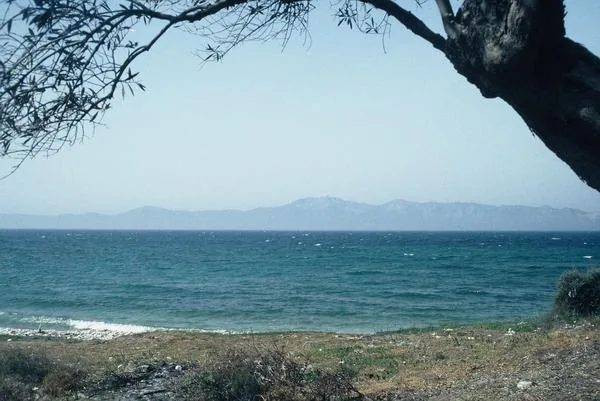
The beach at Cape Artemisium, with Magnesia in the distance, 2019. Photo: Marco Prins (Livius.org) · CC0 · Source page
While Leonidas held the pass, 271 Greek triremes, more than half of them Athenian, held the strait at Artemisium. Their commander was the Spartan Eurybiades; Themistocles led the Athenians. Their task: to stop the Persian fleet landing troops behind Leonidas.
A three-day gale off Magnesia had already wrecked at least 400 Persian ships, says Herodotus. Even so, seeing how many were left, the Greeks wanted to flee. Herodotus claims the Euboeans bribed Themistocles to keep the fleet there, a tale that may come from his later enemies.
Artemisium: who fought whom
Late summer 480 BC, on the same days as Thermopylae
The strait between Cape Artemisium in north Euboea and Aphetae in Magnesia
The Greek fleet
- Commanders: Eurybiades of Sparta, in overall command, Themistocles, leading the Athenians, Adeimantus, leading the Corinthians
- Strength: 271 triremes, later 324 (Herodotus); 280 (Diodorus)
- Losses: many ships; half the Athenian ships damaged on the third day (Herodotus)
More than half the ships were Athenian.
The Persian royal fleet
- Commanders: Four admirals, among them Xerxes’ brothers Ariabignes and Achaemenes
- Strength: 1,207 triremes at the start of the campaign (Herodotus); about 600 to 1,200 at the start (Modern estimates)
- Losses: at least 400 in a storm (Herodotus, before the battle); 30 taken on day one; 200 wrecked off Euboea; heavy losses on day three (Herodotus, in the battle)
Outcome: Indecisive. After three days the Greeks withdrew south when they heard Thermopylae had fallen. The two fleets would meet again at Salamis.
Aeschylus, who fought in the war, already gave 1,207 ships in 472 BC, but for the fleet at Salamis; Herodotus uses the same figure for the fleet that set out. No one knows how many actually reached Artemisium.
The battle of Artemisium
480 BC, three days, alongside Thermopylae
In late summer 480 BC, on the same days as the fighting at Thermopylae, 271 Greek triremes, more than half of them Athenian, hold the strait at Artemisium. About 15 km away, at Aphetae, the rest of the Persian fleet lies at anchor.
Today’s coastlines, traced from OpenStreetMap data; north is up. Thermopylae lies about 60 km to the west. The moves follow Herodotus 7.179–196 and 8.1–23.
The site of Aphetae is disputed: most scholars put it near modern Platanias, about 15 km north of Artemisium, and that is where it is here. The route of the 200 ships, and even whether they existed, is doubted too. The “Hollows” of Euboea, where they were wrecked, lie far south of this map. Herodotus’s own day counts for the land and sea battles do not quite fit together. Ship numbers and the fleets’ exact stations are estimates.
Phases of the battle
- The storm and the arrival A storm off Magnesia wrecks at least 400 Persian ships, says Herodotus. The rest anchor at Aphetae. Across the strait, about 15 km away, 271 Greek triremes wait.
- A trap round Euboea The Persians send 200 ships round Euboea, outside Skiathos and out of the Greeks’ sight, to cut them off from home. Scyllias, a Greek diver in Persian service, deserts and warns them.
- Day one: the ring Late in the afternoon the Greeks row out. Surrounded, they form a ring, rams outward, then charge and take 30 ships. That night a storm wrecks the 200 off Euboea.
- Days two and three Fifty-three more Athenian ships arrive. On the third day, the day of the last stand at Thermopylae, the Persians attack in a crescent. Both sides suffer heavily.
- The news from Thermopylae That evening a boat brings the news from Thermopylae. The Greek fleet slips away south, the Athenians last. Next day the Persians take north Euboea.
The strategy
- Greek fleet: The Greek fleet stays in the strait to stop the Persian fleet landing troops behind Leonidas. When surrounded, it forms a ring with its rams facing outward, then charges.
- Persian fleet: According to Herodotus, the Persian fleet sends 200 ships round Euboea, beyond Skiathos and out of the Greeks’ sight, to cut them off from home. The main fleet attacks in a crescent. The number of ships and their route are disputed.
What decided it: Neither fleet won at sea. The Greek fleet could hold the strait only as long as Leonidas held the pass, so when word came that Thermopylae had fallen, it withdrew south.
The news
A boat from Thermopylae
An Athenian named Abronichus waited at Thermopylae with a fast ship, ready to carry any news to the fleet. On the evening of the third day he arrived. The fleet left at once, the Corinthians first, the Athenians last.
At the watering places Themistocles had messages cut into the rocks for the Ionian Greeks in the Persian fleet: change sides, or at least fight badly. The battle had been indecisive, but the crews had learned they could stand up to the Persian fleet. They would meet it next at Salamis.
After the gates
What came next
- 480 BC The Persians march south. Phocis and Boeotia are overrun, and Thebes joins Persia.
- September 480 BC Athens is evacuated. The Persians burn the Acropolis.
- Late September 480 BC The battle of Salamis (the next lesson).
- 479 BC Victories at Plataea and Mycale end the invasion.
- c. 440 BC Leonidas’s bones are brought home to Sparta, according to Pausanias.
- c. 430 BC Herodotus publishes his Histories, fixing the story for ages to come.
- 279 BC Invading Gauls turn the pass by the same mountain path.
- 191 BC The Romans outflank King Antiochus III the same way, and win.
- 1814 Jacques-Louis David finishes Leonidas at Thermopylae.
- 1941 British, Australian and New Zealand troops delay the German invasion at Thermopylae.
- 2006 The film 300 turns the battle into a comic-book fantasy.
Myth
Three hundred Spartans alone held Thermopylae.
The truth
About 7,000 Greeks held the pass for the first two days. On the last day 700 Thespians, 400 Thebans and the helots stayed with the Spartans. Most of the roughly 4,000 Greek dead were not Spartans. The Thespians, who stayed by choice and died beside the Spartans, are the forgotten heroes.
The evidence
Herodotus 7.202, 7.222, 8.25, and the memorial’s own “four thousand”. The film 300 shows bare-chested Spartans instead of the bronze armour in the picture, and makes Ephialtes a deformed Spartan; in Herodotus he is from Malis.
Myth
When Xerxes demanded that they hand over their weapons, Leonidas answered: “Come and take them” (molon labe).
The truth
The two words first appear in a collection of Spartan sayings attributed to Plutarch, about 580 years after the battle. Herodotus, writing within living memory of the war, does not have them. A story of a defiant reply existed earlier, but the perfect wording is a later polish.
The evidence
Plutarch, Sayings of Spartans (Moralia 225C–D); a longer, earlier version of the reply is in Diodorus 11.5.4–5, probably from the 4th-century historian Ephorus. The same collection gives Leonidas the joke about fighting in the shade, which Herodotus credits to Dienekes: sayings drift towards the most famous name.
Source: A painter’s Thermopylae
Oil painting, begun 1799 and finished 1814, about 2,300 years after the battle
David finished the picture in 1814, as allied armies invaded France and Napoleon’s empire collapsed.
- What in the painting comes from Herodotus, and what is invented? From Herodotus: the altar of Heracles, Leonidas’s ancestor, and the calm before death. Invented: the heroic nudity (hoplites wore bronze), the wreaths, the temple. Even the epitaph on the rock is out of place: it was set up after the battle.
- Why would a French painter care about Thermopylae in 1814? France itself was being invaded. Men dying for their homeland spoke to his day, just as the film 300 spoke to its own. Every age repaints Thermopylae; the sources stay the same.
Why did Leonidas stay?
On the last morning, did Leonidas stay for glory, for military reasons, or for reasons we cannot see?
- Herodotus (c. 430 BC), and Paul Cartledge, Thermopylae (2006) Herodotus says Leonidas stayed for glory and because of an oracle: Sparta would fall unless a king of Heracles’ line died. Cartledge takes Spartan religion and the ideal of a “beautiful death” seriously: for a Spartan king, leaving his post may simply have been unthinkable.
- J. A. S. Evans, ‘The “Final Problem” at Thermopylae’ (1964) Evans saw a military choice. Once the path was lost, a hoplite army retreating in daylight before Persian cavalry could be cut to pieces, so a rearguard had to hold the pass while the Peloponnesians got away. As head of the alliance, Sparta also could not afford to lose its whole force, or its prestige. The oracle, he argued, was a prophecy made up after the event.
- J. R. Grant, ‘Leonidas’ Last Stand’ (1961) Grant argued that Leonidas went beyond his orders, for reasons rooted in Spartan politics and his own stubbornness, and that the heroic story covered this up.
The historian Charles Hignett (1963) thought the question could not be answered on the evidence we have. We have only Herodotus’s choice between two stories he heard. What would you need to know to decide?
What do you know now?
Check yourself
Roughly how many Greeks held Thermopylae on the first two days?
Answer: About 7,000. Right. Herodotus lists about 5,200 plus the Locrians, and historians today reckon about 7,000, not counting the helots.
Check yourself
How did the Persians finally get behind the Greeks?
Answer: A local man, Ephialtes, led the Immortals over a mountain path at night. Right. They climbed all night, surprised the Phocians at dawn, and came down behind the Greeks.
Check yourself
Why do historians doubt Herodotus’s figure of 5,283,220 men?
Answer: He reached it by multiplying guesses and doubling for servants, and no road could feed so many. Right. Herodotus himself wondered how the food sufficed. Supply and water limit every army.
Check yourself
What was the job of the fleet at Artemisium?
Answer: To stop the Persian fleet from landing troops behind Thermopylae. Right. Army and fleet protected each other: the army held the coast, the fleet held the sea behind the army.
Check yourself
Why is the talk between Demaratus and Xerxes a weak source for what was really said?
Answer: It was a private talk, and the words are Herodotus’s own: a “wise adviser” scene. Right. Only the two men were there; at most a family story from Demaratus’s descendants, who lived on in Asia Minor, could have reached Herodotus decades later. That does not make it worthless: it shows what Greeks thought about freedom and about Persia.
Check yourself
Where does the saying “Come and take them” (molon labe) first appear?
Answer: In a collection of Spartan sayings attributed to Plutarch, about 580 years after the battle. Right. Herodotus, writing within living memory of the war, does not have it.
Terms
- hoplite A Greek citizen foot-soldier who paid for his own arms: a large round shield, a spear, a bronze helmet and greaves. Hoplites fought shoulder to shoulder, in close ranks called a phalanx.
- phalanx Hoplites in close ranks, shields overlapping, usually about eight men deep. Its strength was its front; its weakness, its open ends.
- Spartiate A full citizen of Sparta, trained for war from boyhood and fed by the labour of helots. The 300 at Thermopylae were Spartiates.
- helot A serf owned by the Spartan state. Helots farmed the Spartiates’ land and went with them to war as servants or light troops.
- Immortals The Greek name for 10,000 picked Persian foot soldiers. Herodotus says any man who fell was replaced at once, so their number never changed.
- Carneia A Spartan festival of Apollo in late summer. Until it ended, at the full moon, the Spartan army did not march.
- medize To side with Persia. Greeks called the Persians “Medes”, and a city that gave the king “earth and water”, the sign of submission, was a traitor in their eyes.
- trireme A long, fast warship rowed by about 170 oarsmen on three levels, with a bronze ram at the bow.
- Hellenic League The modern name for the alliance of Greek states formed at the Isthmus of Corinth in 481 BC to fight Persia, under Spartan command.
- Delphic oracle The god Apollo’s answers at his shrine at Delphi, spoken by his priestess, the Pythia, often in riddling verse.
- Amphictyons A league of the peoples around Thermopylae and Delphi who ran the sanctuaries there. They set up the memorials at Thermopylae.
- Herodotus A Greek historian born in Halicarnassus, who wrote some fifty years after the battle. He is our main source on Thermopylae.
- Xerxes The king of Persia during the war, son of Darius, who led a huge army into Greece.
- Darius King of Persia, who after Marathon raised a far larger army. He died in 486 BC.
- Marathon A battle in which Athens beat a Persian landing force. It was ten years before Thermopylae.
- Salamis An island near Athens, and the site of a great sea battle in which the Greek fleet beat the Persians.
- Plataea A great Greek land battle a year after Thermopylae, in which the Persians were defeated.
- Hellespont The narrow strait between Asia and Europe. The Persians built bridges of boats across it, and a storm smashed them.
- Mount Athos A mountain in northern Greece, where a storm had wrecked a Persian fleet in 492 BC.
- Thrace A region in north-eastern Greece, on whose coast the Persians set up food stores.
- Trachis A town and plain a few kilometres west of Thermopylae, where the Persian army gathered.
- Ephialtes A local man from Malis who offered the Persians a path over the mountain to the Greek rear, hoping for a generous reward.
- Phocis A region in central Greece whose men guarded the mountain path above Thermopylae.
- Locris A region in central Greece whose homes lay right behind the Thermopylae pass. Its people fought in the defence.
- Thebes A city in central Greece. 400 of its men stayed with the Spartans at Thermopylae, and in the end surrendered.
- Thessaly A large region in northern Greece. It went over to Persia rather than join the Greeks.
- Peloponnese The southern peninsula of Greece, joined to the rest of Greece by a narrow neck of land.
- Artemisium A place at the northern tip of Euboea, where the Greek fleet fought. It was close to Thermopylae, and the two forces heard each other's news.
- Themistocles An Athenian leader who persuaded Athens to build a fleet of triremes. He led the Athenians at Artemisium.
- Demaratus A deposed Spartan king who fled to Persia and marched with Xerxes.
- Megistias A Greek seer who sent his only son home and stayed at Thermopylae.
- Medes An ancient people of what is now Iran, whose troops served in the Persian army.
- Mardonius Xerxes' cousin, who had already led one expedition towards Greece and pressed him to punish Athens.
- Simonides A Greek poet. According to Herodotus, he wrote the epitaph for the seer Megistias.
- Kallidromos The mountain above Thermopylae, between which and the sea the narrow road ran.
Sources
- Herodotus, Histories 7.1–239 and 8.1–26, trans. A. D. Godley, vols III–IV (Loeb Classical Library, Heinemann, 1922 and 1925)
- Aeschylus, Persians 337–347, trans. H. W. Smyth, Aeschylus vol. I (Loeb Classical Library, 1922)
- Simonides, epigrams quoted in Herodotus 7.228; the lyric fragment on the dead of Thermopylae (fr. 531 PMG), quoted by Diodorus 11.11.6
- Diodorus Siculus, Library of History 11.1–13 (after Ephorus, 4th century BC)
- Plutarch, Sayings of Spartans (Moralia 225A–E) and On the Malice of Herodotus 31–33
- Pausanias, Description of Greece 3.14.1 and 10.20–22
- [Aristotle], The Athenian Constitution 22.7, trans. F. G. Kenyon (1891)
- Ctesias, Persica, in the summary of Photius (FGrH 688 F13)
- Paul Cartledge, Thermopylae: The Battle That Changed the World (Macmillan, 2006)
- Chris Carey, Thermopylae (Great Battles; Oxford University Press, 2019)
- J. F. Lazenby, The Defence of Greece 490–479 B.C. (Aris & Phillips, 1993)
- C. Hignett, Xerxes’ Invasion of Greece (Clarendon Press, 1963)
- Peter Green, The Greco-Persian Wars (University of California Press, 1996; first published 1970)
- A. R. Burn, Persia and the Greeks: The Defence of the West, c. 546–478 B.C. (Edward Arnold, 1962; 2nd ed. Duckworth, 1984)
- Pierre Briant, From Cyrus to Alexander: A History of the Persian Empire, trans. P. T. Daniels (Eisenbrauns, 2002)
- John O. Hyland, Persia’s Greek Campaigns: Kingship, War, and Spectacle on the Achaemenid Frontier (Oxford University Press, 2025)
- Christopher Matthew and Matthew Trundle (eds), Beyond the Gates of Fire: New Perspectives on the Battle of Thermopylae (Pen & Sword, 2013)
- J. C. Kraft, G. Rapp, G. J. Szemler, C. Tziavos and E. W. Kase, ‘The Pass at Thermopylae, Greece’, Journal of Field Archaeology 14 (1987), 181–198
- P. W. Wallace, ‘The Anopaia Path at Thermopylai’, American Journal of Archaeology 84 (1980), 15–23
- J. A. S. Evans, ‘The “Final Problem” at Thermopylae’, Greek, Roman and Byzantine Studies 5 (1964), 231–237
- J. R. Grant, ‘Leonidas’ Last Stand’, Phoenix 15 (1961), 14–27
- J. A. S. Evans, ‘Notes on Thermopylae and Artemisium’, Historia 18 (1969), 389–406
- J. F. Lazenby, ‘The Strategy of the Greeks in the Opening Campaign of the Persian War’, Hermes 92 (1964)
- F. Maurice, ‘The Size of the Army of Xerxes in the Invasion of Greece, 480 B.C.’, Journal of Hellenic Studies 50 (1930), 210–235
- B. S. J. Isserlin, R. E. Jones, V. Karastathis, S. P. Papamarinopoulos, G. E. Syrides and J. Uren, ‘The Canal of Xerxes: Summary of Investigations 1991–2001’, Annual of the British School at Athens 98 (2003), 369–385
- M. A. Flower, ‘Simonides, Ephorus, and Herodotus on the Battle of Thermopylae’, Classical Quarterly 48 (1998), 365–379
- M. H. Jameson, ‘A Decree of Themistokles from Troizen’, Hesperia 29 (1960), 198–223
- Coastlines of the Artemisium map traced from OpenStreetMap data (© OpenStreetMap contributors, ODbL)
Image credits
- Jacques-Louis David, Leonidas at Thermopylae, 1799–1814. Musée du Louvre, Paris · Public domain · Source page
- Audience relief from the Treasury at Persepolis (detail), now in Tehran or still at the site. Photo: Arashk rp2 · CC BY-SA 4.0 · Source page
- The pass of Thermopylae near the Phocian wall, 2011. Photo: Fkerasar · CC BY-SA 3.0 · Source page
- Statue of a hoplite, known as “Leonidas”, 480–470 BC. Archaeological Museum of Sparta. Photo: George E. Koronaios · CC BY-SA 4.0 · Source page
- The beach at Cape Artemisium, with Magnesia in the distance, 2019. Photo: Marco Prins (Livius.org) · CC0 · Source page


