Talas, 751: the battle and the paper
Summer 751, in a river valley in Central Asia. For five days, by most accounts, a Tang army and an Abbasid army fought without either giving way. The battle is often linked to a story about paper reaching the West, but that story appears only in later writing.
Decisions, questions and your own progress, in the app
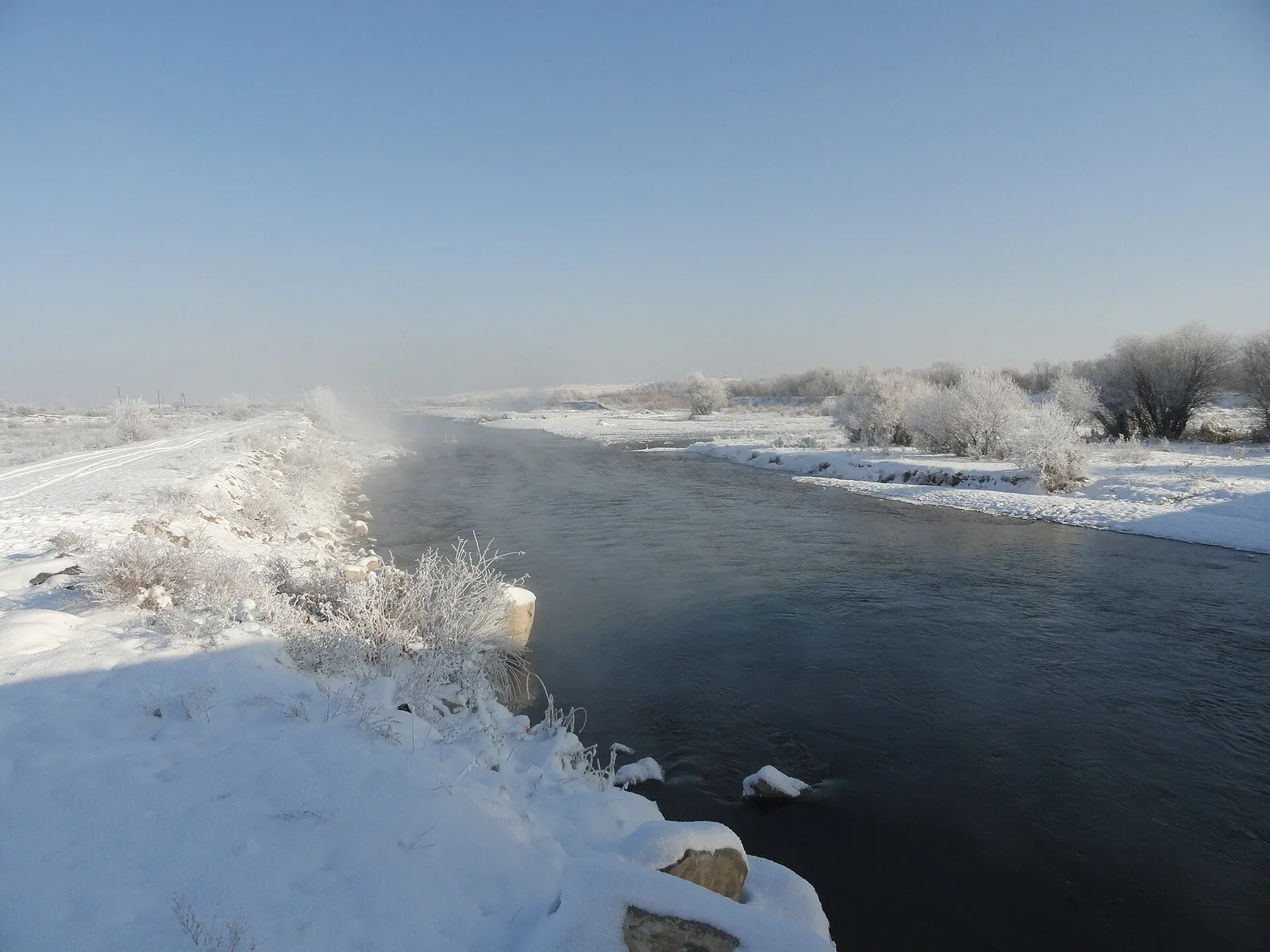
Photo: Thermokarst, Wikimedia Commons (own work). Public domain. · Public domain · Source page
The scene
Five days on the Talas river
Summer 751. Two armies face each other in a river valley in Central Asia, near today’s border between Kazakhstan and Kyrgyzstan. One is a Chinese army of the Tang dynasty. The other serves the Abbasid caliphate, which has just come to power far to the west.
For five days, the sources say, neither side gives way. Then the battle turns, and the Chinese army falls back in defeat. Why is a fight in a remote valley still told today, and often as a story about paper? Let us check what is true.
Who and why
Two empires at the edge of their reach
By 751 the Tang dynasty had pushed its frontier west, into the oases and valleys of Central Asia, along the caravan routes known as the Silk Road. Its generals fought for control of those roads, and local kingdoms were dragged into the fight.
In 750 the Abbasids overthrew the Umayyad caliphate in a battle at the Zab, and took power for themselves. Now their armies came east, to the same valley where the Chinese stood.
Gao Xianzhi
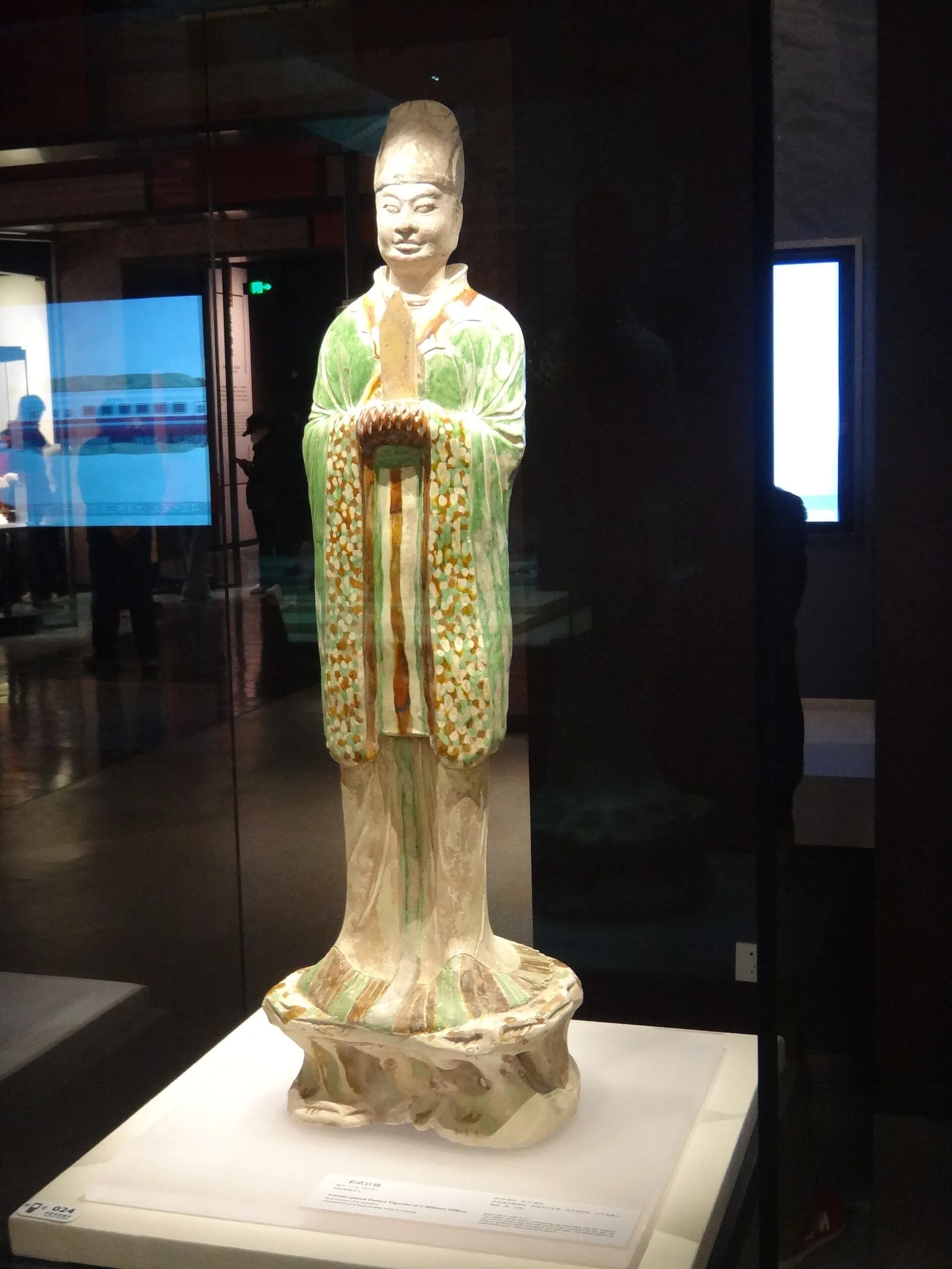
Pottery figure of a military official, China, Tang dynasty. Wikimedia Commons, photo: Baomi, 2023. · CC BY-SA 4.0 · Source page
A Tang general of Goguryeo descent. He won in the mountains and at Shi, lost at Talas, and was executed in 756.
- Born: Not known, Not known
- Died: 756, Executed after a court official accused him. He reportedly protested his innocence.
- Won: Little Bolor, 747: took its king and a princess; Shi (Tashkent), 750: took its king and brought him back to the Tang
- Lost: Talas, 751
Gao attacked Shi, and on the Talas plain seventy thousand men were lost.
The road to the river
The road
Two campaigns, two victories
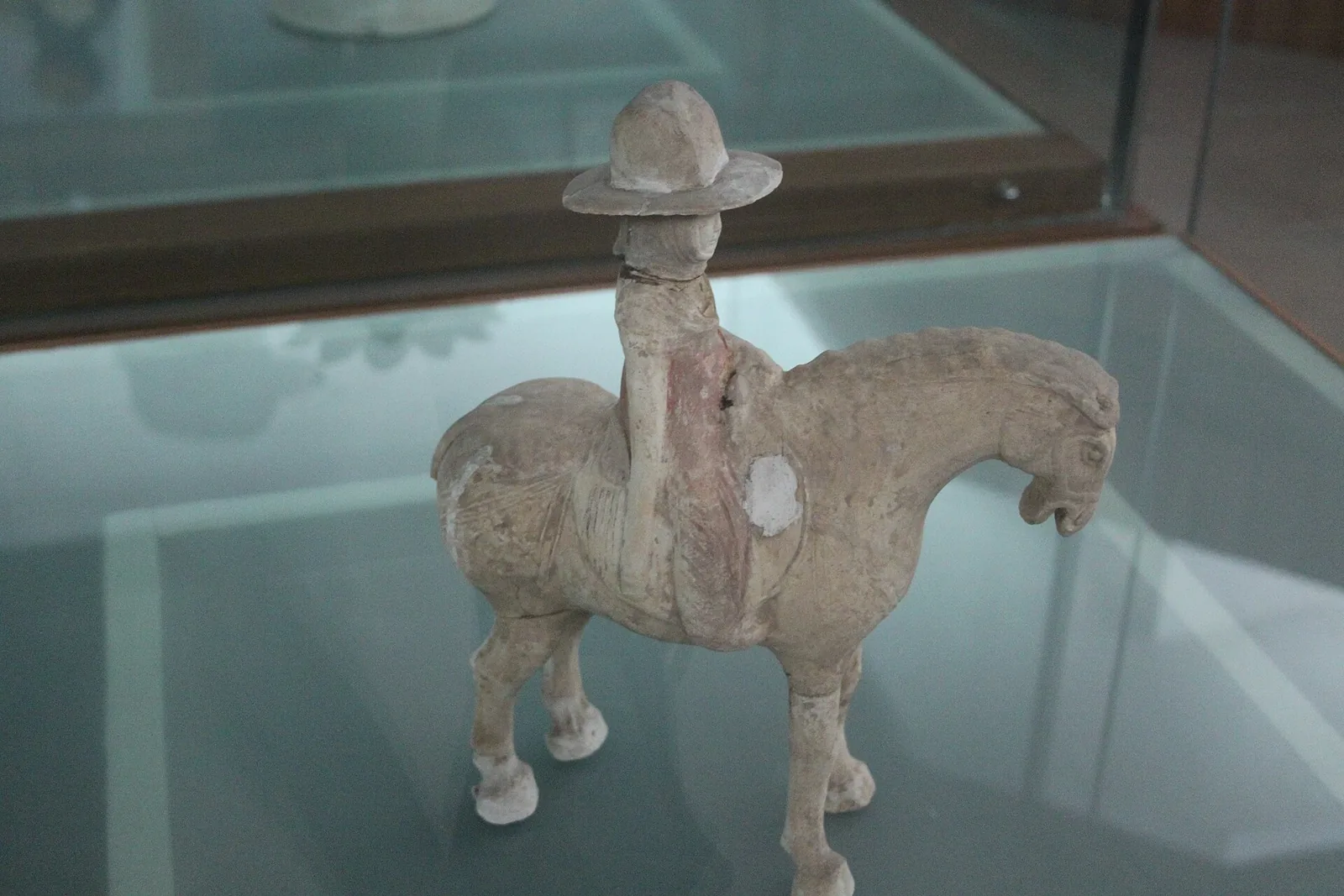
Pottery horse and rider, Gongyi Museum, Henan. Photo: Gary Todd, 2011. · CC0 · Source page
In August 747 Gao led about 10,000 men, horse and foot, against Little Bolor, a kingdom near today’s Gilgit. The Old Book of Tang says that about 5,000 of its people were killed, 1,000 were taken prisoner, and its king and a princess were captured.
In 750 he marched on Shi, a kingdom around modern Tashkent. The Old Book of Tang says only that Shi was “pacified” and its king brought back to the Tang. The Zizhi Tongjian, written much later, tells a different story: Gao made a false peace, attacked, and killed the old and the weak.
The rival
New rulers in the west
In 750 the Abbasids overthrew the Umayyads and took power in the Muslim world. In 751 their army reached the Talas valley, led by a commander named Ziyad ibn Salih.
Few sources describe Ziyad himself, and little is known about his character.
A decision point
You are Gao Xianzhi.
Summer 751, the Talas valley.
You have won twice: in the mountains against Little Bolor, and at Shi, where you brought its king back to the Tang as a prisoner.
Your army is large, and its ranks include Karluk contingents who have fought beside the Tang before. The Abbasid army is close, and you do not know its strength. You also do not know whether your allies will stand with you to the end.
What do you do?
- Press the attack without pause, and push until the enemy gives way. Probably a long and costly fight. If your allies hold, you could win the valley. If they break, the army could be lost.
- Pull back at once, before the fight costs the army dearly. Probably the army survives intact, but the Abbasids keep the valley, and your earlier victories count for less.
- Dig in on a defensive line and wait for the enemy to attack you. Probably the enemy attacks when it chooses. Meanwhile, supplies and allies are harder to keep in place.
What really happened
Press the attack without pause, and push until the enemy gives way.
Gao chose to keep fighting rather than withdraw. According to the Zizhi Tongjian, the two armies faced each other for about five days, and then the Tang army fell back. No source gives Gao’s own words, so his reasons are a guess.
He had already won twice, both times by attacking. Those wins may have shaped his choice, but the sources do not say so.
The five days
The armies
How many men?
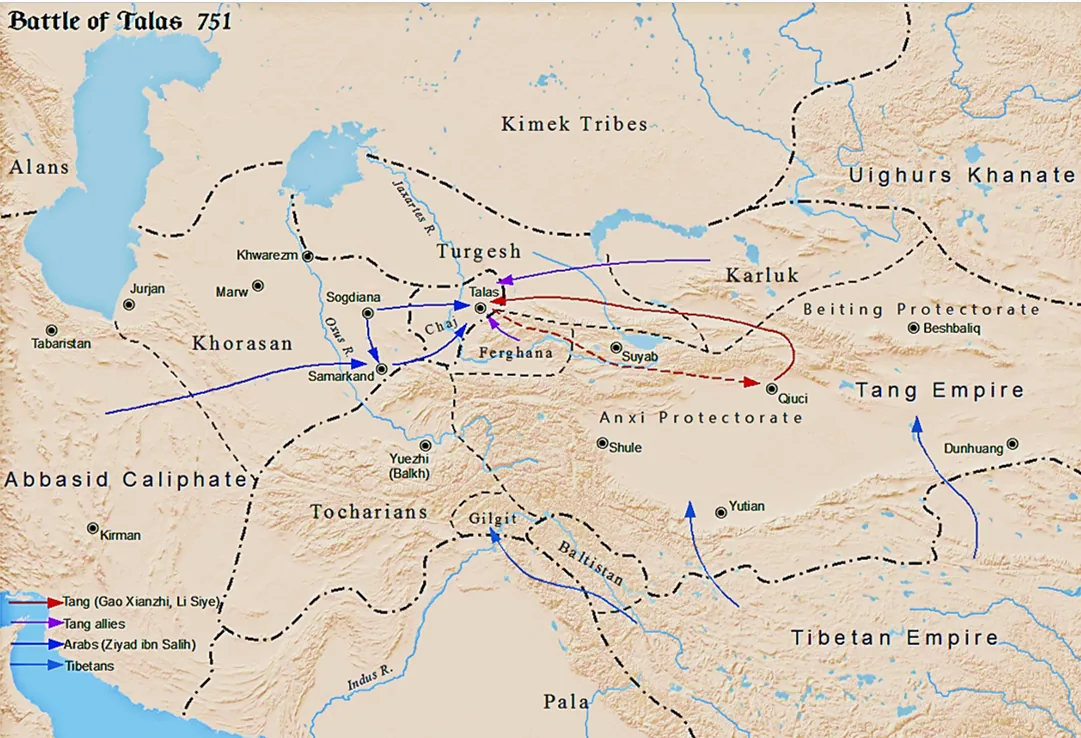
Battle of Talas, 751: map by SY, Wikimedia Commons (own work), 2017. · CC BY-SA 4.0 · Source page
20,000 to 100,000
The sources do not agree on the size of the Tang army. The Old Book of Tang says Gao led 20,000 men deep into enemy land. The Zizhi Tongjian says 30,000. One biography gives 60,000, and Arab writers give 100,000.
The Tang side was not only Chinese. Troops from Ferghana, a neighbouring valley, fought in it, and so did the Karluks, who had fought beside the Tang before. The Abbasid side is hard to count. Some modern accounts give 200,000, but no ancient source we could check records that figure.
Five days
A standoff, then a turn
Five days
According to the Chinese annals, the two armies held their ground for five days. Then the Karluks rebelled and, with the Arab forces, attacked the Tang army.
Not every historian accepts this. In 1982 the writer Barry Hoberman argued that the Karluks had been allied with the Arabs from the beginning, and were far from mutinying in the battle. The sources do not say why the Karluks would switch sides, if they did.
A decision point
You are a Karluk commander fighting beside the Tang.
Summer 751, during the standoff on the river.
Your men have fought beside the Tang for days. The Abbasid lines have not broken, and neither have the Tang lines.
You do not know whether the Abbasids or the Tang would reward those who stand with them, or whether the Tang army can survive what comes next.
What do you do?
- Stay with the Tang army and fight to the end. Probably you share its fate. If it holds, you share the credit; if it breaks, you break with it.
- Turn on the Tang rear now, while its front line is busy. Probably the Tang line cracks at once. You become enemies of the Tang for good, and must trust the Abbasids to keep their word.
- Leave the field before the fight is decided, and keep your men alive. Probably you keep your men alive, but lose Tang favour and any share in a victory, and the Tang may see you as a deserter.
What really happened
Turn on the Tang rear now, while its front line is busy.
According to the Chinese annals, the Karluks turned on the Tang army after five days and attacked it together with the Arab forces. A 1982 article argues the opposite: that the Karluks were allied with the Arabs from the beginning and did not mutiny in the battle. The sources disagree, so we cannot be sure what the Karluk leaders chose, or when.
No source we can read gives the Karluks’ motive, so it is not known. Guesses are possible, but none has been proved.
The retreat
Gao gets away
The Old Book of Tang says that Li Siye urged a retreat to a ridge. Gao Xianzhi got away. Many of his men did not.
The Old Book of Tang says that only several thousand men survived. Other figures differ sharply. A passage in the Tongdian says seventy thousand were lost on the Talas plain, and Arab writers give other numbers again. The figures are rough, and historians cannot settle them.
Some Chinese soldiers were taken prisoner in these wars. Du Huan, a Chinese soldier, was one of them. He spent years in Abbasid lands and was released in 762. Only extracts of his travel record survive, copied into the Tongdian.
What we really know
Source: The Old Book of Tang: two biographies
Paraphrase: Gao, the biography says, was of Goguryeo origin. It records his victories over Little Bolor in 747 and over Shi in 750. Of his army at Talas, it says that the Arabs destroyed it and that only several thousand men survived.
A dynastic history: an official account of the Tang, compiled by scholars working for a later dynasty.
- Who wrote this, and when? Scholars of a later dynasty, long after the battle. They worked from older records, not from eyewitnesses.
- What does it leave out? The reasons for Gao’s choices. It gives Talas only a few lines.
- Can we trust the numbers? Only as rough figures. ‘Several thousand’ is vague, and other sources give other figures for the dead.
Myth
“Paper reached the West because of this battle.”
The truth
The story is not found in any source written at the time. It is a later tradition, found in Arabic writing centuries after Talas, and historians do not agree which text first tells it. Jonathan Bloom, a historian of paper, doubts it.
The evidence
Du Huan’s account, copied into the Tongdian, names weavers, painters and goldsmiths among the Chinese craftsmen he met, and does not name papermakers. By the usual dating, papermaking in Baghdad began about 794–795, more than forty years after Talas. And a 1982 article notes that the historian al-Tabari, who died in 923, never mentions the battle.
Source: Du Huan’s travel record
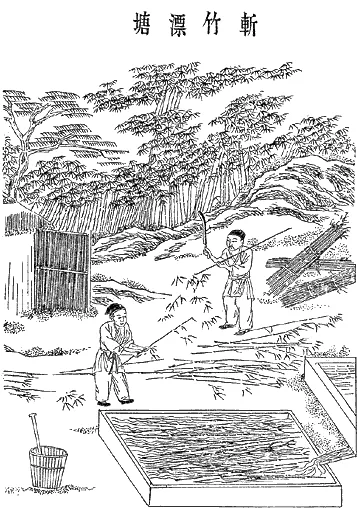
Tiangong kaiwu (1637), woodcut from the Ming edition. Wikimedia Commons. Public domain. · Public domain · Source page
Paraphrase: among the craftsmen that Du Huan names are Chinese weavers, painters and goldsmiths. His list does not mention papermakers.
Du Huan was a Chinese soldier who travelled in Abbasid lands. His own book is lost; only extracts survive, copied into the Tongdian, a Chinese encyclopedia of government institutions written decades after the battle.
- Who was he, and what was his position? A former prisoner who was free to travel and wrote warmly about the Abbasid lands. A prisoner’s view can be warm and still be partial.
- What is missing? Papermaking. A list of trades that names weavers, painters and goldsmiths says nothing about paper. Silence is not proof, but it is a clue.
- How do we know what he wrote? We do not have his book. We have passages that a later writer copied, and each copy can change the words a little.
A decision point
You are Gao Xianzhi.
December 755, Tong Pass.
The general An Lushan has risen in revolt, in December 755. You are ordered to raise 50,000 men from the Guanzhong region, around the capital.
You and Feng Changqing hold Tong Pass, a mountain pass on the road to the capital. You do not know how strong the rebels are. Your officers ask what to do: march out and meet the rebels in the open, hold the pass and wait, or fall back further.
What do you do?
- Hold Tong Pass on the defensive, and wait for the rebels to come. Probably you keep the pass and your army for now. But a court that wants results may judge a general who waits as a failure.
- March out at once and fight the rebels in the open. Probably a battle with troops you have only just raised, against rebels whose strength you do not know. A defeat would leave the pass open.
- Fall back further, and keep the army whole for a later fight. Probably you save the army, but the pass is abandoned, and the court may see the retreat as abandoning your post.
What really happened
Hold Tong Pass on the defensive, and wait for the rebels to come.
Gao and Feng held Tong Pass on the defensive, as the sources describe it. In 756 the court official Bian Lingcheng accused them, and both were executed. The exact day of the execution is disputed.
No source gives Gao’s own reasons. He had been ordered to raise troops, and he reportedly protested his innocence later. We can only guess why he preferred the pass to the open field.
What followed, and the quiz
Afterwards
A revolt at home
Within a few years, envoys had restored relations between the Tang and the Abbasids.
The bigger break came at home. In December 755 the general An Lushan rose in revolt. According to one modern essay, the Tang forces in Central Asia left only after this. In 756 Gao was executed.
What came after
- 752–753 Envoys restore relations between the Tang and the Abbasids.
- December 755 The general An Lushan rises in revolt. One modern essay says Tang forces in Central Asia begin to leave.
- 756 Gao Xianzhi and Feng Changqing are executed after a court official accuses them.
- 762 Du Huan is released. Later he writes his travel record, which survives only in extracts.
- About 794–795 By the usual dating, a paper mill starts work in Baghdad.
- 10th and 11th centuries Arab writers describe Chinese papermakers. The captives-and-paper story appears only later, and historians do not agree which text tells it first.
Was Talas a turning point?
Did this battle decide the fate of Central Asia, or was it one battle among many?
- L. Carrington Goodrich, as quoted by Hoberman Goodrich called the battle “one of the decisive battles of history”. It is often said that the Tang push west was halted after it.
- Barry Hoberman, 1982 Talas was not the only cause of the Tang withdrawal. Pressure from Tibet and the Uighurs, and the revolt of An Lushan in 755, mattered too. He adds that China could not recover after Talas.
Look at the dates. Envoys restored relations in 752–753, and the revolt came in 755. Which event would each side say ended the Tang presence?
Check yourself
What does Du Huan’s account, as copied in the Tongdian, say about the craftsmen he names?
Answer: Chinese weavers, painters and goldsmiths are named, but no papermakers.. Right. The extract names these craftsmen and leaves out papermaking. Silence is not proof, but it is a clue.
Check yourself
The Tongdian says seventy thousand men were lost on the Talas plain. Why should we be careful with that figure?
Answer: Because it was written decades after the battle, and other sources differ.. Right. The Tongdian was written decades later, and the Old Book says only several thousand survived. The sources disagree, so the figure is not settled.
Check yourself
Which order of events is correct?
Answer: Envoys restored ties in 752–753, An Lushan rose in 755, Gao was executed in 756.. Right. The envoys came first, then the revolt of December 755, then Gao’s execution in 756.
Check yourself
According to Hoberman’s 1982 article, why did the Tang withdraw from the west?
Answer: Talas was one cause among several, with the 755 revolt among them.. Right. Hoberman lists several pressures, and the 755 revolt is among them.
Check yourself
What do the Chinese annals and a 1982 article say about the Karluks?
Answer: The annals say they turned after five days; the 1982 article says they did not mutiny in the battle.. Right. The two accounts disagree, and the lesson shows both.
Check yourself
What happened to Gao Xianzhi in 756?
Answer: He was executed after a court official accused him, and reportedly protested his innocence.. Right. The Zizhi Tongjian records his execution, and the accusation came from the court official Bian Lingcheng.
Terms
- Tang dynasty The Chinese dynasty that ruled from 618 to 907. At its height it pushed its power deep into Central Asia.
- Abbasid The dynasty of caliphs who took power in 750, after overthrowing the Umayyads, and ruled until 1258.
- Karluks A people of Central Asia who fought as allies of the Tang at Talas. Their part in the battle is disputed.
- contingent A body of soldiers sent by one people or ruler to fight in another’s army.
- paper A thin sheet made by pressing wet plant fibres together and drying them.
- annals A history that records events year by year.
- dynastic history An official history of one dynasty, written by scholars of a later dynasty after the first had fallen.
- Goguryeo A kingdom on the Korean peninsula and in Manchuria, whose people were among the Tang’s enemies. Gao’s family came from there.
- An Lushan A Tang general who rose in revolt in December 755, starting a rebellion that shook the dynasty for years.
- Umayyad An Arab caliphate dynasty, overthrown by the Abbasids in 750.
- Gilgit A town in the mountains of northern Pakistan today.
- Little Bolor A small mountain kingdom near today's Gilgit, attacked by the Tang in 747.
- Tashkent A large city in Central Asia, today the capital of Uzbekistan.
- Ziyad ibn Salih An Abbasid commander who led their army to the Talas valley in 751.
- Ferghana A fertile valley in Central Asia, next to the Talas valley. Its fighters served on the Tang side.
- Tongdian A Chinese encyclopedia of government institutions, written decades after the battle.
- Zizhi Tongjian A large Chinese history book, written long after the battle. It tells the battle very differently from other sources.
- Du Huan A Chinese soldier captured in these wars, who spent years in Abbasid lands and was released in 762.
- Jonathan Bloom A historian of paper who doubts the story linking the Talas battle to paper.
- Barry Hoberman A writer who argued in 1982 that the Karluks had been allied with the Arabs from the start.
- Li Siye A Tang general at the Talas battle, who urged a retreat to a ridge.
- Bian Lingcheng A court official who accused Gao and Feng Changqing; both were executed in 756.
- Feng Changqing A Tang commander who held Tong Pass with Gao. He was executed in 756.
- Guanzhong The region around the Tang capital, from which troops were to be raised.
- Silk Road An ancient network of caravan routes linking China with Central Asia and lands further west.
- Central Asia A large region of Asia, home to countries such as Kazakhstan and Kyrgyzstan.
- Kazakhstan A large country in Central Asia. Its border runs close to the Talas valley.
- Kyrgyzstan A small mountainous country in Central Asia, a neighbour of Kazakhstan.
Sources
- 舊唐書 (Jiu Tangshu, Old Book of Tang), chapter 104 (Gao Xianzhi) and chapter 109 (Li Siye), Chinese text
- 資治通鑑 (Zizhi Tongjian, Comprehensive Mirror in Aid of Governance), Sima Guang, chapters 216 and 217, Chinese text
- 杜佑 (Du You), 通典 (Tongdian), chapters 185 and 193, Chinese text; chapter 193 contains extracts from Du Huan, 經行記 (Jingxingji, Record of Travels)
- Barry Hoberman, “The Battle of Talas”, Saudi Aramco World 33, no. 5 (September–October 1982), pp. 26–31
- Jonathan M. Bloom, Paper Before Print: The History and Impact of Paper in the Islamic World (New Haven: Yale University Press, 2001)
Image credits
- Photo: Thermokarst, Wikimedia Commons (own work). Public domain. · Public domain · Source page
- Pottery figure of a military official, China, Tang dynasty. Wikimedia Commons, photo: Baomi, 2023. · CC BY-SA 4.0 · Source page
- Pottery horse and rider, Gongyi Museum, Henan. Photo: Gary Todd, 2011. · CC0 · Source page
- Battle of Talas, 751: map by SY, Wikimedia Commons (own work), 2017. · CC BY-SA 4.0 · Source page
- Tiangong kaiwu (1637), woodcut from the Ming edition. Wikimedia Commons. Public domain. · Public domain · Source page


