The Taiping Rebellion: the exam failure who called himself Jesus's younger brother
Hong Xiuquan failed the imperial exams again and again, then read a missionary tract and decided he was the younger brother of Jesus. Within a few years he ran a state with its own capital, army and exams, and his war cost tens of millions of lives.
Decisions, questions and your own progress, in the app
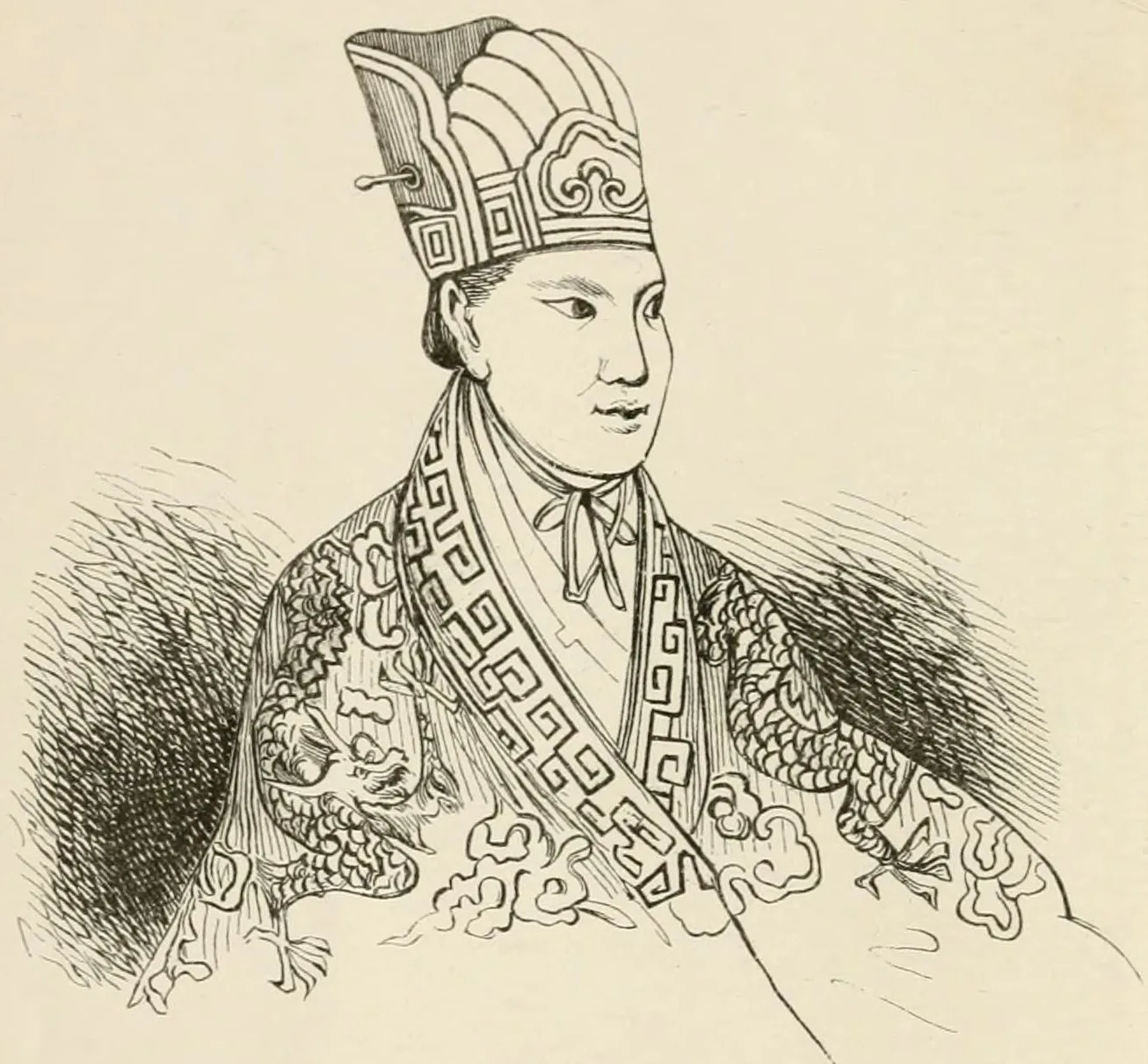
Ford & West Lith., from History of the insurrection in China, p. 8, published 1853 (Internet Archive) · Public domain · Source page
The scholar who failed
He failed the exams, then built a state
Guangzhou, 1836. A young man who has failed the imperial examinations once more is handed a small religious pamphlet. He skims it and sets it aside.
Within fifteen years he will lead a state with its own capital, army and exams. The war that follows will cost tens of millions of lives.
Background
Exams, again and again
Hong Xiuquan was born in 1814 in Guangdong province, near Guangzhou. He wanted to be an official, and the road ran through the imperial examinations, tests on the Confucian classics.
He failed again and again. The sources count three or four failures, the last in 1843.
Visions
A pamphlet, a collapse, visions
In 1836 Hong was given some tracts, Good Words for Exhorting the Age, and skimmed them. In 1837, after another failure, he collapsed. For days he was delirious, and afterwards he spoke of visions of a heavenly family.
A new reading
Jesus's younger brother
In 1843 he read the tracts seriously, and his visions took on a new meaning: God was the heavenly father, Jesus the elder brother, and Hong the younger son. He was not Jesus himself. He was Jesus's younger brother.
In 1847 he asked the American Baptist missionary Issachar Roberts in Guangzhou to baptise him. Roberts refused. The reason is unclear.
The movement
A society, then a crown
In 1844 his cousin Feng Yunshan founded the God Worshippers Society in Guangxi. On 11 January 1851, at Jintian, Hong proclaimed himself Heavenly King, and the Taiping Heavenly Kingdom was born.
Check yourself
In Hong's 1843 reading, what was his relation to Jesus?
Answer: He was Jesus's younger brother, and a younger son of God.. Right. God was the father, Jesus the elder brother, and Hong the younger son.
Nanjing, 1853
Conquest
The Heavenly Capital
19 March 1853
On 19 March 1853 Nanjing, a large city on the Yangtze, fell to the Taiping. They renamed it Tianjing, the Heavenly Capital, and made it their seat of government.
Earlier, on 13 January 1853, which one account calls Hong's birthday, they held a special examination for women. Fu Shanxiang came first and won the title of zhuangyuan. The sources record no later women's examinations.
Rules
No queue, no opium
The Taiping banned the import of opium, abolished foot binding, and did not wear the queue, the braid the Qing required of men. That is why they were called the Long-Hairs.
A decision point
You are Hong Xiuquan.
Nanjing, spring 1853
Nanjing has been yours since March. The dynasty still rules from Beijing, its capital. You have a large army and a land plan set out in writing.
Your commanders split. Some want an army sent north to take Beijing. Others want to hold the south and build the state first.
What do you order?
- Send a large army north at once, to take Beijing and end the dynasty. The army sets out, and probably struggles to take the city, far from its base.
- Stay in the river region and build the state first: government, exams and land. Probably you gain time to build your government, but the Qing gain time to regroup and raise new forces.
What really happened
Send a large army north at once, to take Beijing and end the dynasty.
The army went north but did not take Beijing. The campaign is called a complete failure, and it weakened the Taiping.
The aim was to bring down the dynasty at its seat. The sources do not record Hong's reasoning in detail, so treat this as what was done, not as a known motive.
Check yourself
What happened to the northern expedition of 1853?
Answer: It failed, and it weakened the Taiping.. Right. It is called a complete failure, and it weakened the Taiping.
Two documents
Source: The land document, 1853
All the fields in the empire are to be cultivated by all the people alike.
The division of land must be according to the number of individuals, whether male or female.
This passage comes from a collection published by the historian Franz Michael in 1971, almost 120 years after it was written.
- What is missing? The text states an ideal. It does not say how much was carried out, so read it as a plan, not a record.
- Why would leaders issue a text like this? To give people a reason to join, and to show that the state had a plan. That is a purpose, not proof that the plan worked.
Source: A Qing-side lithograph, 1886
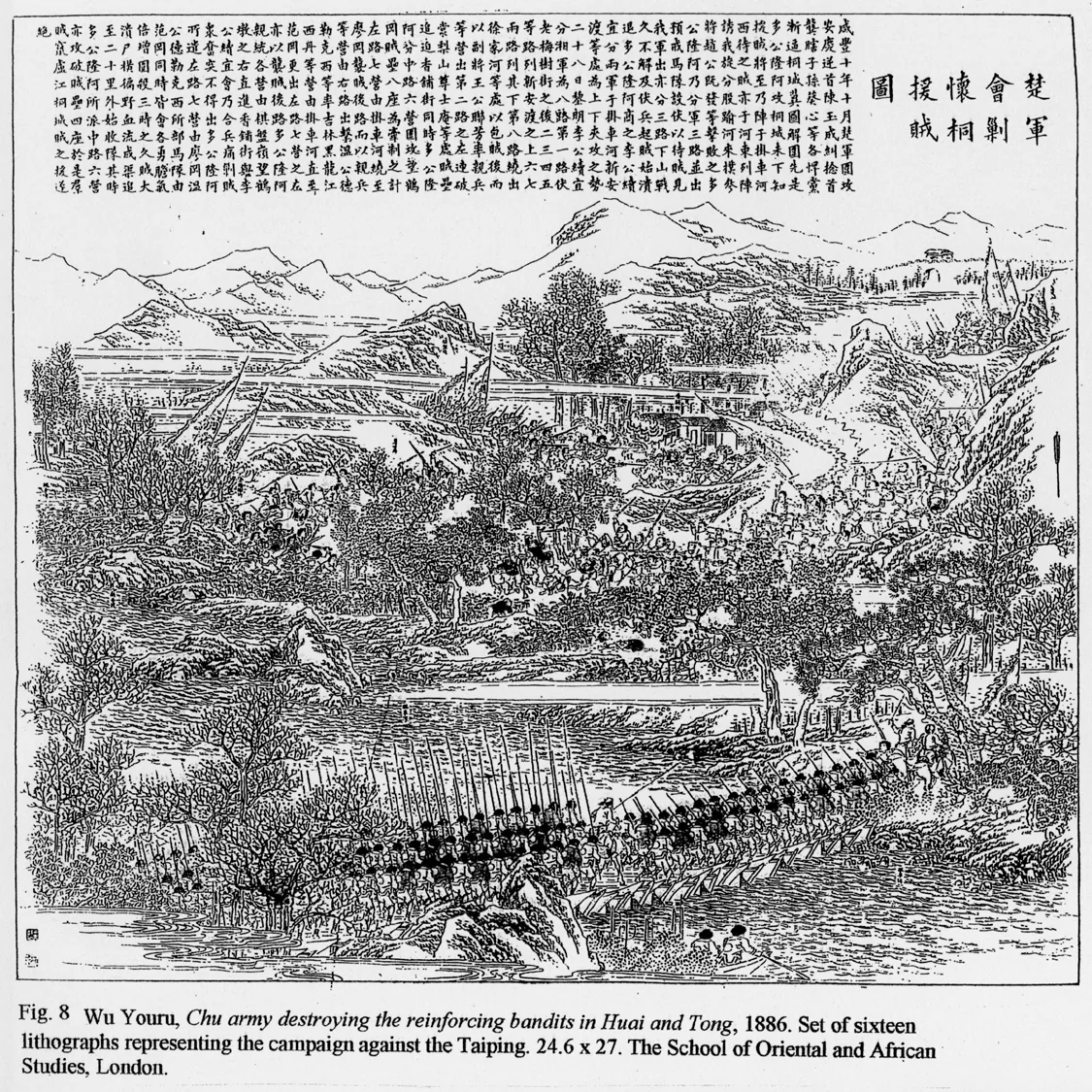
Wu Youru, Chu army destroying the reinforcing bandits at Huai and Tong, 1886 (Wikimedia Commons) · Public domain · Source page
Wu Youru, Chu army destroying the reinforcing bandits at Huai and Tong, 1886 (Wikimedia Commons)
One of a series of lithographs made in 1886, more than twenty years after Nanjing fell in 1864. It shows a Qing army, and its title calls the Taiping 'bandits'.
- Who drew it, and from which side? A painter of the Qing period, on the side that won the war. The picture shows the winners' view.
- What is missing? The Taiping view, and any eyewitness account. A picture made in 1886 cannot show what the battle actually looked like.
A scholar who chooses to command
A decision point
You are Zeng Guofan.
Hunan, around 1851–52
You passed the highest imperial examination and served in the Hanlin Academy. The Taiping have moved through Hunan, and a special decree orders you to help the governor raise local volunteers.
You do not know whether the volunteers will hold.
What do you do?
- Refuse, and ask to stay in your civil post. Probably the governor is left with too few men, and the Taiping keep advancing through the province.
- Help raise volunteers, but place them under the regular army's officers. Probably the volunteers are absorbed into a weak system, under officers who do not know them.
- Raise your own volunteer army from local men, and command it yourself. Building a force like this is slow and costly, and it may take years before it is ready.
What really happened
Raise your own volunteer army from local men, and command it yourself.
Zeng raised a force of his own. It became the Xiang Army, and over the following years one of the Qing's main forces against the Taiping. The sources give no exact founding date; the early 1850s is the safest answer.
The sources do not give his full reasoning. What we see is a scholar who chose to build a force of his own rather than leave the defence to others.
Myth
The Taiping were a Christian revolt that the West backed.
The truth
No. Hong's faith mixed Christianity with Taoism, Confucianism and folk belief in a coming new age. Roberts refused to baptise him.
Britain and France stayed officially neutral. Later they sent officers, and naval help went to the Qing, not to the Taiping.
The evidence
In February 1861 the Royal Navy officer James Hope visited Nanjing. In 1861 Royal Navy help reached Qing forces at Anqing.
Check yourself
What was the official position of Britain and France in the war?
Answer: They stayed neutral, and later sent officers to help the Qing.. Right. They did not back the Taiping, and naval help went to the Qing at Anqing.
Tianjing, 1856
Leadership
The killing in the palace
2 September 1856
Yang Xiuqing, a senior Taiping leader, is killed in his palace in Tianjing by troops of two other generals. Historians call this the Tianjing Incident. Estimates of the number killed in the city run to about 27,000 to 30,000, and these are estimates.
A decision point
You are Shi Dakai.
Outside Tianjing, September 1856
You are a Taiping leader, away from the capital with your own army. Word comes that Yang Xiuqing has been killed, and that the troops who did it now hold the city.
Your officers ask what you will do.
What do you do?
- Hurry back to the capital. Probably you face the troops who now hold the city, and your life is at risk.
- Keep your army outside the city and wait. Probably the capital stays in other hands. You keep an army, but not the centre of power.
- Leave Taiping territory with your army now. Probably you keep your army, but give up any claim to the capital.
What really happened
Hurry back to the capital.
He hurried back to the capital in October 1856. After warnings that he could be assassinated, he fled the city, and in 1857 he left Tianjing with an army of his own.
The sources do not record his reasons in detail. Going back was the one way to contest the capital, and it was dangerous.
What the war left
Memory
The memory of the winners
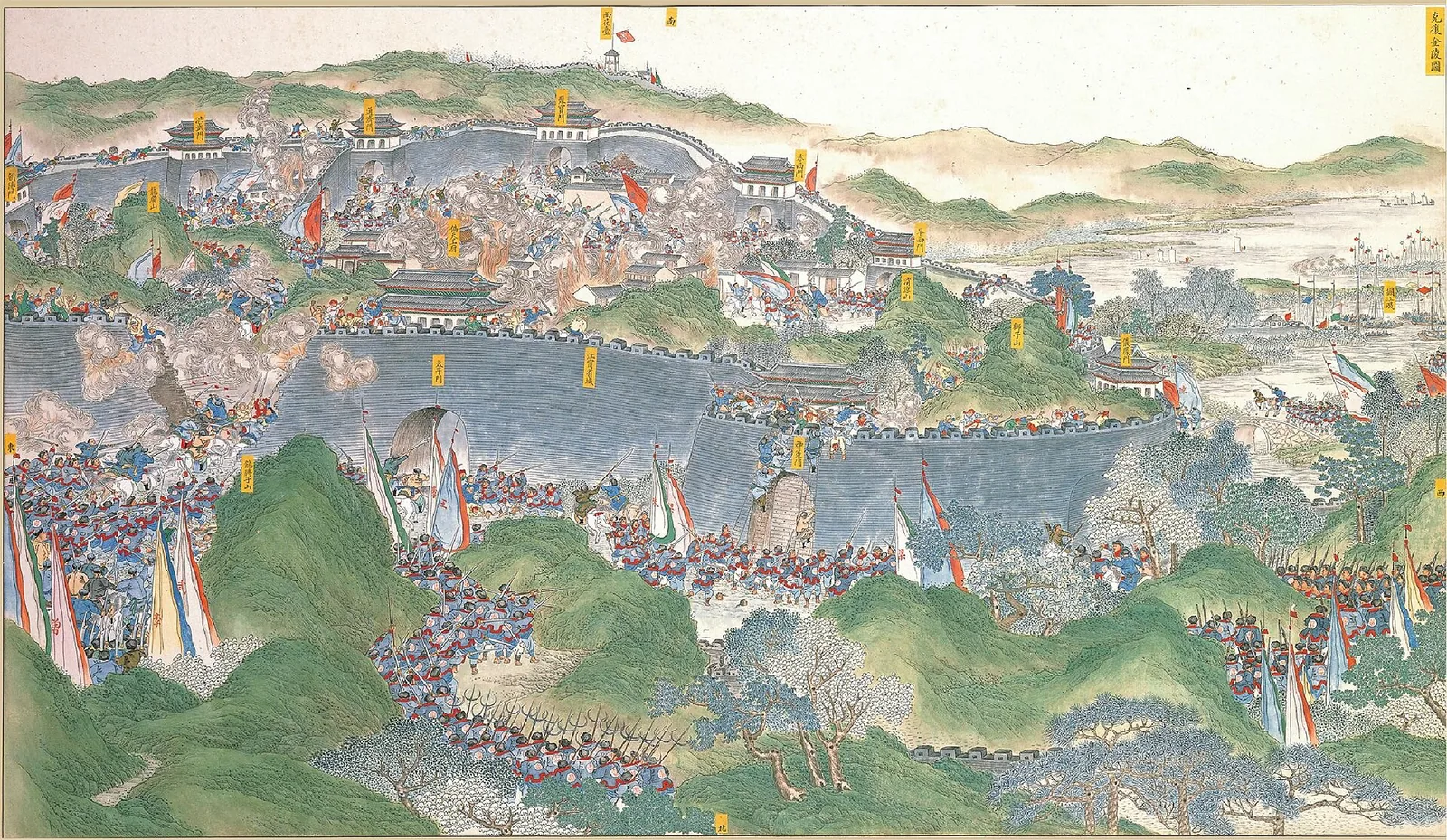
Wu Youru, Regaining Jinling, 1886 (Wikimedia Commons) · Public domain · Source page
The painting here was made in 1886, more than twenty years after Nanjing was retaken. It is a memory kept by the winners, not a record of the moment.
After 1856, in order
- December 1856 The Xiang Army retakes Wuchang.
- 1861 Qing forces take Anqing, with help from the British Royal Navy.
- May 1862 The Xiang Army besieges Nanjing.
- 1 June 1864 Hong Xiuquan dies in Tianjing, aged 50. The most likely cause is illness, after he ate wild plants during a food shortage. Some have suggested suicide by poison.
- July 1864 Qing forces under Zeng Guoquan take Nanjing.
How many died?
How many people died in the war, and how could we know?
- The usual estimates 20 to 30 million, about 5 to 10 percent of China's population. These are estimates, not counts.
- Higher estimates Some estimates reach about 100 million. The sources do not agree on why the figures differ.
Can an exact figure be known, when war, famine and disease ran together?
Check yourself
What was the Tianjing Incident of 1856?
Answer: Yang Xiuqing was killed by troops of two other generals.. Right. The killing came from within the Taiping leadership, and it weakened their government.
Check yourself
What do the sources say about the number of dead in the war?
Answer: The usual estimates are 20 to 30 million, though some run higher.. Right. These are estimates, not counts, and they differ widely from one another.
Check yourself
How did Hong Xiuquan die?
Answer: Probably of illness, after eating wild plants in a food shortage.. Right. That is the most likely cause according to the sources. Suicide by poison has also been suggested, as a possibility.
Terms
- imperial examinations The state examinations that chose officials for the Qing. They tested the Confucian classics, and the main route to office and status ran through them.
- tract A short printed pamphlet with a religious message, meant to persuade its reader.
- queue The long braid the Qing required of men as a sign of submission. The Taiping did not wear it.
- zhuangyuan The title given to the candidate who came first in the highest imperial examination.
- land plan An 1853 Taiping document that set out an equal division of land by the number of people.
- Xiang Army A volunteer army raised in Hunan under Zeng Guofan. It became one of the Qing's main forces against the Taiping.
- Guangzhou A big city in southern China, capital of Guangdong province.
- Guangdong A province in southern China where Hong Xiuquan was born.
- Guangxi A region in southern China where Hong's cousin founded the God Worshippers Society.
- Nanjing A large city on the Yangtze, taken by the Taiping in 1853 and made their seat of government.
- Tianjing The name the Taiping gave to Nanjing, meaning Heavenly Capital.
- Beijing The capital of China, from which the Qing dynasty ruled during the war with the Taiping.
- Yangtze A great river in central China, on whose banks Nanjing stands.
- Jintian The place where Hong Xiuquan proclaimed himself Heavenly King on 11 January 1851.
- Hunan A province in central China that the Taiping marched through.
- Feng Yunshan Hong Xiuquan's cousin, who founded the God Worshippers Society in Guangxi in 1844.
- Issachar Roberts An American Christian missionary in Guangzhou. He refused to baptise Hong Xiuquan.
- Franz Michael A historian who published an edition, from which one of the passages in this lesson comes.
- Fu Shanxiang A woman who came first in a special examination for women held by the Taiping, and so won the zhuangyuan title.
- Qing dynasty The last imperial dynasty of China. It ruled from Beijing and was the Taiping's main enemy.
- God Worshippers Society A religious society founded by Hong Xiuquan's cousin in Guangxi in 1844.
- Good Words for Exhorting the Age A small religious tract Hong was given in 1836. He skimmed it at first, and later read it seriously.
- lithograph A printing method: an image is drawn on a stone slab and printed in many copies.
- Taoism An ancient Chinese religion and philosophy centred on the Dao, the natural Way of the world.
- Confucianism The Chinese teaching based on Confucius, stressing learning, family and good conduct.
- missionary A person who travels to other places to persuade people to adopt his religion.
- Hanlin Academy An academy of top scholars who served the emperor, joined by those who passed the highest imperial exam.
- foot binding An old Chinese custom of binding girls' feet tightly so they stayed small. The Taiping abolished it.
- opium A strong narcotic made from poppy plants. The Taiping banned its import.
- Zeng A Chinese official and commander serving the Qing, who raised a force of his own against the Taiping.
- Heavenly King The title Hong Xiuquan gave himself in 1851, as ruler of the Taiping state.
Sources
- The Land System of the Heavenly Kingdom (1853), in Franz Michael, The Taiping Rebellion: History and Documents, vol. 2, Documents and Comments (University of Washington Press, 1971), pp. 313–315, 319–320
- Wu Youru, Chu Army Destroying the Reinforcing Bandits at Huai and Tong (1886), lithograph
- Wu Youru, Regaining Jinling (1886), painting


Image credits
- Ford & West Lith., from History of the insurrection in China, p. 8, published 1853 (Internet Archive) · Public domain · Source page
- Wu Youru, Chu army destroying the reinforcing bandits at Huai and Tong, 1886 (Wikimedia Commons) · Public domain · Source page
- Wu Youru, Regaining Jinling, 1886 (Wikimedia Commons) · Public domain · Source page
