Three promises, one map: the Middle East, 1915–1920
Ask who drew the modern Middle East, and many people will say two diplomats, in secret, in 1916. It is a good story, and only partly true. The real one has three promises, one secret deal, and more than a century of argument about what they meant.
Decisions, questions and your own progress, in the app
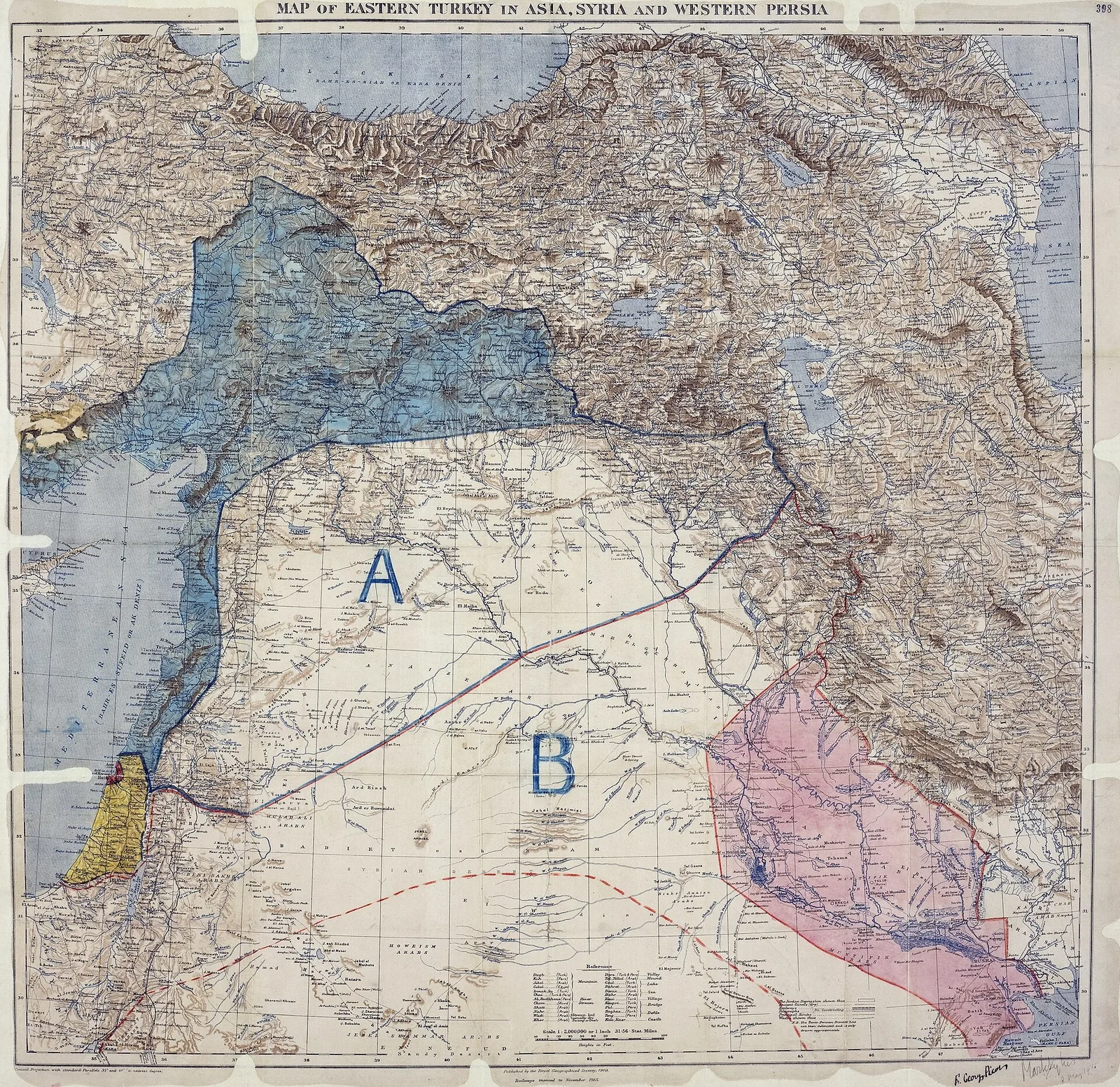
Royal Geographical Society map, 1910–1915, signed by Mark Sykes and François Georges-Picot. The National Archives, London (MPK1/426). · Public domain · Source page
The map on the table
Who drew the modern Middle East?
Ask who drew the modern Middle East, and many people will say: two diplomats, in secret, in 1916. It is a good story. It is only partly true.
The diplomats were Mark Sykes and François Georges-Picot. Their Sykes–Picot agreement of 1916 divided the Arab lands of the Ottoman Empire into zones of control, and it came with a map.
Why it matters
Why we still argue about the lines
The mandates handed out after the First World War followed the framework of the 1916 deal. Iraq and Transjordan took shape at the Cairo conference of 1921.
Historians still argue about how much of today’s map comes from the 1916 paper.
Three promises
Three promises in one place
Three promises
The first promise came in letters to Sharif Hussein of Mecca: Britain would support Arab independence, within limits. The second was a secret deal with France. The third was the Balfour Declaration, promising a national home for the Jewish people in Palestine.
Some historians say these promises contradict one another. Others say the first was too vague to contradict anything. Let us look at the evidence.
Faisal bin Hussein
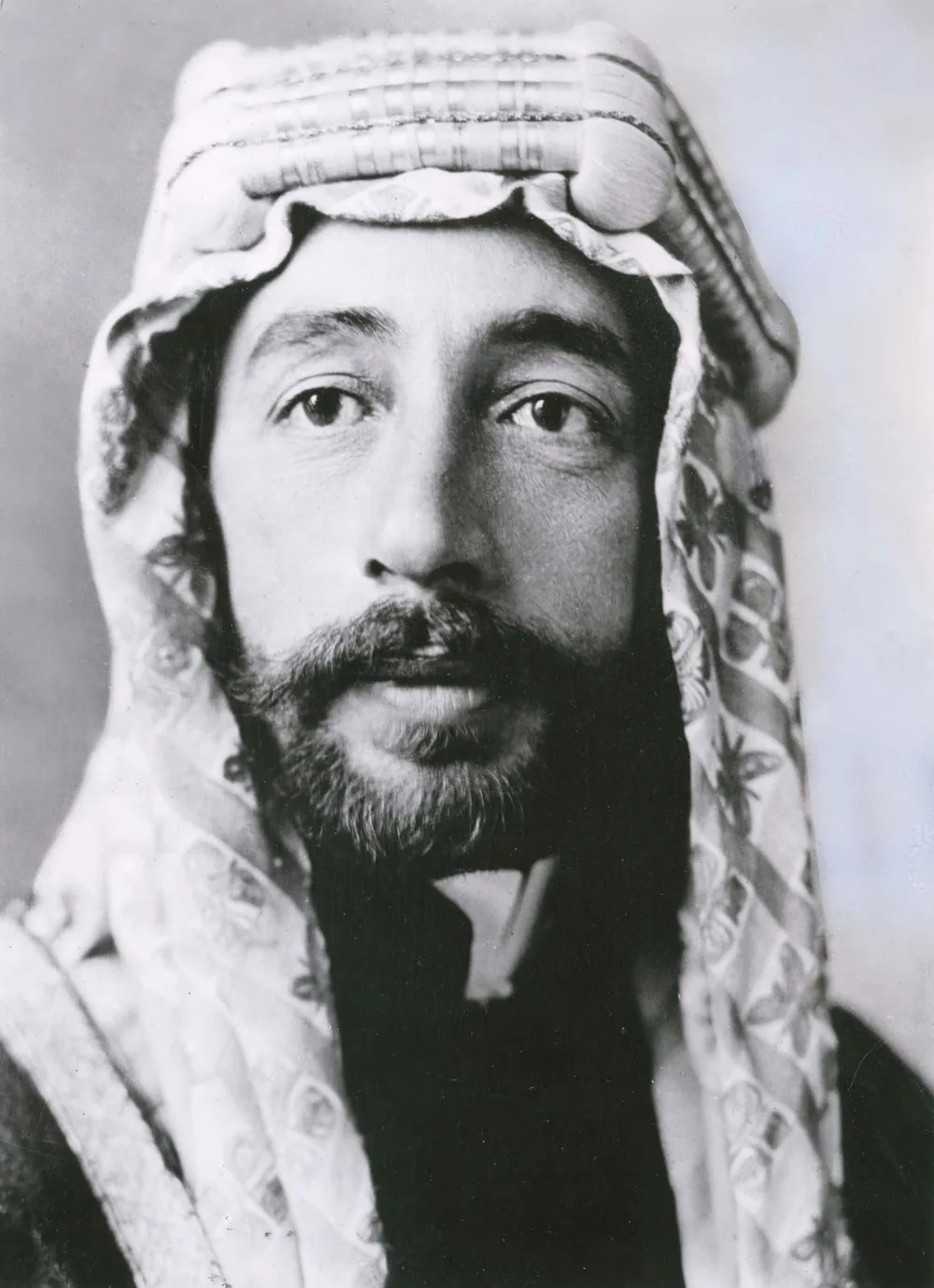
Emir Faisal, 1919. Photograph from the BBC Hulton Picture Library, as published on Britannica; author unknown. · Public domain · Source page
Hussein’s son, planned as king of Iraq, who lost his Syrian kingdom in 1920.
- Born: c. 1883 or 1885 (sources differ)
- Died: 1933
- Won: King of Iraq, from 1921
- Lost: The Syrian kingdom: French troops enter Damascus, late July 1920
Paraphrase: Faisal’s agreement depends on the Arabs gaining the independence he demanded in his memorandum of 4 January 1919.
The road to it
1915
A long correspondence
24 October 1915
In July 1915 Sharif Hussein of Mecca began a correspondence with Sir Henry McMahon, Britain’s High Commissioner in Egypt. It is known as the Hussein–McMahon letters.
On 24 October 1915 McMahon wrote the letter that Hussein read as the key promise: Arab independence, within limits. The letter set some Syrian districts aside, and historians argue about which.
Was Palestine one of them? That is the heart of the dispute.
1915–1916
A deal made in London
Mark Sykes, a Conservative politician and diplomatic adviser, and François Georges-Picot, a professional diplomat, negotiated the deal in secret.
The talks began in London on 23 November 1915, and by 3 January 1916 the two men had a memorandum. Russia was consulted. As far as the sources show, Hussein did not know the terms.
The deal was written up in the spring of 1916, and the sources give different dates for it.
A decision point
You are Sharif Hussein, in Mecca, in 1916.
1916, Mecca
The Ottoman Empire is at war with Britain, and it rules the land around you. A British official in Egypt has written to you, promising Arab independence within limits.
You do not know what Britain has agreed with France about these same lands.
The letters are unclear about the districts they leave out, and Palestine is one of the places where the reading is in doubt.
What do you do?
- Stay neutral and wait for a clearer promise. Probably Britain turns to other Arab leaders, and your standing as leader of the Arabs weakens. But you keep your army and your options.
- Join the British war against the Ottomans, and raise an Arab revolt. Probably you gain arms, money and a claim to the Arab lands after the war. But your fate rests on a promise written in vague words, and if Britain changes its mind, you lose.
- Refuse to move until Britain signs a binding treaty. Probably Britain will not sign everything you ask, and the revolt never starts. But you keep your conditions and your reputation.
What really happened
Join the British war against the Ottomans, and raise an Arab revolt.
Hussein chose the British side. In June 1916 he launched the Arab Revolt against the Ottomans.
The letters promised Arab independence, within limits, and that gave him a reason to act. What he privately thought is not recorded in a source we could check, so his reasons can only be inferred from what he did.
1917: a letter, a leak and a city
Palestine
Promises already on paper
By 1917 Britain had already promised Arab independence and made a secret deal with France. Zionist leaders in Britain wanted a public statement of support for a national home in Palestine.
The 1916 map had marked the Jerusalem district for international administration.
Russia
Russia in revolution
Russia had been consulted about the 1916 deal. In 1917 it was in revolution, and its government was changing hands.
In London the cabinet had to weigh all of this at once.
A decision point
You are a member of the British cabinet.
31 October 1917, London
A draft declaration says the government supports a national home for the Jewish people in Palestine. Supporters argue it would win Jewish support for the war.
But Britain has already made promises about these lands to Sharif Hussein, and it has a secret deal with France. The wording is still open.
What do you vote for?
- Make no public statement at all. Probably Zionist leaders keep lobbying, and Britain gives up a card it could play. But it avoids a public commitment that could cost it goodwill with the Arabs.
- Delay the decision, and ask for more time and evidence. Probably the option stays open for a while, but the question returns in another form when the war ends, and the timing is harder to control.
- Approve a declaration backing a national home for the Jewish people in Palestine. Probably Zionist leaders win public support, while Arab leaders and the French read it as a rival claim. The vague wording lets each side read into it what it wants.
What really happened
Approve a declaration backing a national home for the Jewish people in Palestine.
The cabinet approved the declaration on 31 October 1917. Balfour sent it as a letter on 2 November. It speaks of a ‘national home’, and never of a state.
The cabinet’s reasons are not recorded in a source we could check. Historians point to the war and to the wish for Jewish support, but disagree on how much weight each carried.
November–December 1917
A letter, a leak and a city
On 2 November 1917 Balfour’s letter went to Lord Rothschild. Within weeks the Bolsheviks published secret documents. Their foreign commissar, Leon Trotsky, said he wanted an end to secret diplomacy. Whether the Sykes–Picot text was among the papers is disputed.
On 9 December 1917 Jerusalem surrendered to the British army. The 1916 text had planned international administration for the district.
What we really know
Source: McMahon’s promise, 1915
Paraphrase: Britain will support Arab independence within limits. Parts of Syria are set aside. Whether Palestine is among them is the point in dispute.
- Who wrote it, and why? Sir Henry McMahon, for the British government, to bring Hussein into the war.
- What does the letter leave unsaid? Which districts are set aside, and whether Palestine is among them.
Myth
Sykes–Picot drew today’s borders with a ruler.
The truth
Not quite. The 1916 text drew coloured zones and two areas, (a) and (b), not final borders. At San Remo in April 1920 the Allies formally annulled the agreement, yet the mandates followed its framework. Iraq and Transjordan came from the Cairo conference of 1921.
The evidence
The text itself names its colours: blue for direct French control, red for direct British control, and brown for international administration in the Jerusalem district.
Source: The 1916 text, read closely
The Sykes–Picot agreement, 1916, from the text published by the Avalon Project at Yale Law School, and the archive map shown above.
- Who wrote it, and for whom? Two negotiators, for their governments. It divided lands that Arab leaders understood had been promised to them, and the Arabs were not at the table.
- What does the map show that the text does not? The lines themselves, and where the two areas sit. The annexed map is not printed in the text.
Source: The Balfour letter, 2 November 1917
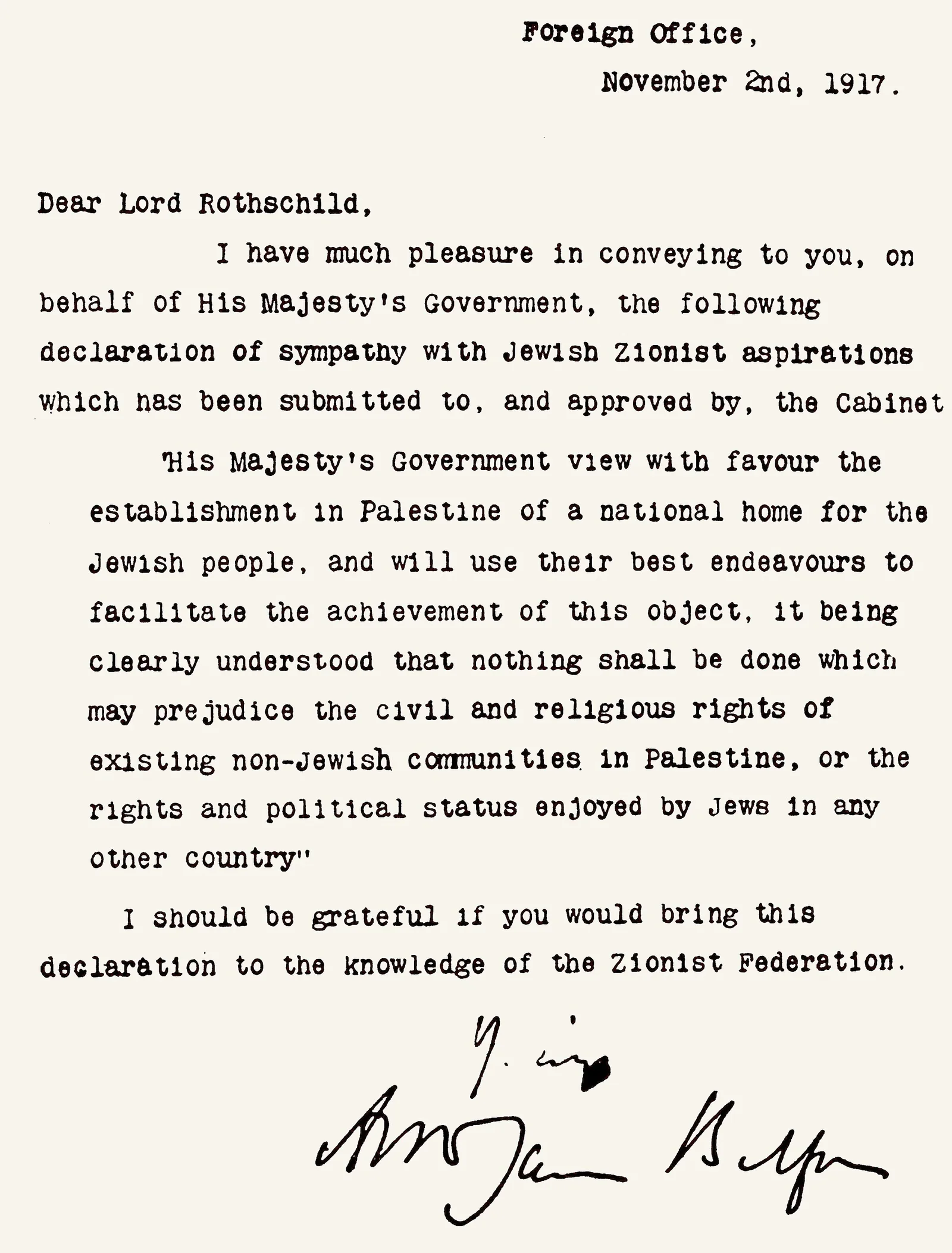
Arthur Balfour, letter to Lord Rothschild, 2 November 1917. British Library, via Wikimedia Commons. · Public domain · Source page
…a national home for the Jewish people … the civil and religious rights of existing non-Jewish communities in Palestine…
- Who gets the promise, and what about the people already there? The Jewish people get the home. Existing communities are promised protection of their civil and religious rights, and nothing on their political future.
- What does the letter leave out? A state. The letter promises a national home, not a state.
A decision point
You are Faisal, Hussein’s son, in Damascus.
July 1920, Damascus
In March your Syrian Congress made you king of an Arab Syria. In April, at San Remo, the Allies gave Syria to France as a mandate.
In mid-July, according to the sources we checked, the French general Gouraud sends an ultimatum: disband your army, accept French authority, and reply by 20 July.
Your war minister, Yusuf al-Azma, wants to resist. The rest of the cabinet is more cautious.
Do you accept the ultimatum, or resist?
- Resist with the army, and fight the French near Damascus. Probably the army is defeated, and the kingdom ends. But you fight for the kingdom you were given, and many in Damascus keep their faith in you.
- Accept the ultimatum: disband the army, accept French authority. Probably you keep your life and your position for a while, and the French govern the country under a mandate. But nationalists in Damascus will see it as surrender, and your rule would be empty.
- Leave Syria and wait for a better moment abroad. Probably the French enter Damascus without a fight, and your name stays available for later talks. But you give up the kingdom without a fight.
What really happened
Accept the ultimatum: disband the army, accept French authority.
The decision split. According to the summaries we checked, most ministers, except the war minister, agreed on 18 July to accept. Some accounts say the reply was delayed. The war minister chose to fight. According to the summaries we checked, he was killed near Damascus, about 24 July. Faisal left Damascus soon after.
Faisal’s own reasons are not recorded in a source we could check. The choice was split, so reasons differ from person to person.
What followed, and the quiz
1920–1921
The lines get names
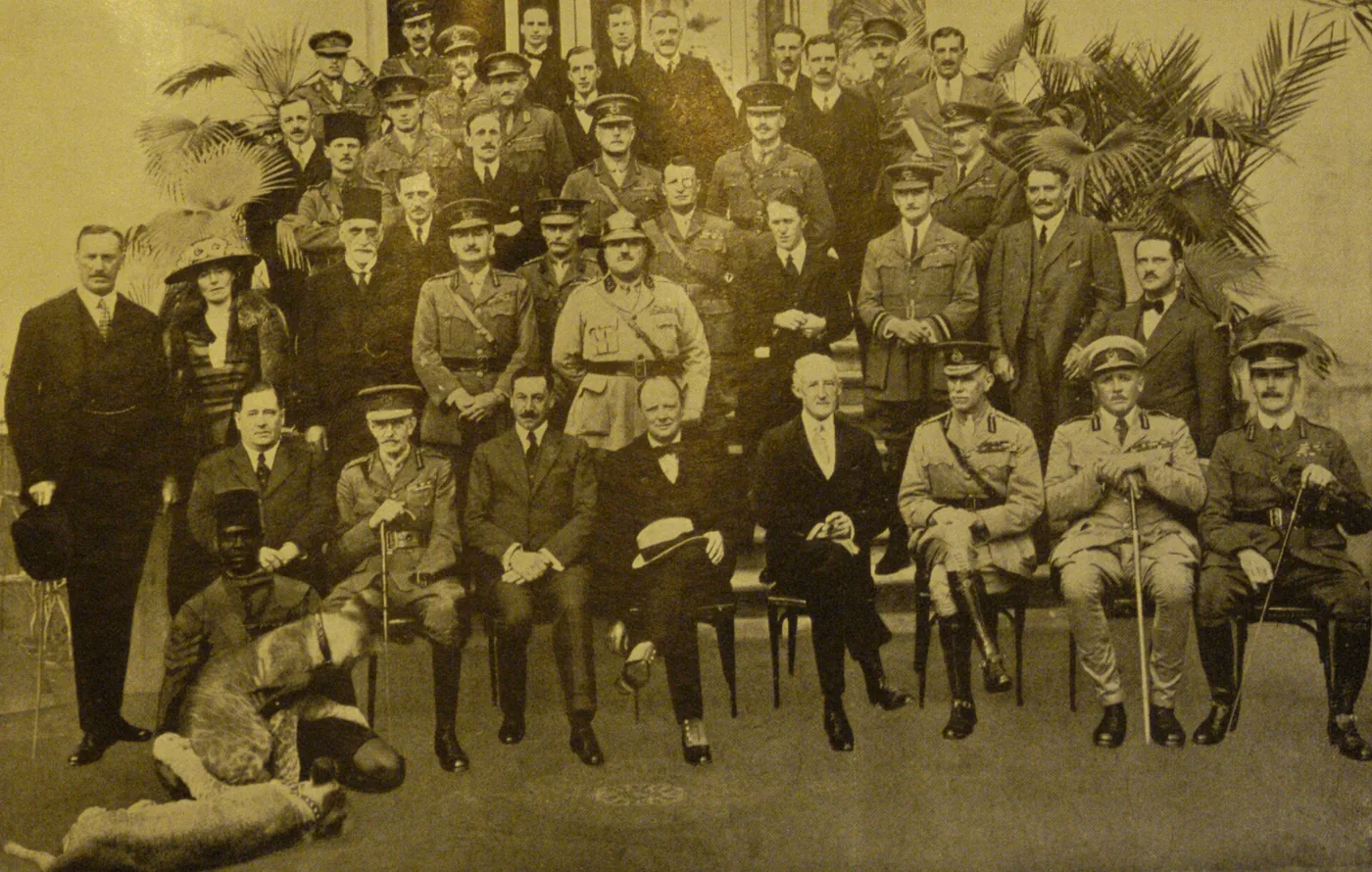
Delegates to the Cairo conference, March 1921. Photograph, author unknown; via Wikimedia Commons. · Public domain · Source page
Cairo, 1921
After San Remo, France held the mandate for Syria and Britain held the mandate for Palestine. In March 1921 the Cairo conference planned to make Faisal king of Iraq, subject to a vote, and put Abdullah on a six-month trial in Transjordan.
Iraq and Transjordan took shape at Cairo, not in the 1916 text.
1922–1939
The quarrel outlives the lines
In June 1922 Winston Churchill wrote that Palestine had been excluded from McMahon’s pledge. In July 1937 McMahon told The Times he had not meant to include it.
So the argument about 1915 went on for decades.
From the deal to the dispute
- 1916 The Sykes–Picot text is written in secret: coloured zones and two Arab areas.
- 2 November 1917 The Balfour letter promises a national home for the Jewish people in Palestine.
- April 1920 San Remo: the Allies annul the agreement and assign mandates for Syria and Palestine.
- July 1920 The French ultimatum, the battle near Damascus, and the French enter the city.
- March 1921 The Cairo conference: Iraq and Transjordan take shape.
- June 1922 Churchill’s memorandum: all of Palestine excluded from McMahon’s pledge.
- February 1939 Britain prepares a White Paper to print the Hussein–McMahon letters.
Did Britain betray the Arabs?
Did Britain break its word to the Arabs?
- George Antonius (1938); James Barr Britain and France broke their word. The McMahon pledges, the secret deal and the Balfour letter contradicted one another, on this reading.
- Elie Kedourie (1956) The promises were vague, and the charge of betrayal reads a later quarrel back into 1915.
- Michael D. Berdine (2018) The 1916 deal was a secret imperial bargain, and the modern borders were fixed mainly by the decisions of 1920 to 1923.
Which reading do the sources in this lesson support best? What evidence would change your mind?
Check yourself
Which description fits the 1916 Sykes–Picot text best?
Answer: Coloured zones and two Arab areas, on an annexed map.. Right: the text names its colours and two areas, (a) and (b), and refers to an annexed map that it does not print.
Check yourself
What did the McMahon letters leave unclear?
Answer: Whether Palestine was among the districts set aside.. Right: the letter set some Syrian districts aside, and whether Palestine was one of them is the point in dispute.
Check yourself
Which words did the Balfour letter use for the Jewish future in Palestine?
Answer: A national home for the Jewish people.. Right: these are the letter’s own words, and the sentence is quoted in the Balfour source step.
Check yourself
At which meeting did Iraq and Transjordan take shape?
Answer: Cairo, 1921. Right: the Cairo conference of March 1921 planned Faisal as king of Iraq and set up a six-month trial in Transjordan.
Check yourself
Which statement about the Bolsheviks’ November 1917 publication is true?
Answer: Historians disagree on whether Sykes–Picot was published.. Right: the sources disagree on this point, and the deeper panel on the leak sets out the dates they give.
Check yourself
Which statement about Faisal’s July 1920 decision is best supported?
Answer: The cabinet split: most ministers accepted, the war minister did not.. Right: this is the split decision the lesson describes. The dates, and the delay in the reply, are reported with caution.
Terms
- Sykes–Picot agreement A secret 1916 agreement between Britain and France, with Russia consulted. It divided the Arab lands of the Ottoman Empire into zones of direct control and influence.
- Hussein–McMahon letters A series of letters, 1915–1916, between Sir Henry McMahon, Britain’s High Commissioner in Egypt, and Sharif Hussein of Mecca. They promised Arab independence, within limits.
- sharif A title of honour for a descendant of the Prophet Muhammad. Hussein was sharif of Mecca, and later ruled the Hejaz.
- Hejaz A region in the west of the Arabian Peninsula, where Mecca and Medina lie. Britain recognised Hussein as King of the Hejaz.
- Arab Revolt The uprising against Ottoman rule that Sharif Hussein launched from Mecca in June 1916, with British backing.
- Balfour Declaration A letter of 2 November 1917 from the Foreign Secretary, Arthur Balfour, to Lord Rothschild. It expressed British support for a national home for the Jewish people in Palestine.
- mandate A territory that the victorious powers after the First World War placed under one power, to govern until it could stand alone. In 1920 France received Syria and Britain received Palestine.
- secret diplomacy Agreements and talks kept hidden from the public and from other governments. In 1917 Trotsky made ending it a public aim.
- Bolsheviks The Russian revolutionary party that took power in November 1917. Leon Trotsky was its commissar for foreign affairs.
- ultimatum A final demand with a deadline; refusing it brings the threatened action. In July 1920 General Gouraud sent one to Faisal’s government in Damascus.
- Mark Sykes A Conservative politician and diplomatic adviser in Britain. He negotiated the deal in secret with Georges-Picot.
- François Georges-Picot A professional French diplomat. He negotiated the secret deal with Mark Sykes.
- Henry McMahon Britain’s High Commissioner in Egypt. In his letters to Sharif Hussein he promised Arab independence, within limits.
- Ottoman Empire An empire that ruled many Arab lands, and fought Britain in the First World War.
- Cairo conference A conference in Cairo in 1921, where Iraq and Transjordan took shape.
- Transjordan The area that later became Jordan, under the British mandate. It took shape at the Cairo conference in 1921.
- San Remo A town in Italy. In April 1920 the Allies formally annulled the agreement there, and gave Syria to France as a mandate.
- Syrian Congress A representative body of the Syrians. In March it declared Syria an Arab kingdom, with Faisal as king.
- International administration Rule over an area by several countries or an international body, instead of by one state.
- Cabinet The senior ministers who run the government and take the major decisions.
- Leon Trotsky A Bolshevik leader in Russia, the foreign commissar of the new government.
- Manchester Guardian A British newspaper. According to the English Wikipedia, it printed the texts on 26 November.
- Marx Memorial Library A library in London that holds only a summary of the text of the agreement.
- Old Style The calendar Russia used at the time. By it, 23 November is 6 December in the calendar used in the West.
- Memorandum A short written record of an early agreement between sides, before a full deal.
- Lord Rothschild A Jewish leader in Britain, to whom Balfour sent his declaration.
- Damascus The capital of Syria. According to the summaries checked, the Syrian war minister was killed near the city when he chose to fight.
- University of Illinois A university in the United States. Its account of Trotsky’s statement does not mention the agreement at all.
- Winston Churchill A British politician. In a memorandum of 1922 he wrote that all of Palestine was excluded from McMahon’s pledge.
Sources
- Sykes–Picot Agreement, 1916 (text), The Avalon Project, Yale Law School
- Arthur Balfour to Lord Rothschild, letter of 2 November 1917 (the Balfour Declaration), The Avalon Project, Yale Law School
- Winston Churchill, memorandum of 3 June 1922, in Foreign Relations of the United States, 1939, vol. IV, document 770 (US Department of State, history.state.gov)
- Jewish Virtual Library, “The Sykes-Picot Agreement, 1916”
- George Antonius, The Arab Awakening (1938)
- Elie Kedourie, England and the Middle East (1956)
- Elie Kedourie, In the Anglo-Arab Labyrinth: The McMahon–Husayn Correspondence and Its Interpretations, 1914–1939 (1976)
- Michael D. Berdine, Redrawing the Middle East: Sir Mark Sykes, Imperialism and the Sykes-Picot Agreement (2018)
Image credits
- Royal Geographical Society map, 1910–1915, signed by Mark Sykes and François Georges-Picot. The National Archives, London (MPK1/426). · Public domain · Source page
- Emir Faisal, 1919. Photograph from the BBC Hulton Picture Library, as published on Britannica; author unknown. · Public domain · Source page
- Arthur Balfour, letter to Lord Rothschild, 2 November 1917. British Library, via Wikimedia Commons. · Public domain · Source page
- Delegates to the Cairo conference, March 1921. Photograph, author unknown; via Wikimedia Commons. · Public domain · Source page


