15 August 1945: the broadcast that announced the surrender
At noon on 15 August 1945 the emperor addressed his people by radio. The night before, officers tried to stop the broadcast by force. Who decided to surrender, and why not sooner?
Decisions, questions and your own progress, in the app
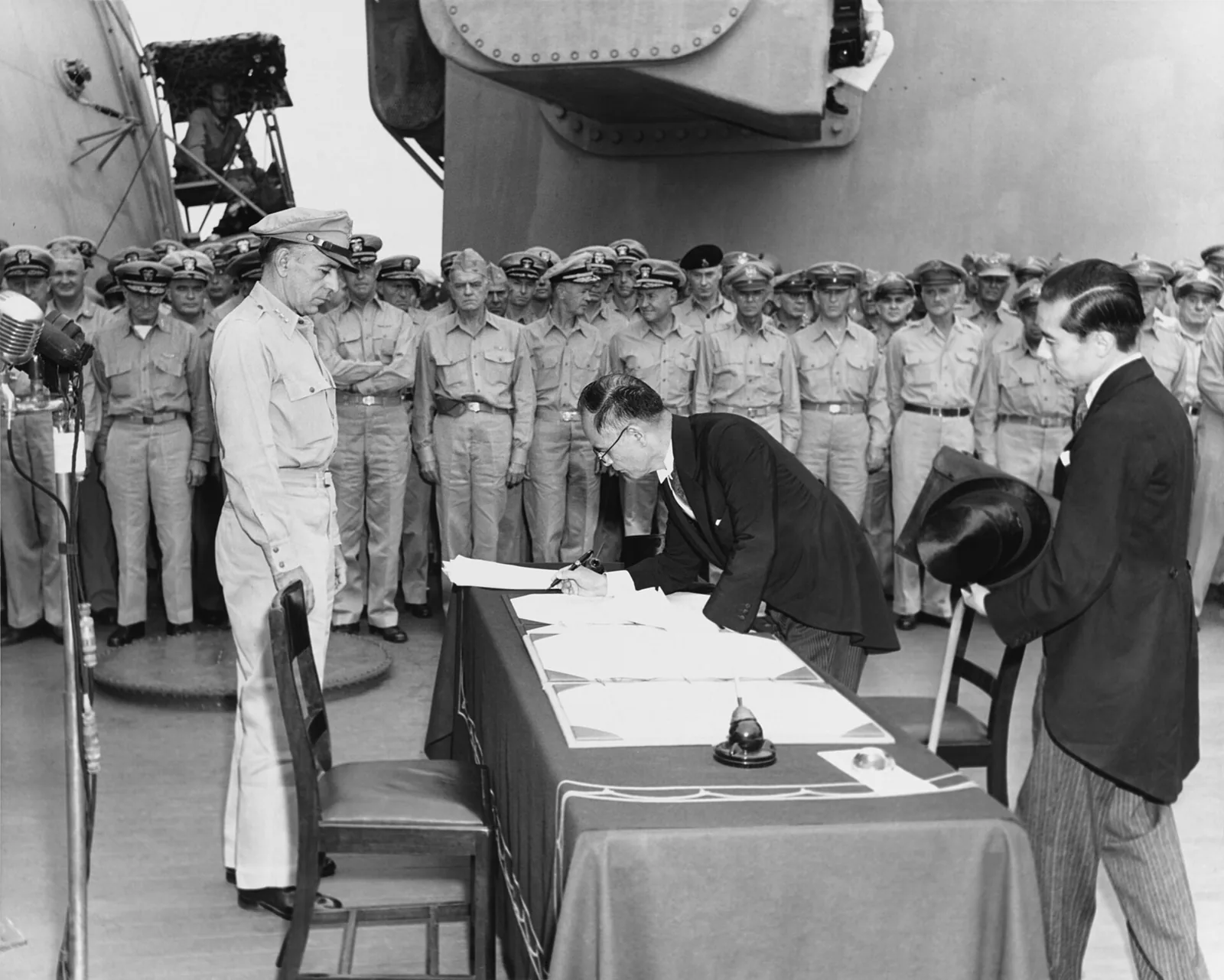
US Army Signal Corps photographer Stephen E. Korpanty, restored by Adam Cuerden, 2 September 1945 (Naval Historical Center photo SC 213700). · Public domain · Source page
A declaration and one word
Noon, 15 August 1945
At noon on 15 August 1945, Japanese radio carried the voice of Emperor Hirohito.
The night before, army officers had tried to stop that broadcast by force. Who decided that Japan would surrender, and why not weeks earlier?
Background
The declaration
26 July 1945
On 26 July 1945 the Allies issued the Potsdam Declaration. It set out the terms on which Japan could end the war.
On 27 July the Japanese government decided how to answer. Newspapers reported the decision on 28 July. The answer was mokusatsu.
The word means ‘to ignore’, or to treat something with silent contempt. Some translators read it as ‘no comment’, a much softer meaning. Either way, the Allies did not hear a yes.
The council splits
August 1945
Two bombs and an invasion
6–9 August
On 6 August an atomic bomb fell on Hiroshima. Estimates of the Hiroshima dead in the months after the bomb range from about 90,000 to 166,000 (Atomic Heritage Foundation summary).
Late on 8 August the Soviet Union declared war on Japan. Just after midnight, its forces invaded Manchuria.
On 9 August a second atomic bomb fell on Nagasaki.
9–10 August
Six men
Six men ran Japan’s war: the Big Six. They were the prime minister, the foreign minister, the navy and army ministers, and the chiefs of the army and navy staffs.
Just before midnight on 9 August they met at an imperial conference. Three of them, Foreign Minister Shigenori Togo, Navy Minister Mitsumasa Yonai and Prime Minister Kantaro Suzuki, wanted to accept the Potsdam terms with one condition: the imperial institution would stay.
Army Minister Korechika Anami and the army and navy chiefs wanted three more conditions: that Japan disarm itself, that Japan try its own war criminals, and that no foreign army occupy the country.
The vote split three against three, so no proposal had a majority.
A decision point
You are Kantaro Suzuki, prime minister of Japan.
The night of 9–10 August 1945
Since just after midnight, Soviet forces have been advancing into Manchuria. Today a second atomic bomb fell on Nagasaki. Three days ago the first fell on Hiroshima.
Three council members want to accept the Potsdam terms with one condition: the imperial institution must stay. Three want more conditions.
What do you do?
- Accept the Potsdam terms now, asking only that the imperial institution stays. Probably the war ends within days. The army would be bitter, and some officers might resist. But the Allies would have to answer your one condition.
- Accept only if the army’s three extra conditions are granted. Probably the Allies reject the extra conditions. The talks drag on while Soviet forces advance, and Japan’s position weakens each day.
- Reject the declaration and fight on until better terms are offered. Probably the war goes on, with more attacks on Japanese cities and the Soviet advance continuing. There is no sign the Allies would offer better terms.
- Ask the Emperor to decide, since the council cannot agree. Probably the deadlock ends quickly, in the Emperor’s name. What he decides depends on his own view, which no minister can be sure of.
What really happened
Ask the Emperor to decide, since the council cannot agree.
The council stayed split, and the decision went to the Emperor. In the early hours of 10 August he agreed with Togo. Japan’s reply that day accepted the terms on one condition: that the imperial institution be kept.
They could not agree, so the choice went up to the Emperor, and he chose the answer Togo had argued for. Historians argue about how much the bombs and the Soviet attack pushed the council there. We come back to that at the end.
Two replies
Source: The Allied reply, 11 August
From the moment of surrender the authority of the Emperor and the Japanese Government to rule the state shall be subject to the Supreme Commander of the Allied powers.
The reply came through Swiss intermediaries. It did not promise the Emperor his throne.
- Who wrote this, and for whom? The US Secretary of State, for four Allied governments. Japan had attached a condition to its reply, so this answers a government that must decide.
- What is missing? Any promise that the Emperor keeps his place. The sentence makes his authority depend on the Allied commander.
- Why could a reader in Tokyo be alarmed? The reply left the Emperor’s future open. The government had asked for exactly that promise, and the sentence says neither that he will be removed nor that he will stay.
A decision point
You are Emperor Hirohito.
14 August 1945, Tokyo
You hold the Allied reply of 11 August. It does not promise your position, which was the one condition your government asked for.
Your ministers are divided. Some officers want to fight on. Others see no way to go on. Japanese cities have already been hit by atomic bombs.
What do you order?
- Accept the reply, and let the government arrange the signing. Probably the war ends within weeks. The risk is the army: officers who oppose surrender may try to stop it by force.
- Refuse the reply, and first ask the Allies for a clear promise on your position. Probably the talks stall. Fighting goes on while Soviet forces advance and air attacks continue.
- Order the army to fight on until better terms are offered. Probably the fighting lasts many weeks. No better terms are in sight, and the cost falls on soldiers and civilians alike.
- Wait a week and see what the Soviet Union does. Probably the Soviet advance grows, the Allies press harder, and the choice in front of you gets no easier.
What really happened
Accept the reply, and let the government arrange the signing.
On 14 August the Emperor chose acceptance. Japan’s reply said he ‘is prepared to authorize and ensure the signature’ of the terms. His message was recorded that day.
The Emperor had already chosen acceptance on 10 August, and his choice on 14 August was the same. Historians disagree on how much weight the two shocks carried in this second decision.
Myth
The Emperor alone decided to surrender, on his own.
The truth
His word settled the matter, twice. But he chose between a split council, under the pressure of the Soviet entry and the bombs. Many people shaped it.
The evidence
On 9–10 August the six leaders split three against three. The decision reached the Emperor only because the council could not agree.
The night of 14 August
14–15 August
The night
That night, army officers led by Major Kenji Hatanaka tried to stop the surrender. Their revolt is known as the Kyūjō incident.
They wanted the recording of the Emperor’s message, due to be broadcast at noon the next day.
A decision point
You are Lieutenant General Takeshi Mori, commander of the division that guards the palace.
The night of 14–15 August 1945
The surrender has been decided. Now officers from your division come and say the army will not accept it.
They ask your men to help stop the surrender, and you to join them tonight.
What do you do?
- Join the officers, and hold the palace with your men until the army decides. Probably the surrender is delayed for hours or days, and the government and the army end up in open conflict.
- Refuse to join, and keep your men out of the plot. Probably the officers treat you as an enemy of the plot, and the danger to you that night is real.
- Report the plot to the Eastern Army headquarters and wait for orders. Probably the plot ends sooner. The Eastern Army headquarters is the authority that did end it in practice.
What really happened
Refuse to join, and keep your men out of the plot.
Mori refused to join the plot, and Major Hatanaka shot him.
The accounts describe his refusal, but they do not record his own reasons, so this lesson will not guess at them. What is known is what the refusal cost him.
15 August
What happened next
The plotters then forged an order in Mori’s name and sealed it with his stamp.
For hours they searched the palace for the recording, and did not find it.
Earlier that morning Army Minister Korechika Anami had taken his own life. Hatanaka had given up the revolt after orders from the Eastern Army headquarters, under General Shizuichi Tanaka. Around 11:00 he took his own life too.
At noon the recording was broadcast.
Source: The broadcast, 15 August
…has developed not necessarily to Japan’s advantage…
The imperial rescript was read on the radio at noon on 15 August, addressed to the Japanese people.
- Who is speaking, and to whom? The Emperor, to his own people. The Allies are not the audience here.
- What is missing? The word ‘surrender’. In this English translation it does not appear. The text describes the situation and the decision instead.
- Is an English translation a neutral source? No. A translation chooses words, and this one comes from a US recording reported by a newspaper. Compare it with the original before trusting a phrase.
After the broadcast
2 September 1945
Tokyo Bay
On 2 September 1945 the instrument of surrender was signed aboard the US battleship USS Missouri, in Tokyo Bay.
Foreign Minister Mamoru Shigemitsu signed for the Japanese government. General Yoshijiro Umezu signed for the army.
Japan had announced its acceptance on 15 August. The signature came later.
From the broadcast to the signature
- 15 August 1945, early morning Army Minister Anami takes his own life.
- 15 August 1945, around 11:00 Major Hatanaka takes his own life, after giving up the revolt.
- 15 August 1945, noon The Emperor’s recording is broadcast. Japan announces its acceptance of the Potsdam terms.
- 2 September 1945 The instrument of surrender is signed aboard USS Missouri in Tokyo Bay.
Which shock weighed more?
Did the atomic bombs or the Soviet declaration of war push Japan to surrender?
- Tsuyoshi Hasegawa, Racing the Enemy (2005) Hasegawa ranks the Soviet entry above the bombs. He argues that Japan’s leaders still hoped Moscow would mediate, and that both shocks were needed together.
- Richard Frank, Downfall (1999) Frank argues that the bombs mattered more than the Soviet declaration, and that surrender was not imminent in August 1945.
Both sides accept the same basic sequence of events. They disagree about which shock moved the leaders more, and how to weigh a Soviet attack against two atomic bombs.
Check yourself
What did the word mokusatsu mean in the Japanese government’s answer to the Potsdam Declaration?
Answer: Ignoring it, with silent contempt. Correct. The word means to ignore, or to treat with silent contempt. ‘No comment’ is the softer reading.
Check yourself
Why did the decision on Japan’s answer pass to the Emperor on the night of 9–10 August?
Answer: Because the six leaders split three against three. Correct. The vote was tied, so the decision went to the Emperor.
Check yourself
What did the phrase ‘subject to the Supreme Commander’ mean for a reader in Tokyo?
Answer: His authority would depend on the Allied commander. Correct. That is what the sentence says. It does not promise the Emperor his throne, which is why a reader could be alarmed.
Check yourself
Which word does the rescript never use, according to the source step?
Answer: ‘Surrender’. Correct. In this translation the word does not appear. The text describes the situation and the decision instead.
Check yourself
What happened in the palace on the night of 14–15 August?
Answer: Officers forged an order and searched for the recording. Correct. This is what the sources describe, including the forged order sealed with the commander’s stamp and the search that failed.
Check yourself
Which statement about Japan’s surrender is correct?
Answer: Japan accepted on 15 August and signed on 2 September.. Correct. The announcement came first, and the formal document was signed aboard the USS Missouri.
Terms
- Potsdam Declaration The Allied declaration of 26 July 1945, setting out the terms on which Japan could end the war. Japan did not accept it at once.
- mokusatsu A Japanese word meaning to ignore, or to treat with silent contempt. It was Japan’s answer to the Potsdam Declaration in July 1945.
- Big Six The six leaders who ran Japan’s war in 1945: the prime minister, the foreign minister, the navy and army ministers, and the army and navy chiefs of staff.
- imperial institution The Emperor’s position as head of the state. Japan’s leaders saw keeping it as their central condition.
- Kyūjō incident An attempted revolt by army officers on the night of 14–15 August 1945. They tried to stop the surrender and to find the Emperor’s recording in the palace.
- imperial rescript A formal announcement issued in the Emperor’s name. The rescript of 15 August 1945 was read on the radio in the Emperor’s own voice.
- instrument of surrender The formal document by which a defeated state accepts the surrender terms. Japan’s was signed on 2 September 1945.
- Hirohito Emperor of Japan during the war. His voice was broadcast on the radio at noon on 15 August 1945, when Japan announced its acceptance of the terms.
- The Allies The countries that fought Japan and Germany in the Second World War, including the United States and Britain.
- Manchuria A region in north-east China. At the end of the war Soviet forces invaded it.
- Soviet Union A huge communist state with Russia at its core. In August 1945 it declared war on Japan.
- Atomic Heritage Foundation An organization that documents the history of the atomic bomb. This lesson cites its estimates of the Hiroshima dead.
- Kenji Hatanaka An army officer who led the Kyūjō revolt to stop the surrender. He gave up the revolt that morning, and later took his own life.
- Korechika Anami Japan’s army minister at the time of surrender. Early that morning, the day of the broadcast, he took his own life.
- Shigenori Togo Japan’s foreign minister. At the imperial conference he wanted to accept the Potsdam terms if the imperial institution stayed.
- Mitsumasa Yonai Japan’s navy minister. At the imperial conference, like Togo, he wanted to accept the Potsdam terms if the imperial institution stayed.
- Kantaro Suzuki Japan’s prime minister at the time of surrender. He too wanted to accept the Potsdam terms if the imperial institution stayed.
- Mamoru Shigemitsu The foreign minister who signed the surrender document for the Japanese government.
- Yoshijiro Umezu A Japanese general who signed the surrender document for the army.
- Mori A man who refused to join the revolt on the night before the surrender, and was shot by Major Hatanaka.
- Eastern Army The headquarters of part of the Japanese army. Its orders made Hatanaka give up the revolt.
- Shizuichi Tanaka A Japanese general who headed the Eastern Army headquarters during the revolt.
- Division A large military unit made up of several regiments.
- Imperial conference A formal meeting of Japan’s top leaders, where major decisions were made.
- USS Missouri An American battleship. Japan’s formal surrender was signed aboard it.
- Tokyo Bay A bay next to Tokyo, the capital of Japan. The battleship Missouri stood in it when the surrender was signed.
- Occupying force A foreign army that controls a conquered country and runs its affairs.
Sources
- James F. Byrnes, reply of 11 August 1945 for the four Allied governments, as printed in Foreign Relations of the United States, 1945, vol. VI, document 440 (Office of the Historian, US Department of State).
- Hirohito, Imperial Rescript on the Termination of the War (15 August 1945). English translation from a US government recording of the broadcast, as reported by The New York Times and quoted by the Atomic Heritage Foundation.
- Tsuyoshi Hasegawa, Racing the Enemy: Stalin, Truman, and the Surrender of Japan. Cambridge, MA: Belknap Press of Harvard University Press, 2005.
- Richard B. Frank, Downfall: The End of the Imperial Japanese Empire. New York: Random House, 1999.
- Atomic Heritage Foundation, “Bombings of Hiroshima and Nagasaki, 1945”, Nuclear Museum.
- PBS, American Experience, “Pacific Negotiating Surrender” (quotes the Byrnes reply of 11 August 1945).
Image credits
- US Army Signal Corps photographer Stephen E. Korpanty, restored by Adam Cuerden, 2 September 1945 (Naval Historical Center photo SC 213700). · Public domain · Source page
