Sun Tzu: the man, the book and the legend
The Art of War is one of the most read books in the world, but there is no agreement on when it was written, or perhaps even by whom. What do we really know about Sun Tzu?
Decisions, questions and your own progress, in the app
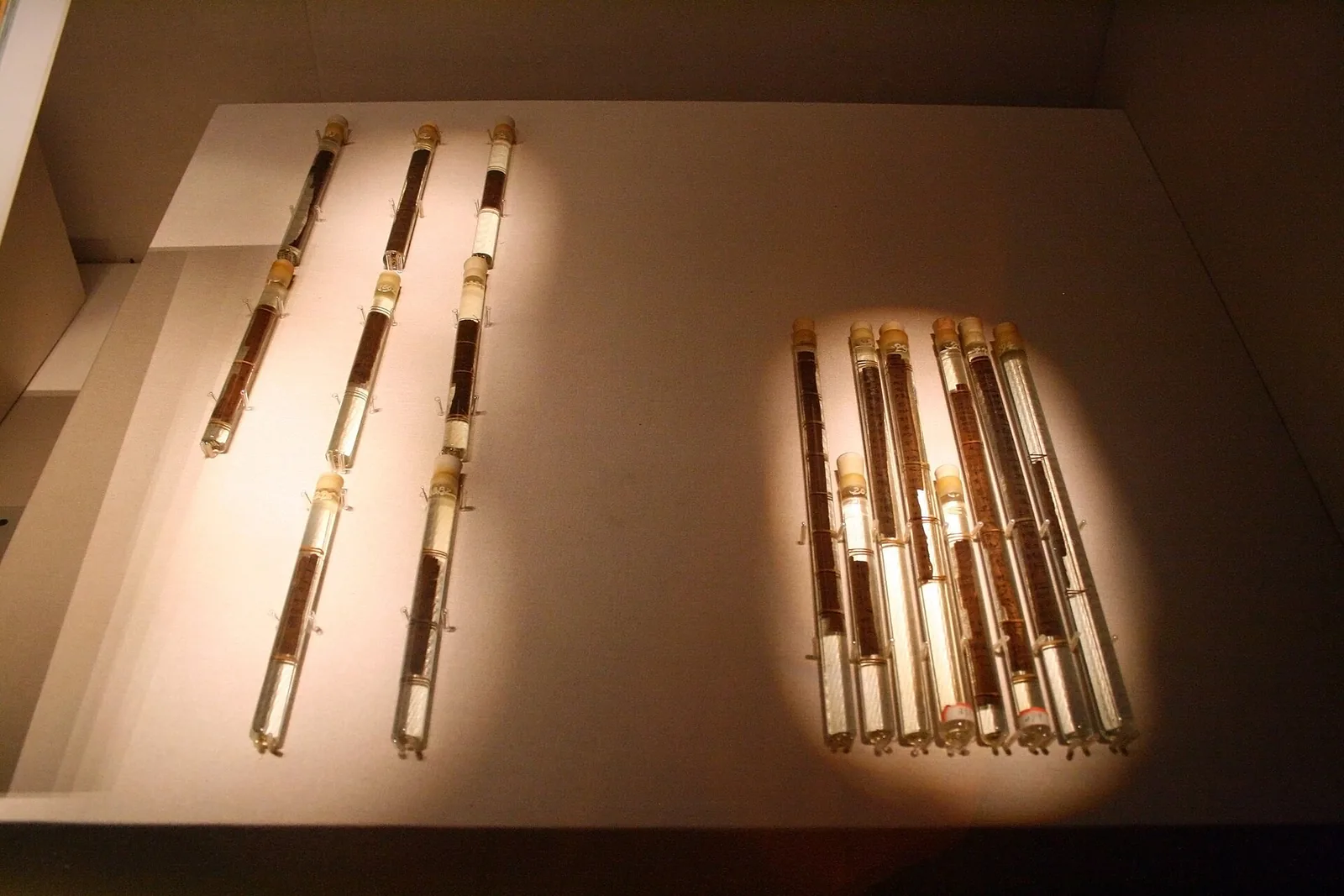
Inscribed bamboo slips, Yinqueshan, Shandong. Photo: AlexHe34, 2011 · CC BY-SA 3.0 · Source page
A king who wants a test
Who wrote The Art of War?
The Art of War is one of the most read books in the world. But there is no agreement on when it was written, or perhaps even by whom.
In this lesson we check what is really known about Sun Tzu, what is only told about him, and why the two are hard to separate. The book may have been written long after the man whose name it carries.
Background
A state in the south-east
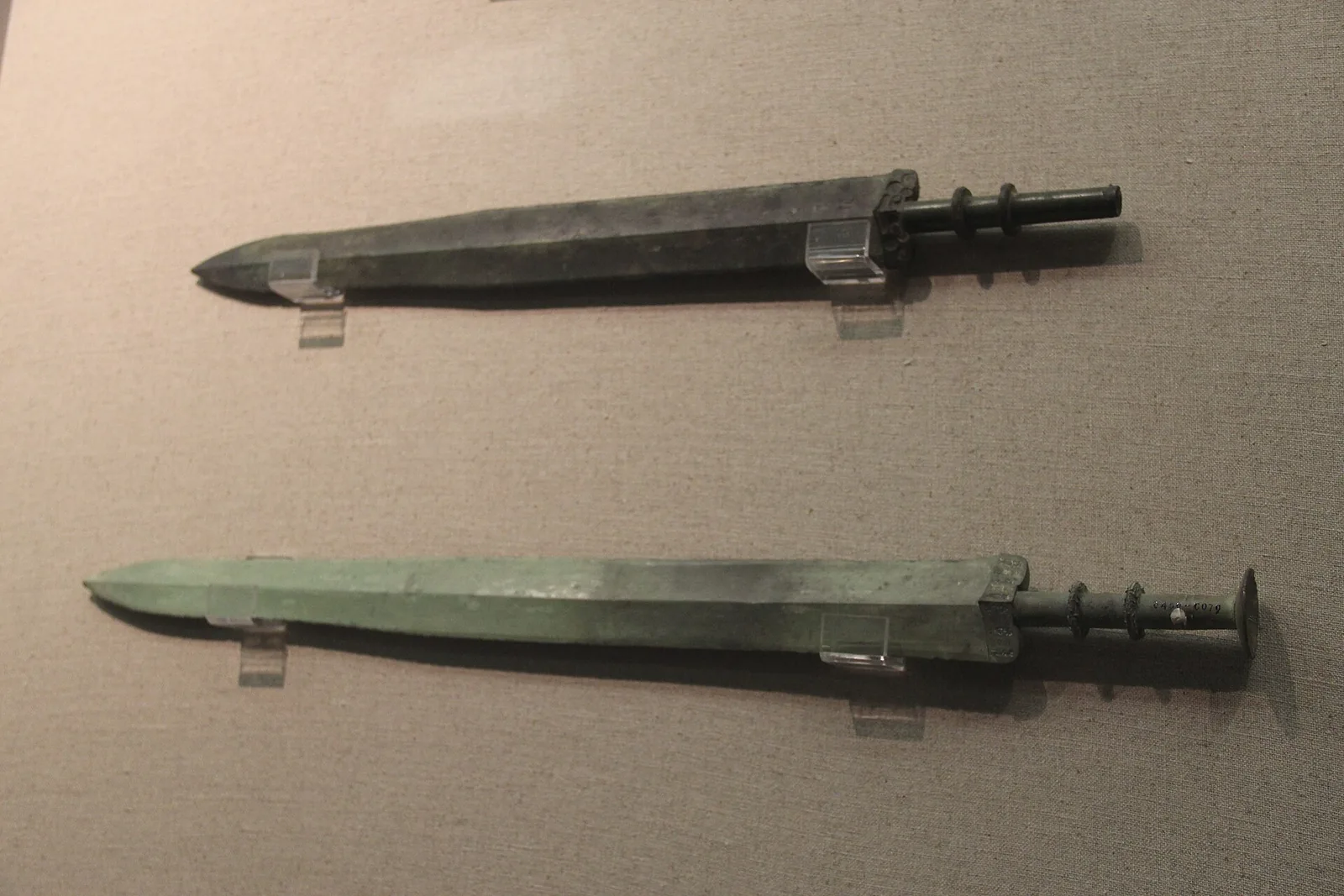
Bronze swords, Anhui Provincial Museum, Hefei. Photo: Gary Lee Todd, Ph.D., 2012 · CC0 · Source page
In the period called Spring and Autumn, China was not one country. It was a set of rival states, which fought one another for land, prestige and power.
The state of Wu lay in the south-east. Its capital, which the sources name in several ways, was probably near the present city of Suzhou. The king of Wu in this story is Helu, who reigned from 514 to 496 BC.
A man from the state of Chu, Wu Zixu, fled to Wu after King Ping of Chu killed his father and his elder brother. He became Helu’s adviser. (Giles spells him Wu Tzŭ-hsu; the sources spell the name in several ways.)
The book
A book in thirteen chapters
According to Sima Qian, a man came to the court of the king of Wu with a book on war in thirteen chapters. The king read it carefully. Chinese sources also call him Sun Wu; it is the same man.
Reading is not testing. The king asked whether the man’s ideas on managing soldiers could be tried in a small test. The man agreed.
A decision point
You are King Helu of Wu.
The palace of Wu. The date is not known. The book is already in your hands.
The book is about managing soldiers: how to set out ranks, how to give orders, and how to win without fighting. It may be sound, or it may be empty talk.
You need soldiers and you need wars. If you give command to a man you have never seen lead troops, you may lose a whole army. If you never test him, you will never know whether the book is worth anything.
How do you test him?
- Test him with a small task first, and widen his command only if he passes it. Probably you would learn something about his ability without risking a war. But a small test might be too small to show what he is really worth. He would also learn what your court expects of him.
- Give him full command at once, because the book seems clear enough to you. Probably a man no one has seen lead troops would stand at the head of your army. If he succeeds, you will look bold. If he fails, you will pay in soldiers and in trust.
- Keep him as an adviser beside Wu Zixu, with no command, for one season. Probably the question stays open, and the book stays a text in the palace. You would know no more about him than what he wrote, and he would affect no war.
What really happened
Test him with a small task first, and widen his command only if he passes it.
In the Shiji, Sima Qian says the king tested the man with women from the palace, and then made him a general. This story is the only detailed account of it. The next step looks at its details closely.
Giles’s translation has the king ask for a “slight test”, so the idea of a small test is the source’s. The split between a small test and full command is ours: the source tells of a test, and then an appointment. That is why we marked the first option as the closest.
Sima Qian does not say what the king thought. He gives only the sequence: a test, and then command. A later book, from the first century AD, says that Wu Zixu recommended the man earlier. Giles calls that book romantic, so we do not rely on it.
No source says how the court saw the man. What survives is the sequence.
Two leaders, one drill
The drill
180 women in the yard
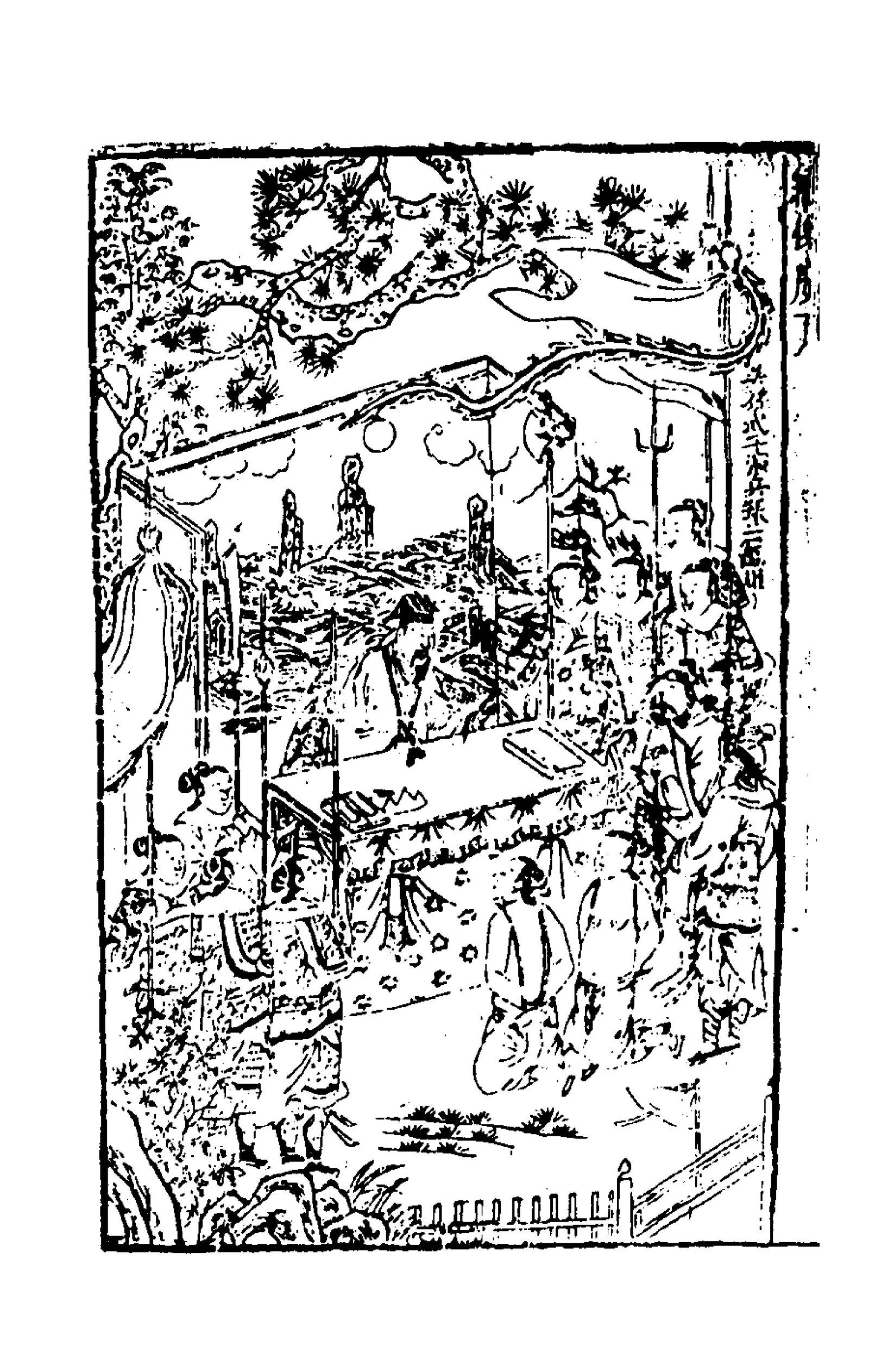
Illustration from an illustrated Chinese book of generals’ lives, 1643. Artist unknown. Public domain (by age) · Public domain · Source page
According to Sima Qian, the king asked for the test to be run on women from the palace, and brought 180 of them. Sun Tzu divided them into two companies, and placed at the head of each one of the king’s favourite concubines. He explained the commands to them: eyes front, left turn, right turn, about turn. They said they understood.
The drill began to the beat of drums. Sun Tzu gave the order “right turn”, and the women burst out laughing. He said that if the commands were not clear and distinct, the general was to blame.
He began again and gave the order “left turn”. The women laughed again. This time he added a sentence: if the commands are clear and the soldiers still disobey, the fault lies with their officers.
From a raised pavilion above the yard, the king was watching. He saw his favourite concubines standing at the head of the drill.
A decision point
You are Sun Tzu, in command of the drill.
The palace yard, after the second burst of laughter.
You have already said the rule aloud: when the orders are clear and the soldiers still refuse, the fault lies with their officers. The two leaders are the king’s favourite concubines, and they laughed twice.
The king is watching from above, and everyone in the yard knows what he wants. If you change the rule before his eyes, the soldiers will learn that rules bend according to rank.
What do you do with the two leaders?
- Spare them. The drill goes on with the same two leaders. Probably the rule breaks in front of the whole court. The women and the soldiers would learn that rules bend before the king. The test would fail, and no one would believe the book was worth anything.
- Remove the two from their posts, and put the next pair in line in their place. No punishment. Probably the drill goes on under the rule, and the two leaders are humiliated in front of the court. But the king may take it as a personal insult, and the problem would move from the yard to the throne room.
- Stop the test, and ask the king to set another test that does not involve his favourites. Probably the test is put off, and the king either grows angry or respects the refusal. Your authority survives, unless the king insists on his way.
What really happened
Remove the two from their posts, and put the next pair in line in their place. No punishment.
This is the nearest choice in the lesson, not the history itself. In the Shiji, Sun Tzu orders the two leaders to be beheaded. The king sends a message asking that they be spared, and Sun Tzu refuses. He then has them beheaded and puts the next pair in their place.
This lesson does not offer the killing as a choice. Option (b) keeps the replacement and the rule, and leaves out the killing, so it is marked as the closest choice rather than the one that was made.
Sun Tzu puts the rule first: the commander answers for the order, and the officers answer for the soldiers. That idea is easy to admire. The difficulty is that the story makes the rule merciless.
Another question: did the drill happen at all? Many scholars doubt the whole scene. Ye Shi, a Song scholar, found the story incredible. See the sources later in this lesson.
What the Shiji says next
A perfect drill, and a king who will not come down
After the replacement, the drill was perfect. The women turned right and left, advanced and wheeled back, knelt and stood, and did not make a sound.
Sun Tzu sent word that the troops were ready for inspection and would go through fire and water if ordered. The king replied that he had no wish to come down and inspect them. Sun Tzu’s answer, as the Shiji has it, was: “The King is only fond of words, and cannot translate them into deeds.”
Sima Qian adds that the king then saw that Sun Tzu knew how to handle an army, and made him general. Sun Tzu’s reply to the king’s message had been that, having received command of the army, there were some of the king’s commands he was unable to accept.
Source: The biography, at its close
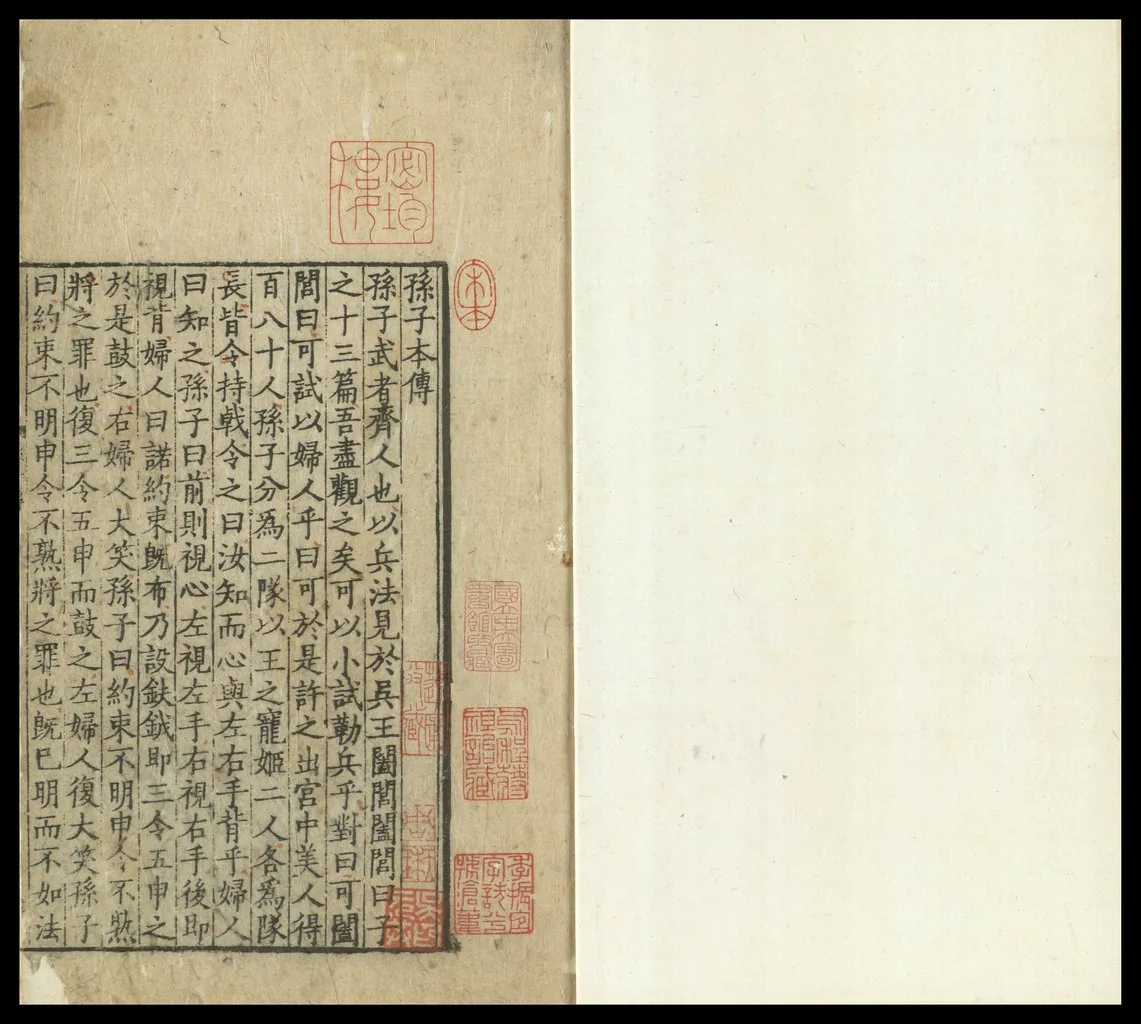
Eleven Commentaries to The Art of War, World Digital Library item 11410. Date as given in the record · Public domain · Source page
And Sun Tzŭ shared in the might of the King.
This line closes the biography, and it sums up Sun Tzu’s share in Helu’s successes. Sima Qian wrote about four centuries after the events he describes. The page in the picture comes from a later printed edition of the book, with commentaries.
- Who wrote the line, and when? Sima Qian, a historian of the Han dynasty, writing about 97 BC. He wrote about four centuries after the events, from sources most of which we no longer have.
- Does the line describe a battle, or a political success? A political success. “Shared in the might of the king” is a line of praise, not a military report. It does not say what Sun Tzu did, in which battle, or in what post.
- What is missing from it? Everything needed to test the story: place, date and orders. Sima Qian does not say that Sun Tzu fought at Ying, or that he went there at all. We come back to this in chapter five.
The silent chronicle
The silence
A chronicle that never names him
The Zuo zhuan is an ancient chronicle of the Spring and Autumn period. It covers the states and their wars in great detail, and it names even ordinary people and hired fighters. Among its entries are Wu’s wars under Helu, including the campaign against Chu.
What it does not contain is Sun Tzu. Not one line. Giles notes that the chronicle records even hired ruffians, so the silence about a general of such fame strikes him as very odd.
Doubt
A scholar who doubted the man
Doubt about the man is older than modern scholarship. Ye Shi, a Song scholar who died in 1223, argued that Sima Qian had said more than his text supports, and that the man himself might never have existed.
But Giles quotes Ye Shi as placing the book’s style towards the end of the Spring and Autumn period or the start of the Warring States, around the 5th century BC. So he doubted the man, but still tied the book to that period. We come back to that split in chapter six.
Myth
Sun Tzu wrote every line of the book himself, around 500 BC, and he certainly existed as a man of flesh and blood.
The truth
Nobody knows. The traditional dates of his life are 544–496 BC, but that is a traditional date, not one that has been checked. The sinologist Victor Mair, in his 2007 translation, calls Sima Qian’s biography essentially fictional.
The copy found at Yinqueshan dates from the 2nd century BC. The text we read today comes down to us through many later editions.
The evidence
The Han imperial catalogue lists 82 pian (sections of writing) under Sun Tzu’s name. Giles reports the view of the scholar Pi I-hsün that the other titles may have been contained within those 82 pian. What the number counted is not clear.
Source: The Huainan Tzu
When sovereign and ministers show perversity of mind, it is impossible even for a Sun Tzŭ to encounter the foe.
According to Giles, this is the earliest direct reference to Sun Tzu that can be pointed to. The book was compiled at the court of Liu An, prince of Huainan, who died in 122 BC.
- What does this line say about Sun Tzu? Almost nothing about his life. It assumes the reader knows the name, and uses it as a symbol of military genius.
- Does the line prove that a man of that name once lived? No. It proves that the name was known before Sima Qian wrote his biography. A name can become a symbol, so the line leaves the man’s existence open.
- Why does it matter that the line is older than the biography? Because it cannot be the source of the biography, it is independent of it. It is evidence that the name circulated before any story about its bearer appeared.
512 BC: the army is tired
Wu’s campaigns
The third year of Helu’s reign
According to Sima Qian, in the third year of his reign, which is 512 BC, Helu took the field against Chu with Wu Yuan (Wu Zixu) and Po P’ei. They captured the town of Shu.
Helu then thought of going down to Ying, the capital of Chu. The troops had marched a long way, and the campaign had been long. At this point a decision has to be made.
A decision point
You are the military adviser to King Helu, in 512 BC.
Wu, after the capture of Shu. Ying, the capital of Chu, is the next target.
The king says he wants to go down to Ying, the capital of Chu. Shu has fallen, and the troops have marched far, tired from the road.
The question is not whether to attack, but when. Every choice will cost soldiers.
What do you advise the king?
- Attack Ying at once, while Chu is still confused. Probably you reach the city with a worn-out army. If Chu recovers, the campaign ends without a victory, and you bear the blame for the lost soldiers.
- Halt, let the army rest and grow stronger before the battle. Probably Chu regroups and the surprise is lost. But the army regains its strength, and the next campaign is fought at full power.
- First win over the neighbouring states of Tang and Cai, which bear Chu a grudge, and only then attack. Probably you gain useful allies. But it takes time, and the king may grow impatient with the delay.
What really happened
Halt, let the army rest and grow stronger before the battle.
In the Shiji, in 512 BC, Sun Wu advises waiting, because “The army is exhausted”, and it is not yet possible to attack. Wu waits. The king asks again six years later, in 506 BC, which is the next part of the story.
All three options are sensible. Attacking uses Chu’s shock, but leaves a tired army in front of a major city. Waiting keeps the army whole, at the cost of surprise. The alliance looks wise, but it slows the campaign, and the king may read the delay as weakness.
Note: the alliance advice (Tang and Cai) appears in the Shiji for 506 BC, not 512. We put it here as an option, to test the choice, not to settle the chronology.
Boju, 506 BC
Six years later
The king asks again
According to Sima Qian, in the ninth year of his reign, which is 506 BC, Helu asked Wu Zixu and Sun Wu whether the time was now ripe to enter Ying, since they had said earlier that it was not yet possible.
Both men answered that Chu’s general, Nang Wa (Giles’s Tzŭ-ch’ang), was grasping and covetous, and that the princes of T’ang and Ts’ai both had a grudge against him. Their key line is: “If Your Majesty has resolved to make a grand attack, you must win over T’ang and Ts’ai, and then you may succeed.”
Giles reports that the king followed the advice. His text adds, in square brackets, that Wu then beat Chu in five pitched battles and marched into Ying.
Two accounts
Two accounts of the same campaign
In the Zuo zhuan version the story is different. In James Legge’s translation of the chronicle (Duke Ding, years 4 and 5), Fugai, Helu’s younger brother, argues before the battle that Nang Wa lacks benevolence and that his officers will not die in this fight. The king refuses, but Fugai attacks anyway, with his own men.
The battle account records no advice from Wu Zixu or Sun Wu before the attack, and Sun Wu is not mentioned in the chronicle at all. Wu Zixu appears as a long-time planner against Chu, but not as an adviser in this battle. This is one of the central conflicts in the story. The two sources do not agree, and both can be read.
The battle
The battle at Boju
The armies met at Boju, a place that modern reconstructions put near the town of Macheng, in present-day Hubei. The battle takes its name from it.
Wu’s commanders were Helu, his brother Fugai, and Wu Zixu. Chu’s commanders included Nang Wa and Shen Yin Shu. The English Wikipedia article on the battle lists Sun Tzu among the commanders in its box, but notes that there is no record of his taking part in the fighting.
Wu won, and Ying fell into its hands. The sources we checked give no casualty figures for either side, so we will not guess a number.
A decision point
You are King Helu, in Ying, after the victory.
Ying, late 506 BC.
Ying is yours. The king of Chu has fled the city, and a minister of Chu has gone to ask the state of Qin for help.
Your troops have won, but they are tired, and the city is far from home. What do you do in it?
What do you do in Ying?
- Garrison the city with a force and hold it. Probably you keep the victory for a while, but your forces are spread across foreign land, far from your base.
- Withdraw to Wu with the spoils, before Chu and its allies regroup. Probably you keep the army and the spoils. But a victory won so quickly is fragile, and Ying would return to Chu.
- Pursue the king of Chu and destroy his army in the field. Probably you win a greater victory, but the chase stretches the army further and takes you further from your base.
What really happened
Garrison the city with a force and hold it.
According to the Zuo zhuan, in James Legge’s translation, the king of Chu fled the city and then went on to Sui. A minister asked Qin for help, and Qin sent 500 chariots. After more fighting, Qin’s army defeated Wu’s, and in the following year the king of Chu re-entered Ying. Fugai went back to Wu and set himself up as king. The Shiji and Giles do not tell this part.
We marked holding the city as the closest choice, since Wu did hold it, though only briefly. On this account, the victory did not last more than a year.
Each option is familiar from the history of war. Holding is the natural way to keep a captured city. Withdrawing avoids risk, but gives up the city. Pursuit sounds like total victory, but it wears the army down and takes it further from its base.
A War College essay, which is an opinion piece rather than a source, argues that Wu’s win owed much to luck, and that beyond taking the capital Wu had no clear strategy. That is a view, not evidence.
The book: thirteen chapters
What the book says
What the book says
The Art of War has thirteen short chapters. It does not follow one battle. It is about ideas: intelligence, preparation, manoeuvre, and the link between commander and soldiers.
A few lines readers remember:
“All warfare is based on deception.” (ch. I §18)
“There is no instance of a country having benefited from prolonged warfare.” (ch. II §6)
“If you know the enemy and know yourself, you need not fear the result of a hundred battles.” (ch. III §18)
The idea returns in chapter X in other words. But each of these is one sentence in a long text, and it should be read with the rest.
Quotations are from Giles’s translation (1910). The Hebrew is ours.
Source: Chapter VII, section 36
When you surround an army, leave an outlet free.
The passage carries a note by the later commentator Tu Mu, who explains the aim: to make the enemy believe there is a road to safety, so that he does not fight with the courage of despair. The text we read was edited in the early third century AD by Cao Cao, a military leader and statesman. In his preface he says he edited the text and removed some passages; how much he removed is unclear. He also wrote the earliest commentary that survives on the book.
- Who wrote the sentence, and which version are we reading? The book carries Sun Tzu’s name. But the version we have was edited in the early third century AD, and by Cao Cao’s own account parts were cut. So we cannot know for certain which words are original.
- Why would a commander want to leave the enemy an exit? Because an army sealed in completely fights to the end. The commentator is talking about psychology: if the enemy believes there is a road to safety, he is more likely to run than to fight to the death.
- What does the sentence not say? It does not say to let the enemy go. According to the commentator, once the enemy believes in the road to safety, you may crush him.
1972
Slips from a tomb
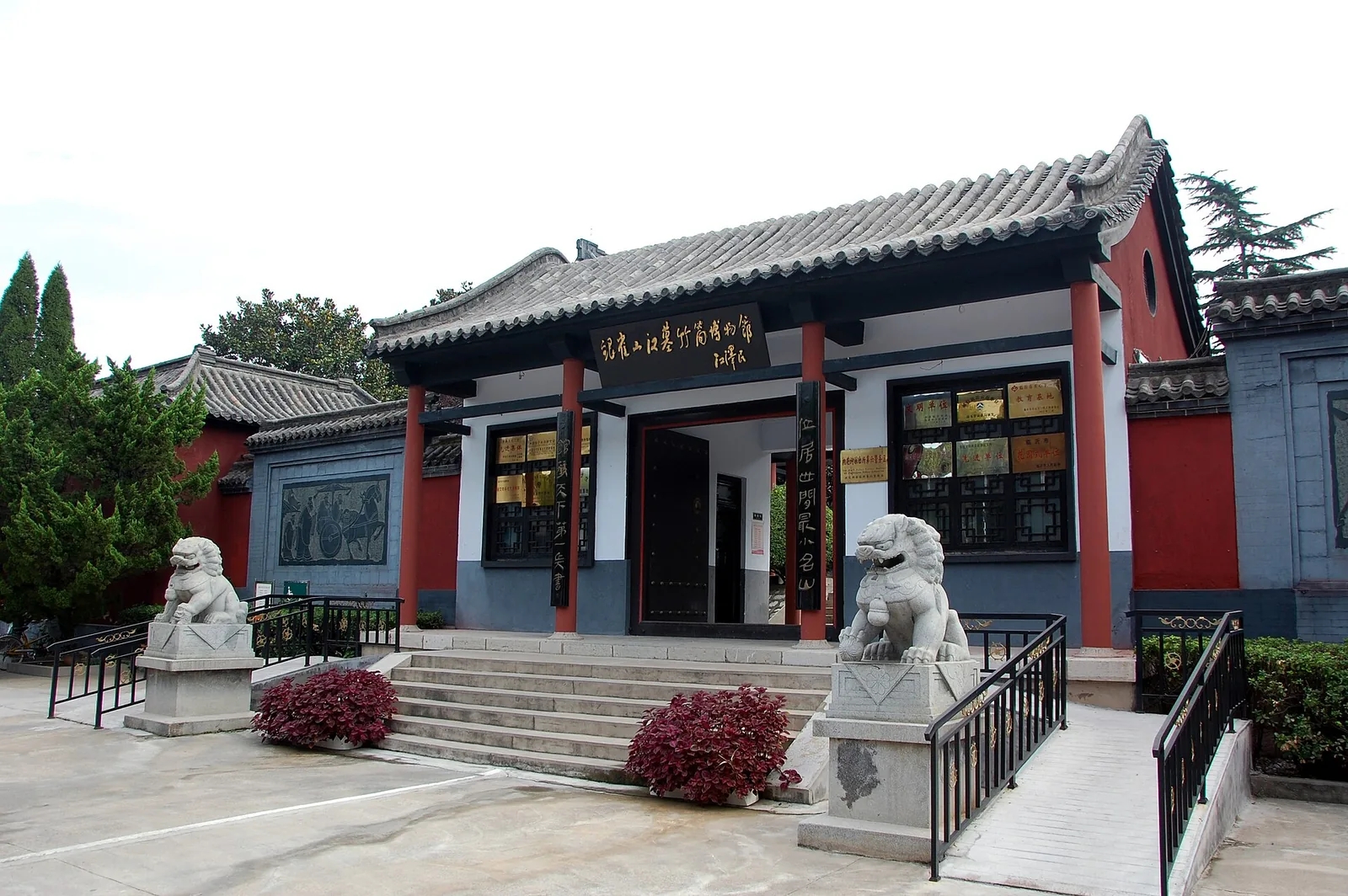
Yinqueshan Han tomb museum, Linyi, Shandong. Photo: kanegen, 2008 · CC BY 2.0 · Source page
In April 1972, construction workers at Yinqueshan, near the town of Linyi in Shandong province, found a tomb of the Han period. Inside were bamboo slips with ink writing. Some carried The Art of War. Others carried a separate text attributed to Sun Bin, whom Sima Qian describes as a descendant of Sun Wu.
The find showed that Sun Bin’s book is a different work. It did not date Sun Tzu’s book, and both sides in the debate cite it.
According to the English Wikipedia article, the tomb is dated to about 134–118 BC, and other sources give slightly different ranges. The slips are a copy, buried about 360 years after the traditional date of Sun Wu’s death in 496 BC.
Source: The slips, as displayed
Photo: AlexHe34, 2011 (CC BY-SA 3.0).
This is a copy from about the 2nd century BC, not the author’s own manuscript. The slips are displayed in glass cases lit from above. The writing is too small to read in the photograph, so what we know of their content comes from comparison with other versions.
- Is this the author’s own handwriting? No. It is a copy buried about 360 years after the author’s traditional death. It is a text from the Han world, not from the world of Wu.
- What does the tomb teach us? There was a second book in the same tomb, by Sun Bin. So at that time people already had at least two military texts under Sun names. The find does not show when Sun Tzu’s text was first written.
- What do you see in the picture? Bamboo strips in lit glass cases. The writing runs in columns, but in the photograph it cannot be read, so the content cannot be made out by eye.
When was the book written, and by whom?
Can the book be dated without deciding who the man was?
- Giles (1910) Giles argued that the thirteen chapters were written specially for King Helu. If so, they must date to 505–496 BC, during a lull in the hostilities, since Wu had presumably exhausted itself against Chu. Wu itself was not extinguished until 473 BC. He wrote before the 1972 slips were found.
- Griffith (1963) Griffith’s translation was published by Oxford in 1963. Catalogue records of the translation attribute to Griffith a date for the text in the fourth century BC. We did not check his introduction ourselves.
- Ye Shi (Song dynasty) Ye Shi doubted the man. According to Giles, who quotes him directly, he placed the style of the chapters towards the end of the Spring and Autumn period or the start of the Warring States, around the 5th century BC. So one can doubt the man and still date the book that way. Some modern accounts credit him with a later dating.
What would count as proof that one person wrote a book: a name on it, a style, or a physical copy? Each answer leads to a different date.
From Amiot to Wall Street
From Wu’s battle to the cinema
- 544–496 BC (traditional) The traditional dates of Sun Wu’s life, following Sima Qian. A traditional date, not checked.
- 514–496 BC Helu rules Wu.
- 512 BC Wu takes Shu, and then, on the advice given, holds off from attacking Ying.
- 506 BC The battle at Boju. Per Sima Qian and Giles, Wu enters Ying. The Zuo zhuan tells it differently.
- About 97 BC Sima Qian writes the Records of the Grand Historian, with the biography of Sun Tzu.
- 122 BC Liu An, prince of Huainan, dies. The book compiled at his court names Sun Tzu: the earliest reference Giles found.
- About 134–118 BC The Yinqueshan tomb is sealed, and a copy of The Art of War is buried in it. According to the English Wikipedia.
- Early 3rd century AD Cao Cao edits the text and writes the earliest surviving commentary.
- 760 AD According to the English Wikipedia, the book reaches Japan.
- 1772 Jean-Joseph-Marie Amiot publishes a French translation in Paris.
- 1910 Lionel Giles publishes the first annotated English translation.
- 1972 The slips are found at Yinqueshan in Shandong.
- 1987 In the film Wall Street, Gordon Gekko quotes the book.
After Wu
A state that vanished, a book that survived
Wu ceased to exist as a state in 473 BC, by Giles’s chronology. It was conquered by Yue. The book survived, and like many ancient texts it reached us through copies, commentaries and printings.
According to the English Wikipedia, the book reached Japan in 760 AD, and was later read by Oda Nobunaga, Toyotomi Hideyoshi and Tokugawa Ieyasu. Those claims appear in the English article only, and we did not check them against a Japanese or other primary source.
Europe
From Beijing to Paris, then London
Jean-Joseph-Marie Amiot, a Jesuit working in Beijing, published a French translation in Paris in 1772, under the title Art militaire des Chinois. It was reissued in 1782. Adam Parr argues (2019, Brill) that Amiot used the translation to push a radical political programme, drawing on the idea of the Mandate of Heaven.
In 1910 Lionel Giles published in London the first annotated English translation. An earlier partial version by Everard Calthrop, The Book of War (1905), was incomplete. Giles’s translation is the one we quote from in this lesson, and we quote only short sentences from it.
Myth
“Keep your friends close and your enemies closer” is Sun Tzu, and so is the advice to build your enemy a golden bridge to retreat over.
The truth
The friends-and-enemies line is not in Giles’s translation. The word “friend” appears only in a note that quotes a British officer on Wellington, which has nothing to do with the saying.
The word “golden” does not appear in the text. The bridge idea is close to the passage about leaving an outlet (ch. VII §36), but that passage says nothing about a golden bridge, and Tu Mu’s note reads it as a matter of the enemy’s psychology.
The evidence
The real lines you can check are “All warfare is based on deception” (ch. I §18), and “When you surround an army, leave an outlet free” (ch. VII §36). Both have a context you can read.
Today
From war to business
In the 1987 film Wall Street, Gordon Gekko quotes the book. That is one example among many, and we did not check how widely the book is used in business.
A claim that Mao Zedong partly credited his 1949 victory to the book appears in an encyclopaedia summary. We found no historian who documents it, so we do not present it as fact.
Check yourself
How many palace women did the king lend for Sun Tzu’s test?
Answer: 180 women. Correct. Giles’s translation gives 180 women for the drill.
Check yourself
In which year BC did Wu take Ying, at the battle of Boju?
Answer: 506 BC. Correct. At Boju in 506 BC, Ying was taken, according to Sima Qian and Giles.
Check yourself
Which early chronicle does not mention Sun Wu?
Answer: The Zuo zhuan. Correct. The Spring and Autumn chronicle never names Sun Wu at all.
Check yourself
Where were the slips found in 1972?
Answer: Yinqueshan, Shandong. Correct. The slips were found at Yinqueshan, near Linyi in Shandong province.
Check yourself
Who made the first European translation, in Paris in 1772?
Answer: Jean-Joseph-Marie Amiot. Correct. Amiot, a Jesuit in Beijing, published the French version in Paris in 1772.
Check yourself
Who published the first annotated English translation, in 1910?
Answer: Lionel Giles. Correct. Giles’s 1910 translation was the first annotated English one.
Terms
- Shiji Records of the Grand Historian, a general history of China written by Sima Qian about 97 BC. It includes the short biography of Sun Tzu.
- Zuo zhuan A chronicle of the Spring and Autumn period, with much detail on the wars and politics of the states. Its authorship and date are disputed.
- Spring and Autumn period The period when China was split among many rival states, roughly from the 8th to the 5th century BC.
- bamboo slips Thin strips of bamboo written on in ink. Strips tied together with cords made up a book.
- commentary Notes written on an earlier text to explain it. The Art of War has many commentaries; the earliest known one is by Cao Cao.
- Yinqueshan A hill near the town of Linyi in Shandong, where Han-period tombs were found. In 1972 slips of The Art of War and a separate text by Sun Bin were found there.
- Boju The place of the battle of 506 BC between Wu and Chu. Modern reconstructions put it near the town of Macheng in Hubei.
- Huainan Tzu A philosophical book compiled at the court of Liu An, prince of Huainan, who died in 122 BC. It names Sun Tzu, and is the earliest reference to the name, according to Giles.
- Sima Qian A Chinese historian. Around 97 BC he wrote the Shiji, which contains the biography of Sun Tzu.
- Helu King of the state of Wu, who reigned from 514 to 496 BC. In his time Wu went to war against Chu.
- Wu Zixu A man from Chu who fled to Wu after the king of Chu killed his father and elder brother. He became Helu’s adviser.
- Fugai The younger brother of Helu. According to the Zuo zhuan, he attacked in battle against the king’s wish, and later declared himself king.
- Nang Wa A general of Chu. According to Helu’s advisers, he was grasping and greedy for gain.
- Sun Bin According to Sima Qian, a descendant of Sun Tzu. The Yinqueshan find showed that his book is a separate work.
- Cao Cao A Chinese military leader and statesman. In the early 3rd century AD he edited the text and wrote the earliest surviving commentary on it.
- Tu Mu A later commentator on the book. In his reading, the passage aims to make the enemy believe there is a road to safety, so that he does not fight in despair.
- Lionel Giles The English translator of the book. His 1910 translation is the one this lesson quotes.
- James Legge A translator into English of the chronicle Zuo zhuan. In his version, the story of the war between Wu and Chu differs from Sima Qian’s.
- Victor Mair A sinologist. In his 2007 translation he called Sima Qian’s biography essentially fictional.
- Ye Shi A Chinese scholar of the Song dynasty, who died in 1223. He argued that Sima Qian said more than his text supports, and that Sun Tzu may never have existed.
- Chu A rival state of Wu in the Spring and Autumn period. Its king, Ping, killed the father and elder brother of Wu Zixu.
- Qin A Chinese state. According to the Zuo zhuan, it sent chariots to help Chu, and later defeated Wu.
- Yue A state that conquered Wu. By Giles’s chronology, Wu ceased to exist as a state in 473 BC.
- Ying The capital of the state of Chu. In 506 BC it fell to Wu after the battle at Boju.
- Shandong A province in eastern China, on the coast. The Yinqueshan hill, with a tomb from the Han period, lies in it.
- Hubei A province in China. Modern scholars place the battle of Boju near the town of Macheng, in Hubei.
- Warring States The period after the Spring and Autumn period, when China’s states fought one another.
- Han dynasty An ancient Chinese dynasty. A tomb from its period, on Yinqueshan, was found in 1972 with bamboo slips, some carrying the book.
- Sinologist A scholar of China, who studies its language, history and culture.
- Mandate of Heaven The Chinese idea that heaven gives a ruler the right to rule the land.
- Chariot A light two-wheeled vehicle pulled by horses. In ancient times it was used in war.
- Jesuit A member of the Society of Jesus, a Catholic religious order. Its members also worked in Beijing, the capital of China.
Sources
- Sima Qian, Shiji (Records of the Grand Historian), ch. 65, c. 97 BC. The biography of Sun Tzu, in Lionel Giles’s English translation (1910)
- Sun Tzu, The Art of War, trans. Lionel Giles (London: Luzac, 1910), with the Introduction; Project Gutenberg eBook 132
- Huainan Tzu (Huainanzi), quoted in Giles’s Introduction to The Art of War (1910)
- Zuo zhuan (Zuo’s Commentary on the Spring and Autumn Annals), Duke Ding, years 4–5, in James Legge’s translation (The Chinese Classics, vol. V, 1872), read in a scanned copy on archive.org
- Samuel B. Griffith, Sun Tzu: The Art of War (Oxford: Clarendon Press, 1963), with a foreword by B. H. Liddell Hart
- Victor H. Mair, The Art of War: Sun Zi’s Military Methods (New York: Columbia University Press, 2007). Read through secondary summaries; the book itself was not checked
- Adam Parr, The Mandate of Heaven: Strategy, Revolution, and the First European Translation of Sunzi’s Art of War (1772) (Leiden: Brill, 2019). Read through its publisher’s description; the book itself was not checked
- English Wikipedia: “Sun Tzu”, “Battle of Boju”, “State of Wu” and “Sun Bin”, used for dates and secondary summaries only
Image credits
- Inscribed bamboo slips, Yinqueshan, Shandong. Photo: AlexHe34, 2011 · CC BY-SA 3.0 · Source page
- Bronze swords, Anhui Provincial Museum, Hefei. Photo: Gary Lee Todd, Ph.D., 2012 · CC0 · Source page
- Illustration from an illustrated Chinese book of generals’ lives, 1643. Artist unknown. Public domain (by age) · Public domain · Source page
- Eleven Commentaries to The Art of War, World Digital Library item 11410. Date as given in the record · Public domain · Source page
- Yinqueshan Han tomb museum, Linyi, Shandong. Photo: kanegen, 2008 · CC BY 2.0 · Source page


