Suleiman the Magnificent: the sultan who built the walls of Jerusalem
He tried to take Vienna and failed, built the walls of Jerusalem that still stand, and made a fateful decision about his eldest son. Who was Suleiman, and why did the West call him "the Magnificent"?
Decisions, questions and your own progress, in the app
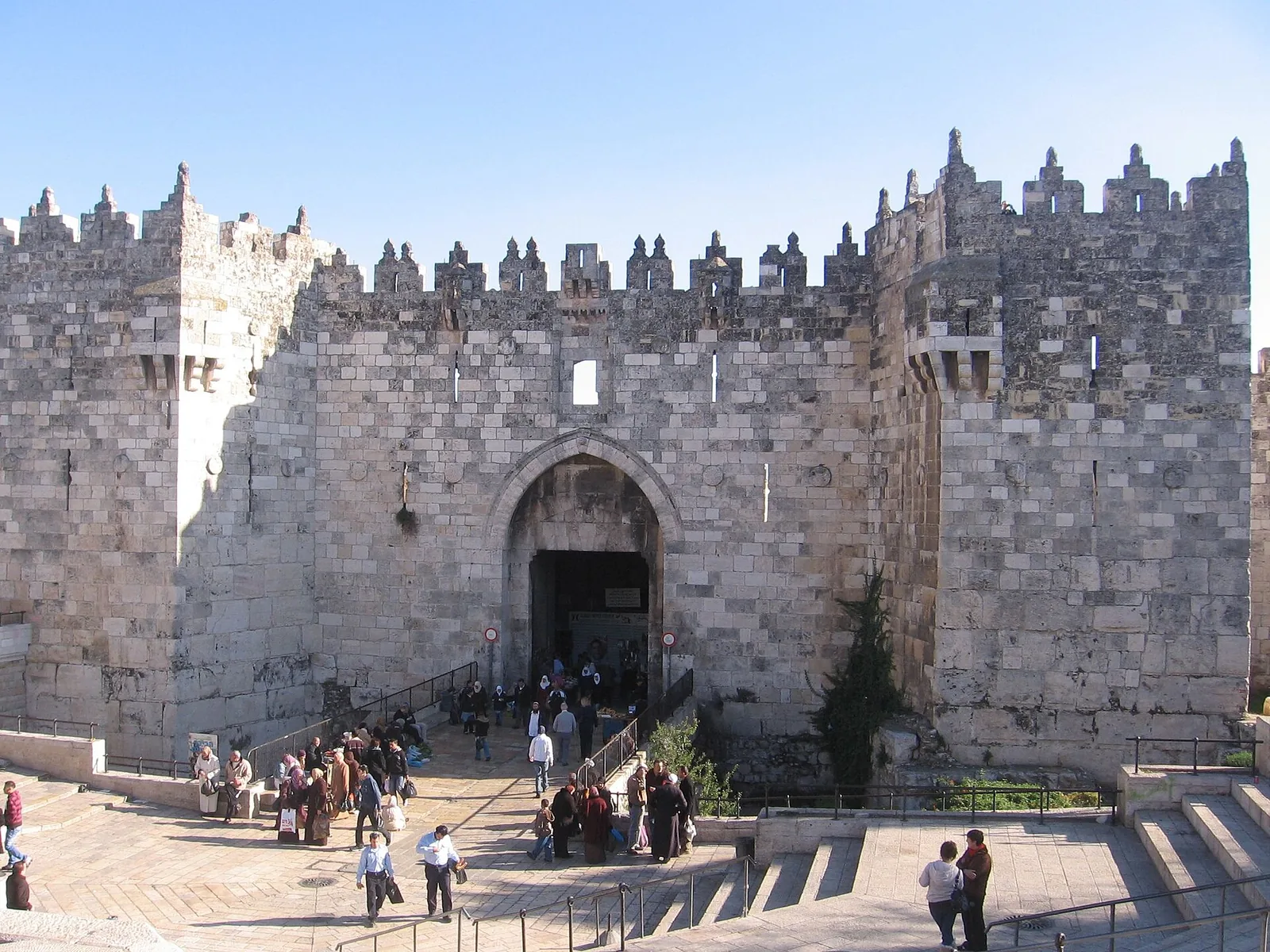
Photo: Gellerj, 2009 (own work). The Damascus Gate in Jerusalem’s walls. Wikimedia Commons · CC BY-SA 3.0 · Source page
A sultan at twenty-five
The walls built by the man Europe called “the Magnificent”
On the night of 5–6 September 1566, Suleiman I died in his tent, on campaign. His army kept the news secret for weeks, and only a small circle knew that the sultan was dead.
He ruled the Ottoman Empire for forty-six years and died in his early seventies. In Europe they called him “the Magnificent”. He led great armies, built the walls of Jerusalem, and made a fateful decision about his eldest son. Who was this man, and why did the West call him “the Magnificent”?
Background
Selim’s son
Suleiman was born in 1494 or 1495. The usual date is 6 November 1494, though some sources give a window that runs into spring 1495. He was the only son of Sultan Selim I.
His father beat the shah Ismail of the Safavid dynasty at Chaldiran in 1514. In 1516 and 1517 Selim defeated the Mamluks and took Syria and Egypt. Jerusalem also came under Ottoman rule in 1517.
The crown
Autumn 1520
Selim died in the autumn of 1520. Suleiman came to the throne on 30 September 1520, aged twenty-five or twenty-six. He had no brother to contest the crown, because he was the only son.
He inherited a large state with two hostile frontiers: the shah in the east, and the king of Hungary and the Habsburgs in the west.
East or west
Background
Two frontiers
At the start of his reign Suleiman had two frontiers to think about. In the east, beyond the mountains, lay the state of Shah Ismail, who had lost at Chaldiran but was not destroyed.
In the west, on the edge of the Balkans, stood Belgrade: a great fortress on the Danube and the gate into Hungary. Hungary was ruled by a young king, Louis II. North and west of it lay the lands of the Habsburgs, who ruled Austria, and whose main city in the east was Vienna.
A decision point
You are Suleiman, a new sultan.
Autumn 1520, Istanbul
A few weeks after your father’s death, your commanders are waiting for a plan. The army he led has no campaign in front of it, and the soldiers expect a war that will justify their pay.
You have two frontiers to choose from. In the east, Shah Ismail has not forgotten Chaldiran. In the west, Belgrade blocks the road into Hungary. Careful advisers suggest a third course: stay in Istanbul for a year, pay the troops and watch the borders.
What do you do?
- March east against the shah, as your father did. Probably a long war in mountains and desert, far from home. You may gain little ground quickly, and the eastern frontier stays tense.
- Turn west and attack Belgrade, the gate into Hungary. Probably a costly siege that opens the road into Hungary. Europe will notice, and the rulers of the west will see the new sultan as a threat.
- Stay in Istanbul: pay the troops, strengthen your hold on power and watch both frontiers. Probably calm and safety, but an army without a war can grow restless, and a sultan who does nothing may look weak.
What really happened
Turn west and attack Belgrade, the gate into Hungary.
He turned west. The siege of Belgrade ended with the fall of the city on 29 August 1521.
The sources do not give his full reasons. Historians suggest several: a young sultan needed a quick victory to prove he could lead; an army waiting for war also waited for its pay; and Belgrade was the key to Hungary, a country the Ottomans had attacked again and again for decades. A campaign in the east meant mountains and long supply lines.
Successes
Belgrade and Rhodes
Belgrade fell on 29 August 1521. About a year later the army reached Rhodes, the island of the Knights of St John (the Hospitallers), a military religious order that had held it for more than two centuries.
The siege began on 26 June 1522, and the sources give a fleet of about 400 ships. Suleiman himself reached the island on 28 July. After a siege of about six months, the Knights agreed to terms on 22 December 1522 and left the island on 1 January 1523. Those who stayed under the new rule were given five years without taxes.
Successes
Mohács, 1526
On 29 August 1526 the Ottoman army met the Hungarian army at Mohács, on the Danube. King Louis II tried to escape. He drowned in the marshy ground near the Csele stream, weighed down by his armour.
Hungary was left without its king, and the Habsburgs and the sultan would fight over the country for generations.
Source: A miniature of Mohács, about 1558
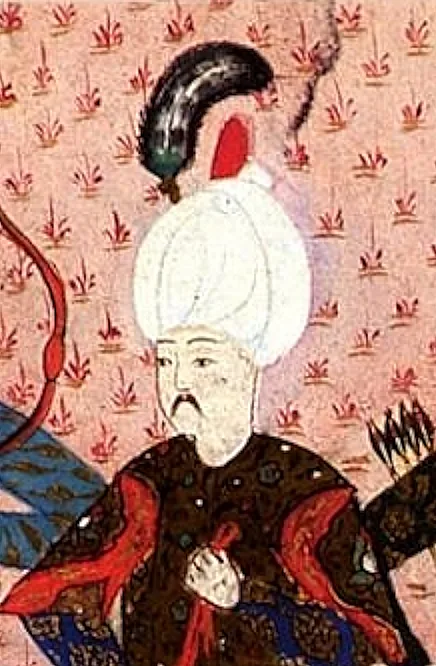
Unknown Ottoman court artist, Süleymanname, about 1558. Detail from a double page of the Battle of Mohács. Wikimedia Commons · Public domain · Source page
Süleymanname (Book of Süleyman), unknown Ottoman court artist, about 1558
This is a detail from a miniature of the battle of Mohács, in an illustrated book made for the Ottoman court around 1558, more than thirty years after the battle. Wikimedia Commons gives the artist as unknown.
- Who is painted here, and what is he doing? A figure in a tall white turban with a feather holds a hand to his chest. A curved bow hangs behind him and a quiver of arrows is at his side. He is calm and in command: the picture shows control, not the mud and confusion of battle.
- Who painted this, and when? A painter working for the court, more than thirty years after the battle. It was made not to record the moment, but to remember the dynasty as the court wanted it seen.
- What is missing from this picture? The mud, the dead and the king’s flight. A detail like this shows only one figure, and nothing here tells us what happened at the decisive moment.
Vienna, 1529
Background
The road to Vienna
In 1529 the sultan himself led an army to Vienna, the main city of the Habsburg lands in the east.
At the core of the army stood the janissaries, the sultan’s standing infantry.
Source: Busbecq on the janissaries
“Yet these are the famous Janissaries, whose approach inspires terror everywhere.”
Busbecq was an envoy of the Habsburgs at the sultan’s court, and he wrote letters to Europe about what he saw. When he first met janissaries at Buda, he says, he would have taken them for Turkish monks, or for members of a Muslim college, had he not been told who they were. On an earlier page he gives the full strength of the corps as 12,000 men.
- Who wrote this, and for whom? A foreign envoy, writing for readers at home. He is close to the court but watching from outside, so ask what he sees and what he chooses to stress.
- What is surprising in the description? He describes men who look like monks, and yet he speaks of terror. The fear does not come from their appearance, but from what they do and what they stand for in the army.
- What is missing here? It describes the janissaries of the 1550s, not the siege of 1529. A source about one army can tell us about a different period, and the reader must notice the gap.
A decision point
You are Suleiman, outside Vienna.
Mid-October 1529, the camp before Vienna
You have been outside Vienna for more than two weeks. The rain has begun, the camp has turned to mud, and supplies are running low.
Winter is coming. Your commanders offer three paths, and none of them is clean: attack now with everything you have, keep the siege going through the winter, or withdraw while the army is still whole and come back another year.
What do you decide?
- Order one last all-out assault on the walls, now. Probably a bloody assault with heavy losses. If it breaks through, the city may fall. If it fails, the army goes home weaker.
- Keep the siege going through the winter and hope the supplies arrive. Probably hunger, sickness and desertion. A winter camp far from its bases is hard to supply.
- Withdraw now, while the army is still whole, and come back another year. Probably a withdrawal without huge losses. Vienna stands, and the sultan can come back. But the retreat will look like a failure.
What really happened
Order one last all-out assault on the walls, now.
He chose one final assault. On 14 October it was beaten back. The next day, with supplies running low and winter coming, the sultan called off the siege. The siege had run from 27 September to 15 October 1529.
His advisers debated one last assault, which historians describe as an all-or-nothing gamble. The reasons against waiting were the rain, the emptying stores and the approaching winter. The sources do not say how far the decision came from the army’s mood, and how far from the sultan’s own plan.
The defence
The city that held
The city did not fall. Its defence was led by Count Niklas Salm and his men. Estimates put the defenders at between about 16,000 and 21,000, including local militia.
After nearly three weeks of siege the city still stood. The last assault was driven back, and the siege was lifted.
Myth
Suleiman nearly conquered Europe. In 1529 he stood at the gates of Vienna, and only the weather stopped him.
The truth
Vienna did not fall. The last assault was beaten back, and the city stayed in its defenders’ hands. Rain and supplies were important, but they were not the only reasons. Historians disagree about how close the sultan came to winning, and the sources disagree about the numbers.
The evidence
The assault was driven back on 14 October, and the siege was lifted the next day. In 1532 the army never reached Vienna at all, because a siege at Güns (Kőszeg) held it up.
The palace
Background
The grand vizier
The sultan did not rule alone. At his side stood the grand vizier, Pargali Ibrahim Pasha, who took office on 27 June 1523.
In November 1534 his army took Baghdad from the Safavids, and in 1535 the sultan himself made a grand entry into the city. For years Ibrahim was the second man in the empire.
The palace
Hurrem Sultan
In the harem of the palace grew up a woman whom Europe called Roxolana and the Ottoman sources called Hurrem. She was probably born in Ruthenia, in eastern Europe, into an Orthodox Christian family. She came to the palace as a slave.
Breaking custom, Suleiman freed her and married her, making her his legal wife. The sources describe this as unprecedented. The wedding probably took place around 1533 or 1534; the exact date is not known. Hurrem died on 18 April 1558.
Source: Venetian envoys on Hurrem
“donna di nazione russa” (“a woman of Russian nation”)
Venetian envoys sent reports on the sultan’s court back to the city’s rulers. As quoted, they describe Hurrem as a woman of Russian nation. The word “Russian” was vague at the time, and the report does not say which lands it meant.
- Who wrote the report, and for whom? Envoys writing to the rulers who make policy. Someone writing to government wants to know who influences the sultan, and a woman’s origin at court is not always checked carefully.
- What might the word “Russian” have meant? Check a dictionary and a study before relying on it. It may have meant the Rus’ lands of eastern Europe, not necessarily Moscow. The report does not explain it.
- What is not written here? How she came to the palace, what her life had been before, and what she herself said. The report gives an origin, not a life story.
Myth
Hurrem Sultan was a witch who ruled the sultan and destroyed her rivals.
The truth
The picture of Hurrem as a witch grew from stories and rumours, mostly from people who were not in the room. Historians are very cautious about tales of palace plots. Hurrem did hold real influence. Leslie Peirce argues that women of the Ottoman royal household shaped politics through their place in the family and the harem. That is a different thing from a witch who plots murders.
The evidence
The Venetian envoys who describe her call her a woman of “Russian nation”, not a witch. The tales of her plots were told by outsiders, and historians do not treat them as first-hand evidence.
A decision point
You are Ibrahim Pasha, the grand vizier.
March 1536, Istanbul, an evening in Ramadan
For almost thirteen years you have been grand vizier. You run the state in the sultan’s name and have led armies. At court you have rivals, and they say that you have taken titles above your rank, and that Hurrem does not like you. These are rumours, and it is not clear which of them is true.
Today a message arrives from the palace. The sultan invites you to iftar this evening, the meal that breaks the day’s fast during Ramadan.
What do you do?
- Go to the palace as you always have, trusting your years of service. Probably an ordinary dinner, and the sultan’s favour may hold. But if he has already decided against you, you walk into the palace with no one to protect you.
- Go, but first ask the sultan for a written guarantee of your safety. Probably the request is read as fear or as plotting. If a guarantee comes, it buys days, not years.
- Send word that you are ill, and stay at home with your guards. Probably taken as an insult or a sign of guilt. The sultan may send for you again, this time more firmly.
- Leave Istanbul at once for a distant province. Probably seen as flight, which confirms the rumours. The sultan’s messengers can follow you, and your power in a province would be far smaller than in the capital.
What really happened
Go to the palace as you always have, trusting your years of service.
He went. That night, in his room in the palace, four deaf-mute executioners strangled him on the sultan’s orders. He had been grand vizier for almost thirteen years.
He went, because refusing would look like guilt. Why he fell is disputed. One modern source says that he overstepped his rank and took titles beyond it. Hurrem is believed to have influenced the decision, but historians note that the stories of court plots are not based on first-hand evidence. There is no single answer, and we do not know what the sultan planned when he sent the invitation.
The prince
Background
The eldest son
Mustafa was Suleiman’s eldest son. He was born to another woman of the harem, not to Hurrem. For years he was the obvious heir, and many at court and in the army saw him as the one who would follow his father.
Hurrem’s sons were younger, and they grew up in the same palace.
A camp, 1553
Rumours in the tents
In 1553 the sultan was in Anatolia, the Asian heartland of his empire, while the long war with Persia (1532–1555) still ran on. Rumours spread through the camp.
Officials and soldiers said that the prince was plotting against his father and meant to take the throne while his father still lived. Who started the rumours is not known. The charge is on record, but it was never proven.
A decision point
You are Suleiman, the sultan, in the camp.
Autumn 1553, a camp in Anatolia
Your son, Prince Mustafa, is on the road to your camp. The rumours run through the tents: that he plans to depose you, and that he has supporters in the army.
You do not know who stands behind the rumours. Some suspect rivals at court. Others name Rustem Pasha, your son-in-law, or Hurrem. You can let him come and hear him face to face, send a trusted officer to find out what is true before he arrives, write to him and demand a written answer, or order him to stay in his province.
What do you decide?
- Let him come to the camp and hear him face to face. Probably a hard hearing before your officers. If he can answer the charges, the rumours may fade. If not, you must decide in front of the whole army.
- Hold him at a distance and send a trusted officer to find out what is true. Probably slower and safer. But the officer’s report will be only as good as the people he trusts, and the army will talk while you wait.
- Write to him, demand a written answer to every charge, and wait. Probably an answer that settles nothing. The rumours stay, and the soldiers take sides while they wait.
- Order him to stay in his province, far from the army. Probably a cold standoff. The rumours do not vanish, and a prince far away with supporters of his own is a risk of a different kind.
What really happened
Let him come to the camp and hear him face to face.
He came to his father’s camp, and in October 1553 he was executed at Ereğli, in Anatolia. The sources give 6 or 16 October for the day, and they do not agree. They do not describe in detail how he died. The charge was a plot to depose his father. Who started the rumours is not known. According to one modern study, poets of the time blamed Rustem Pasha. Many later accounts name Hurrem as well, but that rests on rumour.
Why the sultan chose to see his son is not fully recorded. Historians ask whether he wanted a fair hearing, or had already decided and wanted to see his son once more before the end. The evidence does not settle the question. What is clear is that letting the prince come to the camp was the most loaded of the four options: it promised a hearing, and it put the prince in front of everyone in the camp.
What was heard
What a foreign envoy heard
Ogier Busbecq, the Habsburg envoy at the sultan’s court, wrote letters to Europe from Istanbul. He was not an eyewitness to the affair. He reports what soldiers and people at court said.
According to him, the soldiers believed that the sultan had discovered the schemes of Rustem Pasha and the sorceries of the sultan’s wife, but had seen through them too late, and that this brought about Rustem’s fall. It is a rumour, not a report from the room. It still shows how people at the time explained what had happened.
Jerusalem
The city
The walls, 1537–1541
Jerusalem had been under Ottoman rule since 1517. Work on the city walls began in 1537 and went on until 1541, largely along the line of older walls. The walls are about four kilometres long and some twelve metres high, with towers and gates.
Part of Mount Zion was left outside them, and the Zion Gate leads to the Jewish Quarter. Some accounts date the completion to 1538.
Jewish life
The doctor and the decree
Moses Hamon, a Jew of Spanish origin, was the sultan’s favourite physician and dentist. In late 1553 or in 1554, according to the sources, Suleiman issued a firman, an official decree in his name, formally denouncing the blood libel against the Jews. The proposal came from Hamon.
A blood libel is the lie that Jews murder Christian children to use their blood. For centuries that lie led to violence and expulsions in Europe.
Jewish life
Tiberias
Dona Gracia Nasi, a wealthy Jewish businesswoman living in Istanbul, received from Suleiman in 1558 a long-term lease of Tiberias and several towns around it in the Galilee. She meant the place to be a safe haven for Jews fleeing persecution.
Her nephew Joseph Nasi helped with the rebuilding. In Cori, near Naples, a Jewish community raised money so that its members could go there.
Source: The inscription over the Jaffa Gate
“In the name of Allah, the Merciful, the Compassionate, our lord the sultan, king of the Turks, Arabs and Persians, Suleiman son of Selim Khan, ordered the construction of this wall. May Allah make his work eternal.”
The inscription names the sultan and his father, and it names no builders or workers. The text we have gives no date, and this English rendering has not been checked against the original.
- Who appears in the inscription, and who does not? The sultan and his father. No builders, engineers or workers are named. The inscription presents the rule, not the people who built it.
- Why would a ruler want his name on a wall? It is a statement of power and of religious responsibility. Whoever defends the holy city wants everyone who enters to know who is responsible. The name over the gate is a political message.
- What is missing before we can trust the translation? A reading of the Arabic text itself, and an exact date. Without them, this is a second-hand witness, not a direct source.
Myth
The sultan built the walls after a dream in which lions chased him.
The truth
The dream story is a legend. It appears in later books about Jerusalem, and we found no record of it from the time the walls were built. Historians offer other explanations: rumours of a new crusade, and raids by Bedouin. The exact reason is not known.
The evidence
One news article traces the tale to Zev Vilnay’s books of Jerusalem legends, and notes that the story never names the sultan.
Legacy and the final quiz
Suleiman I, “the Magnificent”
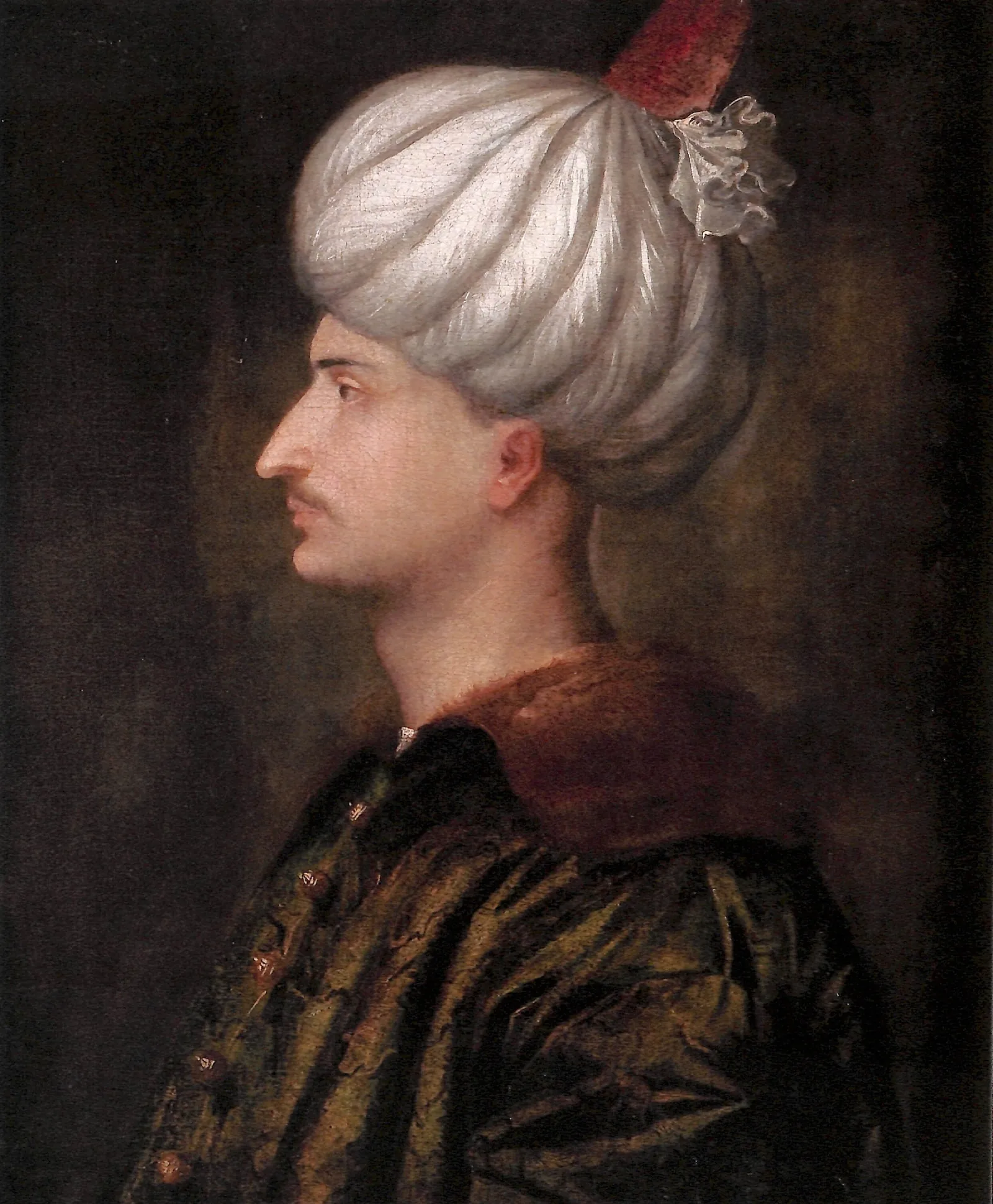
Workshop of Titian, Suleiman the Magnificent, about 1538–1540. Wikimedia Commons · Public domain · Source page
The Ottoman sultan from 1520 to 1566: a poet with a pen name, whose reign is seen as the peak of the empire’s power, and who failed at Vienna.
- Born: 6 November 1494 (the usual date)
- Died: The night of 5–6 September 1566, Szigetvár, Hungary
- Won: Belgrade, 1521; Rhodes, 1522; Mohács, 1526
- Lost: Vienna, 1529
“tall and slender but tough, with a thin and bony face.”
The last campaign
Szigetvár, 1566
In August 1566 the Ottoman army besieged Szigetvár, a fortress in Hungary defended by Nikola Zrinski. The sultan was with the army.
On the night of 5–6 September he died in his tent. The grand vizier Sokollu Mehmed Pasha ran the army in practice, and only a small circle knew of the death. One source says the secret held for 48 days; another says more than three weeks. On 7 September the final attack on the fortress began. Zrinski died in the last fighting, and the fortress was taken. Selim, the sultan’s son, came to take his father’s body back to Istanbul.
Legacy
A mosque by one architect
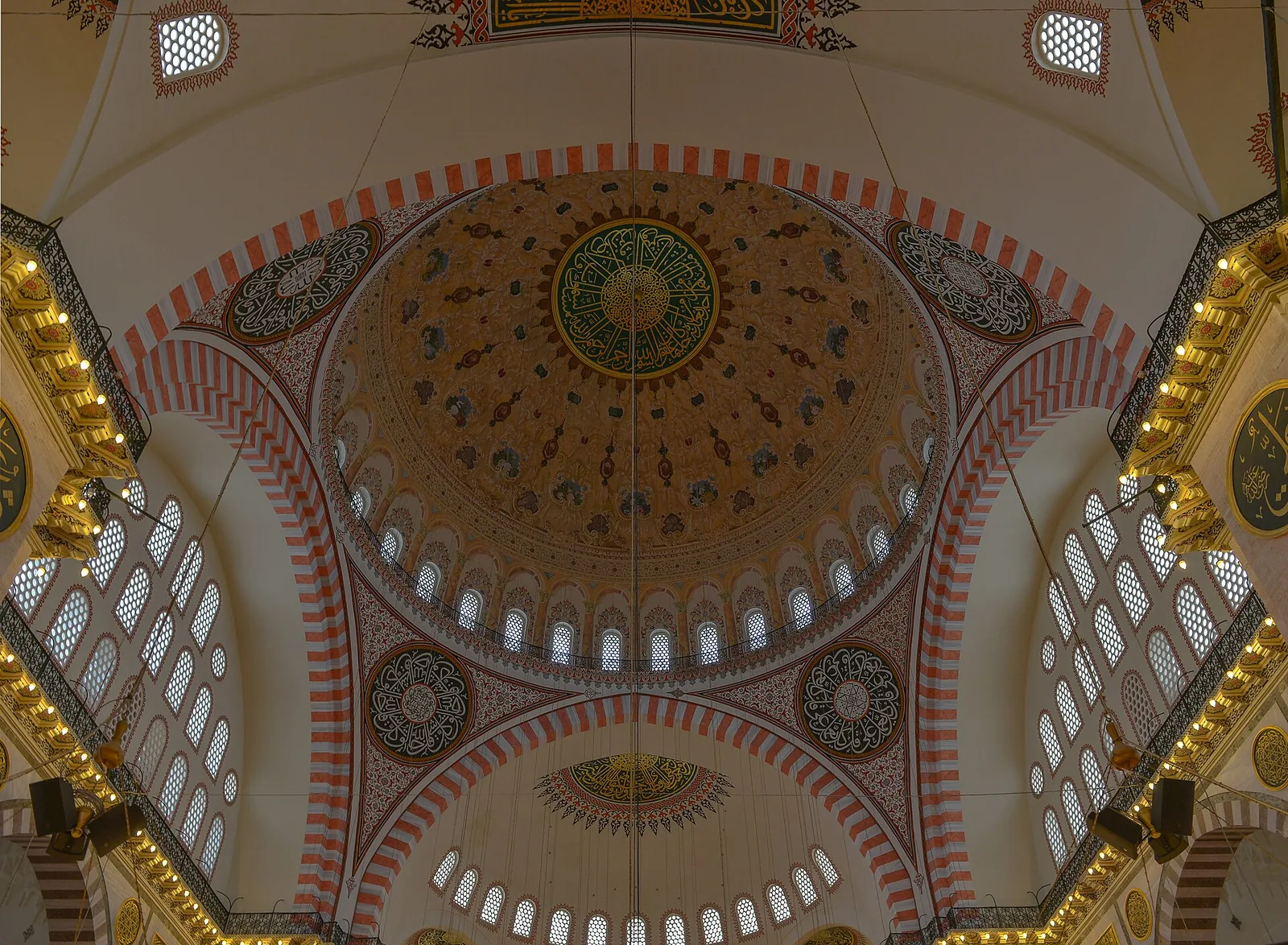
Photo: Arild Vågen, 2013 (own work). Dome of the Süleymaniye Mosque, Istanbul. Wikimedia Commons · CC BY-SA 3.0 · Source page
The architect Mimar Sinan served as chief architect at the court from 1538 until his death in 1588. In 1550 he began the Süleymaniye complex in Istanbul, which was finished in 1557.
The complex still dominates the skyline of the city. In the picture you can see the dome from below: striped arches, many windows and panels of Arabic calligraphy.
Myth
Suleiman was called “the Lawgiver” during his lifetime, by his subjects, because he gave them laws.
The truth
The nickname Kanuni, “the Lawgiver”, does not appear in sixteenth- or seventeenth-century Ottoman sources. When it first came into use is unclear, and it may date from the early eighteenth century. The sultan did issue law codes, so the name fits his reputation, but it was attached to him later. “The Magnificent” is also a European name. Ottoman writers used his name and his titles, as the Jaffa Gate inscription does.
The evidence
Historians disagree on when the name began, but the sources in which it appears are all later than his reign.
What followed him
- 1534–1535 Baghdad is taken from the shah, and the sultan makes his entry in 1535.
- March 1536 Pargali Ibrahim Pasha is strangled in the palace, on the night of 14–15 March.
- 1537–1541 The walls of Jerusalem are built, largely along the line of older walls.
- October 1553 Prince Mustafa is executed at Ereğli, in Anatolia.
- 1555 The Peace of Amasya with Persia settles the frontier.
- 1558 Hurrem dies on 18 April. Dona Gracia Nasi receives the lease of Tiberias.
- 1561 Bayezid, who had fled to the Safavid shah, is executed in Qazvin by agents sent by his father.
- September 1566 Suleiman dies at Szigetvár, and Selim II succeeds him.
A golden age, or the start of decline?
Was Suleiman’s reign a golden age, and did the empire decline after him?
- Halil İnalcık In his book on the “classical age” of the empire, 1300–1600, he presents the sixteenth century as a peak of an orderly system of government, army and law. On this view the period is a golden age, because the machinery worked.
- Many historians of the later empire Many historians describe the decades after his death as a time of crisis and adaptation, rather than of sudden simple decline.
Was his reign the peak of the empire’s power, or the first sign of its problems? What evidence would settle the question?
Check yourself
Which of these cities did the sultan’s army fail to take?
Answer: Vienna. Right. The siege of 1529 ran from 27 September to 15 October, and the sultan lifted it without taking the city.
Check yourself
Which statement about Prince Mustafa in 1553 is best supported by the evidence?
Answer: He was executed in Anatolia, in October 1553. Right. The execution was at Ereğli, in Anatolia. The exact day is disputed: the sources give 6 or 16 October, and they do not describe the execution in detail.
Check yourself
What is best supported about the death of Pargali Ibrahim Pasha?
Answer: He was strangled in the palace in March 1536, on the sultan’s orders. Right. The sources describe his death that night, in his room. The reason for his fall is itself disputed.
Check yourself
Which description best fits Busbecq’s passage on the janissaries?
Answer: A Habsburg envoy’s letter from the 1550s, describing janissaries who look like monks yet inspire terror. Right. The writer is a foreign envoy, and he speaks of an appearance that does not match the fear the men inspire.
Check yourself
What is true about the nickname Kanuni, the Lawgiver?
Answer: Its first use is unclear, and it may date from the early 18th century, after his death.. Right. The sources do not agree on when it appeared, but it is not found in writings from his own time.
Check yourself
Which claim about the walls of Jerusalem is best supported by the evidence?
Answer: Built in 1537–41, largely on older lines, with part of Mount Zion left outside. Right. This is what the sources in the chapter support, including what is said about Mount Zion and the Zion Gate.
Terms
- sultan The title of the ruler of the Ottoman Empire. The sultan led the state, the army and the law.
- janissary A soldier of the sultan’s standing infantry, the core of the Ottoman army. Busbecq calls them the infantry of the royal guard.
- grand vizier The sultan’s chief minister. He ran the government in the sultan’s name and often commanded the army.
- pasha A high title for governors and commanders in Ottoman service. It comes after the name, as in Ibrahim Pasha.
- harem The private quarters of the palace, where the sultan’s women, children and servants lived. Women there could hold real influence.
- Safavid The dynasty of shahs that ruled Iran from 1501, founded by Ismail. They were the Ottomans’ great rivals in the east.
- Mamluk A member of the military ruling class of Egypt and Syria. Mamluk rule fell to the Ottomans in 1516–17.
- firman An official decree issued in the sultan’s name, with the force of law.
- blood libel The false accusation that Jews murder Christians to use their blood. For centuries this lie led to violence and expulsions.
- iftar The evening meal that breaks the day’s fast during Ramadan.
- Kanuni The nickname “the Lawgiver” attached to Suleiman. When it began is unclear, and it may date from the 18th century.
- Habsburg The dynasty that ruled Austria and large parts of central Europe, with Vienna among its cities. It was the Ottomans’ great rival in Hungary.
- Belgrade A great fortress on the Danube, on the edge of the Balkans, and the gate into Hungary. The sultan took it in 1521.
- Shah Ismail Shah (king) of the Safavid dynasty in Persia, today's Iran. He was beaten at Chaldiran in 1514 but was not destroyed.
- Chaldiran A battle in 1514 in which Sultan Selim I beat Shah Ismail.
- Selim I Ottoman sultan and father of Suleiman. In 1516 and 1517 he defeated the Mamluks and took Syria and Egypt.
- Mustafa Suleiman's eldest son, long seen as the natural heir. In 1553 he was executed in Anatolia, charged with plotting against his father.
- Ereğli A town in Anatolia, in today's Turkey. In 1553 Prince Mustafa was executed there.
- Anatolia The Asian part of today's Turkey, the heartland of the Ottoman state.
- Ogier Busbecq The Habsburg envoy at the sultan's court in Istanbul. He wrote letters to Europe about what he saw and heard.
- Danube A great river in central Europe. It flows through Hungary to the Black Sea.
- Louis II King of Hungary at the time of the battle of Mohács. He tried to escape and drowned in a marsh, weighed down by his armour.
- Mohács A town in Hungary on the Danube. In 1526 the Hungarian army was defeated there by the Ottoman army.
- Rhodes A Greek island in the Mediterranean. In 1522 its knights agreed to terms, and in early 1523 they left the island.
- Knights of St John A military religious order, also called the Hospitallers. It held the island of Rhodes for more than two centuries.
- Mimar Sinan The chief architect of the Ottoman court from 1538 until his death. He built many mosques in Istanbul, including the Süleymaniye complex.
- Süleymaniye A large mosque complex in Istanbul. Sinan began it in 1550 and it was finished in 1557. It still dominates the city's skyline.
- Sokollu Mehmed Pasha The grand vizier who ran the army in practice in 1566, when the sultan died in camp and his death was kept secret.
- Pargali Ibrahim Suleiman's grand vizier. He took office in 1523 and for years was the second most powerful man in the empire.
- Rustem Pasha Suleiman's son-in-law and a grand vizier. According to one modern study, poets of the time blamed him for the affair of Prince Mustafa.
- Hijri year A year in the Islamic calendar, counted from Muhammad's migration from Mecca. AH stands for 'after the Hijra'.
- Moses Hamon The sultan's favourite physician and dentist, a Jew of Spanish origin. He proposed the decree against the blood libel.
- Dona Gracia Nasi A wealthy Jewish businesswoman living in Istanbul. In 1558 she received a long-term lease of Tiberias and several towns in Galilee from the sultan.
- Leslie Peirce A historian who argues that women of the Ottoman royal household shaped politics. Her hypothesis places Hurrem's wedding in early May 1534.
- Niklas Salm A count who led the defence of Vienna in 1529, when the Ottoman army besieged the city.
- Nikola Zrinski The commander of the fortress of Szigetvár in Hungary. He died in the last fighting in 1566, when the fortress was taken.
- Szigetvár A fortress in Hungary. The Ottoman army besieged it in 1566, and Suleiman died in camp during the siege.
Sources
- Ogier Ghiselin de Busbecq, Turkish Letters, in The Life and Letters of Ogier Ghiselin de Busbecq, eds C. T. Forster and F. H. B. Daniell (1881), vol. 1, pp. 86–88 (Project Gutenberg eBook 53629)
- Süleymanname (Book of Süleyman), miniature of the Battle of Mohács, about 1558; reproduced in Süleymanname: The Illustrated History of Süleyman the Magnificent (National Gallery of Art, 1986)
- Inscription over the Jaffa Gate, Jerusalem, from the building of the walls (1537–41); English rendering printed by Ynet in “Lions’ Gate legends”; the Arabic was not checked
- Reports of Venetian envoys, 16th century, as quoted in Wikipedia, “Hurrem Sultan” (the Italian originals were not checked)
- Bartolomeo Contarini, Venetian envoy, as quoted in Wikipedia, “Suleiman the Magnificent” (the original report was not checked)
- The Times of Israel, “Gates to the city” (on the walls of Jerusalem and the Zion and Damascus gates)
- Halil İnalcık, The Ottoman Empire: The Classical Age 1300–1600 (London: Weidenfeld & Nicolson, 1973)
- Leslie P. Peirce, The Imperial Harem: Women and Sovereignty in the Ottoman Empire (New York: Oxford University Press, 1993)
Image credits
- Photo: Gellerj, 2009 (own work). The Damascus Gate in Jerusalem’s walls. Wikimedia Commons · CC BY-SA 3.0 · Source page
- Unknown Ottoman court artist, Süleymanname, about 1558. Detail from a double page of the Battle of Mohács. Wikimedia Commons · Public domain · Source page
- Workshop of Titian, Suleiman the Magnificent, about 1538–1540. Wikimedia Commons · Public domain · Source page
- Photo: Arild Vågen, 2013 (own work). Dome of the Süleymaniye Mosque, Istanbul. Wikimedia Commons · CC BY-SA 3.0 · Source page


