Suez, 1956: a secret pact near Paris
In late October 1956, in a villa at Sèvres near Paris, senior ministers from Britain, France and Israel hold secret talks about Egypt. Within a week, Israeli soldiers are inside Sinai. What was agreed in that closed room? And what did the British prime minister tell Parliament afterwards?
Decisions, questions and your own progress, in the app
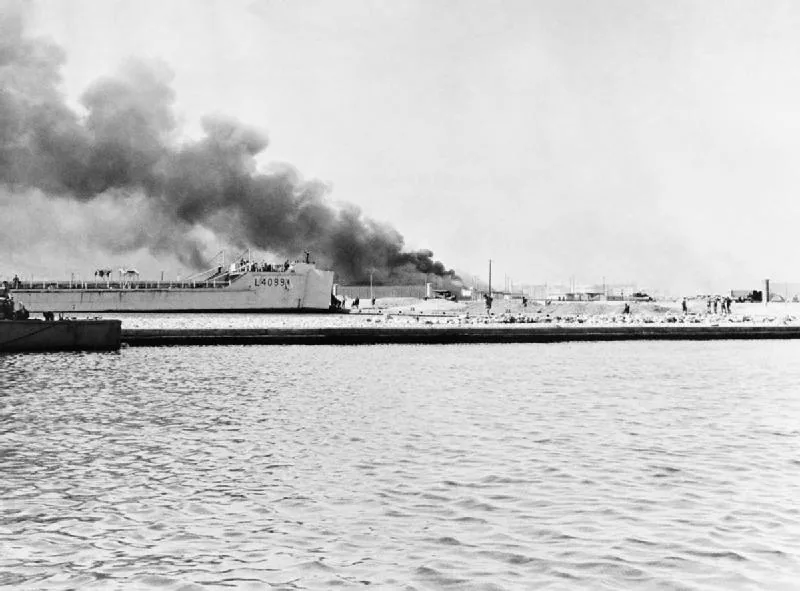
Royal Navy official photographer. The Suez Crisis (operation Musketeer), 1956. Imperial War Museums, MH 23500. · Public domain · Source page
A villa near Paris
Paris, October 1956
Late October 1956. In a villa at Sèvres, on the edge of Paris, ministers and senior officials from Britain, France and Israel hold secret talks about Egypt.
Within a week, Israeli soldiers are inside Sinai. Two days later, British and French bombers are over Egyptian airfields. What did the men in that room agree? And what did the British prime minister tell Parliament afterwards?
The canal
A canal with a French owner
44%
The Suez Canal runs through Egypt. It opened on 17 November 1869. It was run by the Suez Canal Company, a French company with its head office in Paris.
In 1875 Britain bought 44 per cent of the company’s shares. That did not make Britain the owner, but it gave London a large stake in the canal.
So when the company came under dispute in 1956, London and Paris had a direct interest. They were not bystanders.
Gamal Abdel Nasser
An Egyptian army officer, one of the leaders of the officers who took power in 1952, and the man who nationalised the Suez Canal Company in 1956.
- Born: 1918
- Died: 1970
- Won: Nationalisation of the company, 26 July 1956; The canal stayed under Egyptian control after the war
- Lost: The American and British offers to pay for the Aswan High Dam were withdrawn in July 1956
The road to it
Background
Officers take power in Egypt
In July 1952 a group of army officers, the Free Officers, seized power in Egypt. Two of their leaders were Naguib and Nasser.
By 1956 Nasser was the leader of Egypt.
Background
A dam, and a withdrawn offer
Egypt wanted the Aswan High Dam, and Western governments had offered to pay for it. On 19 July 1956 the United States withdrew its offer. Britain followed.
A week later, Nasser had to decide what to do next.
A decision point
You are Gamal Abdel Nasser.
26 July 1956, Alexandria
The American offer to pay for the Aswan dam has been withdrawn, and Britain has followed. The dam still has to be paid for.
The canal is run by a French company, and Britain bought a large share of it in 1875. Your advisers warn that London and Paris will be angry if you take it over.
You have two real options. You can take the company into Egyptian hands now, with full compensation. Or you can keep the company as it is and negotiate with London and Paris.
What do you do?
- Nationalise the Suez Canal Company now, and offer full economic compensation. Probably Britain and France call it unacceptable, and the dispute turns to who will control the canal and how it was taken.
- Keep the company as it is, and negotiate with London and Paris about the canal’s future. Probably long talks with no quick result, with London and Paris pressing to keep control of the canal.
What really happened
Nationalise the Suez Canal Company now, and offer full economic compensation.
Nasser nationalised the company on 26 July and offered full economic compensation. Britain and France called the move unacceptable, and the dispute turned to method and control.
This lesson does not quote his own reasons, because the text of his speech was not checked. What is known: the dam offer had been withdrawn a week earlier, and the compensation was part of the offer from the start.
The event
Israel
Raids from Sinai
For Israel, the danger came from Sinai. According to Israel, armed raiders called fedayeen crossed the border from bases in the peninsula, and, Israel said, mines had been laid.
Israel also said that Egypt was blocking the canal to its ships. That was Israel’s account of the problem, not an agreed fact.
A decision point
You are David Ben-Gurion, Israel’s prime minister.
22–24 October 1956, at a villa near Paris
Raids and mines from Sinai trouble Israel, and Egypt still blocks its ships from the canal, as you see it.
British and French officials have come to a villa at Sèvres with a joint plan written as a protocol. Israel attacks into Sinai first. Britain and France then issue an ultimatum to both sides.
You can sign and join the plan, or stay out and take your case against Egypt to the United Nations.
Do you sign?
- Sign the protocol, and prepare to attack Sinai on 29 October, with the ultimatum to follow. Probably the Sinai campaign goes ahead, and British and French forces join within days. The weak point: if the secret comes out, all three partners are exposed together.
- Stay out of the plan, and take your case against Egypt to the United Nations. Probably the raids and mines continue, and Israel has to argue its case at the United Nations rather than act on the ground. No Anglo-French force comes in.
What really happened
Sign the protocol, and prepare to attack Sinai on 29 October, with the ultimatum to follow.
Ben-Gurion signed the protocol. On 29 October Israeli forces moved into Sinai.
Ben-Gurion’s own words on the decision are not quoted here, because we did not check them. In public, Israel gave the raids as its reason. Historians differ on his full motives: Avi Shlaim reads the protocol as a war planned in advance.
The campaign
Israel moves into Sinai
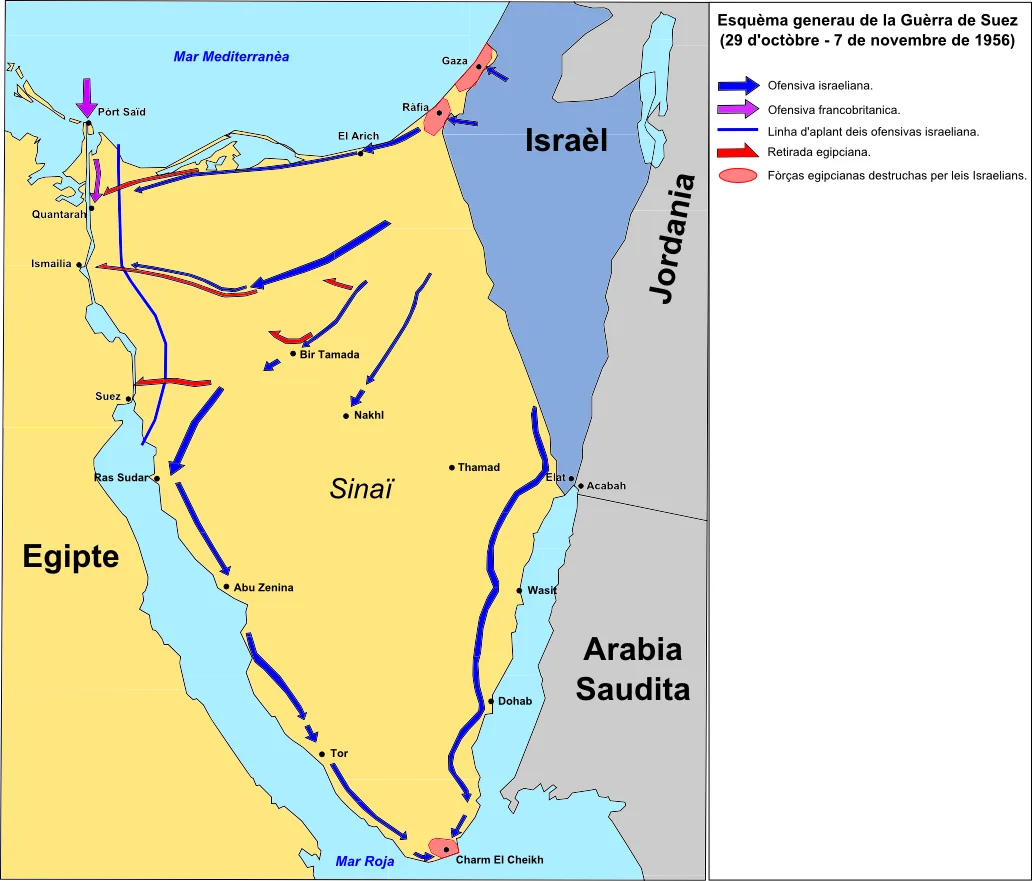
Nicolas Eynaud, Crisi de Suez (1956), 2013. Own work. · CC BY-SA 3.0 · Source page
On 29 October Israeli forces moved into Sinai, the Egyptian desert peninsula east of the canal. The attack came first, as the Sèvres plan had set it out.
The next day, 30 October, Britain and France issued an ultimatum to both Israel and Egypt.
The war widens
Bombers, then the United Nations
On 31 October British and French aircraft bombed twelve Egyptian airfields. The war was no longer only in Sinai.
On 1 November the UN General Assembly met in emergency session. On 2 November it called for a ceasefire in Resolution 997. On 5 November the UN Emergency Force began its mission.
What we really know
Source: The Israeli Foreign Ministry statement, 29 October 1956
Israel has taken the necessary measures to destroy Egyptian fidayun [commando] bases in the Sinai Peninsula.
A statement by a government that was itself a party to the war, issued on the day the operation began, to explain its own action.
- Who wrote this, and why? The Israeli government, a party to the war. It wrote to explain and justify its own operation.
- What is missing? The Sèvres talks. It says nothing about the plan agreed there, so it cannot be relied on alone as evidence of intent.
- Which claims can be checked? The raids and mines can be checked against other records. The reason itself is one side’s claim.
Myth
Britain and France only reacted to Israel’s war. There was no plan.
The truth
On 22–24 October leaders and officials from Britain, France and Israel met at Sèvres and signed a protocol. It set Israel’s attack for 29 October, with the Anglo-French ultimatum after it. That is what happened.
The evidence
The protocol survives: the Israeli copy is in the Ben-Gurion Archives at Sde Boker. And Eden told the Commons that the government had discussed every possible hypothesis. Still disputed: the protocol’s full text, and what Eden knew.
Source: Eden in the Commons, 20 December 1956
But I repeat that there was no agreement arrived at until I informed the House about it. So of course we discussed every possible hypothesis.
The prime minister, answering MPs who suspected collusion with France and Israel. He spoke after the fighting had stopped.
- Who is speaking, and to whom? The prime minister, to MPs who suspected a secret deal. He was defending his government.
- What does he say, and why might MPs doubt him? He says no agreement was reached until he informed the House, and that every hypothesis was discussed. Later accounts say he was widely suspected of having misled the House.
- Can we check him against the protocol? Only partly. Historians disagree on what the full protocol says, and on what Eden knew.
A decision point
You are Dwight D. Eisenhower, President of the United States.
Late October and early November 1956
Since August, Britain has hinted at using force over the canal, and your allies are preparing for it. You oppose the use of force.
A fight over Suez could split NATO, the alliance you share with Britain and France. At the same time the Soviet Union is acting in Hungary, and you fear Soviet involvement in the crisis.
You can keep quiet and let your allies act, or you can press them to stop.
What do you do?
- Back your allies quietly, and do not press them to stop. Probably the fighting lasts longer, and the split in NATO you fear becomes more likely.
- Press Britain and France to accept a ceasefire, and use financial pressure to get one. Probably the fighting stops sooner, but the allies feel humiliated, and the strain with them lasts.
What really happened
Press Britain and France to accept a ceasefire, and use financial pressure to get one.
Eisenhower pressed for a ceasefire. The United States refused to help Britain support sterling until the fighting stopped. The ceasefire was announced on 6 November.
Historians point to fear of a split in NATO, of Soviet involvement, and of being seen to back colonialism. His own words are not quoted here, because we did not check them.
What followed, and the quiz
Consequences
A ceasefire, and a resignation
On 6 November, the day seaborne troops landed at Port Said, Eden announced a ceasefire. The American pressure had included sterling, the British currency.
On 9 January 1957 Eden resigned, officially for reasons of ill health. Historians link his fall partly to a public rebuke from Washington.
After the war
- 6 Nov 1956 Eden announces a ceasefire. The United States had pressed for it.
- 22 Dec 1956 The deadline for British and French forces to finish leaving Egypt.
- 9 Jan 1957 Eden resigns, officially for reasons of ill health.
- 4 Feb 1957 A Commons debate cites an inquiry giving about 650 killed at Port Said.
- 16 May 1967 Egypt demands that the UN Emergency Force leave its territory.
A planned war, or pressure?
Was this war planned in advance, and what ended it?
- Avi Shlaim, historian Shlaim reads the Sèvres protocol as a war planned in advance. In his view Eden’s denials were false, and the ultimatum served as cover for a plan already made. This is his view, and it is disputed.
- David Reynolds, historian Reynolds argues that money ended the war: the United States refused to help sterling until the fighting stopped.
Both views can be true together. Still disputed: what Eden knew, what the full protocol says, and whether the ultimatum was only cover. Which source would change your mind?
Check yourself
Who ran the Suez Canal before 1956?
Answer: A French company, with Britain a large shareholder from 1875.. Correct. The company was French, with its head office in Paris. Britain bought 44 per cent of its shares in 1875: a large shareholder, but not the only owner.
Check yourself
What did Egypt offer along with the nationalisation of the canal company on 26 July 1956?
Answer: Full economic compensation.. Correct. Nasser announced the nationalisation in Alexandria on 26 July, and offered full economic compensation.
Check yourself
In what order did these events happen?
Answer: Israel’s attack in Sinai, then the ultimatum, then the bombing.. Correct: the attack on 29 October, the ultimatum on 30 October, and the bombing from 31 October, as the protocol had set out.
Check yourself
Which statement matches what the lesson says about the Sèvres talks?
Answer: British, French and Israeli leaders met in secret, and a protocol set the timetable.. Correct. The talks ran from 22 to 24 October, and the protocol had Israel attack first, with the ultimatum after it.
Check yourself
Why should you test Israel’s statement of 29 October 1956 against other sources?
Answer: Because a party to the war wrote it, to justify its attack.. Correct: it is one side’s explanation, so its claims must be checked against other records.
Check yourself
What did the United States do to press Britain and France to stop?
Answer: It refused to help Britain support sterling until the fighting stopped.. Correct: the pressure was financial, and Washington tied its help for sterling to a ceasefire.
Terms
- nationalisation When a state takes over a company, even a foreign one, and puts it under public ownership. In 1956 Egypt nationalised the Suez Canal Company.
- Free Officers A group of Egyptian army officers who seized power in July 1952. Their leaders included Naguib and Nasser.
- fedayeen Armed raiders who, in Israel’s view, crossed the border from bases in Sinai to attack it. In 1956 Israel said its operation aimed to destroy those bases.
- protocol A written agreement signed at the Sèvres talks in October 1956 by representatives of Britain, France and Israel. It set out the order of the war.
- collusion Secret cooperation between parties, usually to act against a third party or to mislead the public.
- ultimatum A final demand with a deadline. If it is refused, force is the next step.
- UN Emergency Force A multinational UN force set up in November 1956 and deployed in Egypt. Its mandate ran until June 1967.
- sterling The British pound, Britain’s currency. In 1956 Britain needed American financial help to support it.
- Hansard The official record of debates in the British Parliament, in the House of Commons and the House of Lords.
- Sèvres A town on the edge of Paris. In a villa there in 1956, ministers and officials from Britain, France and Israel held secret talks about Egypt.
- Suez Canal Company The French company that ran the Suez Canal, with its head office in Paris. Britain bought 44 per cent of its shares in 1875.
- Aswan High Dam A large dam on the Nile in southern Egypt. Egypt wanted it, and Western governments offered to pay, until the United States withdrew its offer in 1956.
- Muhammad Naguib One of the leaders of the Free Officers, who seized power in Egypt in 1952.
- Gamal Abdel Nasser Leader of Egypt during the crisis. On 26 July 1956 he nationalised the Suez Canal Company.
- Anthony Eden Britain's prime minister during the crisis. He announced a ceasefire on 6 November and resigned in 1957.
- Antony Head Britain's Minister of Defence. On 21 November 1956 he gave an estimate of the dead and wounded to the Commons.
- House of Commons The lower house of the British Parliament, where elected members sit.
- Port Said An Egyptian port at the northern entrance to the Suez Canal. On 6 November seaborne troops landed there.
- Resolution 997 A UN General Assembly resolution of 2 November 1956 that called for a ceasefire.
- UN General Assembly The main assembly of the United Nations, where all member states sit. In a crisis it can meet in emergency session.
- Library of Congress The national library of the United States, in Washington. It publishes background studies of countries around the world.
- Eisenhower The US president during the crisis. He pressed for a ceasefire.
- NATO A military alliance of Western states, including the United States, Britain and France.
- Soviet Union A huge communist state that included Russia and other republics. In 1956 it acted in Hungary.
- Sinai A desert peninsula east of the Suez Canal, part of Egypt. In 1956 Israeli forces moved into it.
- Emergency session A special meeting called quickly to deal with an urgent crisis.
Sources
- Israeli Foreign Ministry, statement on the Sinai operation, 29 October 1956 (as reproduced by the Jewish Virtual Library)
- House of Commons, debate on Israel and Egypt and the Anglo-French ultimatum, 20 December 1956, Hansard, HC Deb vol. 562, cols. 1456–1463
- House of Commons, answer on Port Said casualties by the Minister of Defence, 21 November 1956, Hansard, HC Deb vol. 560
- House of Commons, Port Said casualties, 4 February 1957, Hansard
- Office of the Historian, US Department of State, “The Suez Crisis, 1956”
- Avi Shlaim, “The Protocol of Sèvres, 1956: Anatomy of a War Plot”, International Affairs 73, no. 3 (1997), pp. 509–530
- James M. Boughton, “Northwest of Suez: The 1956 Crisis and the IMF”, IMF Staff Papers 48, no. 3 (2001)
- Keith Kyle, Suez (London: Weidenfeld and Nicolson; New York: St Martin’s Press, 1991)
Image credits
- Royal Navy official photographer. The Suez Crisis (operation Musketeer), 1956. Imperial War Museums, MH 23500. · Public domain · Source page
- Nicolas Eynaud, Crisi de Suez (1956), 2013. Own work. · CC BY-SA 3.0 · Source page

