Subutai: the general behind the Mongol conquests
In 1241 a Mongol army defeated the Hungarian army at the battle of Mohi, and the king of Hungary fled. Then they withdrew. Who planned the battle, and why did they withdraw?
Decisions, questions and your own progress, in the app
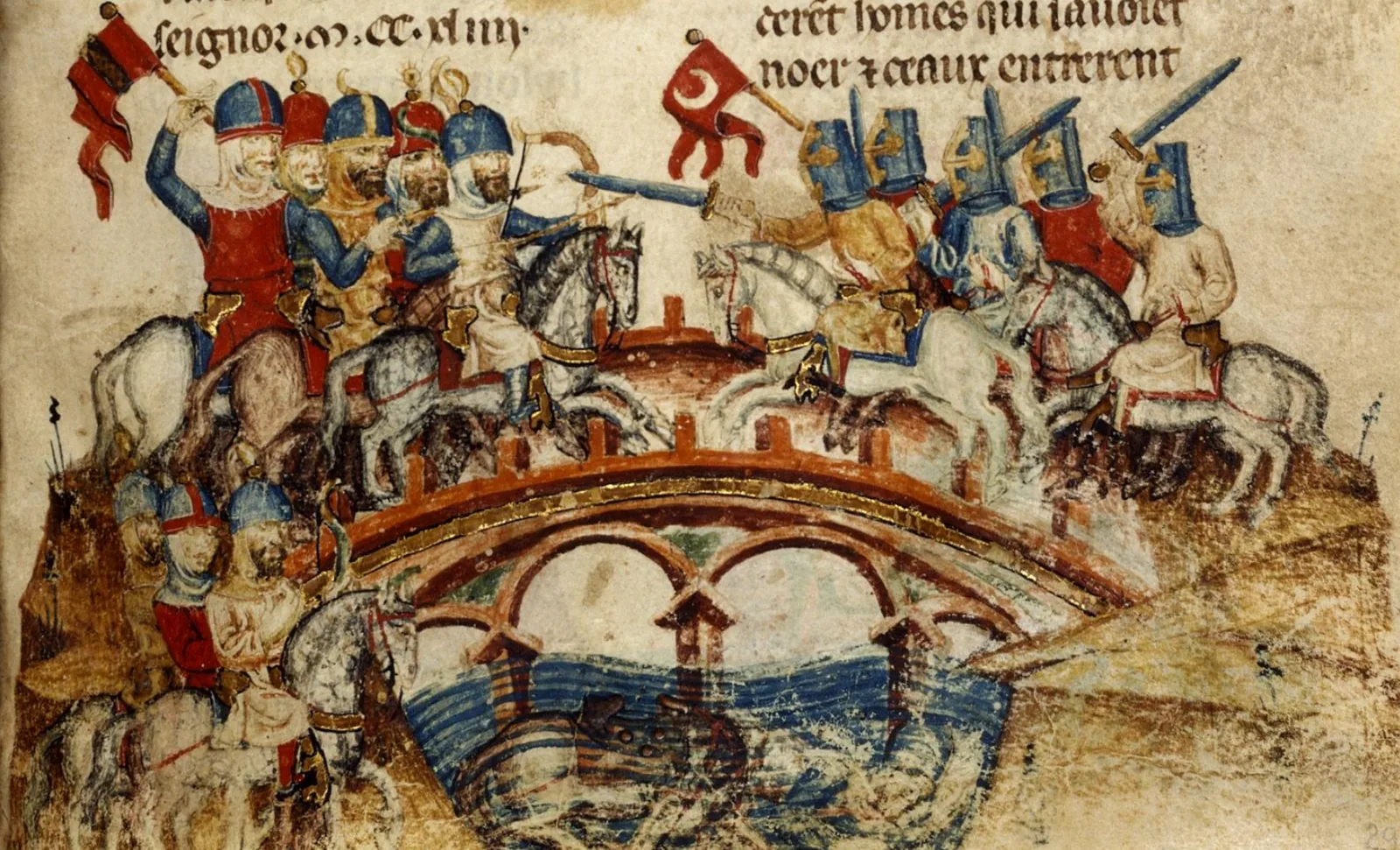
Anonymous illumination in a copy of Hayton of Corycus’s history, 1350–1374. Austrian National Library, Vienna (Cod. 2623) · Public domain · Source page
The chase that ended at the coast
A king on the run
In the winter of 1220 the Shah of Khwarazm was running for his life. Two Mongol generals were chasing him, and the chase had reached the shore of the Caspian Sea.
The Shah had ruled an empire that stretched from the Caspian to Afghanistan. Now he had a boat and an island far out on the water. The Mongols had thousands of horsemen and archers, and not one boat. The question is what to do when a chase ends. The answer belongs to Subutai, the general behind many of the Mongol conquests, whom most readers have probably never heard of.
Background
The invasion of Khwarazm
1219–20
Genghis Khan opened a war against the Khwarazmian Empire in 1219. The trigger was the killing of a Mongol merchant caravan at Otrar, a frontier city, in 1218. Shah Muhammad II refused Genghis’s demand that the governor who had seized the caravan be punished. Otrar, Bukhara and Samarkand fell in 1219 and 1220. The killing in those cities was heavy, and our sources describe it in grim terms.
The lesson on Genghis Khan tells the whole invasion. Here we need only its shape: a great army working in the west, and a Shah who could not hold the cities of his own realm.
The man
A family in Temüjin's service
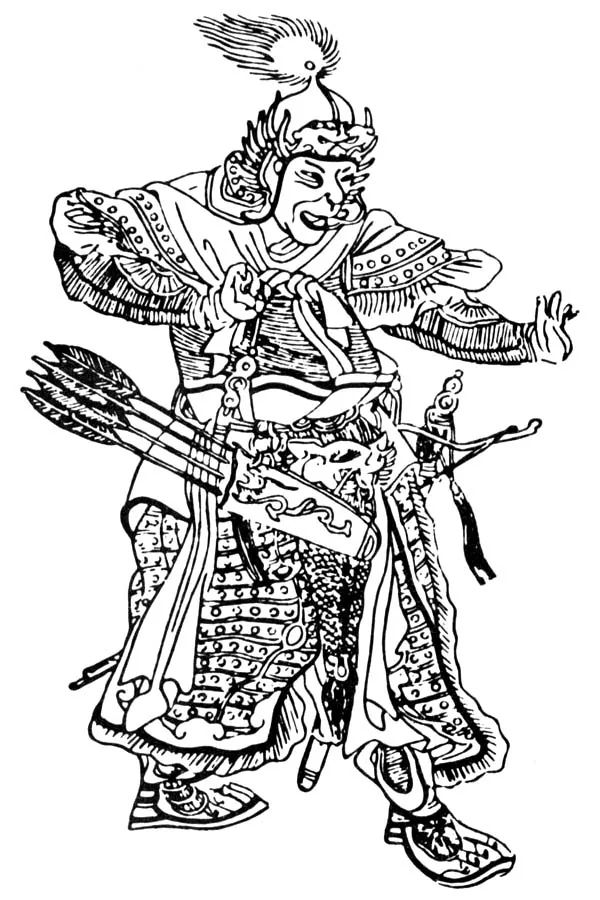
Anonymous Chinese drawing of Subutai, dated to the 16th century (per Wikimedia Commons) · Public domain · Source page
Subutai was born around 1175, probably near the upper Onon river, in the same country where Temüjin, the future Genghis Khan, grew up. The popular version makes him an outsider: a man of the Uriankhai, a people of the northern forests who herded reindeer. The story is vivid, but a modern study of the Chinese sources finds little evidence for it and calls it a literary tale.
His family served Temüjin. The Yuan shi, the official Chinese history of the Mongol dynasty, compiled after the Mongols had been driven out of China, tells how Subutai and his brother rescued their father from sheep robbers. It is a family story, written more than a century after his death. The year Subutai himself joined Temüjin is not recorded.
We call the people in this lesson Mongols. European writers called them Tatars, a name that lumped several peoples together. Both names appear in the sources, and the quotations keep their own words.
The chase
Twenty thousand riders after one man
20,000
In 1220 Genghis sent two of his best commanders after the Shah. Jebe and Subutai led about 20,000 men between them, each commanding a tümen, a unit of ten thousand soldiers. Jebe was the archer whose life Genghis had once spared, as the lesson on Genghis Khan tells.
The Shah ran west across Persia, from one city to the next. He reached a port on the Caspian shore and took a boat to an island called Ashur-Ada. The Mongols chased him to the shore and no further. Without boats, they could not follow him onto the island. The pursuit had reached the edge of the land.
A decision point
You are Subutai.
Winter 1220–21. The Caspian shore of northern Persia (today Iran).
The Shah has slipped away again. For months you have chased him across Persia, from one city to the next. Now he has reached a port on the Caspian shore and taken a boat to an island far out on the sea. Your scouts say there is no way to reach him.
You have about 20,000 men, most of them riders, and not one boat. Your horses are thin, and the grazing along the shore is poor. Your orders from the Great Khan were to catch the Shah, and they say nothing about what to do if he cannot be caught. To the west lie the cities of Persia, and beyond them Baghdad, rich and famous, seat of the caliph. Jebe is beside you and waiting to hear what you decide.
What do you do?
- Turn back east now and rejoin Genghis with the plunder you already have. The safe choice. The army goes home with what it has. The Persian cities you passed will probably rise again behind you, and the western victory stays partial.
- Send a messenger to Genghis, far to the east, and ask leave to go west through the mountains for a year or two. A slow gamble. The answer takes months, and the army waits or raids on its own. Genghis may refuse, which would cost you time and face. If he agrees, the raid could reach deep into the Caucasus, and the army could come home with more than plunder.
- Press on west towards Baghdad now, without asking, while the Shah's empire is still in confusion. A bold gamble. Baghdad is rich, but a huge city is hard for riders to take quickly, and the army would be far from home and supplies. Probably it would be cut off, and Genghis's anger would follow.
What really happened
Send a messenger to Genghis, far to the east, and ask leave to go west through the mountains for a year or two.
They asked Genghis for permission to go west, and he agreed. The raid that followed lasted about three years. The Shah died on the island that winter: most sources say December 1220, while a Chinese source that modern historians cite gives 11 January 1221.
No source records what Subutai and Jebe thought. What we know is what they did: they did not turn back at once, and they did not gamble alone. Asking the khan was the careful course for a commander far from home. It also meant that the long raid was Genghis's decision, not theirs.
Afterwards
Cities on the road
While they waited for the answer, the army raided on its own. Rey, Zanjan and Qazvin were sacked, and Hamadan was taken. When permission came, the raid went on further west.
Through the Caucasus
The raid
Around the Caspian
3 years
From 1221 the army raided around the Caspian Sea. It went west through Persia and Azerbaijan, then north through the Caucasus mountains into the steppe. The historian Richard Gabriel counts the whole raid at about 5,500 miles, roughly 8,800 kilometres, covered in about three years. The army did not try to hold the land it passed. It had to find its way, feed its horses and avoid being cut off.
The mountains were the hardest part. The army left its siege engines behind, and the crossing cost men and horses. It relied on local guides who knew the passes.
Georgia
An ambush in the hills
1221
In late 1221 the army met the kingdom of Georgia in the mountains. Georgian horsemen followed Subutai's men, and the Mongols pulled back in a feigned retreat, drawing the pursuers on. Jebe had put about 5,000 men in ambush. When the Georgian cavalry rode into the trap, it was destroyed near the town of Khunan, and King George IV was mortally wounded.
The tactic was not new, and we come back to that point later in this lesson. Here the point is the trap itself: the army had patience, knew the ground, and waited for the enemy to act as it expected.
The steppe
The Cumans beaten
The army beat a coalition of Caucasian peoples, and then the Cumans, the horse nomads of the western steppe, also called Kipchaks. Koten, the Cuman khan, watched his people break. He fled north to his son-in-law, Mstislav, prince of Galicia, in the lands of the Rus'.
The army came down to Derbent, the old fortress on the Caspian shore, and went through the passes into the steppe north of the mountains. The Mongols were now close to the lands of the Rus' princes.
The warning
A flight north
Koten's flight carried the news north. The princes of the Rus' gathered their armies, and the steppe between them and the Mongols became the next battlefield. The raid had come a long way, and now it was close to home for the Rus'.
Kalka
The envoys
Ten envoys who were killed
The Mongols sent ten envoys to the prince of Kiev. The envoys were executed. A second embassy then came and declared war. The Rus' princes gathered their armies on the steppe, and the Cumans who had fled to them rode in the Rus' ranks.
The chase
Nine days of retreat
9 days
For nine days the Mongols pulled back across the steppe, and the Rus' armies followed. In late May 1223 the Mongols reached the Kalka river and stopped on its far bank. There a rearguard of about a thousand men waited on the far bank. The rest of the Mongol army was out of sight.
The Cumans had their own reasons for wanting a fight. Their khan had fled, and their people had been beaten.
A decision point
You are Mstislav the Bold, prince of Galicia.
Late May 1223. The steppe on the Kalka river, north of the Sea of Azov.
The princes have gathered their armies, but they have no single commander. You have brought your Galician men. Some of the other princes have not yet arrived, and the Kievan army is camped further back.
Across the river your scouts see a small Mongol force, perhaps a thousand men. The rest of the enemy is out of sight. Ten Mongol envoys were executed, and a later embassy declared war. The Cumans camped with you want revenge, and they are ready to fight now.
What do you do?
- Wait until the other princes arrive, and attack together. Safer if the others arrive in time. But the Mongols may move, the Cumans may leave you, and the princes may argue over who commands.
- Cross the river and attack at once, with the men you have. Quick and bold. You hit the rearguard before the main Mongol army can form. But you fight an enemy you have not seen, and if he wants a battle, the advantage is his.
- Leave the Cumans to fight alone, and keep your men out of the battle. Keeps your army whole. But the Cumans would be destroyed, your standing among the princes would suffer, and the Mongols could then turn their eyes on you.
What really happened
Cross the river and attack at once, with the men you have.
You attacked at once, without waiting for the other princes. On 31 May 1223 the Rus' army crossed the river and fell into the feigned retreat. The small force on the far bank had been bait. The Cumans ran back through the Rus' ranks, and the Rus' army broke. Mstislav of Kiev held a fortified camp for three days, then came out on a promise of safety from the Mongols and was killed. You got back across the Dnieper and had the boats cut loose behind you.
The sources give his reasons only in general terms. The Galician prince did not wait for the other princes, and the Cumans had fled to him for help. Historians argue about whether patience would have saved the army. The Novgorod chronicle, which describes the battle, has a view of its own, and we read it in a moment.
The field
The plan of Kalka
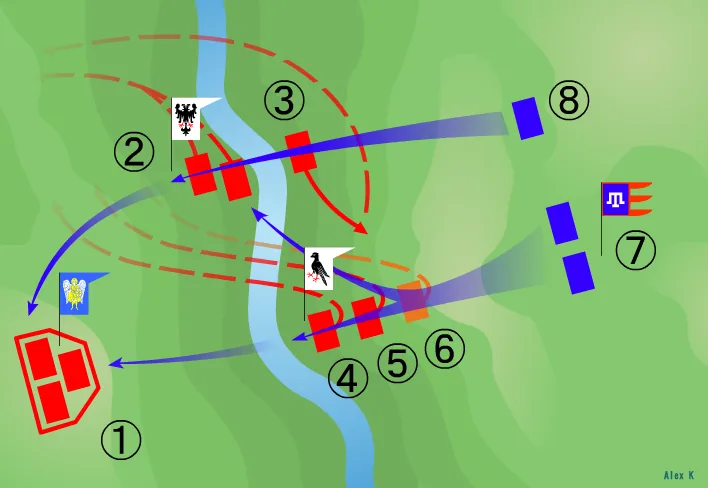
Alex K, ‘Battle of the Kalka River scheme’, 2007. Own work, based on a Russian text on the battle · CC BY-SA 2.5 · Source page
This is a modern plan of the battle, drawn from a Russian text on the battle. The Rus' units (1 to 6) stand on the left and in the centre. The Mongols under Subutai and Jebe (7), with the Brodniki under Ploskinya (8), stand on the right, across the river. The plan shows the sides and their arrangement, not what the commanders could see.
Myth
The feigned retreat was a Mongol invention.
The truth
No. Commanders used a fake retreat to lure pursuers into a trap long before the Mongols appear in history. The Mongols used it with great skill, which is why it is often linked to them, but they did not invent it.
The evidence
Herodotus reports that the Spartans used it at Thermopylae in 480 BCE. The Carthaginian general Hanno used it near Agrigentum in 262 BCE. The Lusitanians used it to defeat a Roman general in 153 BCE. At the battle of Augsburg, also called Lechfeld, in 910 CE, the Magyars used repeated feigned retreats against German heavy cavalry.
Source: The Novgorod chronicle on Kalka
“And having taken the Knyazes they suffocated them having put them under boards, and themselves took seat on the top to have dinner. And thus they ended their lives.”
Written in Novgorod, far north of the steppe, by a chronicler who was not at the river. He heard the news and wrote it up, probably soon after the battle, and he chose a moral explanation. He blames a Rus' commander, Ploskinya, who had sworn an oath and then handed the princes over, and he says God allowed the Rus' to fail because of their sins. This is a witness with a side: read it as a view from home.
- Who wrote this, and how did he know? A Novgorod chronicler, reporting what he heard from others. He did not see the battle, so he worked from reports already shaped by those who told them.
- Why does the chronicler explain the defeat with God and with one traitor? A chronicle is a moral history. It names culprits and sin, because that turns the story into a lesson. A historian asks a different question: what the armies could actually do.
- What is missing from the account? The Mongol side. We learn nothing of their plan, their numbers or why they halted by the river. The account sees the disaster only from the Rus' side.
The toll
One in ten
The chronicle says that of the rest of the troops ‘every tenth returned to his home’. We cannot test that figure. Other chronicles give very different death tolls, from about 10,000 to 60,000. The gap itself shows how unreliable the numbers are, but the sense of catastrophe is clear in every source.
Before the west: Kaifeng and the road
Before the west
A siege of more than a year
1232–33
Subutai's wars were not all in the west. He also fought in north China, against the Jin dynasty. Around 1231–32 his army joined the main Mongol force, and Subutai took charge of the siege of Kaifeng, the Jin capital.
The siege began on 8 April 1232. A siege that long meant hunger inside the walls. The Jin emperor left the city in February 1233, and Kaifeng fell on 29 May 1233.
The road west
One army, two names
In 1235 a quriltai, an assembly of the Mongol princes, gave the western campaign to Batu, a grandson of Genghis Khan. Batu was the overall leader. In the field, many historians hold, Subutai ran the army. Batu had the royal name; Subutai had the experience and the discipline.
The Volga
Across the Volga
1236
In 1236 the army crossed the Volga and attacked Volga Bulgaria, a trading state of the middle Volga with a Muslim ruling class. It was the first step of the western campaign.
Ryazan
The city that was destroyed
6 days
In November 1237 the Mongols besieged Ryazan, a Rus' city on the Oka river. It fell after six days of fighting, and the city was destroyed.
Vladimir
Fire at Vladimir
1238
The siege of Vladimir, the city of the grand prince, began on 4 February 1238. The Mongols took it three days later and burnt it. On 4 March the army of the grand prince was destroyed on the Sit river.
Kiev
The old capital
1240
In 1240 the Mongols took Kiev, the old capital of the Rus'. It was the city whose army had marched to Kalka seventeen years earlier.
Two columns
The refugees
A king who would not hand them over
Many Cumans fled west into Hungary, where King Béla IV took them in. The Mongols demanded that he hand them over, and he refused. That refusal shaped the next campaign: Subutai planned an invasion of Hungary and Poland at once.
The plan
Two columns
The plan split the army. One force, led by Baidar, Orda and Kadan, rode north into Poland. The main army, under Batu and Subutai, headed for Hungary. The sources give very different numbers for each column, so this lesson gives no total.
Legnica
Two days before Mohi
9 April 1241
On 9 April 1241, at Legnica in Silesia, the Silesian and Polish forces met a Mongol column. Duke Henry II the Pious, their leader, was killed in the fighting. Two days later, on 11 April, the main Mongol army met the Hungarians at the Sajó river.
Myth
The Mongols were a huge horde that always outnumbered their enemies.
The truth
Not as a rule. European writers made Mongol armies look enormous. Modern estimates put the Mongol cavalry at Legnica at no more than about 25,000, roughly the size of the Silesian army. At Kalka, some modern Russian historians think the Mongols were the larger force. The myth gets both the size and the odds wrong.
The evidence
European chroniclers claimed more than 100,000 Mongols at Legnica. Historians call these figures gross overestimates. Estimates for the Silesian army at Legnica also run to 25,000 at most. At Kalka the estimates for the Rus' side range from about 8,000 to 80,000.
Source: A letter copied into an English chronicle
“the Tartars made their way into the kingdom like a whirlwind, and suddenly surrounded them on all sides.”
Matthew Paris was a monk at St Albans in England, and he copied this letter into his chronicle. It claims to come from an emperor, and the source does not let us say with confidence who that emperor was. A letter like this was written to shape opinion and rouse Christian rulers. It is not an eyewitness account: neither the letter nor the monk saw the fighting.
- Who is speaking, and who copied it? A letter in an emperor’s name, copied by an English monk who never saw the Mongols. Two removes separate the reader from the events, and the letter was written to make a point.
- What feeling is the writer trying to create? Fear and urgency. The enemy comes ‘like a whirlwind’ and surrounds everyone at once. A letter that wants Christian rulers to act needs an enemy that looks unstoppable.
- What does the letter leave out? The Mongol side, and any sign of how the battles were fought. A political letter gives only the version that serves its purpose.
Mohi
The camp
A camp inside wagons
11 April 1241
On the night of 10–11 April 1241, the Hungarian army was camped on the far side of the Sajó river, near the village of Mohi. Its men had drawn the wagons into a ring around the camp, a wagon fort, and they waited inside it.
The bridge was the main crossing over the river.
The night
A fight on the bridge
Around midnight the Mongol vanguard reached the bridge, after about seven kilometres through the dark. A Hungarian force came out and fought it there. After a hard fight the Hungarians pulled back to their camp, and they were inside it again by about two in the morning.
This is one of the few details we have about that night. The sources do not agree on what the Mongol commanders intended, but the sortie shows that the Hungarians thought the bridge worth holding.
A decision point
You are Batu, overall commander of the western army. Subutai, the field commander, is beside you.
11 April 1241, at dawn. The Sajó river near Mohi, Hungary.
The Hungarian army is across the river, inside its ring of wagons. King Béla IV has gathered a large army, and the camp looks ready for a long fight.
The bridge is the only crossing your scouts have found, and a Hungarian guard holds its far end. Your vanguard is still shaken from last night. Subutai is building a makeshift bridge further south, but it is not ready. With you are stone-throwers, heavy engines that can hurl stones at the guards and the camp. Scouts report a ford downstream, where horsemen could cross.
Every hour you wait gives the Hungarians time to strengthen the camp, or to slip away.
What do you order?
- Attack the bridge and the camp now, with the stone-throwers and your best men. Probably costly. A narrow bridge is a poor place to attack, and men pushing across it are easy to cut down. But it would pin the Hungarians in place and could break the guard quickly.
- Send a strong force to the ford downstream, to cross and come up behind the camp, and hold the bridge with a small force. It splits the army and risks it. The ford may be deeper than the scouts say, and the force may arrive late. If it works, the Hungarians are caught between two attacks.
- Attack the bridge at dawn, and at the same time send a force to the ford, so the Hungarians are hit from two directions. It looks like a good plan if the timing holds, but it needs two actions in two places at the same dawn. A one-hour mistake could turn one strong attack into two weak ones.
- Wait until Subutai’s bridge is ready, then attack together, in daylight, at a time of your choosing. The safest plan, if the Hungarians stay where they are. But they could strengthen the camp, slip away, or find out where the ford is.
What really happened
Attack the bridge at dawn, and at the same time send a force to the ford, so the Hungarians are hit from two directions.
Batu’s men attacked the bridge at dawn with seven stone-throwers, and went for the Hungarian guards on it. Sejban led a force to the ford and crossed. Subutai’s makeshift bridge was late, and when it was ready he attacked the Hungarian rear. The Hungarians fell back to their camp before the encirclement closed.
The sources give the sequence of the day, not the reasons. Historians suggest the Mongols meant to pin the Hungarians at the bridge while a second force reached their flank. It was a familiar steppe method: hold the enemy in front and strike where he is least ready. It worked because the Hungarians could not guard the bridge, the ford and the camp at once.
The aftermath
A broken army
The Hungarian army was broken. King Béla IV escaped, and many of his men died in the fighting and in the flight that followed. The medieval sources give no reliable count of the dead, and modern writers differ widely. One estimate from 1961 puts the Hungarian dead as high as 70,000. Historians treat such figures with great caution.
The route
One reconstruction of the battle
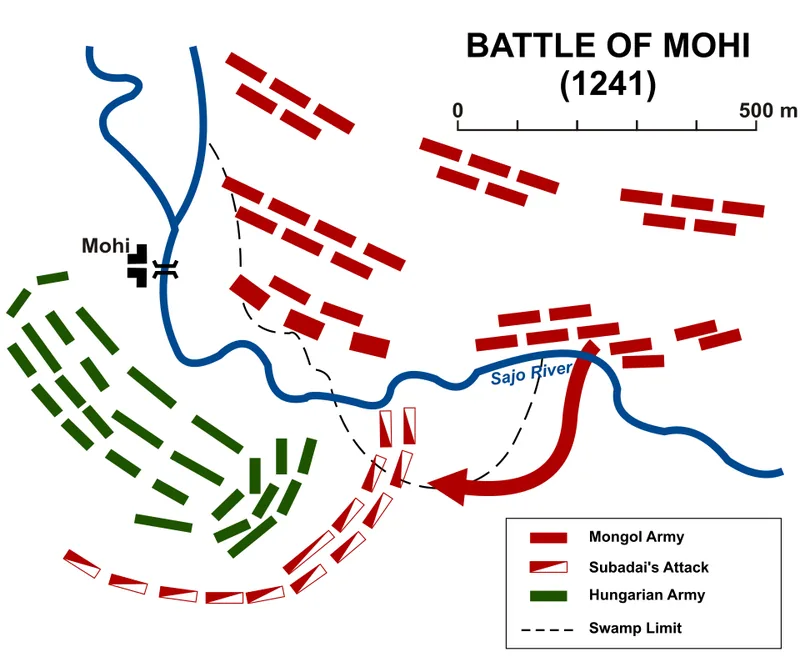
Alex:D, ‘Battle of Mohi’ map, 2008. Own work · CC BY-SA 4.0 · Source page
This map is one reconstruction, drawn in 2008 for Wikimedia Commons. The Mongol army (red) lies on one side of the Sajó, and the Hungarian army (green) on the other. The striped units show Subutai’s attack, which swings round toward the Hungarian flank. The dashed line marks the edge of a marsh. Treat the arrows and positions as approximate, because the sources do not survey the ground.
Source: A Hungarian chronicle picture, about 1360
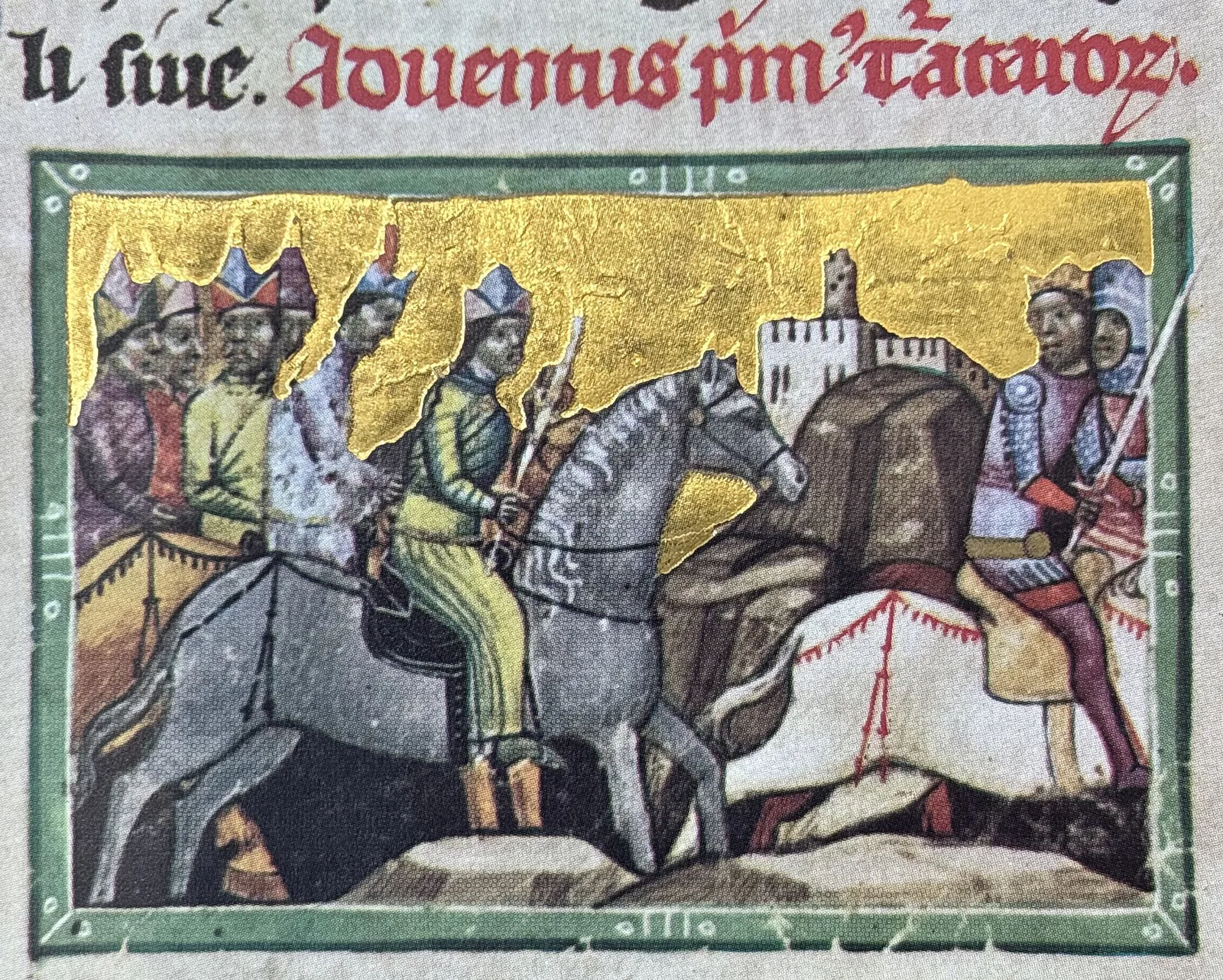
Chronicon Pictum (Illuminated Chronicle), Hungary, c. 1360, page 125. Photograph by Márk Kálti, Wikimedia Commons · Public domain · Source page
Chronicon Pictum (Illuminated Chronicle), Hungary, c. 1360, page 125
A page from the illuminated chronicle of Hungary, made around 1360. It shows the first Mongol invasion of Hungary: the Mongols pursue King Béla IV, who flees on horseback with his followers.
- Who made this picture, and when? Hungarian artists around 1360, more than a century after the events. It was made for a book, not as a report from the field.
- How does the artist dress the Mongols? The riders wear tall pointed hats. A Hungarian reader already knew steppe peoples, such as the Cumans who had fled into Hungary, and the picture may draw on that.
- Where is the focus of the picture? On the king. Béla is shown fleeing, and the story is his escape, not the battle or the Mongol commanders. The picture takes the view of the defeated man.
After the Khan’s death
The news
The Khan dies
11 Dec 1241
On 11 December 1241 Ögedei Khan died. He was Genghis Khan’s son and the Great Khan who ruled the whole empire. His death meant that the princes had to gather and choose a new khan, and every prince with an army in the west had to decide whether to go home.
A decision point
You are Subutai, advising Batu.
December 1241 to early 1242. Hungary, after the battle at Mohi.
The Hungarian army is broken and its king has fled. The Mongol army is strong and well fed on the Hungarian plain, and nothing in the west stands in its way. Scouts report that beyond Hungary lie lands of stone walls and fortified towns, which will take time to break.
Then a rider comes from the east with news: Ögedei is dead. The princes will have to go home and choose a new khan. Batu must decide whether to press on, stay in Hungary, or return to the Volga and wait for the summons.
What do you advise?
- Press on west, into the lands beyond Hungary, while the army is strong. A bold choice. The army is strong, and the lands beyond may be rich. But you would be far from the council that chooses the next khan, and no one there would confirm your gains.
- Withdraw to the Volga and wait quietly for the princes’ summons. Probably the safest. The army stays whole, and so do the plunder and the Rus' lands. But you give up the chance to press west, and Hungary is left time to recover.
- Stay in Hungary, govern the land and hold it. A long occupation of a hostile country, by an army too thin to hold it. The Hungarians would resist, and the army would be cut off from the steppe it came from.
What really happened
Withdraw to the Volga and wait quietly for the princes’ summons.
Batu withdrew in 1242. He settled on the lower Volga and never went back to Mongolia. The lands he held in Rus' became the base of a state of his own, later called the Golden Horde.
The sources say the princes were called home to choose a khan, and most historians accept that. Subutai’s own advice is not recorded in the sources we have, so we cannot say what he proposed. Pressing on was a real option: an army far from home, with no khan chosen, risked losing everything it had won.
The retreat
Batu turns back
In 1242 the Mongol armies left Hungary and Poland, and they did not hold either country. Subutai had been with the western campaign from the start, but his last years are poorly documented. He died in Mongolia in 1248.
Myth
Ögedei’s death alone saved Europe.
The truth
That is too simple. Most historians accept that the death of Ögedei sent the princes home, but Batu did not go to Mongolia. Other reasons are argued: the cost of the campaign, the difficulty of feeding so many horses far from home, and the fortifications the army met in Europe.
The evidence
The Mongol sources give the succession as the reason, and it is the strongest explanation. The fact that Batu stayed on the Volga is the main objection. Stephen Pow (2012) argued that fortifications mattered more than the sources admit. This is a minority view, but it is argued in detail, and the debate below returns to it.
What followed
- 1223 Kalka. The Rus' armies are broken, and the Mongols ride back east.
- 1232–33 Kaifeng: after more than a year, the Jin capital falls to Subutai’s siege.
- 1236 The army crosses the Volga and attacks Volga Bulgaria.
- 1237 Ryazan falls after six days of fighting.
- 1238 Vladimir is burnt, and the grand prince’s army is destroyed on the Sit river.
- 1240 Kiev is taken.
- 9 April 1241 Legnica: Duke Henry II the Pious is killed.
- 11 April 1241 Mohi: the Hungarian army is broken, and King Béla IV flees.
- 11 December 1241 Ögedei Khan dies, and the princes must return to choose a new khan.
- 1242 Batu withdraws from Hungary and Poland to the lower Volga.
- 1246 Güyük is chosen as Great Khan.
- 1248 Subutai dies in Mongolia.
Why did the Mongols leave?
Why did the Mongols leave Hungary and Poland in 1242?
- Most historians, following the Mongol sources The death of Ögedei sent the princes home to choose a new khan. The Mongol accounts put the succession at the centre, and the explanation fits the timing. Its weak point is Batu, who never went back to Mongolia.
- Stephen Pow, in a 2012 doctoral thesis at the University of Calgary The Mongols met walls, ditches and fortified towns in Hungary and Poland, and taking them was costly. Pow argues that the fortifications were a real reason for the withdrawal, and that the sources underrate them. This is a minority view, but it is argued in detail.
- Some scholars, on logistics Feeding a huge number of horses far from home was a constant problem, and some scholars think it made the campaign hard to keep going. The argument is plausible, but the evidence is indirect and hard to test.
Batu never went back to Mongolia. If the succession was the only reason, why did he stay on the Volga? Which side convinces you, and what evidence would change your mind?
Check yourself
On what day was the battle on the Kalka River fought?
Answer: 31 May 1223. Correct. The Novgorod chronicle dates the defeat to 31 May, St Eremei’s Day, and modern histories agree.
Check yourself
Which came first, the battle of Legnica or the battle of Mohi?
Answer: Legnica, on 9 April 1241, two days before Mohi. Correct. Legnica was fought on 9 April 1241, and the main Mongol army met the Hungarians at Mohi on 11 April.
Check yourself
On what date did Ögedei Khan die?
Answer: 11 December 1241. Correct. Ögedei died on 11 December 1241, and the news sent the princes home.
Check yourself
When did the siege of Kaifeng begin, and when did the Mongols enter the city?
Answer: 8 April 1232, and 29 May 1233. Correct. The siege began on 8 April 1232, and the city fell on 29 May 1233, more than a year later.
Check yourself
Where did Shah Muhammad II die, and why could the Mongols not follow him there?
Answer: On an island in the Caspian Sea, and the Mongols had no boats. Correct. The Shah reached the island of Ashur-Ada, and the Mongols had no boats to follow him.
Check yourself
How long did the siege of Ryazan last, and in which year was it?
Answer: Six days, in 1237. Correct. The Mongols besieged Ryazan in November 1237, and the city fell after six days of fighting.
Terms
- tümen A unit of ten thousand soldiers in the Mongol army, and the command of such a unit. Subutai and Jebe each led one in 1220.
- quriltai A great assembly of Mongol princes and commanders, called to choose a khan or decide on war.
- khan The ruler of a steppe people. The Great Khan stood above all the other khans.
- Great Khan The supreme ruler of the Mongol empire, called qa’an. Genghis Khan’s successors used the title, starting with Ögedei.
- Jin The dynasty that ruled northern China from 1115 to 1234. Its rulers were Jurchens, a people from Manchuria.
- Tatars The name European writers used for the Mongols and other steppe peoples. Many sources say ‘Tatars’ where modern books say ‘Mongols’. This lesson uses ‘Mongols’ except in quotations.
- Cumans A Turkic people of the western steppe, also called Kipchaks. Many fled west from the Mongols, and some reached Hungary.
- feigned retreat A tactic in which an army pretends to run, so that its pursuers break their ranks and can be struck. It is very old.
- stone-thrower A siege engine that throws heavy stones at walls, at defenders, or at men on a bridge.
- chronicle A history written year by year, usually by monks, a royal court or city clerks. Chronicles mix eyewitness reports, rumour and moral lessons.
- Golden Horde A name given later to the Mongol state that Batu founded on the Volga and the steppe.
- Khwarazm An empire that stretched from the Caspian Sea to Afghanistan, ruled by a shah. In 1219 and 1220 the Mongols took many of its cities.
- Temüjin The birth name of Genghis Khan, founder of the Mongol Empire.
- Uriankhai A people of the northern forests who herded reindeer. A popular story says Subutai came from them, but there is little evidence for it.
- Yuan shi The official Chinese history of the Mongol dynasty, written after the Mongols were driven out of China.
- Jebe A Mongol commander and skilled archer whose life Genghis Khan had once spared. Together with Subutai he led the chase after the Shah.
- Ashur-Ada A remote island in the Caspian Sea, where the Shah fled. The Mongols could not reach it without boats.
- Derbent An ancient fortress on the Caspian shore. The Mongols passed through it into the steppe north of the mountains.
- Kingdom of Georgia A Christian kingdom in the Caucasus mountains. In late 1221 its horsemen were destroyed in a Mongol ambush.
- King George IV The king of Georgia, mortally wounded in the ambush near the town of Khunan.
- Koten The khan of the Cumans, nomads of the western steppe. When his people broke, he fled north to his son-in-law in the lands of the Rus'.
- Brodniki A group of free warriors from the steppe who fought on the Mongol side at the Kalka river, under Ploskinya.
- Ploskinya A commander of the Brodniki at the battle of Kalka. According to a Novgorod chronicle, he swore an oath and then handed over the princes.
- Kalka A river on the steppe where, in 1223, the Mongols fought the Rus' and Cuman armies.
- Novgorod A Rus' city far north of the steppe, where a chronicle of the battle of Kalka was written.
- Rus' The name of the medieval lands of the East Slavs, ruled by princes. Kiev was their old capital.
- Volga Bulgaria A trading state on the middle Volga with a Muslim ruling class. The Mongols attacked it in 1236, at the start of the western campaign.
- Ryazan A Rus' city on the Oka river. The Mongols took it in 1237 and destroyed it.
- Kaifeng A city in north China, capital of the Jin dynasty. It fell in 1233 after a long siege, in which hunger struck the people inside.
- Legnica A town in Silesia where Duke Henry II the Pious was killed in 1241, fighting the Mongols.
- Sajó A river in Hungary, on whose banks in 1241 a battle broke the Hungarian army.
- Béla IV King of Hungary during the Mongol invasion. His army was broken at the Sajó, and he escaped.
- Ögedei Genghis Khan's son and Great Khan of the empire. His death in 1241 sent the princes home to choose a new khan.
- Batu Genghis Khan's grandson, who led the western campaign. He settled on the lower Volga, and his lands in Rus' became the base of the Golden Horde.
- Caliph The ruler of the Muslim world, leader of religion and state. His seat was Baghdad.
- Matthew Paris An English monk who copied into his chronicle a letter claiming to come from an emperor. He did not see the battle himself.
Sources
- Song Lian and others, Yuan shi (History of the Yuan), biography of Subutai, completed 1370 (in Chinese)
- Novgorod First Chronicle, 1223 entry, trans. Robert Michell and Nevill Forbes, The Chronicle of Novgorod 1016–1471 (Camden Third Series 25, London, 1914)
- Matthew Paris, Chronica Majora, entry for 1241 (‘The Emperor’s Letter’), trans. J. A. Giles, Matthew Paris’s English History (London, Bohn, 1852)
- Chronicon Pictum (Illuminated Chronicle), Hungary, c. 1360, page 125
- Herodotus, Histories 7.211 (the Spartans at Thermopylae)
- Richard A. Gabriel, Genghis Khan’s Greatest General: Subutai the Valiant (Potomac Books, Washington, 2004)
- Stephen Pow, ‘Deep ditches and well-built walls: a reappraisal of the Mongol withdrawal from Europe in 1242’ (PhD thesis, University of Calgary, 2012)
- Stephen Pow and Jingjing Liao, ‘Subutai: Sorting Fact from Fiction Surrounding the Mongol Empire’s Greatest General’, Journal of Chinese Military History 7:1 (2018), pp. 38–76

Image credits
- Anonymous illumination in a copy of Hayton of Corycus’s history, 1350–1374. Austrian National Library, Vienna (Cod. 2623) · Public domain · Source page
- Anonymous Chinese drawing of Subutai, dated to the 16th century (per Wikimedia Commons) · Public domain · Source page
- Alex K, ‘Battle of the Kalka River scheme’, 2007. Own work, based on a Russian text on the battle · CC BY-SA 2.5 · Source page
- Alex:D, ‘Battle of Mohi’ map, 2008. Own work · CC BY-SA 4.0 · Source page
- Chronicon Pictum (Illuminated Chronicle), Hungary, c. 1360, page 125. Photograph by Márk Kálti, Wikimedia Commons · Public domain · Source page


