Stalin: how the "grey" party secretary became sole ruler
Before he died, Lenin asked the party to think about removing Stalin from his post. The leaders kept the letter from publication, and Stalin stayed in office. How did the "grey" party secretary become sole ruler, and what did he do with that power?
Decisions, questions and your own progress, in the app
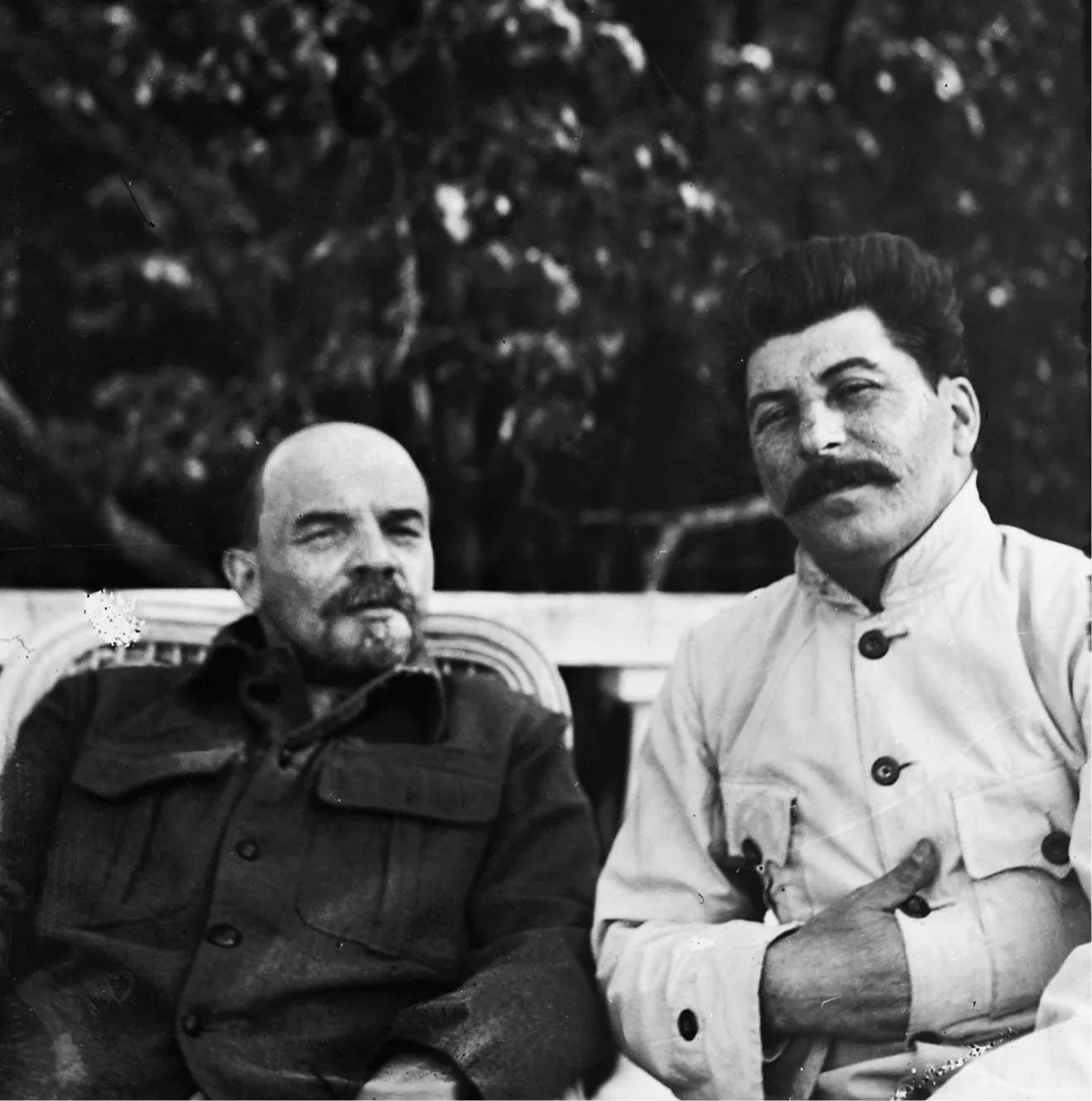
Lenin and Stalin at Gorki, 1922. Photo: Maria Ulyanova. Public domain · Public domain · Source page
The boy from Gori
September 1922, Gorki, outside Moscow
On a white bench in a garden sit two men. One is Vladimir Lenin, the founder of the Soviet state, ill and frail. Beside him sits Joseph Stalin, the party’s General Secretary.
Lenin would die in January 1924. Stalin would die in 1953, almost thirty years later. In between, Lenin wrote a letter asking the party to think about removing Stalin from his post. What happened to that letter, and how did this grey official become sole ruler?
Background
Two birthdays
He was born in Gori, a small town in Georgia, then part of the Russian Empire. The baptism record gives 18 December 1878 by the calendar used in the West. Russia still kept the older Julian calendar, which made it 6 December.
Years later the official biography gave a different date: 21 December 1879. Historians think the change came after he rose to power, and the sources do not agree on when. His own handwritten résumé from 1920, and a questionnaire from the same year, both give 1878.
Training
The seminary in Tiflis
In 1894 he moved from the church school in Gori to the Orthodox seminary in Tiflis, to train for the priesthood. He left in April 1899 without a diploma. Russian sources say he was expelled.
This was not the mind of an uneducated man. At the seminary he read the radical writer Nikolai Chernyshevsky and the Georgian writer Alexander Kazbegi, and later Karl Marx’s Das Kapital.
1907
A raid in Tiflis
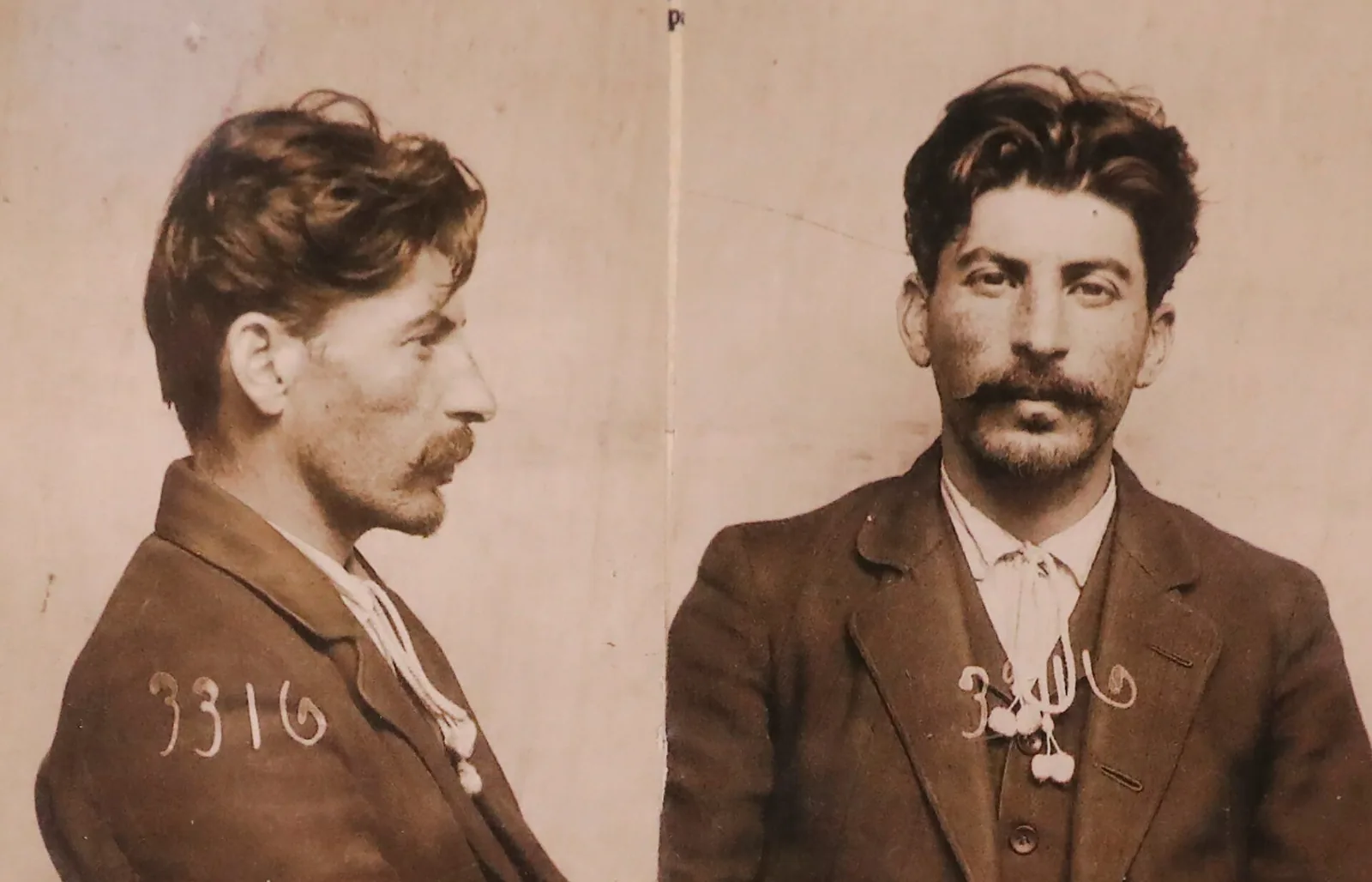
Tsarist police card, c. 1911. From the files of the Tsarist secret police, St Petersburg · Public domain · Source page
About 40
In June 1907 Bolsheviks in Tiflis organised a raid to seize money for the party. Around forty people were killed in the attack. Many accounts link Stalin to its planning, but his exact role is still debated.
The Tsarist police kept a file on him. The picture here is a police identity card, made around 1911 (the date is an estimate). It gives his age as between 32 and 34, so it dates to about 1911 or 1912.
A new name
The name Stalin
He used the name from 1912. It first appeared in print in 1913, in the journal Prosveshcheniye, in a series of articles called Marxism and the National Question, signed “K. Stalin”. The name comes from the Russian word for steel, which is why it is often translated as ‘man of steel’.
Myth
Stalin means ‘man of steel’, and he chose the name for that meaning.
The truth
The name does come from the Russian word for steel. But no source explains why he chose it. Saying he picked it for its meaning is a guess, and a neat one.
The evidence
The name appears in print from 1913. The sources show when he began to use it, not why he chose it.
1917
A grey blur
In 1917 Stalin was not the public face of the Bolsheviks. He sat on committees and stood behind other men. A phrase often used about him comes from Nikolai Sukhanov, a socialist who watched the revolution in Petrograd, and whose memoirs were later translated into English.
The phrase is “a sort of grey blur”. It comes from a 1955 British review of an abridged English translation, and the reviewer is the one who quoted it. No one has shown that Sukhanov wrote those words in exactly that form, and the Russian original is not checked here. Keep that in mind when you meet the phrase “grey man” in history books.
Rise
General Secretary
In May 1918 the Soviet government sent Stalin to Tsaritsyn on the Volga (later Stalingrad, today Volgograd) to secure grain for the hungry cities.
In April 1922 the party’s Central Committee made him General Secretary. The secretariat ran the party’s staff, its files and its appointments. The title sounded like office work. But the post put one man in contact with the party’s local officials across the country, and that mattered more than the title suggested.
The letter
1922–1923
Three strokes
Lenin had his first stroke in May 1922, a second in December 1922, and a third in March 1923. He could no longer work for long stretches, and he spent much of this time at Gorki, outside Moscow. He died on 21 January 1924.
1922
Who is shown with Lenin?
In September 1922 Lenin’s sister, Maria Ulyanova, photographed Lenin and Stalin together at Gorki. Stalin had pictures from the visit published, to suggest that Lenin was recovering and that Stalin was close to him. The photograph that opens this lesson, taken during the same visit, was not among the pictures that were published.
Late 1922
The letter
In late 1922 Lenin dictated a letter for the next party congress. Secretaries wrote it down. It is dated 23 December 1922, and a postscript followed on 4 January 1923. Later the letter became known as Lenin’s Testament.
It judged the leaders one by one, but it was sharpest about one man: the General Secretary. Lenin wrote that this man had gathered enormous power, and that the power was dangerous in his hands. He asked the party to think about how to move him from the post. Lenin did not live to settle the matter himself.
A decision point
You are one of the party’s senior leaders in 1924.
Moscow, May 1924, before the 13th Party Congress.
Lenin died in January 1924. The letter he dictated at the end of 1922 is now in your hands. It asks the party to think about removing the General Secretary, Stalin, from his post, and it says he has gathered enormous power.
The question is not whether Lenin was right. The question is what to do with the letter: who sees it, and who decides?
What do you do with the letter?
- Read it to the whole congress, and put Stalin’s post to a vote. A public fight over the dead leader’s last words. A vote might remove Stalin, but it could also split the leadership in front of the whole party. The result is uncertain, and the struggle would probably go on.
- Keep the letter among the senior leaders, and do not show it to the delegates. Calm is kept, and the decision stays with senior men, many of them rivals. The letter might remain a threat that nobody acts on.
- Read it to each regional delegation separately, with no notes and no debate in the full session. The letter reaches the delegates, but in a controlled form. No open decision is taken, and the General Secretary keeps his post. This would probably keep the party calm in the short run, and weaken Lenin’s warning.
What really happened
Read it to each regional delegation separately, with no notes and no debate in the full session.
In the end the third road was taken. Lev Kamenev read the letter to the Council of the Elders. Then the agreed procedure was that each regional delegation heard it separately, with no notes, and it was not raised in the full sessions. There was no vote to remove Stalin, and he kept his post.
According to one account, the three men who led the party at the time (Stalin, Zinoviev and Kamenev) proposed this compromise, and would have preferred to suppress the letter.
Historians read this compromise in two ways. Some see an attempt to avoid an open crisis just after Lenin’s death. Others see senior men protecting themselves, and the General Secretary above all. The sources do not settle between the two readings, and this lesson does not pretend that they do.
Notice what the compromise did not do. It did not remove Stalin, and it did not clear him either. The question stayed open.
The Testament
Source: Letter to the Congress (the ‘Testament’)
“Comrade Stalin, having become Secretary-General, has unlimited authority concentrated in his hands.”
From the postscript of 4 January 1923: “Stalin is too rude and this defect, although quite tolerable in our midst and in dealing among us Communists, becomes intolerable in a Secretary-General.” And: “I suggest that the comrades think about a way of removing Stalin from that post.”
Lenin dictated the letter and secretaries took it down. Read it for its tone as much as its content. It is a private judgement, written as advice, and it was not made public for more than thirty years.
- Who was the letter for, and what did Lenin expect it to do? It was addressed to the party congress, the body that could act on it. Lenin expected delegates to weigh the General Secretary’s post. The letter gives advice, not an order.
- Lenin says Stalin is “too rude”, and that this matters more in a Secretary-General. Why? A rough manner among comrades is one thing. In a post that controls appointments and files, the same fault becomes a danger, Lenin argues. His complaint is about power, not manners.
- What is missing from the document? Stalin’s answer, and any record of how the leaders reacted when they heard it. The letter tells us what Lenin wanted, but not what happened in the room.
1956
Kept back for decades
The letter was not printed in the Soviet Union for more than thirty years. It first appeared in 1956, in the party’s journal Kommunist, number 9, the same year as Khrushchev’s Secret Speech.
Some delegates had heard parts of it in 1924. For most people it stayed out of sight. In the decades between, the document could be quoted, shelved, or ignored, as the leadership chose.
Myth
Lenin chose Stalin as his heir.
The truth
The letter says the opposite. It asks the party to think about removing Stalin from the post of General Secretary. After Lenin’s death, Stalin rose to the top through the party’s machinery and through alliances with other leaders. He did not rise because Lenin named him.
The evidence
The part of the letter and postscript quoted above names no successor.
Two roads
1925–1927
Alliances, then rivals
After Lenin died, the leaders fought each other for influence. From 1923 to 1925 Stalin worked with Zinoviev and Kamenev against Trotsky. From 1925 he turned against them and drew closer to Nikolai Bukharin, a leading economic thinker who edited Pravda.
In 1926 and 1927 Zinoviev, Kamenev and Trotsky formed a ‘United Opposition’ against him. Stalin defeated it, with Bukharin’s support and with the party machine that he had been building quietly.
1928–1929
Exile
In January 1928 Trotsky was sent into exile in Alma-Ata, in Central Asia, in the city now called Almaty, in Kazakhstan. In February 1929 he was expelled from the Soviet Union to Turkey.
Trotsky had been Lenin’s partner in the October Revolution and the organiser of the Red Army. By 1929 he was outside the country, and out of the party.
1928
A shortage of grain
In 1928 the state struggled to buy enough grain from the villages. Farmers held back their grain rather than sell at the prices the state set, and the cities faced shortages of bread. The leadership had to decide what to do: persuade the peasants, force them, or change the whole policy.
A decision point
You are a member of the Politburo, the party’s top committee.
Moscow, 1929.
The state wants heavy industry, and it wants it fast. That needs grain, money and discipline. Tens of millions of peasants work small plots, many of them with a few animals, and many refuse to sell at the prices the state offers. There are two broad roads, and each has a price.
Which road do you propose to the Politburo?
- Keep the link with the villages, let the peasants prosper, and build industry slowly. Less pressure on the peasants, and fewer shortages in the short run. But industry would be slower, and the state weaker if war came. Village markets and private farming would probably survive longer.
- Speed up heavy industry with a Five-Year Plan, and bring the villages into collective farms through collectivisation. Rapid growth in industry, and a state with far more control over the villages. It would bring force, resistance and seizures of grain. The planners may not have foreseen all the consequences.
- Ease the pressure and postpone the decision on the villages for a year or two. A compromise might hold for a year or two. It keeps the factional fight open and leaves the grain problem unsolved.
What really happened
Speed up heavy industry with a Five-Year Plan, and bring the villages into collective farms through collectivisation.
Stalin’s line won. In April 1929 Bukharin lost his post in the Comintern and his editorship of Pravda. On 17 November 1929 the Politburo expelled him from its ranks. From the winter of 1929–30 the villages were pushed into collective farms, often by force.
Stalin argued that the country was too weak to wait. Industry had to grow quickly, and the cities and the army needed grain. Bukharin argued for patience, warning that forcing the peasants would wreck the countryside and the economy. Both men gave reasons, and historians still argue about which road was realistic. What is clear is that this choice shaped the rest of the decade.
Source: The same photograph, a different face
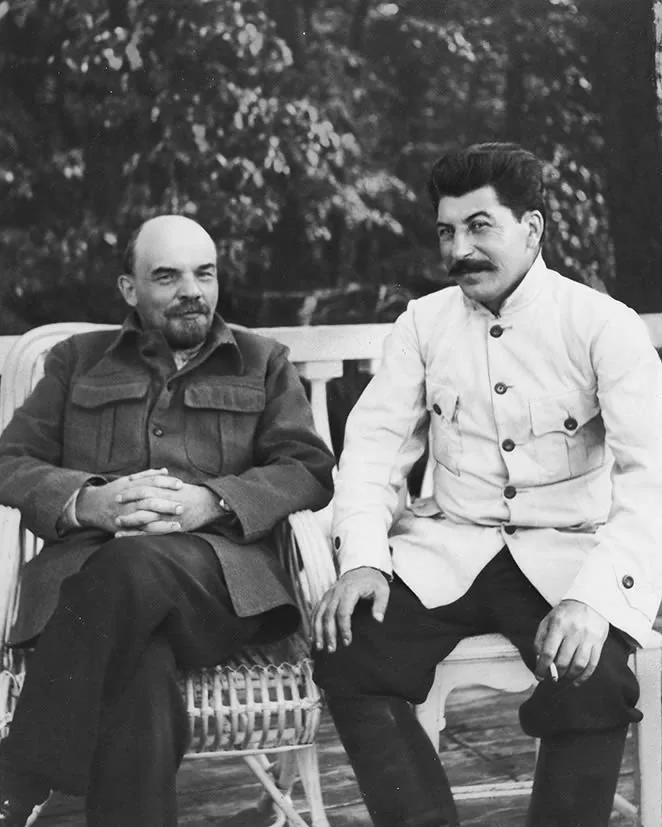
Lenin and Stalin at Gorki, 1922, retouched version. Photo: Maria Ulyanova · Public domain · Source page
Maria Ulyanova, Lenin and Stalin at Gorki, 1922, in a retouched version. According to the file description on Wikimedia Commons, this version was reprinted in Soviet newspapers in 1936 and 1945.
The original was first printed in the photo pages of Pravda in 1922. In this copy Stalin’s face has been smoothed, and the pockmarks on his skin removed. On Wikimedia Commons the file is titled “Doctored Stalin-Lenin.”
- What has changed between this copy and the 1922 photograph? The skin of Stalin’s face looks smoother, and the retouching removed the marks on it. Everything else in the frame looks much the same, which is why such edits are easy to miss.
- Why might a state-controlled press change a face? Retouching can be routine. But in a press controlled by the party, even a small edit is a choice about how the leader should look.
- Who is the source, and what does the file not tell us? The photographer was Lenin’s sister, Maria Ulyanova. The file does not say who retouched this copy or why, so we have to read the change against the reprint dates and the photograph’s own history.
The village and the Terror
March 1930
Dizzy with success
In March 1930 Stalin published an article in Pravda called “Dizzy with Success”. He blamed local officials for going too far, and wrote: “Collective farms must not be established by force.” He also claimed that by 20 February half the peasant farms in the Soviet Union had been collectivised, and that the plan had been overfulfilled by more than 100 per cent.
It sounds like a warning against excess. But it came after a winter in which officials had pushed the villages hard, and many of them had used force. Stalin retreated in words, while the collectivisation campaign had already gone very far.
1932–1933
The famine
The forced campaign and the grain seizures left villages without food. In 1932 and 1933 famine killed millions of people in Ukraine, in Kazakhstan, in the Volga region and in the North Caucasus. Estimates of the excess deaths across the Soviet Union vary widely. R. W. Davies and Stephen Wheatcroft put the total at about 5.5 to 6.5 million; other historians go higher, to about 8.7 million (Wolowyna, 2020). These are estimates, not a count of names.
The campaign had also targeted the kulaks, a label for better-off peasants, and many ordinary families were caught in it. What historians argue about is less the scale than the cause. Did the state know what it was doing? Did it use hunger to break the villages? The question is taken up in the deeper panel below and in the debate at the end.
1934–1938
Kirov and the show trials
In December 1934 Sergei Kirov, the party boss in Leningrad, was murdered. The killing was used to justify tighter control, and the NKVD, the Soviet secret police, was put in charge of the investigation.
The first big public trial in Moscow was held in August 1936. A second came in January 1937, and a third, the Trial of the Twenty-One, in March 1938. The defendants confessed in public to crimes that many of them had not committed, and the verdicts were settled before the trials began. A show trial is one whose result is known in advance.
Source: Order No. 00447
“the following number of persons subject to repression is hereby established:”
Category I: “They are subject to immediate arrest and, after consideration of their case by the troikas, to be shot.”
Category II: “They are subject to arrest and to confinement in concentration camps for a term ranging from 8 to 10 years.”
The order was a plan for mass operations. It set numbers by region for two categories, and it was to run from 5 August 1937 for about four months. It was written for the regional NKVD offices, not for the public.
- Read the two categories. How do they differ, and what do they share? Category I meant death after a quick review by a troika, a panel of three officials. Category II meant camps for eight to ten years. Both were decided by small panels, without a trial, and the order does not ask for evidence.
- Who wrote this, and for whom? It was issued by the NKVD leadership in Moscow, for the regional offices that would carry it out. It is written in a neutral, bureaucratic language, which hides what it describes.
- What does the bureaucratic language hide, and why does it matter? Phrases such as ‘subject to repression’ and ‘established number’ make mass killing read like paperwork. Historians read such texts for what they leave unsaid, as well as for their numbers.
The quotas
Numbers that grew
681,692
The first quotas in the order added up to about 76,000 people in the first category and about 193,000 in the second, which meant camp sentences in the Gulag system. Altogether about 268,000. Counts differ slightly, depending on the translation and the table used.
The quotas did not stay fixed. Historians who have counted the results, Timothy Snyder among them, find that by the end of 1938 the NKVD had executed about 387,000 people under the order. The first quota was exceeded many times over. The NKVD’s own totals for 1937–38, in a 1953 compilation by the Soviet interior ministry, give 681,692 executions and about 1.58 million arrests.
Myth
Stalin killed twenty million people in the Terror.
The truth
No source supports twenty million for the Terror of 1937–38. The NKVD’s own records give 681,692 executions in 1937–38 and about 1.58 million arrests. Scholarly estimates of total deaths in the Terror run from roughly 700,000 to 1.2 million, and the debate continues.
The evidence
The figures come from the 1953 Soviet interior ministry compilation and from historians such as Werth and Snyder. The figure of twenty million does not appear in them. It is often mixed up with the total of all Soviet repression over decades, including the Gulag and the famine, which is a different and much debated question.
May–June 1937
The army and the security police
In May 1937 Marshal Mikhail Tukhachevsky, one of the most famous commanders of the Red Army, was arrested. In June he was tried in secret by a special military tribunal and executed. Other senior officers were tried with him. The sources do not agree on every detail of the eight generals’ fates, so this lesson gives no number for them.
Nikolai Yezhov, the head of the NKVD in the worst years, was himself removed and executed in 1940. Each wave of arrests ended with the arrest of the men who had carried it out.
The pact and the war
Summer 1939
Talks in Moscow
In the summer of 1939, Britain, France and the Soviet Union held talks in Moscow about a common front against Germany. They moved slowly. The Western delegations were less clear and less quick than Moscow wanted, and the military questions went on without a result.
In August Berlin made a different offer: a non-aggression pact, and a visit to Moscow by the German foreign minister, Joachim von Ribbentrop.
A decision point
You are a member of the Soviet leadership.
Moscow, August 1939.
The talks with Britain and France have stalled. Their delegates came, but they gave no firm commitments. Now Berlin offers a non-aggression pact. Germany is already preparing to attack Poland, which lies between your country and Germany.
A pact would buy time and borders. But it also means working with a regime that names communists as its chief enemy.
What do you advise?
- Continue the talks with Britain and France, and press for a firm military alliance against Germany. It keeps the Western option open. But the talks have stalled, and it is unclear what would follow if Germany attacked Poland. The Soviet Union might find itself alone.
- Sign a non-aggression pact with Germany, with a secret agreement on spheres of influence in Eastern Europe. It would probably buy time and territory, and keep the Soviet Union out of war in 1939. It would also mean dividing Eastern Europe with a dictatorship, and leaving the states in between without protection.
- Stay neutral, with no treaty, and wait to see who wins. It keeps options open. But Germany might attack without a treaty, and the western border would have no agreed line.
What really happened
Sign a non-aggression pact with Germany, with a secret agreement on spheres of influence in Eastern Europe.
The Soviet leadership chose the pact. The treaty is dated 23 August 1939, and Molotov and Ribbentrop signed it in Moscow. A secret protocol divided Eastern Europe into spheres of influence. The public text was a non-aggression treaty.
Some accounts say the pact was actually signed a day later and dated back. This lesson follows the date on the document.
Stalin wanted time, borders, and assurance that Germany would not turn east in 1939. He did not trust Britain and France, who had given way at Munich about a year earlier. Historians differ on how much he expected war, and on whether he believed the pact would last. It is one of the most debated decisions of the twentieth century.
23 August 1939
The handshake
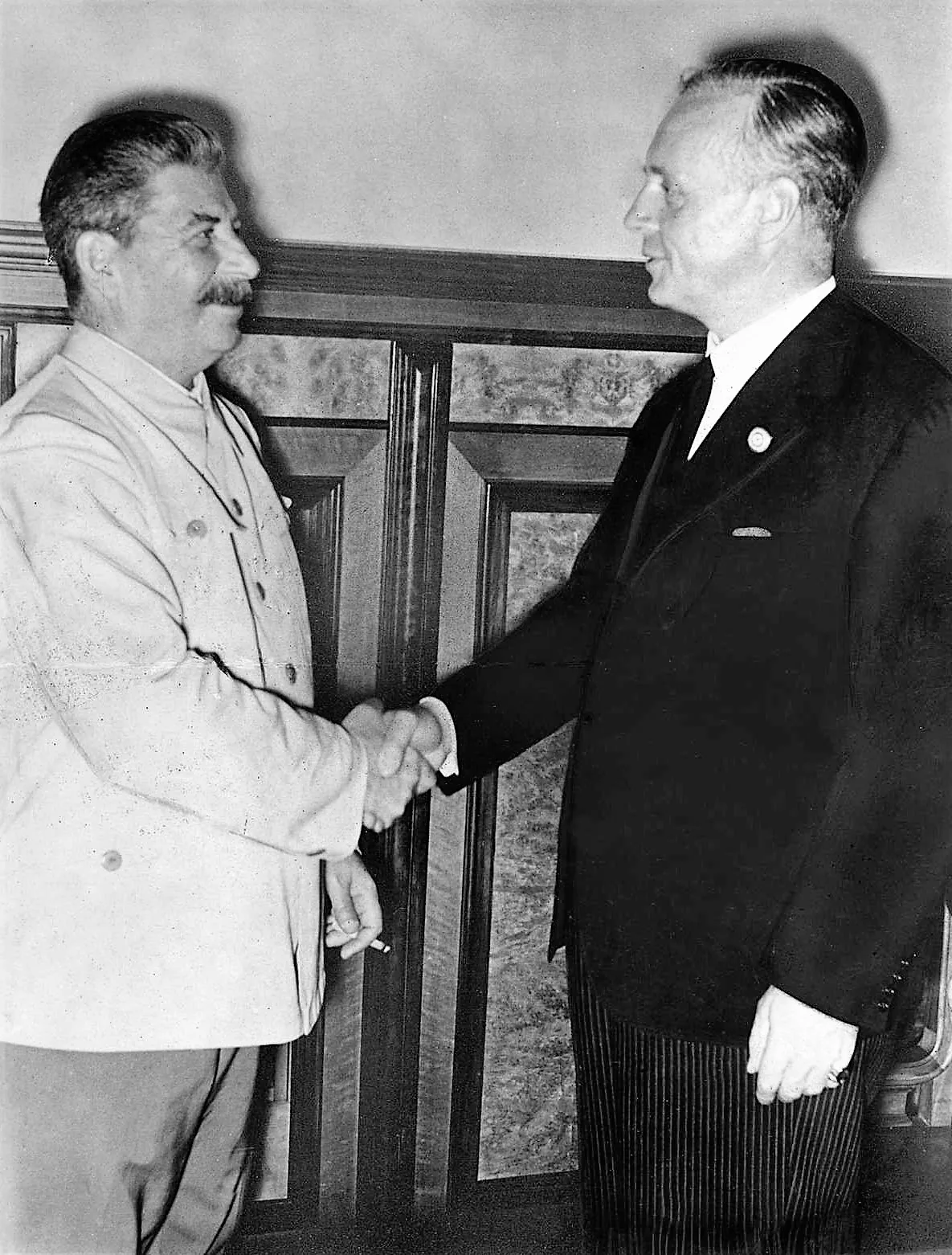
Stalin and Ribbentrop, Moscow, 23 August 1939. German Federal Archive (Bundesarchiv), image 183-H27337 · Bundesarchiv, Bild 183-H27337 / Helmut Laux · CC BY-SA 3.0 · Source page
The photograph shows Stalin shaking hands with the German foreign minister, Joachim von Ribbentrop, in the Kremlin. The German Federal Archive dates it to 23 August 1939, the day the treaty is dated. Molotov signed for the Soviet Union, and Ribbentrop for Germany.
The handshake is the public face of the deal. The secret protocol does not appear in any photograph.
Source: The secret protocol
“the northern boundary of Lithuania shall represent the boundary of the spheres of influence of Germany and U.S.S.R.”
“In any event both governments will resolve this question by means of a friendly agreement.”
“The German side declares its complete political disinterest in these areas.”
“This protocol shall be treated by both parties as strictly secret.”
The public treaty promised not to attack each other. The protocol was a separate paper, kept secret, that drew lines across Eastern Europe. It was signed by the German foreign minister and the Soviet foreign minister.
- Which places and states appear in these lines, and what does ‘spheres of influence’ do? Lithuania is named. ‘Spheres of influence’ means each power has a free hand in its zone, without saying so openly. The phrase hides who would control which land and people.
- Why does the text say it must be ‘strictly secret’? A treaty that divided neighbours was not something either government wanted to show the world. The secrecy tells us that both governments knew how the document would look.
- What does the text leave out? It does not say what will happen to the people living in these areas, and it does not ask them. Their fate comes through later events, above all the invasion of Poland in September 1939.
September 1939
Poland and Finland
On 17 September 1939, sixteen days after Germany attacked Poland from the west, Soviet forces crossed into eastern Poland. The Soviet Union took the areas that the protocol had assigned to it. In the following months it pressed the Baltic states to accept Soviet bases, and in November 1939 it attacked Finland in the Winter War.
Spring 1941
The warnings
From spring 1941 warnings reached Moscow. Richard Sorge, a Soviet spy in Tokyo who was close to the German ambassador there, sent reports that Germany was preparing to attack. On 30 May he reported that Berlin had told the ambassador that the attack would come in the latter part of June. On 1 June he gave mid-June as the expected start. On 20 June he reported that, in the ambassador’s view, war between Germany and the Soviet Union was inevitable.
The British warned too, in a letter from Churchill that reached Stalin through the deputy foreign minister, Andrei Vyshinsky. On the evening of 21 June a German deserter crossed the lines and said that the attack would begin at 4 a.m. the next morning.
A decision point
You are a senior official in the Soviet defence ministry.
Moscow, the night of 21 June 1941.
The warnings came from several sources: Tokyo, London, and a German deserter who named the hour of the attack. Some reports contradict each other. The border is quiet. The commanders in the western districts are asking for orders. A full alert might look like provocation in Berlin. Waiting could cost hours that matter.
What order do you give tonight?
- Order every unit in the western districts to full combat alert at once, with all the measures that go with it. The forces would be ready at dawn. But it might be read in Berlin as provocation, and it could bring war sooner. The armies would probably take fewer losses in the first hours.
- Order readiness in quiet steps: stronger guards, units prepared, some forces moved, but no open alarm. This is the cautious middle path. Forces would be better prepared, though not fully, and Berlin would hear no clear signal. Whether it is enough depends on how fast the attack comes.
- Trust the pact and the German word, and treat the warnings as disinformation. The army would stay on normal footing. If the deserter was right, the first hours of the attack would find the forces unready, and commanders unable to respond in time.
What really happened
Order readiness in quiet steps: stronger guards, units prepared, some forces moved, but no open alarm.
The orders issued late on 21 June told the forces to be ready for combat and to avoid any provocative act. Stalin chose not to order a full alert. The German attack began before dawn on 22 June 1941, at about 3:15 a.m.
Stalin believed that Germany would not fight a war on two fronts so soon after the pact, and that a visible alert would give Hitler a pretext. Many officers wanted more readiness. The debate is still open. Historians ask how far Stalin believed the warnings, and how far his fear of provoking Germany tied his hands.
22 June 1941
The invasion
Before dawn on 22 June 1941, German forces attacked along a front stretching from the Baltic to the Black Sea. Within hours the first Soviet orders went out from Moscow, including one for counter-attacks across the border. The largest war the Soviet Union ever fought had begun.
Myth
After the invasion Stalin vanished for ten days, and the country had no leader.
The truth
This is a popular story, and the sources do not settle it. What is documented is that Soviet orders went out from the first morning, and that Stalin did not address the nation until 3 July 1941, eleven days after the invasion. Some accounts describe him withdrawing from view for a time, but they disagree on the dates, and no published record shows what he did hour by hour on 22 June.
The evidence
The radio address of 3 July 1941, in which Stalin spoke to the nation after the invasion, is documented. Historians describe the first days in different ways, so the lesson presents the story as debated, not as fact.
After the war, and the quiz
July 1942
Not one step back
In the summer of 1942 German armies pushed deep into southern Soviet Russia. On 28 July 1942 Stalin signed Order No. 227, under the words “Not one step back!” (Ни шагу назад!). It treated retreat without orders as treason, and it set up blocking detachments behind the front, with orders to shoot those who tried to fall back.
In the first three months, one historian’s count gives about 1,000 soldiers shot by these units and about 24,000 sent to penal battalions. It is one of the harshest documents of the war, and it was aimed at Soviet soldiers themselves.
February 1945
Yalta
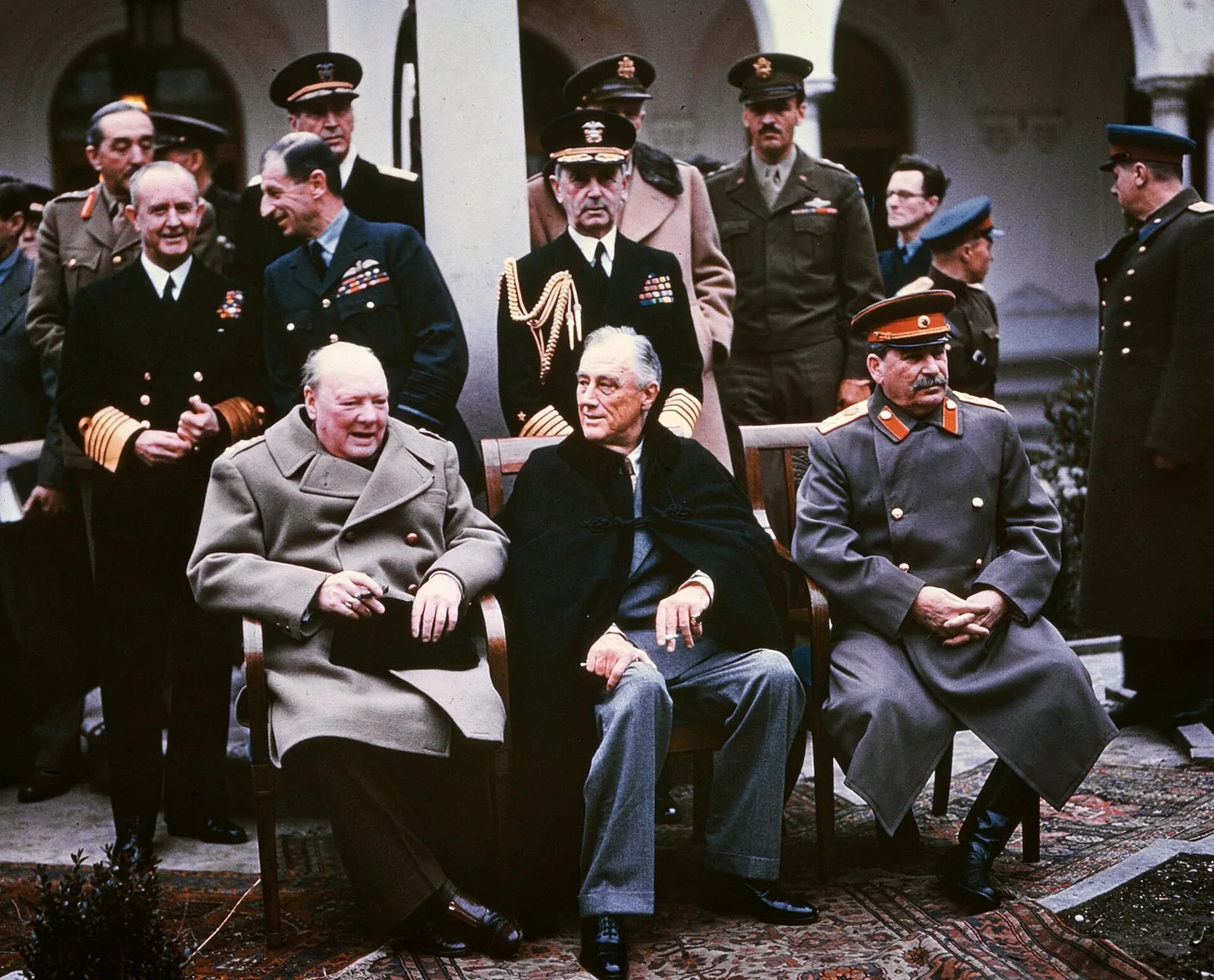
Yalta Conference, 1945. US Army Signal Corps collection, US National Archives · Public domain · Source page
In February 1945, with Germany close to defeat, Churchill, Roosevelt and Stalin met at Yalta in Crimea. They planned the end of the war and the shape of Europe afterwards. Stalin came with the Red Army already in Poland and in Germany. The photograph shows the three leaders, with officers standing behind them.
Much was agreed in general terms. Historians still argue about how much was promised, and how much was simply accepted by the West.
May 1948
Recognition of Israel
On 14 May 1948 the State of Israel was declared. On 17 May the Soviet Union gave it the first de jure recognition. Molotov’s note reached Israel the next day, 18 May, and some books date the recognition to that day. The Soviet Union supported the new state in its first months.
1948–1952
Cosmopolitans
After the war the state launched campaigns against what it called “rootless cosmopolitans”. The label was aimed especially at Jews and at intellectuals with foreign ties. The Jewish Anti-Fascist Committee, set up during the war to rally support, was caught up in this campaign. Its leaders were arrested in September 1948 and again in June 1949.
On 12 August 1952, 13 of the defendants were executed in the Lubyanka prison in Moscow. They are remembered as the “Night of the Murdered Poets”. The trial was conducted in secret.
1952–1953
The Doctors’ Plot
From the autumn of 1952 the security services arrested many doctors, many of them Jewish, and accused them of plotting to kill Soviet leaders. On 13 January 1953 the official news agency TASS announced the arrest of a group of doctors accused of sabotage, and the story became a wave of hostile propaganda.
Stalin died on 5 March 1953. On 31 March a decree cleared the doctors. On 4 April the Ministry of Internal Affairs declared the case fabricated, and Pravda printed that on 6 April.
February 1956
The Secret Speech
On 24 and 25 February 1956, at the 20th Congress of the party, Nikita Khrushchev gave a closed speech about Stalin. In one passage he described the repressions of 1937 and 1938, and said of Stalin: “Possessing unlimited power, he indulged in great willfulness and stifled people morally as well as physically.”
The speech was not published in the Soviet Union at the time. It was read to party members, and in time it reached the world outside.
The sequence, in order
- January 1924 Lenin dies. The letter stays in the party’s hands, and Stalin stays in the secretariat.
- November 1929 Bukharin is expelled from the Politburo. Collectivisation of the villages begins.
- 1932–1933 Famine strikes the Soviet Union, above all in Ukraine, Kazakhstan, the Volga region and the North Caucasus.
- 1937–1938 The Great Terror. By the NKVD’s own figures, 681,692 executions and about 1.58 million arrests.
- 23 August 1939 The Molotov–Ribbentrop Pact is dated. The secret protocol divides Eastern Europe.
- 17 September 1939 Soviet forces enter eastern Poland.
- 20 August 1940 Trotsky is attacked in Mexico City and dies the next day, in a killing carried out by an NKVD agent.
- 22 June 1941 Germany invades the Soviet Union. Stalin addresses the nation on 3 July.
- July 1942 Order No. 227, and the blocking detachments.
- May 1945 The war in Europe ends. The arrangements made at Yalta in February shape the postwar map.
- 17 May 1948 The Soviet Union gives Israel de jure recognition.
- 12 August 1952 13 defendants of the Jewish Anti-Fascist Committee are executed.
- March 1953 Stalin dies on 5 March. On 31 March the doctors are cleared.
- February 1956 Khrushchev’s Secret Speech. The same year, Lenin’s letter is printed.
Who made the Terror?
Did the Great Terror come from one man’s plan, or from a system that worked at every level?
- Robert Conquest, The Great Terror (1968) The Terror was directed from the top, and Stalin’s own choices and orders were decisive. The picture is of a leader who used the power of the state to remove real and imagined enemies.
- J. Arch Getty, Origins of the Great Purge (1985) The Terror grew out of the party’s own internal life: local officials, quotas that rose from below and fears of the centre. Stalin still matters, but the purge was not simply one man’s plan.
- Oleg Khlevniuk, Stalin: New Biography of a Dictator (2015) Stalin’s power was real and personal, but he worked through a web of officials, and many of them carried out the Terror on their own initiative. The question is not either/or.
The archives opened after 1991 gave historians far more documents. They narrowed the questions, but did not close them. The heart of the argument is what counts as ‘the system’, and what counts as ‘Stalin’.
Check yourself
What did Lenin’s Testament ask the party to do about Stalin?
Answer: Think about removing him from the General Secretary post.. Yes. The letter and its postscript ask the comrades to think about a way of removing him from that post.
Check yourself
Why does Stalin have two birth dates?
Answer: Records from Gori give 1878, and a later official biography gave 1879.. Yes. The 1878 date appears in early records, and 1879 appears in a biography written after he rose to power.
Check yourself
What did NKVD Order No. 00447 do?
Answer: It set quotas, region by region, for people to be shot or sent to camps.. Yes. Each region had numbers for the two categories, and the order was meant to run for about four months.
Check yourself
What did the secret protocol of 23 August 1939 do?
Answer: It split Eastern Europe into spheres of influence.. Yes. The secret protocol set spheres of influence, and asked that it be kept strictly secret.
Check yourself
Which statement about the warnings of 1941 is best supported by the lesson?
Answer: Several warnings came in, and the leadership did not order a full alert.. Yes. The spy, the British and the deserter all warned, and the orders of 21 June asked for readiness without provocation.
Check yourself
What did Khrushchev’s Secret Speech of 1956 do?
Answer: It criticised the repressions of 1937–38 and Stalin’s unlimited power.. Yes. The speech described the repressions and the unlimited power that allowed them, given at the closed session of the 20th Congress.
Terms
- General Secretary The head of the party’s secretariat, which ran its staff, files and appointments. The post sounded like office work, but it gave its holder control over the party machine.
- Politburo The small committee at the top of the Communist Party, which made the main decisions between congresses. It was chosen by the Central Committee.
- Testament Lenin’s letter to the party congress, dictated in December 1922 with a postscript in January 1923. Later readers called it his Testament, his last word on the party.
- kulak A better-off peasant. The Soviet state used the word for landowners and prosperous farmers; in the late 1920s it was stretched to cover many ordinary families.
- collectivisation Forcing peasant farms into collective farms, where land, animals and tools were shared, and grain was handed to the state.
- Five-Year Plan A plan for the economy set for five years at a time. The first Soviet Five-Year Plan began in 1928 and put heavy industry first.
- NKVD The Soviet secret police and interior ministry in these years. Its officers made arrests, ran the camps and carried out the orders.
- Gulag The network of labour camps and colonies run by the NKVD. Its name comes from its central administration.
- show trial A public trial whose result is fixed before it begins. The Moscow trials of 1936–38 are the best-known examples.
- Molotov–Ribbentrop Pact The non-aggression treaty between the Soviet Union and Nazi Germany, dated 23 August 1939. Its secret protocol divided Eastern Europe into spheres of influence.
- Gori A small town in Georgia where Stalin was born. At that time it was part of the Russian Empire.
- Julian calendar The older calendar that Russia still used when Stalin was born. It ran behind the Western calendar, and the gap grew over the years.
- Tiflis The city where the seminary Stalin attended stood. Today it is called Tbilisi, the capital of Georgia.
- Orthodox seminary A school that trains young men for the priesthood in the Orthodox Church. Stalin studied at one in Tiflis and left in 1899 without a diploma.
- Nikolai Chernyshevsky A radical Russian writer. Stalin read his work while he was at the seminary.
- Alexander Kazbegi A Georgian writer whose books were among Stalin's reading at the seminary.
- Prosveshcheniye A Russian journal where Stalin's first series of articles on the national question was published.
- Pravda The newspaper of the Communist Party in Russia. Bukharin edited it, and Stalin published articles in it.
- Bolsheviks The radical wing of the socialist party in Russia, led by Lenin. In 1917 they seized power.
- Secretariat The party body that ran its staff, its files and its appointments.
- Central Committee The top governing body of the party. In April 1922 it made Stalin General Secretary.
- Comintern An international organisation of communist parties from around the world, dominated by Moscow.
- Red Army The army of the Soviet Union after the revolution. Tukhachevsky was one of its most famous commanders.
- Nikolai Bukharin A Bolshevik economic theorist who edited Pravda. Stalin first allied with him, then turned against him, and in 1929 he was removed from the Politburo.
- Zinoviev A Bolshevik leader. In the years after Lenin's death he worked with Stalin against Trotsky, then opposed him.
- Kamenev A Bolshevik leader who read Lenin's letter to the Council of the Elders. Later he joined Trotsky and Zinoviev against Stalin.
- Trotsky A Bolshevik leader, Lenin's partner and the organiser of the Red Army. In 1929 he was expelled from the Soviet Union to Turkey.
- Alma-Ata A city in Central Asia, now called Almaty, in Kazakhstan. Trotsky was sent into exile there in 1928.
- Order No. 227 A Soviet order from July 1942. It treated retreat without orders as treason and set up blocking units behind the front, with orders to shoot those who fell back.
- Penal battalions Army units to which soldiers were sent as punishment, often for the most dangerous fighting.
- Yalta A town in Crimea where Churchill, Roosevelt and Stalin met in 1945 to plan the end of the war.
- Richard Sorge A Soviet spy in Tokyo, close to the German ambassador there. From spring 1941 he sent Stalin warnings of a German attack.
- Lubyanka A prison and interrogation centre of the secret police in Moscow. Thirteen defendants in a secret trial were executed there in 1952.
- Rootless cosmopolitans A label the Soviet authorities pinned on people seen as foreign to the nation, especially Jews and intellectuals with foreign ties.
Sources
- V. I. Lenin, Letter to the Congress (the ‘Testament’), 23 December 1922, with postscript of 4 January 1923, Collected Works, vol. 36. English text on the Marxists Internet Archive
- Secret additional protocol to the Molotov–Ribbentrop Pact, Moscow, 23 August 1939. English text on Wikisource
- NKVD Order No. 00447, 30 July 1937. English translation by Benjamin Sher, published on Kyle Orton’s website, based on J. Arch Getty and Oleg Naumov, The Road to Terror (2008)
- N. S. Khrushchev, Secret Speech to the 20th Congress of the CPSU, 24–25 February 1956. English text on the Marxists Internet Archive
- Robert Service, Stalin: A Biography (2004)
- Stephen Kotkin, Stalin, Volume I: Paradoxes of Power, 1878–1928 (2014)
- Oleg Khlevniuk, Stalin: New Biography of a Dictator (2015)
- J. Arch Getty, Origins of the Great Purge: The Soviet Communist Party Reconsidered, 1933–1938 (1985)
- Robert Conquest, The Great Terror: Stalin’s Purge of the Thirties (1968)
- Timothy Snyder, Bloodlands: Europe Between Hitler and Stalin (2010)
- R. W. Davies and Stephen Wheatcroft, The Years of Hunger: Soviet Agriculture, 1931–1933 (2004)
- Anne Applebaum, Red Famine: Stalin’s War on Ukraine (2017)
Image credits
- Lenin and Stalin at Gorki, 1922. Photo: Maria Ulyanova. Public domain · Public domain · Source page
- Tsarist police card, c. 1911. From the files of the Tsarist secret police, St Petersburg · Public domain · Source page
- Lenin and Stalin at Gorki, 1922, retouched version. Photo: Maria Ulyanova · Public domain · Source page
- Stalin and Ribbentrop, Moscow, 23 August 1939. German Federal Archive (Bundesarchiv), image 183-H27337 · Bundesarchiv, Bild 183-H27337 / Helmut Laux · CC BY-SA 3.0 · Source page
- Yalta Conference, 1945. US Army Signal Corps collection, US National Archives · Public domain · Source page


