Spartacus: the gladiator who terrified Rome
A small band of gladiators escaped from a school in Capua. Within two years they had beaten Roman armies and threatened Rome itself. Who was Spartacus, what did he want, and what do we really know about him?
Decisions, questions and your own progress, in the app
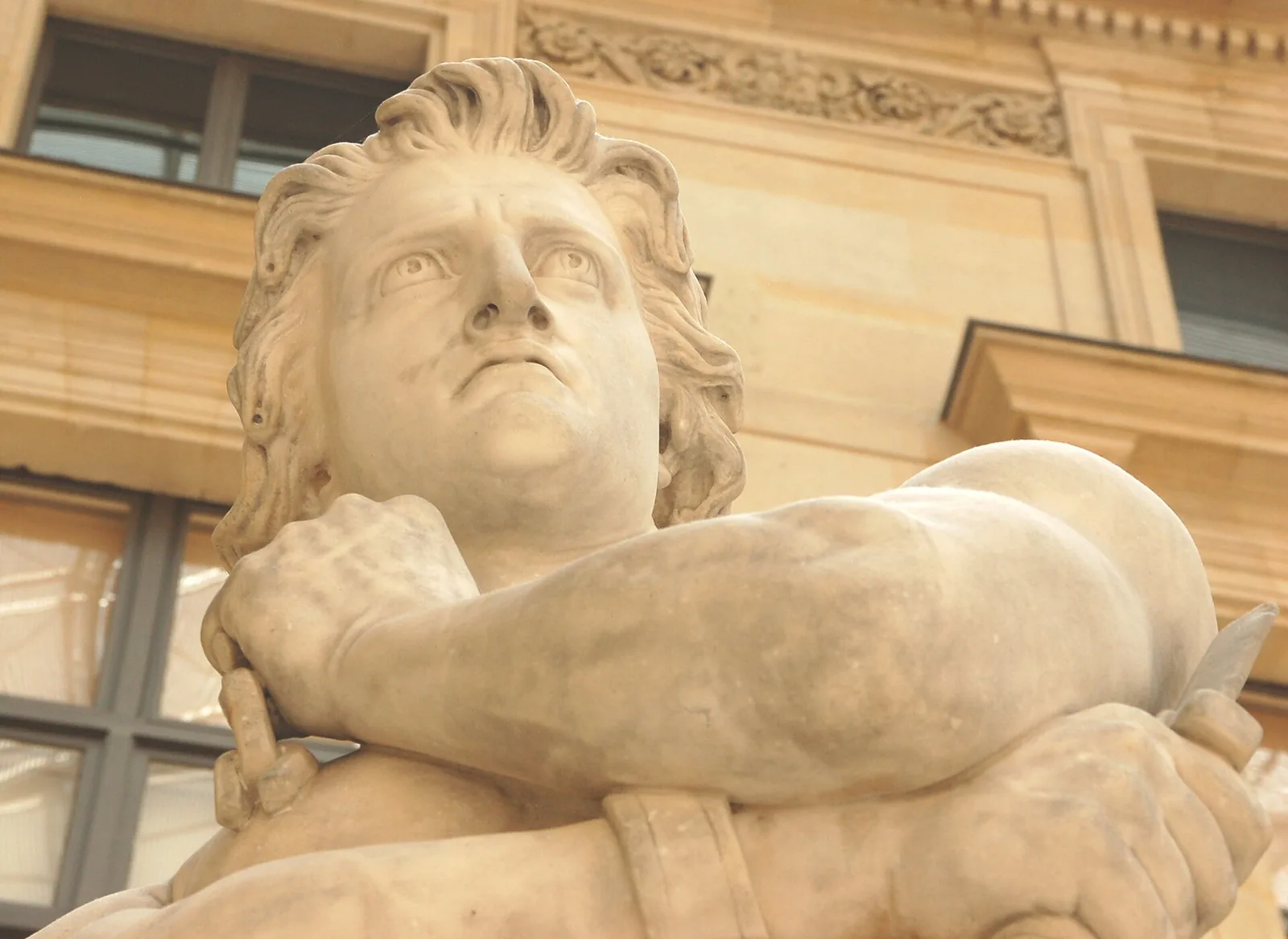
Spartacus, Denis Foyatier, 1830. Musée du Louvre, Paris. Photo: Gautier Poupeau · Gautier Poupeau from Paris, France · CC BY 2.0 · Source page
Capua: the breakout
Capua, 73 BC: the breakout
A night in Capua, a town in southern Italy. Gladiators are planning an escape. They were trained to fight to the death for a crowd, and dozens of them break out of the school where they are kept.
Within two years they have beaten Roman armies, and the Senate in Rome is afraid. Who led them? What did they want? And what do we really know about him?
Background
Rome at war, and a Rome of slaves
In 73 BC Rome is fighting on several fronts. In Spain the Roman general Sertorius has rebelled against the government in Rome and held large parts of the province for years. In the east, Roman armies are fighting King Mithridates of Pontus.
In southern Italy the economy rests on slave labour. Rich owners run huge farms, called latifundia, worked by many slaves. Gladiators were part of the same system: many were slaves or prisoners of war, watched by crowds in Rome and Italy. They trained in a ludus, a gladiator school, where they were taught to fight and closely guarded.
Capua
A school in a rich town
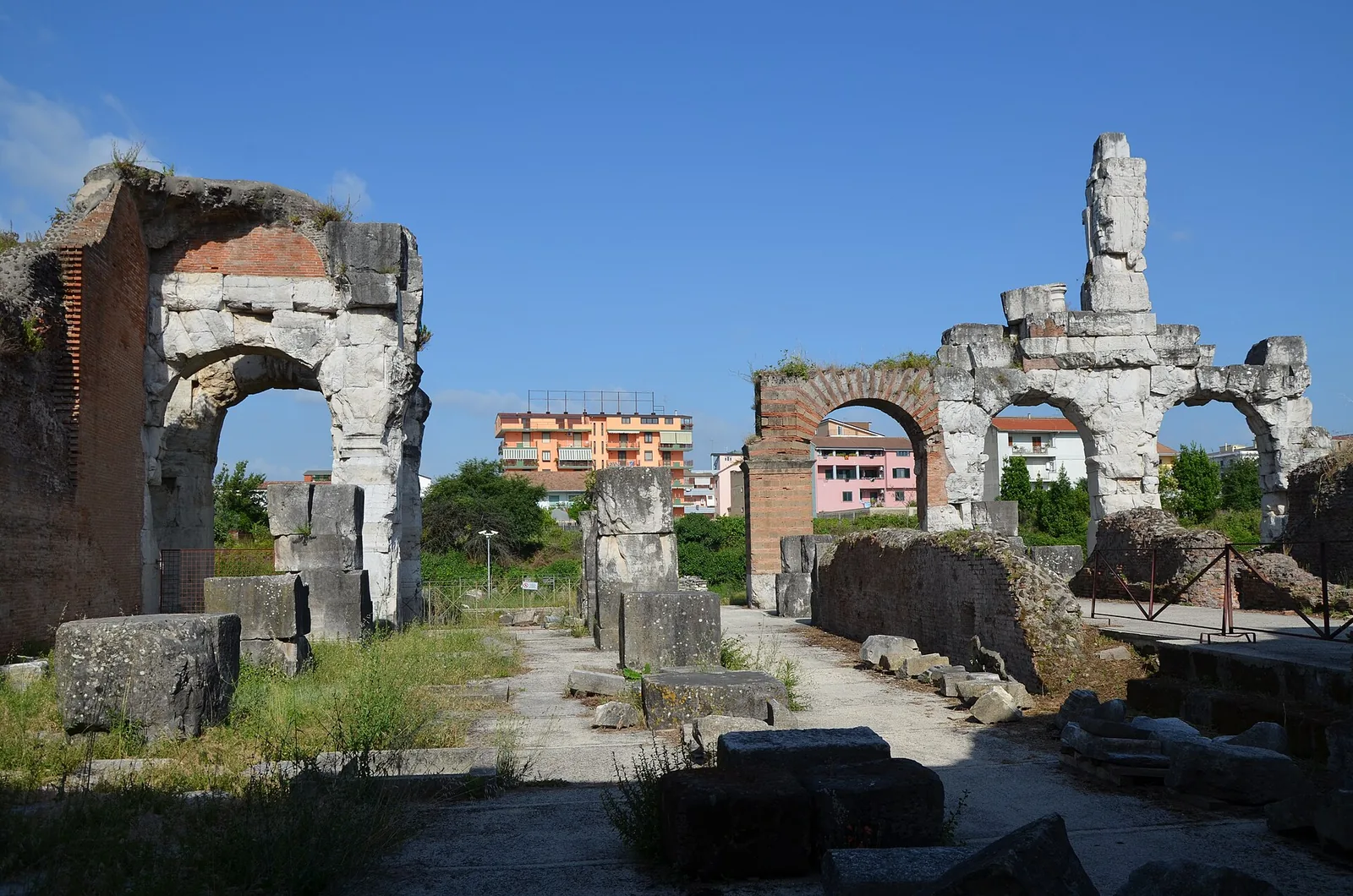
The Roman Amphitheatre, Capua, 2014. Photo: Carole Raddato · Carole Raddato from FRANKFURT, Germany · CC BY-SA 2.0 · Source page
Capua was a rich town in Campania, north of Naples. There Lentulus Batiatus kept a school of gladiators. According to Plutarch, most of its men were Gauls and Thracians, and they were kept in close confinement, not because of anything they had done, but because of their owner’s injustice.
We do not know where the school stood, and no trace of it survives. The arches in the photograph belong to an amphitheatre usually dated to about AD 100, long after Spartacus. Some scholars think an earlier building stood on the site.
73 BC
Seventy-eight, or thirty, or seventy
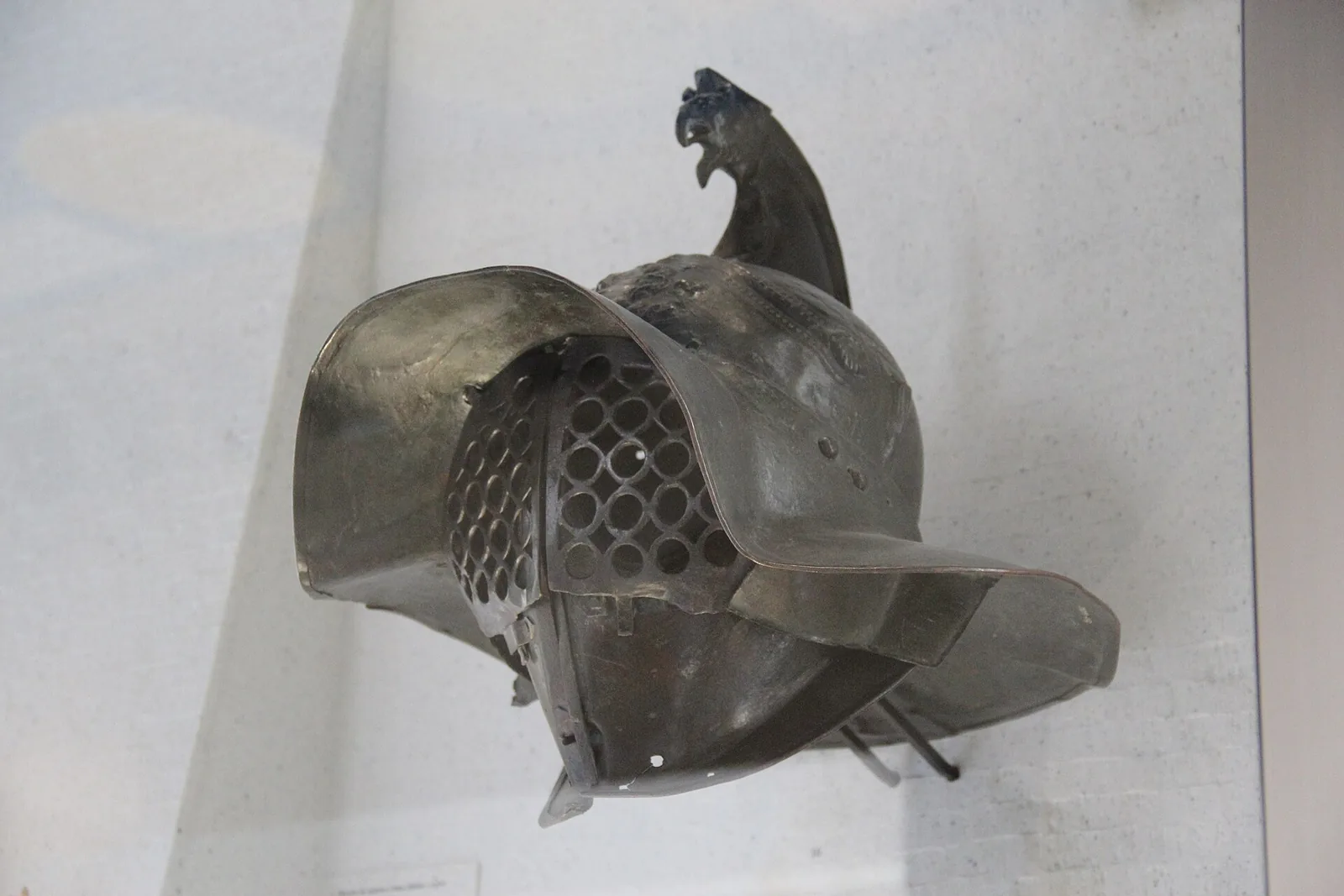
Bronze Thracian gladiator’s helmet from Pompeii, 1st century AD. Commons lists it at the Louvre Museum, Paris. Photo: Gary Todd · CC0 · Source page
The sources do not agree on how many got out. Plutarch says seventy-eight men seized cleavers and spits from the school’s kitchen and broke out. On the road they met wagons carrying weapons for gladiators to another town, took the weapons and armed themselves. Appian says about seventy, armed with clubs and daggers taken from travellers. Florus says thirty or rather more.
They elected three leaders, and the first was Spartacus. The other two names in the sources are Crixus and Oenomaus. They made their camp on Mount Vesuvius, above the Bay of Naples.
Source: Plutarch on Spartacus’s origins
“The first of these was Spartacus, a Thracian of Nomadic stock, … and more Hellenic than Thracian.”
Plutarch, a Greek, wrote moral biographies to show character, not to record battles. He wrote nearly two centuries after the escape.
- Who describes Spartacus, and when? A Greek writing nearly two centuries later, and not an eyewitness.
- Why does the writer stress that Spartacus was more Greek than Thracian? It makes him sound cultured and clever, a man a Greek reader could admire. Ask what the writer gains from such a description.
Myth
Spartacus fought to end slavery, and wanted to free every slave in Italy.
The truth
No ancient source says that. The sources describe gladiators who wanted their own freedom, and runaways who joined them. Historians still argue about what the rebels wanted, but no ancient writer says that the aim was to end slavery itself.
The evidence
Appian (Civil Wars 1.116, trans. Horace White, 1899) says that he ‘persuaded about seventy of his comrades to strike for their own freedom rather than for the amusement of spectators’. According to a review in the Bryn Mawr Classical Review, Aldo Schiavone, in a major modern book on the rebellion, argues that Spartacus was not trying to end slavery (see the debate at the end).
The mountain
73 BC
The praetor’s siege
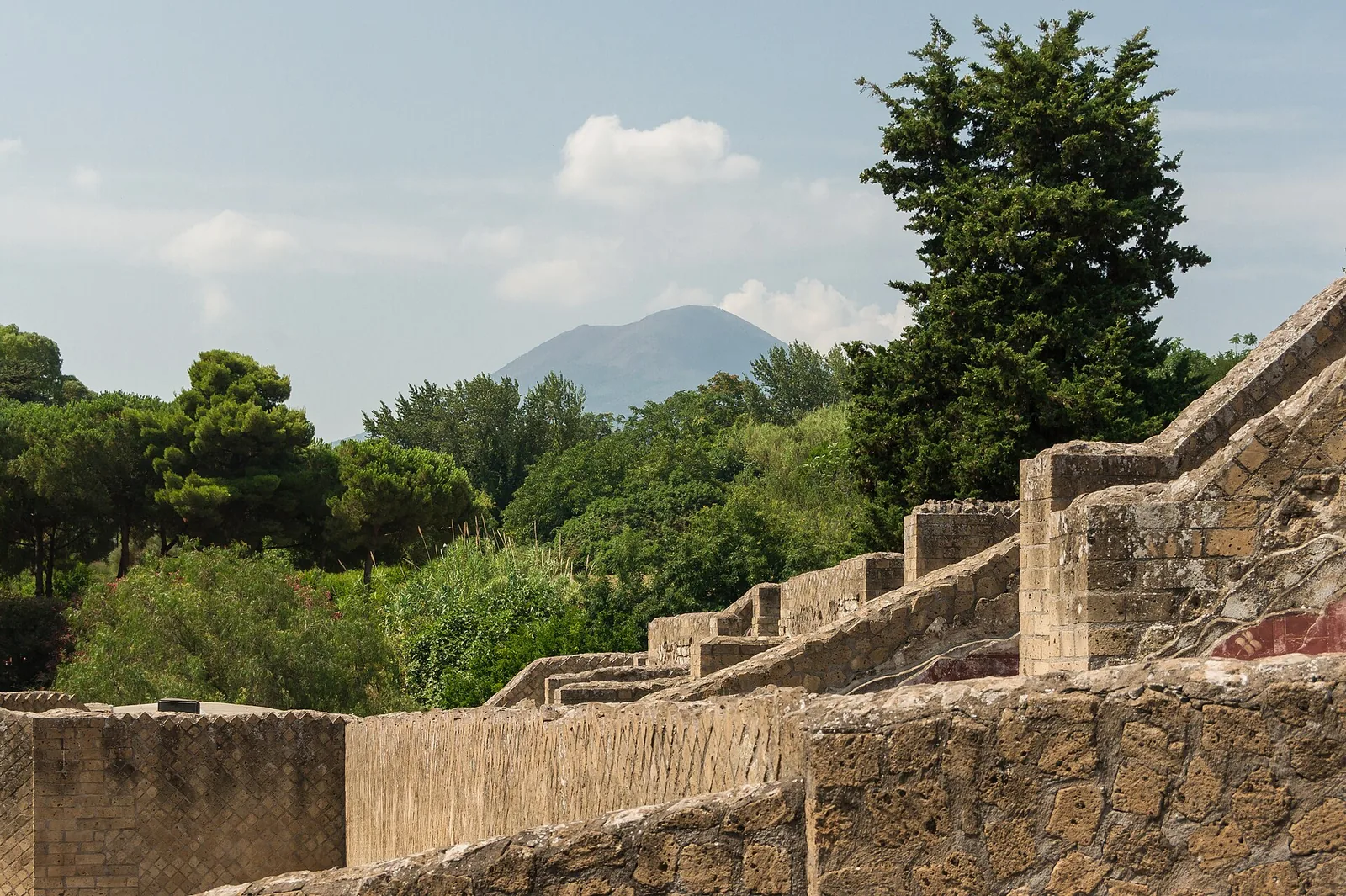
Mount Vesuvius from Pompeii, 2015. Photo: Jebulon · CC0 · Source page
Rome responds. Plutarch says that a praetor named Clodius was sent out with three thousand soldiers. Appian calls him Varinius Glaber, and Florus Clodius Glaber. The sources disagree on his name, so we will call him Glaber. He surrounds the rebels on Vesuvius.
The hill has only one way up, a narrow and difficult path that Glaber’s men watch without a break. On every other side the cliffs are sheer. The rebels have already beaten the soldiers sent out from Capua and taken real weapons from them. But to leave the mountain they must get past the Romans, and the Romans can wait.
A decision point
You are Spartacus.
Mount Vesuvius, 73 BC, during the siege
Below you, three thousand Roman soldiers guard the only path off the mountain. On every other side the cliffs are sheer. Your men have good weapons, but going up or down that narrow path means fighting the men who hold it.
What do you do?
- Send envoys to Glaber, ask for terms and give up your weapons. The sources mention no offer of mercy. Probably you would be taken back to the school in chains, or killed.
- At dawn, go down the only path together and break through the Roman line. The weapons from the wagons would help, but the path is narrow and the soldiers hold it. Most of your men would probably fall on the slope.
- Look for a way down the cliff at night, while the Romans watch the path. A descent in the dark might catch the guards unready. One fall, or one noise, and the plan fails.
What really happened
Look for a way down the cliff at night, while the Romans watch the path.
You chose the cliff. Plutarch says the men cut the wild vine growing across the hilltop, wove its branches into ladders long enough to reach down the cliff face to the plain, and climbed down one by one. The last man stayed above to drop the weapons, then came down himself. The Romans watched only the path, so they were taken by surprise, and the rebels took their camp.
Florus, a later writer, also mentions ropes of vine, but gives no details.
Why the cliff? It was the one way the Romans had not guarded, and it needed nerve. But the vine ladders come from Plutarch, who wrote nearly two centuries later and liked a clever stratagem. We cannot check how the descent was made. What is certain is that the rebels got off the mountain, and that Glaber lost his camp.
An army of runaways
73–72 BC
Herdsmen, shepherds and runaways
The camp on Vesuvius was not the end but the beginning. According to Plutarch, herdsmen and shepherds from the region joined them: sturdy men, quick on their feet. Some were armed fully, and others served as scouts and light troops. Appian says many runaway slaves came, and some free men from the countryside.
Florus adds that the rebels made weapons as they went. They remelted iron from the forced-labour prisons where slaves were kept and turned it into swords, made shields of wicker and hide, and took horses from captured herds. Spartacus was becoming an army.
73–72 BC
Praetors and their lieutenants
Rome sends more men. Plutarch names Publius Varinius, a praetor, who sent his lieutenant Furius against the rebels with two thousand soldiers. The rebels beat Furius. Then they nearly caught Cossinius, who had been sent to help Varinius, while he was bathing near Salinae. Cossinius barely escaped, his camp was taken with great slaughter, and he himself was killed.
Spartacus also took the praetor’s lictors, the attendants who walked before him, and the horse he rode. Appian muddles the commanders’ names further.
Myth
Spartacus led an army of 100,000 slaves.
The truth
The ancient figures vary. Appian gives 70,000 men at the height of the revolt, and 120,000 foot marching on Rome. Florus gives no number, and a modern encyclopaedia gives at least 90,000. These are estimates from a few numbers in hostile sources. Not everyone who joined was a slave: Appian mentions free men from the countryside.
The evidence
The figure of 100,000 does not appear in the texts we have read. Appian gives 70,000 men (1.116) and 120,000 foot on the march towards Rome (1.117). He was writing more than two centuries after the events, and his numbers come with no count behind them.
72 BC
Both consuls take the field
By 72 BC the Senate sends both consuls into the field. These are the two highest elected officials of the Republic. Plutarch says the revolt no longer troubled the Senate as an insult, but as a danger.
The consul Lentulus sends his legates against the rebels. Spartacus rushes them, beats them and seizes all their baggage. Gellius falls on a band of ‘Germans’ who have split from the main body of rebels and cuts them to pieces.
72 BC
Who killed Crixus?
Crixus, another of the three leaders, took his own band away from the main army. Appian says one of the consuls ‘overcame Crixus with 30,000 men near Mount Garganus’ in Apulia, and that two-thirds of Crixus’s men died with him. Livy’s summary names a praetor, Quintus Arrius, who crushed Crixus and 20,000 men, and gives no place. Plutarch does not mention Crixus at all.
Some modern books put Gellius at Garganus, combining Appian, Livy and Plutarch. That is a guess, not a fact.
Source: Florus on the captives and the pyres
“ordered his captives to fight at their pyres, just as though he wished to wipe out all his past dishonor”
Florus wrote a short summary of Roman history. This sentence describes what the rebel did after his commanders died. Appian reports 300 Roman prisoners sacrificed to Crixus’s spirit; Florus gives no number.
- Look at ‘as though’. Is Florus reporting a fact, or guessing a motive? He is guessing a motive he could not know. Ask where the writer’s judgement enters the story.
- Appian gives a number and Florus gives none. Both wrote about the same episode. Which should you trust more? Neither was there. A number does not prove reliability; when writers differ, check both.
North or south
Spring 72 BC
A very large army
By spring 72 BC this is no longer a band of runaways. Appian gives the army 70,000 men at its height. The rebels have beaten a praetor and the armies of both consuls, and taken large amounts of weapons and horses.
The leaders disagree about what to do next, and every road carries a price.
A decision point
You are Spartacus.
Southern Italy, spring 72 BC
Your army is large, and so far it has won every battle. But Rome keeps sending new armies. Some of your men want to go home, to Thrace or to Gaul. Others want the rich farms of the south.
Three roads are open: north, over the Alps and out of Italy; south, to plunder; or straight on Rome.
What do you do?
- Lead the whole army north, over the Alps and out of Italy. Men who want to go home would have a clear road. But the mountains are hard going, and a Roman army could block the passes.
- Stay in the south and plunder the rich estates while Rome is stretched. The plunder would feed the army for a while. But Rome could keep sending armies, and each defeat would wear the men down.
- March on Rome itself, and force the Senate to bargain. A march on the city might shake the Senate. But your army is poorly armed, and no Italian city has joined you. Defeat before Rome’s walls would be likely.
What really happened
Lead the whole army north, over the Alps and out of Italy.
You took the north, the road the sources agree Spartacus first took. Near Mutina (modern Modena, in northern Italy) the rebels beat Gaius Cassius, governor of Cisalpine Gaul, who had about ten thousand men. Florus places the defeat at Mutina. Then the army turned back south.
According to Plutarch, the men would not follow him over the mountains, and preferred to plunder Italy. According to Appian, a consul blocked the road to the Alps, and Spartacus dropped the march on Rome because the army was not ready: poorly armed, and with no city joined to it.
According to Plutarch, Spartacus himself wanted to lead the army over the Alps, so that each man could go home: some to Thrace, some to Gaul. According to Florus, he weighed attacking Rome itself.
Plutarch’s reason concerns the men: they would not listen. Appian’s concerns the army: the road to the Alps was blocked, and the army was not ready for Rome. Modern readers must choose between them, or combine them.
All our main sources wrote from the Roman side of the war, and none lets us hear the rebel camp.
Rome responds
Rome chooses Crassus
According to Plutarch, the Senate was angry with the consuls and gave the war to Marcus Licinius Crassus. Many nobles served under him, because of his reputation and their friendship with him. Crassus took position on the border of Picenum, in eastern Italy, to meet Spartacus as he hurried there.
Crassus and the legion
Marcus Licinius Crassus
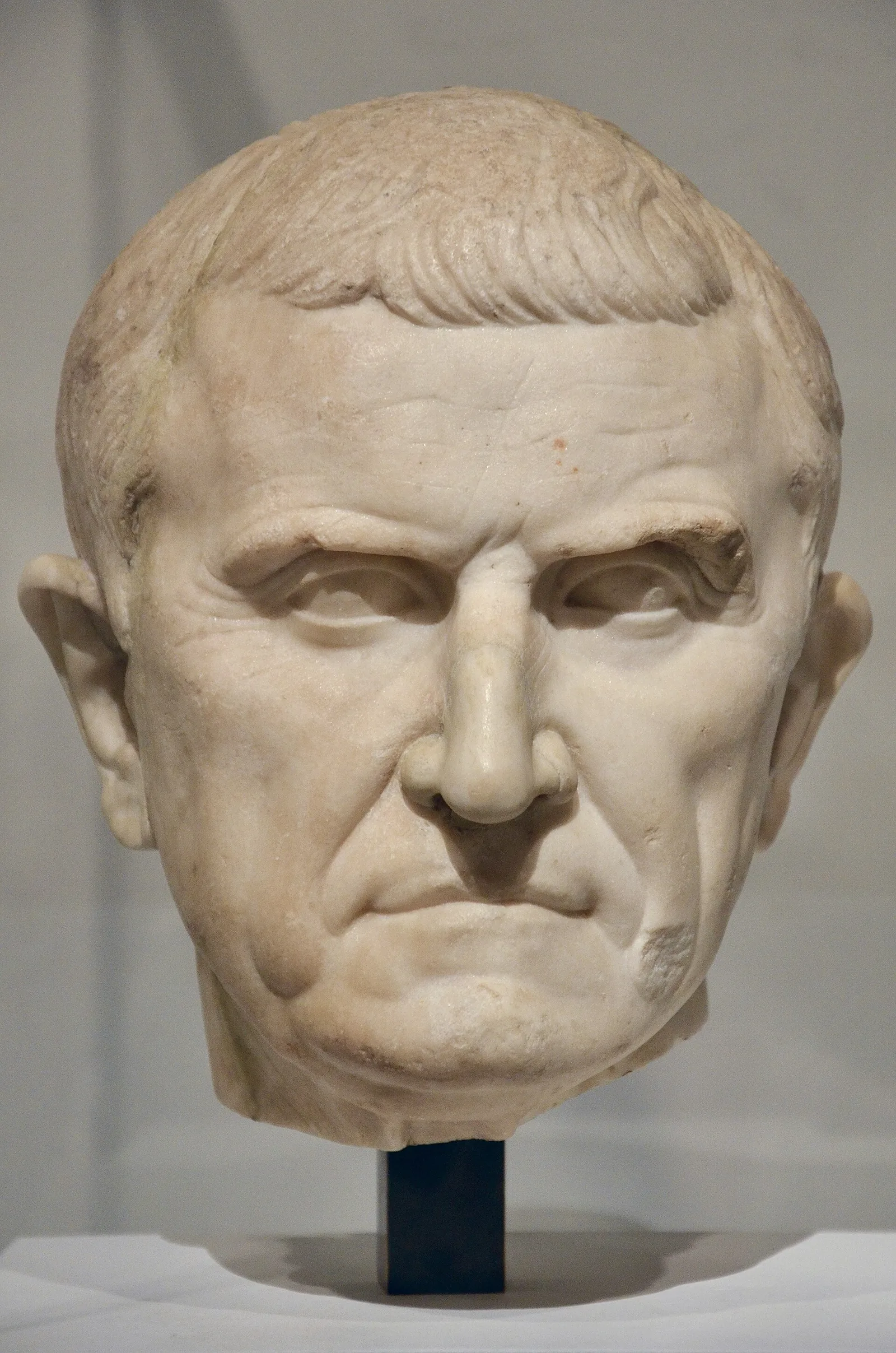
Head of a man, “Crassus” (identification uncertain), mid-1st century BC. Commons lists it at the Musée du Louvre, Paris (Ma 1220); photographed at the Grand Palais, 2014 · Following Hadrian · CC BY-SA 2.0 · Source page
A rich Roman noble who built his power on money and connections, and wanted the glory that Pompey and Caesar had.
- Born: c. 115 BC, Rome
- Died: 53 BC, Carrhae, in Mesopotamia (today in Turkey), killed in battle against the Parthians, the empire east of Rome
- Won: Colline Gate, 82 BC, on Sulla’s side
- Lost: Carrhae, 53 BC
71 BC
Eight legions
Crassus takes the command as a praetor. According to Appian he marched against Spartacus with six new legions, and then took over the two legions of the consuls. Eight in all.
He stands on the border of Picenum and waits for the rebels to come to him.
71 BC
Mummius disobeys
Crassus sends his legate Mummius, a senior officer, with two legions to follow the enemy. The orders were to follow but not to fight. Mummius attacks at the first chance he sees, and is beaten. Many of his men throw away their arms and run.
Crassus is furious. He gives Mummius a harsh reception, and makes the re-armed men pledge to keep their weapons. Now he must decide what to do with the men who ran.
A decision point
You are Marcus Licinius Crassus, a praetor now in command of the army.
Picenum, 71 BC
Two legions have fallen back. Their legate Mummius disobeyed orders and was beaten, and many threw down their arms. The whole army is watching what you do now.
Roman discipline depended on men who held their ranks. Old commanders had a harsh punishment for running: one man in ten, chosen by lot. It is called decimation, from the Latin for ‘taking a tenth’. Plutarch says it had not been used for many years.
What do you do with the men who ran?
- Gather the army and speak to it. Then put the men who ran in the front line of the next battle, to win back their honour. If they believe you and fight well, discipline returns without an execution. If they run again, you have no punishment left that the army has not seen.
- Punish them with heavy labour, the loss of rewards and public shame, and keep them under guard. The shame may fade, and the work may harden the men. But fear of being called a coward can spread through the ranks.
- Choose five hundred of the worst of those who ran, and by lot kill one man in ten, before the whole army. The line would probably hold, and the army would learn that running has a price: fifty men dead, and soldiers who fear their general as much as the enemy. Is that price worth the result? That is the question.
What really happened
Choose five hundred of the worst of those who ran, and by lot kill one man in ten, before the whole army.
Crassus chose decimation. Plutarch says he picked five hundred of the cowards, split them into groups of ten, and had one man from each group killed by lot: fifty men, before the whole army. Appian says he decimated the two legions of the consuls, and reports that some said he decimated the whole army and killed about 4,000.
The sources agree on the method, not on the numbers.
Decimation was an old Roman punishment that Plutarch says had been revived after many years. Plutarch himself calls it disgraceful and horrible, and says the whole army had to watch.
Plutarch does not explain what Crassus had in mind, and we lack his own words. What is known is what followed: he led the army against the rebels again, and Plutarch later credits him with generalship.
The sea and the wall
71 BC
Towards Sicily
Spartacus now moves south through Lucania towards the sea. At the Strait of Messina, the narrow water between the toe of Italy and Sicily, he meets pirate ships from Cilicia, on the south coast of Asia Minor.
Sicily had seen a great slave revolt in the 130s BC. According to Plutarch, Spartacus hoped to rekindle the servile war there by putting two thousand of his men on the island. Plutarch says that war had not long been extinguished.
A decision point
You are Spartacus, on the shore of the strait.
The Strait of Messina, 71 BC
Pirate ships are here. Their captains offer to carry two thousand of your men to Sicily, and ask for gifts to seal the deal.
The current in the strait runs fast. You have no ships of your own, and Crassus’s army is somewhere behind you.
What do you do?
- Trust the pirates: pay them and load the men onto their ships. If they keep their word, a new revolt starts on Sicily. But pirates serve whoever pays best, and a better offer from Rome would end the deal.
- Build rafts from timber and barrels, and cross by yourselves. Rafts are slow and fragile, and the current is fast. Many would drown, and any Roman ship would finish off the rest.
- Turn north at once and try to break through Crassus’s army. You would give up the sea and the island, and might have to fight in the open against the whole Roman army.
What really happened
Trust the pirates: pay them and load the men onto their ships.
You trusted the pirates, as Plutarch says Spartacus did. The Cilicians took the gifts, came to terms, then deceived him and sailed away. He marched back and set up his army on the peninsula near Rhegium.
Florus tells a different story: there were no ships at all, and the rafts of beams and barrels failed in the fast water of the strait.
Plutarch sees betrayal. Florus sees a plan that never had ships behind it. The two accounts agree only on the result: Sicily was never reached. We cannot settle which is right.
71 BC
A wall from sea to sea
Now Crassus understands the shape of the land. Spartacus is penned on a peninsula, a neck of land near Rhegium at the toe of Italy. According to Plutarch, Crassus dug a ditch from sea to sea across the neck, with a wall of astonishing height and strength above it. The work was about three hundred stadia long, roughly 55 kilometres, and the ditch was fifteen feet wide and deep, about 4.6 metres.
The work kept Crassus’s soldiers busy and cut the enemy off from supplies. At first Spartacus ignored it. Then his food began to run short, and he found he was walled in.
71 BC
A snowy night
When the food ran out, Spartacus had to break out. He waited for a snowy night and a wintry storm. He filled part of the ditch with earth, timber and tree branches, and got about a third of his force across.
Plutarch puts it simply: he ‘threw a third part of his force across’. The rest stayed on the near side of the ditch. What followed split the army apart.
The last battle, and the memory
71 BC
The camp that split
After the breakout the rebel army came apart. According to Plutarch, many of the rebels quarrelled with Spartacus and camped by themselves beside a lake in Lucania, whose water, they say, turns from sweet to bitter. Crassus attacked them there. The Romans tried to hide the glint of their helmets, but two women who were making sacrifices for the rebels saw it, and Crassus attacked at once.
Plutarch counts 12,300 rebels killed, and says that only two were wounded in the back. The rest, he says, died standing in their ranks. The leaders of this band were Canicius and Castus.
71 BC
Forced to fight
Crassus was in a hurry. According to Plutarch, Pompey was already on his way from Spain, and many people expected the victory to go to him. Crassus wanted to finish first. He camped near the rebels and began to dig a trench.
According to Plutarch, the rebels could no longer avoid battle. Their men would not obey their leaders: when the leaders tried to march away, the men surrounded them with weapons in hand and forced them back towards the Romans. Some leapt into the trench and fought the diggers, and the battle began.
Where the last battle was fought is not clear. Appian has Spartacus heading for Brundisium, on the Adriatic coast. Florus has him hemmed in around the corner of Bruttium, the toe of Italy. Plutarch names no place. Some modern accounts name the river Silarus in Lucania, but our three main sources do not.
71 BC
The last moments
Plutarch’s account of the last moments is the most vivid. When his horse was brought to him, Spartacus drew his sword and killed it. He pushed through the flying spears towards Crassus himself, and killed two centurions who came at him together, but he never reached Crassus. When his companions had fled he stood alone, still defending himself, and was cut down.
Appian says he was wounded in the thigh, sank to one knee and fought from behind his shield. Florus says he fell in the front rank, fighting like a commander. Appian writes plainly: “The body of Spartacus was not found.”
After the battle
The road
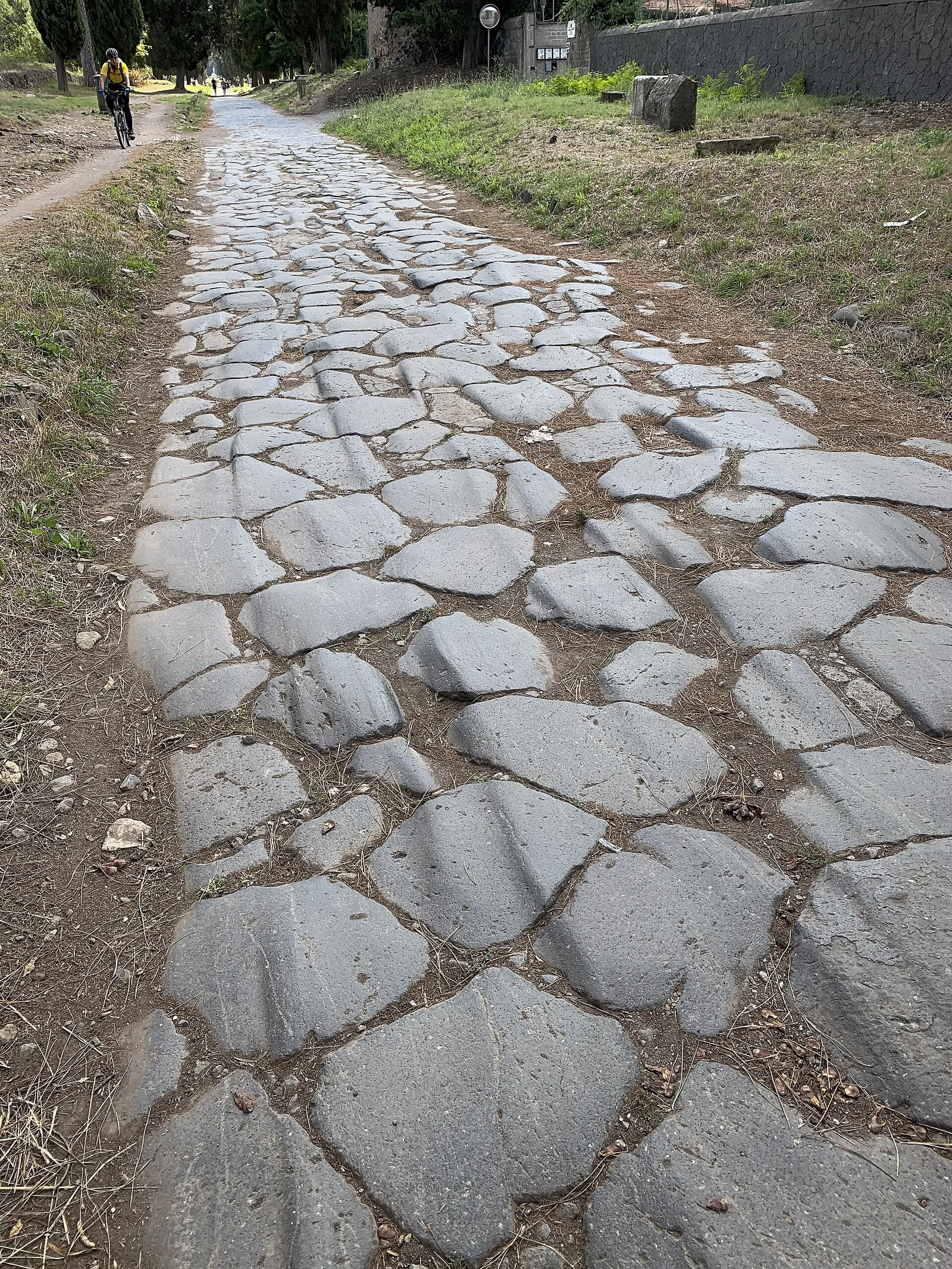
Via Appia Antica outside Rome, 2019. Photo: Nicholas Hartmann · CC BY-SA 4.0 · Source page
Appian says that six thousand survivors were captured and “crucified along the whole road from Capua to Rome”. Crucifixion was a public punishment, meant to frighten. Appian gives this figure alone; no other source we read gives it.
Appian does not name the road; modern readers identify it as the Via Appia, built in 312 BC.
After the battle
Who took the credit?
Pompey was returning from Spain. Plutarch reports that Pompey wrote to the Senate that Crassus had beaten the slaves in open battle, but that he himself had uprooted the war. Pompey had already celebrated a full triumph for his victories over Sertorius in Spain.
Crassus did not dare to ask for the full triumph. He celebrated an ovation instead: a smaller parade, on foot, for a war against slaves.
Source: Plutarch on the ovation
“it was thought ignoble and mean in him to celebrate even the minor triumph on foot, called the ovation, for a servile war.”
Plutarch reports what ‘was thought’, without naming who thought it. He is writing a moral biography, and this detail fits the story he wants to tell about Crassus’s pride.
- Whose opinion is this? Of people Plutarch does not name. ‘It was thought’ hides the author. Ask who is speaking, and whether Romans of the time really thought so.
- Why would a biographer writing nearly two centuries later care what kind of parade Crassus chose? He is looking for character: a man who wanted honour and was embarrassed by its size. The detail says more about the moral he wants to teach than about the war.
What followed
- 73 BC The escape from Capua. The rebels take Glaber’s camp on Vesuvius.
- 72 BC The consuls and Cassius are beaten. Crixus’s band is destroyed. The army marches north, then turns south.
- 71 BC Crassus takes command. Two legions break, and fifty men are put to death by lot.
- 71 BC The pirates fail. Crassus walls off the peninsula. A third of the rebels break out on a stormy night.
- 71 BC The last battle. Spartacus falls, and his body is never found. Six thousand are crucified along the road from Capua to Rome.
- 1861 Karl Marx writes to Friedrich Engels that Spartacus is the ‘most capital fellow’ of antiquity.
- 1916–1919 In Germany the Spartacus League, named after him, opposes the war. At the end of 1918 it helps found the German Communist Party.
- 1960 Stanley Kubrick’s film Spartacus opens, based on Howard Fast’s novel. Its famous scene, in which captured rebels each declare themselves Spartacus, is invented for the film.
Source: Marx on Spartacus, 1861
“Spartacus emerges as the most capital fellow in the whole history of antiquity.”
Marx used Roman history to make a political point. In 19th-century English, ‘capital’ could mean ‘first-rate’, so this is high praise for a rebel. Marx saw Spartacus as a representative of the ancient working class.
- Why would a German writer living in London praise a Roman rebel in 1861? Marx wanted a historical example of working people rising against their masters. The letter tells us as much about 1861 as about 71 BC.
- What does Marx’s praise rest on? On the same few ancient sources we have read. Ask what the judgement adds to them.
Myth
After the last battle, captured rebels stood up one by one and declared that they were Spartacus, to save their leader.
The truth
No ancient source tells this. The scene comes from the 1960 film, which drew on Howard Fast’s novel of 1951. The film is a story made for the screen, not a record of the war.
The evidence
Plutarch, Appian and Florus describe the last battle, and none of them mentions such a scene. Appian states plainly that Spartacus’s body was not found.
Spartacus
A Thracian who had once served as a Roman soldier, according to Appian, and later became a gladiator. He led the best-known slave revolt in Roman history.
- Born: unknown, Thrace, according to the sources
- Died: 71 BC, Unknown. His body was never found., Fell in the last battle against the Roman army
- Won: Vesuvius, 73 BC (the descent); Varinius and the consuls, 73–72 BC; Cassius, at Mutina, 72 BC
- Lost: The last battle, 71 BC (the place is uncertain)
Why did Spartacus not leave Italy?
What did the rebels want, and why did they stay in southern Italy?
- Plutarch (ancient) The rebels wanted to go home, some to Thrace and some to Gaul. Spartacus wanted to lead them over the mountains, but his men refused and went ravaging over Italy.
- Appian (ancient) A consul blocked the road to the Alps, and the army was not ready for Rome: it was poorly armed, and no Italian city had joined it.
- Aldo Schiavone, Spartacus (Italian 2011, English 2013) A review in the Bryn Mawr Classical Review reports that, in his reading, the aim was not to end slavery. Spartacus looked for allies inside Italy, in the cities and among the free poor, against Rome.
All the ancient sources were written from the Roman side, and none lets us hear what was said in the rebel camp. Read Appian and Plutarch side by side, and Schiavone alongside them. For further reading, Barry Strauss’s The Spartacus War (2009) is a good place to compare. Notice what each one assumes.
Check yourself
How many gladiators escaped from Capua? The sources disagree.
Answer: Somewhere between thirty and seventy-eight.. Right. Florus gives thirty or more, Appian about seventy, and Plutarch seventy-eight.
Check yourself
How did the rebels get off Vesuvius when the Romans guarded the only path?
Answer: Down the cliff, on vine ladders.. Right. Plutarch says the rebels wove vine branches into ladders, and Florus mentions vine ropes.
Check yourself
Which of these claims about Spartacus is a myth?
Answer: His body was found after the battle.. Right, this is a myth. Appian states plainly: ‘The body of Spartacus was not found.’
Check yourself
According to Appian, how many prisoners were crucified along the road from Capua to Rome?
Answer: About six thousand.. Right. Appian alone gives this figure; no other source we read repeats it.
Check yourself
What did Marx mean by praising Spartacus in 1861?
Answer: A representative of ancient workers.. Right. Marx writes that Spartacus was ‘a real representative of the proletariat of ancient times’.
Check yourself
Plutarch says five hundred men were picked for the punishment. How many were executed?
Answer: Fifty: one from each group of ten.. Right. The five hundred were divided into fifty groups of ten, and one from each was put to death.
Terms
- gladiator A fighter who fought in the arena before a crowd, sometimes to the death. Many gladiators were slaves or prisoners of war, trained in special schools.
- ludus A gladiator school: a place where fighters were trained and held before the games. Its owner bought, sold and hired them out.
- latifundium A large estate, typically in southern Italy, owned by a rich man and worked by many slaves.
- praetor A senior elected magistrate for one year. He judged cases and sometimes governed a province or commanded an army.
- consul One of the two highest elected officials of Rome, for one year. They led the army and presided over the Senate.
- legion A unit of the Roman army of several thousand men. In this period the legion was the backbone of the army.
- decimation An old Roman punishment: the men of a unit were divided into groups of ten, and one from each group was killed, chosen by lot. The Latin word means ‘taking a tenth’.
- crucifixion Public execution by fixing a person to a cross or stake. Rome used it against rebels and slaves, as a warning.
- triumph A victory parade in Rome, granted by the Senate to a general who had won a major war. It was the highest honour a Roman could win.
- ovation A lesser victory honour, celebrated on foot rather than in a chariot, for a less important war.
- Capua A rich town in southern Italy, where a gladiator school was kept.
- Sertorius A Roman general who rebelled against the government in Rome and held large parts of the Spanish province for years.
- Mithridates The king of Pontus, whom the Roman armies fought in the east.
- Lentulus Batiatus The owner of the gladiator school in Capua, where the trainees were kept.
- Plutarch A Greek writer of moral biographies, who wrote nearly two centuries after the escape.
- Appian An ancient source on the revolt, which gives many numbers that differ from one another.
- Florus A later writer who wrote a short summary of Roman history.
- Livy A Roman historian whose long book is lost; what survives is a summary.
- Mount Vesuvius A mountain above the Bay of Naples, where the rebels made their camp.
- Crixus One of the three rebel leaders, who took a band of his own away from the army.
- Cossinius A Roman officer sent to help Varinius, who was killed.
- Furius The deputy of the praetor, sent against the rebels with two thousand soldiers, and beaten.
- Gellius A Roman commander who destroyed a band of 'Germans' that had split from the rebels.
- Mummius A Roman legate who disobeyed orders, was beaten, and whose men ran away.
- Crassus The praetor who took command of the war against the rebels and ordered the decimation.
- Pompey A Roman commander returning from Spain, who wrote that he had uprooted the war.
- Cilicia A region on the south coast of Asia Minor. Pirates from there offered to carry the rebels to Sicily.
- Messina The narrow strait between the toe of Italy and Sicily.
- Rhegium A town at the toe of Italy, near the neck of land where Spartacus was trapped.
- Lictor An attendant who walked before a praetor or consul, carrying the symbol of his authority.
- Via Appia A Roman road built in 312 BC, already in use in the time of Spartacus.
- Picenum A region in eastern Italy, on whose border Crassus waited for the rebels.
- Marx A German thinker who saw Spartacus as a representative of the ancient working class.
- Howard Fast An American writer whose novel about Spartacus was the basis of the 1960 film.
Sources
- Plutarch, Life of Crassus 8–11, trans. Bernadotte Perrin (Loeb Classical Library)
- Appian, Civil Wars 1.116–121, trans. Horace White (1899)
- Florus, Epitome 2.8, trans. E. S. Forster (Loeb Classical Library, 1929)
- Livy, Periochae 96–97 (summaries of his lost books), in English on livius.org
- Karl Marx to Friedrich Engels, [London], 27 February 1861, Marx–Engels Collected Works, vol. 41
- Aldo Schiavone, Spartacus, trans. Jeremy Carden (Cambridge, MA: Harvard University Press, 2013)
- Barry Strauss, The Spartacus War (London, 2009)
- Encyclopaedia Britannica, entries on Spartacus and the Spartacus League
- Theresa Urbainczyk, review of Aldo Schiavone, Spartacus (Harvard University Press, 2013), Bryn Mawr Classical Review, 2013
Image credits
- Spartacus, Denis Foyatier, 1830. Musée du Louvre, Paris. Photo: Gautier Poupeau · Gautier Poupeau from Paris, France · CC BY 2.0 · Source page
- The Roman Amphitheatre, Capua, 2014. Photo: Carole Raddato · Carole Raddato from FRANKFURT, Germany · CC BY-SA 2.0 · Source page
- Bronze Thracian gladiator’s helmet from Pompeii, 1st century AD. Commons lists it at the Louvre Museum, Paris. Photo: Gary Todd · CC0 · Source page
- Mount Vesuvius from Pompeii, 2015. Photo: Jebulon · CC0 · Source page
- Head of a man, “Crassus” (identification uncertain), mid-1st century BC. Commons lists it at the Musée du Louvre, Paris (Ma 1220); photographed at the Grand Palais, 2014 · Following Hadrian · CC BY-SA 2.0 · Source page
- Via Appia Antica outside Rome, 2019. Photo: Nicholas Hartmann · CC BY-SA 4.0 · Source page


