The Spanish Civil War: fascism, communism and a republic
In July 1936 generals tried to take over Spain in a few days. The coup failed in half the country and became a three-year war that drew in great powers and volunteers from all over the world.
Decisions, questions and your own progress, in the app
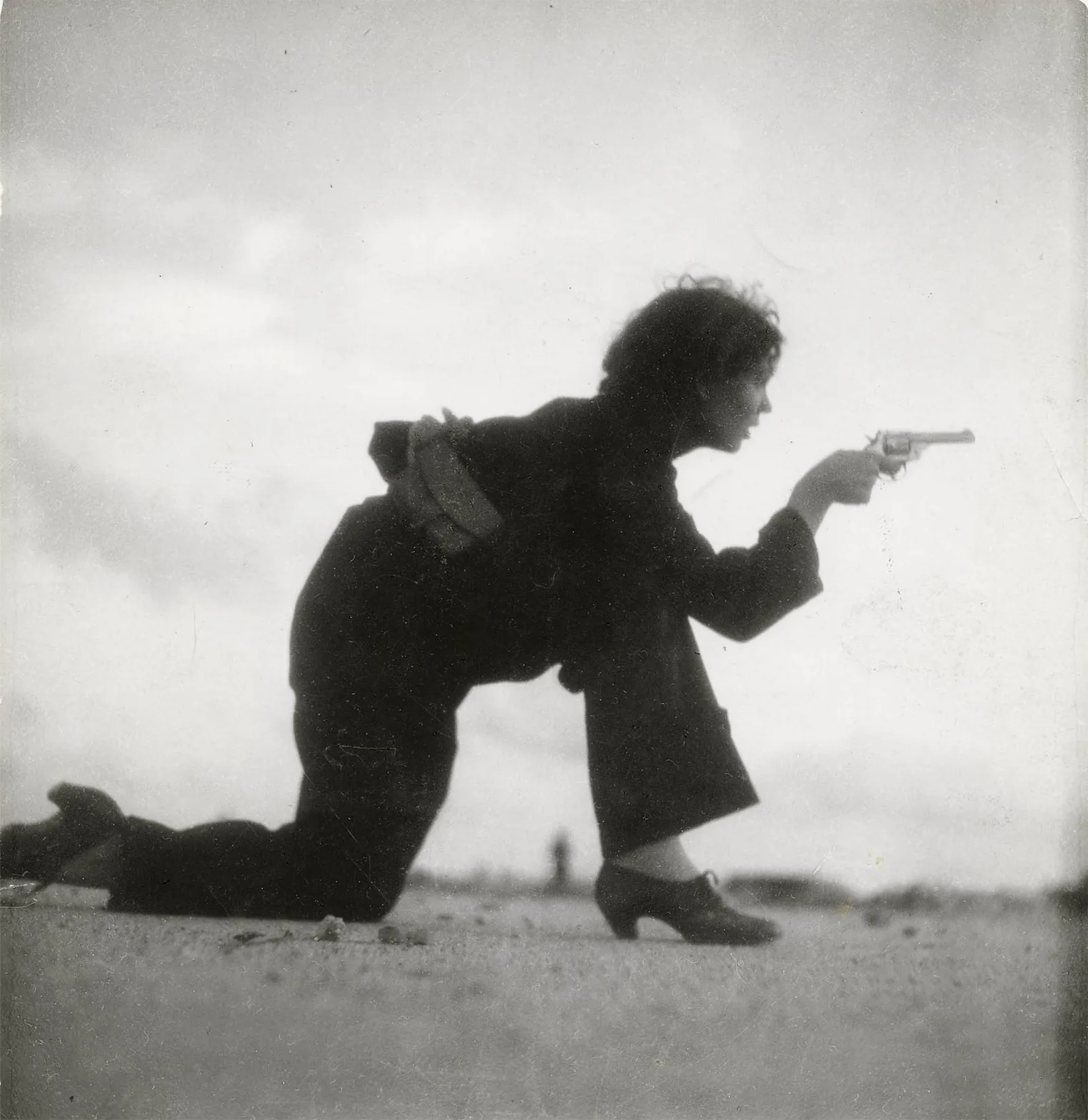
Gerda Taro, woman training for a Republican militia, August 1936 · Public domain · Source page
A republic on the edge
Training for the militia, August 1936
In August 1936 a young woman kneels on open ground and aims a revolver. She is training for a Republican militia, one of many who volunteered in the war’s first weeks.
A few weeks earlier, army officers had risen against the Republic. Millions of Spaniards had to choose a side, or try to survive without choosing. What drove them, and who else was drawn into this war?
Background
A republic, 1931
14 April 1931
On 14 April 1931 Spain was proclaimed a republic, later known as the Second Republic.
From the start it had enemies at both ends of the political map: some wanted far more change, and some wanted far less. Within the army were officers who did not accept the change.
Election
The February 1936 election
16 Feb 1936
On 16 February 1936 Spain voted. The Popular Front, an alliance of left-wing parties, won narrowly.
The margin was small, but the result alarmed the right, and the left saw a chance for reform. From then on, each side saw the other as a threat.
Exile in the islands
A general sent to the Canaries
23 Feb 1936
On 23 February 1936 the government sent General Francisco Franco to the Canary Islands as military commander. Franco saw it as banishment.
According to Wikipedia, a secret meeting in the La Esperanza forest on Tenerife, in June 1936, planned the coup. By the end of April, General Emilio Mola had already emerged as the leader of the wider conspiracy.
13 July
Calvo Sotelo is killed
13 July 1936
In the early hours of Monday 13 July 1936, José Calvo Sotelo, one of the leaders of the right in parliament, was killed in Madrid.
The killers were Assault Guards and socialist militiamen. According to Wikipedia, the operation was organised from the Pontejos barracks, and the autopsy took place the next day. This lesson does not guess who gave the order.
The first days
17 July
The rising begins
17 July 1936
On 17 July 1936 army units in Spanish Morocco rose against the Republic. Similar risings spread to the mainland, but they did not succeed everywhere. They took some cities and failed in others.
Many historians date the start of the war to 17 July, though some sources give 19 July. On 20 July General José Sanjurjo, who was to lead the rising, was killed in an air crash.
Madrid
The government in Madrid
In Madrid the government of Santiago Casares Quiroga gave way to a new one, led by José Giral. The government controlled the police, but it could not be sure of the army.
Left-wing groups and trade unions press for weapons. Some army garrisons have already joined the rising.
A decision point
You are José Giral, prime minister of the Spanish Republic.
Madrid, 19 July 1936.
The rising began two days ago in Morocco, and now it is spreading across the mainland. Some units have joined the rebels, and others remain loyal to you. In the capital you have the police and armed supporters on the left who want to stand behind the Republic.
Your own forces are small, and the army is split. Trade unions and left-wing parties want you to open the arsenals. If you do nothing, the rebels may win in the big cities.
What do you do?
- Keep the weapons under state control, and try to negotiate with the rebel generals. Probably the rising would have spread with little organised resistance, with the army divided. The generals might have accepted a deal, but there would be no guarantee they kept it.
- Hand out weapons to civilians and workers’ organisations, so they can defend the Republic. Guns reach many hands at once, and the rebels in the big cities would probably struggle. But afterwards no one controls those guns. The militias that form would answer to their parties more than to the government.
- Ask France for aircraft and weapons, and wait for them to arrive. Any weapons would take days or weeks to arrive, if they came at all. In the meantime the cities stay with whoever already holds guns, and the rebels get time to organise.
What really happened
Hand out weapons to civilians and workers’ organisations, so they can defend the Republic.
Giral ordered that weapons be given to civilians. In the main industrial cities, according to Wikipedia, this helped defeat the army’s rising. In Madrid the rising was pinned down at the Cuartel de la Montaña, which fell after fighting.
Giral’s government resigned on 4 September 1936, and Francisco Largo Caballero became prime minister.
The sources do not record Giral’s reasoning in detail. What is known is that the army was divided and that time was short.
The historian Hugh Thomas argues that if the government had armed the workers early, it could probably have crushed the coup very quickly. That is a counterfactual, a claim about what might have happened, not a fact.
Source: A call to resist
“¡No pasarán!” (“They shall not pass!”)
The broadcast was made on 19 July, in the first days of the rising. Ibarruri was speaking to the people, not to a debate. The rebels had already taken to the streets, and the government was still deciding what to do.
- Who is speaking, and for whom? Ibarruri, speaking for the Communist Party. This is one side’s voice, not the government as a whole.
- What does the broadcast promise? That the people will not give in. It offers faith and struggle, not a plan.
- What is missing from it? Any account of the other side, and any detail of what actually happened. It is a call to mobilise, not a record.
Myth
It was simply fascism against democracy.
The truth
Not exactly. The Republic was a coalition of the Popular Front: socialists, anarchists, communists and separatists. The other side included the Carlists, the Falange, monarchists and conservatives.
According to Wikipedia, the historian Stanley Payne argues that the Republic was neither a full democracy nor a strict dictatorship. Outside powers were divided too: the Soviet Union and Mexico backed the Republic, and Germany and Italy backed the Nationalists.
The evidence
Wikipedia’s article on the Spanish Civil War, which lists the parties on each side.
Telegrams and London
Paris, July 1936
A left government in Paris
21 July 1936
In Paris, a government led by Léon Blum is in office. It is a Popular Front government, like Spain’s, and France has a war on its border.
Madrid sends an urgent request for weapons. For Paris, this is a question of foreign policy, and London will watch every step closely.
A decision point
You are Léon Blum, prime minister of France.
Paris, 21 July 1936.
Madrid urgently asks for weapons and ammunition. In your cabinet, the Air Minister, Cot, wants to send them openly to the Spanish government.
You know that any step will be watched in London, and that British policy shapes every move. There are three paths, and each has a price.
What do you propose to the cabinet?
- Send arms openly to the Spanish government, as Air Minister Cot wants. The Republic gets aircraft and rifles quickly. But Britain would probably object, and the risk of a wider war in Europe would grow. The states already backing the other side would probably increase their help.
- Send nothing, and wait to see how the situation develops. The Republic is left with what it has. Germany and Italy would probably keep supporting the other side, and the Republic’s weapons would come late, if at all.
- Propose a non-intervention agreement under which all European states promise to stay out, and test whether it holds. The agreement might stop open arms deals, but not the states that already back one side. If it fails to hold, the Republic is left alone, and the question stays open.
What really happened
Propose a non-intervention agreement under which all European states promise to stay out, and test whether it holds.
The cabinet did not settle on one path at once. According to a US embassy telegram, on 21 July some members of the cabinet, including Cot, decided to meet the request. After a cabinet council hastily called on 25 July, a press statement said the government had unanimously decided against supplying arms.
On 1 August France proposed a non-intervention agreement. According to Wikipedia, Britain backed it on 7 August; another speaker in the same Commons debate dates British support to 2 August. The committee first met in London on 9 September 1936.
The telegram gives one main reason. The French ambassador in London warned that the British government was extremely worried, and according to the telegram that was the chief reason for Blum’s sudden trip to London.
But the telegram is itself secondhand: a press contact who heard it from a member of the French Supreme War Council. Careful readers check such reports against other sources.
Source: A telegram on the French cabinet
certain members of the Blum Cabinet particularly Cot, Air Minister, decided on July 21 to accede to a request from Spain and to send arms and ammunition urgently required by the Madrid Government.
The telegram relies on a press contact, who heard the news from a member of the French Supreme War Council. It is secondhand, and it is not Blum’s own words.
The same telegram also reports a press statement saying that the cabinet had unanimously decided against supplying arms.
- Who wrote the telegram, and for whom? American diplomats, writing for their own government. They were not in the cabinet; they recorded what they were told.
- Why could a report like this mislead? Because it passed through at least two people, and each could change the message. The telegram itself gives two different versions.
- What does the telegram suggest about how fast decisions changed? That the decision changed within a short time. In the war’s first weeks, decisions in Paris changed quickly.
Italy and Germany
While the committee talks
Italy supplied the Nationalists with machine guns, artillery, aircraft and troops. Germany formed the Condor Legion and flew the Army of Africa across the Strait to the mainland.
The contrast matters: while the powers talked about an agreement, the Nationalists were already getting real help.
Gold and the Alcazar
Madrid, September 1936
The gold in the bank
About 510 tonnes
The Bank of Spain in Madrid holds the Republic’s gold reserve. In September 1936 this amounts to about 510 tonnes, roughly 72.6 per cent of the bank’s reserves.
The war is moving toward the capital, and the Republic will have to pay for any weapons it buys abroad.
A decision point
You are Juan Negrin, finance minister of the Republic.
Madrid, 13 September 1936.
Nationalist forces are advancing toward Madrid, and fighting is intensifying around Toledo and elsewhere. You must decide what to do with the gold held at the Bank of Spain.
You can order the gold, silver and bills moved to the safest place. The Republic will have to pay for any arms it buys abroad, so the decision is financial and political at once. It is not obvious where the safe place is.
Where do you send the gold?
- Leave the gold in the Bank of Spain’s vaults in Madrid. The gold stays inside the zone of fighting. If Madrid fell, the reserve would fall with it. Meanwhile it could not pay for weapons unless it was moved abroad.
- Move the gold to a safer place inside Republican territory, far from the front. The gold is safer from capture, but anyone who wants to buy weapons abroad would still have to get it out of the country.
- Send the gold to Moscow, and receive weapons and supplies from the Soviet Union in return. The Republic gets Soviet arms, but it depends on a single foreign supplier. Moscow would probably gain a say in Republican policy.
What really happened
Send the gold to Moscow, and receive weapons and supplies from the Soviet Union in return.
The decree, signed by Negrin on 13 September 1936, allowed the gold, silver and bills to be moved to a safe place, and named no country. It asked that the matter be kept confidential.
In autumn 1936 about 510 tonnes of gold were shipped to the Soviet Union. This is the story behind the name Moscow gold. Soviet material aid to the Republic began in October 1936. Later, by March 1937, another 174 tonnes had gone to the Bank of France.
The decree itself gives safety as the reason, and it asks for secrecy because of the nature of the measure and the reasons behind it.
Historians disagree. Pio Moa argues that the transfer broke the banking law, the Cambó Law. Ángel Viñas argues that the law was followed. Most historians see Negrin as the main actor, but his motive is disputed. Antony Beevor cites a suggestion from a Soviet agent that a “gold account” be opened in Moscow.
Source: The decree itself
“the location esteemed to be the safest”
This is an official document. It speaks of the safest place, not of a country. Article II says the government will, when appropriate, answer to the Cortes, the parliament, for the decree. According to Wikipedia, it never did.
- What does the decree promise parliament? That the government will answer for it. The promise is written down, but it depends on timing: ‘when appropriate’.
- Why does the decree not say where? Because it authorises the action without naming the destination. Readers should ask what the text leaves out.
- What does this teach about official documents? That an official document can be lawful and formal, and still leave out the main point.
A decision point
You are Francisco Franco, a general leading the Nationalist forces advancing on Madrid.
Spain, late September 1936.
A few days ago, at Salamanca, you were chosen as the supreme military commander and given the title Generalísimo. Your forces are close to Madrid, and some of your advisers urge you to push straight on.
But in Toledo the Alcázar, an old fortress, is held by a Nationalist garrison under Republican attack. You can relieve it first, or push on toward the city.
What do you do?
- Push straight on to Madrid, as your advisers urge. The forces might reach the city before its defences are fully organised. But the garrison in Toledo would be left on its own, and an assault on Madrid might fail.
- Relieve the Alcázar in Toledo first, and make the relief a public victory. The garrison is saved and the propaganda gains. But the advance on Madrid is delayed, which may weaken the assault on the capital.
- Halt, and wait for reinforcements and ammunition before any assault. The forces stay outside Madrid, and the garrison in Toledo gets no help. In the meantime the Republic can organise its defence.
What really happened
Relieve the Alcázar in Toledo first, and make the relief a public victory.
On 27 September 1936 Franco’s forces reached the Alcázar and relieved the garrison. That was the choice he made.
Six days earlier, on 21 September, at Salamanca, he had been chosen chief military commander and given the title Generalísimo. On 1 October, at Burgos, he was made head of state. According to Wikipedia, many of his advisers thought he should have kept advancing on Madrid, but Franco judged the propaganda value of the relief to be greater.
Franco judged the propaganda value of the relief to be greater. Critics among his own advisers said he should have kept pushing on Madrid.
Historians still argue over whether the delay cost him the capital.
October 1936
Soviet help and the Madrid front
In October 1936 Soviet material aid began to reach the Republic. Whether the gold paid for it is still disputed.
In November 1936 the defence of Madrid went on. Foreign volunteers in the International Brigades were sent into the fighting around the capital.
Source: The Foreign Secretary in the Commons
“It is an improvised safety-curtain.”
Eden defends British policy in a Commons debate on Spain. He admits the device is makeshift. He argues that the alternative, free export of arms to both sides, risks war. He also notes that the committee’s first meeting, on 9 September in London, had every European country represented except Portugal.
- What is a safety-curtain supposed to do? In a theatre, a safety curtain comes down to stop a fire. Eden presents the agreement as a device to stop a wider war, and admits it is makeshift.
- Why would a government say it is not trying to set a principle? Because it presents the policy as temporary, not a long-term commitment. Ask yourself whether a temporary arrangement is enough while the war goes on.
- What would you need to know to tell whether the agreement works? A way of checking whether each state keeps the agreement. The sources in this lesson do not describe such a check in place in 1936.
Guernica
April 1937
One decree, one party
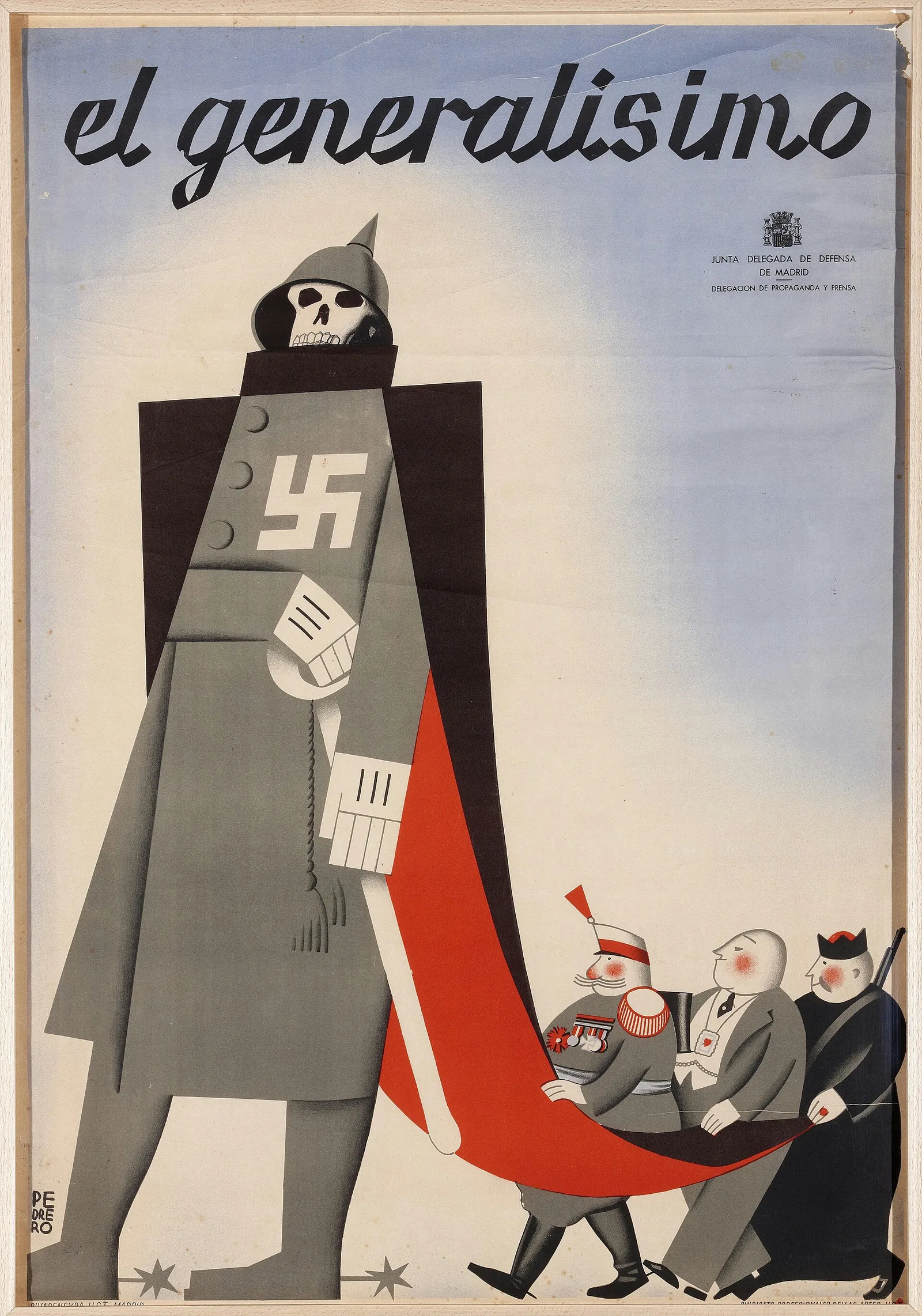
Pedrero, ‘El generalísimo’, poster, 1936–1937. Museo Reina Sofía, Madrid (image via Google Arts & Culture) · Public domain · Source page
19 April 1937
On 19 April 1937 Franco issued a decree that forcibly merged the Falange with the Carlists into one movement, called FET y de las JONS. Franco became its national chief.
The Republican poster in the picture, from the same period, shows Franco as the Generalísimo: a giant with a skull for a face and a swastika on his coat. Three men hold up his cape: a general, a capitalist and a priest.
26 April 1937
Guernica
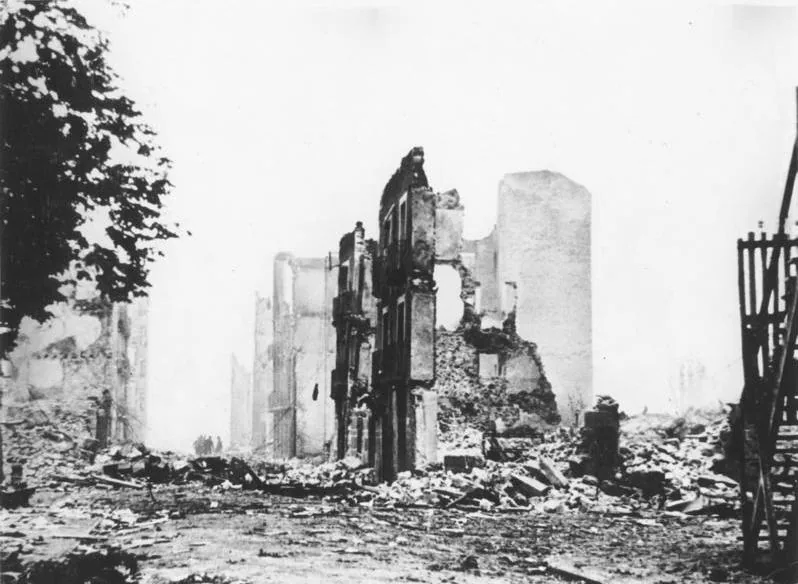
Ruins of Guernica, 1937. German Federal Archive (Bundesarchiv), image 183-H25224 · Unknown author · CC BY-SA 3.0 · Source page
26 April 1937
On 26 April 1937 aircraft of the German Condor Legion and Italian aircraft bombed the Basque town of Guernica (Gernika). According to Wikipedia, the target included a bridge and roads near the front. According to the historian James Corum, the bombing was carpet bombing, because precise bombing was not possible.
The death toll is disputed. The Basque government counted 1,654 dead and 889 wounded. Local historians counted 126, later revised to 153. Wikipedia gives a range of about 150 to 1,654 dead.
Picasso
The painting not shown here
The Republic had commissioned Pablo Picasso for the Spanish pavilion at the Paris exhibition. After the bombing he changed the work.
The painting is still in copyright, so this lesson describes it rather than showing it.
The witnesses
What the reporters wrote
According to Wikipedia, George Steer, The Times correspondent, wrote that Guernica was not a military objective. According to Wikipedia, Stanley Payne argues that Steer exaggerated the casualties.
According to the same account, Franco afterwards ordered that no open town be bombed without his direct order. That claim rests on one source, and this lesson has not checked it.
Myth
Guernica was either a legitimate military target or a pure terror raid.
The truth
Both halves leave out part of the evidence. The target included a bridge and roads near the front, and the bombing was carpet bombing, according to Corum. Civilians were killed in large numbers. Historians also disagree on whether the raid was a legitimate attack or a war crime, and the death toll is disputed.
The evidence
Wikipedia’s article on the bombing, which sets out the positions and the figures from each side.
May in Barcelona
3–8 May 1937
Barcelona, May 1937
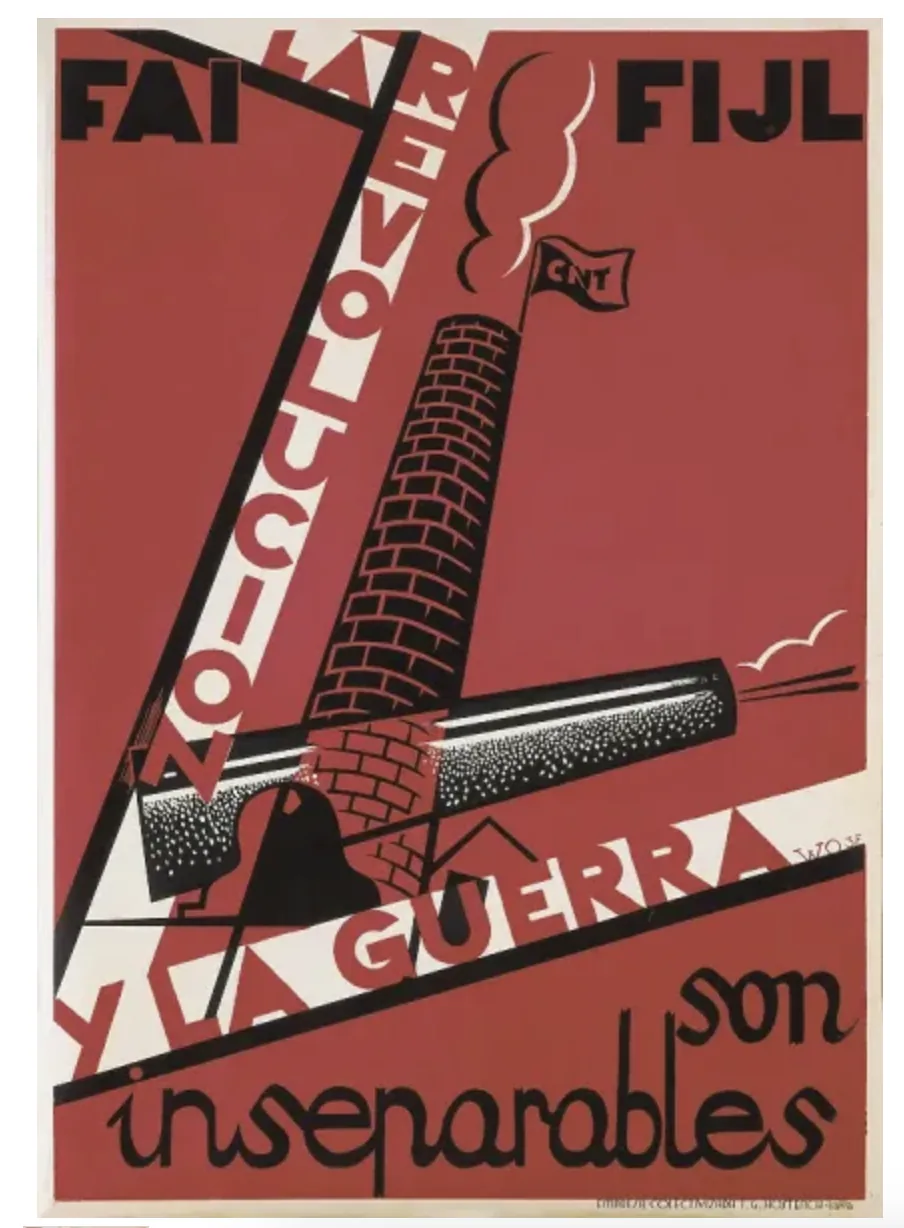
Wolf Hamburger (‘Wo’), poster, Barcelona, spring 1937 · Public domain · Source page
3–8 May 1937
From 3 to 8 May 1937, Barcelona saw street fighting among Republicans. On one side were the anarchists of the CNT-FAI and the POUM; on the other were the government’s forces.
The poster in the picture is from the same spring. In Spanish it says that the revolution and the war are inseparable, and it carries the CNT flag.
17 May 1937
Largo Caballero leaves
17 May 1937
Francisco Largo Caballero was prime minister from 4 September 1936 until 17 May 1937. After he resigned, Juan Negrin led the government.
From then on, decisions about the POUM were made by Negrin’s government.
June 1937
The party is outlawed
16 June 1937
Arrests of POUM leaders began on 16 June 1937, and the party was then outlawed. The Soviet-aligned Communists had denounced it as an instrument of the fascists.
Its leader, Andreu Nin, was also killed in June 1937. The date and the circumstances are disputed, and this lesson does not settle them.
A witness
An English witness
George Orwell, the English writer, volunteered and fought in a POUM militia. He described what he saw in Homage to Catalonia (1938), a memoir published while the war was still going on.
He was a participant, writing from inside the POUM militia, so his book is read alongside other sources.
The farewell and the end
July–November 1938
The Ebro
25 July – 16 November 1938
The battle of the Ebro ran from 25 July to 16 November 1938, nearly four months.
In October, while the fighting was still going on, the Non-Intervention Committee demanded that the International Brigades leave Spain.
Autumn 1938
The farewell
In autumn 1938 a farewell parade for the Brigades was held in Barcelona. A Barcelona city council source gives 28 October, and other sources give 15 November. This lesson says “autumn 1938”, because the sources disagree.
Juan Negrin and the president of the Republic, Manuel Azaña, attended. Dolores Ibarruri, known as La Pasionaria, told the volunteers: “You are history. You are legend.” That is the English translation published by the International Brigades Memorial Trust.
1939
The fall
Barcelona fell on 26 January 1939.
On 5 March 1939 Colonel Segismundo Casado led a coup against Negrin’s government.
1 April 1939
The end, on paper
1 April 1939
The infobox of Wikipedia dates the war from 17 July 1936 to 1 April 1939, and on that day the Republic was dissolved.
What followed under the new regime is a different story, and this lesson stops here.
Numbers
How many died?
There is no single agreed number. Wikipedia’s infobox gives ranges by category, and each comes from a different source.
Killed in action, figures not split by side in the source: about 110,000 and 90,000, from Michael Clodfelter (2017).
Civilians killed in the Republican zone: about 38,000 to 110,965, from Antony Beevor (2006).
Civilians killed in the Nationalist zone: about 50,000 to 200,000, in the infobox. The upper figure is Beevor’s estimate for killings behind Nationalist lines.
Adding the ranges gives about 290,000 to 510,000. That is an arithmetic sum of figures from different sources, not one historian’s total.
What followed
- May–June 1937 Largo Caballero resigns, and the POUM is outlawed.
- July–November 1938 The battle of the Ebro.
- October 1938 The Non-Intervention Committee demands that the Brigades leave.
- Autumn 1938 Farewell parade for the Brigades in Barcelona.
- 26 January 1939 Barcelona falls.
- 5 March 1939 Casado’s coup against Negrin.
- 1 April 1939 The war ends and the Republic is dissolved.
Myth
The Republic lost only because of foreign aid to Franco.
The truth
This is not proven as fact, so it is shown here as a debate. Italy was the stronger backer of the Nationalists. The Soviet Union was the Republic’s only major backer, and Wikipedia says its aid came with a say in Republican policy. Inside the Republic there were splits too: the POUM was outlawed, and the May clashes took place.
Hugh Thomas argues that arming the workers early could have crushed the coup quickly. That is a claim about the start of the war, not about its end.
The evidence
Wikipedia’s articles on the Spanish Civil War and on Moscow gold. The historians’ positions on the defeat are not checked in full here.
Who organised the killings behind the lines?
Were the killings on each side ordered and approved from the centre, or did they come from local organisations acting at every level?
- Paul Preston, Antony Beevor, Helen Graham and Hugh Thomas The executions behind Nationalist lines were organised and approved by the leadership.
- Stanley Payne, Julius Ruiz and José Sánchez, as listed in Wikipedia Political violence in the Republican zone was organised by the left. This view concerns the Republican zone, and the view above concerns the Nationalist zone.
Both sides carried out killings. The question is who organised and who approved them, and whether the violence was deliberate policy or the work of local bodies. The sources here do not settle it.
Check yourself
On what date was the Second Republic proclaimed?
Answer: 14 April 1931. Yes. The Republic was proclaimed on 14 April 1931, and was later called the Second Republic.
Check yourself
Who was killed in Madrid on 13 July 1936?
Answer: José Calvo Sotelo, in Madrid. Yes. Calvo Sotelo was killed in Madrid by Assault Guards and socialist militiamen.
Check yourself
On what date did General Sanjurjo die in an air crash?
Answer: 20 July 1936. Yes. Sanjurjo was killed in an air crash on 20 July 1936.
Check yourself
When and where did the Non-Intervention Committee first meet?
Answer: 9 September 1936, in London. Yes. The committee first met in London on 9 September 1936.
Check yourself
When was Guernica bombed?
Answer: 26 April 1937. Yes. The bombing took place on 26 April 1937.
Check yourself
Which two groups did the decree of 19 April 1937 merge into one movement?
Answer: The Falange and the Carlists. Yes. The decree forcibly merged the Falange with the Carlists into one movement.
Terms
- Popular Front An alliance of left-wing parties that won the February 1936 election. Its members ranged from socialists to communists and regional separatists.
- non-intervention A promise by European governments to stay out of the Spanish war and not send arms to either side.
- Condor Legion A German air and ground unit sent to help the Nationalists. Parts of it took part in the bombing of Guernica.
- International Brigades Volunteers from many countries who fought for the Republic. According to Wikipedia, about 32,000 fought in them.
- POUM A small Marxist party in Catalonia, opposed to the Soviet-aligned Communists. It was outlawed in June 1937.
- Generalísimo The title of supreme commander of all forces. Franco was given it at Salamanca on 21 September 1936.
- Falange A Spanish party in the fascist style. In 1937 Franco forcibly merged it with the Carlists.
- Moscow gold The Republic’s gold reserve, about 510 tonnes, shipped to the Soviet Union in autumn 1936. Whether it paid for arms is disputed.
- Alcázar of Toledo An old fortress in Toledo, where a Nationalist garrison was besieged in 1936.
Sources
- Dolores Ibarruri, broadcast of 19 July 1936 (“¡No pasarán!”), Spanish text on Marxists.org
- US government telegram, 1936, Foreign Relations of the United States, vol. II, doc. 367
- House of Commons, debate on Spain, 29 October 1936, Hansard (HC Deb vol. 316)
- Ministry of Finance decree, 13 September 1936, English translation as quoted in Wikipedia’s article ‘Moscow gold’
- International Brigades Memorial Trust, the farewell parade of October 1938 and the English text of La Pasionaria’s words
- Antony Beevor, The Battle for Spain: The Spanish Civil War 1936–1939 (2006)
- Hugh Thomas, The Spanish Civil War
- Paul Preston, The Spanish Holocaust (W. W. Norton)
- Helen Graham, on the executions behind Nationalist lines
- Stanley G. Payne, on the early years of the Franco regime
- James S. Corum, on the bombing of Guernica
- Ángel Viñas, on the banking law and the gold transfer
- George Orwell, Homage to Catalonia (1938)
Image credits
- Gerda Taro, woman training for a Republican militia, August 1936 · Public domain · Source page
- Pedrero, ‘El generalísimo’, poster, 1936–1937. Museo Reina Sofía, Madrid (image via Google Arts & Culture) · Public domain · Source page
- Ruins of Guernica, 1937. German Federal Archive (Bundesarchiv), image 183-H25224 · Unknown author · CC BY-SA 3.0 · Source page
- Wolf Hamburger (‘Wo’), poster, Barcelona, spring 1937 · Public domain · Source page


