Socrates: the trial that killed a philosopher
In 399 BC a jury of several hundred Athenian citizens found Socrates guilty. He wrote not a word, yet we know him. Why was he tried, and what do we really know about him?
Decisions, questions and your own progress, in the app
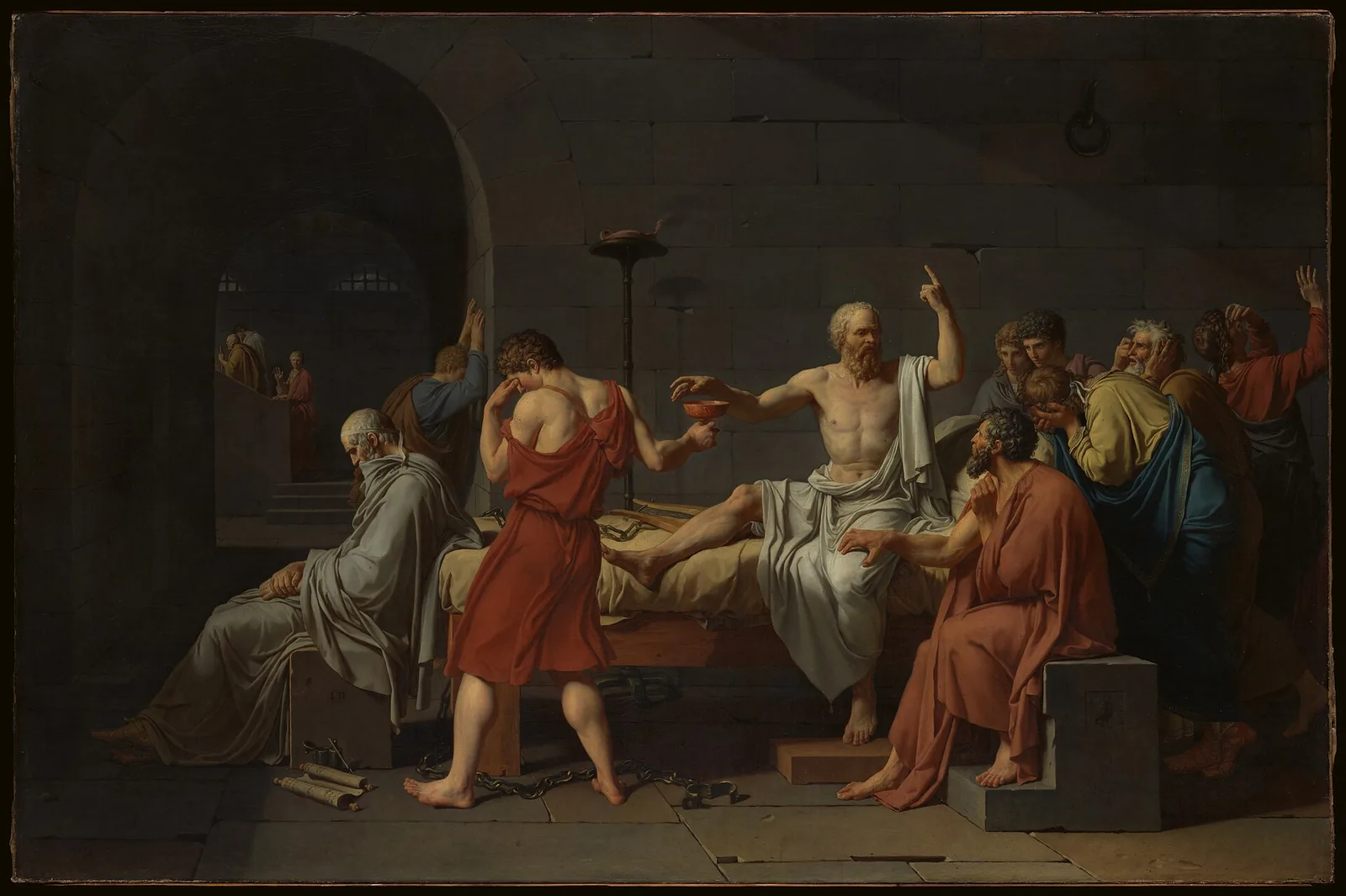
Jacques-Louis David, *The Death of Socrates*, 1787. Metropolitan Museum of Art, New York · CC0 · Source page
A man who left no writing
Athens, 399 BC
In Athens in 399 BC an old man named Socrates stands trial. He is about seventy, the son of a sculptor, and he has never written a book.
Several hundred citizens sit as jurors. By the end of the day they must decide whether he is guilty and, if so, what his punishment should be.
Socrates left not a line of his own. Yet more than 2,400 years later we know him well. Why was he tried? And what would you have done in his place?
Background
The son of a sculptor and a midwife
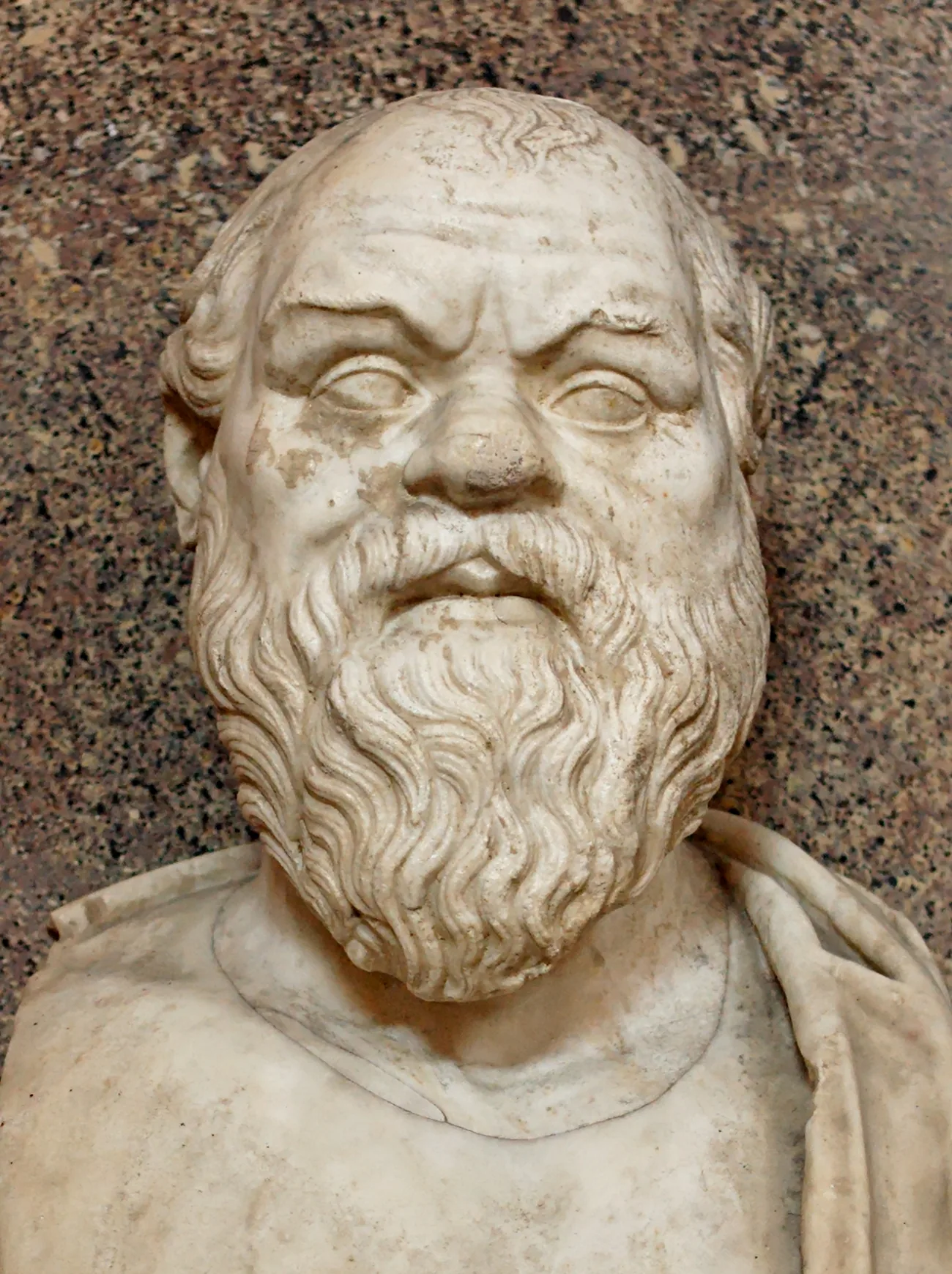
Bust of Socrates, Roman copy of a Greek original. Vatican Museums (Pio-Clementino). Photo: Jastrow, 2006 · Public domain · Source page
Socrates was born in Athens around 469 BC. His father, Sophroniscus, was a sculptor. His mother, Phaenarete, was a midwife.
Diogenes Laertius gives these details. He wrote several centuries after Socrates, and adds that the mother’s trade can also be read in Plato’s Theaetetus.
Life
A soldier, a husband, a father
Socrates served as a hoplite, a heavy-armed foot soldier, in Athens’ long war with Sparta. According to Diogenes he fought at Potidaea, at Delium and at Amphipolis. Modern accounts date these campaigns to about 432 to 422 BC. At Delium, he saved the life of a young man who had fallen from his horse: Xenophon, the future writer.
His first wife was Xanthippe. They had a son, Lamprocles.
The problem
The Socratic problem
Socrates left no writing of his own. What we know of him comes from sources written by people who knew him or opposed him. Plato wrote dialogues in which Socrates is usually the main speaker. Xenophon, a soldier and writer, wrote about him in his Memorabilia and in an Apology. The comic playwright Aristophanes put him on stage in The Clouds in 423 BC.
Historians call this the Socratic problem: when several writers describe the same man, each for a purpose of his own, how do we find the man himself?
The oracle and the questions
Delphi
An answer from the oracle
According to Plato, Chaerephon, a friend of Socrates, asked the oracle of Apollo at Delphi a single question: was anyone wiser than Socrates? The answer came back: no one was wiser.
Socrates was astonished. He knew that he was not wise, so he set out to understand what the god meant. He went to people who had a name for wisdom, to test whether they really knew what they claimed.
Source: The answer from Delphi, as Plato tells it
“… and the Pythian prophetess answered that there was no man wiser.”
“Chaerephon is dead himself, but his brother, who is in court, will confirm the truth of this story.”
This is the speech Socrates gives at his trial, as Plato wrote it down afterwards. Socrates brings up the oracle to explain to the jurors why he does what he does.
- Who tells this story, and when was it written down? Socrates himself, in a speech that Plato wrote after the trial. It is not a court transcript, but Plato’s version of what was said.
- Why does Socrates name a witness who is still in court? So that the claim can be checked. A witness who can be asked is harder to dismiss as invention.
- What does the story give Socrates? A man who claims no wisdom, sent on a task by the god: to question others. His questioning then looks like a duty, not arrogance.
The questioning
Questions in the market
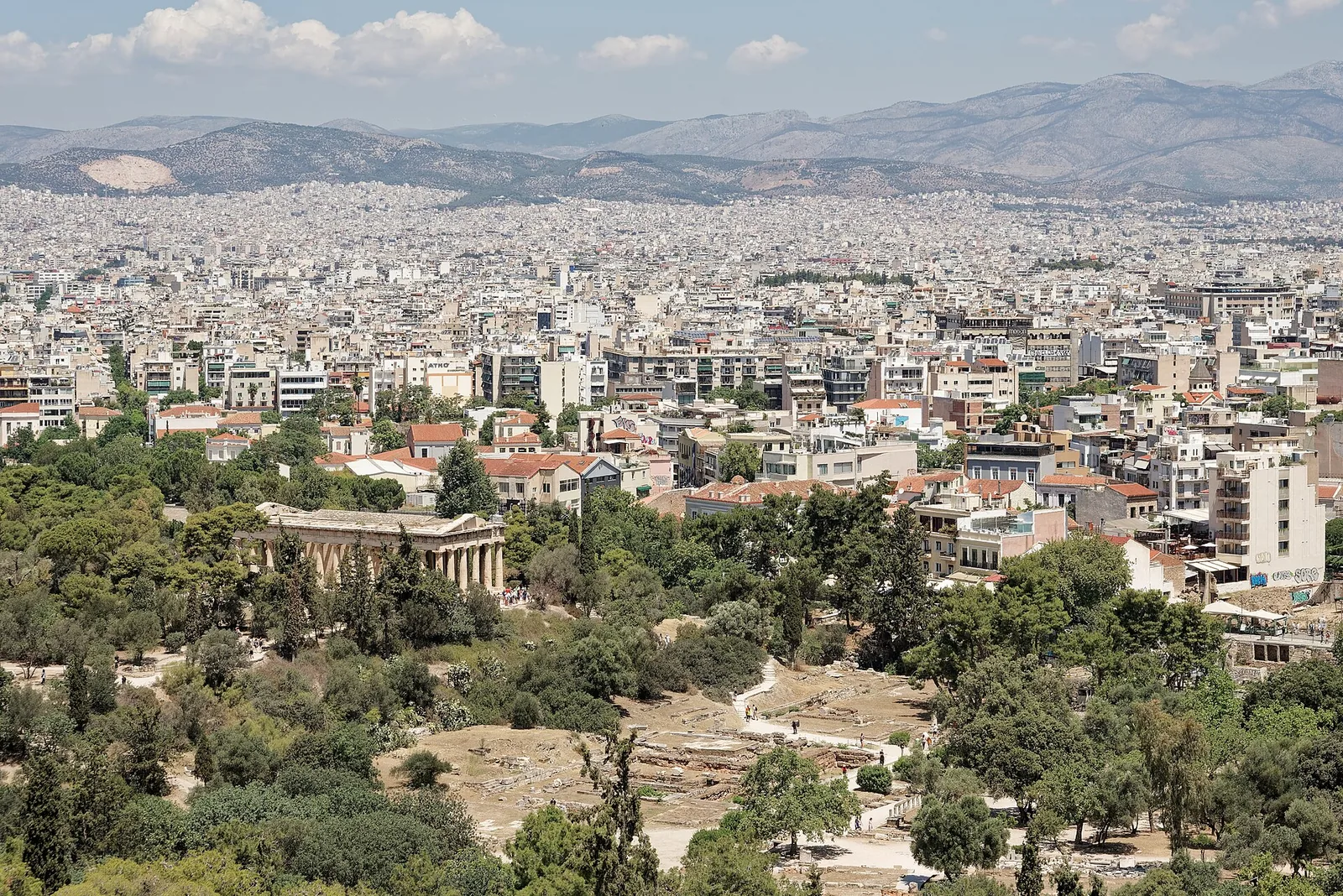
View of the Hephaisteion and the Agora from the Areopagus Hill, Athens, 2024. Photo: Jakub Hałun · CC BY 4.0 · Source page
Socrates went to people with a reputation for wisdom: politicians, poets and craftsmen. He asked them what they knew, and now and then showed that they did not know what they thought they knew. Plato’s Socrates describes this in the Apology (21b–22e), and it is how he explains himself to the jury. The people he questioned did not enjoy it.
He also spoke of a private sign, which he called his daimonion: a divine warning that held him back from certain acts. The way he questioned, step by step, is now called the Socratic method. The name is modern, and the method is seen most clearly in Plato’s dialogues.
Most of these talks happened in public places. The agora, the market square at the centre of the city, was one of the main ones.
The comedy
Socrates on stage
In 423 BC Aristophanes staged The Clouds. His Socrates is a figure of fun. He hangs in a basket to study the sky, and he teaches young men to win any argument, whether or not they are right.
The play was meant to make people laugh. We cannot know whether anyone took the joke seriously. But the play shows that Socrates was already famous, and already a target, twenty-four years before his trial.
War, the Assembly and the Thirty
Background
Athens at war
The Peloponnesian War, between Athens and Sparta, ran from 431 to 404 BC. Athens lost, and the city that came out of it was divided and exhausted.
As the war dragged on, politics grew harsher. Later critics linked Socrates to two men who did great harm to Athens: Alcibiades, a brilliant commander who defected to Sparta, and Critias, who would lead the Thirty Tyrants.
A decision point
You are Socrates, a member of the presiding committee of your tribe, the committee that runs the Assembly’s session.
Athens, 406 BC, after the battle of Arginusae
Athens has won a sea battle off the Arginusae islands. But after the victory a storm stopped the rescue of men who had fallen into the water, and many of them drowned. The Assembly is furious, and the demand to try all the generals together grows louder.
The motion in front of you would try them all at once, in one vote, today. You believe that it breaks the law. The crowd wants it, and you sit on the committee that must put it to the vote.
What do you do?
- Put the motion to the vote, as the Assembly demands. Probably all the generals are voted on together, and the unlawful motion passes unopposed. You would be one hand among many, at little personal risk.
- Refuse to put the motion, and say that you will act only in accordance with the law. Probably you face the anger of the crowd, and perhaps a charge. But the unlawful vote might be stopped, and the generals could be tried one by one.
- Ask for a delay, so that the Council can find a lawful way forward. Probably the delay cools tempers for a while. But the Assembly may simply reject the request and vote anyway.
What really happened
Refuse to put the motion, and say that you will act only in accordance with the law.
Socrates was the only member of the committee who refused to put the motion. Xenophon, in his Hellenica (book 1, chapter 7), reports that the presidents, “stricken with fear”, agreed to put the question, “all of them except Socrates, the son of Sophroniscus”, and that he “said that in no case would he act except in accordance with the law.”
Plato adds a detail in the Apology: “the tribe Antiochis, which is my tribe, had the presidency at the trial of the generals” (32b). The two accounts agree on the main point.
Why did he refuse? Xenophon presents it as a matter of law. Plato mentions only that his tribe held the presidency. We have no record of what the other committee members thought, or how many of them were afraid, or what would have happened to them.
The Thirty
A regime of the few
Two years after Arginusae, Sparta defeated Athens and the city surrendered. In 404 BC an oligarchy was imposed on it, backed by Sparta. Its opponents called it the Thirty Tyrants, and it put many of its opponents to death. Among its leaders was Critias.
A decision point
You are Socrates, one of five citizens whom the Thirty call in.
Athens, about 404 BC, in the round hall where the Thirty meet
The Thirty have called you and four others in. They order you to sail to Salamis, the island near Athens, and bring back Leon. They want to put him to death.
It is a direct order, and there is little room to argue with the Thirty.
What do you do?
- Flee Athens before they can reach you. Probably you survive, but you leave family and friends behind and live in exile.
- Go home and refuse to take part, without leaving the city. Probably you risk punishment, since refusal may be seen as defiance. But you take no part in an execution.
- Go to Leon and warn him, so that he has time to escape. Probably Leon escapes, but you become a suspect. If the Thirty find out what you did, you will pay a heavy price.
What really happened
Go home and refuse to take part, without leaving the city.
Four of the five went to Salamis and fetched Leon. Socrates went home quietly. In the Apology he says: “when we came out of the rotunda the other four went to Salamis and fetched Leon, but I went quietly home” (32c–d).
Plato’s Socrates offers a fact, not an argument: he went home. The sources do not say what he expected to happen, or how much danger he thought he was in, and historians disagree about how exposed he was. What is clear is that the Thirty’s rule collapsed within a year.
After
Democracy returns
In 403 BC the Thirty fell and democracy returned to Athens. According to modern accounts, the restored Assembly declared an amnesty for most of the regime’s supporters, but excluded the most violent of them.
Four years later Socrates was tried, under the same democracy that had pardoned most of the Thirty’s followers. That fact matters, and the debate at the end of this lesson returns to it.
The trial, 399 BC
The charge
What is Socrates charged with?
The charge was written down in a short document, sworn by an accuser named Meletus. Diogenes Laertius gives its text. The first count is impiety (asebeia), a broad offence in Athens, open to many readings: not honouring the city’s gods, and bringing in others. The second, corrupting the young, is not defined in the text.
Source: The indictment, as Diogenes Laertius gives it
“This indictment and affidavit is sworn by Meletus, the son of Meletus of Pitthos, against Socrates, the son of Sophroniscus of Alopece: Socrates is guilty of refusing to recognize the gods recognized by the state, and of introducing other new divinities. He is also guilty of corrupting the youth. The penalty demanded is death.”
Diogenes wrote several centuries after the trial, and does not say where he found the text. Read it as the charge as it was later reported, not as a court transcript.
- Who is Meletus, according to the text and according to Plato? The text gives his father’s name and his town. Plato’s Socrates says that Meletus has a quarrel with him on behalf of the poets (Apology 23e).
- What is missing from the charge? A specific act. There is no date, no witness and no deed that could be checked. The charge is about belief and influence.
- What might ‘corrupting the youth’ mean? The text does not say. A charge this broad could cover many things, and that is why it matters to the debate at the end of this lesson.
The jury
A court of citizens
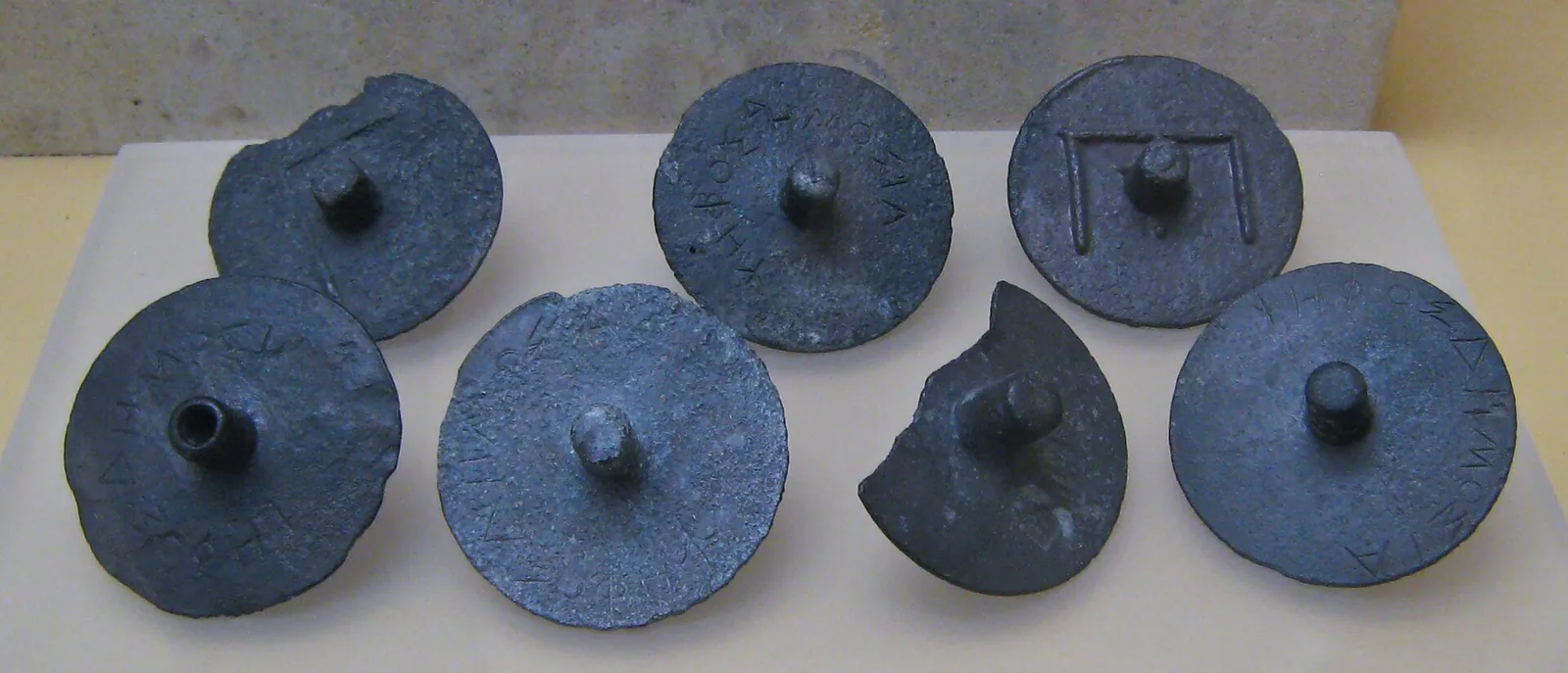
Bronze juror’s voting discs, about 300 BC. Ancient Agora Museum, Athens. Photo: Sharon Mollerus, 2009 · CC BY 2.0 · Source page
Athenian courts had no professional judges in our sense. The decision lay with a large panel of jurors, several hundred citizens chosen by lot. They heard both sides and voted.
Each juror received two bronze discs, one with a solid axle and one with a hollow axle, which look alike from outside. He dropped one into the voting urn, so that no one outside could tell which disc he had chosen. The sources we checked do not agree on which disc meant guilty. The discs in the photograph date from about 300 BC, roughly a century after the trial.
Time
Time measured in water
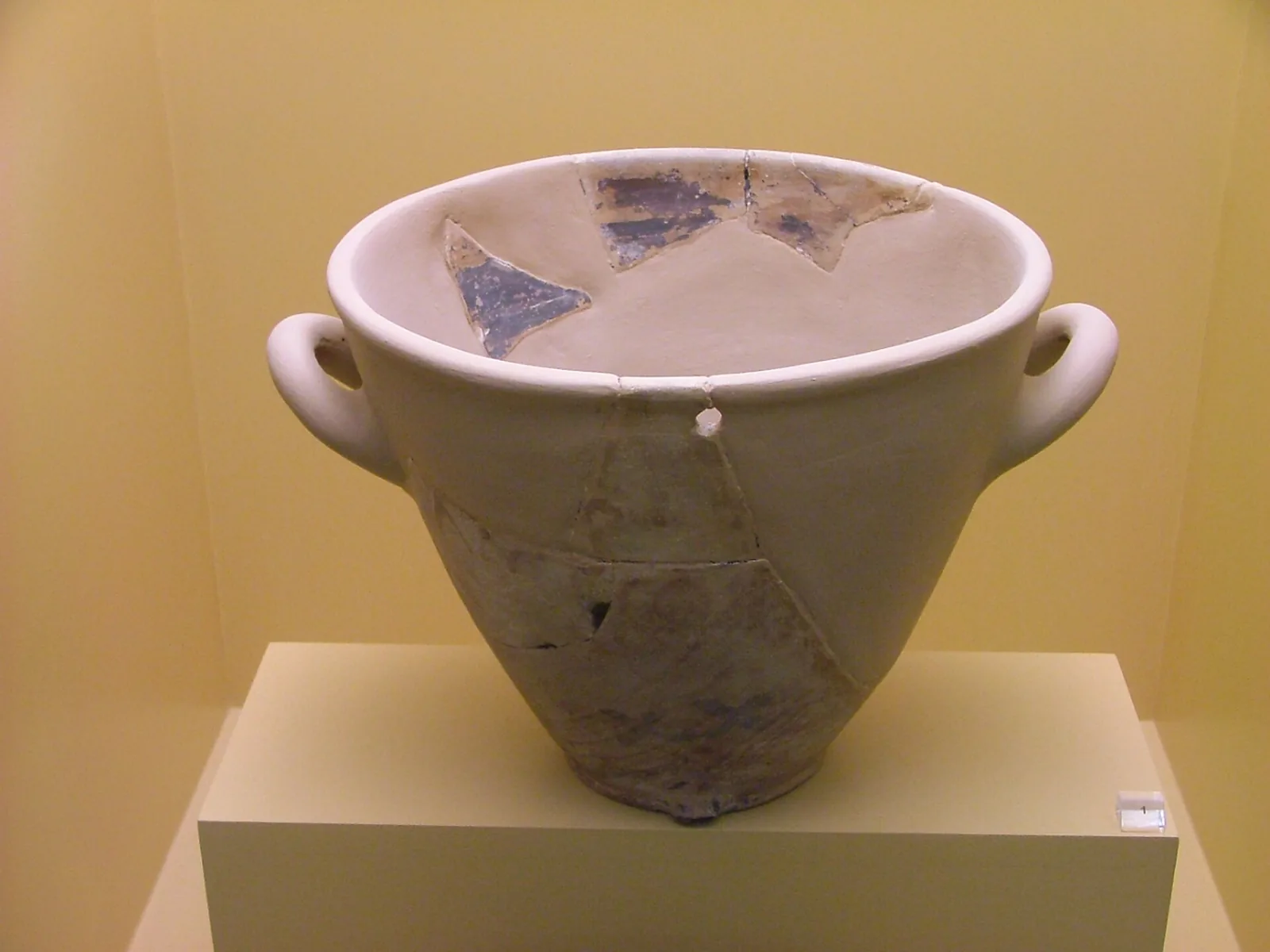
Klepsydra (water clock), reconstruction of an ancient clay original. Ancient Agora Museum, Athens. Photo: Dorieo, 2007 · CC BY-SA 4.0 · Source page
Speeches in Athenian courts were timed with a water clock, or klepsydra: a vessel from which water ran out at a steady rate. When the water was gone, the speaker had to stop. Later accounts describe this as ordinary practice in Athens. We do not know whether it was used at Socrates’ trial.
Socrates says that if Athens had a law, as other cities do, that a capital case should not be decided in one day, he would have convinced the jury. As things stood, he says, the time was too short (Apology 37a–b).
The verdict
The first vote
The jury voted on guilt. The sources we checked do not agree on the exact count, so we do not print one. Plato’s Socrates gives a hint: “had thirty votes gone over to the other side, I should have been acquitted” (Apology 36a). So a narrow majority convicted him.
A decision point
You are Socrates, and you have been found guilty. Now a penalty must be set.
Athens, 399 BC, after the guilty verdict
The accusers have asked for death. The law lets the defendant propose a penalty of his own, and the jury will then choose between the proposals. The debate has moved to the penalty, and you must decide what to propose.
The people who know you best are in the crowd, waiting for your answer.
What penalty do you propose?
- Exile: leave Athens and never return. Probably the jury would weigh whether this is enough. You would live, and could go on teaching somewhere else, but not in Athens.
- A fine you can pay, guaranteed by friends. Probably the jury would weigh a fine against death, and a sum that can be paid might move some votes. But a fine implies a kind of admission, and the accusers may see it as weakness.
- Free meals in the Prytaneum, as a benefactor of the city. Probably the jury takes it as mockery, and more jurors vote for death. The proposal does not persuade those who are listening.
- Propose no penalty of your own, and leave the decision to the jury. Probably the jury chooses between the death the accusers ask for and no alternative at all, and death is the likely result.
What really happened
Free meals in the Prytaneum, as a benefactor of the city.
Plato’s Socrates first proposes free meals in the Prytaneum, the public dining hall where the city fed its honoured guests: “There can be no more fitting reward than maintenance in the Prytaneum, O men of Athens” (Apology 36d).
Then his friends, Plato among them, asked him to name thirty minae, with themselves as sureties for the payment (38b). The jury voted on the penalty and chose death. Diogenes Laertius says the death sentence gained eighty fresh votes, but gives no total.
Why meals? Plato’s Socrates presents the first proposal as a fitting reward: a man who has served the city should be fed by it. Many readers have found this either proud or ironic, and the text does not settle which was meant.
The thirty minae came from his friends, who offered to stand as sureties. Xenophon tells the story differently: his Socrates proposed nothing, because a counter-penalty would be “like a confession of guilt”. We have to decide which account is closer to what happened.
The prison and the cup
The prison
Waiting for the ship
Socrates was taken to prison, but he was not executed at once. According to Plato’s Phaedo, during the holy season the city may not be polluted by public executions. The season began when a sacred ship sailed for Delos, the island where Apollo was born. Until the ship came back there could be no execution, and so Socrates lay in prison for a long time (Phaedo 58).
His old friend Crito visits him and says the ship will probably arrive that day. Socrates does not expect it before the next day (Crito 43–44).
A decision point
You are Socrates, in prison, waiting for the sentence to be carried out.
The prison in Athens, 399 BC
Crito, your friend of many years, comes to you with a plan. Escape from the prison, he says, and go to Thessaly, where he has friends who will welcome you and protect you. There are people, he says, who would get you out for little money.
An escape would leave the sentence standing, and would put your friends at risk. What do you do?
Do you escape with Crito?
- Escape with Crito to Thessaly. Probably you live, and can go on thinking and questioning elsewhere. But you leave Athens and its laws behind, and Crito and your friends may pay for it.
- Stay in prison and accept the sentence. Probably the sentence is carried out soon. You die without escaping, keeping to the laws as you understand them, and your friends must live with that decision.
- Ask the city to approve exile in place of execution. Probably there is no lawful way to change the sentence at this stage, and such a request would likely be refused. It might also put your friends at risk.
What really happened
Stay in prison and accept the sentence.
Socrates refused. In Plato’s Crito his reasons come in a speech that Socrates imagines the Laws of Athens making to him. That speech is quoted in the next step.
In the dialogue, Crito pleads with him with all his strength. Socrates answers with an argument rather than with feeling: one must never do wrong, not even in return for a wrong. That answer is the heart of the dialogue.
Source: The Laws speak
“Consider, Socrates, if this is true, that in your present attempt you are going to do us wrong.”
In the dialogue Socrates imagines the Laws of Athens speaking to him. They remind him that they raised him, and that by living in the city and enjoying its laws he agreed to obey them. Plato wrote the dialogue some years after the trial.
- Who is speaking here? Neither Socrates nor Crito. Socrates imagines the Laws speaking. It is a literary device: the argument is placed in the mouth of the city’s laws, not just one man’s opinion.
- What does the Laws’ argument need in order to work? That Socrates owes the city obedience because it raised him, and that by staying he accepted its rules. A reader can accept both assumptions or doubt them.
The last day
The cup

Hemlock (*Conium maculatum*) in flower, Boultham Moor, Lincoln, 2009. Photo: Mick Talbot · Mick Talbot from Lincoln (U.K.), England · CC BY 2.0 · Source page
On the last day, according to Plato’s Phaedo, the Eleven, the officers in charge of the prison, take off his chains and give orders that he is to die that day. In Jowett’s translation: “they are taking off his chains, and giving orders that he is to die to-day” (Phaedo 116a).
Then the cup is brought, and Socrates drinks. Plato describes the moment: “Then raising the cup to his lips, quite readily and cheerfully he drank off the poison” (Phaedo 117b–118a). In these lines Plato does not name the plant. Scholars usually identify the poison with hemlock, pictured here.
His last words are about a debt: “Crito, I owe a cock to Asclepius; will you remember to pay the debt?” (Phaedo 118a).
Two Socrates
Comparing
Two stories about one man
Plato and Xenophon both wrote about the trial, and no official record survives to check them against. They do not agree on everything. Both knew Socrates, and each had reasons of his own for the Socrates he chose to show.
Source: Xenophon’s Apology
“would neither do so himself nor suffer his friends to do so for him”
“choose death rather than supplicate in servile sort for leave to live a little longer”
Xenophon knew Socrates and wrote about him several times. His Apology is much shorter than Plato’s, and its Socrates is more practical. The English text we read has no section numbers, so the quotations carry none.
- What counter-penalty does Xenophon’s Socrates offer? None. He calls a counter-penalty “like a confession of guilt”, and so he proposes nothing. This is the direct contrast with Plato, whose Socrates offers meals and then thirty minae.
- Which Socrates would you trust more, and why? Neither on its own. Both writers knew him, and both had reasons to show him in a certain light. Compare them, and notice where they differ.
Myth
Socrates said: “I know that I know nothing.” It is his motto.
The truth
This is not Plato’s wording. In the Apology (21d) Socrates says that he neither knows nor thinks that he knows. That is a claim about the limits of his knowledge, not a slogan of ignorance.
The evidence
Plato, Apology 21d, trans. Jowett: “I neither know nor think that I know.”
Myth
Socrates chose death for philosophy, in his own words.
The truth
No text we read has him say this. Xenophon’s Socrates prefers death to begging for a little more life. That is an argument about personal dignity, not about philosophy.
The evidence
Xenophon, Apology: “choose death rather than supplicate in servile sort for leave to live a little longer.” The phrase “for philosophy” does not appear in the passage we read.
Socrates
An Athenian philosopher who left no writing, and whom his jury condemned in 399 BC.
- Born: c. 469 BC, Athens
- Died: 399 BC, Athens, in prison, He drank poison, as Plato tells it.
- Won: Refused an unlawful vote (406 BC); Did not fetch Leon, and went home (404 BC)
- Lost: His trial, and his life
“The hour of departure has arrived, and we go our ways - I to die, and you to live. Which is better God only knows.”
What followed
- 432–422 BC Military service at Potidaea, Delium and Amphipolis, according to Diogenes Laertius. The dates are approximate, from modern accounts.
- 423 BC Aristophanes stages The Clouds, and Socrates becomes a figure of fun on stage.
- 406 BC Arginusae: Socrates refuses to put the unlawful motion against the generals to the vote.
- 404 BC The regime of the Thirty is imposed. Socrates does not fetch Leon, and goes home.
- 403 BC The regime of the Thirty falls, democracy returns, and most of its supporters are pardoned.
- 399 BC The trial: the guilty verdict, the proposal of meals, the fine of thirty minae, and the death sentence.
- 399 BC, after the delay Socrates refuses to escape with Crito, and drinks the poison in prison.
- After 399 BC Plato, one of the sureties for the fine, writes his dialogues and founds a school in Athens, which is called the Academy.
Why was he condemned?
The question
Why him?
You now know what happened: a charge, a penalty that was rejected, and a death sentence. One question remains, and historians have argued over it for more than two thousand years: why him?
The sources offer several answers. One is politics. Another is religion. A third is what Socrates did in his talks, and what he said about the city and its democracy.
Three readings of the trial
Was he tried for politics, for religion, or for his questions?
- Religion: the charges were about the gods and the young Thomas Brickhouse and Nicholas Smith (Socrates on Trial, 1989) argue that the charges were religious, impiety and corrupting the young, and that Socrates’ defence was sincere.
- Politics: Socrates and Athens’ dangerous years I. F. Stone, The Trial of Socrates (1988), reads the trial as political, tying Socrates to Critias and Alcibiades. Myles Burnyeat, in ‘Cracking the Socrates Case’ (1988), criticises Stone’s use of the sources.
- The evidence does not settle it Mogens Herman Hansen (The Trial of Sokrates, 1995) argues that the evidence does not settle the question. Political factors could have mattered, but he does not share Stone’s hostile view of Socrates.
Did the jury punish what Socrates taught, the company he had been seen keeping, or what he said about the city and its democracy? And how much of this mattered in a year when the city was still raw from the war and from the Thirty?
Check yourself
What did the Delphic oracle answer when asked whether anyone was wiser than Socrates?
Answer: There was no man wiser than him.. Right. This is the answer Plato reports (21a), and Socrates’ investigation starts from it.
Check yourself
What did Socrates do on the presiding committee in 406 BC, when the Assembly demanded a single vote on the generals?
Answer: He refused to put the motion, as it broke the law.. Right. Xenophon reports this, and Socrates said he would act only in accordance with the law.
Check yourself
What did Socrates do when the Thirty Tyrants ordered him to fetch Leon from Salamis?
Answer: He went home and took no part.. Right. This is Plato’s account: a quiet refusal, without any open act.
Check yourself
Which penalty did Socrates first propose, according to Plato, after the verdict?
Answer: Free meals in the Prytaneum.. Right. This was his first proposal, according to Plato (36d). The later offer of thirty minae came from his friends.
Check yourself
Why, according to Plato’s Crito, does Socrates refuse to escape?
Answer: Because one must never do wrong, even in return for wrong.. Right. This is the main argument of the dialogue, and it is put in the Laws’ speech.
Check yourself
Why is the historical Socrates hard to recover?
Answer: Because the sources were written by friends and enemies.. Right. Those who wrote about him knew him or opposed him, and each wrote for a purpose of his own. This is the Socratic problem, explained at the start of the lesson.
Terms
- agora The market square at the centre of Athens: a place for trade, politics and talk. Many of Socrates’ conversations took place in public places like this one.
- hemlock A poisonous plant of the carrot family (Conium maculatum). It is usually identified with the poison Socrates drank, though Plato does not name the plant in the passages we read.
- Socratic problem The question of how to tell the historical Socrates from the Socrates of Plato, Xenophon and Aristophanes, each of whom wrote for a purpose of his own.
- Socratic method A way of questioning a claim step by step until its holder contradicts himself or makes it clearer. The name is modern; the method is seen mostly in Plato’s dialogues.
- daimonion A divine inner sign which, Socrates said, warned him against certain acts. The indictment speaks of new divinities in the plural; the singular daimonion is his own sign.
- presiding committee The fifty members of Athens’ Council who came from one tribe and, in turn, ran the Council and the Assembly for a tenth of the year.
- Thirty Tyrants The pro-Spartan regime set up in Athens in 404 BC, after Sparta won the war. It fell in 403 BC.
- impiety (asebeia) In Athens a person could be tried for asebeia, failing to honour the city’s gods or bringing in new ones. The charge was broad and open to many readings.
- jury Ordinary citizens chosen by lot to hear a case and vote on it. There were no professional judges in the modern sense.
- mina A Greek unit of money. One mina was 100 drachmae, so thirty minae was a very large sum.
- water clock A vessel from which water runs out at a steady rate, used to measure time. Athenian courts timed speeches with one.
- Sophroniscus Socrates's father, a sculptor.
- Phaenarete Socrates's mother, a midwife.
- Diogenes Laertius A writer who wrote several centuries after Socrates and tells of his life.
- Plato Socrates's pupil, who wrote dialogues in which Socrates speaks.
- Xenophon A soldier and writer who wrote about Socrates.
- Aristophanes A comic playwright in Athens who put Socrates on stage.
- The Clouds A comedy by Aristophanes in which Socrates is a figure of fun.
- Apology Socrates's defence speech at his trial, as Plato wrote it.
- Phaedo A dialogue by Plato about Socrates' last day in prison.
- Crito Socrates's old friend, who tried to persuade him to escape from prison.
- Thessaly A region in northern Greece, where Crito wanted Socrates to flee.
- Delos A Greek island where Apollo was born, to which a sacred ship sailed.
- Asclepius The Greek god of healing. Socrates asked Crito to pay a last debt to him.
- Prytaneum The public dining hall of Athens, where honoured guests were fed.
- Meletus The accuser who brought the charge against Socrates.
- Arginusae Islands off Asia Minor, where Athens won a sea battle.
- Thirty minae The sum his friends offered to guarantee for payment.
- Drachma A Greek silver coin.
- Amnesty A decision not to punish people for what they did in the past.
- Oligarchy A rule in which a few people govern a city.
- Critias One of the leaders of the Thirty, who ruled Athens in the oligarchy.
- Alcibiades A brilliant Athenian commander who defected to Sparta.
- Sparta A Greek city-state, Athens's rival in the Peloponnesian War.
- Hoplite A heavy-armed foot soldier, with armour and a large shield.
Sources
- Plato, *Apology*, trans. Benjamin Jowett (1871)
- Plato, *Crito*, trans. Benjamin Jowett (1871)
- Plato, *Phaedo*, trans. Benjamin Jowett (1871)
- Xenophon, *Apology of Socrates*, trans. H. G. Dakyns (Project Gutenberg)
- Xenophon, *Hellenica* 1.6–1.7, trans. C. L. Brownson (Loeb, 1918)
- Diogenes Laertius, *Lives of the Philosophers*, book 2, trans. R. D. Hicks (Loeb, 1925)
- Aristophanes, *The Clouds* (first staged 423 BC)
- Thomas C. Brickhouse and Nicholas D. Smith, *Socrates on Trial* (Princeton University Press, 1989)
- I. F. Stone, *The Trial of Socrates* (Little, Brown, 1988)
- Mogens Herman Hansen, *The Trial of Sokrates: From the Athenian Point of View* (Historisk-filosofiske Meddelelser 71, Royal Danish Academy, 1995)
- Myles Burnyeat, ‘Cracking the Socrates Case’, *The New York Review of Books*, 31 March 1988
- Stanford Encyclopedia of Philosophy, ‘Socrates’ (revised 2022)
Image credits
- Jacques-Louis David, *The Death of Socrates*, 1787. Metropolitan Museum of Art, New York · CC0 · Source page
- Bust of Socrates, Roman copy of a Greek original. Vatican Museums (Pio-Clementino). Photo: Jastrow, 2006 · Public domain · Source page
- View of the Hephaisteion and the Agora from the Areopagus Hill, Athens, 2024. Photo: Jakub Hałun · CC BY 4.0 · Source page
- Bronze juror’s voting discs, about 300 BC. Ancient Agora Museum, Athens. Photo: Sharon Mollerus, 2009 · CC BY 2.0 · Source page
- Klepsydra (water clock), reconstruction of an ancient clay original. Ancient Agora Museum, Athens. Photo: Dorieo, 2007 · CC BY-SA 4.0 · Source page
- Hemlock (*Conium maculatum*) in flower, Boultham Moor, Lincoln, 2009. Photo: Mick Talbot · Mick Talbot from Lincoln (U.K.), England · CC BY 2.0 · Source page


