Shaka: how an army was built and what we really know
Shaka is credited with making the short spear the main weapon of the Zulu army. But almost everything written about him dates from after his death, mostly by outsiders. What is fact and what is legend?
Decisions, questions and your own progress, in the app
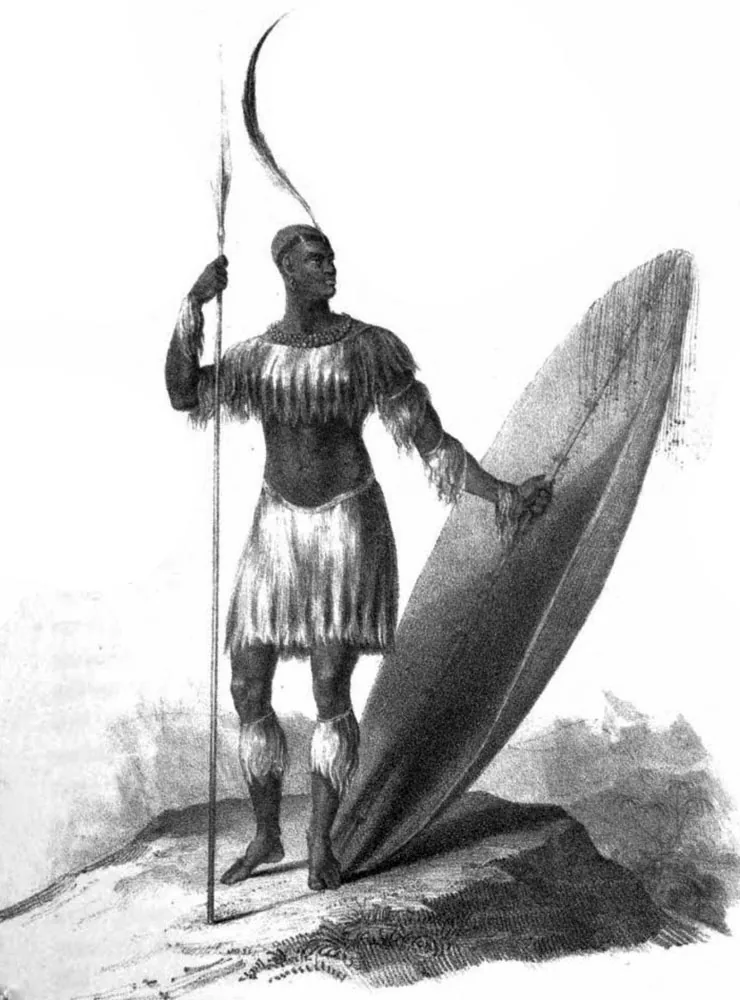
Sketch attributed to James King, 1825, printed in Isaacs’s *Travels* (1836). Wikimedia Commons · Public domain · Source page
The Shaka everyone knows
Which battle is in Zulu?
In 1964 a film called Zulu put a small British post under attack from thousands of Zulu warriors. The battle in the film was real, but it was fought in 1879, more than fifty years after Shaka died.
Many people who have heard of Shaka first met his name on a screen. In 1986 the South African broadcaster SABC showed Shaka Zulu: ten episodes based on Joshua Sinclair’s 1985 novel. It was a drama, and a drama is not a record.
So this lesson asks a plainer question. What did Shaka really do? What comes from people who were there, what was written down later, and what came from the films? Most of that can be answered only by reading the sources with care.
Where
A map from 1879, sixty years later
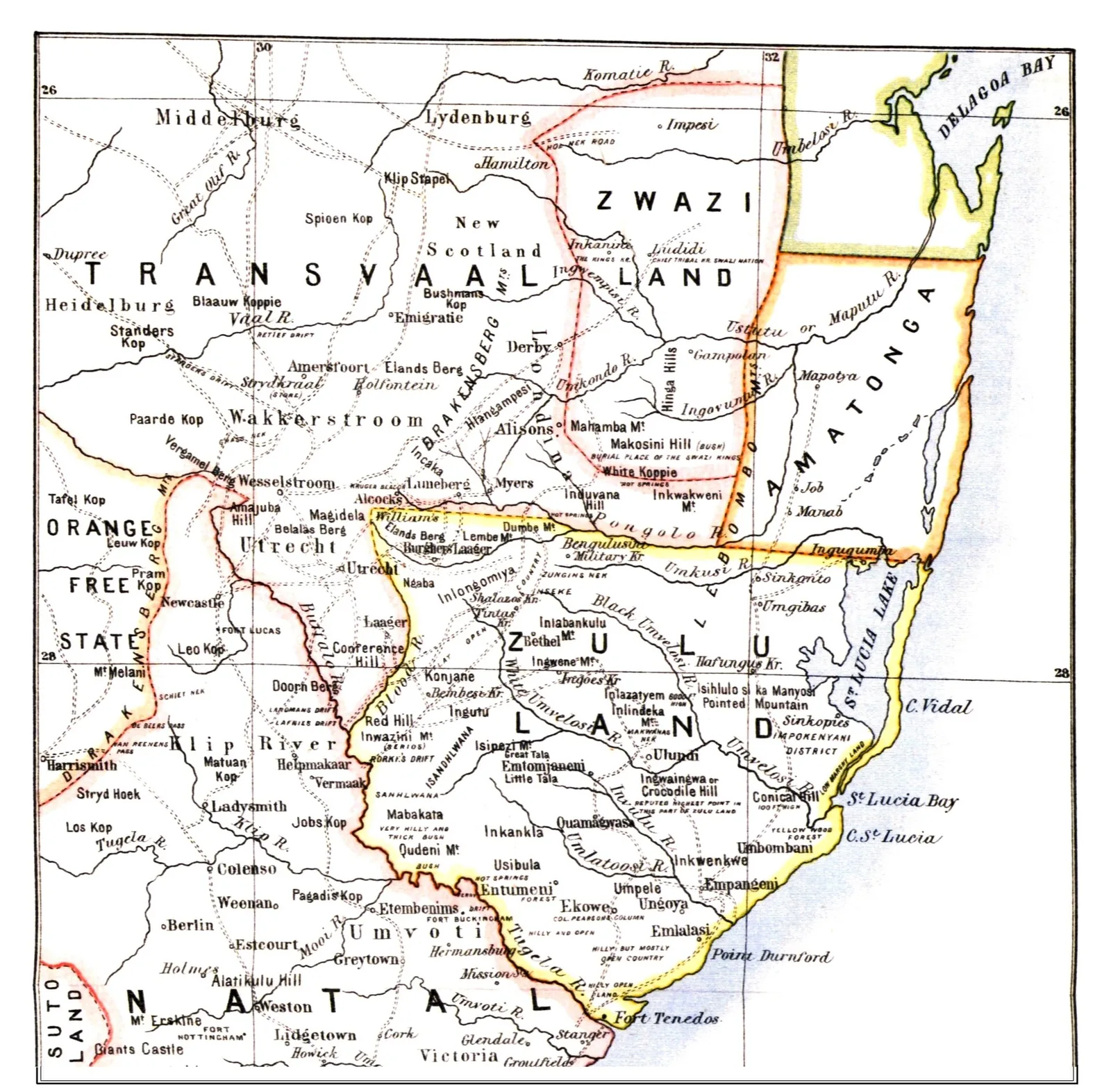
Map of Zululand, Natal and the Transvaal, 1879 (printed map, anonymous). Wikimedia Commons · Public domain · Source page
Zululand is the region of today’s KwaZulu-Natal province in South Africa. In 1816, when Shaka became chief of the Zulu clan, the Zulu were a small group in that region.
This map was printed in 1879, more than sixty years after he took over the clan. It shows the Zulu country as Europeans saw it in 1879, the year of the Anglo-Zulu War, not as it was in Shaka’s day.
Keep this in mind for the whole lesson: every picture, map and book about Shaka was made by someone, in some year, for some reason.
Source: The picture most often used for Shaka
Attributed to James King, 1825; printed in Nathaniel Isaacs, Travels (1836)
A sketch dated 1825 and attributed to James King, printed in Nathaniel Isaacs’s book of 1836 (see chapter 5). Nothing in the picture itself proves that the man is Shaka.
- Who made it, and when? It is attributed to James King and dated 1825. It was printed eleven years later, in 1836. Who kept the original, and who copied it, is not known to us.
- Is the man Shaka? How could you tell? The picture alone cannot prove it. A name written on a picture is not a likeness, and another picture labelled as Shaka has been questioned. Sandra Klopper (1994) argues that it shows his nephew Utimuni.
- What does the picture want you to believe? That this is a proud, armed leader, with a long shield and a spear. It suits a travel book that wanted a striking warrior on its page more than a record of one meeting.
Two kinds of evidence
What we have on Shaka
Almost everything we know about Shaka comes from two kinds of evidence. The first is oral tradition: what Zulu people remembered and told, which was written down only long afterwards, mostly in the years around 1900, by a colonial official working through an interpreter.
The second is written accounts by Europeans who met Shaka in Natal. Most were written down, or written again from memory, after his death, and many of their authors were traders who wanted land, books or a reputation. Writings like these are primary sources for what their writers saw or heard, but they were written years later, so each one raises questions: who wrote it, when, why, and for whom.
This lesson has seven chapters. Four times you will take a decision as one of the people involved, knowing only what they could know then.
A boy sent away
Birth
Born around 1787
Shaka was born around 1787. Most sources give that year and no more precise date.
The sources disagree about the place. Wikipedia puts his birth near Melmoth (Mthonjaneni). The South African History Online site (SAHO) says he was born in Langeni territory, at his mother’s uncle’s homestead. Both places lie in what is now KwaZulu-Natal.
Mother
A mother from the Langeni
His mother was Nandi, a woman of the Langeni people. His father, Senzangakhona, was chief of the Zulu clan. The boy grew up among his mother’s people, and what we know of his childhood comes almost entirely from oral tradition, recorded long after it happened.
The sources also disagree about Nandi’s own family and birth date, so this lesson does not build on those details.
Sent away
Sent to the Mthethwa
Around 1802, in a time of famine, Shaka was sent to live among the Mthethwa, a larger and stronger people under their chief, Dingiswayo. SAHO says he probably went in the time of a famine called Madlantule.
Why he went is unclear. Some accounts say that his father had rejected his mother, Nandi. Others say the community pressed the family to leave. The sources do not settle between them, so this lesson does not call it an exile: the cause is disputed.
Dingiswayo
A chief who was building an alliance
Dingiswayo was building a larger alliance than the Zulu had known. He brought more chiefs under his authority and expanded the age regiments: the system in which young men belong to a regiment according to their age. According to Wikipedia, an earlier chief called Jobe had set the system up. Shaka served first under Jobe and then under Dingiswayo.
SAHO says he joined a regiment at about the age of twenty-three. Sources give different estimates of how many years he served there, and the dates are hard to pin down.
So far
What we can and cannot say
So far, almost everything we know about Shaka’s first thirty years comes from oral tradition collected long afterwards. That does not make it false. It means every detail needs a second look.
In 1816 his father died, and Shaka became chief of the Zulu. Roughly two years later Dingiswayo, the Mthethwa leader who had protected him, was also dead, and Shaka had to face the army of Zwide.
A hill and a choice
1816 to 1818
A new chief, and a war
In 1816 Senzangakhona died, and Shaka became chief of the Zulu. Within about two years Dingiswayo, who had protected him, was dead as well. Zwide, leader of the Ndwandwe, had him killed. The sources give the year as 1817 or 1818.
Zwide’s army was now marching against the Zulu. Shaka led a small clan, with a few years of soldiering behind him, and he had a choice to make.
A decision point
You are Shaka, chief of the Zulu clan, in about 1818.
Zululand, about 1818, as Zwide’s army advances.
Dingiswayo, who protected you, is dead, and Zwide had him killed. Zwide’s army is larger than yours, and it is coming.
You know the ground: the hills, the river crossings and the paths the enemy could use. You do not know how many men Zwide will bring, or how far he will push.
What do you do?
- Hold a prepared position on a hill above the river, and make the enemy attack uphill. If the line holds, the enemy must climb under your spears. A small army can win that way. But if the hill falls, you may lose everything in one day.
- Fall back into the hills, avoid a battle and let the enemy tire. Your people survive, but Zwide’s army could take the open country, your herds and your homesteads. Rivals may decide that you are weak.
- Send envoys to Zwide with tribute, to buy time. Zwide might take the cattle and wait. A ruler who has already had one leader killed would probably come back with more men.
What really happened
Hold a prepared position on a hill above the river, and make the enemy attack uphill.
The tradition gives Shaka a hill and a victory over Zwide’s first attack. Its details are oral tradition, written down long afterwards.
SAHO says Zwide’s first expedition was beaten at Gqokli Hill, and it dates Zwide’s second, larger invasion to April 1818. Wikipedia gives April 1818 for the battle too, but notes that some claim it never happened as told. Dan Wylie, writing in The Conversation, is among those who doubt it.
SAHO also describes a feigned retreat that drew the enemy into a trap. The casualty figures given for the battle cannot be checked against any record made at the time, so this lesson does not use them.
Shaka’s own reasons were not recorded. A small army facing a larger one would usually choose ground where the enemy has to come to it, and the tradition gives him that choice.
Historians still argue about how much of the tradition to trust. It reached us through people who remembered it many years later.
A story of betrayal
An accusation that stayed
In his later account, Fynn, the trader we meet in chapter 5, says that Shaka betrayed Dingiswayo. SAHO points out that Shaka had not reached the battle until after Dingiswayo was taken, and that firm evidence for the charge is lacking.
The story is worth remembering for another reason. It shows how a tale about one man can grow in the telling, and how one writer’s suspicion can turn into ‘what happened’.
After the spears
A decision point
You are Shaka, after your victory over Zwide’s army, in about 1819 or 1820.
Zululand, about 1819 to 1820.
Zwide’s army has been beaten at the Mhlathuze River. The sources give the battle to 1819 or 1820. Men of the Ndwandwe and of other defeated peoples are now living in your country, with their cattle.
Some of their chiefs are ready to submit. Others are waiting to see what you will do with the young men, who are strong and used to war.
What do you do with them?
- Enrol the young men in your own regiments, so that they fight for you. Your army grows, with men who know the enemy’s ways. But men forced into your regiments are a risk too, and some will look for a way out.
- Leave their chiefs in place, take cattle as tribute, and post your own officials, the izinduna, to watch them. The chiefs stay, and the cattle come in. This keeps the border quiet, but it brings you no new fighters, and chiefs who resent the watchers may plot against you.
- Give their land to your allies, and settle the rest on the frontier to guard it. Your allies are rewarded, and the frontier is held. But the people who were moved would have to find land elsewhere, and they would probably press on the peoples already living there, which could spread the fighting further.
What really happened
Enrol the young men in your own regiments, so that they fight for you.
No record from that time shows what Shaka chose. Everything we have on this comes from later accounts, not checked against any earlier document. Those accounts say he took some of the defeated men into his regiments, and that others fled.
Mzilikazi, who had served under Shaka, left his service in the early 1820s and later founded a state of his own far to the north-west, in what is now Zimbabwe.
Shaka needed men, and the defeated peoples were both a gain and a risk. Historians debate whether the drive to absorb them, and the wars that followed, were Shaka’s own plan or part of a wider process in the region.
We cannot know what he thought. What we have is what later writers wrote.
A word
A word that came later
Later historians used the word mfecane for the wars and forced movements that shook southern Africa between about 1815 and 1840. The word itself is a twentieth-century coinage, and the picture it paints, with the Zulu at the centre, is disputed.
J. D. Omer-Cooper argued in 1966 that Zulu expansion was the main cause. Julian Cobbing argued in 1988 that the Zulu-centred story was built by liberal and apartheid-era historians, and that the slave trade through Delagoa Bay drove much of the violence. Who caused the upheaval is still an open argument.
The short spear
The spear and the army
Shaka is credited with turning the short stabbing spear, the iklwa, into the main weapon of his army, and with drilling his men to use it at close quarters. A warrior who went in close with a stabbing spear did not throw his weapon away at a distance.
John Laband (1997) calls this a “terrifying advantage” over opponents who still threw their spears. Credit for the drill is well supported. Credit for the invention is not, as the next pages show.
Source: A warrior photographed in 1917
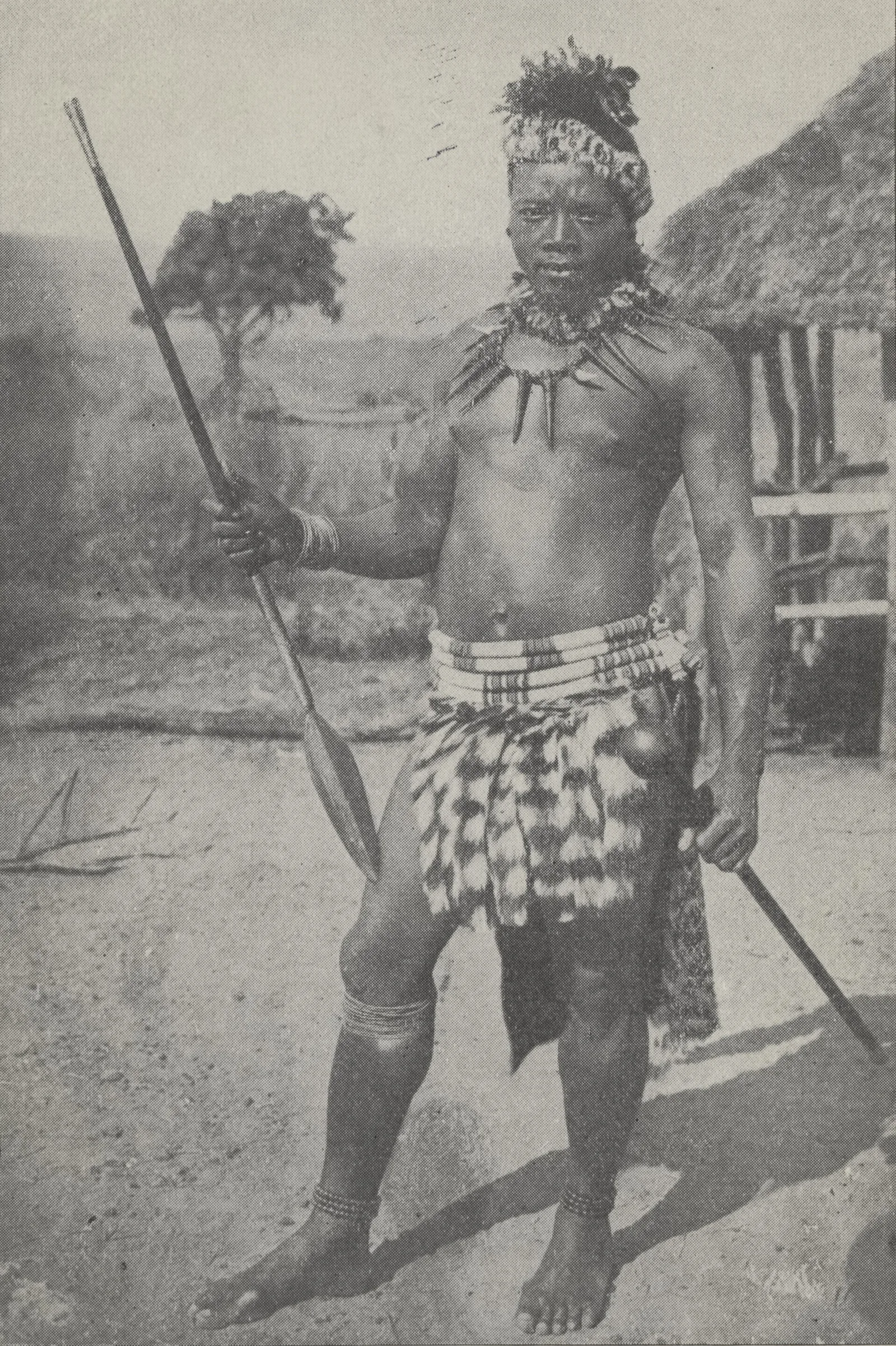
Patton, Cornelius H., ‘Zulu warrior’, 1917, from *The Lure of Africa*. New York Public Library · Public domain · Source page
Cornelius H. Patton, photograph, 1917, from The Lure of Africa
A photograph by Cornelius Patton, printed in a book called The Lure of Africa. It is held by the New York Public Library and is captioned simply ‘Zulu warrior’.
- When was this taken, and how far is it from Shaka’s time? In 1917, almost a century after the Gqokli battle and the years of Shaka’s reign. This is a man of the early twentieth century, not one of Shaka’s soldiers.
- Can the picture show what kind of spear the man holds? Not clearly. The picture shows long spears, but it cannot show whether one of them is the short stabbing spear the sources describe.
- Who gave the picture the title ‘Zulu warrior’, and why? The caption ‘Zulu warrior’ was written by whoever prepared the picture for the book, and it shows what they wanted readers to see. The picture does not tell us whether the man was a warrior at all.
Myth
Shaka invented the iklwa, the short stabbing spear, and the ‘buffalo horns’ battle formation.
The truth
Shaka did not invent the short spear, and he was not the first to use it. He is credited with making it the main weapon and with training his men to use it. The buffalo-horns formation is credited to him in popular books, such as Donald Morris’s of 1965, but no early source we know of credits him with it.
The evidence
Dan Wylie argues that Shaka neither invented the weapon nor was the first to use it (2006). Laband (1997) describes Shaka’s training, not an invention. Morris (1965) is a popular account, and historians who work from the sources, Wylie and Laband among them, criticise its heroic version.
The shield
The shield and the regiments
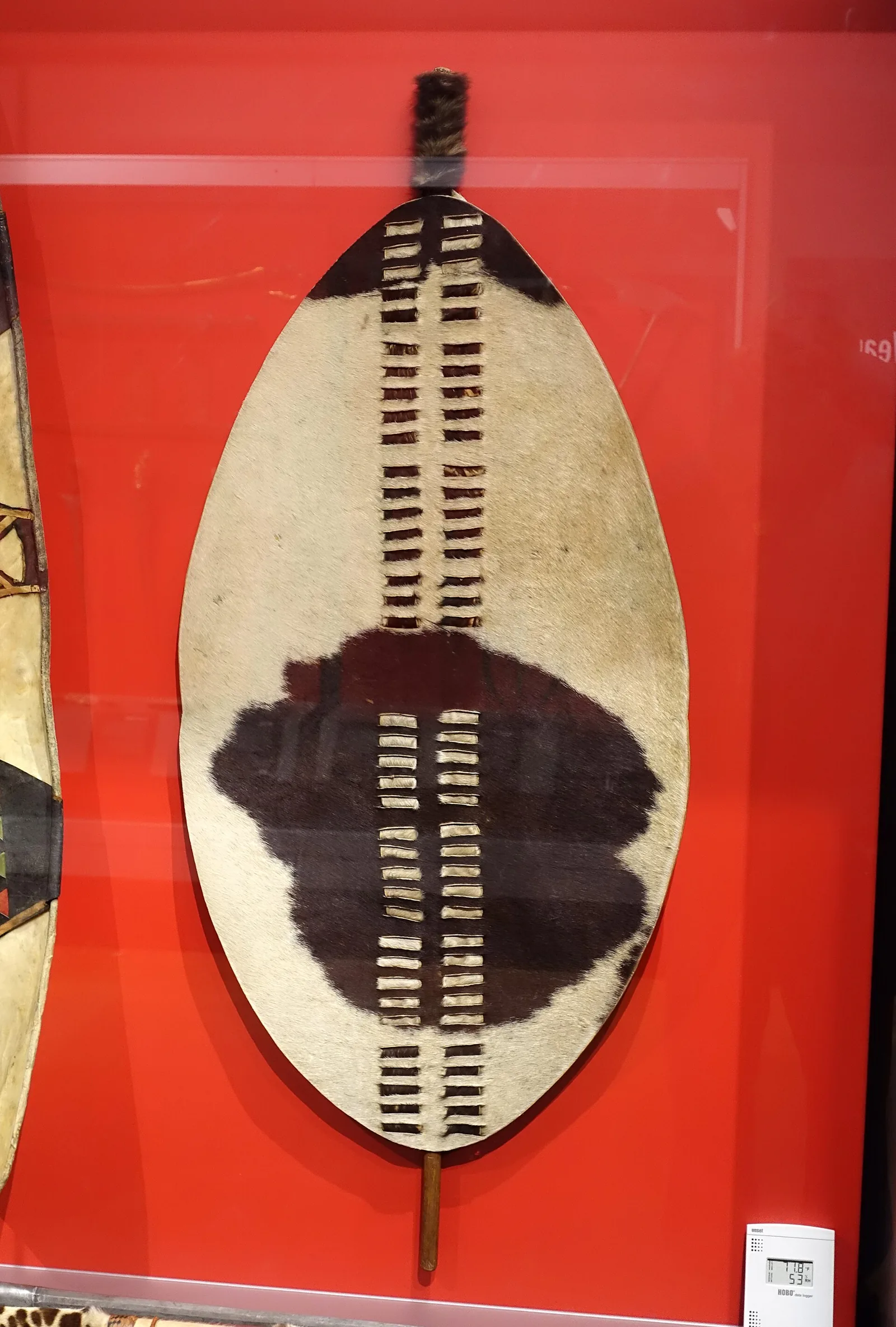
Shield, Zulu, Southern Africa, cow hide. Peabody Museum, Harvard University. Photo: Daderot, 2017. Wikimedia Commons · Public domain · Source page
The shield and the regiments are the other two items in the credit. Shaka is said to have introduced a larger, heavier cowhide shield, but no early source we know of says so. The shield in this photograph is a museum object, and nothing in the photograph says when it was made.
The age regiments were older than Shaka. According to Wikipedia, Chief Jobe organised them, and Dingiswayo expanded them. Shaka used them and changed them, which is a safer claim than that he invented them.
The men at Port Natal
1824
Two traders on the bay
By July 1824 Francis Farewell and Henry Francis Fynn were running a trading post at Port Natal, the bay where Durban stands today. They were a small party, and they wanted land and a place to trade.
The decision that follows asks what to give these strangers, and it will shape what is written about you afterwards.
A decision point
You are king of the Zulu, at your capital, in 1824.
Your capital, 1824.
Two European traders, Francis Farewell and Henry Francis Fynn, come to you with a request. They want land at Port Natal, the bay on the coast, and a place to trade. They bring goods and offer trade.
Your people have seen traders’ goods before. You weigh what the coast could bring against what it could cost you.
What do you do?
- Grant the bay and the land around it. The traders stay and trade, and the bay becomes a European base. Later claims to the land would rest on your grant, and the traders would use it to ask for more.
- Refuse the grant, but allow trade at the edge of your land. The traders would trade from the border and keep moving. You would keep control of the terms, and the coast would develop more slowly.
- Grant a small plot near the bay, with your control kept and the right to take it back. The traders stay on a small plot under your control. The right to take it back keeps you in charge, but the traders might see the terms as a limit and look for land elsewhere.
What really happened
Grant the bay and the land around it.
Accounts report that a large land grant was made in 1824. Its boundaries are disputed. According to Dan Wylie, as summarised in Wikipedia, Fynn asked for a huge grant of land in an area said to have been emptied by Shaka’s wars.
We could not confirm a formal document of 1824 from a second source, so the size of the grant is uncertain.
The sources do not record Shaka’s reasons. What they do record comes largely from the traders, who gained from the grant.
He may have wanted trade goods, a link to the coast, or a check on the traders. We cannot tell which.
The next arrival
Another European arrives
Nathaniel Isaacs came later. He sailed on the brig The Mary, under a captain named James King, and anchored off Port Natal on 1 October 1825. On 29 November he set off with King to visit Shaka, who had given cattle to Europeans who had washed up on his shores.
The sketch in chapter 1 is attributed to a James King. The name is the same as the captain’s, but it has not been shown that they were the same man.
A trader’s tale
Sandals of ox-hide
Traders’ stories entered the record and stayed there. Fynn’s account says that when the Zulu army reached hard, stony ground in 1826, Shaka ordered sandals of ox-hide to be made. Laband doubts it, and asks what we are to make of such a claim.
The example is small, but it shows how a story from a trader’s notebook can pass into the books and be repeated, without anyone checking it.
Source: A letter: make Shaka as bloodthirsty as you can
Here you are about to publish. Do make Shaka out to be as bloodthirsty as you can; it helps swell out the work and make it interesting.
We know this letter only through Dan Wylie’s quotation in his book on the Shaka legend. Isaacs writes to Fynn, who was about to publish his account of Shaka.
- Who is writing, to whom, and about what? Isaacs, a trader, to Fynn, a fellow trader who was about to publish. The letter is about a book, not about Shaka.
- What does the writer want Shaka to be? Bloodthirsty. He says so openly, and gives a reason: it makes the work longer and more interesting.
- What does this do to the early record? It shows that some of the blood in the early books was chosen for the market. Before you believe a violent detail, ask whether the writer had a reason to tell it.
Mourning
1827
Nandi dies
On 10 October 1827 Nandi, Shaka’s mother, died of dysentery. SAHO dates her death to October 1827, and the two sources agree on the month and year.
What followed her death is the weakest part of the record. The story of the mourning rests on a single memory, written up years later and repeated by others.
The image
A warrior seen by a European
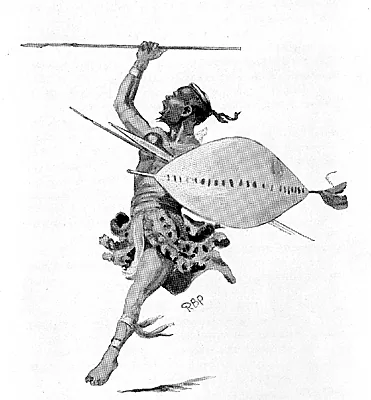
Sir Robert Baden-Powell, 1913, from *Boy Scouts Beyond the Seas*. Wikimedia Commons · Public domain · Source page
This sketch appeared in 1913 in a book by Robert Baden-Powell, founder of the Scout movement. It is labelled ‘A Zulu Warrior’. It shows a generic warrior, drawn the way a European imagined one, not a portrait of any particular man.
Keep it in mind as we read the mourning story. The writers who described Shaka already carried a picture of ‘the Zulu’ in their heads, and that picture may have shaped what they saw and what they wrote.
Myth
Shaka ordered a year of mourning for his mother: no milk to be drunk, no crops to be planted, and many people executed, with the exact number known.
The truth
The story goes back to Henry Francis Fynn’s memory of events. Donald Morris repeated it in 1965. SAHO says that large numbers were killed during the mourning ceremonies, but no document we can check gives the exact figures or the details, and the figures should not be taken as fact.
The evidence
Fynn’s diary was rewritten from memory about twenty years after the original was lost, and was not published until 1950. Dan Wylie (1995) argues that Fynn had reasons of his own, including land. The number and the details rest on one memory, and on a historian who repeated it.
Source: A trader’s contrast
The warring elements in the latter made him a ferocious savage …
Isaacs spells the name ‘Chaka’. In the same passage he sets Shaka against his successor, Dingane, whom he calls calm and calculating. Isaacs dealt with both men.
- Who is speaking, and what does he want from the kings he describes? A trader who wanted trade and favour from the Zulu kings. Such a writer had reasons to make one ruler look like a monster and the next look sensible.
- What does ‘ferocious savage’ tell you about the writer? It is the language of its time, which saw African rulers as lesser men. Do not repeat it as your own voice. Read it as a clue to what the writer believed.
- What is missing from this passage? Any Zulu voice. Isaacs does not tell us what Shaka’s own people thought of him, or of the wars.
Who made the monster?
How much of the Shaka of the early books is Shaka, and how much is the writers who had a use for him?
- Dan Wylie Fynn and Isaacs shaped Shaka to win land and to sell books. In his work of 1995 and 2006, Wylie treats the bloodthirsty Shaka of the early writers as much a product of their motives as of his deeds.
- Carolyn Hamilton In Terrific Majesty (1998), Hamilton argues that the image of Shaka was shaped by European writers and by African politics. But history limits how far an image can be invented. The image is not simply false: it is built from real material, and the limits of history matter.
- Julian Cobbing In 1988 Cobbing argued that the Zulu-centred story of the mfecane was built by liberal and apartheid-era writers. He argued too that the story helped justify the division of land under apartheid.
Few historians deny that Shaka’s wars were real and bloody. The argument is about the image, and about the historiography that shaped it: which parts of the monster are evidence, and which were useful to people who wanted land, books or a political case?
The brothers
The court
A divided court
Shaka’s court was not at peace in his last years. His half-brothers Dingane and Mhlangana held posts close to him, and Mbopha, his adviser, stood near the king.
Some accounts say that the brothers had already tried to kill Shaka at least twice. We cannot check the details of those attempts.
A decision point
You are Shaka, king of the Zulu, at Dukuza, in September 1828.
Dukuza, September 1828.
Your half-brothers Dingane and Mhlangana hold posts close to you. A warning reaches you that they are plotting against you. Mbopha, your adviser, takes it seriously.
Some accounts say most of your warriors are away on a campaign against Soshangane, in the north.
What do you do?
- Remove the brothers from their posts and send them to distant places, under watch. They lose their power, but they keep their grievances and their followers. Sending them away could make a plot more likely, not less.
- Call a council, and question the brothers in public, before the warriors and the guard. Questioning in public might expose the plot, or it might warn the plotters. Either way, the brothers would have to answer in front of the people who count.
- Recall the army to guard Dukuza, and double the royal guard. Your personal safety rises, and the brothers would find it harder to act. But recalling the army means leaving the campaign, and your rivals would see your fear.
- Take no action yet, and wait to see whether the warning proves true. You keep the court calm and avoid a rash step. But if the warning is true, waiting gives the plotters the time and the chance they need.
What really happened
Take no action yet, and wait to see whether the warning proves true.
The sources we have do not say what Shaka decided, if he decided anything, after the warning. What they agree on is what came next. In September 1828 his half-brothers Dingane and Mhlangana killed him at Dukuza. Mbopha is said to have created a diversion for the killers. The sources give 22 or 24 September for the day, and the year 1828 is agreed. So the option ‘take no action yet’ is marked as the one that fits the record: the sources mention no step by Shaka against the brothers before the killing. That is a fit with the record, not a recorded decision.
Shaka’s reasons, and what he knew, were not recorded. Most of what we have was written by outsiders, years later.
A decision that looks obvious afterwards may have looked like a bluff, a rumour or a plain family quarrel at the time.
Afterwards
What came next
Shaka was killed at Dukuza, near his military barracks, in the area of what is now KwaDukuza, once called Stanger. The exact spot is disputed. The sources describe the killing briefly, and this lesson says no more than they do.
Dingane took the throne and ruled until about 1840. In his later years he was drawn into conflict with the Voortrekkers, Boer settlers who had moved into the region.
Who gave the order is still disputed. The usual account makes Dingane the main killer. Elizabeth Eldredge (2014) argues that Mhlangana was the real instigator of the killing, with Mbopha carrying it out.
What followed, in order
- c. 1787 Shaka is born. The birthplace is disputed.
- c. 1802 Sent to live among the Mthethwa, probably in a famine year.
- 1816 Senzangakhona dies, and Shaka becomes chief of the Zulu.
- 1817 or 1818 Zwide has Dingiswayo killed.
- April 1818 (disputed) The battle of Gqokli Hill, if it happened as told.
- 1819 or 1820 Zwide is defeated at the Mhlathuze River.
- 1824 Traders settle at Port Natal. A large land grant is reported.
- 10 October 1827 Nandi dies. The mourning story rests on a memory written up again later.
- September 1828 Shaka is killed at Dukuza by his half-brothers. Dingane takes the throne.
- 1836 Isaacs publishes his Travels and Adventures in Eastern Africa.
- 1950 Fynn’s diary is published, edited by D. McK. Malcolm from James Stuart’s compilation.
- 1986 The SABC series Shaka Zulu is broadcast.
Myth
Shaka killed millions of people, and the figures are modern inventions.
The truth
No reliable count exists. The figure of about a million traces back to Fynn’s account, which came before the modern estimates. Some modern summaries give a range of one to two million, and scholars call those numbers controversial. SAHO notes that some estimate more than a million people died in the wider upheaval. A precise figure has no firm basis.
The evidence
Dan Wylie treats Fynn’s million as a guess. Cobbing (1988) argued that much of the violence came from the slave trade through Delagoa Bay, not from Shaka alone. Omer-Cooper (1966) put Zulu expansion at the centre. Historians disagree about the cause, and so about the blame and the count.
A symbol
A symbol that outlived him
Shaka became a symbol. SAHO records that he became a Zulu nationalist icon, and political movements have claimed his name. The 1986 series added new images, and it is based on a novel, not on the early records.
Anyone who writes about Shaka today has to begin with the sources and the images together. That is the real subject of this lesson: we cannot fully separate what happened from what was written about it, and we should not pretend that we can.
Check yourself
When did Shaka’s mother, Nandi, die?
Answer: In October 1827. Right. Wikipedia gives 10 October 1827, and SAHO gives October 1827. Her death opens the mourning story of chapter 6.
Check yourself
Who killed Shaka at Dukuza in 1828?
Answer: His half-brothers Dingane and Mhlangana. Right. The sources agree that Dingane and Mhlangana killed him, with Mbopha’s help. Some historians give Mhlangana the main role, and the matter is debated.
Check yourself
Which battle does the 1964 film Zulu show?
Answer: Rorke’s Drift, in 1879, in the Anglo-Zulu War. Right. The film depicts the 1879 defence of Rorke’s Drift, a mission post, during the Anglo-Zulu War. Shaka had been dead for more than fifty years.
Check yourself
Which of these is true of the 1986 SABC series Shaka Zulu?
Answer: It ran for ten episodes, based on a 1985 novel.. Right. The series ran for ten episodes and was based on Joshua Sinclair’s novel of 1985. It is a drama, not a record of Shaka’s life.
Check yourself
What does Julian Cobbing argue in “The Mfecane as Alibi” (1988)?
Answer: Later writers built the Zulu-centred story, and the slave trade drove much violence.. Right. Cobbing argued that the Zulu-centred story was built by liberal and apartheid-era historians, and that slave trading through Delagoa Bay drove much of the violence.
Check yourself
Did Shaka invent the iklwa, the short stabbing spear?
Answer: No. The spear was older, and he is credited with making it the main weapon.. Right. The short spear was in use before Shaka. Laband (1997) describes his training of the men, not an invention.
Terms
- oral tradition Knowledge kept in memory and told aloud, and written down only long after the events. It is valuable, but it changes each time it is retold.
- primary source A document, image or testimony made by someone who was there or heard it at first hand. Ask who made it, when, why and for whom.
- age regiments Regiments of young men grouped by age, who served the king together. The system existed before Shaka, and he changed it.
- iklwa The short stabbing spear of the Zulu army, used at close quarters. Shaka is credited with making it the main weapon, but the spear was older than him.
- mfecane A name coined in the twentieth century for the wars and forced movements in southern Africa between about 1815 and 1840. Shaka’s part in them is disputed.
- izinduna Officials appointed by the king to oversee chiefs and districts.
- land grant A right to land given by a ruler to a person or group. In 1824 the traders asked Shaka for one at Port Natal.
- historiography The study of how history has been written: who wrote it, for whom, why, and what changed along the way.
- Zululand The region in South Africa where the Zulu clan lived. Today it lies in KwaZulu-Natal province.
- Nandi Shaka's mother, a woman of the Langeni people. She died in 1827.
- Senzangakhona Chief of the Zulu clan and father of Shaka. He died in 1816.
- Langeni The people Shaka's mother belonged to. One source places Shaka's birth in their territory.
- Mthethwa A larger, stronger people, among whom Shaka lived as a young man under their chief Dingiswayo.
- Dingiswayo Leader of the Mthethwa, who built a large alliance and protected Shaka.
- Jobe A chief who, according to Wikipedia, set up the age regiments before Shaka.
- Zwide Leader of the Ndwandwe, who ordered Dingiswayo killed and then marched against the Zulu.
- Ndwandwe A people led by Zwide. His army was defeated at the Mhlathuze River.
- Henry Francis Fynn A European trader at Port Natal who wrote a later account. In it he claims Shaka betrayed Dingiswayo.
- Francis Farewell A European trader who, with Fynn, asked for land and a place to trade at Port Natal.
- Nathaniel Isaacs A European who reached Port Natal in 1825 and visited Shaka. His book was printed in 1836.
- James King Captain of the brig The Mary, which Isaacs sailed on. The name appears on a sketch in chapter 1, but it is not proven to be the same man.
- Mzilikazi Served under Shaka, left in the early 1820s and later founded his own state, far to the north-west.
- Dingane Shaka's half-brother. In the usual account he is the main killer, and he ruled after the murder.
- Mhlangana Shaka's half-brother. A 2014 argument holds that he was the real instigator of the murder.
- KwaDukuza The town where Shaka was killed. It was once called Stanger.
- Donald Morris Author of a popular 1965 book that repeated stories about Shaka, including the buffalo-horns formation.
- Omer-Cooper A historian who argued in 1966 that Zulu expansion was the main cause of the mfecane. In 1993 he replied to Cobbing.
- Julian Cobbing A historian who argued in 1988 that the slave trade through Delagoa Bay drove much of the violence.
- Delagoa Bay A bay on the east coast of Africa. According to Cobbing, the slave trade through it drove much of the violence.
- Robert Baden-Powell Founder of the Scout movement. His 1913 book about his world tour was written for young readers.
Sources
- Nathaniel Isaacs, *Travels and Adventures in Eastern Africa, descriptive of the Zoolus, their manners, customs, etc., with a sketch of Natal* (London: E. Churton, 1836)
- Henry Francis Fynn, *The Diary of Henry Francis Fynn*, compiled from original sources by James Stuart, edited by D. McK. Malcolm (Pietermaritzburg: Shuter and Shooter, 1950)
- *The James Stuart Archive of Recorded Oral Evidence relating to the History of the Zulu and Neighbouring Peoples*, edited by C. de B. Webb and J. B. Wright, vol. 1 (1976)
- Dan Wylie, *Myth of Iron: Shaka in History* (Pietermaritzburg: University of KwaZulu-Natal Press, 2006)
- Dan Wylie, ‘Proprietor of Natal: Henry Francis Fynn and the Mythography of Shaka’, *History in Africa* 22 (1995), pp. 409–437
- Julian Cobbing, ‘The Mfecane as Alibi: Thoughts on Dithakong and Mbolompo’, *Journal of African History* 29, no. 3 (1988), pp. 487–519
- Carolyn Hamilton, *Terrific Majesty: The Powers of Shaka Zulu and the Limits of Historical Invention* (1998)
- Donald R. Morris, *The Washing of the Spears: The Rise and Fall of the Zulu Nation* (New York: Simon and Schuster, 1965)
- John Laband, *The Rise and Fall of the Zulu Nation* (London: Arms and Armour Press, 1997)
- J. D. Omer-Cooper, *The Zulu Aftermath: A Nineteenth-Century Revolution in Bantu Africa* (Evanston: Northwestern University Press, 1966)
- J. D. Omer-Cooper, ‘Has the Mfecane a Future? A Response to the Cobbing Critique’, *Journal of Southern African Studies* 19 (1993)
- Elizabeth A. Eldredge, *The Creation of the Zulu Kingdom, 1815–1828: War, Shaka, and the Consolidation of Power* (Cambridge: Cambridge University Press, 2014)
- South African History Online (SAHO), ‘Shaka Zulu’
Image credits
- Sketch attributed to James King, 1825, printed in Isaacs’s *Travels* (1836). Wikimedia Commons · Public domain · Source page
- Map of Zululand, Natal and the Transvaal, 1879 (printed map, anonymous). Wikimedia Commons · Public domain · Source page
- Patton, Cornelius H., ‘Zulu warrior’, 1917, from *The Lure of Africa*. New York Public Library · Public domain · Source page
- Shield, Zulu, Southern Africa, cow hide. Peabody Museum, Harvard University. Photo: Daderot, 2017. Wikimedia Commons · Public domain · Source page
- Sir Robert Baden-Powell, 1913, from *Boy Scouts Beyond the Seas*. Wikimedia Commons · Public domain · Source page


