Scipio Africanus and Zama
At 25 he asks for a command nobody else wants. Eight years later he faces Hannibal himself.
Decisions, questions and your own progress, in the app
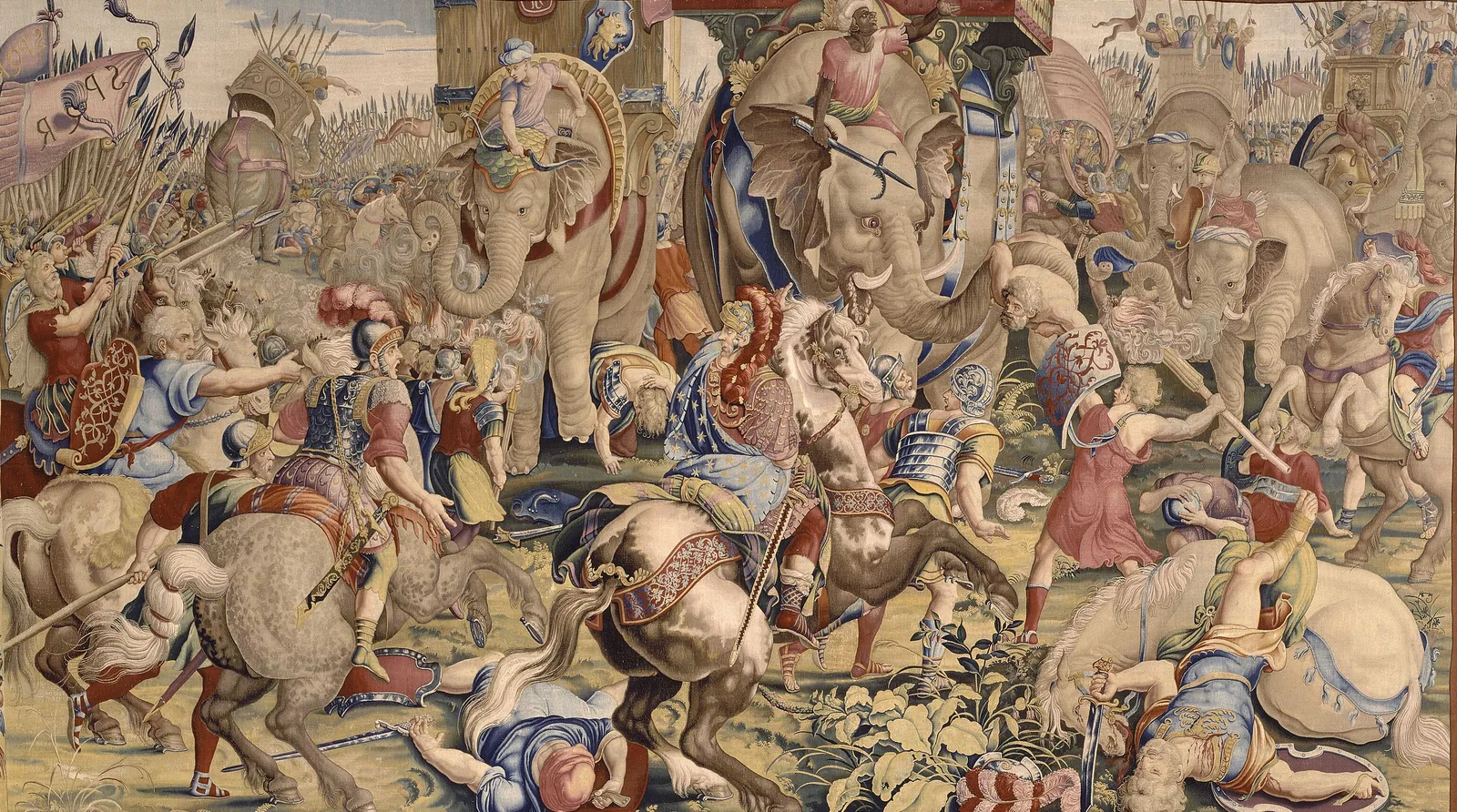
The Battle of Zama, from the Story of Scipio tapestries, Gobelins, 1688–1690; cartoon by François Bonnemer after Giulio Romano and Gianfrancesco Penni. Musée du Louvre, Paris · Public domain · Source page
Nobody stands up
A volunteer for a lost war
Rome, 210 BC. The citizens gather on the Field of Mars to choose a general for Spain, and nobody comes forward. A year earlier both Roman commanders there, two brothers, were killed within a month of each other.
Then a young man climbs a low rise where everyone can see him, and offers himself. He is only about twenty-five, and has never been consul, or even praetor. He is the son of one dead general and the nephew of the other. Every vote goes to him.
Eight years later, on a plain in Africa, he faces Hannibal himself. How did he get there? And how much of his legend can we believe?
Our witnesses
A friend of the family
That scene comes from Livy, a Roman who wrote under Augustus, almost two hundred years later, to show his readers Roman greatness. Our oldest surviving witness is Polybius, a Greek brought to Rome as a hostage in 167 BC, who became the friend of Scipio’s adopted grandson.
Polybius questioned Gaius Laelius, Scipio’s friend and lieutenant, and read a letter Scipio wrote himself. But Polybius wrote for the family that protected him, and set out to prove that Scipio owed nothing to luck. Appian, a Greek of the 2nd century AD, adds scenes nobody else knows. At every step, ask: who told him?
Publius Cornelius Scipio Africanus
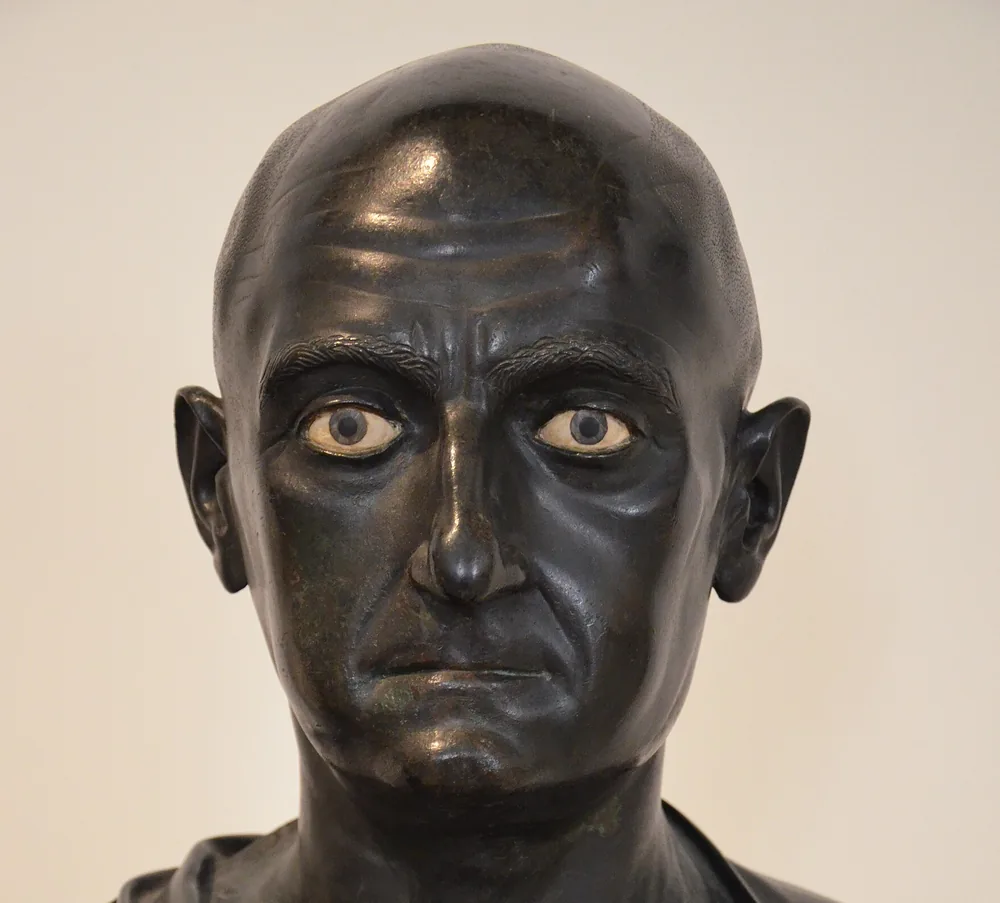
Bronze bust, so-called Scipio Africanus, from the Villa of the Papyri, Herculaneum. Museo Archeologico Nazionale, Naples. Photo: Carole Raddato, 2014 · CC BY-SA 2.0 · Source page
A young man handed a war Rome was losing, who won it by surprise and ended his life as Rome’s most suspected citizen.
- Born: 236 or 235 BC, Rome, into the patrician Cornelii
- Died: c. 183 BC, Probably Liternum, on the coast of Campania, at his country house, in self-chosen retirement after political trials
- Won: New Carthage, 209 BC; Baecula, 208 BC; Ilipa, 206 BC; The burning of the camps and the Great Plains, 203 BC; Zama, 202 BC
- Lost: Hasdrubal slips away to Italy after Baecula, 208 BC; The siege of Utica, abandoned, 204 BC; The trials and retirement to Liternum, 187–184 BC
“…it was not proper for the Roman people to listen to anyone who accused Publius Cornelius Scipio, to whom his accusers owed it that they had the power of speech at all.”
Rome holds on
Background
After Cannae
In 216 BC, at Cannae, Hannibal destroyed the largest army Rome had ever put in the field. As we saw in the last lesson, Rome still would not talk peace. Capua, the second city of Italy, went over to him, and so did Syracuse in Sicily.
Rome answered with a war of endurance: shadow Hannibal, avoid a pitched battle, besiege the cities that had changed sides. Syracuse, where Archimedes’ machines beat off the first Roman assaults, held out for two years and fell in 212 BC, and a Roman soldier killed Archimedes in the sack. In 211, to draw the besiegers away from Capua, Hannibal marched on Rome itself and camped 40 stades, about seven kilometres, from its walls. Rome kept its nerve, the siege went on, and Capua fell.
Spain, 211 BC
Twenty-nine days
29
Far to the west, the brothers Publius and Gnaeus Scipio had fought in Spain for seven years, keeping Hannibal’s brother Hasdrubal Barca from taking a second army to Italy. In 211 BC they split their forces and relied on 20,000 hired Celtiberians, whom Hasdrubal paid to go home.
Publius was killed attacking a Carthaginian army whose Numidian horsemen were led by a young prince named Masinissa. Twenty-nine days later Gnaeus fell too. The survivors held on north of the river Ebro. That is why nobody stood for Spain in 210 BC, and why the son did.
Four years in Spain
A decision point
You are Publius Cornelius Scipio, proconsul in Spain.
Tarraco, on the coast of north-east Spain, winter 210/209 BC
You can march with about 27,500 men and leave a guard on the Ebro, and you command the sea. Three Carthaginian armies hold the rest of Spain. Their generals quarrel, and each is more than ten days’ march from New Carthage, their main base.
New Carthage holds their treasury, their stores and their Spanish hostages, with a garrison of only about a thousand trained soldiers. Fishermen say the lagoon behind it is shallow, and that its water often goes down in the evening.
Your father and uncle died because they split their forces and trusted hired allies. Caution says: hold the line and wait.
What do you do?
- Hold the Ebro and wait for reinforcements Safe, and what caution advises. But each year of waiting lets Carthage hire new soldiers with Spanish silver, and perhaps send another army over the Alps to Hannibal.
- Seek out one Carthaginian army and beat it before the others come up A victory would shake Carthage’s hold on Spain. But if the other two armies arrive in time, you could die exactly as your father did.
- March on New Carthage in secret and storm it If it works, Carthage loses its money, its stores and its hostages at one blow. If the city holds out for even a few weeks, the three armies will gather against you, and your fleet will have to take you off.
What really happened
March on New Carthage in secret and storm it
Scipio told only Laelius, who sailed the fleet down the coast while the army marched. They arrived together, and the city fell on the day of the attack.
Polybius sets out Scipio’s reasoning point by point, partly from a letter Scipio later wrote to Philip V of Macedon. Modern historians agree the choice was brilliant, but add that it needed luck, and enemy generals careless enough to leave their richest base almost unguarded.
New Carthage, 209 BC
Neptune’s ford
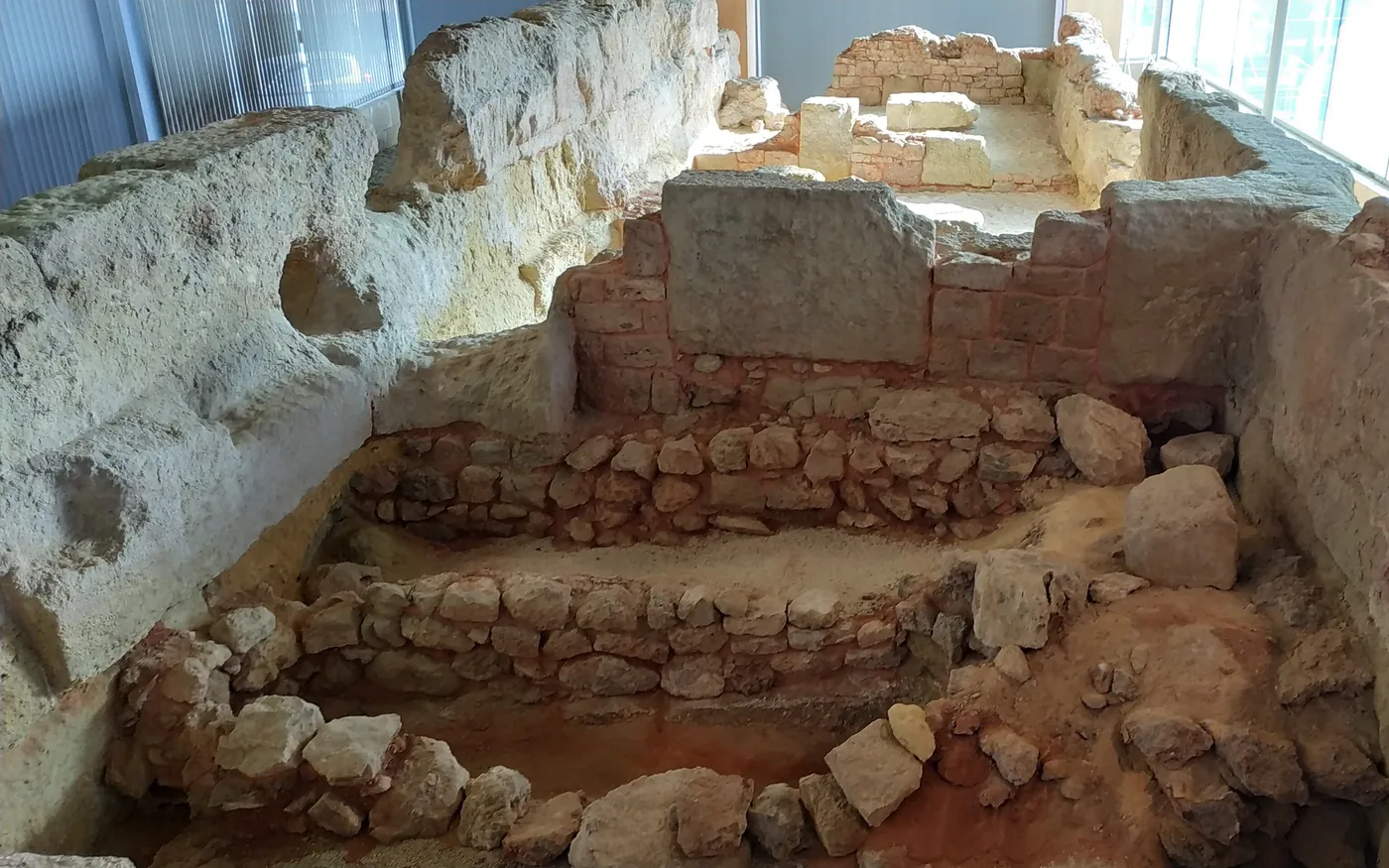
The Punic wall, Centro de Interpretación de la Muralla Púnica, Cartagena, 2019. Photo: María Rodriguez · CC BY-SA 4.0 · Source page
New Carthage stood on a hilly peninsula: the sea to the south, a lagoon to the north and west, a narrow neck of land to the east. Scipio promised gold crowns to the first men on the wall, and told his soldiers that Neptune, god of the sea, had shown him the plan in a dream.
The assault across the neck of land failed. In the afternoon, as the lagoon fell, 500 men carried ladders through the shallows to a stretch of wall nobody was guarding. By evening the city was Roman, with its treasury, 18 ships and more than 300 hostages. Scipio treated the hostages kindly and sent many home, and Spanish tribes began to change sides.
Source: Calculation or a god?
“…Scipio similarly made the men under his command more sanguine and more ready to face perilous enterprises by instilling into them the belief that his projects were divinely inspired. That everything he did was done with calculation and foresight, and that all his enterprises fell out as he had reckoned, will be clear from what I am about to say.”
Just before this, Polybius complains that ‘all other writers’ make Scipio a favourite of fortune.
- What does Polybius think Scipio himself believed? That the plans were his own, and the gods a way to give his men courage. Polybius admired reason and gave his hero the same mind.
- Who could have told Polybius what Scipio was thinking? Laelius, whom Polybius questioned when Laelius was an old man, and Scipio’s letter to Philip V. Both wanted Scipio to look clever rather than lucky; Laelius had commanded the fleet that day.
- Livy, writing later, will not choose. Why might that be honest? Livy says Scipio acted as if guided by visions of the night, and cannot tell whether he believed in them or used them to be obeyed. Nobody can see into another mind, and a Roman could believe in his gods and use them too.
208–207 BC
The brother who got away
In 208 BC Scipio drove Hasdrubal Barca off a ridge at Baecula, near the silver mines of southern Spain. Spanish allies hailed him as king; he refused, for a Roman noble could be imperator, ‘general’, but never king.
But Hasdrubal got away with his treasure and elephants, and in 207 BC crossed the Alps. In Italy the consul Gaius Claudius Nero slipped away from Hannibal with 7,000 picked men, joined his colleague and destroyed Hasdrubal’s army on the Metaurus river. Scipio’s critics never forgot that he had let Hasdrubal go.
Ilipa: who fought whom
Spring 206 BC
Near Ilipa (Alcalá del Río), north of Seville
Romans and Latins
- Commanders: Scipio, on the right wing, Lucius Marcius and Marcus Junius Silanus, on the left
- Strength: about 45,000 foot and 3,000 horse (Polybius); 45,000 in all (Livy); not a third of the enemy’s number (Appian (2nd c. AD)); about 45,000–48,000, perhaps half of them Spanish allies (Modern estimate)
- Losses: 800 (Appian)
The totals are for Scipio’s whole army, Spanish allies included.
Scipio’s Spanish allies
- Commanders: Spanish chiefs who had joined Scipio
- Strength: part of Scipio’s total; one chief, Colichas, brought 3,000 foot and 500 horse (Polybius); perhaps half of Scipio’s army (Modern estimate)
- Losses: give no separate figure (The sources)
Carthage and its allies
- Commanders: Hasdrubal son of Gisco, Mago, Hannibal’s brother, Masinissa, with the Numidian horse
- Strength: about 70,000 foot, 4,000 horse, 32 elephants (Polybius); 50,000 foot, 4,500 horse (‘some say’ 70,000 foot) (Livy); 70,000 foot, 5,000 horse, 36 elephants (Appian); about 35,000–55,000 (Modern estimates)
- Losses: 15,000 dead (Appian); Hasdrubal escaped with only about 6,000 (Livy)
Much of the army was Spanish levies of doubtful loyalty.
Outcome: A decisive Roman victory. Within months Carthage had lost all Spain; Gades (today’s Cádiz), its last city there, went over to Rome.
Polybius’s figures for Scipio’s army probably rest on Roman records; the enemy’s numbers can only have been estimates. Polybius’s casualty figures do not survive.
The battle of Ilipa
Spring 206 BC, after several days of waiting
Two armies stand on the plain between their camps near Ilipa in Spain: the Roman legions and Scipio’s Spanish allies against the Carthaginian army under Hasdrubal son of Gisco. For days both come out late and stand facing each other, and at stake is control of Spain.
One reconstruction. The camps follow H. H. Scullard’s suggestion (1936): the Roman camp on the low hill of Pelagatos, about 10 km north-east of Alcalá del Río, and the Carthaginian camp on a hill about 5 km south-west of it. J. Millán León (1986) accepted it as a working hypothesis; no excavation has tested it. It fits the ground, but nothing has proved it.
The deployment and the manoeuvre follow Polybius 11.20–24 and Livy 28.12–16. Polybius’s account of the wheeling of the wings is notoriously hard to reconstruct. Appian describes a quite different battle, with no reversed order. The course of the Guadalquivir is today’s; in 206 BC it may have run differently. Unit depths are exaggerated so they can be seen; positions are approximate.
Phases of the battle
- Days of waiting For days both armies come out late and stand on the plain between their camps: Hasdrubal’s Libyans, his best troops, in the centre facing Scipio’s legions, Spaniards on the wings, elephants in front of the wings.
- Dawn: the order reversed On the chosen day Scipio’s men eat before dawn. His horse and light troops attack the Carthaginian outposts at first light, and he forms up mid-plain with the Spaniards in the centre and the legions on the wings. Hasdrubal’s men come out in haste, unfed, in their usual order.
- The wings wheel After hours of skirmishing, about 700 metres from the enemy, the Roman wings turn outward in column, then swing in on the Carthaginian wings while horse and light troops ride round the ends. Scipio’s Spaniards advance slowly and never close; the Libyans dare not move.
- Heat, elephants and rain Pelted with javelins, the elephants run wild through their own ranks. In the midday heat the hungry Carthaginian wings give way and run for their camp. A cloudburst stops the Romans at the rampart. That night Hasdrubal flees; most of his army is caught in the pursuit.
The strategy
- Romans and Latins: Scipio’s men eat before dawn, and the enemy comes out hungry and in haste, while his horse and light troops strike the Carthaginian outposts at first light. The Spaniards hold the centre and the legions the wings; the wings first turn outward, then swing inward on the Carthaginian wings, while the horse rides round the ends. The exact manoeuvre is hard to reconstruct.
- Scipio’s Spanish allies: Scipio’s Spaniards in the centre advance slowly against the Libyans and never close with the enemy. Most likely their aim is to hold the Libyans in place, since they dare not move, while the Roman wings wheel.
- Carthaginian army: Hasdrubal sets the Libyans, his best troops, in the centre facing the legions, the Spaniards on the wings and the elephants in front of the wings. The reconstruction does not explain why. When Scipio’s attack comes, his men come out hungry and in haste, in their usual order.
What decided it: The battle was decided by preparation and timing. Scipio’s men had eaten before dawn, while the Carthaginians came out hungry and in haste. In the midday heat, once the panicking elephants burst through their own ranks, the hungry Carthaginian wings broke and fled to their camp.
To Africa
206 BC
Two kings of horsemen
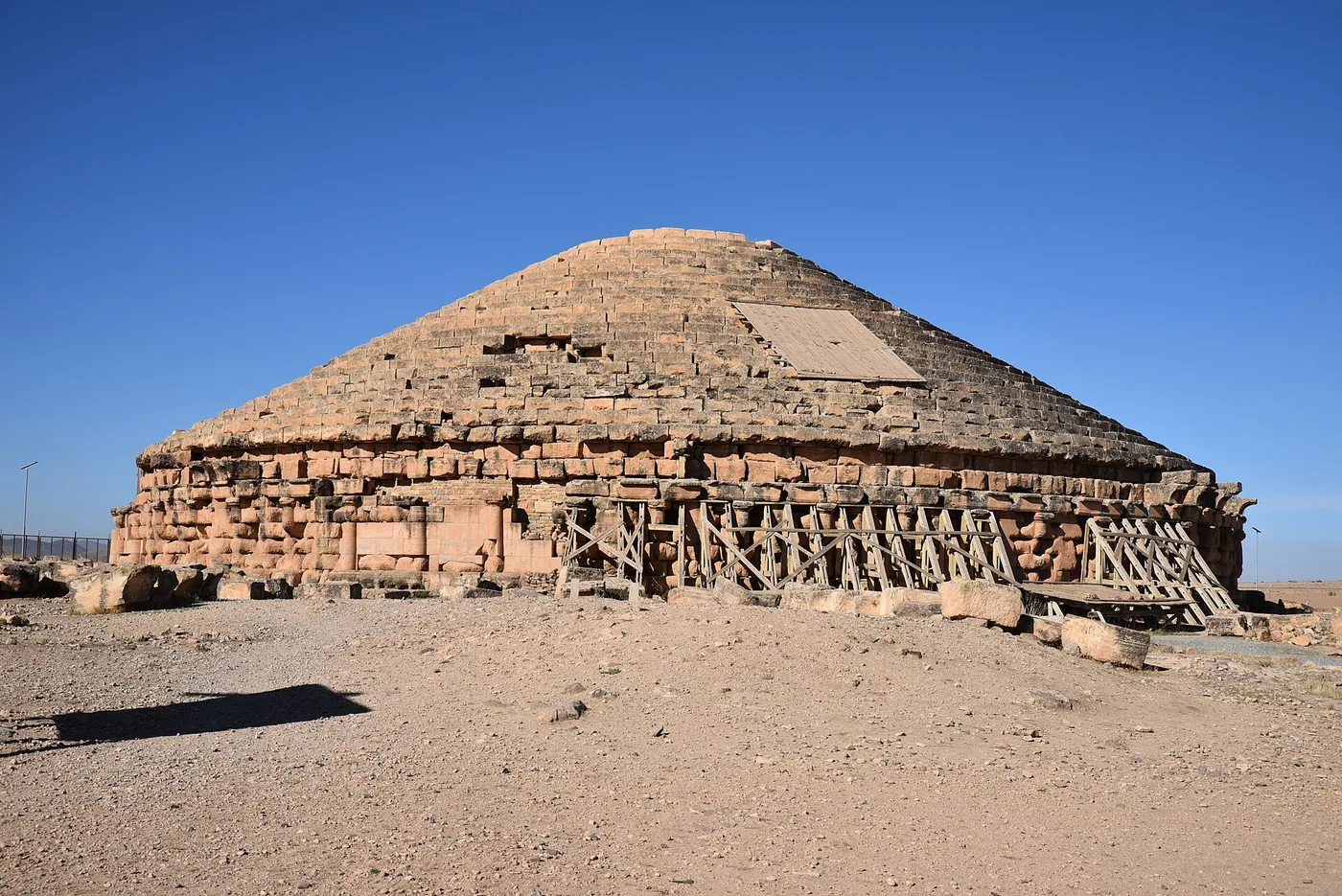
The Medracen royal mausoleum, near Batna, Algeria, 2022. Photo: Carole Raddato · CC BY-SA 2.0 · Source page
After Ilipa Scipio looked across the sea to Numidia. Its two kingdoms were rivals. In the west ruled Syphax, the stronger king. Scipio sailed to meet him with just two warships, and found Hasdrubal son of Gisco, the enemy he had just beaten, already there. Syphax had them dine on one couch.
In the east the young Masinissa, who had fought Rome for six years, was ready to change sides; Scipio had freed his captured nephew. They met in Spain, and Masinissa stayed Rome’s friend for the rest of his very long life. Syphax went the other way: he married Hasdrubal’s daughter Sophonisba and joined Carthage.
Masinissa
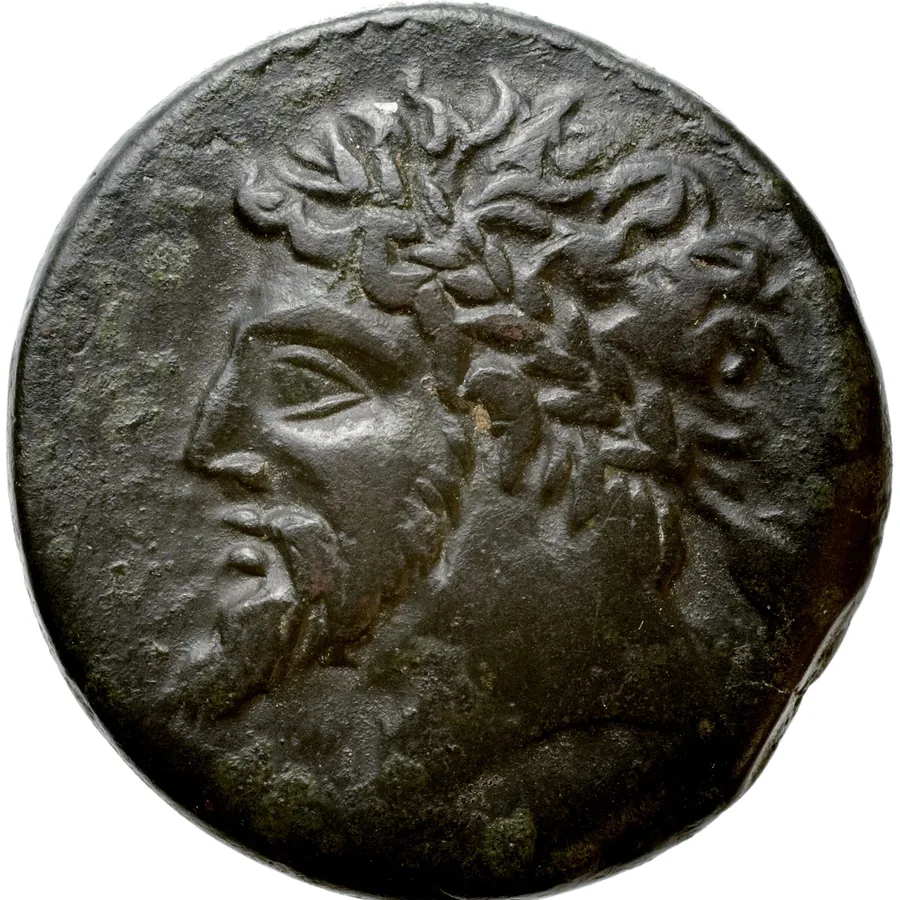
Numidian bronze coin, reign of Masinissa or Micipsa. Bibliothèque nationale de France, Cabinet des médailles, Paris · Public domain · Source page
A Numidian prince who fought Rome, changed sides at the right moment, and outlived everyone else in this story.
- Born: c. 238 BC, Numidia; son of Gala (Gaia in Numidian inscriptions), king of the Massylii
- Died: 148 BC, Cirta (Constantine, Algeria), aged about 90, still on the throne
- Won: With Laelius, over Syphax, 203 BC; The right wing at Zama, 202 BC; Over Carthage, 150 BC
- Lost: Beaten by Syphax and driven from his kingdom, c. 205 BC
“…the loyalty which he subsequently displayed throughout his long life to its close proved beyond question that his motives at the beginning were carefully weighed.”
A decision point
You sit in the Roman Senate.
Rome, spring 205 BC
Scipio, back from Spain, has been elected consul at about thirty. He wants to take the war to Africa, and rumour says that if you refuse, he will go over your heads to the people.
Old Quintus Fabius Maximus, the ‘Delayer’, who after Trasimene taught Rome to wear Hannibal down by refusing battle, speaks against him. Hannibal still holds the toe of Italy, he says, and the treasury cannot pay for two wars. Regulus’s invasion of Africa fifty years ago ended with Regulus a prisoner. “Let there be peace in Italy before there is war in Africa.”
Scipio answers that a century ago Agathocles of Syracuse landed in Africa and forced Carthage to call its armies home. Hannibal, he says, will have to follow.
How do you vote?
- With Fabius: finish Hannibal in Italy first The safe course, if Hannibal can be beaten in Italy at all. No Roman has managed it in thirteen years, and every year of war in Italy ruins more farms of Rome’s allies.
- With Scipio: send him to Africa with a full army The boldest course. But it strips Italy of troops while Hannibal is still there, and if Scipio fails like Regulus, Rome loses its best army and its best general at once.
- A middle way: Sicily, with leave to cross, but no new levy Scipio may go, but at his own risk, with the troops already in Sicily and whatever volunteers he can raise. If he fails, the blame is his, not the Senate’s.
What really happened
A middle way: Sicily, with leave to cross, but no new levy
The Senate gave Scipio Sicily, with leave to cross to Africa if he judged it in the state’s interest, but no new levy. He raised 7,000 volunteers, and in Sicily he took over the ‘Cannae legions’, survivors of the defeat sent there in disgrace.
Livy wrote both speeches himself and makes Fabius jealous of a young rival. But the debate was real, and Fabius’s case was sound. The compromise kept the Senate’s caution and Scipio’s plan, which was itself Fabian in a way: it avoided fighting Hannibal in Italy.
Africa, 204–203 BC
Fire in the night
Scipio landed near Utica in 204 BC, and Masinissa, driven from his kingdom by Syphax, joined him with a few horsemen. Through the winter Scipio talked peace with Syphax, sending officers disguised as slaves with his envoys to study the two enemy camps. The Numidians’ huts, they reported, were made of reeds and mats.
Early in the spring of 203 BC Scipio broke off the talks with formal notice and attacked by night. Laelius and Masinissa fired Syphax’s camp; when the Carthaginians ran out to help, Scipio fired theirs. Thousands died in the flames. A month later he broke Carthage’s new army at the Great Plains, Laelius and Masinissa captured Syphax, and Carthage asked for peace and called Hannibal home.
Myth
When Carthage called him home, Hannibal wept as he left Italy.
The truth
Our only source, Livy, hedges it twice: “It is said that he gnashed his teeth, groaned, and almost shed tears”. Livy also says that Hannibal had guessed what was coming and had his ships ready. The scene, with the speech Livy wrote for it, makes a moral point: the great enemy beaten by the envy of his own city’s Senate.
The evidence
Livy 30.20, trans. W. M. Roberts (Everyman’s Library, 1912–24). Polybius’s account is lost. Hannibal sailed in autumn 203 BC, after fifteen years in Italy.
Zama
Autumn 202 BC
Two generals and their interpreters
The truce did not hold: in spring 202 BC Carthaginians seized stranded Roman supply ships and attacked Scipio’s envoys. Scipio marched up the Bagradas valley, storming towns and selling their people as slaves, until Carthage begged Hannibal to fight.
Hannibal marched to Zama, five days west of Carthage. Masinissa reached Scipio with 6,000 foot and 4,000 horse. The camps stood about five kilometres apart: Scipio’s by water “within the throw of a javelin”, Hannibal’s on a hill too far from it. Then Hannibal asked to talk. The two greatest generals of their age met between the camps, each with only an interpreter.
Source: One conversation, two versions
Hannibal: “Would that neither the Romans had ever coveted any possessions outside Italy, nor the Carthaginians any outside Africa…”
Scipio: “Of what further use then is our interview? Either put yourselves and your country at our mercy or fight and conquer us.”
Livy’s longer version has Hannibal say, “What I was at Thrasymenus and at Cannae, that you are today.” Livy also admits that the private talk “allowed free scope for invention” when Scipio reported it to his men.
- Only a handful of people heard this talk. Who could have told Polybius? Scipio, through Laelius and the family, or one of the interpreters. Nothing came from Hannibal’s side, and nobody wrote the words down at the time.
- Livy’s Hannibal says much the same as Polybius’s, only at greater length. What does that suggest? That Livy rewrote Polybius, his main source, rather than finding a new witness. Ancient historians often retold their sources and added speeches to draw the moral.
- Why would both a Greek and a Roman writer want the two greatest generals to meet before the battle? It draws the whole war into one moment: fortune, pride, peace or war. Appian, centuries later, even has them fight a duel in the battle, which Polybius and Livy know nothing about.
A decision point
You are Hannibal Barca.
Your camp near Zama, autumn 202 BC, the evening after the meeting
Scipio has refused your terms. Masinissa has just joined him, so the Romans now have more cavalry, and better. Your army is a mix: about 12,000 hired foreigners, new levies from Carthage and Libya, and your veterans from Italy, your best infantry. You have more than 80 elephants, many probably newly caught and barely trained.
Your camp is short of water. Carthage’s council begs you to fight before the Romans ruin the country. Scipio’s legions are veterans too: many are the very men Cannae shamed.
What do you do?
- Refuse battle: fall back towards Carthage and make Scipio come to the walls You keep your army, and winter is coming. But Scipio would go on burning the country, Masinissa’s horsemen would harass every step, and the council that begged you to fight might make peace without you.
- Fight: wear down the legions with elephants and two lines, and keep your veterans for the last blow Your best plan with the army you have. It depends on your weaker horse keeping the enemy’s busy, and on the elephants breaking the Roman ranks before that cavalry can come back.
- Dig in on strong ground and wait for Scipio to attack Strong ground blunts the legions. But without water you cannot wait long, and Scipio, who has the better cavalry and the supplies, does not have to attack at all.
What really happened
Fight: wear down the legions with elephants and two lines, and keep your veterans for the last blow
Hannibal fought the next morning in three lines, elephants in front, veterans held back. Polybius, a friend of his enemies, judged it the best plan possible.
He had little choice: Carthage wanted a battle, and his camp lacked water. Historians still ask whether his veterans should have stood closer, to support the second line.
Zama: who fought whom
Autumn 202 BC
Inland Tunisia, west of Zama; the exact site is unknown
Rome and its Italian allies
- Commanders: Scipio, Gaius Laelius, the Italian horse
- Strength: gives no total (Polybius); about 23,000 foot and 1,500 horse (Appian (2nd c. AD)); about 23,000–29,000 foot and 1,500–2,700 horse (Modern estimates)
- Losses: more than 1,500 dead (Polybius); 2,500 dead (Appian)
Masinissa’s Numidians
- Commanders: Masinissa
- Strength: 6,000 foot and 4,000 horse (Polybius and Livy)
- Losses: rather more than the Romans (Appian)
Carthage and its allies
- Commanders: Hannibal
- Strength: over 80 elephants and 12,000 mercenaries in the first line; no other figures (Polybius); about 50,000 (Appian); about 36,000–40,000 foot and 4,000 horse (Modern estimates)
- Losses: about 20,000 dead and nearly as many captured (Polybius); over 20,000 dead, almost as many captured, 11 elephants (Livy); 25,000 dead and 8,500 captured (Appian)
Outcome: A decisive Roman victory. Hannibal escaped with a few horsemen to Hadrumetum and told Carthage to make peace.
Polybius’s book 15 survives only in excerpts and gives few figures. Modern estimates rest on the known size of Scipio’s legions. Livy’s ‘legion of Macedonians’ in Hannibal’s second line is rejected by almost all historians.
The battle of Zama
Autumn 202 BC, the morning after the meeting
This is the morning after the two generals met, and the truce has already broken. Scipio, with his legions and the horse of Laelius and Masinissa, faces Hannibal and his army: more than 80 elephants, mercenaries, new levies and veterans from Italy. At stake is Carthage’s future.
Schematic. The site is unknown: no battlefield has been found, and the name ‘Zama’ was attached to the battle later. Drawn after G. Veith’s reconstruction (1912), followed by H. H. Scullard and J. F. Lazenby: an open plain, the Draa el-Metnan, south-west of El Kef in Tunisia. Others place the battle near Naraggara (Sakiet Sidi Youssef) or in the Siliana valley.
The deployment and the course of the battle follow Polybius 15.9–16. The orientation, the distances between the lines and the frontages are approximate; unit depths are exaggerated so they can be seen, and the lanes between the maniples are shown as a single lane. In Veith’s reconstruction the Roman camp lies to the west and Hannibal’s to the east, so north is to the left here. Livy’s ‘legion of Macedonians’ is left out, and so are Masinissa’s 6,000 foot, whose place Polybius does not give.
Phases of the battle
- Deployment Scipio’s three lines stand with the maniples one behind another, leaving lanes through the army, filled for now with velites. Laelius’s Italian horse holds the left, Masinissa’s Numidians the right. Hannibal has more than 80 elephants in front, then the mercenaries, then new levies from Carthage and Libya, and his veterans held back.
- Elephants and horsemen Hannibal launches the elephants. Trumpets and horns scare many: some turn back onto his own Numidians, others run down the lanes or off towards Laelius’s flank. Masinissa and Laelius charge the enemy horse on both wings.
- The first lines meet The horsemen of both sides vanish in the pursuit. The infantry close. The mercenaries fight well, but get no help from the second line; they break and turn on the Carthaginians behind them. The hastati are worn and disordered.
- A new line The second line breaks too; Hannibal’s veterans level their spears to keep the fugitives out. Scipio pauses, has the wounded carried back, and forms one long line beyond the dead: hastati in the centre, principes and triarii on the wings. The fresh lines meet. “The contest was for long doubtful.”
- The horsemen return Laelius and Masinissa return from the pursuit and fall on the veterans from behind. Polybius counts 20,000 killed and almost as many taken, against more than 1,500 Roman dead. Hannibal rides off to Hadrumetum.
The strategy
- Romans and Italians: Scipio sets three lines of maniples one behind another, leaving lanes between the units, for now filled with velites. Most likely the lanes let a charge of elephants pass through without breaking the line. Laelius’s Italian horse holds the left and Masinissa’s Numidians the right.
- Masinissa’s Numidians: Masinissa and his Numidians on the right charge the Carthaginian horse and ride after it. Afterwards, when the pursuit ends, they turn back and fall on Hannibal’s veterans from behind, since the Romans have more and better horse.
- Hannibal’s army: Hannibal sends the elephants forward, the mercenaries behind them and the new levies behind those, keeping his veterans back. His camp is short of water, and Carthage’s council begs him to fight before the Romans ruin the country. His plan is to wear down the legions with elephants and two lines, and keep the veterans for the last blow.
What decided it: The battle turned when Laelius and Masinissa, returning from the pursuit, fell on Hannibal’s veterans from behind: the troops he had kept for the last blow. Hannibal escaped to Hadrumetum with a few horsemen.
A decision point
You are Scipio, commander in Africa.
Near Tunis, winter 202/201 BC
Carthage’s last army is gone, and its envoys ask for terms. Your officers want to destroy the city. But its walls are among the strongest anywhere, and a siege could take a year or more.
In Rome the new consul wants Africa, and the glory of ending the war. Masinissa needs a strong kingdom beside Carthage. And Rome is already turning to a new war, against Philip V of Macedon.
What peace do you offer?
- No peace: besiege Carthage and destroy it Rome’s great rival would be gone for ever. But the siege could last until your successor arrives to finish it and take the credit, and a desperate city with Hannibal inside is a terrible place to storm.
- Leave Carthage standing, disarmed, paying for fifty years and forbidden to make war Carthage survives as a rich city with no power of its own. Rome gets money and peace at once, and Masinissa becomes Rome’s watchman in Africa. But a disarmed neighbour that a land-hungry king can raid is a quarrel waiting to happen.
- Accept the terms Hannibal offered before the battle: Sicily, Sardinia, Spain and the islands Quick and generous, and Rome already holds all of those. But Carthage would keep its fleet, its elephants and its freedom, and could fight again within a generation.
What really happened
Leave Carthage standing, disarmed, paying for fifty years and forbidden to make war
Carthage kept its African lands and its laws, but gave up all but ten warships, its elephants and 100 hostages. It would pay 10,000 talents of silver, about 260 tonnes, over fifty years, make no war outside Africa and none in it without Rome’s leave, and restore to Masinissa all his ancestors had held. Hannibal himself, according to a story Polybius repeats, pulled a speaker off the platform in Carthage and urged acceptance.
Polybius gives Scipio a noble motive: mercy “for our own sake … and in consideration of the fortune of war”. Livy adds a plainer one: fear that his successor “might come and claim the glory of terminating the war”. Both can be true. The vague clause on Masinissa’s ancestral lands gave the king a legal excuse to bite into Carthage’s land for fifty years.
After Zama
201–183 BC
The hero who became a suspect
Scipio came home to the most splendid triumph Rome had yet seen, and a new name: he was, Livy says, the first Roman general named after a people he had conquered, Africanus.
In 190 BC he served beside his brother Lucius against Antiochus III, king of Syria. Afterwards enemies in Rome accused the brothers of keeping the king’s money; many believed Cato the Elder was behind the charges. Scipio tore up the account book before the Senate. On one hearing day, the anniversary of Zama, he led the whole crowd up to the Capitol to thank the gods, leaving his accusers alone. Then he withdrew to his farm at Liternum in Campania and never came back. He probably died there, around 183 BC, aged about 52; in those same years Hannibal, hunted by Rome, took poison in Bithynia.
Myth
Scipio’s tomb at Liternum bore the bitter words: “Ungrateful fatherland, you shall not even have my bones.”
The truth
The epitaph first appears in Valerius Maximus, a collector of moral anecdotes, about 210 years later. Livy, writing earlier, only reports a story that Scipio asked to be buried at Liternum so that his ungrateful country would hold no funeral for him. Livy had seen a monument with a statue there, but mentions no inscription, and could not say whether Scipio lay there or in Rome. Seneca, who stayed at the villa, saw only “an altar which I am inclined to think is the tomb of that great warrior”.
The evidence
Valerius Maximus 5.3.2b; Livy 38.53, 38.56; Seneca, Moral Letters 86.1 (trans. R. M. Gummere, 1920). No inscription of Africanus has been found, not even in the Tomb of the Scipios in Rome.
Source: A lesson for kings
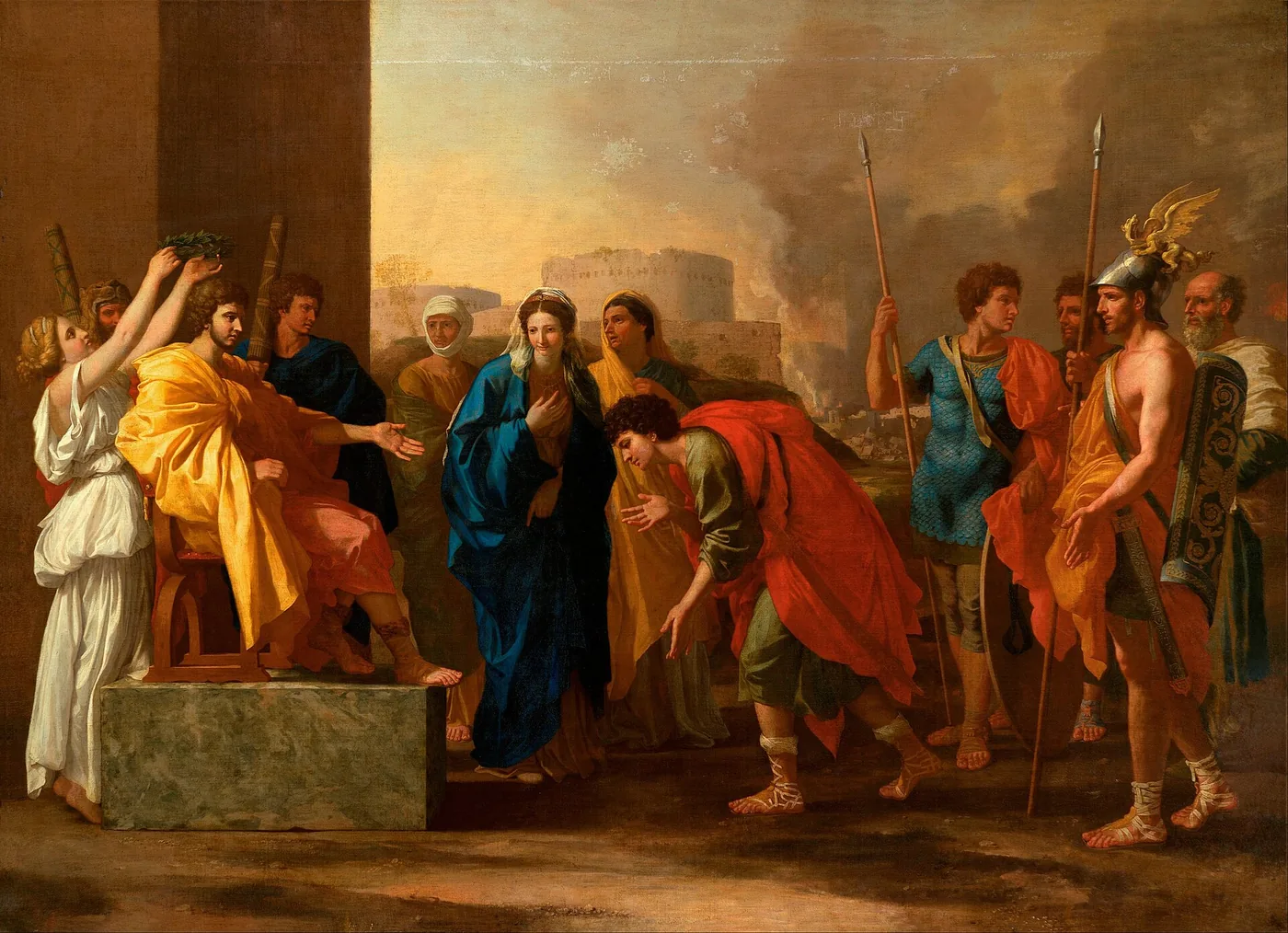
Nicolas Poussin, The Continence of Scipio, 1640. Pushkin State Museum of Fine Arts, Moscow · Public domain · Source page
Nicolas Poussin, The Continence of Scipio, 1640
At New Carthage, the story goes, soldiers brought Scipio a beautiful captive. In Livy he returns her untouched to her fiancé, a young Celtiberian noble, and adds her ransom as a wedding gift. Painters made this ‘continence’, or self-control, a model for rulers.
- What did a French painter of 1640 want his viewers to learn? That the best ruler first masters himself. Poussin painted for collectors who read Livy as a guide to virtue. The laurel wreath crowns Scipio for a victory over himself, not over Carthage.
- Which details come from Livy, and which from no ancient source at all? The fiancé and the handing over come from Livy. The woman with the wreath is Poussin’s, an allegory. The clothes and armour are a 17th-century idea of antiquity.
- Who is missing from the picture? The young woman’s own voice: she is handed from one man to another. And the thousands of other captives, made public slaves or put to row in the fleet, whom no painter showed.
Myth
Scipio, the chaste young general, gave a beautiful captive back untouched to the man she loved.
The truth
The oldest version, Polybius’s, probably from Laelius, is plainer. The soldiers brought her “being aware that Scipio was fond of women”. As a private man, Scipio said, he would have welcomed no present more; as general, none less. He returned her to her father. There is no fiancé, and one Roman writer, Valerius Antias, even claimed that Scipio kept her. The gesture was probably real, and political: he held the Spanish tribes’ hostages and wanted their loyalty.
The evidence
Polybius 10.19.3–7; Livy 26.50; Aulus Gellius 7.8, quoting Valerius Antias.
What Zama led to
- 201 BC Peace. Carthage keeps its city and its African lands but loses Spain, its fleet and its elephants.
- 200–197 BC Rome turns east at once: the Second Macedonian War against Philip V, won at Cynoscephalae.
- 196–195 BC Hannibal, elected suffete of Carthage, puts its finances in order. Roman envoys come to accuse him of plotting with Antiochus III, and he flees to the king. Scipio had opposed sending them.
- 190–189 BC Lucius Scipio, with Africanus as his adviser, defeats Antiochus at Magnesia and takes the name Asiaticus; Africanus himself lies ill during the battle.
- c. 183 BC Scipio dies, probably at Liternum. Hannibal poisons himself in Bithynia, perhaps in the same year.
- 151–149 BC Carthage fights Masinissa without Rome’s leave, and Rome declares war.
- 146 BC Scipio Aemilianus, Africanus’s adopted grandson, destroys Carthage (the next lesson). Africa becomes a Roman province.
How did Scipio beat Hannibal?
Was Zama won by Scipio’s genius, by a better army and better horse, or was the war decided before the battle?
- B. H. Liddell Hart, A Greater than Napoleon (1926); H. H. Scullard, Scipio Africanus (1930, 1970) Scipio was one of history’s great commanders. Liddell Hart made him a model of the ‘indirect approach’: strike the enemy’s base (New Carthage) and homeland (Africa) rather than his army, and win by surprise and manoeuvre. Scullard stressed his tactical innovation: he taught the legion’s second and third lines to move on their own, at Ilipa, the Great Plains and Zama.
- J. F. Lazenby, Hannibal’s War (1978); Adrian Goldsworthy, The Punic Wars (2000) Both admire Scipio but stress the conditions. At Zama he had veteran legions and, thanks to Masinissa, the stronger cavalry; Hannibal had a hastily raised, mixed army and elephants that were probably half-trained. Polybius himself says Hannibal’s plan was as good as it could be. The battle turned on the cavalry coming back in time.
- Dexter Hoyos, Hannibal’s Dynasty (2003) and Mastering the West (2015) Hoyos and others stress that the war was decided before Zama: by Rome’s far larger reserves of men, by Carthage’s loss of Spain with its silver and soldiers, and by the loss of its Numidian allies. Zama only finished it. Scipio’s greatness lay as much in winning allies, from the Spanish hostages to Masinissa, as on the battlefield.
If Masinissa had stayed with Carthage, would Zama have been a second Cannae? And does a general who chooses his battles, his allies and his moment well deserve less credit than one who wins by brilliance alone?
What do you know now?
Check yourself
Why did Scipio choose New Carthage as his target in 209 BC?
Answer: It held Carthage’s treasury, stores and Spanish hostages, with a small garrison. Right. In one day Carthage lost money, equipment and hostages, and Spanish tribes began to change sides.
Check yourself
What was Scipio’s trick at Ilipa?
Answer: After days of the same order, he reversed it: the Spaniards in the centre, the Roman legions on the wings. Right. His men had also eaten before dawn, while the Carthaginians came out hungry. His best troops met the enemy’s weakest.
Check yourself
How did Scipio’s army deal with Hannibal’s elephants at Zama?
Answer: The maniples stood one behind another, leaving lanes, and trumpets scared many elephants back. Right. After a fight with the velites, some elephants ran down the lanes and off the field without harming the heavy infantry, and some turned back onto Hannibal’s own Numidians.
Check yourself
Why do historians doubt that Hannibal wept when he was called home from Italy?
Answer: Livy, the only source, hedges it with ‘it is said’ and ‘almost’, and the scene makes a moral point. Right. Livy even adds that Hannibal expected the recall and had his ships ready, so he was not taken by surprise.
Check yourself
Why must we be careful with Polybius’s picture of Scipio?
Answer: His main informant was Laelius, Scipio’s friend, and he wrote for Scipio’s family. Right. That does not make him a liar: he is close to the events and understands war. But he has a reason to show Scipio as a calculator rather than a lucky man.
Check yourself
Which term of the peace of 201 BC led to the next war?
Answer: Carthage had to give back to Masinissa his ancestors’ lands, and could not fight in Africa without Rome’s leave. Right. Masinissa bit into Carthage’s land for fifty years, and when Carthage finally fought him in 150 BC, Rome called it a breach of the treaty.
Terms
- consul One of the two magistrates the Roman people elected each year to lead the state and command its armies. They were usually experienced men in their forties; Scipio was elected at about thirty.
- proconsul A man given a consul’s power of command, the imperium, outside Rome without being consul that year. Scipio received it in 210 BC as a young private citizen, something almost without precedent.
- legion Rome’s main army unit: about 4,200 to 5,000 foot soldiers and 300 horsemen, all citizens. Beside each legion fought a unit of Italian allies of about the same size.
- maniple A company of about 120 heavy infantry (60 among the triarii), the building block of the legion. Maniples stood with gaps between them, which let the legion move freely and open lanes.
- hastati, principes, triarii The legion’s three lines of heavy infantry: the youngest men in front (hastati), men in their prime behind them (principes), and veterans last (triarii).
- velites The light infantry of the legion, the youngest and poorest citizens, armed with javelins. They skirmished in front before a battle, then fell back behind the lines.
- Numidians The native peoples of the land west of Carthage (today’s northern Algeria and western Tunisia), ancestors of today’s Berbers. Their light horsemen, who rode without bridles, were the best cavalry in the western Mediterranean.
- talent A weight used to measure money. The Euboic talent, in which the peace of 201 BC was reckoned, was about 26 kilograms of silver.
- triumph The victory parade of a Roman general through the streets of Rome to the temple of Jupiter on the Capitol. The Senate granted it for a great victory.
- cognomen A Roman’s third name, often a nickname handed down in the family. Livy calls ‘Africanus’ the first taken from the name of a conquered nation.
- suffete One of the two chief magistrates of Carthage, elected every year. The Punic word, shofet, is the same as the Hebrew word for ‘judge’.
- stade A Greek measure of distance, about 180 metres. Polybius gives his distances in stades.
- Polybius A Greek historian brought to Rome as a hostage. He wrote about Rome's rise and talked with men who knew Scipio.
- Livy A Roman historian who wrote about Rome in the time of Augustus, long after Scipio.
- Appian A late Greek historian who added scenes about Scipio that nobody else knows.
- Laelius Scipio's friend and second-in-command. He led the fleet at New Carthage and the Italian cavalry at Zama.
- Masinissa A young Numidian prince who fought Rome, then switched sides and stayed Rome's friend all his life.
- Syphax The stronger king of western Numidia. He married Sophonisba and joined Carthage, then was captured by Laelius and Masinissa.
- Sophonisba Wife of Syphax. According to the story she then married Masinissa, and poets made her a tragic heroine.
- Quintus Fabius Maximus An elderly Roman general nicknamed the Delayer, who avoided big battles against Hannibal.
- Regulus A Roman general who invaded Africa in the past and was taken prisoner. People cited him as a warning.
- Agathocles The ruler of Syracuse, who landed his army in Africa and forced Carthage to bring its armies home.
- Hasdrubal Barca Hannibal's brother. He tried to bring a second army to Italy, but his army was destroyed on the Metaurus river.
- Cato the Elder A Roman politician. Many believed he stood behind the charges against Scipio and his brother.
- Syracuse A city in Sicily that switched to Hannibal. Archimedes' war machines beat off the first Roman attacks before it fell.
- Capua A large city in Italy that went over to Hannibal and later fell to Rome.
- Cannae A battle in Italy where Hannibal destroyed the largest army Rome had ever put in the field.
- Trasimene A battle in Italy that Hannibal won against the Romans. Afterwards Rome avoided big battles.
- Ilipa A battle in Spain. After it, Scipio turned his eyes across the sea to Numidia.
- New Carthage The main Carthaginian base in Spain. Scipio took it in a surprise attack.
- Celtiberians A warlike people of Spain. Their fighters were hired by the armies in the war in Spain.
- Punic Relating to Carthage and its people. The Romans used the phrase Punic faith to mean treachery.
- Praetor A senior Roman magistrate, below the consul. Praetors served as judges and commanders.
- Imperator A title for a Roman general. It means commander, not king.
- Mercenary A soldier who serves for pay rather than out of loyalty to a state.
- Field of Mars An open area near Rome where citizens gathered to elect generals.
Sources
- Polybius, Histories 9.5–9; 10.2–20, 34–40; 11.20–24; 14.1–10; 15.1–19; 23.14; 36.16, trans. W. R. Paton, Loeb Classical Library, vols. IV–VI (1925–1927)
- Livy, History of Rome 25.32–36; 26.7–20, 41–51; 27.17–20, 43–51; 28.12–18, 35, 38–46; 29.24–35; 30.3–45; 38.50–60; 39.52, trans. W. M. Roberts (Everyman’s Library, J. M. Dent, 1912–1924)
- Appian, Iberica 18–38 and Punica (Libyca) 7–66, trans. Horace White, The Roman History of Appian of Alexandria, vol. 1 (Macmillan, 1899)
- Aulus Gellius, Attic Nights 7.8, trans. J. C. Rolfe, Loeb Classical Library, vol. II (1927)
- Seneca, Moral Letters to Lucilius 86, trans. R. M. Gummere, Loeb Classical Library, vol. II (1920)
- Valerius Maximus, Memorable Doings and Sayings 5.3.2b; Cornelius Nepos, Hannibal 6–13; Cicero, On Old Age 19
- H. H. Scullard, Scipio Africanus in the Second Punic War (Cambridge University Press, 1930)
- H. H. Scullard, Scipio Africanus: Soldier and Politician (Thames and Hudson, 1970)
- H. H. Scullard, Roman Politics 220–150 B.C. (Clarendon Press, 1951; 2nd ed. 1973)
- H. H. Scullard, ‘A Note on the Battle of Ilipa’, Journal of Roman Studies 26 (1936), 19–23
- F. W. Walbank, A Historical Commentary on Polybius, vol. II (Clarendon Press, 1967)
- F. W. Walbank, ‘The Scipionic Legend’, Proceedings of the Cambridge Philological Society n.s. 13 (1967), 54–69
- J. F. Lazenby, Hannibal’s War: A Military History of the Second Punic War (Aris & Phillips, 1978; University of Oklahoma Press, 1998)
- B. H. Liddell Hart, A Greater than Napoleon: Scipio Africanus (William Blackwood, 1926)
- Adrian Goldsworthy, The Punic Wars (Cassell, 2000; as The Fall of Carthage, 2003)
- Dexter Hoyos, Hannibal’s Dynasty: Power and Politics in the Western Mediterranean, 247–183 BC (Routledge, 2003)
- Dexter Hoyos, Mastering the West: Rome and Carthage at War (Oxford University Press, 2015)
- Serge Lancel, Hannibal, trans. Antonia Nevill (Blackwell, 1998)
- Richard Miles, Carthage Must Be Destroyed: The Rise and Fall of an Ancient Civilization (Allen Lane, 2010)
- Mir Bahmanyar, Zama 202 BC: Scipio Crushes Hannibal in North Africa (Osprey, Campaign 299, 2016)
- J. Kromayer and G. Veith (eds), Antike Schlachtfelder, vol. III: Italien und Afrika (Weidmann, 1912)
- J. Millán León, ‘La batalla de Ilipa’, Habis 17 (1986), 283–303
- J. P. Bellón, C. Rueda, M. Á. Lechuga and M. I. Moreno, ‘An archaeological analysis of a battlefield of the Second Punic War: the camps of the battle of Baecula’, Journal of Roman Archaeology 29 (2016), 73–104
- Erich S. Gruen, ‘The “Fall” of the Scipios’, in I. Malkin and Z. W. Rubinsohn (eds), Leaders and Masses in the Roman World: Studies in Honor of Zvi Yavetz (Brill, 1995), 59–90
- John Briscoe, A Commentary on Livy, Books 38–40 (Oxford University Press, 2008)
Image credits
- The Battle of Zama, from the Story of Scipio tapestries, Gobelins, 1688–1690; cartoon by François Bonnemer after Giulio Romano and Gianfrancesco Penni. Musée du Louvre, Paris · Public domain · Source page
- Bronze bust, so-called Scipio Africanus, from the Villa of the Papyri, Herculaneum. Museo Archeologico Nazionale, Naples. Photo: Carole Raddato, 2014 · CC BY-SA 2.0 · Source page
- The Punic wall, Centro de Interpretación de la Muralla Púnica, Cartagena, 2019. Photo: María Rodriguez · CC BY-SA 4.0 · Source page
- The Medracen royal mausoleum, near Batna, Algeria, 2022. Photo: Carole Raddato · CC BY-SA 2.0 · Source page
- Numidian bronze coin, reign of Masinissa or Micipsa. Bibliothèque nationale de France, Cabinet des médailles, Paris · Public domain · Source page
- Nicolas Poussin, The Continence of Scipio, 1640. Pushkin State Museum of Fine Arts, Moscow · Public domain · Source page


