The Schism of 1054: one Saturday in Hagia Sophia
On Saturday morning, 16 July 1054, three envoys from Rome laid a charter of excommunication against the Patriarch on the altar of Hagia Sophia. Textbooks say Christianity split in two that day. Who excommunicated whom, and what really happened?
Decisions, questions and your own progress, in the app
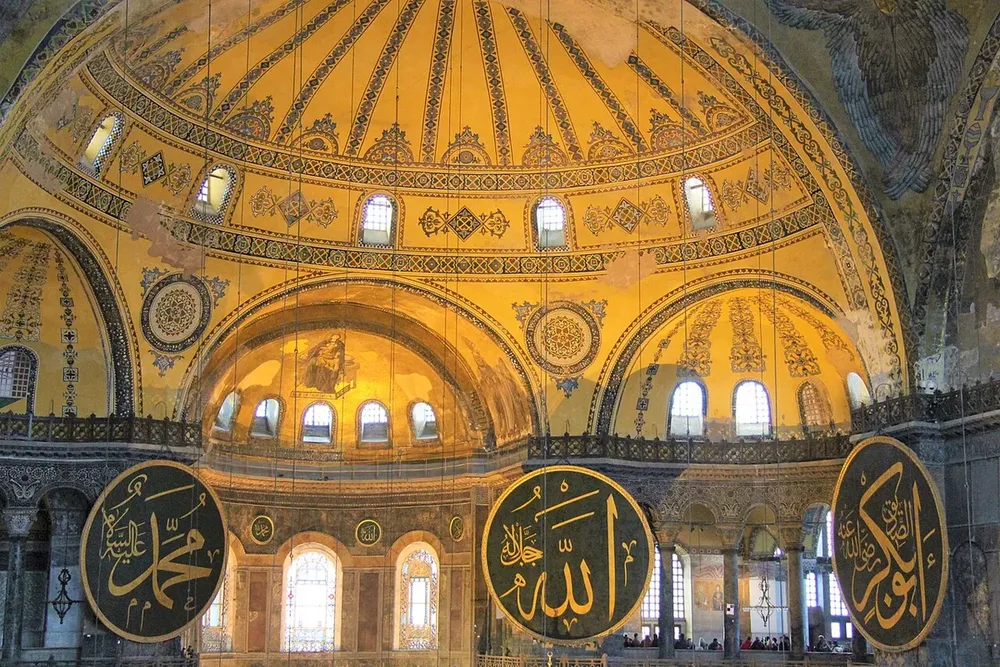
Hagia Sophia, Istanbul, 2013. Photo: Rabe! · CC BY-SA 4.0 · Source page
One Saturday in Hagia Sophia
Three men at the altar
Constantinople, a Saturday morning, 16 July 1054. In the great cathedral, Hagia Sophia, clergy prepare for the service.
Three legates from Rome lay a document on the main altar. According to Cardinal Humbert, one of the three, they shake the dust from their feet on the way out and say in Latin: “May God see and judge.”
The document excommunicates the patriarch of Constantinople, Michael Cerularius, and his men. The familiar story calls it the day Christianity split into Catholics and Orthodox (Greek for “of the right belief”). But who excommunicated whom, and did anything split that morning?
Background
Old Rome, new Rome
Rome spoke Latin. Constantinople, capital of the Byzantine Empire (the Greek-speaking eastern Roman Empire), called itself New Rome. The Church had five great centres, each under a senior bishop.
In 381 a council of bishops ranked Constantinople’s bishop next after Rome’s, “because Constantinople is New Rome”: a rank that rested, in the council’s own reasoning, on its being the emperor’s city.
Catholics hold that the pope, successor of the apostle Peter, leads the whole Church: this is papal primacy. Orthodox Christians hold that the great bishops and their councils decide together, with Rome first in honour.
What the quarrel was about
A word, a leader, a loaf
First, a word. The Creed is the statement of belief Christians recite in worship. The Greek text of 381 says the Holy Spirit (the third figure of God in Christian belief) comes from the Father. The West added the phrase “and from the Son” (in Latin, Filioque). Catholics hold that the Spirit comes from the Father and the Son as one source, the Father still first. Orthodox Christians hold that the Father alone is the source, and object to changing the Creed without a council.
Second, who leads: primacy again. Third, customs. In communion, the Church’s central rite, the Latins (Western Christians) used unleavened bread (matza) and the Greeks leavened. Saturday fasting, priests’ marriage and shaving were also disputed.
In the first 1053–54 letters the word was barely mentioned; it came up in the charges of summer 1054. On the evidence, the fight was mostly about authority and customs.
Two worlds, one letter
1053
A pope taken prisoner
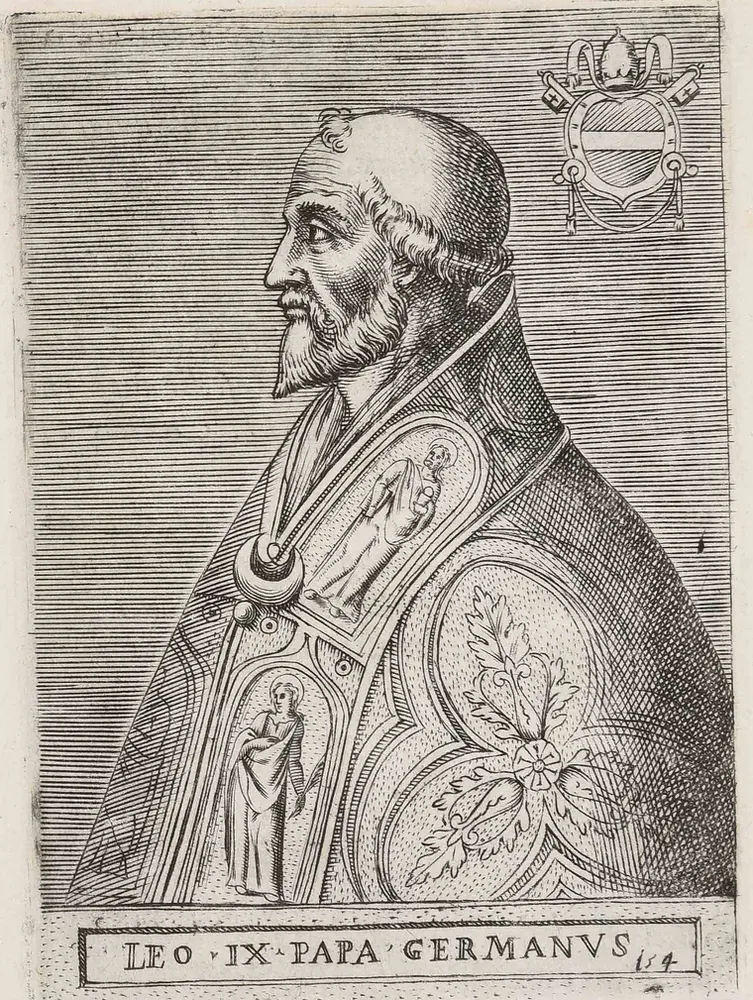
Leo IX, engraving by Giovanni Battista de' Cavalieri, 1580, from Pontificum Romanorum effigies. Copy in the Biblioteca comunale di Trento · CC0 · Source page
First, a year back: 18 June 1053, Civitate, southern Italy. The Normans, conquerors from northern Europe, beat Pope Leo IX’s army and take him prisoner. He will be held at Benevento until March 1054.
Byzantine Emperor Constantine IX Monomachos has Norman troubles of his own and wants the Pope’s help. Rome and Constantinople need each other.
The letter
A letter from Ohrid
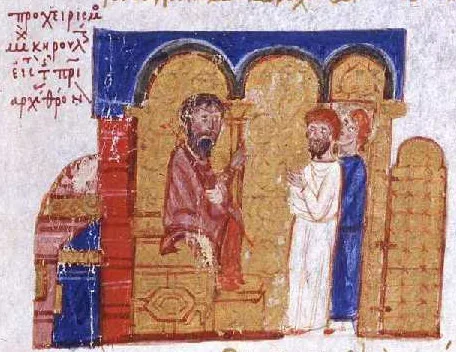
The appointment of Michael Cerularius as patriarch, Madrid Skylitzes (the chronicle of John Skylitzes), 12th or 13th century. Biblioteca Nacional de España, Madrid, fol. 225r · Public domain · Source page
The quarrel starts with a letter. In 1053 Leo, archbishop of Ohrid in Bulgaria, writes to a churchman in southern Italy, for the eyes of the Pope and the Latin bishops. Among other things, he attacks the Latins’ unleavened bread. According to the historian Kamas, Patriarch Michael Cerularius probably knew of the letter; scholars differ on his part in it. Cardinal Humbert, a senior Roman churchman, translates it into Latin for the Pope.
In September 1053 Pope Leo IX answers with a firm letter (some scholars doubt it was ever sent): Rome leads the whole Church. He leans on the Donation of Constantine, a forged document, then believed genuine, by which Emperor Constantine supposedly gave the popes the West. In early 1054 he sends three legates: Humbert, Frederick of Lorraine and Peter, archbishop of Amalfi.
A decision point
You are Michael Cerularius, Patriarch of Constantinople.
Constantinople, 1054, after the first meetings with the legates
Three papal legates are in your city. The Emperor honours them: he wants the Pope’s help against the Normans. At your first meeting, according to a Roman source, they withheld the customary bow.
The letters they brought greet you warmly, but they press Rome’s claim to lead the whole Church. You say someone tampered with the seals.
What do you do?
- Keep talking and look for a compromise The Emperor would probably be pleased, and tempers would cool for a while. But the quarrel is about who leads the whole Church, and in the Eastern view the five great centres decide that together. In the end you would probably have to give way or refuse.
- Refuse further talks until the other patriarchs and a council can decide The talks stop. The legates probably have nothing to take back to Rome, and the Emperor, who needs the Pope’s friendship, is caught between you and them.
- Condemn the Latin customs publicly, on your own The legates would probably take it as an open attack on Rome, and the Emperor, who wants the Pope as an ally, would be angry. You would be speaking alone, without the other patriarchs.
What really happened
Refuse further talks until the other patriarchs and a council can decide
You refused all further dealings. Why? We have two main accounts, each written by one of the sides. Rome’s side blames your pride. Your side says you wanted the other patriarchs and a council to decide, and that someone had tampered with the seals. The story of the withheld bow is from a Roman source, retold in a 1910 history of the popes (Mann).
Principle, or pride? We cannot read his mind. The reason he gave fits the Eastern view that the great centres and councils decide together; Rome's side sees pride. The Emperor, for his part, wanted the Pope's help against the Normans at the time.
The paper on the altar
A decision point
You are Cardinal Humbert, envoy of Pope Leo IX.
Mid-July 1054, Constantinople
You have been here since spring, bearing letters from the Pope. The Emperor, who wants the Pope’s help against the Normans, receives you with honour. Patriarch Michael Cerularius refuses all further contact.
You carry no charter of excommunication. If you want one, you must write it here.
What do you do?
- Leave quietly and report to Rome Rome would hear of the refusal in your report, not from a paper on an altar. What would follow, no one can say.
- Ask the Emperor again and wait for instructions The Emperor might try to mediate, but the Patriarch will probably keep refusing. You would wait in the city, and the Patriarch would not agree to see you.
- Write a charter excommunicating the Patriarch and lay it on the high altar You write it, lay it down and walk out. The Patriarch and his council of bishops answer with a sentence of their own against the legates.
What really happened
Write a charter excommunicating the Patriarch and lay it on the high altar
On Saturday 16 July 1054, in the morning, at the third hour by the period’s count, Humbert and his colleagues laid the charter on the high altar of Hagia Sophia. Humbert wrote it in Constantinople. And Pope Leo IX? He had died on 19 April, three months earlier, and the papal throne stayed empty until April 1055. Did Humbert know? We do not know.
Humbert’s own report is the main source for that day, and it leans towards Rome; the edict of the Patriarch’s council of bishops, too, speaks for one side only. Many historians doubt that the legates still had authority, since the man who sent them was dead; whether his death ended their mandate is interpretation, not settled fact. Adrian Fortescue, a Catholic writer, called this charter the only sentence Rome pronounced.
The Saturday
Two stories of one morning
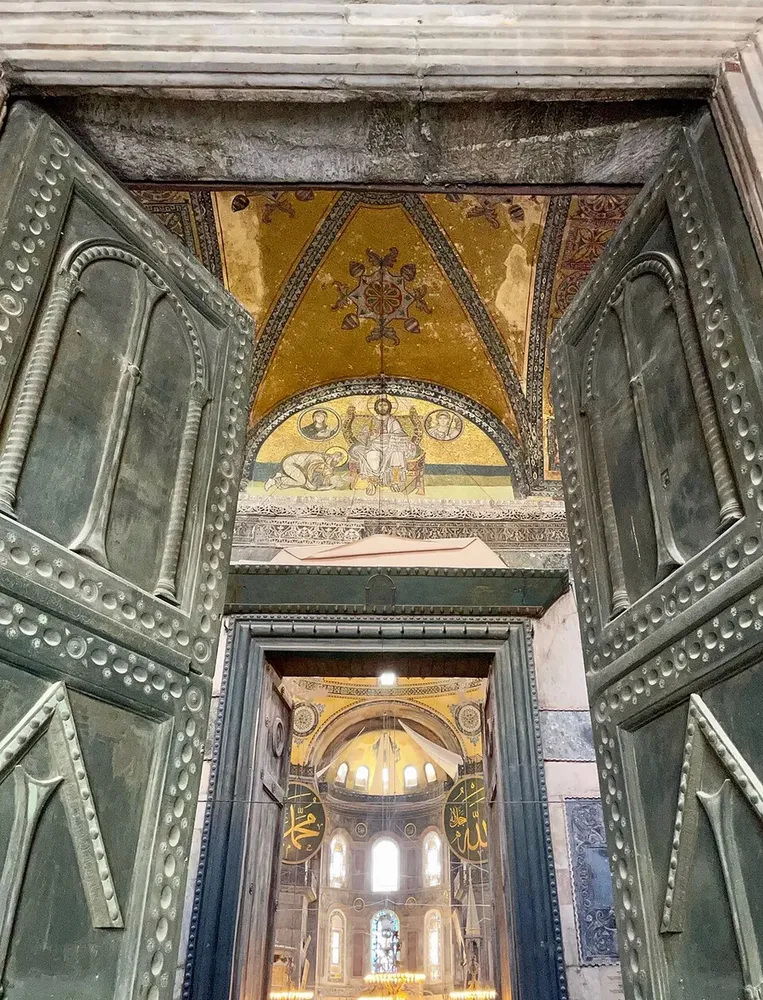
Mosaic above the Imperial Gate, Hagia Sophia, c. 900. Photo: Sonse, 2021 · CC BY 2.0 · Source page
You already know the legates’ side: the charter on the altar and, as they left, according to Humbert, “May God see and judge.”
The Patriarch’s side says junior clergy (subdeacons) lifted it from the altar and offered it back; the legates refused, and it was cast down. Both accounts come from the parties themselves.
Source: The legates’ charter
“Michael, patriarch by abuse, neophyte ... shall be Anathema Maranatha ... with all heretics, and with the devil and his angels, unless they repent. Amen.”
“As far as the pillars of the Empire are concerned, and its wise and honoured citizens, this city is most Christian and Orthodox.”
‘Anathema Maranatha’ is a solemn formula excluding someone from the Church, often rendered ‘curse’. The Patriarch’s council of bishops answered with an anathema too. Here ‘Orthodox’ means ‘of the right belief’.
- Whom does it excommunicate, and whom not? The Patriarch and two others, with their followers. Not the whole Church.
- What does it say about the city? ‘Most Christian and Orthodox’. A curse on men, praise for a city.
Myth
In 1054 the Pope and the Patriarch excommunicated each other, and the Church split in two.
The truth
The Pope had died three months earlier. The charter excommunicated three men and their followers, not Churches. The Patriarch’s synod anathematised the charter and those who advised, wrote and issued it (20 July in the usual reading of its edict), naming no pope. Many modern historians say the break grew over centuries.
The evidence
In 1965 Pope Paul VI and Patriarch Athenagoras I declared that the sentences were aimed at persons, not at the Churches, and lifted both. Full communion (sharing the sacred meal together) was not restored.
The answer
After the charter
Emperor Constantine IX begged the Patriarch not to be harsh, and blamed the circle of Argyros, a Byzantine commander, and the interpreters. The legates had left unharmed, the Emperor wrote, because they were ambassadors.
One of the three legates, Frederick of Lorraine, became Pope Stephen IX in 1057. Cerularius was exiled in 1058 and died soon after. Humbert died in 1061.
The split in slow motion
After
Barely recorded
As far as we know, no Byzantine chronicler of the time mentions the legates’ charter. Historian George Dennis wrote in 1990 that no serious scholar holds that the schism began in 1054, though older works did place it there.
In 1095, says a Western chronicle, Emperor Alexios I’s envoys asked Pope Urban II for help at Piacenza.
Many historians see the split hardening only later, some above all in 1204, others at later dates.
Game
What was really said?
Each side listed the other’s ‘errors’ in sharp words. These lists are real sources. Can you spot which accusations were really written?
Check yourself
Which accusation really appears in the legates’ charter against Cerularius and his followers?
Answer: That they believe leavened bread has a soul. Right. In a long list of ‘errors’, the charter accuses Cerularius and his followers of believing that leavened bread has a soul (a Latin text, our translation). It also charges priests’ marriage, and refusing communion (the ritual bread and wine) to shaved clergy. These are the legates’ words, not a neutral description of Greek belief.
Check yourself
What did the 1053 letter of Leo, archbishop of Ohrid, say about the Latins’ unleavened bread?
Answer: That it was a Jewish custom. Right, in outline: the letter calls the Latins’ unleavened bread a Jewish custom. In this quarrel ‘Jewish’ was a word of reproach: the writer meant that the Latins were keeping an Old Testament practice which, in his view, Christians had left behind. It is polemic from one side of a long quarrel, quoted here as a source. It tells us about the writer’s argument, not about Jews, and this lesson does not share it. The legates, for their part, wrote just as sharply about leavened bread, as the last question showed.
Source: Two witnesses of 1204
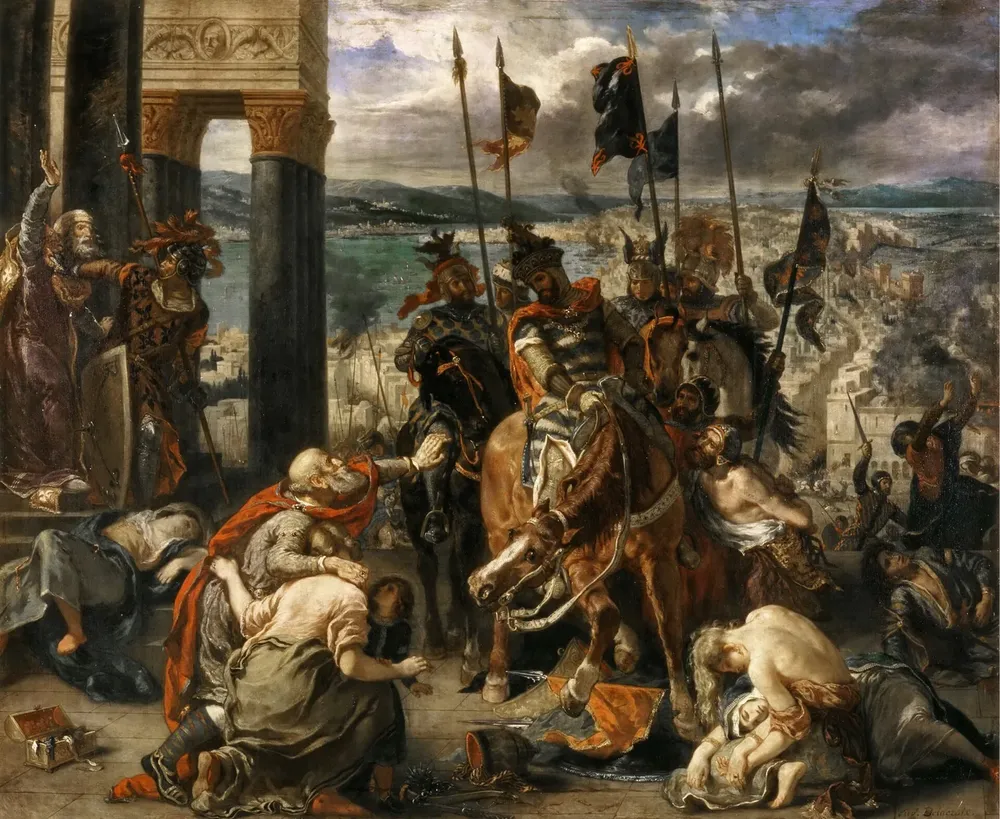
Eugène Delacroix, The Entry of the Crusaders into Constantinople, 1840. Musée du Louvre, Paris · Public domain · Source page
Choniates: “Alas, the images, which ought to have been adored, were trodden under foot! Alas, the relics of the holy martyrs were thrown into unclean places!” ... “mules and saddled horses were led to the very sanctuary of the temple.”
Villehardouin: “never, since the world was created, had so much booty been won in any city.”
In April 1204 crusaders pillaged Constantinople. Delacroix’s painting of 1840 is an imagining, not evidence.
- What does each notice? Choniates, a victim, sees holy things defiled. Villehardouin, a crusader, counts booty; in this passage he describes no desecration, and his silence proves nothing.
- What about the split? According to Robert of Clari, a crusader writer, crusader clergy told the army that the Greeks had stopped obeying Rome. Some historians see 1204 as when the split hardened.
1438
The Emperor goes to Italy
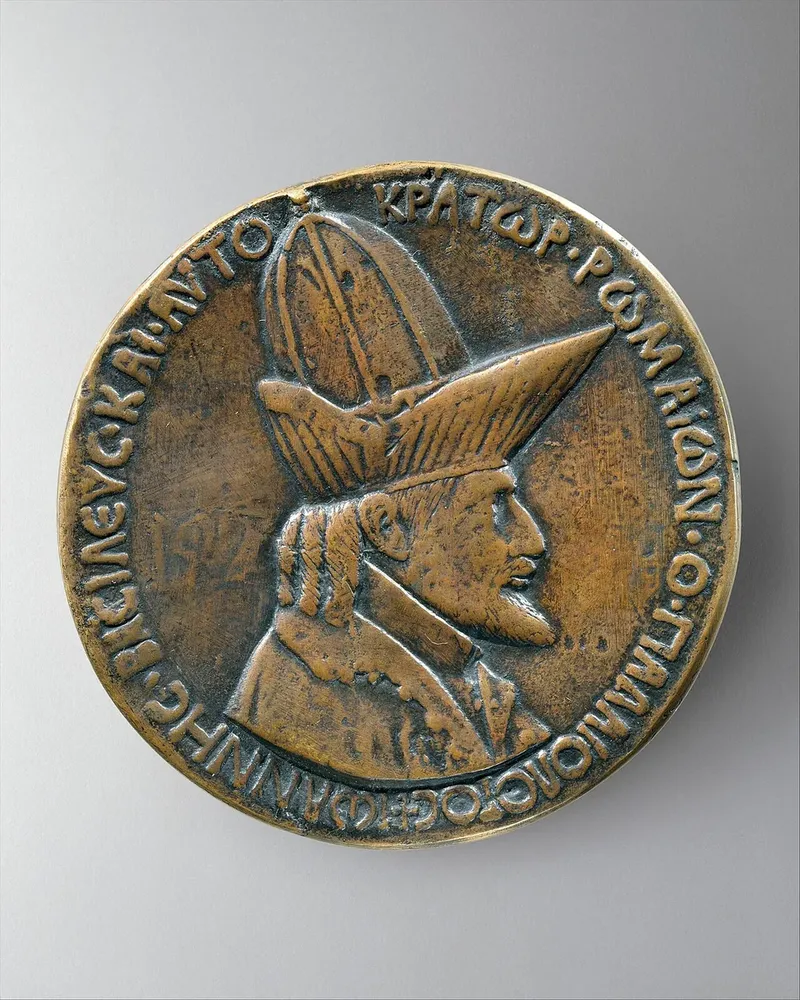
Pisanello, medal of John VIII Palaiologos, designed 1438–39 (this cast possibly 17th century). The Metropolitan Museum of Art, New York · CC0 · Source page
By 1438 the Ottoman Muslim empire threatened Constantinople. Emperor John VIII Palaiologos sailed to Italy with Patriarch Joseph II and about twenty bishops, hoping for ships and soldiers. At Ferrara and then Florence the Churches met to discuss union, arguing for months over the Filioque and papal primacy. On 10 June 1439 the Patriarch died.
A decision point
You are a Greek bishop at Florence.
Florence, 5 July 1439, the eve of the decree
The decree uniting the Churches is ready: the Spirit proceeds from Father and Son; ‘and from the Son’ may be added to the Creed; leavened and unleavened bread are both allowed; the pope heads the whole Church, and Eastern patriarchs keep their privileges and the Greek rites stay.
The Emperor wants ships. Church leaders in Constantinople have not yet approved.
What do you do?
- Sign the decree The union will be proclaimed, with your signature on it. Whether the Church in Constantinople will accept it is not yet known.
- Refuse to sign the decree You would probably anger the Emperor, and might risk his help.
- Sign, but say the Church in Constantinople must approve You sign, and say aloud that the Church in Constantinople must still approve. Rome would probably want an unconditional signature.
What really happened
Sign the decree
The decree is dated 6 July 1439, and almost all the Greek bishops signed it; the one who openly refused to sign, in the usual telling, was Bishop Mark of Ephesus. In Byzantium many signers recanted, and no Orthodox Church accepted the union. The union was proclaimed in Hagia Sophia on 12 December 1452, and many Greeks stayed away. On 29 May 1453 the city fell to the Ottomans.
The Emperor needed help against the Ottomans, and most of the Greek bishops signed; we cannot tell how far each acted from conviction and how far from need. George Dennis found the Filioque compromise reasonable, but not fully satisfactory.
The split in slow motion
- 1054 Legates’ charter (16 July); the Patriarch’s synod answers days later (20 July, says its edict).
- 1095 Alexios I’s envoys at Piacenza (says a Western chronicle); the First Crusade follows.
- 1204 Crusaders pillage Constantinople; a Latin patriarch is appointed; crusader rule (the Latin Empire) lasts until 1261.
- 1274 Council of Lyon: Michael VIII accepts union, fearing invasion from the West; rejected in Byzantium.
- 1439 Florence: decree dated 6 July; union rejected in Byzantium.
What is left of the split
1964–1965
One declaration, two cities
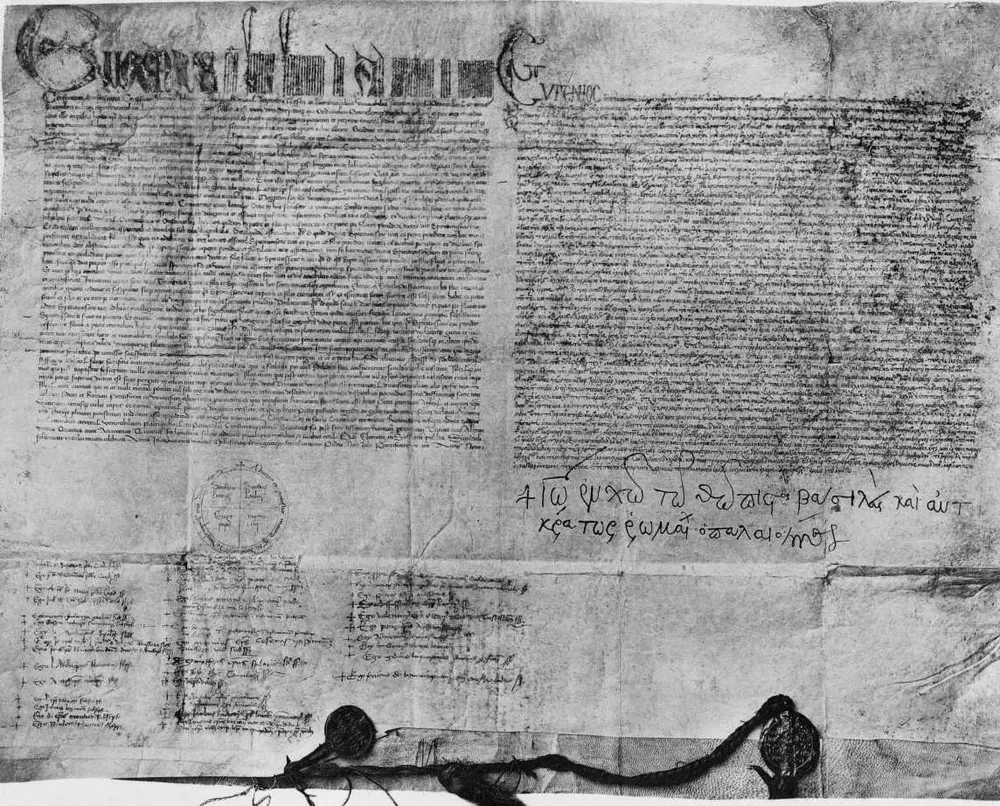
Bull of union Laetentur caeli, 6 July 1439, the copy bearing the emperor's signature. Facsimile in Franz Dölger, Facsimiles byzantinischer Kaiserurkunden · Public domain · Source page
After 1453 the two Churches stayed apart for over five centuries. In January 1964 Pope Paul VI and Patriarch Athenagoras I met on the Mount of Olives in Jerusalem, the first meeting of a pope and a patriarch of Constantinople since the Council of Ferrara–Florence (1438–39), whose union decree you see here.
On 7 December 1965 a joint declaration was read at the same hour in Rome and Istanbul (once Constantinople). Both sides regretted the offensive words and removed the excommunications of 1054 from the Church’s memory. But full communion, which includes sharing the Eucharist (bread and wine), was not restored. The declaration itself says the gesture is not enough; in 2025 both leaders still spoke of restoring it as a hope.
Today
Jerusalem
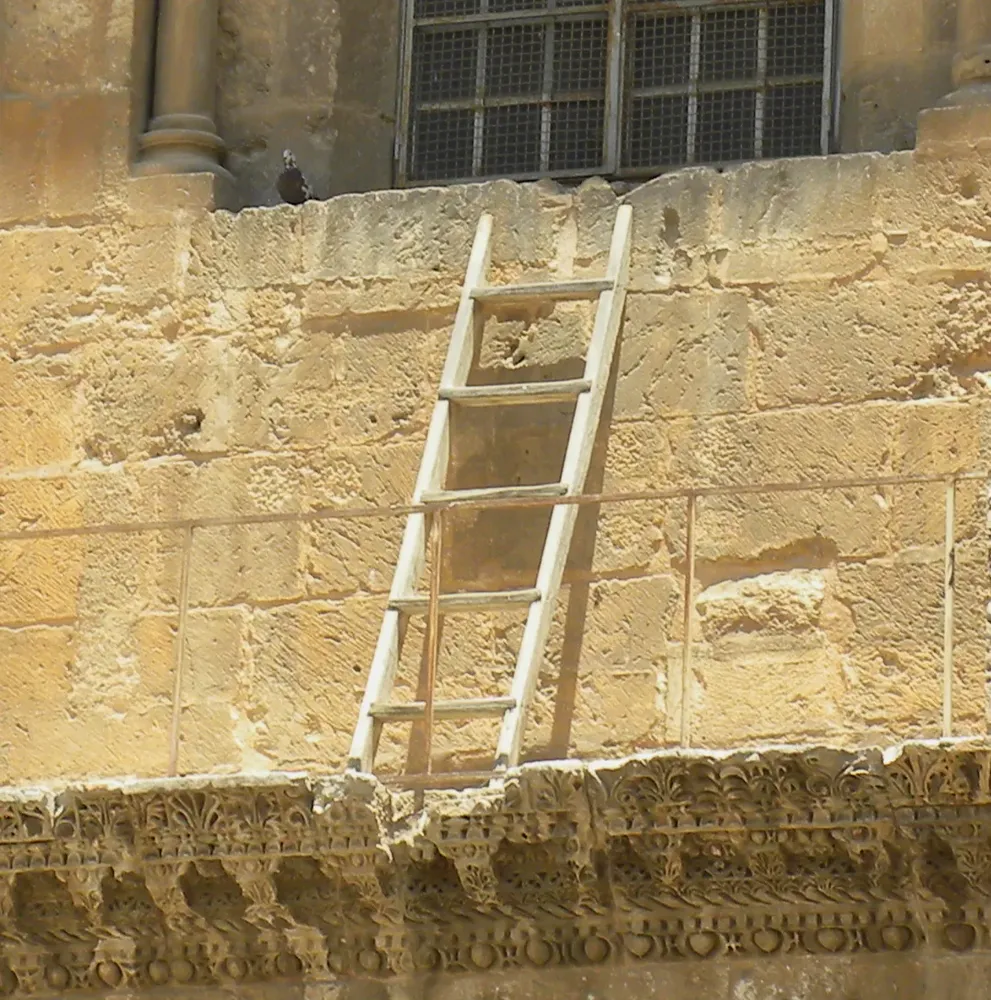
The immovable ladder, Church of the Holy Sepulchre, Jerusalem, 2013. Photo: Wilson44691 · CC0 · Source page
The Church of the Holy Sepulchre in Jerusalem, where Christian tradition places the burial of Jesus, is shared under the status quo. Greek Orthodox, Latins (Catholics, via Franciscans) and Armenians hold the main shares.
The Muslim Joudeh family keeps the key; the Muslim Nusseibeh family opens the door. A ladder shown in an engraving of 1728 still stands under a façade window. Under the status quo no one moves it without everyone’s consent. Its origin and owner are unknown.
Today
Easter on two dates
The gap shows to this day in the calendar. Most Orthodox churches still compute Easter by the Julian reckoning, the West by the Gregorian: in 2026 Western Christians celebrated on 5 April and Orthodox Christians on 12 April, and in 2027 they will be five weeks apart.
When did they split?
Which date marks the split?
- The older view: 1054 Philip Schaff, a Protestant church historian (History of the Christian Church, 1892, revised 1910), wrote of Cerularius and the Pope’s legates that “the schism between the Christian East and West was completed”. The Catholic Encyclopedia’s entry on Pope Leo IX (1910) says that after the excommunication of 16 July “the East was finally cut off” from the body of the Church. For both, the events of July 1054 settled the matter.
- Later: 1204 and after Adrian Fortescue, in the Catholic Encyclopedia (1912), wrote that after the Fourth Crusade “in a sense the schism was now complete”. In the same article he also wrote that “the present schism dates from the Eastern repudiation of the Council of Florence”. The Orthodox Church in America says that 1204 is generally considered the final sealing of the split.
- A slow process, no break in 1054 Dennis, a historian at the Catholic University of America, wrote in 1990 that the chroniclers of the time did not record the events of 1054, and that in 1095, when Urban II called the crusade, there was certainly no schism between the Churches. Kolbaba (2008) warns that reading the whole period as a road to the schism is reading with too much hindsight. The Orthodox bishop Kallistos Ware wrote that the schism is not really an event whose beginning can be dated exactly, and the Catholic cardinal Kurt Koch argued in 2026 that there was no schism in 1054.
The dialogue between the Churches goes on, and both Churches say the work is not yet finished. And whoever tells the story decides which date you remember.
Check yourself
Who excommunicated whom in July 1054?
Answer: The Pope’s legates excommunicated the Patriarch and his supporters, and his synod condemned them in return.. Right, according to the 1965 declaration and Cardinal Koch. The document named three men and their supporters, and the Patriarch’s synod answered the legates, not a pope. Older accounts, such as Schaff’s and Fortescue’s, described a mutual excommunication of the Churches. Leo IX was already dead, and historians dispute whether the legates’ authority lapsed with him.
Check yourself
What did the joint declaration of 1965 do?
Answer: It removed the excommunications of 1054, but did not restore full communion.. Right. Paul VI, and Athenagoras I with his synod, announced it together, at the same hour in Rome and Istanbul. The declaration itself says the gesture is not enough, and even in 2025 restoring communion was spoken of as a hope.
Check yourself
Why did the Greek delegation go to the Council of Florence, and what came of it?
Answer: To seek help against the Ottomans; most bishops signed, but Constantinople rejected the union.. Right. Emperor John VIII hoped for ships and soldiers, Pope Eugene IV promised aid, and most bishops signed the decree dated 6 July 1439. In Constantinople the union was rejected, and no Orthodox Church accepted it.
Check yourself
What is the Filioque?
Answer: A Latin word meaning “and from the Son”, added in the West to the Creed.. Right. Catholics hold that the Spirit comes from the Father and the Son together, as from one source. The Orthodox keep the wording of 381, in which the Spirit comes from the Father, and object to the addition, partly because it was made without a council.
Terms
- patriarch The head of one of the great Churches of the East. The Patriarch of Constantinople led the Church in the Byzantine capital.
- legate A special envoy of the pope who speaks in his name. In 1054 the pope sent three legates to Constantinople.
- excommunication The Church's heaviest punishment: a person is cut off from communion and from the community of the faithful until he repents.
- Creed A short statement of Christian belief, said in church. Its main text was fixed by the councils of Nicaea (325) and Constantinople (381).
- Filioque A Latin word meaning "and from the Son". In the West it was added to the Creed, which then says that the Holy Spirit proceeds from the Father and the Son. The East objected to the addition, and to changing the text without a council.
- papal primacy The Catholic Church holds that the pope, successor of Peter, leads the whole Church. The Orthodox Churches see Rome as first in honour, and prefer that councils and the heads of the great Churches decide together.
- synod An assembly of bishops that decides matters of the Church.
- Status Quo The customary arrangement that settles who may hold and do what in each part of the holy places in Jerusalem. It has no single agreed text, and changing it needs consent.
- Civitate A town in southern Italy where the Normans beat the army of Pope Leo IX and took him prisoner.
- Benevento A town in Italy where Pope Leo IX was held prisoner after his defeat.
- Ohrid A town in the Balkans, where an archbishop wrote the letter that started the quarrel.
- Ferrara A city in Italy where Church leaders met, and later in Florence, to discuss reuniting the Churches.
- Church of the Holy Sepulchre A church in Jerusalem. Christian tradition says Jesus was buried there, and several Christian groups share it.
- Franks Subjects of Charlemagne. They defended the words the Western Church added to the Creed.
- Normans Conquerors from northern Europe who fought in southern Italy.
- Ottoman Empire A large Muslim empire, centred in today's Turkey, which took Constantinople.
- Byzantine Empire The eastern Roman Empire, which spoke Greek and was ruled from Constantinople.
- Charlemagne King of the Franks, who built a large kingdom in western Europe.
- Joudeh family A Muslim family in Jerusalem that keeps the key to the Church of the Holy Sepulchre.
- Nusseibeh family A Muslim family in Jerusalem that opens the door of the Church of the Holy Sepulchre.
- Argyros A Byzantine commander. The Emperor blamed his circle for the trouble with the legates.
- John VIII Palaiologos A Byzantine emperor who sailed to Italy, hoping for ships and soldiers.
- Urban II A pope whom envoys of the Byzantine emperor asked for help.
- Cardinal A senior priest in the Catholic Church, one of the Pope's close advisers.
- Bishop A senior priest in charge of the churches in one area.
- Anathema A solemn formula that cuts someone off from the Church. It is often translated as curse.
- Julian calendar An older way of reckoning the calendar, which most Orthodox churches still use to set Easter.
- Gregorian calendar The calendar method used in the West, which differs from the Julian one.
- Donation of Constantine A forged document, believed genuine at the time, by which Emperor Constantine supposedly gave the West to the popes.
- Delacroix A French painter. His painting of the Crusaders in Constantinople is an artist's imagining, not historical evidence.
Sources
- Adrian Fortescue, The Orthodox Eastern Church (London: Catholic Truth Society, 1907), chapters 5 and 6
- Cornelius Will, Acta et scripta quae de controversiis ecclesiae graecae et latinae saeculo undecimo composita extant (Leipzig and Marburg, 1861)
- Horace K. Mann, The Lives of the Popes in the Early Middle Ages, vol. 6 (London: Kegan Paul, 1910)
- Philip Schaff, History of the Christian Church, vol. 4 (1892; rev. 1910), section 71
- Niketas Choniates, in Dana C. Munro (ed.), Translations and Reprints from the Original Sources of European History, vol. 3, no. 1: The Fourth Crusade (Philadelphia, 1897)
- Geoffrey of Villehardouin, Memoirs or Chronicle of the Fourth Crusade, trans. Frank T. Marzials (London: Dent, 1908)
- Adrian Fortescue, "Michael Caerularius" and "The Eastern Schism", Catholic Encyclopedia (1908, 1912)
- Brett Whalen, "Rethinking the Schism of 1054: Authority, Heresy, and the Latin Rite", Traditio 62 (2007)
- George T. Dennis, "1054: The East-West Schism", Christian History 28 (1990)
- Axel Bayer, Spaltung der Christenheit: Das sogenannte Morgenländische Schisma von 1054 (Cologne: Böhlau, 2002)
- Tia M. Kolbaba, The Byzantine Lists: Errors of the Latins (Urbana: University of Illinois Press, 2000)
- Joseph Gill, The Council of Florence (Cambridge: Cambridge University Press, 1959)
- Kallistos Ware, The Orthodox Church (Harmondsworth: Penguin, 1963)
- Joint Catholic-Orthodox Declaration of Pope Paul VI and Ecumenical Patriarch Athenagoras I, 7 December 1965 (Vatican)
Image credits
- Hagia Sophia, Istanbul, 2013. Photo: Rabe! · CC BY-SA 4.0 · Source page
- Leo IX, engraving by Giovanni Battista de' Cavalieri, 1580, from Pontificum Romanorum effigies. Copy in the Biblioteca comunale di Trento · CC0 · Source page
- The appointment of Michael Cerularius as patriarch, Madrid Skylitzes (the chronicle of John Skylitzes), 12th or 13th century. Biblioteca Nacional de España, Madrid, fol. 225r · Public domain · Source page
- Mosaic above the Imperial Gate, Hagia Sophia, c. 900. Photo: Sonse, 2021 · CC BY 2.0 · Source page
- Eugène Delacroix, The Entry of the Crusaders into Constantinople, 1840. Musée du Louvre, Paris · Public domain · Source page
- Pisanello, medal of John VIII Palaiologos, designed 1438–39 (this cast possibly 17th century). The Metropolitan Museum of Art, New York · CC0 · Source page
- Bull of union Laetentur caeli, 6 July 1439, the copy bearing the emperor's signature. Facsimile in Franz Dölger, Facsimiles byzantinischer Kaiserurkunden · Public domain · Source page
- The immovable ladder, Church of the Holy Sepulchre, Jerusalem, 2013. Photo: Wilson44691 · CC0 · Source page


