The Satsuma Rebellion, 1877: the last samurai?
Saigo Takamori helped build modern Japan, then rose against it. What is true and what is myth in the story of "the last samurai"?
Decisions, questions and your own progress, in the app
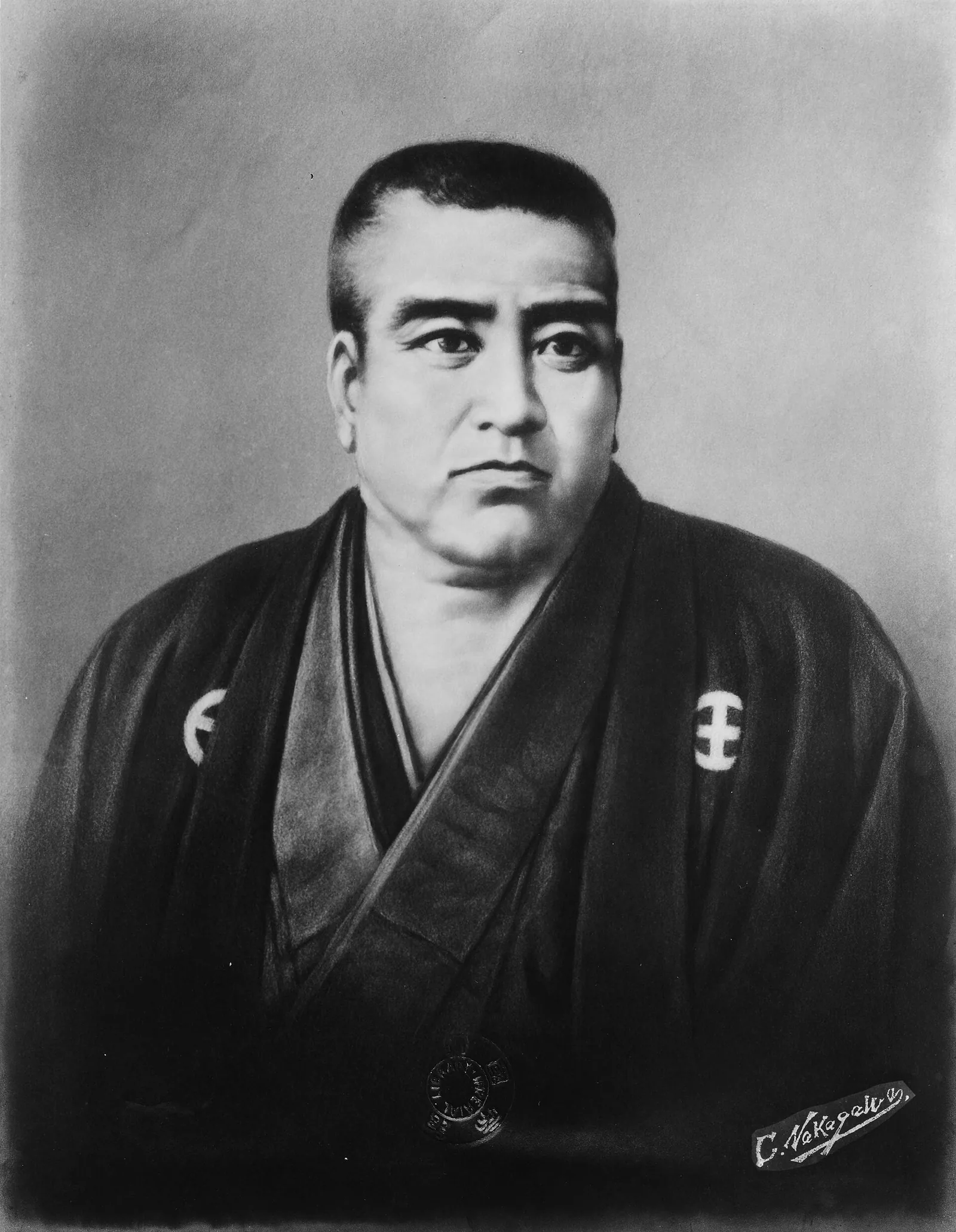
Portrait by C. Nakagawa, before 1935. Japanese book of 1934–35, National Diet Library · Public domain · Source page
A samurai in a changing Japan
He helped build modern Japan, then rose against it
Late January 1877, Kagoshima, southern Japan. At night, students raid an arsenal and take weapons.
One of the most important men in this story is not there. He has gone hunting.
Background
The samurai’s world
For centuries the samurai were Japan’s warrior class. They lived on stipends from their lords, and their rank was part of the old order.
Saigo Takamori was born in Kagoshima in 1828. He was one of the leaders of the Meiji Restoration, the movement that built Japan as a modern state.
Then the new government began to take that world apart.
The reforms
The old order is erased
In August 1871 the government abolished all the feudal domains and replaced them with new administrative units, the prefectures.
Over these years the government cut, and then ended, the stipends that had supported samurai for generations.
In 1873 a conscription law let ordinary people serve in the national army.
In March 1876 a sword edict barred everyone except former lords, soldiers and police from carrying swords in public.
A decision point
You are Saigo Takamori.
1873, Tokyo
Many samurai are angry: the state has taken their stipends and their place in society.
Your proposal, the Seikanron, is to go to Korea. The move could start a war, and the proposal is on the table now.
What do you do?
- Stay in government and fight for your policy from inside. Probably you lose vote after vote, and your voice fades in Tokyo while the stipends and swords go.
- Resign and go home to Kagoshima. Probably you lose your power in Tokyo, but you keep a base of samurai who look to you.
- Go to Korea yourself, without the government’s approval. Probably a diplomatic crisis that the government must handle, and a clash with men who see you as a rebel.
What really happened
Resign and go home to Kagoshima.
The proposal was rejected. Saigo resigned his government posts and went back to Kagoshima.
There he ran a private academy, which became a place where samurai voiced their complaints.
The sources do not give his full reasons. What is known is that the proposal was refused, and that he chose to go home rather than stay in government.
The arsenal raid
Late January 1877
A ship and the arsenals
At the end of January 1877 a government ship reached Kagoshima and began to remove the munitions stored there.
Over the following nights, students raided the arsenals. Saigo was not there. He was away hunting.
A decision point
You are Saigo Takamori.
Kagoshima, late January 1877
You are away hunting. Word reaches you: students raided the arsenals in the night, and the government is already moving the munitions out of the city.
The students are angry and proud. Many samurai in Kagoshima look to you, and the government in Tokyo is watching them all.
What do you do?
- Order the students home, and go to Tokyo yourself to explain. Probably a long journey to a government that is already removing the munitions. The students are left without a leader in Kagoshima.
- Stay out of it, and let the government deal with the students. Probably the students face punishment alone, and the samurai of Kagoshima decide you have abandoned them.
- Accept what has happened: congratulate the students and go with the men who have risen. Probably open war in Kyushu. The government would have to send an army south, and the fighting would spread.
What really happened
Accept what has happened: congratulate the students and go with the men who have risen.
Saigo was away hunting while the munitions were being removed and the students raided the arsenals. Reports say he flew into a rage at the student leaders when he heard. One account says he later congratulated them.
There is no clear evidence that he planned the rising. From then on, the rebellion carried his name.
The sources record his anger, and one account adds his praise, but not his reasons. Whether he was carried into the rising, or chose it once it had begun, the sources do not settle.
Check yourself
What do the sources say about Saigo’s part in the arsenal raid?
Answer: He was away hunting. Reports say he raged at the student leaders.. Right. The sources report this as a report, not a proof, and there is no evidence that he planned the raid.
The castle in the way
February 1877
Kumamoto Castle
The rebel army moved on Kumamoto, a castle town in Kyushu. The government kept a garrison in the castle. By one count it had 3,800 soldiers and 600 police, about 4,400 in all.
A decision point
You command the rebel army, in February 1877.
Kumamoto, 1877
The castle stands in your way. Its garrison is holding out, and your army is at the walls.
You can keep the army at the walls, or leave a small force to hold the castle and march on, deeper into the country.
What do you do?
- Keep the army at the walls and besiege the castle. Probably a long, costly siege, which gives the government time to raise a force to relieve the castle.
- Leave a small force to hold the castle, and march on. Probably an open battle, where the government’s larger army and better long-range weapons count for more, with a garrison left behind you.
- Pull back to Kagoshima and wait for the government to come to you. Probably a defence on home ground, but the government would still come with more men and better weapons.
What really happened
Keep the army at the walls and besiege the castle.
The rebels besieged Kumamoto Castle from 19 February to 12 April 1877. They did not take it.
In March 1877 government forces set out to break the siege, and fought at Tabaruzaka, near Kumamoto, until 20 March. The main Imperial army reached Kumamoto on 12 April.
Our sources record the siege, not a debate about it. It held the rebel army in one place for almost two months, while the government gathered its forces. The other two choices are our own, there to test the decision.
Check yourself
What happened at Kumamoto Castle?
Answer: The rebels besieged it for almost two months and did not take it.. Right. The siege ran from 19 February to 12 April 1877.
Myth
The 2003 film The Last Samurai makes the rebellion look like swords against modern guns, with a Western officer who joins the samurai.
The truth
The Western officer in the film is invented and is not a figure from the rebellion. He is loosely based on two French officers who fought in the Boshin War. The government was stronger, with more men and better long-range weapons. But the rebels had guns too: by one count, about 60 artillery pieces. Their rifles were old muzzle-loaders, their ammunition was short, and at times they fought with swords.
The evidence
By one count, from an online encyclopedia: the rebels began with about 12,000 infantry, 200 artillerymen and 60 guns. The Imperial side is listed at about 51,800 Imperial Army troops and 18,000 police. These are estimates, and they vary between sources.
Two prints and the last battle
Source: A portrait in military dress
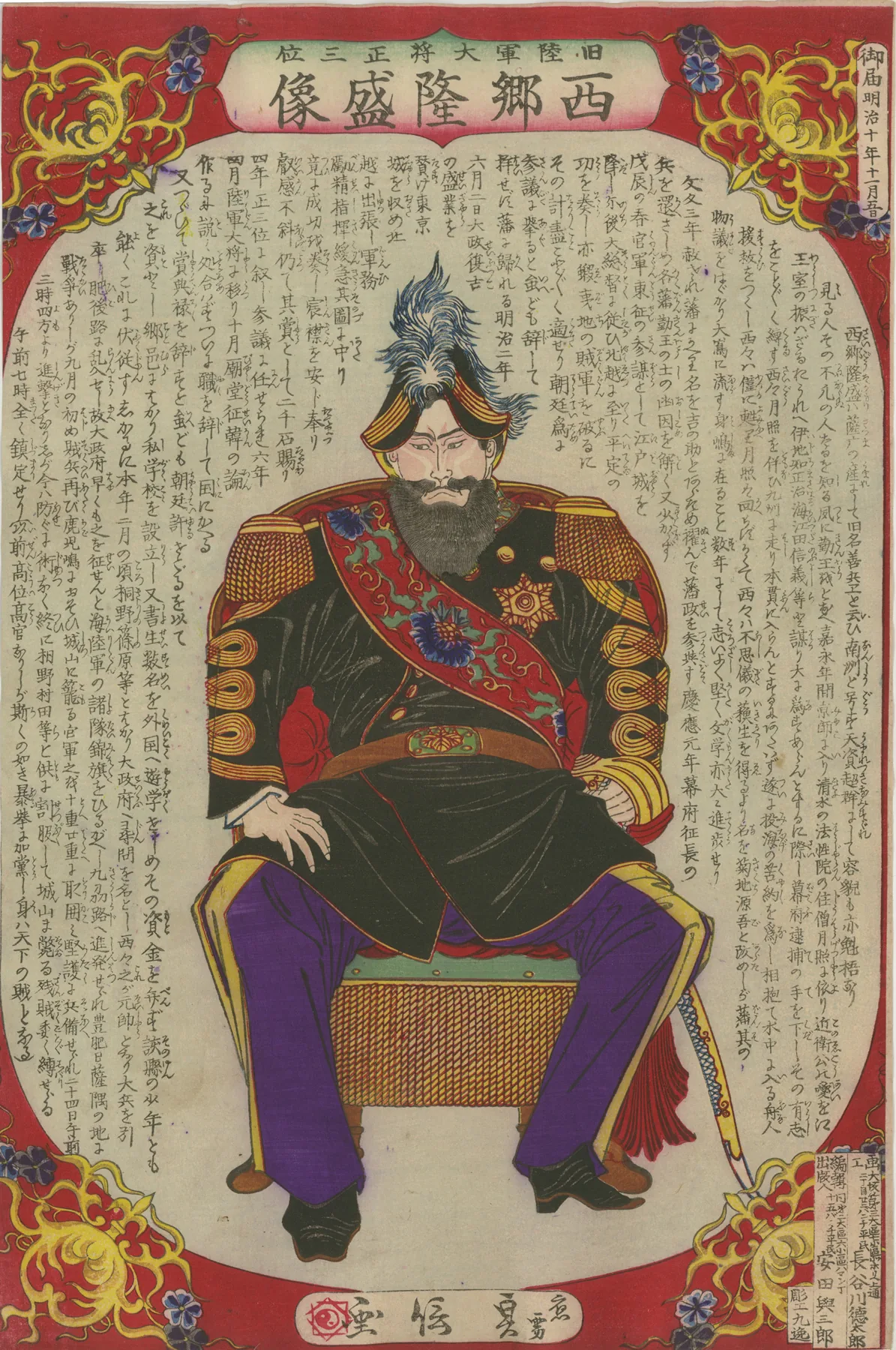
Woodblock print by Hasegawa Sadanobu II, November 1877, via myjapanesehanga.com · Public domain · Source page
Colour woodblock print by Hasegawa Sadanobu II, November 1877
It came out about six weeks after the rebellion ended. It shows Saigo in the uniform of his years in government.
- Who is shown here, and in what clothes? Saigo, seated in a dark military uniform with a red sash and a star.
- The print came out in November 1877. Who might have wanted it, and why? Admirers who wanted to remember him, perhaps, or sellers who knew a famous face would sell. The picture alone cannot tell us who bought it.
- What does the print leave out? The war. It shows the man, not the reasons he fought or what happened in the field.
The last battle
Shiroyama, September 1877
The rebellion ended at Shiroyama, a hill above Kagoshima, on 24 September 1877. Saigo died there, and the government won the war.
How he died is disputed. Accounts agree that he died at Shiroyama, but they differ on the details, and no published eyewitness report of his last moments has been found. The most-told version is that he took his own life in a ritual suicide.
Source: A print of the battle at Shiroyama
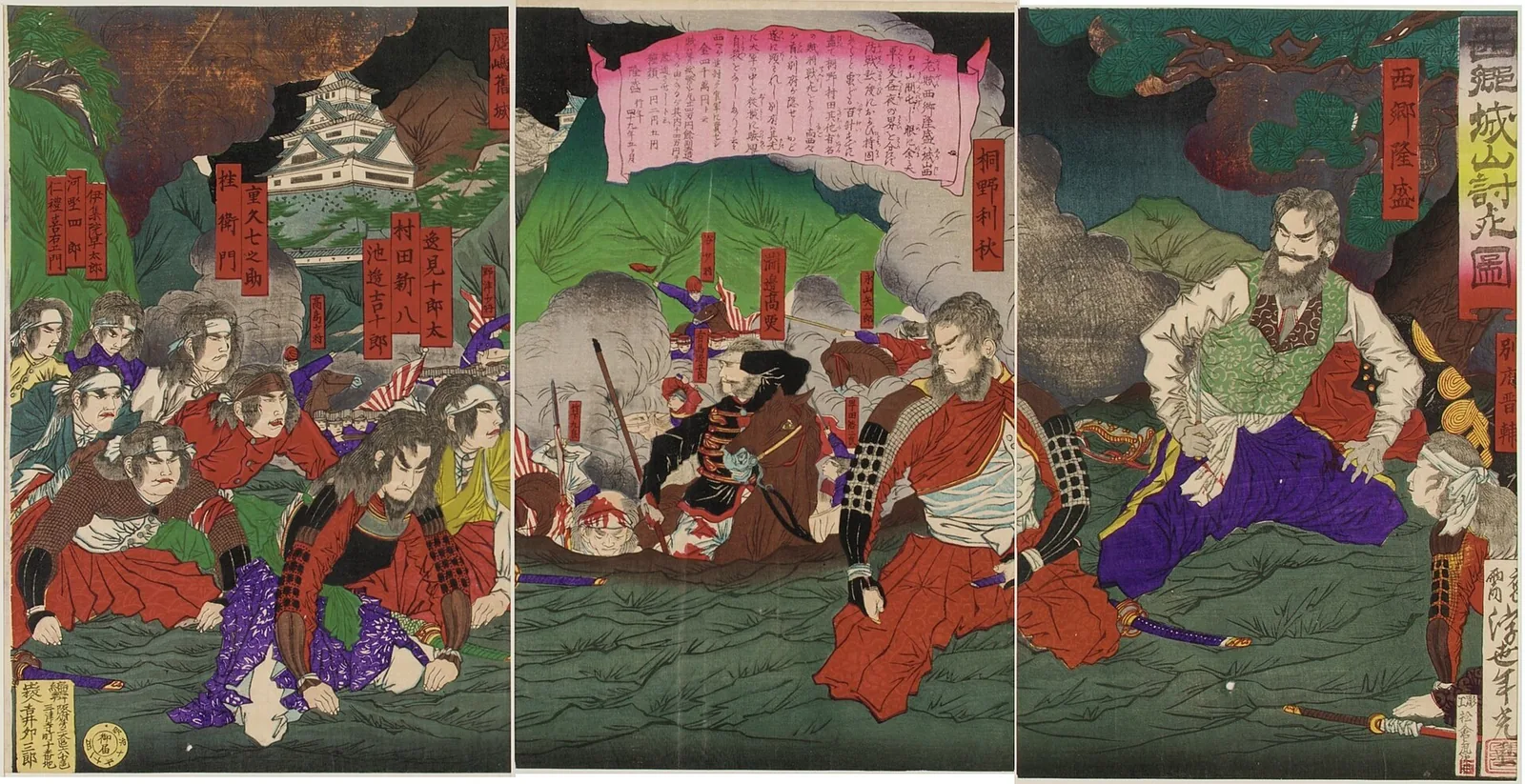
Colour woodblock print by Ukiyo Toshimitsu, 1877. Freer Gallery of Art, Washington · Public domain · Source page
Colour woodblock print by Ukiyo Toshimitsu, 1877. Freer Gallery of Art, Washington
Printed in the battle’s year. Its Japanese title says Saigo died in battle at Shiroyama. No published eyewitness account of his last moments has been found, so nothing can check the scene.
- What does the title say, and what do you see? The title says he fell in battle. The picture shows men on rough ground, a castle on a hill, and a large bearded man on the right. Which moment did the artist choose?
- How soon after the battle was it made, and what could the artist have known? The same year, very soon after. The artist could know what was reported, not a checked account.
- What is missing here? The print chooses one version of Saigo’s death, and the sources disagree on the details. The print does not say so.
Check yourself
Why is the 1877 print a weak proof of how Saigo died?
Answer: Because it was made in the same year, with no published eyewitness account to check it against.. Right. The year is close to the event, but no eyewitness account confirms the scene, and a print like this chooses a version.
After the rebellion
Afterwards
The state that fought him honours him
The rebellion was the last big armed revolt of the samurai against the new state.
In February 1889 Saigo received a posthumous pardon, and his rank at court was restored.
In December 1898 a bronze statue of him was unveiled in Ueno Park, Tokyo, by the sculptor Takamura Kōun.
The chain of events
- 1873 Conscription law. The Korea proposal is rejected, and Saigo goes home to Kagoshima.
- Late January 1877 A government ship removes munitions from Kagoshima. Students raid the arsenals while Saigo is away hunting.
- 19 February to 12 April 1877 The rebels besiege Kumamoto Castle. It does not fall.
- 24 September 1877 The last battle at Shiroyama. The rebellion ends, and Saigo dies.
- February 1889 A posthumous pardon, and his court rank is restored.
- December 1898 A bronze statue in Ueno Park, Tokyo.
Did Saigo start the rebellion?
Did Saigo choose the rebellion, or was he pulled into it?
- One reading: a leader who chose Once Saigo took command, the rebellion was his. He led the army to its last battle and died at Shiroyama. On this reading, it matters less whether he planned the first raid: he chose the war when he chose to lead.
- Another reading: a man carried along He was away hunting when the arsenals were raided, and no source proves he planned the rising. He raged at the students, and one account says he later praised them. On this reading, the rising began without him, and he joined it.
Which document would settle the argument? Write the one you would most want to see.
Check yourself
Which statement about the Meiji reforms is correct?
Answer: In August 1871 the domains were abolished and replaced by prefectures.. Right. This came before the conscription law of 1873.
Check yourself
What do the sources agree on about Saigo’s death?
Answer: That he died at Shiroyama, but the details of his death are disputed.. Right. The place is agreed, and the details are not.
Check yourself
Why does the 1889 pardon matter to the story?
Answer: It restored his court rank, although he was dead.. Right. The pardon came after his death, and it restored his official court rank.
Terms
- samurai A member of Japan’s warrior class, who lived on stipends from a lord. In the Meiji years the class lost its privileges.
- han A domain ruled by a feudal lord (daimyo) before the Meiji period. In 1871 the government abolished them all.
- Meiji Restoration The movement that restored power to the emperor and built a modern state in Japan.
- conscription Compulsory military service, which applied to men outside the warrior class.
- sword edict A decree of 28 March 1876 that banned most people from carrying swords in public. In Japanese it is called Haitorei.
- Seikanron Saigo’s 1873 proposal to go to Korea, a move meant to provoke war. It was rejected.
- arsenal A military store for weapons and ammunition.
- siege Surrounding a town or castle to force its surrender.
- Kagoshima A city in southern Japan. Saigo was born there, and the rebellion began in and around it.
- Kumamoto A castle town on Kyushu. The rebels besieged its castle but did not take it.
- Kyushu One of the large islands of Japan, in the south. Kagoshima and Kumamoto are both on it.
- Shiroyama A hill above Kagoshima. The rebellion ended there, and Saigo died there.
- Tabaruzaka A battle near Kumamoto, where government forces tried to break the siege of the castle.
- Ueno Park A public park in Tokyo, where a bronze statue of Saigo was unveiled.
- Takamura Kōun A Japanese sculptor who made the bronze statue of Saigo in Ueno Park.
- Garrison A military force left in a town or castle to guard it.
- Stipend A regular payment that a person receives from a lord or the state, so he can live on it.
- Munitions Bullets, shells and other material fired from guns.
- Prefecture A new unit of local government that the state created in place of the old feudal domains.
- Boshin War A civil war in Japan, won by the forces that wanted to end the old military rule.
- Posthumous pardon An official decision that cancels the guilt of a person who has died and restores his standing.
- Imperial army The emperor's main army, which reached Kumamoto as the siege ended.
- Rank at court An official standing at the emperor's court, showing a person's honour and place.
- Castle town A town built around a great castle, where local rulers and soldiers lived.
- Muzzle-loader An old rifle loaded through the muzzle at the front, not from the back.
Sources
- Hasegawa Sadanobu II, colour woodblock portrait of Saigō Takamori, November 1877 (Wikimedia Commons, via myjapanesehanga.com)
- Ukiyo Toshimitsu, three-panel woodblock print of the battle at Shiroyama, 1877 (Freer Gallery of Art, Smithsonian; Wikimedia Commons)
- Wikipedia, “Satsuma Rebellion”, for the army sizes, the dates and the outline of the war
- Warhistory.org, “The Satsuma Rebellion Begins”, for the January 1877 raids and Saigō’s reaction
- Wikipedia, “The Last Samurai” (2003 film), for the plot, the real figures it is based on, and the Gatling guns
- Wikipedia, “Battle of Tabaruzaka” and “Siege of Kumamoto Castle”, for the dates, the garrison and the relief


Image credits
- Portrait by C. Nakagawa, before 1935. Japanese book of 1934–35, National Diet Library · Public domain · Source page
- Woodblock print by Hasegawa Sadanobu II, November 1877, via myjapanesehanga.com · Public domain · Source page
- Colour woodblock print by Ukiyo Toshimitsu, 1877. Freer Gallery of Art, Washington · Public domain · Source page
