Sarajevo, 1914: how one month brought Europe down
On 28 June 1914 two shots were fired in a Balkan town. Five weeks later five of Europe's six great powers were at war. Did anyone want it, or did they all just slide in?
Decisions, questions and your own progress, in the app
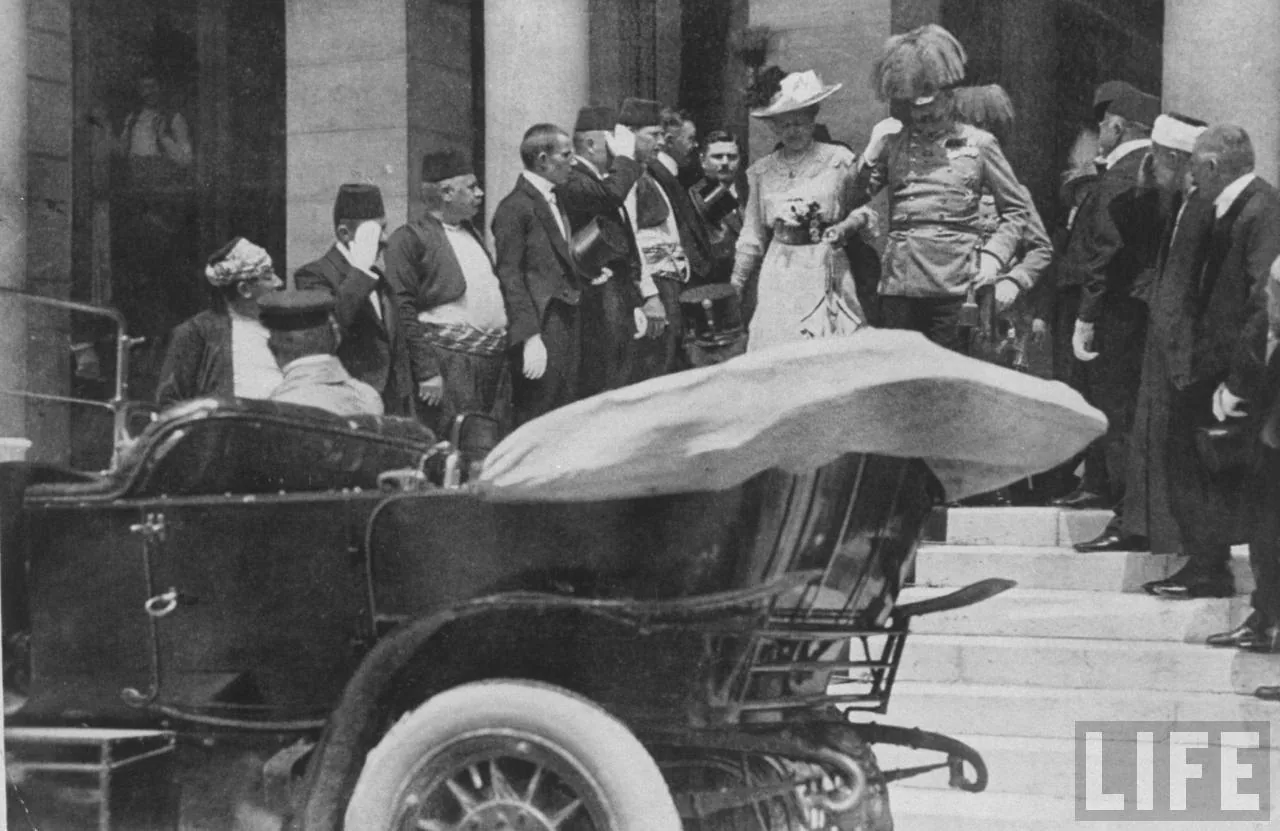
Franz Ferdinand and Sophie leave the Sarajevo Town Hall, 28 June 1914. Photographer unknown. Wikimedia Commons, CC0 · CC0 · Source page
Europe before the shots
Sunday, 28 June 1914
On Sunday 28 June 1914 an open car drives through the streets of Sarajevo, a city in Bosnia. In the back sit Archduke Franz Ferdinand, heir to the throne of Austria-Hungary, and his wife Sophie.
By the first days of August, five of the six great powers of Europe are at war. Did anyone want that? Or did they all slide into it?
Background
Two camps
By 1914 Europe stood in two camps. The first was the Triple Alliance: a defensive pact signed in 1882 by Germany, Austria-Hungary and Italy.
The second was the Triple Entente: Britain, France and Russia. It began with agreements that settled colonial quarrels, and it was not a binding military alliance. Britain did not promise to fight for France or Russia.
Background
Bosnia, 1908
Austria-Hungary had run Bosnia since 1878. In October 1908 Vienna annexed it outright.
Many Serbs had hoped that Bosnia would one day join Serbia, or a state of the South Slav peoples. For them the annexation was a blow. The announcement came on 5 October, and Emperor Franz Joseph proclaimed the annexation on 6 October.
Background
Two Balkan wars
In the First Balkan War (8 October 1912 to 30 May 1913) a league of Balkan states attacked the Ottoman Empire. The next summer, in the Second Balkan War (16 June to 10 August 1913), the former allies fought each other over the spoils.
Serbia pushed into Kosovo and northern Macedonia. It wanted a port on the Adriatic too, but the new state of Albania, created with the backing of the great powers, blocked that. Serbia came out of the wars much larger, and more confident.
Vidovdan in Sarajevo
The date
Vidovdan
28 June is Vidovdan, the Serbian day of remembrance for the Battle of Kosovo in 1389. Prince Lazar and Sultan Murad were both killed in that battle. Serbs remember it as a day of defeat and sacrifice.
In 1914 the archduke and his wife came to Sarajevo on an official visit, on that very day.
The plot
The plotters
A small group of young men from Bosnia, many of them members of Young Bosnia, planned to kill the archduke. They were given weapons and training in Belgrade. The the Black Hand, a secret society of Serbian officers that officially called itself “Unification or Death”, helped set up the plot. Its best-known figure, Dragutin Dimitrijević, known as “Apis”, is believed by many historians to have approved the killing. A railway worker, Milan Ciganović, helped supply the weapons.
And the government in Belgrade? Most historians agree that it did not organise the murder. They disagree about how much it knew. Some say it knew and was too afraid to act; others say it knew nothing.
The visit
On the way to the Town Hall
On Sunday morning the archduke and Sophie leave the army barracks in an open car, heading for a formal reception at the Town Hall. The pavements are full of onlookers. Riding with them is Oskar Potiorek, the governor of Bosnia.
The bomb
A bomb on the road
At about 10:10 a.m. Nedeljko Čabrinović, one of the young plotters, throws a bomb at the car. It hits the folded-back cover, bounces into the road and explodes under the car behind. That car carries the mayor and the police chief. The sources count sixteen to twenty people wounded.
The archduke’s car does not stop. It drives on to the Town Hall.
The Town Hall
The speech
Inside the Town Hall the archduke is angry. In the account Luigi Albertini gives in 1953, he tells the mayor: “Mr. Mayor, I came here on a visit and I am greeted with bombs. It is outrageous.” After Sophie whispers to him, he tells the mayor that he may now speak.
A decision point
You are Oskar Potiorek, governor of Bosnia.
Sarajevo, 28 June 1914, after the bomb
The bomb has gone off under the car behind you. People are hurt, but the archduke and his wife are not. He is angry, and you are responsible for the safety of the visit.
The day’s programme still includes a reception, a museum and more rides through the streets. A visit to the wounded in hospital is on the table, and the hospital lies along the river.
What do you tell the driver?
- Keep to the programme: the receptions and the museum The visit would go on along its known route, through open streets and open cars. The danger would remain. The plotters would probably have had to try again at another time.
- Cancel the rest of the visit and leave the city by the shortest road The couple would probably have been out of the city sooner, and the plotters would have lost the moment they had planned for. There is no way to know whether another chance would have come.
- Drive straight along the river to the hospital to visit the wounded The archduke would visit the wounded, a gesture the city would notice. But the route only works if every driver knows it. That depends on orders, not only on your decision.
What really happened
Drive straight along the river to the hospital to visit the wounded
Potiorek chose the hospital. The motorcade was to go straight along the river. He never told the drivers. The historian Sean McMeekin reports that the change never reached them, and an aide who asked the police chief to pass it on found that it was not done.
Taken alone, the choice looks like a reasonable reaction to the bomb. The wounded were in hospital, and visiting them was part of such a day. Nothing suggests the governor expected a second attack. The mistake was in communication: the change never reached the drivers.
At the Latin Bridge
The shots
The car stops
At the Latin Bridge the driver turns right, as the two cars ahead of him had done. The governor shouts at him to stop. The driver brakes and tries to reverse, and the engine stalls. The car stops close to where Gavrilo Princip stands, at the front of Schiller’s delicatessen on the corner, not on the bridge itself.
Princip steps onto the footboard and fires at point-blank range. The first bullet strikes the archduke in the neck, the second hits Sophie in the stomach. Sophie is dead on arrival at the governor’s residence. The archduke dies about ten minutes later. Both are dead before 11:30 a.m.
The last words
Sophie, Sophie!
According to Count Harrach, who was in the motorcade, the archduke’s last words were: “Sophie, Sophie! Don’t die! Live for our children!” This is his account, published after the events, and no one can check every word.
The killer
Nineteen years old
Princip tries to shoot himself after the shots, but he is seized. He is nineteen, and twenty-seven days short of twenty, the minimum age at which Habsburg law allowed execution.
He is sentenced to twenty years in prison, the maximum. He dies of tuberculosis in April 1918 in the Small Fortress at Theresienstadt, aged twenty-three. The disease worsened in the harsh conditions. His right arm had been amputated.
Source: The arrest photograph
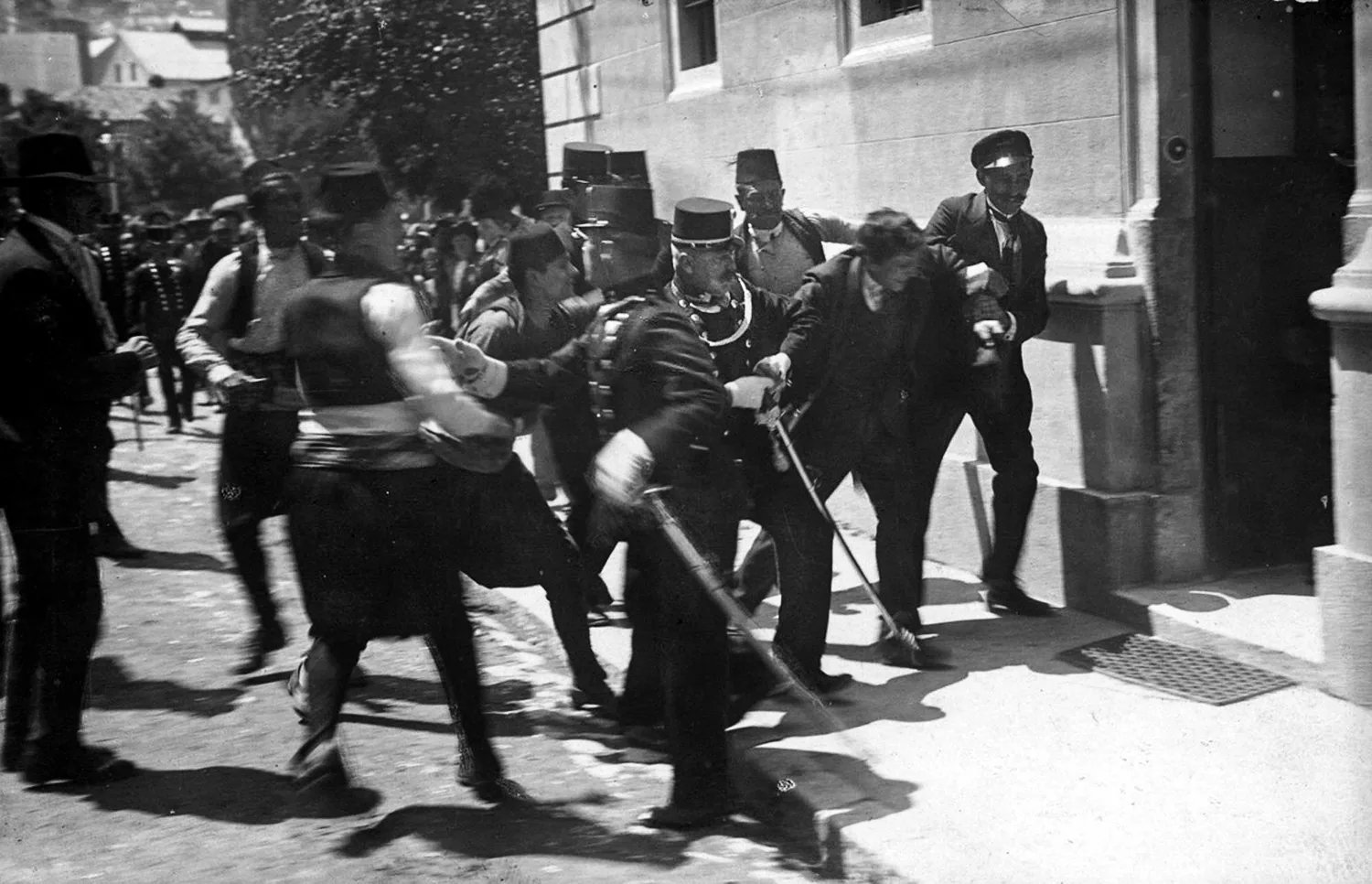
Arrest of a suspect in Sarajevo, July 1914. Photographer unknown. Austrian State Archives, via Wikimedia Commons · Public domain · Source page
Photograph, July 1914. Photographer unknown (sometimes attributed to Walter Tausch). Published in a Viennese illustrated paper with a caption naming Princip as the murderer.
- Who is the man being led away? Most historians now identify him as Ferdinand Behr, a bystander who had been a schoolfriend of Princip and was caught up in the confusion after the shots. In 1930 Behr said he was surprised to find himself led away by the police. The 1914 caption said Princip, and that is the version readers saw.
- What does the caption claim, and who wrote it? The caption says this is the murderer Princip. The picture itself names no one. It shows what was in front of the lens, not who the man is.
- What can this picture not tell you? It does not show who was guilty, or why this man was held. A picture of an arrest can make any bystander look like a suspect, especially in a crisis, when readers want someone to blame.
Myth
The number plate of the car, A III 118, foretold the end of the war: 11.11.18.
The truth
This is numerology. Almost any number can be read as a hint once you know the ending. The date 11 November 1918 is the armistice that ended the fighting for Germany. No source shows that the plate was chosen for that reason.
The evidence
When you know how a story ends, you can find signs in any number. A hint like this fits a good story, but it is not evidence.
Berlin answers Vienna
Vienna asks
What will Germany do?
In Vienna the government wants to act against Serbia, but it fears that Russia might step in to protect it. Its first question is whether Germany, its ally in the Triple Alliance, will stand by it.
Berlin
The envoy arrives
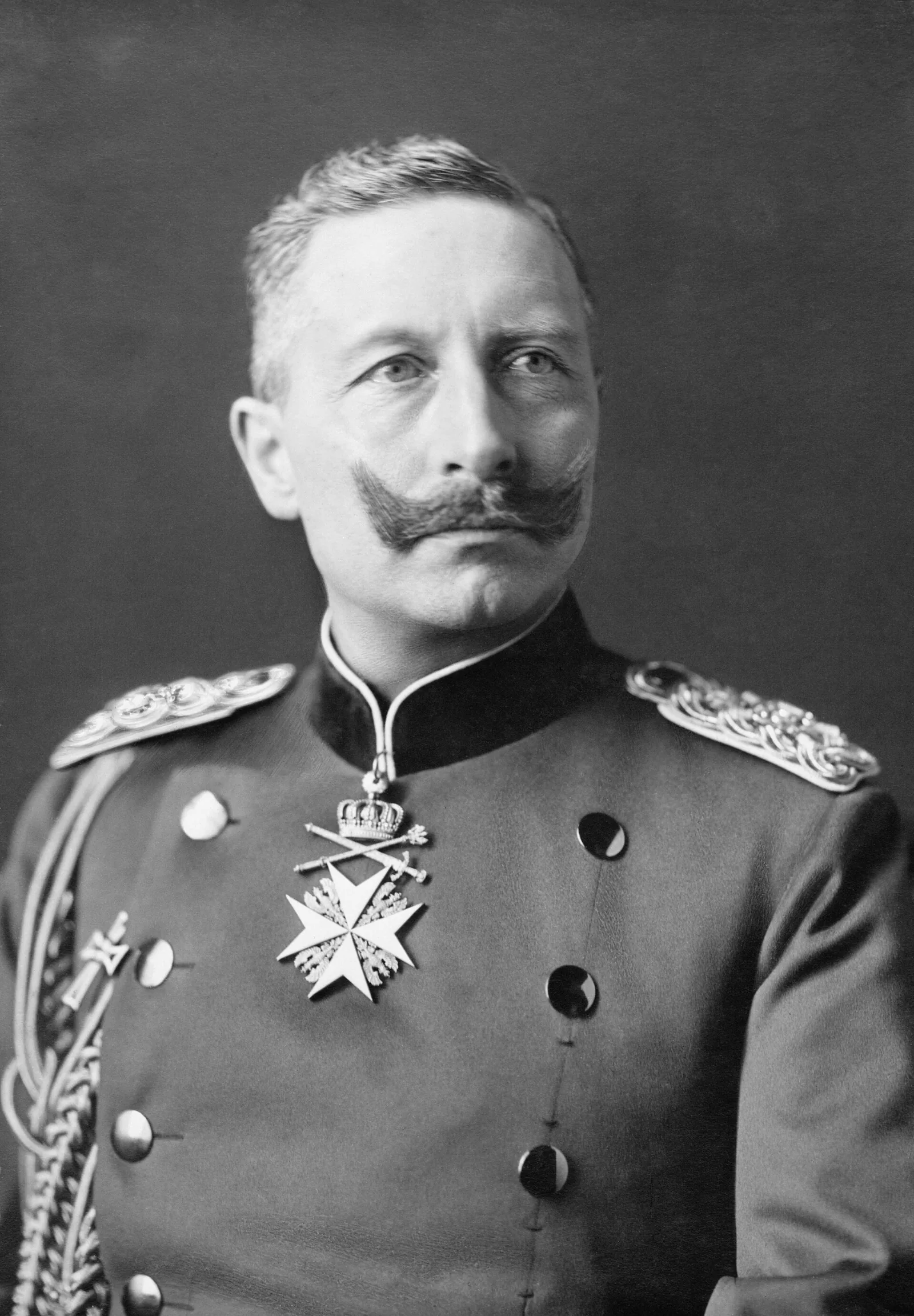
Wilhelm II, studio portrait by T. H. Voigt, Frankfurt, 1902. Imperial War Museums, via Wikimedia Commons · Public domain · Source page
On 5 July 1914 Count Alexander Hoyos arrives in Berlin as Vienna's envoy, with a question: if Austria-Hungary acts against Serbia, will Germany stand by it?
The question goes to the Kaiser, Wilhelm II, and to the chancellor, Theobald von Bethmann-Hollweg. Vienna is waiting for their answer.
A decision point
You are Theobald von Bethmann-Hollweg, chancellor of Germany.
Berlin, 5 July 1914, after Hoyos’s visit
Vienna asks what Germany will do if Austria-Hungary attacks Serbia. If Russia comes to Serbia’s aid, the war could spread across Europe. The Kaiser is ready to back Vienna, and he is waiting for your advice.
You must decide how far Germany commits itself, and in what words Vienna can rely on it.
What do you answer Vienna?
- Full support: Germany stands by Austria-Hungary, whatever it does against Serbia Vienna would probably move quickly against Serbia, knowing Berlin would not back away. The risk of a wider war rises sharply, and everything would then depend on Russia’s reaction.
- Stay out of the dispute and urge Vienna to talk to Serbia first Vienna would probably be angry, and some of its leaders would try to act anyway. But German caution would give the peace party in Vienna an argument, and a quick local war would be less likely.
- Tell Vienna it cannot count on German help if it attacks Serbia Austria-Hungary would have to choose between a limited campaign without German help and a long delay. A war would be less likely, but Vienna might still attack Serbia alone.
What really happened
Full support: Germany stands by Austria-Hungary, whatever it does against Serbia
The Kaiser had given his assurance to Vienna’s envoys at a luncheon on 5 July, and the chancellor confirmed it. Accounts differ on whether the confirmation came on 5 or 6 July. In one translation, the message says His Majesty “will faithfully stand by Austria-Hungary.” Historians later called the promise a blank cheque: German backing, with no limit on what Austria-Hungary might do. The phrase is a later label. The promise itself is on record.
Historians disagree about what Berlin wanted: to keep the war local, in the Balkans, or to escalate a regional crisis into a wider war. The promise itself says nothing about what Vienna would do next.
The ultimatum
23 July
The ultimatum arrives
On Thursday 23 July 1914, at six in the evening, Vienna hands Serbia’s government an ultimatum: a formal note with ten demands and a deadline of forty-eight hours. If the demands are not accepted without conditions, the Austro-Hungarian envoy is to leave Belgrade with his staff.
The demands
What it demands
Some demands ask Serbia to suppress the movement that threatens the Monarchy. The sixth demand, the most controversial, asks for an inquiry into everyone who took part in the murder, with Austro-Hungarian officials sitting in on the proceedings. Ten demands in forty-eight hours is a tight schedule, and historians often describe the note as harsh.
Source: The ultimatum of 23 July 1914
“to agree to the cooperation in Serbia of the organs of the Imperial and Royal Government.”
“to institute a judicial inquiry against every participant in the conspiracy of the twenty-eighth of June.”
Demands 5 and 6 of the ten.
- Who wrote the note, to whom, and what did Vienna expect? Vienna’s government wrote it to Belgrade’s. Historians think Vienna expected a refusal, or a reply it could describe as one.
- What does demand 6 ask, and where would the inquiry take place? An inquiry into everyone who took part in the plot. It is limited to people on Serbian soil, but Austro-Hungarian officials would join the proceedings. Serbia is asked to let a foreign state sit in its courts.
- What is missing? Time. Serbia had forty-eight hours to answer ten demands. Ask how long a government needs to think about a list like that.
A decision point
You are Nikola Pašić, prime minister of Serbia.
Belgrade, 24–25 July 1914
The ultimatum is on your desk, and the deadline falls at six in the evening on 25 July. Serbia is small, and its strength cannot match Austria-Hungary’s. The demands touch its sovereignty and its own courts.
Some people in Serbia are tied to the plot, and it is not clear how much you knew yourself. Only Russia might stand by Serbia. Do you accept the demands, answer in part, or refuse?
What do you send back?
- Accept all ten demands without conditions Serbia would look humiliated but would avoid war for now. Vienna would probably find new demands, and Serbia’s nationalists would turn their anger on your government.
- Accept most demands in substance, and qualify demands 5 and 6 Vienna would probably call the reply inadequate and press on. But Serbia would still look reasonable to the other powers, which mattered to London, Paris and St Petersburg.
- Reject the ultimatum and prepare for war with Austria-Hungary Austria-Hungary would probably declare war within days, with German backing. Serbia would fight alone unless Russia came in, and Russia’s help was not certain.
What really happened
Accept most demands in substance, and qualify demands 5 and 6
Belgrade replied on 25 July. It agreed to most demands in substance, but qualified demands 5 and 6. It said it was not clear what demand 5 meant. On demand 6 it offered its own investigation of those on Serbian soil, but refused Austro-Hungarian officials a part in it. That evening, at six, Vienna’s envoy left Belgrade, and Austria-Hungary broke off relations.
Belgrade’s reply gave its legal reason: foreign officials in its courts would break its constitution. Pašić also wanted to look reasonable to Russia and the other powers. Historians still differ on how much he knew of the plot. Some argue that he knew and was afraid to act; others that he knew nothing. The answer shapes how the Serbian government is judged.
Source: Belgrade’s reply, 25 July 1914
“The Royal Government confesses that it is not clear about the sense and the scope of that demand”
“this cannot be accepted, as this is a violation of the constitution and of criminal procedure.”
- What does Belgrade agree to, and where does it draw the line? It agrees to cooperation that is lawful, and offers its own investigation. The line is foreign officials taking part in that investigation, because that breaks its constitution and its criminal procedure.
- Who else was meant to read this reply? Not only Vienna. Russia, and the powers in London, Paris and Berlin, would read it too. A reply that sounds reasonable can stop the others from blaming Serbia.
- Why is the phrase “not clear” there? It is a polite way to say that the demand is vague and far-reaching, without refusing it outright. It leaves room to negotiate, and Vienna chose not to take it.
Mobilisation
28 July
War on Serbia
On 28 July Austria-Hungary formally declares war on Serbia. In St Petersburg Russia has already begun preparations, from 24 and 25 July. They are secret, but they are noticed in Berlin and Vienna.
The army
The army’s plans
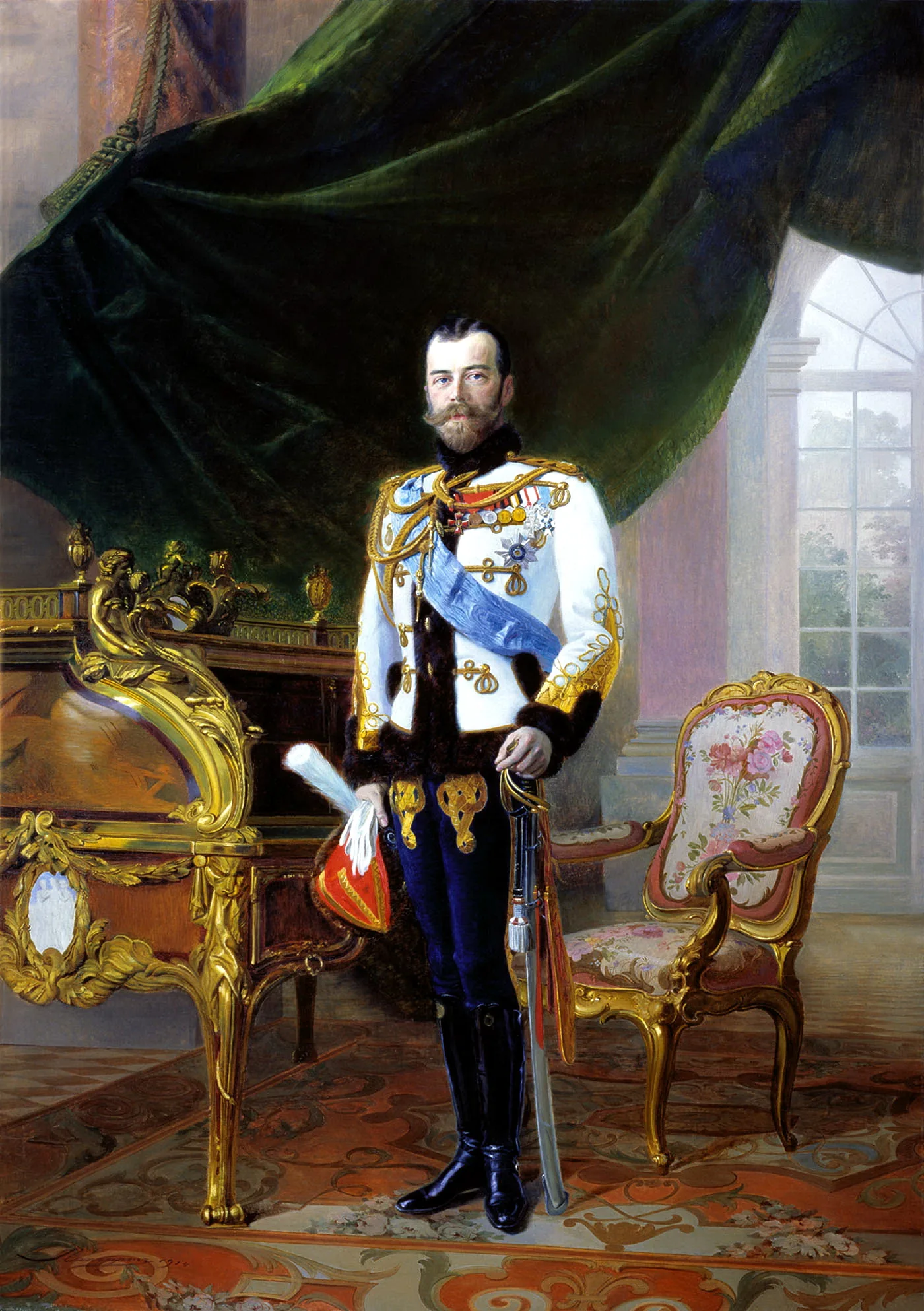
Nicholas II, oil on canvas, 1914. Ernst von Liphart. The Russian Museum, via Wikimedia Commons · Public domain · Source page
mobilisation means calling up the army: reservists are summoned, trains are readied and the plans start to move. A partial mobilisation is aimed at one enemy only, Austria-Hungary. A general mobilisation covers the whole army, including the frontier with Germany.
Most historians point out that Russia’s plans were built around a general mobilisation. Russia sees Serbia as a Slav state in danger, and it fears losing its influence in the Balkans.
A decision point
You are Tsar Nicholas II.
Russia, 29–30 July 1914
Austria-Hungary is at war with Serbia. Your ministers want to protect Serbia, and the army’s plans are built around general mobilisation. A general order would also move troops towards Germany.
The German Kaiser has been writing to you in a warm, personal tone, as an old friend, and he asks you to keep the peace. What do you order?
Which order do you sign?
- Do not mobilise, and give the diplomats more time Austria-Hungary would probably press on against Serbia, and Russia could not stop it in time. Russia would look as if it had stepped back, and its ties with France would weaken.
- Partial mobilisation, against Austria-Hungary alone Russia could act against Austria-Hungary without touching Germany. But its plans were not built for that, so the move would be slow and hard. Berlin might read it as a half-threat.
- General mobilisation of the whole army Germany would treat it as a threat to itself and prepare its own mobilisation. The chance of war with Germany, and then with France, would rise sharply.
What really happened
General mobilisation of the whole army
Nicholas first agreed to general mobilisation on 29 July. After a telegram from the German Kaiser, he ordered only partial measures. On 30 July, after pressure from his foreign minister, Sergey Sazonov, he confirmed general mobilisation. Sources differ on the exact order of the decrees on 29 and 30 July.
Nicholas was reluctant. In his telegram of 29 July he wrote that he foresaw being overwhelmed by pressure. His ministers argued that partial measures would not work with the army’s plans. Christopher Clark counts the general mobilisation among the most consequential decisions of the crisis.
Source: Two telegrams, 29 July and 1 August 1914
“To try and avoid such a calamity as a European war I beg you in the name of our old friendship”
“Immediate affirmative clear and unmistakable answer from your government is the only way to avoid endless misery.”
- Who is writing, and what do the signatures tell you? Two rulers who write to each other as “Willy” and “Nicky”, their family nicknames. The warmth is real, but neither man controlled events alone: both answered to ministers and generals.
- What does each man ask the other to do? Nicholas asks Wilhelm to help keep the peace, and suggests the Hague conference. Wilhelm asks for a clear yes or no. That leaves little room for talks.
- Why should you be careful with any telegram in this crisis? Governments later published selected papers to justify their own side. A telegram shows what the writer wanted the other to read. Compare it with what the government did the same day.
Germany against Russia
Twelve hours
Germany gives Russia twelve hours to stop mobilising. Russia does not. On 1 August Germany declares war on Russia.
Five weeks
The west
Belgium
On 3 August Germany declares war on France. On 4 August its troops enter Belgium. That was no accident. The Schlieffen Plan, the German army’s plan, assumed that a quick victory over France required passing through Belgium and Luxembourg, and winning before Russia could fully mobilise. Belgium was neutral under a treaty of 1839, and Britain was one of the powers that guaranteed it.
Britain
A scrap of paper
Britain had no formal alliance with France, and no binding promise to fight for it. But it had guaranteed Belgian neutrality. Its declaration of war on Germany took effect at midnight between 4 and 5 August, Central European Time, which was 11 p.m. in London on 4 August.
Earlier that day the British ambassador in Berlin, Sir Edward Goschen, reported a last talk with Chancellor Bethmann-Hollweg. In his report Goschen wrote that the chancellor called the 1839 treaty “a scrap of paper.” Historians still discuss what the words were meant to convey.
Italy
Italy stays out
Italy, bound to Germany and Austria-Hungary by the Triple Alliance, declares its neutrality. It judges that Austria-Hungary was the aggressor, so it is not obliged to join in. In 1915 it changes sides.
From 28 June to 4 August
- 28 June 1914 Archduke Franz Ferdinand and Sophie are shot in Sarajevo and die.
- 5 July 1914 Hoyos in Berlin. Germany promises Vienna its support.
- 23 July 1914 The ultimatum to Serbia, with a deadline of 48 hours.
- 25 July 1914 Serbia replies with qualifications. That evening Austria-Hungary breaks off relations.
- 28 July 1914 Austria-Hungary declares war on Serbia.
- 29–30 July 1914 Nicholas II wavers, then confirms general mobilisation. Sources disagree on the order of the decrees.
- 1 August 1914 Germany declares war on Russia.
- 3 August 1914 Germany declares war on France.
- 4 August 1914 German troops enter Belgium. Britain declares war on Germany at 11 p.m. London time.
Myth
One shot started the war.
The truth
The shots gave Vienna a pretext, but the war came from a chain of decisions over five weeks, in six capitals: Vienna, Berlin, St Petersburg, Paris, London and Belgrade. Each decision could have gone another way.
The evidence
The Schlieffen Plan had existed for years, and the German army saw it as the fast route to victory. Each great power’s mobilisation was a decision, not a reflex. Historians still argue how far each power could have chosen differently.
Myth
In August 1914 crowds in every capital cheered the war on.
The truth
The mass enthusiasm was partly a myth, at least in Germany. The historian Jeffrey Verhey studied Germany and found that enthusiasm was concentrated among intellectuals and much of the upper class. His book covers Germany only, and no one should assume the same for Paris, London, St Petersburg or Vienna.
The evidence
Pictures of cheering crowds spread quickly, and they are easy to mistake for the whole country. Ask who is in the picture, and who is missing.
Who is to blame?
Did one country start the war, or did the great powers share the blame?
- Fritz Fischer (1961): Germany In Griff nach der Weltmacht (“Grasp at world power”, 1961) the German historian Fritz Fischer argued that Germany’s leaders had aims of their own. In his reading, Berlin used the July crisis to strike at the Franco-Russian alliance and to win German domination of Europe.
- Christopher Clark (2012): shared responsibility In The Sleepwalkers (2012) Clark argues that the great powers shared the responsibility. They moved towards war like sleepwalkers, each reacting to the others. He does not let Germany off, but he refuses to make it the only guilty party.
- Sean McMeekin (2011): Russia In The Russian Origins of the First World War (2011) McMeekin argues that Russia’s role was larger than most historians had concluded. Critics say his central claims go further than other historians have concluded.
- Article 231 of the Treaty of Versailles (1919) Article 231, signed on 28 June 1919, has Germany and its allies accept “the responsibility of Germany and her allies for causing all the loss and damage”. The article itself never uses the word guilt, but it was read as a verdict on the war’s origins. Critics such as Sidney Fay (1928) found the blame shared.
The sharper question is not who fired first, but who could have stopped the chain, and at which step. Would the answer change if you looked at each capital in turn?
Check yourself
What kind of link was the Triple Entente in 1914?
Answer: An informal set of agreements, not a binding military pact. Correct. It began with colonial agreements, and it was not a binding military alliance.
Check yourself
What happened to the first bomb thrown at the archduke’s car?
Answer: It bounced off the cover and exploded under the next car. Correct. The blast wounded people in the car behind the archduke’s, which carried the mayor and the police chief.
Check yourself
Why did the car stop close to Princip at the Latin Bridge?
Answer: The driver took the usual turn, unaware the route had changed. Correct. The governor had chosen the hospital route, but the change never reached the drivers, so the driver kept to the usual turn.
Check yourself
Which statement about Belgrade’s reply of 25 July is accurate?
Answer: It agreed to most demands but refused foreign officials in the inquiry. Correct. Belgrade agreed in substance to much, but would not allow Austro-Hungarian officials to take part on Serbian soil.
Check yourself
What does the famous ‘arrest of Princip’ photograph most likely show?
Answer: Ferdinand Behr, a bystander, held after the shots. Correct. Most recent historians identify him as Behr, a schoolfriend of Princip who was caught up in the confusion.
Check yourself
Which statement best sums up the historians’ view of the July crisis?
Answer: The shots gave a pretext; later choices made the war. Correct. The war came from a chain of decisions in several capitals, not from the shots alone.
Terms
- Triple Alliance A defensive military alliance signed in 1882 by Germany, Austria-Hungary and Italy.
- Triple Entente An informal understanding between Britain, France and Russia, built up between 1904 and 1907. It was not a binding military alliance.
- Vidovdan 28 June, a Serbian day of remembrance for the Battle of Kosovo in 1389. By the Julian calendar it is 15 June.
- Young Bosnia A movement of young South Slav nationalists in Bosnia, who wanted to free Bosnia from Austro-Hungarian rule and unite the South Slav peoples.
- the Black Hand A secret society of Serbian officers, officially called Unification or Death. It helped the plotters. How much the Serbian government knew of the plot is still debated.
- ultimatum A formal note that sets demands and a deadline. If the demands are refused, a break in relations or war usually follows.
- mobilisation Calling up the army and readying its troops and trains for war. A general mobilisation covers the whole army.
- blank cheque A later label for Germany’s promise of support to Vienna in July 1914. The promise is on record; the phrase is a historians’ label.
- Schlieffen Plan The German army’s plan for a quick victory over France, through Belgium and Luxembourg, before Russia could fully mobilise.
- Bosnia A region in south-east Europe. Austria-Hungary had run it since 1878 and annexed it in October 1908.
- Archduke A title for a prince of the Habsburg family. Archduke Franz Ferdinand was heir to the throne of Austria-Hungary.
- Austria-Hungary A large monarchy in central Europe, ruled by the Habsburgs.
- Ottoman Empire A large empire centred on today's Turkey that also ruled parts of the Balkans.
- First Balkan War A war in which a league of Balkan states attacked the Ottoman Empire. It ran from October 1912 to May 1913.
- Second Balkan War A war in which the former allies fought each other over the spoils, in summer 1913.
- Battle of Kosovo A battle in 1389 between Serbs and Ottomans. Prince Lazar and Sultan Murad were killed in it. Serbs remember it as a defeat.
- Kosovo A region in the Balkans. Serbia expanded into it after the Balkan wars.
- Albania A state in the Balkans. The great powers created it, and so blocked Serbia from a port on the Adriatic.
- Adriatic A sea between Italy and the Balkans. Serbia wanted a port on it, but did not get one.
- Prince Lazar A Serbian prince killed in the Battle of Kosovo in 1389.
- Sultan Murad The ruler of the Ottomans, killed in the Battle of Kosovo in 1389.
- Oskar Potiorek The governor of Bosnia. He rode in the archduke's car and chose the hospital route.
- Milan Ciganović A railway worker who helped supply the plotters with weapons.
- Nedeljko Čabrinović One of the young plotters. He threw a bomb at the archduke's car.
- Dragutin Dimitrijević A Serbian officer and one of the best-known figures in the Black Hand. Many historians believe he approved the killing.
- Franz Joseph Emperor of Austria-Hungary. In October 1908 he proclaimed the annexation of Bosnia.
- Count Harrach A man in the archduke's motorcade. His account of the archduke's last words was published after the events.
- Gavrilo Princip The young man who shot the archduke and Sophie. He was sentenced to twenty years in prison and died there in 1918.
- Latin Bridge A bridge in Sarajevo. The archduke's car stopped close to it, where Princip stood, not on the bridge.
- Theresienstadt A fortress town. Princip died in 1918 in the prison of its Small Fortress.
- Habsburgs The royal dynasty that ruled Austria-Hungary. Its law set the minimum age for execution.
- Wilhelm II Kaiser of Germany during the crisis. After a telegram from him, Nicholas changed his orders.
- Theobald von Bethmann-Hollweg Chancellor of Germany during the crisis. He confirmed the promise made to Vienna.
- Alexander Hoyos Vienna's envoy, who arrived in Berlin on 5 July 1914 with a question about German support.
Sources
- Austro-Hungarian ultimatum to Serbia, 23 July 1914, English translation (BYU WWI site)
- Serbian reply to the ultimatum, 25 July 1914, English translation (BYU WWI site)
- Telegrams of Nicholas II and Wilhelm II, 29 July and 1 August 1914, as printed in the Wikipedia article ‘Willy–Nicky correspondence’, citing the German White Book and a 1915 English collection
- Luigi Albertini, The Origins of the War of 1914, 3 vols, trans. Isabella M. Massey (Oxford University Press, 1952–57)
- Christopher Clark, The Sleepwalkers: How Europe Went to War in 1914 (Allen Lane, 2012)
- Fritz Fischer, Griff nach der Weltmacht (Düsseldorf: Droste, 1961)
- Sean McMeekin, The Russian Origins of the First World War (Harvard University Press, 2011)
- Jeffrey Verhey, The Spirit of 1914: Militarism, Myth, and Mobilization in Germany (Cambridge University Press, 2000)
- Vladimir Dedijer, The Road to Sarajevo (Simon and Schuster, 1966)
- Tim Butcher, The Trigger: Hunting the Assassin Who Brought the World to War (2015)
- Wikimedia Commons, ‘Arrest of a suspect in Sarajevo’ (Austrian State Archives)
- Wikipedia, ‘Blank cheque’ (quoting Johnson and Meredith, 2004)
- BYU WWI site, ‘Origin of the Term “A Scrap of Paper”’

Image credits
- Franz Ferdinand and Sophie leave the Sarajevo Town Hall, 28 June 1914. Photographer unknown. Wikimedia Commons, CC0 · CC0 · Source page
- Arrest of a suspect in Sarajevo, July 1914. Photographer unknown. Austrian State Archives, via Wikimedia Commons · Public domain · Source page
- Wilhelm II, studio portrait by T. H. Voigt, Frankfurt, 1902. Imperial War Museums, via Wikimedia Commons · Public domain · Source page
- Nicholas II, oil on canvas, 1914. Ernst von Liphart. The Russian Museum, via Wikimedia Commons · Public domain · Source page


