1 March 1919: the Korean protest against Japanese rule
On 1 March 1919 Koreans took to the streets across the country and called for independence. Japan answered with force. What set it off, and what changed afterwards?
Decisions, questions and your own progress, in the app
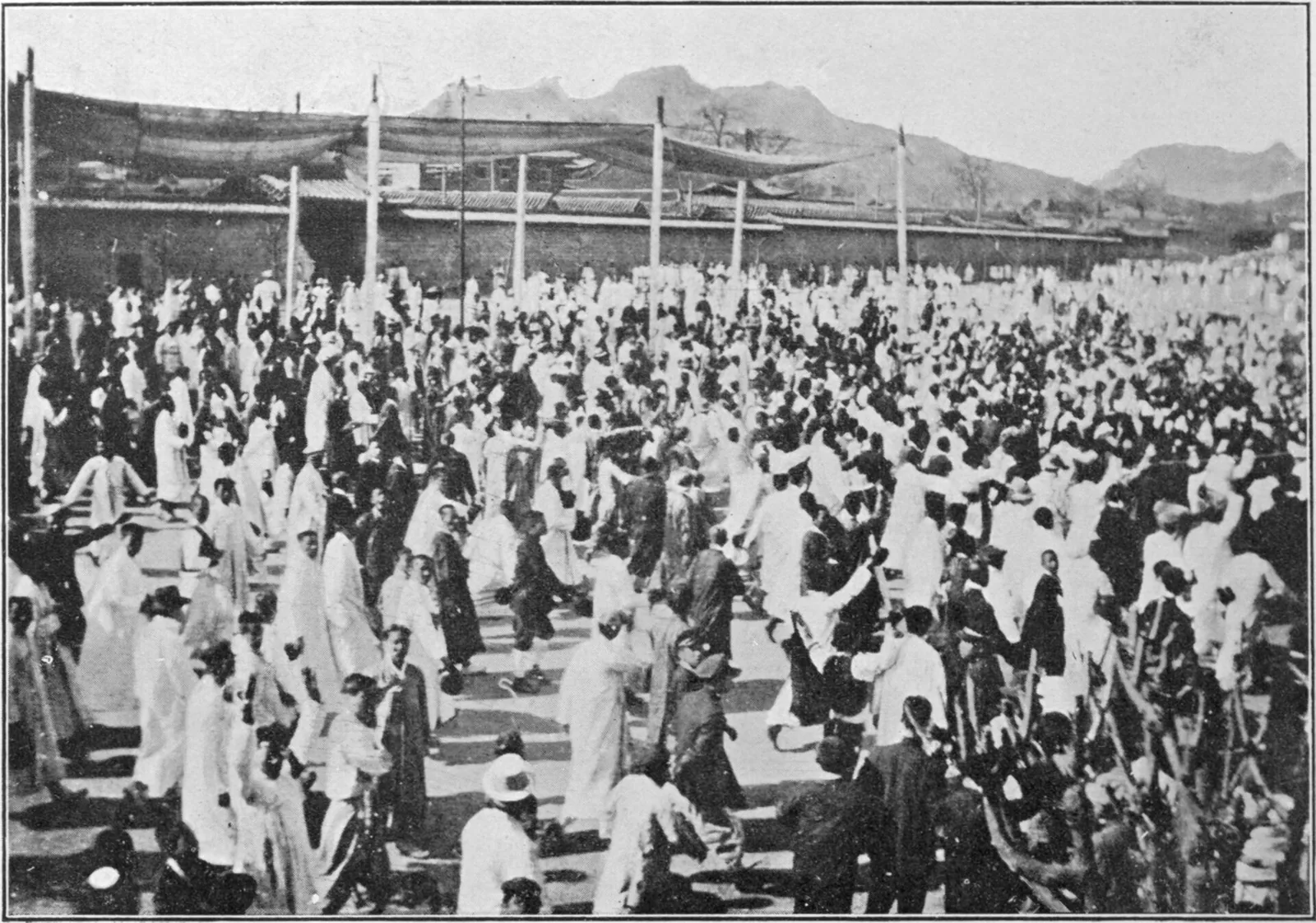
Bureau d'information coréen, L'Indépendance de la Corée et la Paix, 1919 (scan via Wikimedia Commons) · Public domain · Source page
The scene
Seoul, 1 March 1919
On 1 March 1919, Korean leaders in Seoul adopt a declaration that Korea is independent. That afternoon, a crowd gathers in a park in the city centre.
Japan had ruled Korea since 1910. Why would people risk prison, and worse, to say so out loud?
Background
A treaty in 1910
1910
In August 1910, Japan and Korea signed a treaty of annexation. It took effect on 29 August. Korea became part of the Japanese empire, and a Japanese governor-general ran it.
Historians call the years that followed the period of military rule.
January 1919
A former emperor dies
21 January 1919
On 21 January 1919, Gojong, Korea's former emperor, died in Seoul at the age of 66. Japan said he died of natural causes. Many Koreans believed he had been poisoned.
His funeral was planned for early March. Sources give the date as 1 March or 3 March, and they disagree.
Background
A speech about peace
8 January 1918
On 8 January 1918, US President Woodrow Wilson gave a speech on war aims and peace terms. It is known as the Fourteen Points speech.
Many Koreans hoped its ideas would reach them. The phrase self-determination is not in the speech itself. Historians still debate whether the principle covered colonies like Korea. Some argue that it applied only to former colonies of the defeated Central Powers, not to Japan's colonies.
Tokyo
Students speak first
8 February 1919
On 8 February 1919, Korean students in Tokyo issued their own declaration of independence. They wrote it in Korean, then had it translated into English and Japanese for the press and for foreign embassies.
The restaurant
A decision point
You are Son Byong-hi.
February 1919, Seoul
You lead Cheondoism. Activists come to you with a plan: a declaration of independence, signed by leaders of several faiths and then read in public.
Students in Tokyo have already published their own declaration. Your name on this one could lead to prison.
What do you do?
- Sign, and put your followers behind the declaration. Probably your signature draws other leaders in and gives the text real weight. It also makes you a target for arrest.
- Back the plan with money and organisation, but do not sign. Probably your name stays off the paper and your risk stays lower. But the declaration loses a leader with a large following.
- Refuse, and keep your followers out of it. Probably you and your followers stay safe. The movement goes ahead without a leader from your community.
What really happened
Sign, and put your followers behind the declaration.
Son Byong-hi signed the declaration. The sources describe him as a signer and a key backer of the movement.
The sources do not record his own reasons. What is clear is that he signed, and that the signers were arrested on 1 March.
1 March 1919
The restaurant
On 1 March 1919, the signers meet at Taehwagwan, a restaurant in Insa-dong, Seoul. They adopt the declaration there. By one account, 29 of the 33 are present.
By one account, the restaurant's owner, An Sunhwan, reports the gathering to the colonial authorities. The signers are arrested the same day.
The park and the words
A decision point
You are a young man in Tapgol Park.
1 March 1919, the afternoon
Estimates put the crowd at about 4,000 to 5,000 people.
Someone presses a copy of the declaration into your hands. The crowd is waiting.
What do you do?
- Read the declaration aloud to the crowd. Probably the crowd takes up the words and marches, and you become one of the first people the police can single out.
- Pass the paper to someone older and step back. Probably someone else reads it, and you stay out of sight. The words still reach the crowd, but not from you.
- Put the paper away and walk home. Probably the declaration still reaches the crowd through other copies, and you are not part of it.
What really happened
Read the declaration aloud to the crowd.
An unidentified young man read the declaration aloud in the afternoon. The crowd shouted for independence, then marched toward Jongno.
We do not know who he was or why he chose to read. The sources record the reading and what the crowd did next, not his reasons.
Source: The opening line
We, the representatives of 20,000,000 united people of Korea, hereby proclaim the independence of Korea and the liberty of the Korean people.
The declaration was first written in Korean. This English text is a 1919 transcript from the First Korean Congress in Philadelphia. The translator is not named. The Hebrew is our own translation.
- Who is 'we' in this sentence, and what does the number 20,000,000 tell you? 'We' means the signers, speaking for the nation. The number is their own claim, not a census. The sentence does not show how they counted.
- The text was made for a crowd in Seoul, and this copy was published abroad. What does that suggest about its audience? It had more than one audience: Koreans at home, and readers outside Korea whose support the signers wanted.
Myth
The people who signed the declaration also wrote it.
The truth
Choe Nam-seon drafted it. He did not sign it, and he was jailed for two years.
The evidence
The sources name Choe as the drafter, and he is not on the list of signers.
The response
A decision point
You are a senior official of the colonial government in Seoul.
Spring 1919
Protests spread from Seoul to towns and villages across the country through March and April 1919. Police and soldiers are sent to break them up.
Your superiors want order restored quickly.
What do you do?
- Order the police and army to disperse the crowds by force. Probably the protests stop quickly in some places, at a high cost in lives, and the anger it creates lasts for years.
- Arrest the organisers, and allow peaceful meetings to go ahead. Probably fewer people die, but the protests become harder to control as they spread into villages.
- Open talks with the signers and offer reforms. Probably the movement loses force if the reforms are real. But Japan gives up no control over the colony, and many activists would refuse to talk.
What really happened
Order the police and army to disperse the crowds by force.
The authorities used the army and police to suppress the protests. The Japanese government's own count is 553 killed between 1 March and 11 April 1919, and more than 12,000 arrested. Korean counts are much higher, as the last chapter shows.
The sources record what the authorities did, not the reasoning of any one official. Force was the way of a government that had ruled by military rule since 1910.
Source: An appeal to the world
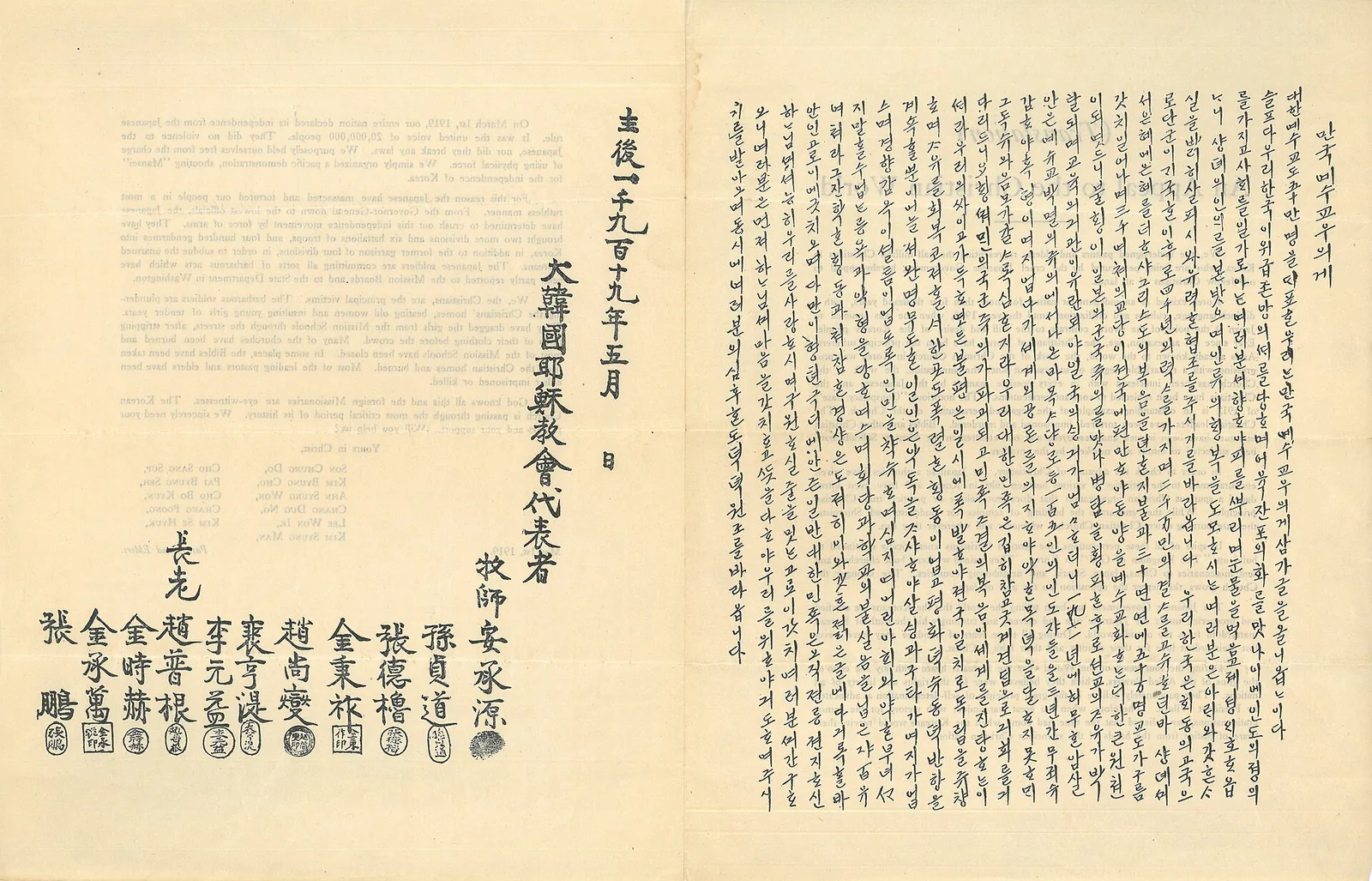
Korean Christian church representatives, appeal, May 1919 (scan on Wikimedia Commons) · Public domain · Source page
Representatives of Korean Christian churches, an appeal dated May 1919 (scan on Wikimedia Commons)
The page is dated May 1919. The faded English text on the left describes the protest, and says the demonstrators did no violence and broke no laws.
- Who wrote this document, and who was it written for? Korean Christian church representatives wrote it. The English text was meant for foreign readers, and the scan's description speaks of 'the world'.
- The English text says the demonstrators did no violence. Can you check that claim from this document alone? No. It is the authors' own claim, from one side of the conflict. Check it against other sources, such as Japanese police reports on the protests, and remember that the authors wanted foreign readers on their side.
- The figure 20,000,000 appears here too. Is that a second, independent count? No. It is the same claim repeated, not a second count. Two documents from the same movement repeating a figure do not confirm it.
What followed
After 1 March 1919
- 11 April 1919 Korean activists form a provisional government in Shanghai, far from Seoul.
- 15 April 1919 At Jeam-ri, near Suwon, Japanese troops lock villagers inside a church, fire on them and burn the building. Estimates put the dead at 20 to 30. The Canadian doctor Frank Schofield witnessed it.
- August 1919 Governor-General Saito Makoto takes office. Military rule gives way to cultural rule, a softer face on the same colonial system.
- 1920 Park Eun-sik publishes a Korean count: 7,509 killed and 15,961 injured. His figures are far above the Japanese government's.
- 28 September 1920 Yu Gwan-sun dies in Seodaemun Prison, aged 17. A student aged 16 in 1919, she had been arrested in Seoul during the protests. Her parents were killed in Cheonan on 1 April 1919.
How many died?
How many people died in 1919, and can we ever know?
- Japanese government, 1919 553 killed between 1 March and 11 April 1919. The count stops early, and a Korean historian, Kwon Tae-eok, argues that Japanese sources understated the numbers.
- Park Eun-sik, 1920 7,509 killed and 15,961 injured. Written in 1920, a year after the events, by a Korean author.
- National Institute of Korean History, 2019 798 to 1,170 deaths between 1 March and 31 May 1919, according to the institute's database on the movement.
The three counts differ widely, and none of them is proven. Which count would you trust, and what would a careful historian need to know before trusting any of them?
Check yourself
Who drafted the Declaration of Independence?
Answer: Choe Nam-seon, who did not sign. Correct. Choe drafted the declaration, did not sign it, and was jailed for two years.
Check yourself
Where did the 33 signers meet on 1 March 1919?
Answer: Taehwagwan restaurant, Insa-dong, Seoul. Correct. The signers met at the restaurant, adopted the declaration there and read it aloud.
Check yourself
Which death toll is the Japanese government's own count, up to 11 April 1919?
Answer: 553 killed (Japanese government). Correct. The Japanese government counted 553 killed up to 11 April 1919. Kwon Tae-eok argues that this count understated the numbers.
Check yourself
What was in Woodrow Wilson's speech of 8 January 1918?
Answer: Fourteen points on war aims and peace terms. Correct. It is the Fourteen Points speech, on war aims and peace terms.
Check yourself
What happened at Jeam-ri on 15 April 1919?
Answer: Villagers were locked in a church, shot at, and the church burned. Correct. Troops locked villagers in a church, fired on them and burned the building. Between 20 and 30 people died.
Check yourself
What changed in Japan's rule of Korea in August 1919?
Answer: Military rule gave way to cultural rule. Correct. Saito Makoto took office in August 1919, and the policy became known as cultural rule. Japan still ruled Korea.
Terms
- annexation The formal absorption of one country into another, so the first stops being independent. Japan annexed Korea in 1910.
- governor-general The head of Japan's colonial government in Korea. Each governor-general ran the colony for Japan.
- Fourteen Points The peace programme Woodrow Wilson set out in his speech of 8 January 1918 on war aims and peace terms.
- self-determination The idea that a people should choose its own government and future. The phrase does not appear in Wilson's January 1918 speech.
- Cheondoism A Korean religious movement. Its leader, Son Byong-hi, was a signer and a key backer of the declaration.
- provisional government The body that Korean activists formed on 11 April 1919 in Shanghai, outside Korea.
- cultural rule The name of the policy Japan adopted from August 1919 in place of military rule. It looked softer, but Japan kept ruling.
- Seoul The largest city in Korea. Today it is the capital of South Korea.
- Japanese empire The Japanese state, which included Korea after the 1910 annexation.
- Gojong Korea's former emperor. Many Koreans believed he had been poisoned.
- Woodrow Wilson US president. In 1918 he gave a speech on the war's aims and peace terms.
- Philadelphia A city in the United States. In 1919 the First Korean Congress was held there.
- First Korean Congress A gathering of Koreans in Philadelphia in 1919. An English transcript of the declaration comes from it.
- Taehwagwan A restaurant in Insa-dong, Seoul, where the signers of the declaration met.
- Insa-dong A district of Seoul, where the Taehwagwan restaurant stood.
- Son Byong-hi One of the signers of the declaration, and a key backer of the movement.
- An Sunhwan The restaurant's owner. By one account, he reported the signers' meeting to the authorities.
- Choe Nam-seon The man who drafted the declaration. He did not sign it, and was jailed for two years.
- Jongno A main street and district in Seoul. The crowd marched toward it after the declaration was read.
- Military rule Rule by the army. Historians describe the years after the annexation this way.
- Colonial rule Rule by a foreign state over another land. Japan ruled Korea this way.
Sources
- Declaration of Independence of Korea, 1 March 1919; English transcript of 1919 (First Korean Congress, Philadelphia; Library of Congress copy)
- Park Eun-sik, The Bloody History of the Korean Independence Movement (1920)
- Kwon Tae-eok (2018), pp. 115–116 (as cited in the English Wikipedia article 'March First Movement')
- National Institute of Korean History, March First Movement Database (2019)
- 'March First Movement', English Wikipedia
- 'Japan–Korea Annexation Treaty', English Wikipedia
Image credits
- Bureau d'information coréen, L'Indépendance de la Corée et la Paix, 1919 (scan via Wikimedia Commons) · Public domain · Source page
- Korean Christian church representatives, appeal, May 1919 (scan on Wikimedia Commons) · Public domain · Source page

