The Salt March, 1930: a handful of salt against an empire
On 6 April 1930 a man walks down onto a beach in western India and picks up a little natural salt. In British India, that act breaks the law. Why would a government make a crime out of salt, and what did the walk to the sea really achieve?
Decisions, questions and your own progress, in the app
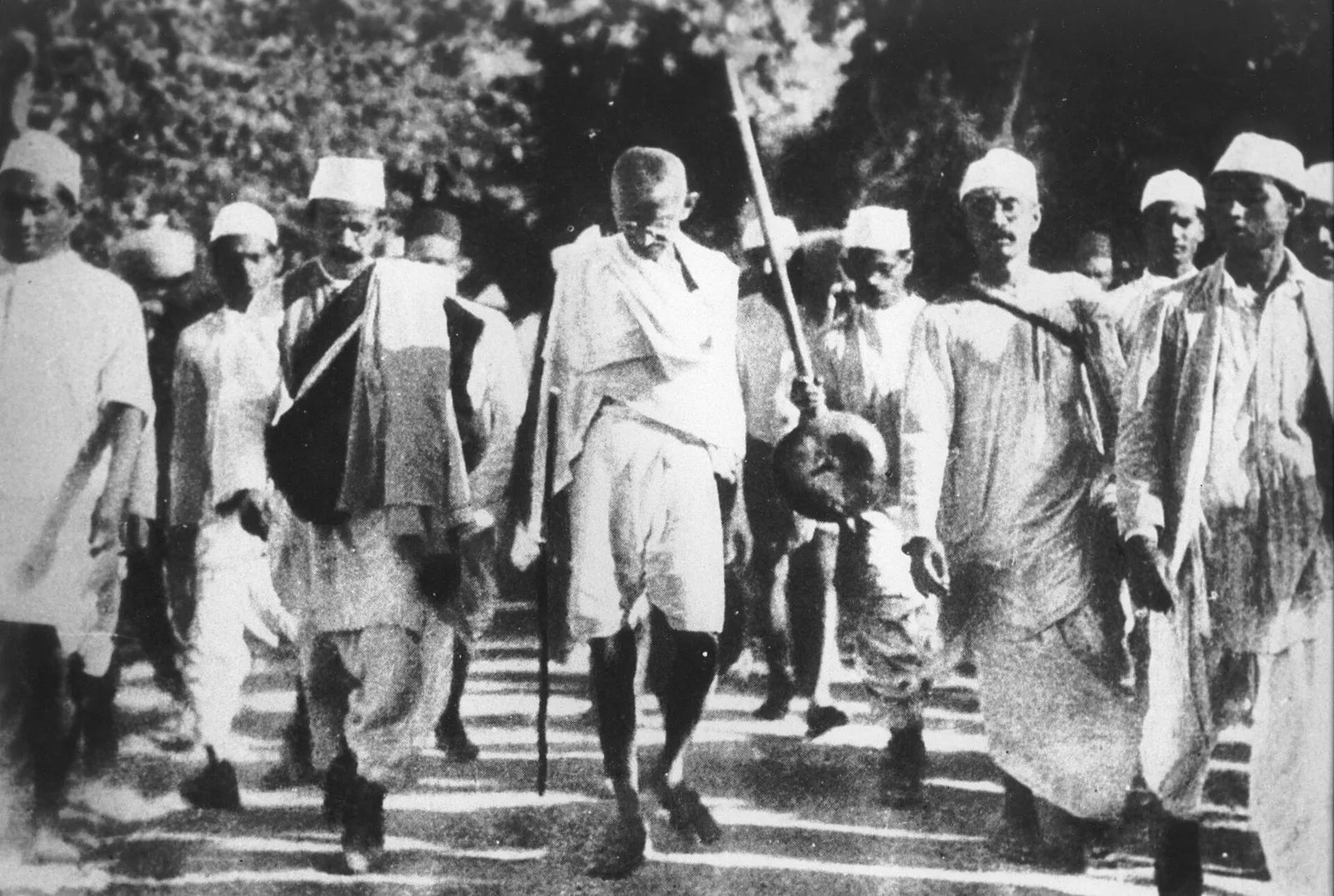
Gandhi during the Salt March, March 1930. Wikimedia Commons (scan by Yann). Photographer not named. · Public domain · Source page
The scene
A handful of salt
On 6 April 1930 a man stands on a beach in western India and picks up a little natural salt from the shore. It is a small act. In British India, it breaks the law.
Why would a government make a crime out of salt? And how did one act shake an empire? Let’s find out.
Background
A tax on salt
In 1835 a commission was set up to look at the salt tax in India. Later the government held a monopoly over making salt.
The Salt Act of 1882 set the penalties. Anyone who broke the rules could have their salt seized, and face up to six months in prison. In 1888 the tax was raised.
Under those laws, taking salt from the shore was a crime. That is the law Gandhi chose to break.
Mahatma Gandhi
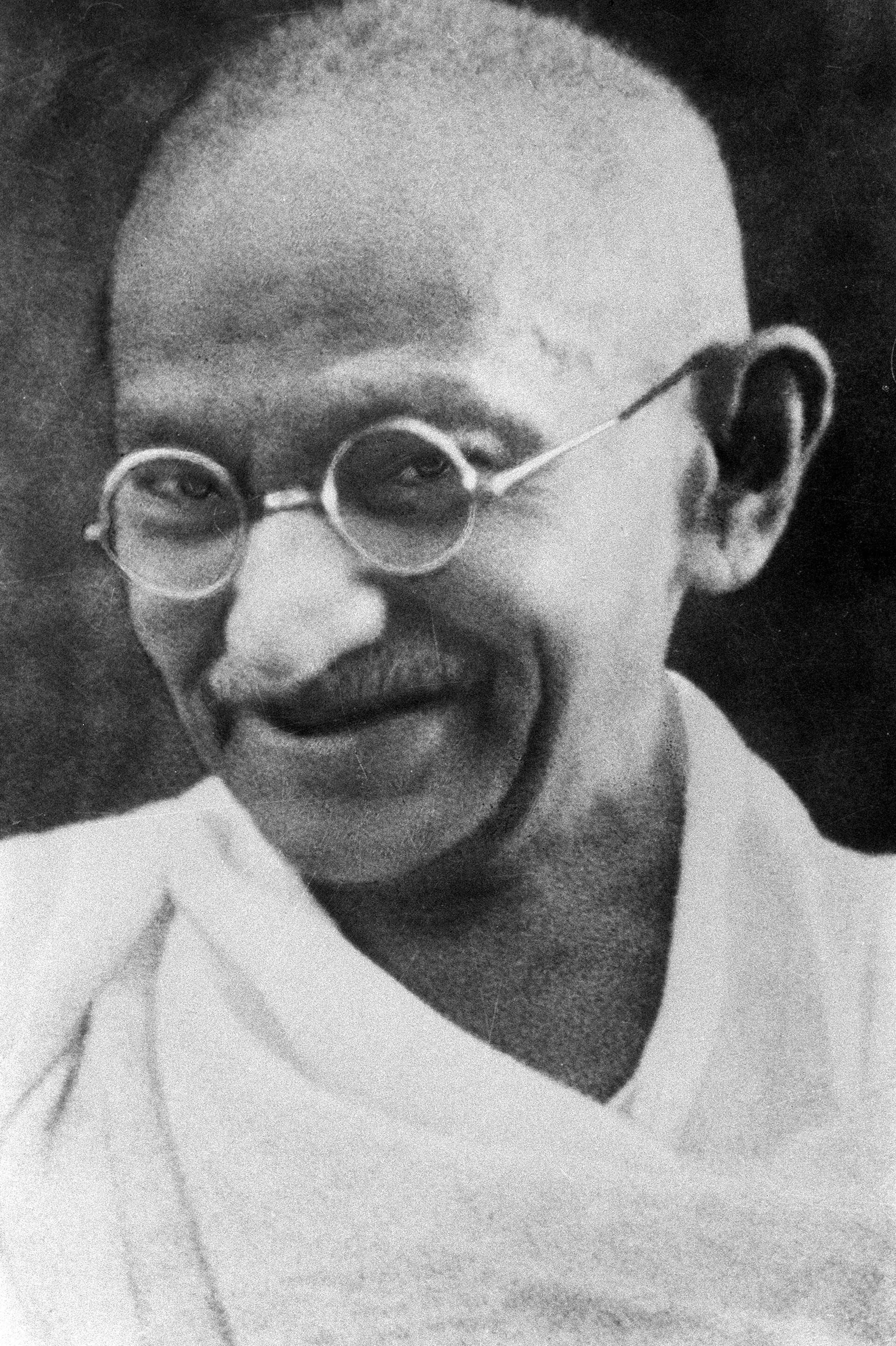
Mohandas K. Gandhi, portrait, probably late 1930s. Wikimedia Commons. Photographer not named. · Public domain · Source page
The leader of the Congress campaign, who chose salt as its issue.
- Born: 1869, Gujarat, western India
- Died: 1948
- Won: The Gandhi–Irwin Pact, March 1931: home salt-making and sale within villages
- Lost: The salt laws were not repealed, March 1931
“I shall proceed with such co-workers of the Ashram as I can take, to disregard the provisions of the salt laws.”
The road to it
Background
Complete independence
26 January 1930
In December 1929 Congress met at Lahore, in what is now Pakistan. At midnight on 31 December it adopted Purna Swaraj, “complete independence”, as its goal.
On 26 January 1930 it set the first Independence Day, and across the country people took a public pledge.
The salt tax still stood.
The letter
A letter with a date
On 2 March 1930 Gandhi writes to Lord Irwin, the viceroy. The viceroy is the king’s representative in India, and his government enforces the salt laws.
The letter is delivered by Reginald Reynolds. It says the salt laws will be disregarded “on the 11th day of this month”. Gandhi sets the day himself.
A decision point
You are Mahatma Gandhi.
Early March 1930, a few days before the date in your letter.
Congress has set complete independence as its goal. Yet the salt tax and the government’s monopoly still stand.
You have written to the viceroy, and your letter names 11 March as the day the salt laws will be broken. You do not know whether he will act.
What do you do?
- Keep writing to the viceroy and negotiate. Probably more letters and slow talks. With no visible act, the campaign would lose its momentum, and the viceroy would feel little pressure to act.
- Walk to the sea with followers and make salt on the shore. Probably crowds and newspaper attention, and a government forced to answer in public. But a walk of weeks gives the authorities time to plan their response.
- Go straight to a government salt works and take salt there. Probably a quick clash at the works, with arrests on the spot. That is a short story, and the government could cut the campaign off at once.
- Accept a small concession and call the campaign off. Probably the tax stays and the campaign ends quietly. A small concession would look like a retreat to the people who had followed you.
What really happened
Walk to the sea with followers and make salt on the shore.
Gandhi walked. He left the Sabarmati Ashram on 12 March with several dozen followers, reached Dandi on 5 April, and picked up salt from the shore on 6 April.
In his letter he wrote that he would go on, with the co-workers he could take, to disregard the salt laws. The sources we checked give no fuller reason in his own words.
The event
The road
Three and a half weeks on foot
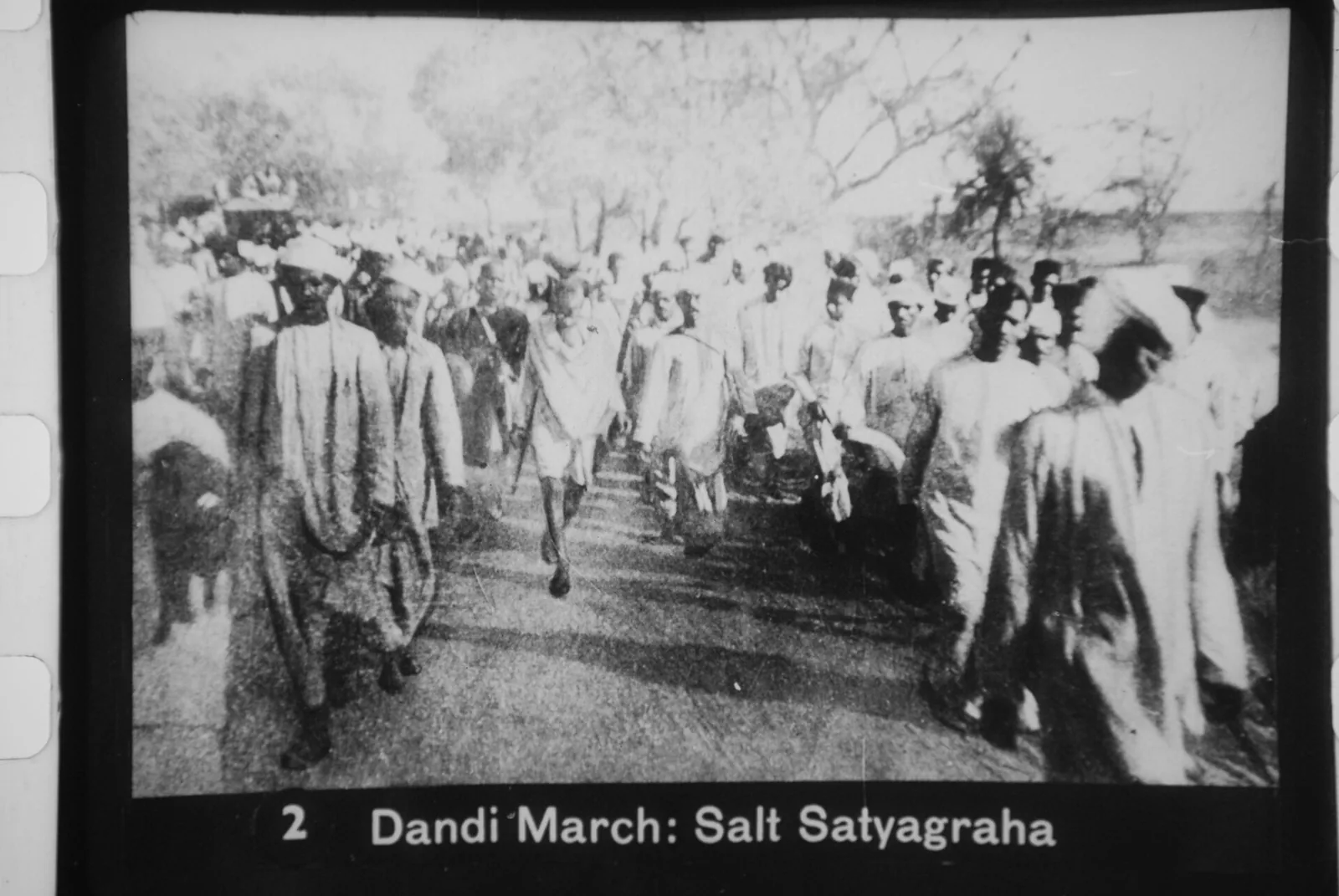
Dandi March: Salt Satyagraha, 1930. Film frame from the Gandhi Smarak Sangrahalaya Samiti collection (per Wikimedia Commons). Scan by Yann. · Public domain · Source page
about 240 miles
On 12 March 1930 Gandhi leaves the Sabarmati Ashram, near Ahmedabad, with several dozen followers. The road to the sea is about 240 miles, some 386 km, though the sources give slightly different distances.
The walk takes about three and a half weeks. On the way the crowds grow.
On 5 April they reach Dandi, on the Arabian Sea coast. According to History.com, tens of thousands are waiting there.
6 April
Salt from the shore
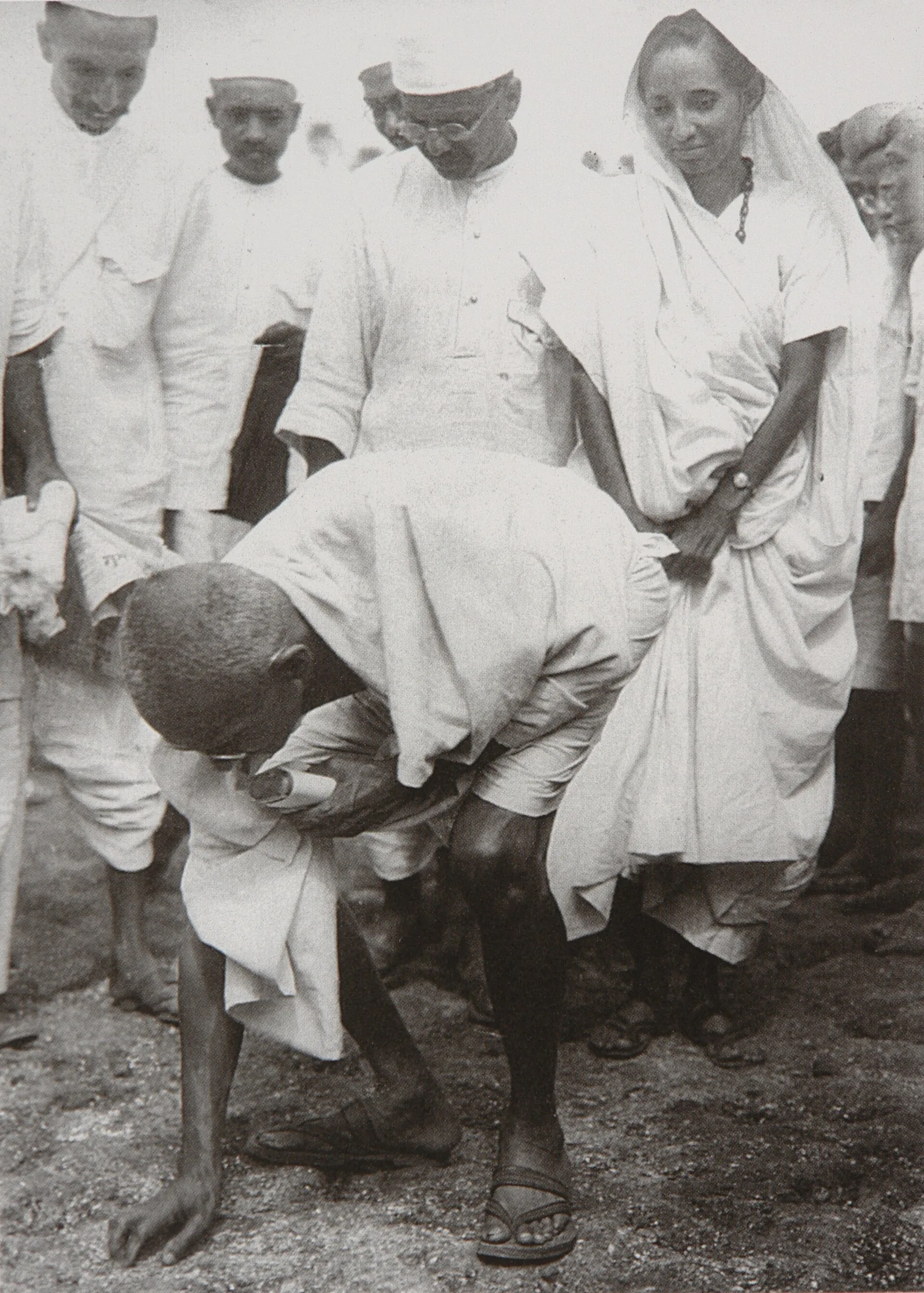
Gandhi at Dandi, 1930 (Wikimedia Commons: 5 April 1930). Photographer not named. · Public domain · Source page
On the morning after they arrive, according to History.com, Gandhi walks down to the shore and picks up natural salt. That breaks the salt law in public.
This is civil disobedience: a law broken on purpose, in public, by someone ready to take the punishment.
Salt-making spreads. According to the Gandhi Heritage Portal, a campaign begins at 27 centres in Bihar on 13 April. The whole movement is known as salt satyagraha.
Late April
A works on the coast
In late April, according to the Gandhi Heritage Portal, Gandhi announces that volunteers will raid the government salt works at Dharasana.
The raid is planned for May. A raid on the works would challenge the salt law directly, and the government would have to answer it.
A decision point
You are Lord Irwin, the viceroy of India.
Late April to 5 May 1930.
The works at Dharasana is one of the places where the salt law is enforced. Volunteers are preparing to march on it.
On 4 May Gandhi writes to you. He lists three ways in which the raid could be stopped.
What do you do?
- Remove the salt tax now, before the raid. Probably the protest loses its main cause and fades. But it would look like a surrender, and the officials who run the salt laws would have to defend it.
- Arrest Gandhi and his close colleagues before the raid. Probably the crowds lose their leader for a while. But Gandhi’s own letter hopes others will take the place of those taken, and a campaign with many leaders is hard to stop by arresting one man.
- Let the raid happen, and hold the works with police. Probably the raid goes ahead, and the police must use force against people who do not fight back. The scene reaches the newspapers, and the government carries the blame.
What really happened
Arrest Gandhi and his close colleagues before the raid.
According to the Gandhi Heritage Portal, Gandhi was arrested shortly after midnight on 5 May and taken to a prison near Pune. The raid still went ahead on 21 May, and the police met the volunteers at the works.
The sources we checked do not record Irwin’s reasons, so we cannot say why he chose. What we know is what Gandhi wrote to him, and what the government did.
5 May
After midnight
Gandhi is arrested in the early hours of 5 May and taken to a prison near Pune. The salt laws are still on the books.
The campaign does not stop. On 12 May a column led by Abbas Tyabji sets out for Dharasana, and Tyabji is arrested, according to the Gandhi Heritage Portal. Other volunteers prepare to follow.
What we really know
Source: Gandhi’s letter of 2 March 1930
The letter says the salt laws will be disregarded “on the 11th day of this month”.
Gandhi writes as a party to the dispute, days before he sets out. It is a warning, with a date attached.
- Who wrote this, and to whom? Gandhi, the campaign’s leader, wrote to the viceroy, who ran the government. He was a party to the dispute, so this is his side of the story.
- What does the letter leave out? It has no numbered list of demands, and it does not say how many would join. Some websites say it lists eleven demands, but the text we checked has no numbered list.
- Why does a date matter in a warning? A date turns a threat into a deadline, and Gandhi set it himself.
Myth
The Salt March began as a huge crowd of supporters setting out together.
The truth
It began with a small group: several dozen people, or about 80 according to Wikipedia. The crowds grew along the way, and at Dandi there were, according to History.com, tens of thousands.
The evidence
Several Wikipedia pages repeat the figure of 78 companions. They are not independent sources, so the figure counts once. Set it against History.com, which says several dozen.
Source: Gandhi’s letter of 4 May 1930
He writes that the viceroy could stop the raid in three ways:
“By removing the Salt Tax;”
“By arresting me and my party, unless the country can, as I hope it will, replace every one taken away;”
“By sheer goondaism unless every head broken is replaced, as I hope it will.”
Written the night before his arrest, and sent to the man who held power. It is his argument as much as a report.
- What does ‘sheer goondaism’ mean, and what does Gandhi accuse the government of? Goondaism means thuggery: force used against a crowd. Gandhi uses the word to say the government has a violent option. It is his accusation, not a record of what the police did.
- Why would Gandhi list the government’s options at all? To make the choices plain, and to show what the government must answer for. Read his list as an argument.
- What is missing? The government’s reply. The letter shows Gandhi’s view of the options, but nothing about how the viceroy weighed them.
A decision point
You are Sarojini Naidu, a Congress politician and poet.
May 1930, before the raid on Dharasana.
Gandhi is in prison. Volunteers are gathering for the raid on the Dharasana works.
Each path has a cost. Whoever stands at the front of the column will be the first the police see.
What do you do?
- Lead the volunteers to the works yourself. Probably the raid becomes a story the whole country reads about. But you take the first risk at the front, and the police are likely to focus on you.
- Send the column on under other leaders, and stay back. Probably the column still marches, but with less of a name at its head, so fewer people outside the campaign hear of it.
- Call the raid off, and keep the campaign to the villages. Probably no raid at all. The campaign would lose its most dramatic act, and the works would stay quiet.
What really happened
Lead the volunteers to the works yourself.
Sources disagree on her role. History.com says she led about 2,500 marchers on 21 May. UPI, reporting that day, says she gave the opening speech and directed operations near the front. According to the Gandhi Heritage Portal, she was arrested on 21 May.
We did not find Naidu’s own account of her reasons in the sources we checked, so no reason is given here.
Source: A reporter at Dharasana, 21 May 1930
“I was the only American correspondent at Dharasana.”
The dispatch gives the injured: “in which 260 of them were injured.”
Written the same day, by the reporter who says he was the only American at the scene. Later accounts give other figures, and sources disagree on deaths.
- Who wrote it, and how close was he? An American United Press reporter who was there and saw the raid. He also writes for readers, so check what he chooses to say.
- What is he counting? The injured, on the day itself. A count made in the hours after a raid can change as more becomes known.
- What is missing? A total of the dead. The dispatch gives no figure, and the sources disagree on whether anyone died there. Do not fill that gap with a guess.
What followed, and the quiz
Afterwards
The salt laws stay
On 5 March 1931 Gandhi and Lord Irwin sign a pact. Civil disobedience stops, and Congress agrees to attend the Round Table Conference in London.
The salt laws are not repealed. According to EBSCO’s research summary, people may make salt for their own use and sell it in their own villages, but not outside them. Other accounts word the rule differently.
The law itself is still on the books.
Abroad
The world watches
The raid at Dharasana drew attention far beyond India. According to EBSCO’s research summary, it caused an international outcry.
From September to December 1931 Gandhi attended the second Round Table conference in London, as the only Congress representative.
What followed
- 6 April 1930 Salt is picked up from the shore at Dandi, and the salt law is broken in public.
- 5 May 1930 Gandhi is arrested. The raid on Dharasana is still planned.
- 21 May 1930 The raid at Dharasana: many volunteers are beaten and injured. The counts differ.
- 5 March 1931 The Gandhi–Irwin Pact: home salt-making and sale within villages are allowed, and the salt laws are not repealed.
- September to December 1931 The Round Table conference in London. Gandhi attends as the only Congress representative.
Did the march win anything?
What did the Salt March achieve, and how can we tell?
- Thomas Weber, On the Salt March (1997): known here only from a library description The book studies how the march has been written about. According to the library description, earlier accounts gave it a few paragraphs and disagreed on its size and route. The description does not say what Weber concluded about what the march achieved.
- A summary in EBSCO on the 1931 pact (encyclopedia-style, not a historian’s book) The summary says the 1931 pact left the salt laws in place and allowed salt for home use and sale within villages. In that sense the concession was limited, and the law stayed.
The sources we checked do not give the historians’ own verdict on the march. Read the books in the sources list before deciding who is right.
Check yourself
On 6 April 1930, what act broke the salt law?
Answer: Picking up natural salt on the shore.. Right. Gandhi picked up natural salt from the shore at Dandi, the morning after arriving, and so broke the salt law.
Check yourself
What kind of evidence is Gandhi’s letter of 2 March 1930?
Answer: One side’s view, with a deadline attached.. Right. Gandhi was a party to the dispute, so the letter is his side of the story, and it sets a date for his action.
Check yourself
What did the 1931 Gandhi–Irwin Pact do about the salt laws?
Answer: It allowed home use and village sale, without repeal.. Right. According to EBSCO, the pact allowed salt for home use and village sale, and the salt laws were not repealed.
Check yourself
Which statement about the Dharasana raid can this lesson safely make?
Answer: Many were beaten and injured, and the counts differ.. Right. Miller reports injuries, the sources disagree on the total, and so no single figure is safe to repeat as the total.
Check yourself
Why does this lesson not explain why Lord Irwin chose as he did?
Answer: Because our sources omit his reasons.. Right. Nothing checked records Irwin’s reasons, so the lesson does not invent them.
Check yourself
Which correction fits the myth that the Salt March began with a huge crowd?
Answer: It began small, and the crowds grew along the way.. Right. The sources give several dozen, or about 80, at the start, and the crowds grew on the route.
Terms
- salt tax A tax the government charged on salt. In India the Salt Act of 1882 set the rules: breaking them could mean losing the salt and up to six months in prison.
- monopoly The sole right to make or sell something, held by one authority. In India the government held a monopoly on making salt.
- Purna Swaraj “Complete independence”: the goal the Congress adopted at Lahore, at midnight on 31 December 1929.
- Congress The Indian National Congress, the main party campaigning for India’s independence. Gandhi led its campaign in 1930.
- viceroy The king’s representative and head of government in British India. From 1926 to 1931 this was Lord Irwin.
- civil disobedience Breaking a law on purpose and in public, as a protest against it, and accepting the punishment.
- satyagraha Gandhi’s name for his method: a nonviolent struggle, based on truth, that refuses to obey an unjust law.
- salt works A place where seawater dries in shallow pans until only salt is left. The Dharasana works was the site of a raid in 1930.
- Round Table Conference A conference in London where British and Indian representatives discussed India’s future. Gandhi attended the second, in 1931, as the only Congress representative.
- Lahore A city that is now in Pakistan. In December 1929 Congress met there.
- Ahmedabad A city in western India, near the Sabarmati Ashram. Gandhi set out from there for the sea.
- Sabarmati Ashram A community near Ahmedabad, where Gandhi lived and from which he set out with followers on the walk to the sea.
- Dandi A place on the Arabian Sea coast. Gandhi reached it after the walk and took salt from the shore.
- Dharasana A government salt works where the salt laws are enforced. Gandhi's volunteers marched on it to raid it.
- Bihar A state in eastern India. The salt campaign began there at 27 centres.
- Arabian Sea Part of the Indian Ocean, along India's western coast. Dandi lies on its shore.
- Lord Irwin The king's representative in India. His government enforced the salt laws, and Gandhi wrote to him.
- Reginald Reynolds The man who delivered Gandhi's letter to Lord Irwin.
- Abbas Tyabji A leader who led a column towards Dharasana on 12 May. According to the Gandhi Heritage Portal, he was arrested.
- United Press An American news agency that supplies news to newspapers. The text cites its report from that same day.
- Pakistan A country next to India. It was once part of British India.
- British India The part of India that Britain ruled before the countries there became independent.
Sources
- Mohandas K. Gandhi, letter to Lord Irwin, 2 March 1930, Living Gandhi Archive, Bucknell University (English)
- Mohandas K. Gandhi, letter to Lord Irwin, 4 May 1930, as printed on mkgandhi.org (English)
- Webb Miller, United Press dispatch from Dharasana, 21 May 1930 (English)
- Judith M. Brown, Gandhi: Prisoner of Hope, 1989
- Thomas Weber, On the Salt March: The Historiography of Gandhi’s March to Dandi, HarperCollins India, 1997
- EBSCO Research Starters, “India signs Delhi Pact”
- History.com, “Salt March” (India topic)
- Gandhi Heritage Portal, chronology of events after the Dandi March
Image credits
- Gandhi during the Salt March, March 1930. Wikimedia Commons (scan by Yann). Photographer not named. · Public domain · Source page
- Mohandas K. Gandhi, portrait, probably late 1930s. Wikimedia Commons. Photographer not named. · Public domain · Source page
- Dandi March: Salt Satyagraha, 1930. Film frame from the Gandhi Smarak Sangrahalaya Samiti collection (per Wikimedia Commons). Scan by Yann. · Public domain · Source page
- Gandhi at Dandi, 1930 (Wikimedia Commons: 5 April 1930). Photographer not named. · Public domain · Source page


