Salamis and Plataea
Athens is burning. Its people are on an island, its fleet is in a strait, and one man sends a secret message to the enemy.
Decisions, questions and your own progress, in the app
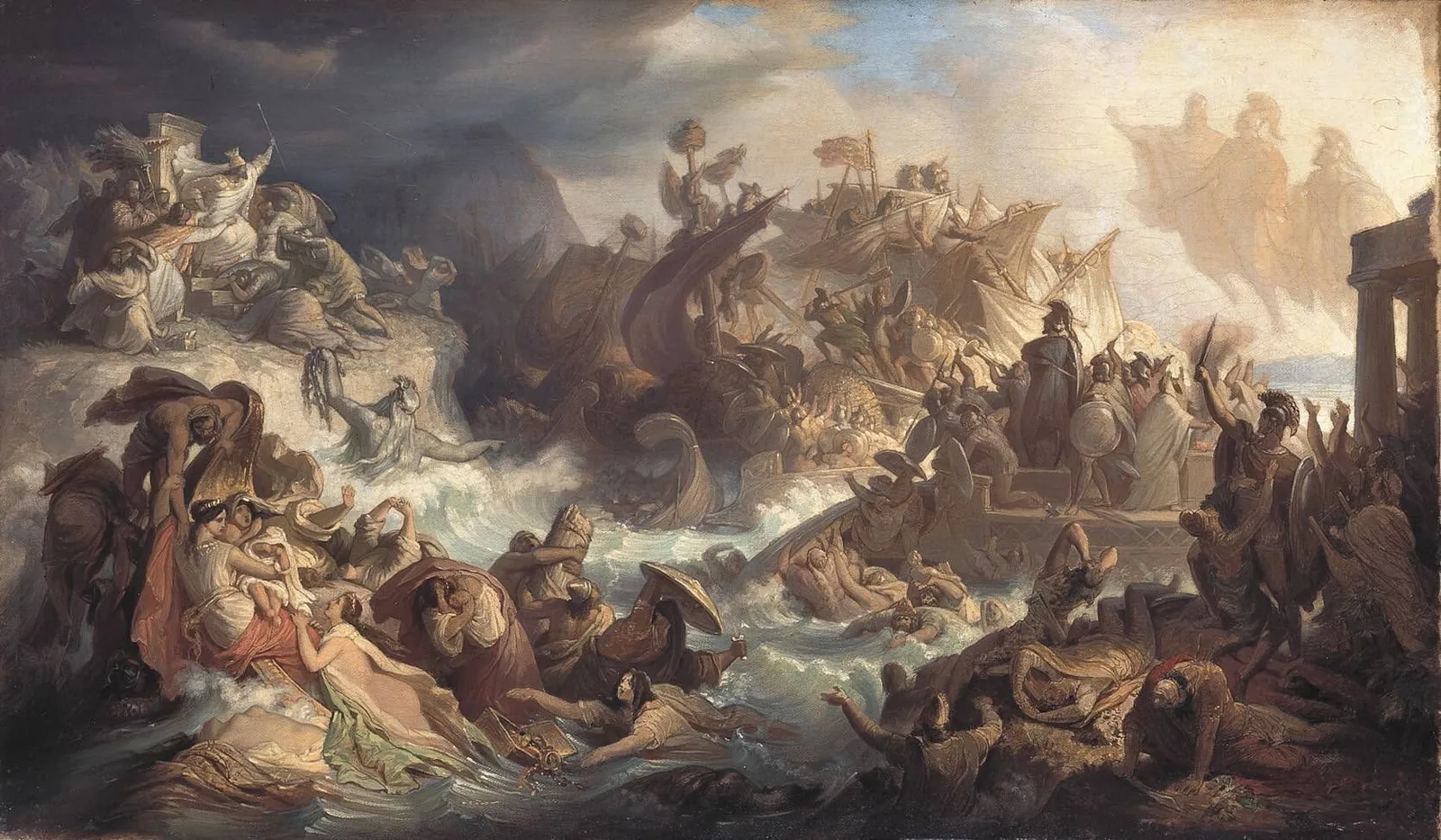
Wilhelm von Kaulbach, The Battle of Salamis, about 1858: a Romantic imagining painted some 2,300 years after the battle. Neue Pinakothek, Munich. Photo: Bayerische Staatsgemäldesammlungen (CC BY-SA 4.0) · Public domain · Source page
Athens is burning
Smoke over the Acropolis
Athens is burning, and its people are watching from an island. It is September 480 BC. On Salamis, a short row from the coast of Attica, Athenian families crowd the shore while smoke rises from the Acropolis across the water. King Xerxes of Persia has taken their empty city.
In the bays below, some 370 Greek warships lie on the beach, and their admirals are arguing about sailing away. Within days one Athenian will send a secret message to the enemy. A year later, Persia’s armies will be gone from Greece for good.
Where we are
Ten years after Marathon
Ten years ago, at Marathon, Athens beat the army King Darius sent. His son Xerxes has come with far more: an army that crossed the Hellespont on bridges of boats, and a fleet to supply it.
Weeks ago Leonidas, his Spartans and the Thespians died at Thermopylae, and the Greek fleet left Artemisium. Now only two things stand between Xerxes and southern Greece: the Isthmus of Corinth, where the Peloponnesians are building a wall, and the ships at Salamis. Nearly half are Athenian, and one man had them built.
Themistocles
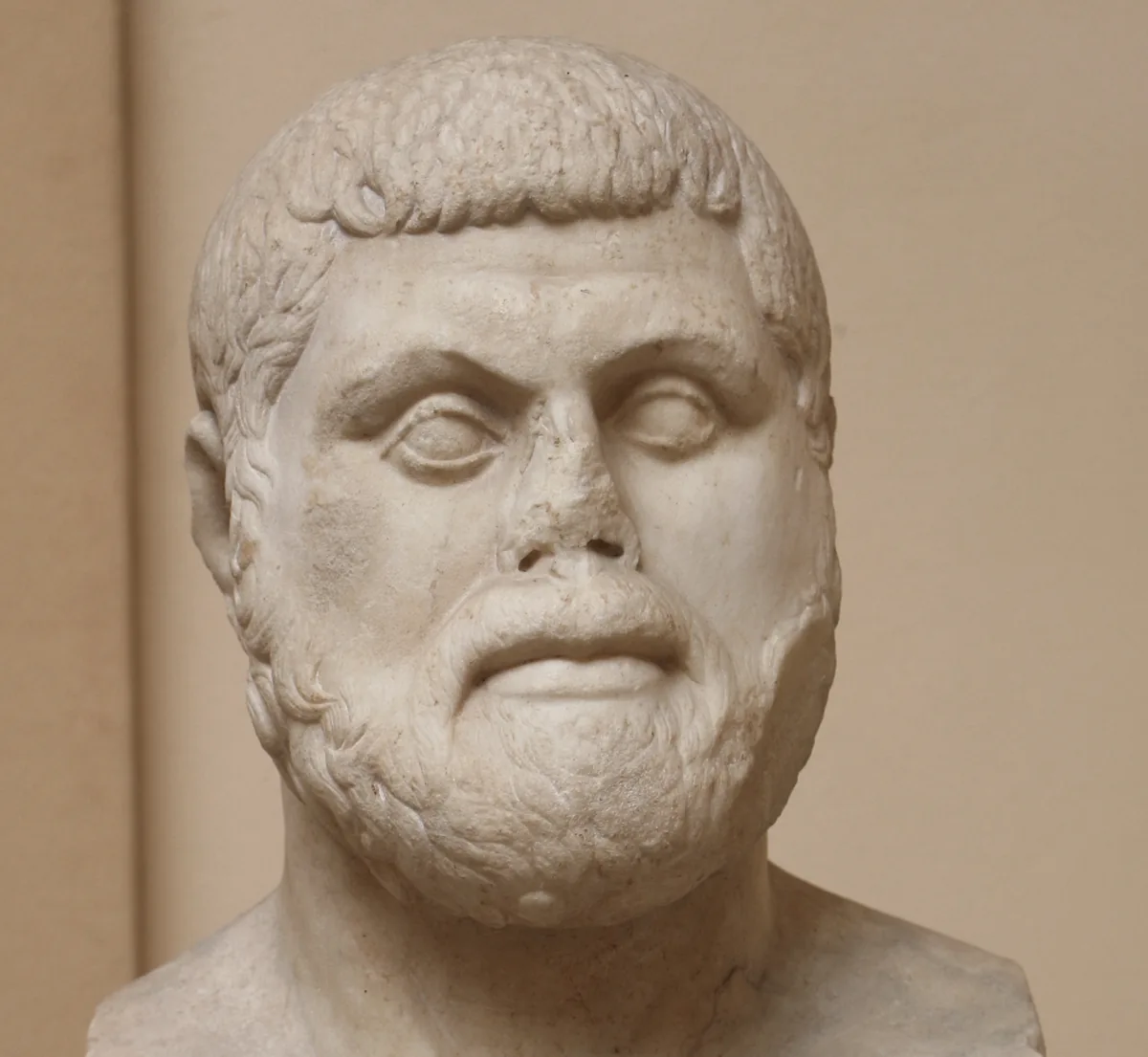
Portrait herm of Themistocles, Roman copy after a Greek original. Museo Ostiense, Ostia Antica. Photo: Sailko · CC BY 3.0 · Source page
The Athenian who built a fleet, chose the narrows where it would win, and ended his life as a governor for the king of Persia.
- Born: c. 524 BC, Athens; his mother was not Athenian
- Died: c. 459 BC, Magnesia on the Maeander, in the Persian Empire, of illness, says Thucydides
- Won: Salamis, 480 BC
- Lost: Exiled by ostracism, c. 471 BC; Condemned for treason in his absence
“…it is for our advantage to fight in a strait as it is theirs to have wide sea-room.”
An empty city
Background
The wooden wall
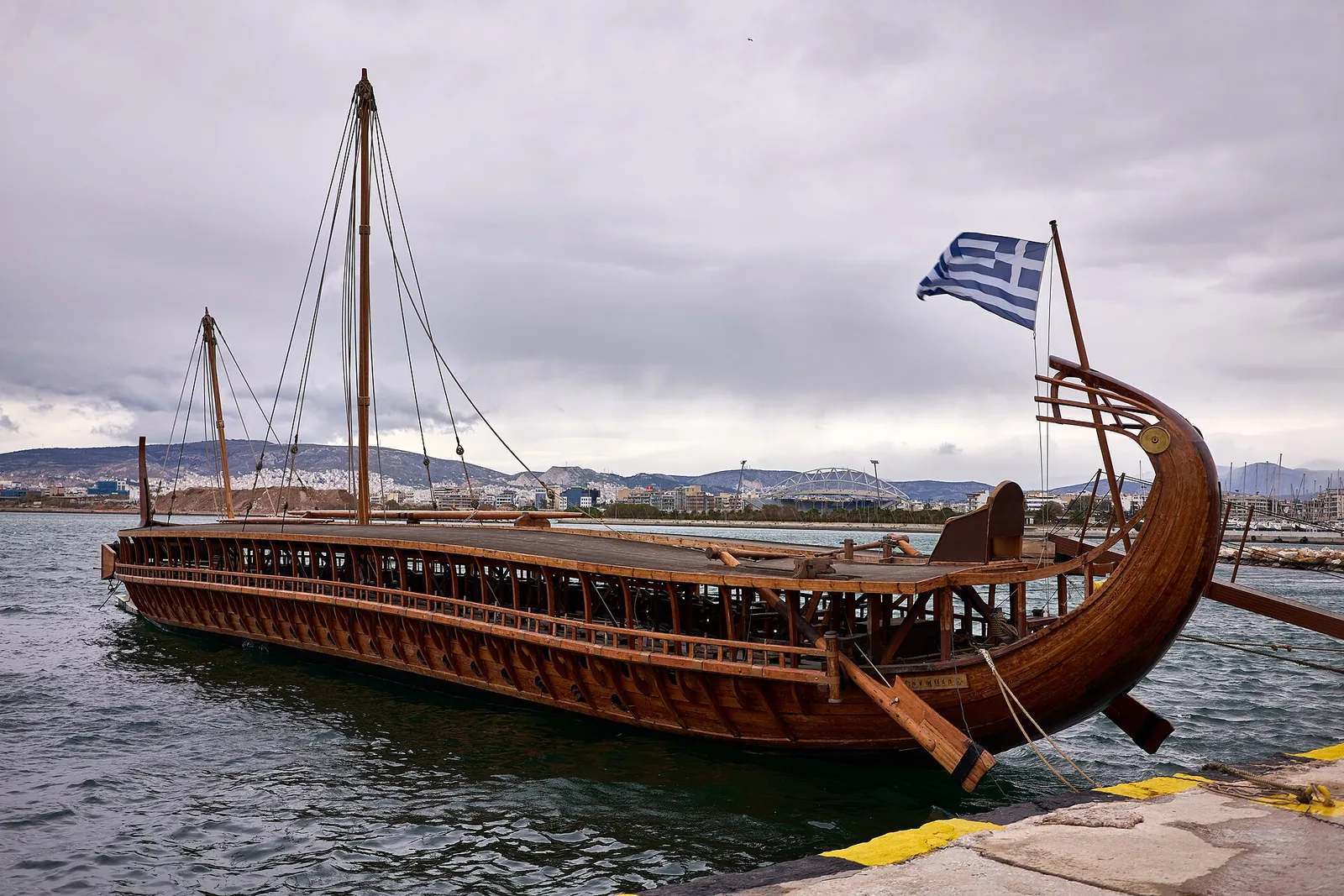
The reconstructed trireme Olympias, Palaio Faliro, 2019. Photo: George E. Koronaios · CC BY-SA 4.0 · Source page
Three years earlier, as the previous lesson told, Themistocles had persuaded Athens to spend a rich new vein of silver from its mines at Laurion on triremes, 200 according to Herodotus, and had read the Delphic oracle’s “wooden wall” as the ships. A trireme was fast and light, rowed by about 170 men, with a bronze ram at the bow.
Many of the rowers were poorer citizens, who could not afford a hoplite’s armour. In 480 BC Athens’ future was in their hands.
Source: A decree carved two centuries late
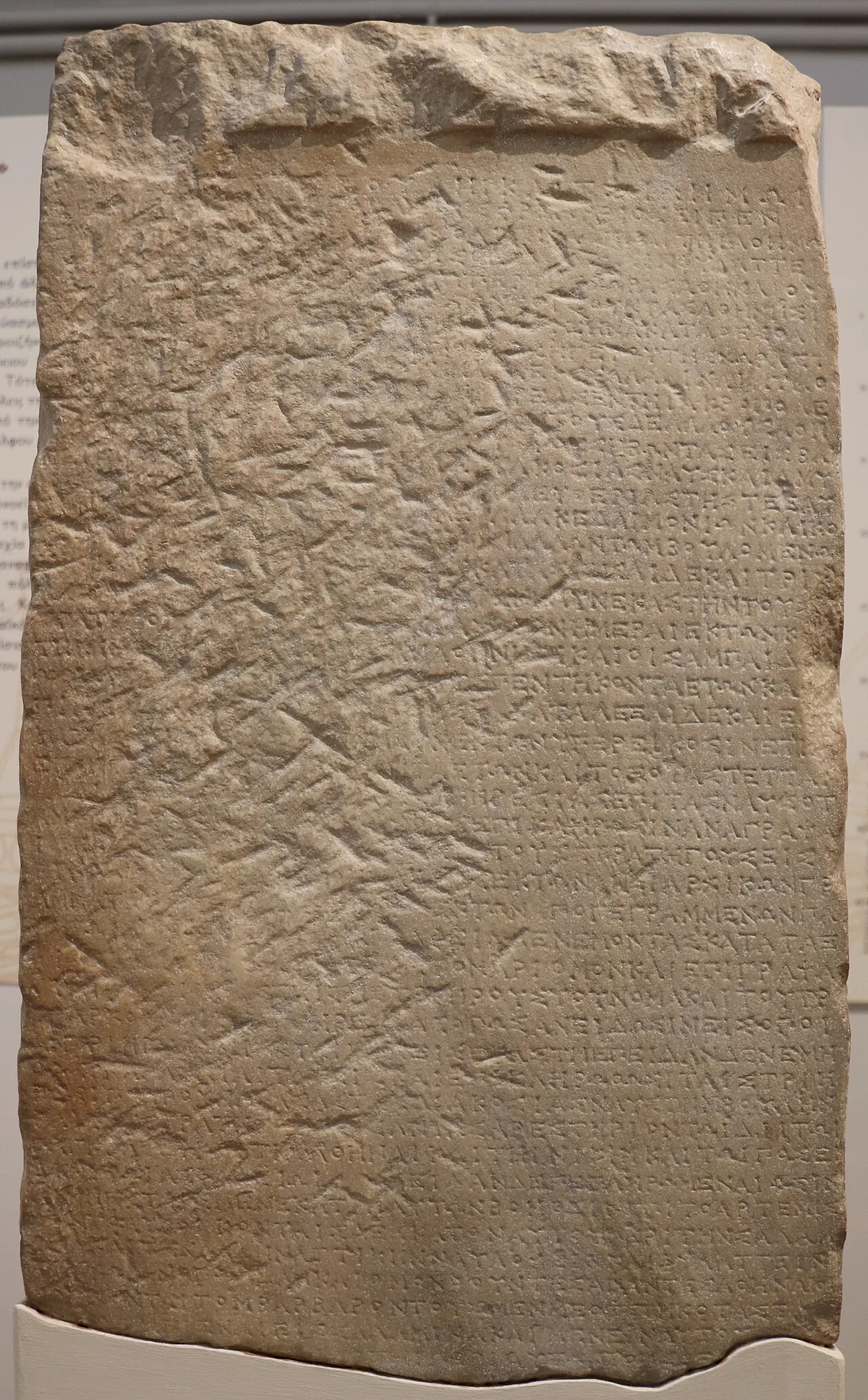
The Troezen Decree (SEG 22.274), 3rd century BC. Epigraphical Museum, Athens. Photo: Furius · CC BY-SA 4.0 · Source page
The ‘Decree of Themistocles’, a marble slab from Troezen carved about 300–250 BC. Epigraphical Museum, Athens
Herodotus says the order to leave Athens came in a hurry, after the fleet returned from Artemisium, and most families fled to Troezen across the gulf. This inscription, published in 1960, tells another story: on Themistocles’ proposal Athens entrusts the city to Athena, sends its women and children to Troezen and mans 200 ships, half for Artemisium and half to guard Attica. A plan made before the fighting began.
- The stone was carved around 300–250 BC. What does that mean for a text about 480? At best it is a copy made over 200 years later; at worst, an invention. Some phrases fit the 4th or 3rd century better than 480, so scholars such as Christian Habicht called it a patriotic fake.
- Herodotus and the decree disagree. Why might either be wrong? Herodotus’s Athenian informants, a generation later, may have remembered a desperate scramble; a later author may have wanted Themistocles to foresee everything. Both are memories shaped by what came after.
- Why set up such a text two centuries later? Perhaps to recall a glorious past in a new crisis: in the 260s BC Athens again fought a great king, this time of Macedon. A source tells you about its own time too.
September 480 BC
The Acropolis burns
The Persians found Athens almost empty. A few poor men and temple stewards held the Acropolis behind a barricade of doors and timber, taking it for the oracle’s wooden wall. After days of siege some Persians climbed the sheer cliff where no one kept watch, killed the defenders and burned the temples. Archaeologists have found the burnt and broken statues the Athenians later buried there.
At Salamis the news caused panic. The Peloponnesians were walling the Isthmus night and day, and their captains wanted to sail there and fight beside their own army. Some hoisted sail at once.
The council of admirals
A decision point
You are Eurybiades of Sparta, navarch: commander of the allied Greek fleet.
September 480 BC, at Salamis, while the Acropolis burns
Your fleet is smaller than the Persian one, perhaps by half, and your ships are heavier. Most of your captains come from the Peloponnese and want to fall back to the Isthmus, a day’s rowing away, to fight beside their own army.
Themistocles, the Athenian general, argues the opposite. In this narrow strait numbers count for little. At the Isthmus you would fight in open water, and give up Salamis, Megara and Aegina. Then he threatens: if you leave, the Athenians will take their families and sail to Siris in southern Italy. They have 180 ships, nearly half your fleet.
What do you do?
- Sail to the Isthmus and fight beside the army Your captains would cheer. But the Athenians might well sail away, as they threatened, and without them your fleet could not face the Persians anywhere. Herodotus argued that the Persian fleet could then land troops behind any wall. A fleet falling back might also simply break up, each squadron heading for its own city.
- Stay and fight in the narrows of Salamis You keep the Athenians, and a battlefield where Persian numbers count for little. But it works only if the Persians come into the strait to fight you, and your own captains may not stay.
- Stay at Salamis but refuse battle, and wait for the Persians to run short of food Attica is ruined and the Persians must feed a huge army and fleet, so time might help you. But the alliance is cracking now, Salamis is crowded with refugees, and the Persians could march on the Isthmus while your fleet waits.
- Split the fleet: the Athenians and their neighbours at Salamis, the Peloponnesians at the Isthmus Each side would guard its own families, but two small fleets would face one large one. The Persians could beat them one at a time.
What really happened
Stay and fight in the narrows of Salamis
Eurybiades stayed. Herodotus thought he gave way “chiefly because he feared lest the Athenians should leave him”. Tempers ran high. When Themistocles spoke before his turn, the Corinthian admiral Adeimantus sneered that at the games, those who start too early are beaten with rods. “Ay,” Themistocles answered, “but they that wait too long win no crown.”
The Athenian threat decided it: without Athens’ 180 ships there was no fleet. Plutarch, about 600 years later, gives the same exchange to Eurybiades himself, who raises his staff to strike; Themistocles replies, “Smite, but hear me.” When two sources give one line to different men, the story has been retold.
A decision point
You are Themistocles, general of Athens.
Late September 480 BC, the evening before the battle
You won the vote, but it has not held. The Persian fleet is in the bay of Phalerum and their army is marching on the Isthmus. Now the Peloponnesian captains are outvoting you. If they leave tonight, the fleet breaks up and the Athenian families on Salamis are abandoned.
You know the Persians want a quick, decisive battle under the eyes of their king. If they block the exits of the strait, the Greeks will have to fight where they are.
What do you do?
- Accept the vote and sail with the others to the Isthmus The alliance holds for now, but you will fight in open water, where numbers count, and Salamis and its refugees are left to the Persians. Athens’ families would be at the king’s mercy.
- Take the Athenian ships and families to Italy, as you threatened Athens would survive as a city in exile, but Greece would lose its biggest fleet, and the Peloponnese would almost certainly fall. It was a threat; carrying it out would be a disaster for everyone, the Athenians included.
- Secretly tell the Persians that the Greeks are about to flee, so that they block the exits A huge gamble. If it works, the Greeks are forced to fight in the narrows. If Xerxes ignores it, nothing is gained; if the Greeks find out, you will be called a traitor.
- Keep arguing, and win over the Spartan commander again It worked once. But time is running out, and this time the majority is against you.
What really happened
Secretly tell the Persians that the Greeks are about to flee, so that they block the exits
Themistocles slipped out and sent Sicinnus, a servant who looked after his children, by boat to the Persian commanders. In Herodotus’s version the message said that Themistocles was on the king’s side and that the Greeks “have lost heart and are planning flight”. That night the Persians closed the exits and landed troops on the islet of Psyttaleia. Before dawn Aristides, Themistocles’ old rival, back from exile, slipped through from Aegina and told the council they were surrounded. A deserting ship from Tenos confirmed it.
Aeschylus told the story as early as 472 BC: in his play “a Hellene, from the Athenian host” brings Xerxes the news. So most historians accept that a message was sent. How much it changed is argued over, since Herodotus says Xerxes had already decided to fight. After the battle, Herodotus says, Themistocles sent Xerxes a second message to earn a refuge in case Athens turned on him; that reads like hindsight.
The battle in the narrows
The battlefield
A mile of water
At its tightest the strait between Salamis and the Attic shore is about a kilometre wide; where the fleets met it was 1.5 to 2 kilometres. A trireme with its oars out needed 15 to 20 metres of room, so a hundred side by side filled almost two kilometres, and the Persians had hundreds. Above it all, on the slopes of Mount Aegaleos, Xerxes sat on a throne to watch, with scribes to write down the names of captains who fought well.
Salamis: who fought whom
Late September 480 BC; the exact day is unknown
The strait between Salamis and Attica
The Greek allies
- Commanders: Eurybiades of Sparta, in overall command, Themistocles, leading the Athenians, Adeimantus of Corinth
- Strength: 378 triremes, 380 with two deserters; his own list adds up to 366 (Herodotus); 310 ships (Aeschylus); about 310–380, some 180 of them Athenian (Modern estimate)
- Losses: no figure (Herodotus); 40 ships (Diodorus, four centuries later)
The fleet of Xerxes
- Commanders: Xerxes, watching from the shore, Ariabignes, the king’s brother, killed, Artemisia of Halicarnassus, with 5 ships
- Strength: 1,207 triremes (Aeschylus and Herodotus); about 600–800 (Modern estimate)
- Losses: no figure; heavy (Herodotus); over 200 ships, besides those captured (Diodorus)
Phoenicians, Egyptians, Cypriots, Cilicians, and Greeks from Ionia and the islands.
Outcome: A Greek victory. The Persian fleet is driven out of the strait with heavy losses, and within days Xerxes begins to march home.
Herodotus counts 1,207 Persian ships at the start of the campaign, and claims new allies replaced the hundreds lost in storms since; few historians believe him.
The battle of Salamis
Late September 480 BC, from the night before to the afternoon
The night before the battle: the Greek fleet lies on the shore in the bays of Salamis, while the Persians, who take Sicinnus’s message at its word, row out from Phalerum towards the strait between Salamis and the Attic shore. At stake: the Greek fleet and Xerxes’s campaign in Greece.
One common reconstruction, after Herodotus 8.76–95 and Aeschylus, Persians 353–471, with the modern studies of N. G. L. Hammond (1956), W. K. Pritchett (1959), J. F. Lazenby (1993) and Barry Strauss (2004). The coastline is today’s without the modern harbour landfill; the sea was a little lower in 480 BC.
Disputed: whether the Persians entered the strait during the night or at dawn; which way the lines faced; where the Corinthians went; whether an Egyptian squadron blocked the western channel round the island (Diodorus only); and where Xerxes sat. The size of each squadron, the positions and the number of lines are approximate.
Phases of the battle
- The night blockade Night. The Greek ships lie beached in the bays of Salamis. Taking Sicinnus at his word, the Persians row out from Phalerum, close the exits of the strait and land infantry on Psyttaleia. Before dawn Aristides slips through from Aegina: the Greeks are surrounded.
- Dawn: the Persians row in At first light the Greeks sing the paean and put out. The Persian squadrons row into the strait along the Attic shore, Phoenicians in the lead, as Xerxes watches from Aegaleos. The Corinthians head north up the channel: fleeing, the Athenians later said, or sent to guard it.
- Backing water, then the first ram Herodotus says the Greeks at first backed water towards the shore; whether from fear or as a ruse to draw the Persians on, he does not say. Then an Athenian captain, Ameinias of Pallene, drove forward and rammed a Persian ship; the Aeginetans claimed the first blow for themselves. The whole line followed.
- The crush in the narrows In the narrow water the Persian numbers turned against them. Front ships that tried to turn back fouled the ones pressing in behind, eager to shine before the king. The Greeks, Herodotus says, fought “orderly and in array”; the Athenians drove the Phoenicians onto the Attic shore. Somewhere in the melee Artemisia escaped by ramming a ship of her own side.
- Rout, and Psyttaleia By afternoon the Persian ships were fleeing for Phalerum, and the Aeginetans waited at the mouth of the strait to catch them. Aristides took Athenian hoplites across to Psyttaleia, and they killed every Persian on the islet. Earlier, in the sea fight, Xerxes’ brother Ariabignes, one of his admirals, had been killed.
The strategy
- Greek fleet: The Greeks are surrounded, and at first light they sing the paean and put out to sea. Herodotus does not say whether their backing water towards the shore is fear or a ruse to draw the Persians in. Then Ameinias of Pallene drives forward and rams, and the whole line follows him.
- Fleet of Xerxes: The Persians take Sicinnus’s message at its word, so they row out from Phalerum, close the exits of the strait and land infantry on Psyttaleia to block the Greeks. At first light they row in along the Attic shore, the Phoenicians in the lead. Most likely they rely on the weight of their numbers.
What decided it: The battle was decided in the narrow strait, where the number of Persian ships worked against them: ships trying to turn back fouled those pressing from behind. Then the Aeginetans waited at the mouth of the strait to catch the fleeing ships, and every Persian on Psyttaleia was killed.
Source: A veteran’s play
“On, ye sons of Hellas! Free your native land, free your children, your wives, the fanes of your fathers’ gods, and the tombs of your ancestors. Now you battle for your all.”
“…when the mass of our ships had been crowded in the narrows, and none could render another aid…”
Aeschylus fought at Marathon and probably at Salamis. Eight years later he put the battle on stage, told by a Persian messenger to Xerxes’ mother. Many in the audience had rowed in the strait.
- What can this source be trusted on? It is the only surviving account by a man who lived through the battle, written for people who had been there. Details the audience knew, such as the night blockade, the hymn at dawn and the crush in the narrows, are hard to invent.
- Who is missing? Every Greek name. No Themistocles, no Sparta, no Corinth. Perhaps a play in democratic Athens avoided making one man the hero; perhaps tragedy wanted the gods, not generals, to humble Xerxes for his pride.
Source: The queen who rammed a friend
“For the king (it is said) saw her charge the ship as he viewed the battle, and one of the bystanders said, ‘Sire, see you Artemisia, how well she fights, and how she has sunk an enemy ship?’ … Xerxes is reported to have said, ‘My men have become women, and my women men’; such, they say, were his words.”
Artemisia, queen of Halicarnassus in Caria, Herodotus’s own city, fought for Xerxes with five ships, though Herodotus says she alone had advised him not to fight at sea. Chased by an Athenian ship, she escaped by ramming a ship of her own side, from Calyndus.
- How does Herodotus show he is not sure? “It is said”, “is reported”, “they say”: he cannot confirm what was said on the hill. Whether she rammed on purpose, he admits, “I cannot say”. Born in her city, he heard her story as local pride and local gossip.
- What does the king’s famous line assume? That courage belongs to men: the joke works only if women are expected to be weak. And Artemisia survived, to advise Xerxes to go home and to take his sons to safety at Ephesus. The 2014 film 300: Rise of an Empire, in which she dies in the battle, is invention.
The year of Plataea
Autumn 480 BC
The king goes home
Xerxes still had a huge army, but no longer the sea. Herodotus says he feared for his bridges over the Hellespont and calls him “panic-stricken”; modern historians add winter, food and the risk of revolt in Ionia. His cousin and general Mardonius offered to stay: “It is not on things of wood that all the issue hangs for us, but on men and horses.”
So the king marched back to Asia, and Mardonius wintered in Thessaly with picked troops: 300,000 in Herodotus’s count, far fewer in reality. Before the next campaign he sent an envoy to Athens: Alexander I, king of Macedon, a vassal of Persia and an old friend of the Athenians.
A decision point
You are a citizen in the Athenian assembly.
Winter 480/479 BC
Your city is a ruin and your families live as refugees. Now Alexander of Macedon brings Mardonius’s offer. The king will forgive everything. You may keep your land, take more wherever you like and live under your own laws, and he will rebuild the temples he burned, if you become his ally.
Alexander adds a warning: Athens lies right in the path of the war. Sparta’s envoys, here too, beg you to refuse, yet Sparta itself stays behind its Isthmus wall. Mardonius’s army is unbeaten, and it will be back by summer.
What do you answer?
- Accept, and become the king’s ally, like Thebes and Thessaly Your city would be rebuilt and spared another invasion. But the Athenian fleet would sail for Persia, and then, as a man from Tegea later warned the Spartans, no wall across the Isthmus could save the Peloponnese. Greece would probably have become a Persian province.
- Refuse outright You keep faith with the other Greeks, and Attica will be invaded again. Your families must flee a second time, and your harvest is lost.
- Refuse, but use the offer to force Sparta to march north Sparta fears nothing more than Athens changing sides. Pressing hard might bring a Spartan army north, but also leave bad blood between the two cities.
- Stall and keep talking You buy time, but both sides start to doubt you. Mardonius might attack anyway, and Sparta might decide you are not worth defending.
What really happened
Refuse outright
Athens refused. To Alexander the Athenians said that “as long as the sun holds the course whereby he now goes, we will make no agreement with Xerxes”. To the Spartans they explained why: the burned temples, and “the kinship of all Greeks in blood and speech, and the shrines of gods and the sacrifices that we have in common, and the likeness of our way of life”.
In the summer of 479 Mardonius took Athens again, and the Athenians fled once more to Salamis; a councillor who proposed hearing a second Persian offer was stoned to death. Sparta delayed for ten days, during a festival and, Herodotus suspects, because its Isthmus wall was nearly done. Only when the Athenians threatened to make their own peace did the Spartans march: 5,000 Spartiates, each with seven helots. Herodotus, who admired Athens, makes this its finest hour. Their commander was the regent Pausanias, a nephew of Leonidas (not the travel writer Pausanias, who lived six centuries later), and they would meet Mardonius below Plataea, the small city that had stood beside Athens at Marathon.
Pausanias of Sparta
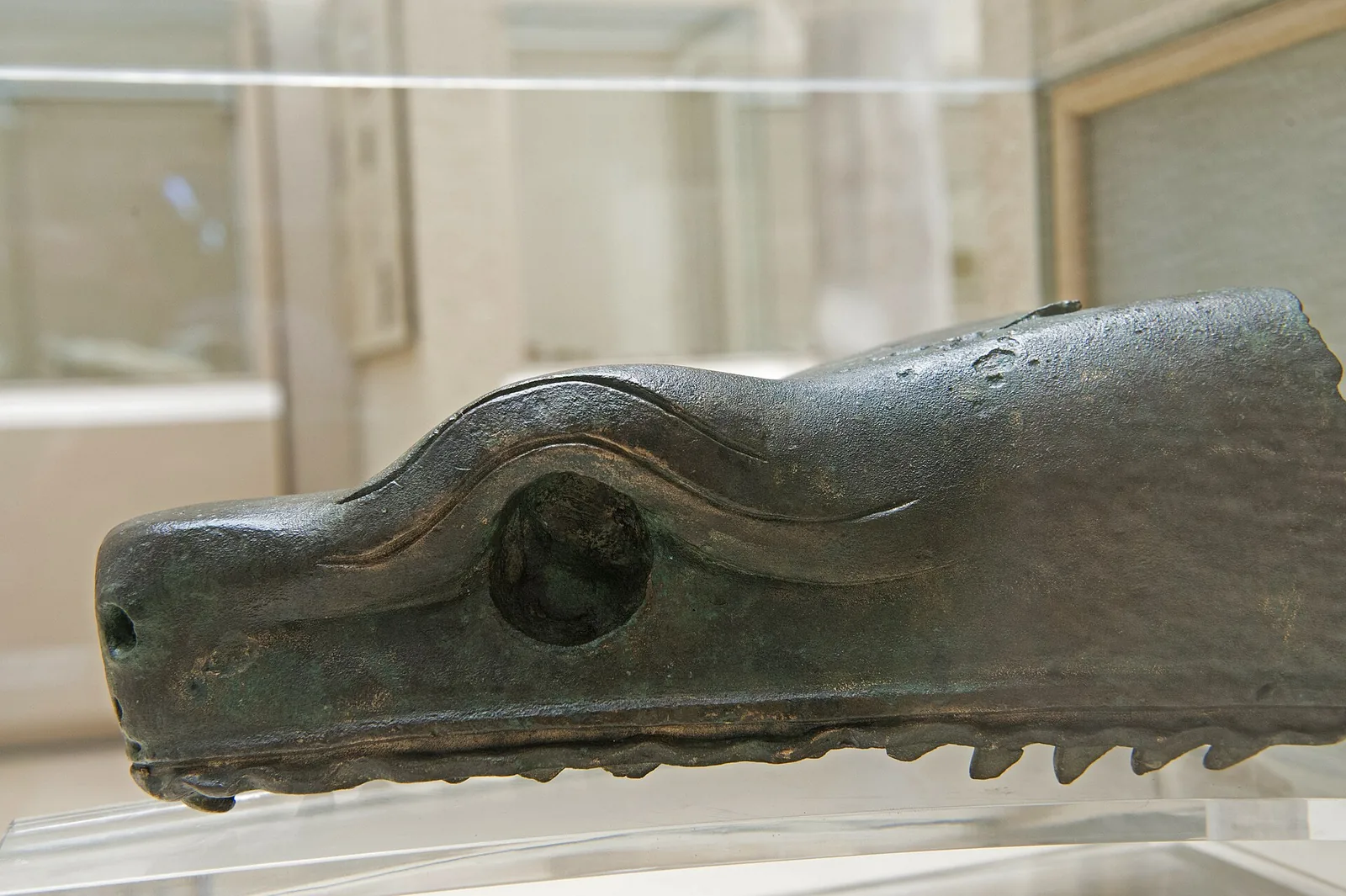
Bronze snake head from the Serpent Column, 479/478 BC (no portrait of Pausanias survives). Istanbul Archaeology Museums. Photo: Dosseman · CC BY-SA 4.0 · Source page
The Spartan regent who won “the most glorious of victories” at Plataea, then fell from grace and was starved to death in a temple at home.
- Born: Date unknown, Sparta, of the Agiad royal family; a nephew of Leonidas
- Died: c. 470 BC (debated), Sparta, in the temple of Athena of the Bronze House, starved to death, after being accused of plotting with Persia
- Won: Plataea, 479 BC; Byzantium, taken 478 BC
- Lost: Lost the allies’ trust, 478 BC; Accused of plotting with Persia and the helots
“…that were an act more proper for foreigners than for Greeks, and one that we deem matter of blame even in foreigners.”
Plataea: who fought whom
August 479 BC (the date conversion is uncertain)
The Asopus valley below Mount Cithaeron, in Boeotia
The Greek allies
- Commanders: Pausanias of Sparta, Aristides, leading the Athenians
- Strength: 38,700 hoplites; 110,000 with the light troops (Herodotus); the hoplite figure is broadly accepted; the whole force perhaps 60,000–110,000 (Modern estimate)
- Losses: 159 citizens: 91 Spartans, 16 Tegeans, 52 Athenians (Herodotus); 1,360 (Plutarch)
Herodotus counts only full citizens, and leaves out the 600 Megarians and Phliasians he himself says were killed.
The army of Mardonius
- Commanders: Mardonius, killed, Artabazus
- Strength: 300,000 (Herodotus); about 70,000–120,000, Greek allies included (Modern estimate)
- Losses: “scarce three thousand” left alive of 260,000 (Herodotus); unknown, but very heavy (Modern estimate)
Thebans and other Greeks with Persia
- Commanders: Attaginus and Timagenidas of Thebes
- Strength: about 50,000 (Herodotus, as a guess)
- Losses: 300 of the best Thebans (Herodotus)
Outcome: A decisive Greek victory. Mardonius is killed, his camp is stormed, and no Persian army ever invades mainland Greece again.
Herodotus lists the Greek hoplites city by city, as if from muster rolls, so historians trust that figure far more than his Persian totals.
A decision point
You are Pausanias, regent of Sparta and commander of the Greek army.
Summer 479 BC, after eleven days by the Asopus
For more than ten days the armies have faced each other across the river, and the omens on both sides forbid attack. Persian horse archers harass your line every day. They have taken a train of 500 pack animals in the pass behind you, and today they fouled the Gargaphia spring, your water.
Last night Alexander of Macedon rode up to the Athenian outposts in secret with a warning: Mardonius is short of food and means to attack. Your allies are thirsty and hungry: the servants you sent for food are cut off in the passes.
What do you order?
- Hold the line and endure: the Persians are short of food too Thirst works faster than hunger. Without water and supplies your army would probably start to fall apart within days, and the Persian horsemen would keep wearing it down.
- Cross the Asopus and attack, despite the omens You would fight in the open plain, where the Persian cavalry is strongest, and against omens your men take seriously. It may be exactly what Mardonius hoped for.
- Withdraw by night to the ‘Island’, about two kilometres back, with water and some cover You reach water and reopen your supply line. But moving an army of tens of thousands in the dark is risky: units may lose their way, and at dawn you may be caught on the move.
- Retreat over Mount Cithaeron to the Isthmus The army would be safe for now, but Athens and Plataea would be abandoned again, and the Athenians might well make peace with Persia. The alliance would probably break.
What really happened
Withdraw by night to the ‘Island’, about two kilometres back, with water and some cover
The council chose the ‘Island’, but the night went wrong. The centre went too far, to the temple of Hera outside Plataea. Amompharetus, a Spartan company commander, threw a great stone at Pausanias’s feet: his pebble, he cried, by which he “voted against fleeing from the strangers”. Pausanias left without him along the foothills; the Athenians went down into the plain. At sunrise Mardonius saw the Greeks scattered, took it for flight, and led his men across the river.
Water and supply forced the move; nobody planned the confusion. Herodotus heard the story from Spartans and Athenians a generation later and may have sharpened both the stubborn Amompharetus and the ‘flight’ of the centre. The historian George Cawkwell judged Pausanias’s long wait far from masterly. Yet the confusion lured Mardonius into attacking Spartan hoplites in exactly the kind of fight they did best.
The battle of Plataea
Summer 479 BC: some ten days of manoeuvre, one night and one morning
The two armies face each other across the Asopus river, after ten days in which the omens on both sides forbade attack. Persian horsemen are disrupting the Greek supply trains, the Gargaphia spring is fouled, and the Thebans stand with Persia. At stake: the future of Greece.
One reconstruction, after Herodotus 9.19–70, with the topographic studies of G. B. Grundy (1894) and W. K. Pritchett (1957) and with J. F. Lazenby (1993). Only the river Asopus, Mount Cithaeron and the site of Plataea are certain; Erythrae is placed at its usual site near modern Erythres.
The Gargaphia spring, the ‘Island’, the temple of Hera, the shrine of Demeter and the Persian camp are placed here from Herodotus’s distances (a stade is about 180 metres); scholars place them differently, and also argue over which way the Greek line faced and how far the centre ‘fled’. Positions and numbers are approximate.
Phases of the battle
- The first position: Masistius The Greeks first drew up on the foothills above Erythrae, out of reach of the Persian horsemen. Mardonius sent his cavalry under Masistius against them. Athenian archers shot his horse; his gold armour, Herodotus says, stopped every blow until one went through his eye.
- Ten days by the Asopus The Greeks moved west to better water near the Gargaphia spring, and the two armies faced each other across the river. For ten days the omens on both sides forbade attack. Persian horsemen raided the Greek supply trains in the mountain pass and finally fouled the spring.
- The night withdrawal That night the Greeks fell back towards the ‘Island’ in front of Plataea. The centre went too far, to the temple of Hera by the town. Amompharetus refused to move until dawn, and the Spartans and Tegeans set off along the foothills without him. The Athenians went down into the plain.
- Mardonius attacks At dawn Mardonius saw the Greek line broken up and, sure it was in flight, led the Persians across the Asopus at a run. Behind a wall of wicker shields they showered the Spartans and Tegeans with arrows while the Spartans waited for good omens. Across the plain the Thebans attacked the Athenians.
- Mardonius falls, the camp is stormed The Tegeans charged first, then the Spartans. The Persians, Herodotus says, were no less brave, “but they had no armour”. When the Spartan Aeimnestus killed Mardonius, they broke and ran for their camp, and Artabazus led his 40,000 away. The Greek centre, hurrying up from the temple of Hera in disorder, lost 600 Megarians and Phliasians to Theban horsemen. Then the Athenians broke into the stockade; few inside survived.
The strategy
- Greeks: The Greeks move to better water by the Gargaphia spring, and at night they fall back to the ‘Island’ in front of Plataea, where there is water and some cover. The Spartans wait for good omens before they attack, so they stay put even under arrows.
- Persian army: Mardonius sends his horse to disrupt the Greek supplies, most likely to force them back without a battle. When the Greek line seems to be breaking up and in flight, he leads the Persians at a run across the Asopus, while archers shoot from behind a wall of wicker shields.
- Greeks with Persia: The Thebans, allies of Persia, attack the Athenians across the plain. Their horsemen then strike the Greek centre, which is hurrying from the direction of the temple of Hera in disorder.
What decided it: The battle was decided when the Spartan Aeimnestus killed Mardonius, and the Tegeans and Spartans charged. The Persians broke and fled to their camp, which was stormed; Herodotus says they had no armour.
After the victory
The same summer
Mycale: the war crosses the sea
While Pausanias fought at Plataea, a Greek fleet of 110 ships under the Spartan king Leotychidas crossed the Aegean to Samos. The Persian fleet fled to the mainland at Mycale, beached its ships and built a stockade. The Greeks landed and stormed it; the Ionian Greeks serving with the Persians changed sides, and the ships were burned. Samos, Chios, Lesbos and other islands joined the alliance. The war had become a war to free the Greeks of Asia.
Source: Who gets the credit?
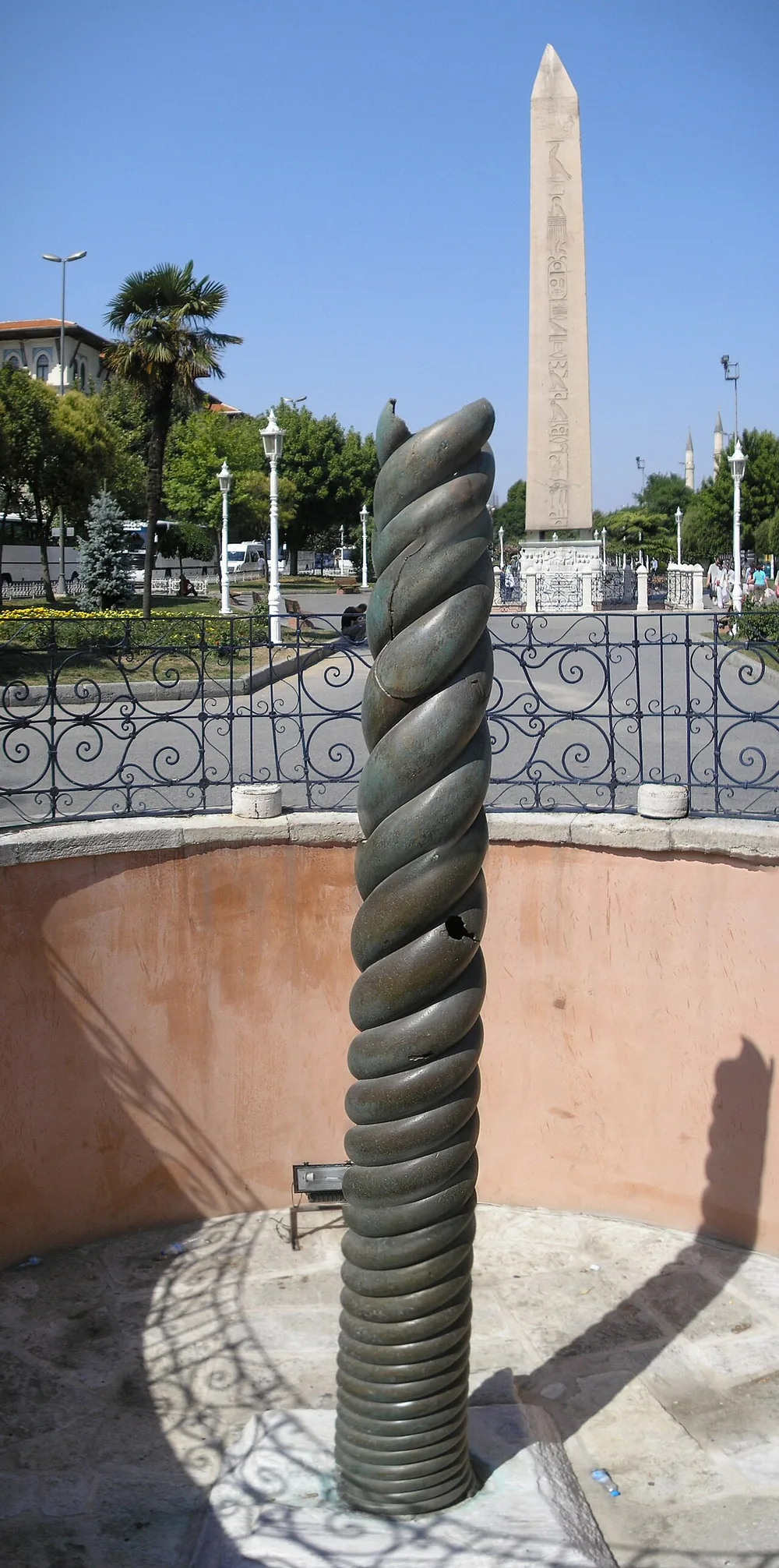
The Serpent Column, Hippodrome, Istanbul. Photo: Gryffindor · Public domain · Source page
“…The Mede defeated, great Pausanias raised / This monument, that Phœbus might be praised. At the time the Lacedaemonians had at once erased the couplet, and inscribed the names of the cities that had aided in the overthrow of the barbarian…”
With a tenth of the spoils of Plataea the Greeks set up a gold tripod at Delphi on a bronze column of three twisted snakes. Its coils now carry the names of 31 states, under a heading meaning “These fought the war”.
- Who gets the credit for a victory? Pausanias put his own name on it; Sparta erased it and listed the cities. Monuments get edited, and the editing is politics: Sparta was already wary of its over-mighty general.
- Who is on the list, and who is not? Sparta, Athens, Corinth, and tiny islands such as Tenos, added for the one ship that deserted before Salamis. Missing: Thebes, Thessaly, Argos and most Greek cities, which stayed neutral or fought for Persia.
- How did it get to Istanbul? The emperor Constantine took it to his new capital, Constantinople, to adorn the Hippodrome. A war memorial became a later empire’s trophy.
Myth
All Greece stood together against Persia.
The truth
Only 31 states are named on the Serpent Column, out of a Greek world of hundreds of cities. Thessaly, Thebes and most of Boeotia took the Persian side; Argos stayed neutral and, Herodotus says, promised Mardonius to hold up the Spartans. At Salamis Greeks from Ionia and the islands rowed in Xerxes’ fleet, and at Plataea Greeks fought hard for Mardonius. Even the allies feuded: Athens with Aegina, Athenians with Corinthians.
The evidence
Herodotus 7.132, 7.148–152, 8.85, 9.31–32, 9.67; the list of names on the Serpent Column.
After Plataea
- 478 BC Pausanias takes Byzantium but treats the allies like a tyrant. Sparta recalls him, and the allies from Ionia and the islands turn to Athens.
- 478/477 BC The Delian League: Athens leads an alliance to keep fighting Persia. Aristides fixes the first tribute at 460 talents, and the treasury is kept on the sacred island of Delos.
- 472 BC Aeschylus stages Persians in Athens. The young Pericles pays for the production.
- c. 471 BC The Athenians exile Themistocles by ostracism. Thousands of potsherds with his name survive, from this vote and earlier ones.
- c. 470 BC Pausanias, accused of plotting with Persia and the helots, takes refuge in a Spartan temple. The doors are walled up; he is carried out starving, just before he dies.
- c. 466 BC Cimon, son of Miltiades, destroys a Persian fleet and army at the river Eurymedon in Asia Minor.
- 465 BC Xerxes is murdered in a palace plot. Themistocles, condemned as a traitor, flees to Asia, where Xerxes’ son Artaxerxes later makes him governor of Magnesia.
- 454 BC The League’s treasury moves from Delos to Athens. The alliance has become an Athenian empire.
- c. 449 BC Fighting between Athens and Persia stops, perhaps by a treaty, the ‘Peace of Callias’, whose very existence historians still argue about.
- 330 BC Alexander the Great burns the palace at Persepolis, calling it revenge for the temples of Athens.
Myth
Rather than lead a Persian army against Greece, Themistocles killed himself by drinking bull’s blood.
The truth
Thucydides, writing within living memory, says “Disease was the real cause of his death”; the poison was only a story. The bull’s blood tale was already a joke in Aristophanes’ comedy Knights of 424 BC, and Plutarch, six centuries later, tells it “as the current story goes”. Themistocles died about 459 BC as a working governor of Magnesia, which struck coins in his name.
The evidence
Thucydides 1.138, trans. R. Crawley; Aristophanes, Knights 83–84; Plutarch, Themistocles 31, trans. B. Perrin.
Which battle saved Greece?
Was Salamis the turning point of the war, or was the war won on land at Plataea, or lost by Persia’s own mistakes?
- Barry Strauss, The Battle of Salamis (2004) Salamis was the turning point. It broke Persia’s command of the sea, sent Xerxes home with much of his army and made Plataea possible. Themistocles’ strategy and the Athenian fleet are at the centre of the story, as Herodotus himself thought.
- Victor Davis Hanson, Carnage and Culture (2001) Hanson sees Salamis as a victory of free citizens, many of them poor rowers fighting for their own city and families, over the subjects of a king. Critics such as John A. Lynn reply that there is no single ‘Western way of war’. Others point out that Xerxes’ crews, Phoenicians and Greeks among them, were skilled professional seamen too.
- George Cawkwell, The Greek Wars (2005) Persian power always rested on the army, not the fleet: after Thermopylae the king could have marched on the Isthmus, and the fleet was needed mainly for supply. To him Salamis made no difference to the outcome; Persia lost through its own decisions, above all leaving Attica and Mardonius’s choice to attack at Plataea. “It was at Plataea, not at Salamis, that the new satrapy was lost.”
Was the war decided at sea, on land, or by Persia’s own choices? And whose memory gave us the answer? Herodotus heard much of his story from Athenians, while Simonides’ poem on Plataea put the Spartans at its centre.
What do you know now?
Check yourself
Why did Eurybiades first agree to keep the fleet at Salamis?
Answer: He feared the Athenians would sail away, and without their ships there was no fleet. Right. Themistocles threatened to sail to Siris in Italy, and Herodotus says Eurybiades gave way chiefly for fear that the Athenians would leave him.
Check yourself
What did Sicinnus’s message tell the Persians?
Answer: That the Greeks were about to flee, and must not be allowed to escape. Right. In Herodotus’s account it pushed the Persians to block the exits of the strait that night, which forced the Greeks to fight in the narrow water.
Check yourself
Why is Aeschylus’s Persians a valuable source on Salamis, even though it is a play?
Answer: It was staged eight years after the battle before an audience many of whom had fought in it, so its main details were hard to invent. Right. Aeschylus probably fought there himself, and the audience knew what had happened. Doubt the numbers and the gods; the night blockade and the crush in the narrows, much less.
Check yourself
How do historians treat the claim that 1,207 Persian ships fought at Salamis?
Answer: As far too high: most modern estimates for Salamis are 600 to 800. Right. 1,207 was a count from the start of the campaign, which some historians accept for that moment, before the storms. But such a fleet could not have been fed on the coast of Attica, and most put the fleet at Salamis at 600 to 800: still about twice the Greek fleet.
Check yourself
What went wrong in the Greek night withdrawal at Plataea?
Answer: The centre went too far, Amompharetus refused to move, and at dawn the army was scattered. Right. Mardonius saw the scattered army, took it for flight and attacked, and that attack is what brought his defeat.
Check yourself
What does the Serpent Column tell us about the Greek alliance?
Answer: That only about 31 states fought, and Sparta erased Pausanias’s boast to list them. Right. Out of hundreds of Greek cities only a few fought, and the monument itself was re-edited to share out the glory.
Terms
- trireme The main Greek warship of the 5th century BC: about 37 metres long, rowed by about 170 men on three levels, with a bronze ram at the bow.
- ram The bronze-sheathed beak at a warship’s waterline, driven into an enemy hull to hole it.
- hoplite A Greek citizen foot-soldier who paid for his own arms: a large round shield, a spear, a bronze helmet and greaves. Hoplites fought shoulder to shoulder, in close ranks called a phalanx.
- helot A serf of Sparta, owned by the state and forced to work the land. Thousands went to Plataea as light troops and servants.
- ostracism An Athenian vote to send a leading citizen into exile for ten years, without trial, by scratching his name on a potsherd (ostrakon).
- medism ‘Taking the Mede’s side’: Greek collaboration with Persia. The Greeks often called the Persians ‘Medes’.
- strategos One of the ten generals Athens elected every year. Themistocles was one of them in 480 BC.
- navarch The commander of a fleet. At Salamis the Spartan Eurybiades commanded the whole allied fleet, because the allies would not serve under an Athenian.
- Isthmus The Isthmus of Corinth: the neck of land, about 6 kilometres wide, that joins the Peloponnese to the rest of Greece.
- paean A hymn to Apollo that Greek soldiers and sailors sang as they went into battle.
- Delian League The alliance Athens led from 478/477 BC to keep fighting Persia, with its treasury on the island of Delos. In time it became Athens’ empire.
- satrap The governor of a province (a satrapy) of the Persian Empire.
- Darius King of Persia and father of Xerxes. The army he sent was beaten at Marathon.
- Leonidas King of Sparta, who died at Thermopylae with his Spartans and the Thespians.
- Thermopylae A narrow pass in Greece, where Leonidas and his Spartans fell against the Persian army.
- Artemisium A place by the sea in Greece, which the Greek fleet left before the battle at Salamis.
- Marathon The battle where Athens beat the army of Darius, ten years before Salamis.
- Hellespont A narrow strait between Europe and Asia. Xerxes crossed it on bridges of boats.
- Psyttaleia A tiny island in the strait near Salamis. The Persians landed troops on it the night before the battle.
- Aeschylus An ancient Greek playwright. He fought at Marathon, and probably at Salamis, and wrote a play about the battle.
- Diodorus A Greek historian who wrote four centuries after the battle, and who inflates the numbers.
- Thucydides A Greek historian who lived through those years and wrote while people still remembered the events.
- The wooden wall Words from an oracle at Delphi. Themistocles read them as ships, while the poor men on the Acropolis took them for a wooden barricade.
- Serpent Column A bronze column at Delphi with three twisted snakes. It carries the names of the Greek states that fought in the war.
- Oath of Plataea A patriotic Greek oath, said to date from the battle at Plataea. Many historians think it was written later.
- Persian Wars The wars between Greece and Persia, including the battles of Marathon, Thermopylae and Salamis.
- Mycale A place on the coast of Asia Minor, where the Greeks defeated the Persian fleet.
- Macedon An ancient kingdom in northern Greece, whose king was a vassal of Persia.
- Aristides An Athenian statesman, Themistocles' old rival. He came back from exile and reported that the Greeks were surrounded.
- Adeimantus Commander of the Corinthian fleet, who mocked Themistocles for speaking before his turn.
- Eurybiades Commander of the Greek fleet at Salamis. Herodotus says he gave way mainly because he feared the Athenians would leave him.
- Sicinnus A servant who looked after Themistocles' children. Themistocles sent him by boat to the Persian commanders.
- Delphi A sanctuary in Greece where the oracle gave answers to those who asked. It also has the Serpent Column.
- Spartiate A full citizen of Sparta, a trained soldier.
- The Acropolis A rocky, fortified hill in Athens, with temples on top.
Sources
- Herodotus, Histories 7.132–144, 8.40–144, 9.1–121, trans. A. D. Godley, Loeb Classical Library, vols. III (1922) and IV (1925)
- Aeschylus, Persians, trans. H. W. Smyth, Aeschylus vol. I (Loeb Classical Library, 1922)
- Thucydides, History of the Peloponnesian War 1.73–74, 1.89–138, trans. R. Crawley (1874)
- Plutarch, Themistocles and Aristides, trans. B. Perrin, Plutarch’s Lives vol. II (Loeb Classical Library, 1914)
- Diodorus Siculus, Library of History 11.1–37 and 12.4, trans. C. H. Oldfather (Loeb Classical Library, 1946)
- [Aristotle], Athenian Constitution 22–23; Aristophanes, Knights 83–84
- The Troezen Decree (SEG 22.274) and the Serpent Column, in R. Meiggs and D. Lewis, A Selection of Greek Historical Inscriptions (Oxford: Clarendon Press, 1969), nos. 23 and 27
- J. F. Lazenby, The Defence of Greece 490–479 BC (Warminster: Aris & Phillips, 1993)
- Barry Strauss, The Battle of Salamis: The Naval Encounter that Saved Greece — and Western Civilization (New York: Simon & Schuster, 2004)
- George Cawkwell, The Greek Wars: The Failure of Persia (Oxford: Oxford University Press, 2005)
- Peter Green, The Greco-Persian Wars (Berkeley: University of California Press, 1996)
- C. Hignett, Xerxes’ Invasion of Greece (Oxford: Clarendon Press, 1963)
- Paul Cartledge, After Thermopylae: The Oath of Plataea and the End of the Graeco-Persian Wars (New York: Oxford University Press, 2013)
- Paul Stephenson, The Serpent Column: A Cultural Biography (New York: Oxford University Press, 2016)
- J. S. Morrison, J. F. Coates and N. B. Rankov, The Athenian Trireme, 2nd edn (Cambridge: Cambridge University Press, 2000)
- Victor Davis Hanson, Carnage and Culture: Landmark Battles in the Rise of Western Power (New York: Doubleday, 2001)
- John A. Lynn, Battle: A History of Combat and Culture (Boulder: Westview Press, 2003)
- Russell Meiggs, The Athenian Empire (Oxford: Clarendon Press, 1972)
- G. B. Grundy, The Topography of the Battle of Plataea (London: John Murray, 1894)
- N. G. L. Hammond, ‘The Battle of Salamis’, Journal of Hellenic Studies 76 (1956), 32–54
- W. K. Pritchett, ‘New Light on Plataia’, American Journal of Archaeology 61 (1957), 9–28
- W. K. Pritchett, ‘Toward a Restudy of the Battle of Salamis’, American Journal of Archaeology 63 (1959), 251–262
- M. H. Jameson, ‘A Decree of Themistokles from Troizen’, Hesperia 29 (1960), 198–223
- C. Habicht, ‘Falsche Urkunden zur Geschichte Athens im Zeitalter der Perserkriege’, Hermes 89 (1961), 1–35
- M. Johansson, ‘The Inscription from Troizen: A Decree of Themistocles?’, Zeitschrift für Papyrologie und Epigraphik 137 (2001), 69–92
- E. Badian, ‘The Peace of Callias’, Journal of Hellenic Studies 107 (1987), 1–39
Image credits
- Wilhelm von Kaulbach, The Battle of Salamis, about 1858: a Romantic imagining painted some 2,300 years after the battle. Neue Pinakothek, Munich. Photo: Bayerische Staatsgemäldesammlungen (CC BY-SA 4.0) · Public domain · Source page
- Portrait herm of Themistocles, Roman copy after a Greek original. Museo Ostiense, Ostia Antica. Photo: Sailko · CC BY 3.0 · Source page
- The reconstructed trireme Olympias, Palaio Faliro, 2019. Photo: George E. Koronaios · CC BY-SA 4.0 · Source page
- The Troezen Decree (SEG 22.274), 3rd century BC. Epigraphical Museum, Athens. Photo: Furius · CC BY-SA 4.0 · Source page
- Bronze snake head from the Serpent Column, 479/478 BC (no portrait of Pausanias survives). Istanbul Archaeology Museums. Photo: Dosseman · CC BY-SA 4.0 · Source page
- The Serpent Column, Hippodrome, Istanbul. Photo: Gryffindor · Public domain · Source page


