Russia, 1917: two revolutions in eight months
At the start of 1917 a tsar still ruled Russia. By the end the Bolsheviks did. How did that happen, and what did the "storming of the Winter Palace" really look like?
Decisions, questions and your own progress, in the app
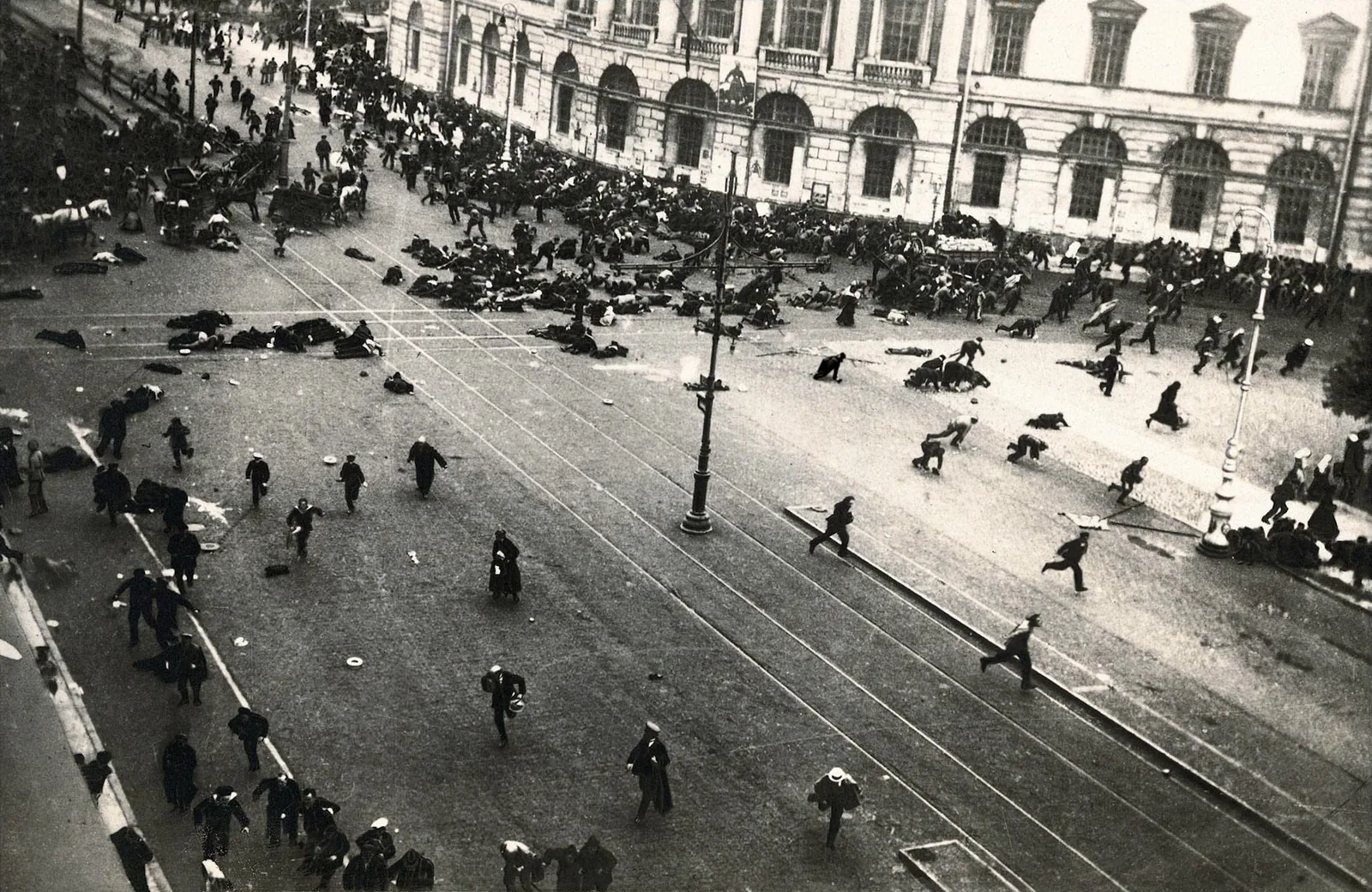
Nevsky Prospekt, Petrograd, 4 July 1917. Photo: V. Bulla, David King Collection (Tate / Scala) · Public domain · Source page
Two calendars, one tsar
Eight months, two revolutions
Nevsky Prospekt, the main street of Petrograd, on a July afternoon in 1917. A crowd is marching along it. Then the shooting starts, and people throw themselves down on the paving to find cover.
Earlier that same year, the city had already been through one revolution. What happened in the eight months between them? And what really happened on the night the Winter Palace was taken?
Background
Two calendars
13 days
In 1917 Russia did not use the calendar of Western Europe. It kept the Julian calendar, which the West had replaced with the Gregorian calendar in the 16th century. By 1917 the Julian calendar ran 13 days behind. So 23 February in Petrograd was 8 March in Paris or London.
Historians write the Russian date with OS (Old Style, the Julian calendar) and the Western date with NS (New Style, the Gregorian calendar). This lesson gives both. When a book says the revolution began in ‘February’, it means the old date. For the rest of the world, it began in March.
Background
A war that would not end
The First World War had already lasted more than two and a half years. The Russian army fought Germany and Austria-Hungary on the eastern front and suffered heavy losses. In the summer of 1915 Tsar Nicholas II took personal command of the army and spent much of his time at army headquarters, far from the capital. From then on, when things went wrong at the front, the blame fell on him directly.
In Petrograd the winter was hard. Women stood in the bread lines, and patience was short. The Empress Alexandra was German by birth, and many people believed she leaned too heavily on the mystic Grigori Rasputin, whose influence at court caused open scandal.
Background
The murder of Rasputin
Rasputin was murdered in the early hours of 30 December 1916 NS (17 December OS) at Prince Felix Yusupov’s palace in Petrograd. The plotters were nobles: Yusupov himself, Grand Duke Dmitri Pavlovich, and the right-wing Duma deputy Vladimir Purishkevich.
The murder did not calm the capital. It only showed how far trust in the court had fallen.
February: crowds, soldiers and two councils
23 February OS
Women’s day, and then another day
8 March NS
On 23 February OS (8 March NS), International Women’s Day, working-class women in Petrograd walked out and marched through the streets. The strike spread quickly. Other workers joined, and a one-day protest became a protest for the whole city.
The historian Lewis Siegelbaum opens his account of the revolution with these words: “The Revolution began on February 23 (March 8 NS) when working-class women, observing the socialist holiday …”
The soldiers
The garrison turns
The capital held a huge garrison, full of men called up for the war. As the crowds grew, most of the garrison mutinied, beginning with the Volynsky Regiment, and some soldiers joined the marchers. Order in the city began to crack.
On 27 February OS (12 March NS) workers and soldiers set up the Petrograd Soviet, a council of elected delegates from the factories and barracks. The Duma, Russia’s parliament, whose powers were limited, also formed a committee in the city. Now two bodies claimed to speak for the revolution.
Source: Order No. 1 of the Petrograd Soviet
“All kinds of weapons, namely rifles, machine-guns, armoured cars and so forth, shall be placed at the disposal and under the control of the company and battalion committees and shall by no means be issued to the officers, not even at their insistence.”
“In formation and on duty, soldiers shall strictly observe military discipline;”
“All orders issued by the Military Commission of the State Duma shall be carried out, except those which run counter to the orders and decrees issued by the Soviet of Workers’ and Soldiers’ Deputies.”
The order was issued before the Provisional Government existed and sent to the garrison in Petrograd. It set new rules for who controlled the troops.
- Who is the order for, and who loses control because of it? It is for the garrison’s soldiers. The officers lose control of the weapons, and the soldiers’ committees gain it.
- What does the order still ask of soldiers? Strict military discipline on duty. The Soviet wanted order, not anarchy, and the text says so.
- Who wrote it, and what is missing? The Soviet’s leaders in the capital. It shows what they ordered, not how the regiments actually behaved. For that we would need the regiments’ own records.
The tsar at Pskov
2 March OS
On the imperial train at Pskov
The tsar was at Pskov, in his imperial train, far from the capital. News of the revolt reached him by telegram. Envoys from the Duma came to Pskov. In Petrograd, meanwhile, the Duma and the Soviet were already acting as two separate centres of power, and each claimed to speak for the people.
A decision point
You are Nicholas II, Emperor of All the Russias.
Pskov, 2 March 1917 (OS), in the afternoon. That is 15 March NS.
Petrograd is in revolt. Most of the garrison has mutinied, and some units have already joined the rebels. The Duma and the Soviet are running the city, and you no longer control it.
Army commanders send you telegrams, and Duma envoys are at Pskov. Your son Alexei is a boy of twelve. By law, after him, the next heir is your brother Michael.
What do you do?
- Give up the throne for yourself and your son, and pass it to your brother Michael. This would probably end the crisis at the top, but it would not settle who governs Russia. Michael would have to decide in a collapsing state, and the parties would go on arguing about the country’s future.
- Give up the throne for yourself alone, and pass it to your son Alexei under a regent. A boy of twelve could not rule alone, so a regent would be needed. The struggle would probably focus on who the regent was, and the soviets and the government would probably go on rejecting a monarchy.
- Refuse to give up the throne, and order loyal troops back to Petrograd to restore order. Some units in the capital had already turned, so loyal troops would have to come from far away. Street fighting and civil war would probably follow. No one can say how many would have died.
What really happened
Give up the throne for yourself and your son, and pass it to your brother Michael.
He gave up the throne for himself and his son, and passed it to his brother Michael. The manifesto was dated 2 March OS at 3 p.m. The next day, 3 March OS (16 March NS), Michael refused the throne unless a future Constituent Assembly chose him. His refusal left the form of the state open.
The manifesto gives its own reason: he acts “in agreement with the State Duma”, and he does not want to be separated from his beloved son. Historians disagree about how free the choice was. Some stress the pressure put on him, including the Duma envoys who came to Pskov. Others read it as a father’s wish to keep his son close.
Nicholas II
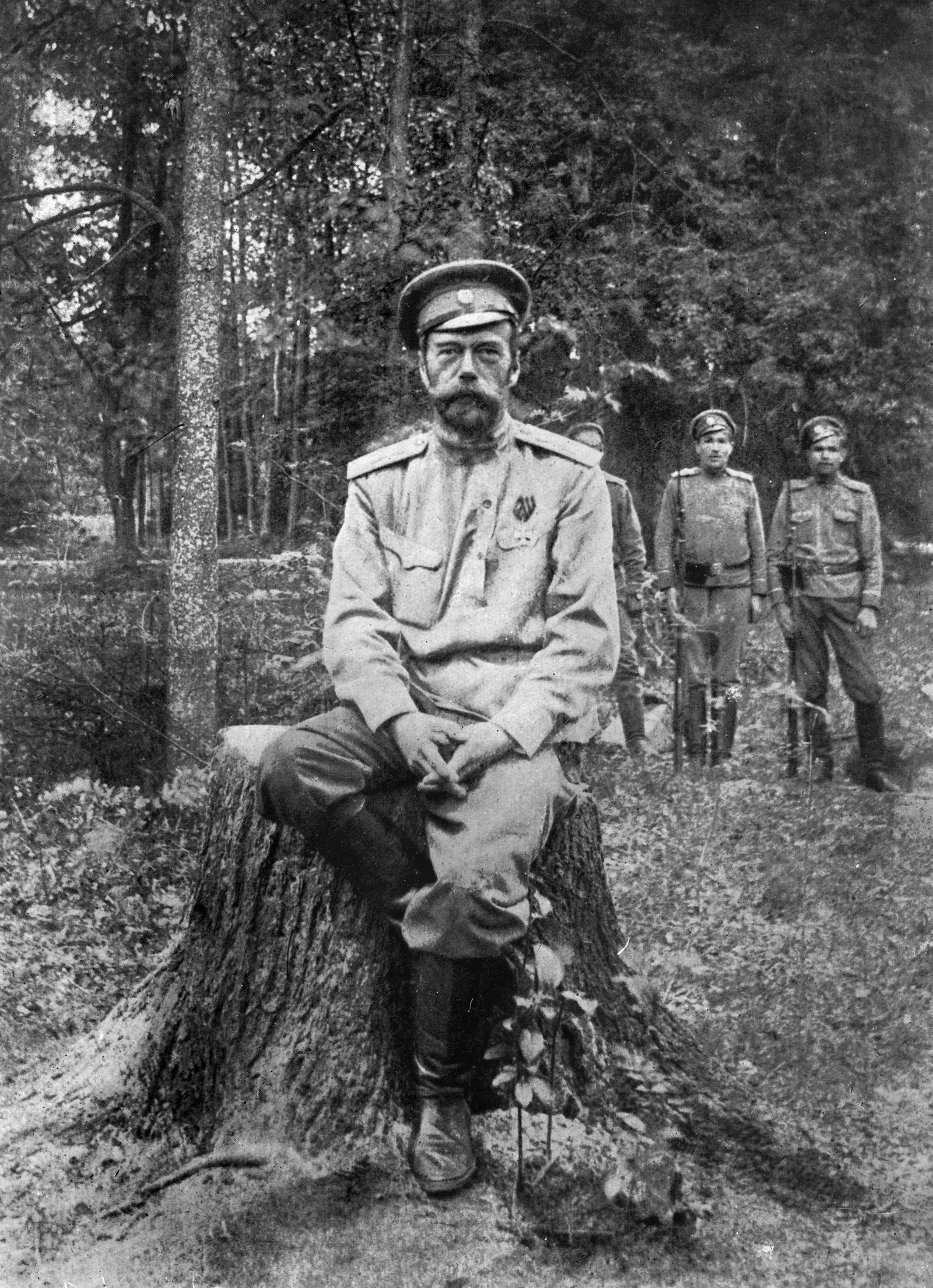
Nicholas II, 1917. Library of Congress, Bain Collection · Public domain · Source page
Emperor of Russia from 1894, father of five children, who saw himself as personally responsible for his country.
- Born: 1868, Tsarskoye Selo
- Died: 1918, Yekaterinburg, Shot with his family in the Ipatiev House, the night of 16–17 July NS.
- Lost: The throne, March 1917
“Not wishing to be separated from our beloved son, we hand down our inheritance to our brother.”
Source: Nicholas II’s abdication manifesto
“For this reason we, in agreement with the State Duma, think it best to abdicate the throne of the Russian State”
“Not wishing to be separated from our beloved son, we hand down our inheritance to our brother”
“May the Lord God help Russia!”
The text was written to announce a decision to the country, and it is short. It speaks of the Duma, of the son and of God.
- Whose decision does the manifesto say this is? The Emperor’s own, taken “in agreement with the State Duma”. He presents it as a joint act with parliament, which makes it look more legitimate to him.
- Why does the Emperor give his son as a reason? He says he does not want to be separated from him. It is the one personal reason in the text. The political choice behind it is that the throne passes to a brother, not to the boy.
- What is missing from the document? The war, the strikes, the soldiers and the Soviet. A formal act like this leaves out the reasons that people in the streets were talking about.
Two powers and one train
Dual power
Two powers in one city
The new government was called the Provisional Government. It grew out of the Duma committee, with Prince Georgy Lvov as chairman and interior minister, named on 2 March OS (15 March NS). Alexander Kerensky, a lawyer and socialist, became minister of justice on 3 March OS (16 March NS).
But the Soviet was not under its control. Order No. 1 said that the Soviet’s orders outranked the Duma’s. So two powers stood side by side: a government with the formal authority, and a soviet with the crowds, the factories and the barracks. Historians call this dual power.
Jews of the empire
The end of the Pale
Most Jews in the Russian Empire were required to live in the Pale of Settlement, a zone in the west of the country, and faced many legal limits beyond it. Those restrictions had been built up over more than a century.
On 20 March OS (2 April NS) 1917 the Provisional Government issued a decree abolishing religious and national restrictions on Jews. It abolished the Pale and the other limits.
Vladimir Lenin
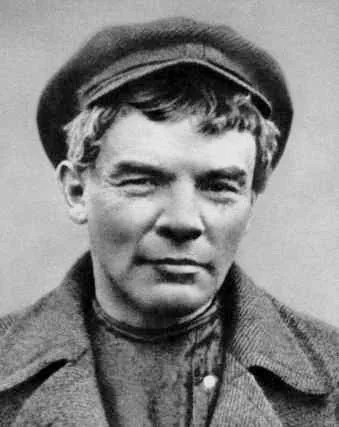
Vladimir Lenin in a wig and cap, 11 August 1917. Photo: D. I. Leshchenko (1876–1937) · Public domain · Source page
Leader of the Bolsheviks, who spent most of the years since 1900 abroad, and returned to Petrograd in 1917.
- Born: 1870, Simbirsk
- Died: 1924, Gorki, near Moscow, After a series of strokes.
“the Soviets of Workers’ Deputies are the only possible form of revolutionary government.”
3 April OS
Arrival at the Finland Station
16 April NS
On 3 April OS (16 April NS) 1917 a train pulled into the Finland Station in Petrograd, bringing Lenin home. He had spent the war in Switzerland. The practical route back ran through Germany, which was at war with Russia, and the German authorities let the exiles pass.
Myth
Lenin came back in a sealed train, paid for with German gold, to seize the revolution for Germany.
The truth
The train did leave Switzerland, cross Germany and reach Petrograd on 3 April OS (16 April NS). But it was not sealed the whole way: the passengers got out in Frankfurt to spend the night. The German authorities let the exiles pass, hoping that a revolutionary Russia would fight less. That part is well documented. How much German money reached the Bolsheviks, and how much it mattered, is still debated.
The evidence
The stop in Frankfurt is described in Ted Widmer’s article in The New Yorker, 20 April 2017.
The April Theses
Read the theses
Four days after he arrived, Lenin published his April Theses in Pravda (7 April OS, 20 April NS). They called for a democratic peace, not one imposed by violence, for no support to the Provisional Government, and for the soviets to take power. Thesis 3 is blunt: “No support for the Provisional Government; the utter falsity of all its promises should be made clear.”
The line was sharp, and most of the other socialist parties still backed the government. In April the Bolsheviks were still a minority in the soviets, and in Petrograd they won a majority in the workers’ section only in September. The slogan many people remember, “All power to the soviets”, is not in the theses. The closest line is Thesis 4, which calls for “transferring the entire state power to the Soviets of Workers’ Deputies”.
Summer: an offensive and the July Days
May 1917
The war minister
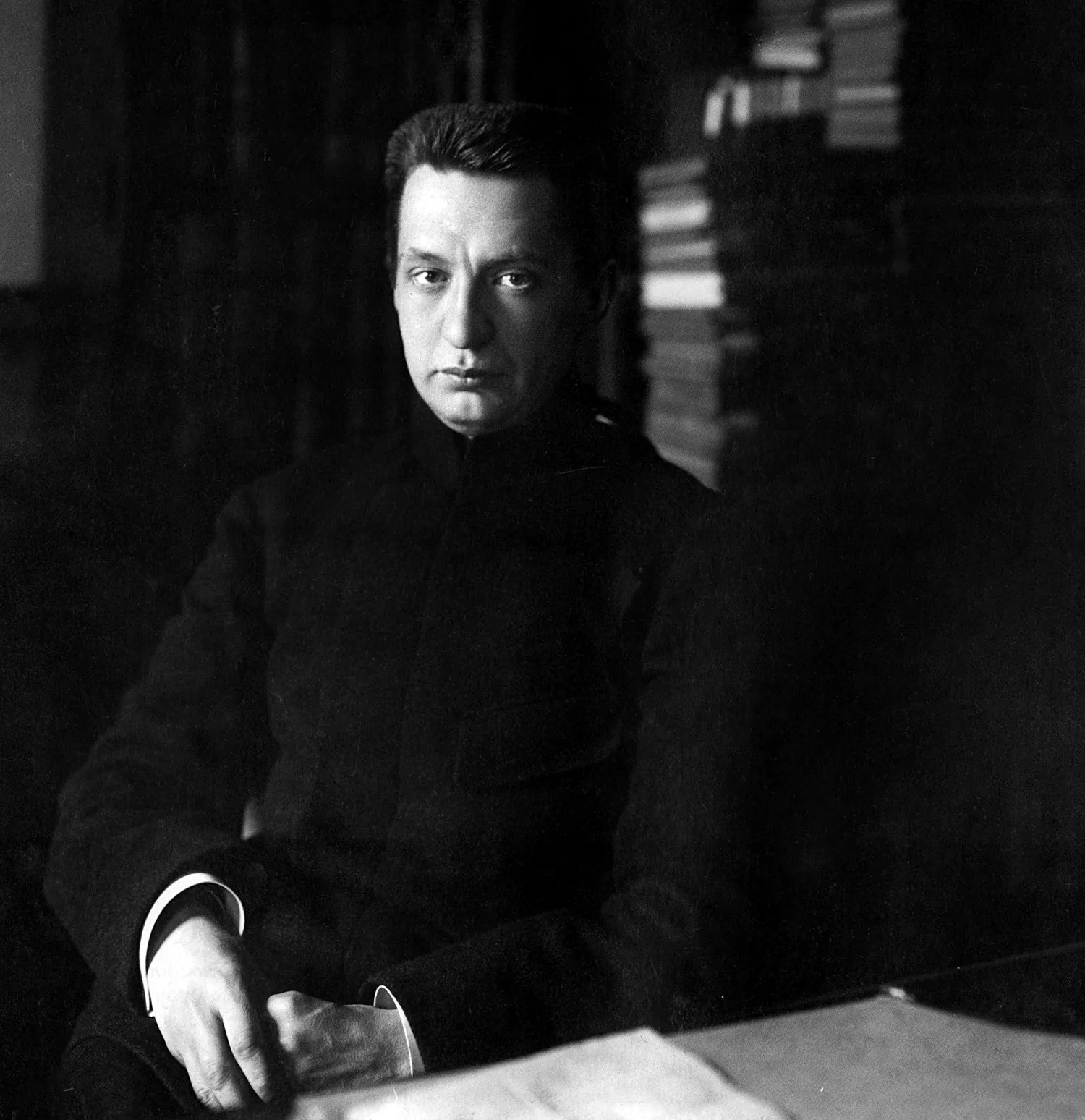
Alexander Kerensky, 1917. Photo: Karl Bulla · Public domain · Source page
In May 1917 Alexander Kerensky became War and Navy Minister in the Provisional Government (5 May OS, 18 May NS). The army was tired, discipline was weakening, and soldiers’ committees now argued over orders. The Allies in France and Britain wanted Russia to attack again. The big question was whether the army could still fight.
A decision point
You are Alexander Kerensky, War and Navy Minister.
Petrograd, June 1917 (OS).
The front-line troops are exhausted, and some of them talk of peace. Their committees argue with orders, and in some units orders are barely carried out. The Allies remind Russia of loans and promises, and they ask for an attack.
If you do not attack, the army may fall apart. If you offer peace, the Allies may abandon Russia to face Germany alone.
What do you do?
- Launch an attack, to restore morale and keep the Allies on side. If the attack succeeded, the government would gain time and trust. But an exhausted army could fail, suffer heavy losses, and strengthen those who wanted an immediate peace.
- Offer peace talks now, without an attack, and leave the terms to a conference. The Allies would probably be furious, and loans and promises would be at risk. The soviets would welcome it, but army commanders would see it as surrender, and the government would lose its grip on the front.
- Hold the front defensively and wait, with neither attack nor peace. Waiting would keep the Allies sour and the soldiers restless. Each week would make the army harder to command, and the question of peace would come back anyway.
What really happened
Launch an attack, to restore morale and keep the Allies on side.
The offensive opened on 18 June OS (1 July NS). It collapsed within weeks, and from about 6 July OS (19 July NS) German counter-attacks followed. Historians disagree on when the operation really ended.
The offensive was meant to show that the government could still win. Kerensky had good reasons to fear the army’s collapse and the loss of the Allies. Historians divide: some see the attack as the last effort of an exhausted army, others as a gamble that failed.
July 1917
The July Days
In early July the capital boiled over. Workers, soldiers and sailors came out in an armed demonstration against the government. The Bolsheviks backed the protest, though how far they led it is still debated.
The July Days ran from 3 to 7 July OS (16 to 20 July NS). Government troops fired on the crowds on Nevsky Prospekt, and the demonstration broke up. The number of dead is not agreed. In the same week Prince Lvov resigned, on 7 July OS (20 July NS), and Kerensky became prime minister on 8 July OS (21 July NS).
The government ordered Lenin’s arrest. He hid in a worker’s flat, and then escaped to Finland.
Late summer: a general, a soviet and a vote
August
A general on the move
In late August OS the army’s commander-in-chief, General Lavr Kornilov, moved troops towards Petrograd. Kerensky, now prime minister, called the move a rebellion against the government. The question was who would stop the general, and with which troops.
The city itself had its own armed workers’ units, the Red Guards. Not every soldier in the capital could be trusted by the government.
A decision point
You are Alexander Kerensky, prime minister.
Petrograd, late August 1917 (OS).
General Kornilov is on his way to the capital with organised troops. You have dismissed him and declared him a rebel.
Not every soldier in Petrograd is loyal to you. The armed workers on the streets are ready to fight Kornilov, but they are not necessarily loyal to you. Few troops in the city are clearly on your side.
What do you do?
- Arm Petrograd’s workers to stop Kornilov. The workers would probably stop Kornilov, but armed workers would not obey the government forever. You would be arming a rival power.
- Accept Kornilov’s terms and hand him the defence of the capital. The general might restore order, but he would probably want a free hand against the soviets. The socialist parties would turn against you, and you would depend on the general.
- Do nothing and hope the crisis resolves itself. Kornilov’s troops could reach the city before any decision was made. Waiting would decide the matter for you, one way or the other.
What really happened
Arm Petrograd’s workers to stop Kornilov.
Kerensky had dismissed Kornilov on 27 August OS (10 September NS). The affair ran from 28 to 31 August OS (10 to 13 September NS). Arms went out to the city’s workers. Who gave that order is disputed: some ascribe it to Kerensky himself, others to the Petrograd Soviet. The Kornilov march fell apart within days, and Bolshevik popularity in the city grew sharply.
Among the forces in the city, the armed workers were the most ready to stand against the general. Historians still argue whether arming them was a necessity, a calculated gamble, or both.
September
The soviets move left
8 October NS
After the affair, the soviets moved left. On 25 September OS (8 October NS) the Bolsheviks won a majority in the workers’ section of the Petrograd Soviet, and the same day Leon Trotsky was elected its chairman.
Source: Lenin, “The Bolsheviks Must Assume Power”
“The Bolsheviks, having obtained a majority in the Soviets of Workers’ and Soldiers’ Deputies of both capitals, can and must take state power into their own hands.”
“By taking power both in Moscow and in Petrograd at once we shall win absolutely and unquestionably.”
It was first published only in 1921. Lenin wrote it as an internal argument for the party’s leaders, not as an appeal to the public. He wrote it from Finland, where he was hiding from the government.
- What does Lenin claim about the soviets of the two capitals? That the Bolsheviks hold a majority in them. This is the premise of his argument. The letter asserts it; it does not prove it.
- Who is the reader, and why does that matter? The party’s leaders. The letter was written to move them, not to speak to crowds. Read it as an argument among insiders.
- What would you need to know before trusting the claim about the majority? Evidence of the majority in each city. For Petrograd we can check the votes, as with Trotsky’s election on 8 October. Moscow needs its own records.
A decision point
You are a member of the Central Committee of the Bolsheviks.
Petrograd, 10 October OS (23 October NS).
Lenin wrote from Finland that the time had come to take power. By his letter, the majority in the soviets of both capitals was on your side. The government is weak, and the Second Congress of Soviets and the elections to the Constituent Assembly still lie ahead.
Some colleagues fear failure, and others speak of an opportunity that may not come again. The decision is yours.
How do you vote?
- For an armed rising now, in the soviets’ name. The chances in the capital would be good, given the soviets and the garrison. But the party could split, and if the rising failed, repression would be open.
- For waiting for the Second Congress of Soviets, and handing power to it. The congress could approve a shared government with other socialist parties. The Bolsheviks would remain partners, not rulers, and the revolution would be put off.
- For waiting for the Constituent Assembly, and leaving the question to an election. An election might give no clear majority, and the Provisional Government would stay in office for months. The Bolsheviks would be a minority with no power.
What really happened
For an armed rising now, in the soviets’ name.
The vote was 10 to 2 for an armed rising. Zinoviev and Kamenev opposed it and warned of disaster.
Lenin argued that the majority in the soviets had to be used now. Zinoviev and Kamenev saw a serious risk in it. Historians still argue how much popular support the rising really had.
The night of 25 October, and after
25 October OS
The signal shot
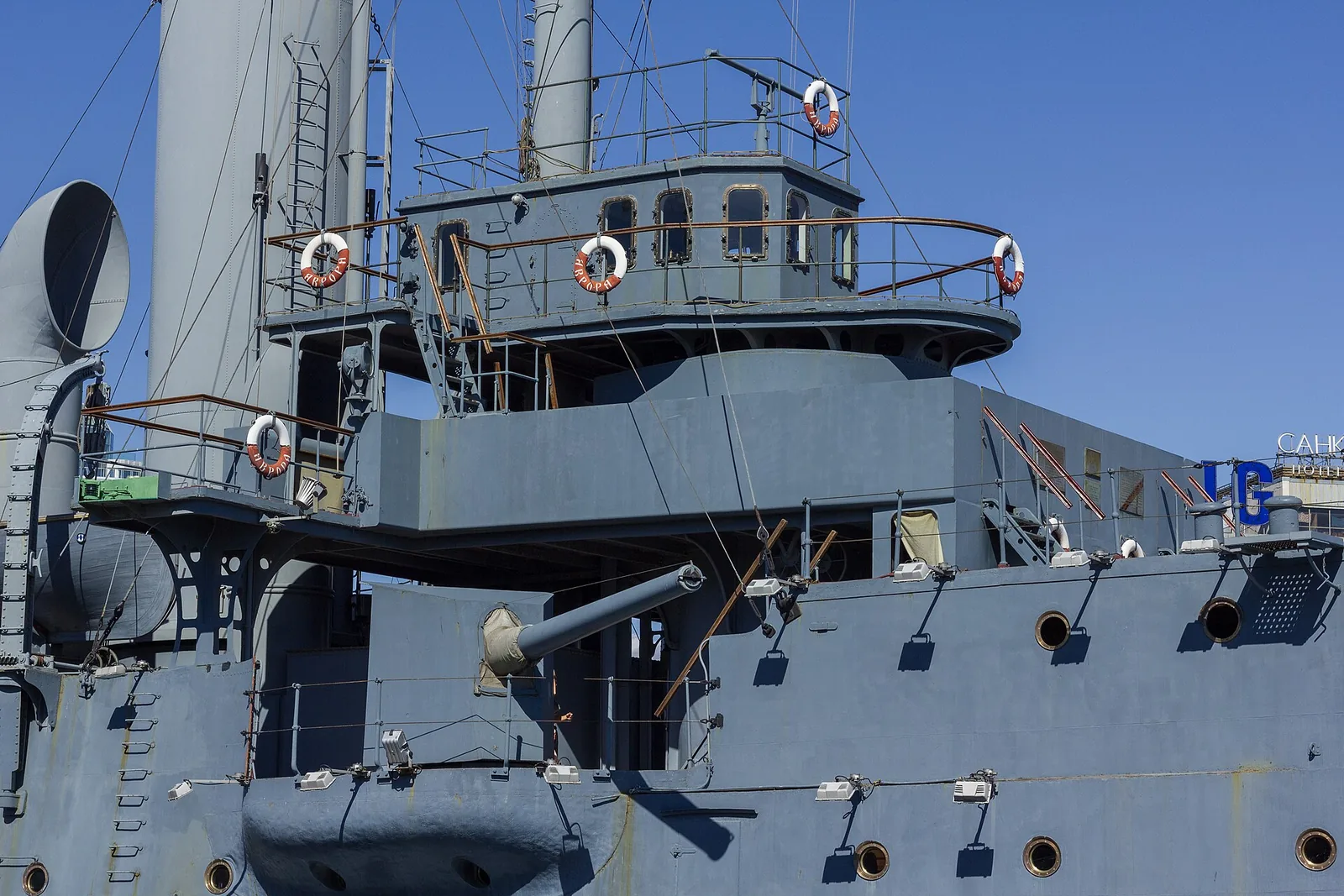
The cruiser Aurora, Saint Petersburg, 2013. Photo: Perituss · CC0 · Source page
9:45 pm
On the evening of 25 October OS (7 November NS), at about a quarter to ten, the cruiser Aurora fired a blank shot from the Neva. By Russian tradition, that shot was the signal for the assault. Bolshevik units moved towards the Winter Palace, where the Provisional Government sat.
The palace was entered in the early morning of 26 October OS (8 November NS). Few people were wounded. Most of the ministers were arrested. Kerensky had already left the city to look for loyal troops.
Myth
The Aurora shelled the Winter Palace, and the storming killed thousands.
The truth
The Aurora fired a blank signal, not a shell, and the palace was taken with few casualties. The famous storming scenes come partly from Sergei Eisenstein and Grigori Aleksandrov’s film October: Ten Days That Shook the World, made in 1927 and released in 1928. Its storming scenes drew more on a staged re-enactment of 1920 than on the night itself.
The evidence
Standard accounts describe the storming as largely without casualties, and record the blank shot. Eisenstein’s film and the 1920 re-enactment created the picture most people know.
Source: Red Guards on Palace Square, c. 1917
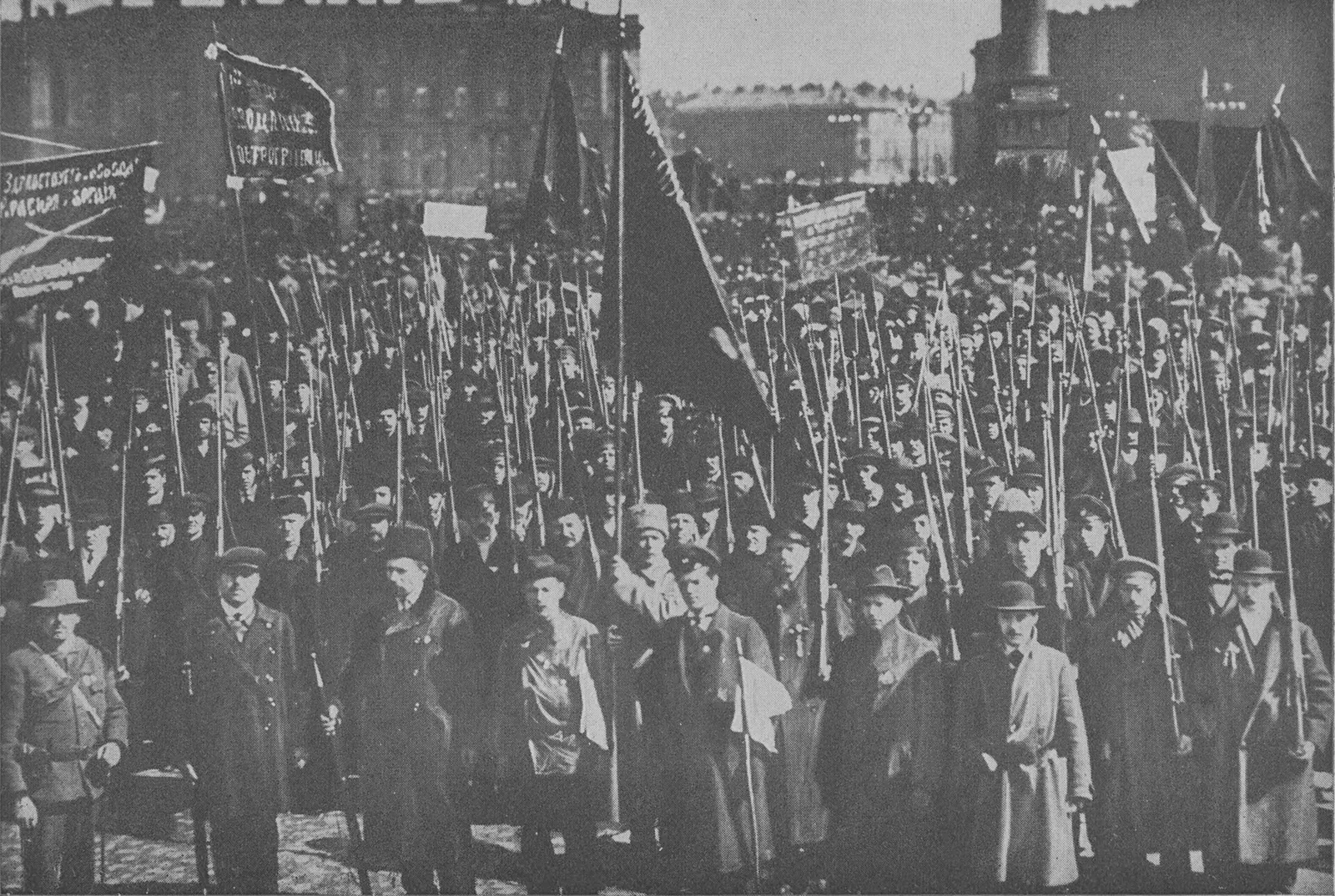
Red Guards outside the Winter Palace, c. 1917. Published in Albert Rhys Williams, Through the Russian Revolution (1921) · Public domain · Source page
Photograph published in Albert Rhys Williams, Through the Russian Revolution (1921), held on Wikimedia Commons (c. 1917).
Williams, an American writer who was in Petrograd in 1917, sympathised with the revolution. The picture shows what the armed crowd looked like, and his book is the view of a sympathiser.
- What does the photograph show about the armed workers? Men with rifles marching in ranks under banners, in good order. It shows strength and organisation, which is probably what the photographer wanted to show.
- Where was it taken, and what does it not show? On Palace Square, with the Alexander Column at the top right. It shows a march, not the storming or the palace’s interior, which is what the myth imagines.
- How does it compare with another eyewitness account? John Reed, an American writer and socialist, wrote an eyewitness book, Ten Days That Shook the World (1919). Such witnesses are useful, but their sympathies have to be counted. Critics have called Reed’s book partisan.
After
The Assembly that did not last
The Provisional Government had promised elections to a Constituent Assembly, which would decide the country’s future. The vote was held on 12 November OS (25 November NS) 1917. The Socialist Revolutionaries won about 38 to 40 per cent of the vote, and the Bolsheviks about 23 to 25 per cent. Sources give slightly different figures, so we give ranges.
The Assembly met in Petrograd on 5 January OS (18 January NS) 1918. The next day, 6 January OS (19 January NS), the Bolsheviks dissolved it. Russia adopted the Gregorian calendar only in February 1918, so from then on the dates here are New Style.
What followed, in both calendars
- 2 November 1917 NS The Balfour Declaration: a British letter that favours ‘a national home for the Jewish people’ in Palestine. It is dated five days before the seizure of power in Petrograd.
- 7 November 1917 NS (25 October OS) The Aurora fires its blank shot. The Second Congress of Soviets opens and sits until 9 November NS. Lenin presents decrees on peace and on land to it.
- 8 November 1917 NS (26 October OS) The Winter Palace is taken in the early morning. The Provisional Government ceases to function.
- 25 November 1917 NS (12 November OS) Elections to the Constituent Assembly. The Bolsheviks win about 23 to 25 per cent of the vote.
- 18 January 1918 NS (5 January OS) The Constituent Assembly meets in Petrograd.
- 19 January 1918 NS (6 January OS) The Bolsheviks dissolve the Assembly.
- 3 March 1918 NS Soviet Russia signs a separate peace with Germany at Brest-Litovsk.
- 16–17 July 1918 NS The former tsar and his family are shot in the Ipatiev House in Yekaterinburg.
Coup or popular revolution?
Was October 1917 a coup by a small party, or a popular revolution?
- Richard Pipes, The Russian Revolution (1990) Pipes argues that October was a coup in the modern sense: an organised, armed group took power without broad mass support.
- Alexander Rabinowitch, The Bolsheviks Come to Power (1976) Rabinowitch, who studied the revolution in Petrograd in close detail, argues that the Bolsheviks had broad popular support, thanks to a popular programme, tolerance of diverse views and decentralised organisation. So, in his view, the rising was not just a plot by a minority.
- Orlando Figes, A People’s Tragedy (1996) Figes is sharply critical of Lenin and the Bolsheviks. In a 1997 interview he called himself ‘mildly pro-Menshevik’, so his critique should be read with that in mind.
Was the Provisional Government doomed from the start, or could a different choice in the summer of 1917 have saved it? None of the sources we read settles the question.
Check yourself
Why do historians give the February Revolution two dates?
Answer: Russia used the Julian calendar, 13 days behind the Western one.. Right. In 1917 the Russian calendar ran 13 days behind the West, so the same day had two dates. We give both, with OS and NS.
Check yourself
What did Order No. 1 do?
Answer: It put weapons under soldiers’ committees and ranked the Soviet above the Duma.. Right. The order put the weapons under the committees (see the quotations in the order step) and placed the Soviet’s orders above those of the Duma’s military commission.
Check yourself
Which claim about Lenin’s train is supported by the lesson?
Answer: It crossed Germany, but passengers got out in Frankfurt for the night.. Right. The stop in Frankfurt is documented, so the train was not sealed the whole way, unlike the myth.
Check yourself
What is true of the taking of the Winter Palace?
Answer: It was entered in the early morning of 26 October OS, with few wounded.. Right. The palace fell in the early morning, without heavy losses, as standard accounts describe.
Check yourself
What did the Central Committee decide on 10 October OS?
Answer: To approve an armed rising, by ten votes to two, in the soviets’ name.. Right. The vote was 10 to 2 for an armed rising.
Check yourself
How does the Balfour Declaration relate in time to the seizure of power in Petrograd?
Answer: The letter is dated five days before the seizure of power.. Right. The letter is dated 2 November 1917 NS, and the seizure came five days later, on 7 November NS.
Terms
- Julian calendar The calendar Russia used until February 1918. In 1917 it ran 13 days behind the Gregorian calendar used in the West.
- soviet A council of elected delegates from workers, soldiers or peasants. The Petrograd Soviet, set up in 1917, was the most powerful of them.
- Duma Russia’s parliament, created in 1906, with limited powers. In 1917 a committee of the Duma formed the first Provisional Government.
- Bolshevik A member of the wing of the Russian Social Democratic Labour Party led by Lenin. The name ‘Bolsheviks’, meaning the majority, dates from a split in 1903. The party later became the Communist Party.
- Menshevik A member of the moderate wing of the Russian Social Democrats, who opposed seizing power by revolution. In 1917 many backed the Provisional Government.
- Provisional Government The government formed in March 1917 after the tsar’s fall. Prince Lvov led it first, and then Kerensky.
- dual power The situation in 1917 in which the government and the soviets both claimed authority over the same country and city.
- Red Guards Units of armed workers, drawn from the factories and districts of Petrograd and other cities in 1917.
- Constituent Assembly An elected body meant to decide the country’s constitution. Elections were held in November 1917, and the Bolsheviks dissolved it in January 1918.
- April Theses Lenin’s programme of April 1917: no support for the Provisional Government, power to the soviets, and a democratic peace.
- Pale of Settlement The zone in the west of the Russian Empire where most Jews were allowed to live. The restrictions were lifted in 1917.
- Central Committee The leading body of a party between its congresses. The Bolshevik Central Committee voted for the October rising in 1917.
- Nevsky Prospekt The main street of Petrograd. Government troops fired on a crowd there in July 1917.
- Petrograd The Russian name of St Petersburg at the time of the revolution. It was Russia's capital then.
- Winter Palace The tsars' palace in Petrograd. The Provisional Government sat there until it was taken.
- Grigori Rasputin A mystic whose influence at the Russian court caused scandal. Nobles murdered him in December 1916.
- Empress Alexandra The wife of Tsar Nicholas II. She was born in Germany, and many believed she leaned too heavily on Rasputin.
- Volynsky Regiment A regiment of the Petrograd garrison. The soldiers' mutiny in the city began there.
- Pskov A city in Russia where the tsar was when news of the revolt reached him.
- Finland Station The railway station in Petrograd where Lenin arrived from exile.
- Gregorian calendar The calendar used in Western Europe, which replaced the Julian calendar. Russia switched to it only in February 1918.
- Pravda The Bolsheviks' newspaper. Lenin published the April Theses in it.
- Georgy Lvov A Russian prince who headed the Provisional Government at the start of 1917. He resigned in July.
- Catherine the Great Empress of Russia. The Pale of Settlement, where Jews were required to live, was created in her time.
- Lewis Siegelbaum A historian who wrote about the Russian revolution. He opens his account with the working women who went on strike.
- Order No. 1 An order the Petrograd Soviet issued to the troops. It said the Soviet's orders outranked the Duma's.
- Second Congress of Soviets A national meeting of delegates from the soviets across Russia. Lenin wrote about it in his letter from Finland.
- Socialist Revolutionaries A Russian socialist party that won about 38 to 40 per cent of the vote in the election to the Constituent Assembly.
- Zinoviev A Bolshevik leader who opposed an armed rising and warned of disaster.
- Aurora A Russian navy cruiser on the Neva. By tradition, a shot from it was the signal to attack.
- Neva A river that flows through Petrograd into the Baltic Sea.
- July Days An armed demonstration of workers, soldiers and sailors against the government in early July 1917. Government troops fired on the crowd.
- Eastern Front The battle line between Russia and Germany and Austria-Hungary in the First World War.
- Old Style (OS) The date by the old calendar (Julian), which Russia used until February 1918.
- New Style (NS) The date by the new calendar, the Gregorian one used in the West.
- Leon Trotsky A Bolshevik leader. He was elected chairman of the Petrograd Soviet on the day the Bolsheviks won a majority in its workers' section.
Sources
- Order No. 1 of the Petrograd Soviet, 1 March OS (14 March NS) 1917; English text in An Illustrated History of the Great October Socialist Revolution (Moscow, 1988)
- Nicholas II, abdication manifesto, Pskov, 2 March OS (15 March NS) 1917; text in Frank Golder, Documents of Russian History 1914–1917 (New York, 1927), pp. 297–98
- Vladimir Lenin, “The Bolsheviks Must Assume Power” (written September 1917; first published 1921), Collected Works, vol. 26, trans. Yuri Sdobnikov and George Hanna
- Vladimir Lenin, “April Theses”, Pravda, 7 April 1917 OS; Collected Works, vol. 24, trans. Isaacs Bernard
- Balfour Declaration, letter of 2 November 1917
- Albert Rhys Williams, Through the Russian Revolution (New York, 1921)
- John Reed, Ten Days That Shook the World (New York: Boni & Liveright, 1919)
- Lewis Siegelbaum, “The February Revolution”, Seventeen Moments in Soviet History (Michigan State University)
- Ted Widmer, article in The New Yorker, 20 April 2017
- Richard Pipes, The Russian Revolution (New York: Knopf, 1990)
- Alexander Rabinowitch, The Bolsheviks Come to Power: The Revolution of 1917 in Petrograd (1976; new edition 2004)
- Orlando Figes, A People’s Tragedy: The Russian Revolution 1891–1924 (London, 1996)
Image credits
- Nevsky Prospekt, Petrograd, 4 July 1917. Photo: V. Bulla, David King Collection (Tate / Scala) · Public domain · Source page
- Nicholas II, 1917. Library of Congress, Bain Collection · Public domain · Source page
- Vladimir Lenin in a wig and cap, 11 August 1917. Photo: D. I. Leshchenko (1876–1937) · Public domain · Source page
- Alexander Kerensky, 1917. Photo: Karl Bulla · Public domain · Source page
- The cruiser Aurora, Saint Petersburg, 2013. Photo: Perituss · CC0 · Source page
- Red Guards outside the Winter Palace, c. 1917. Published in Albert Rhys Williams, Through the Russian Revolution (1921) · Public domain · Source page


