Caesar crosses the Rubicon
One small river, one legion, and a law he was about to break.
Decisions, questions and your own progress, in the app
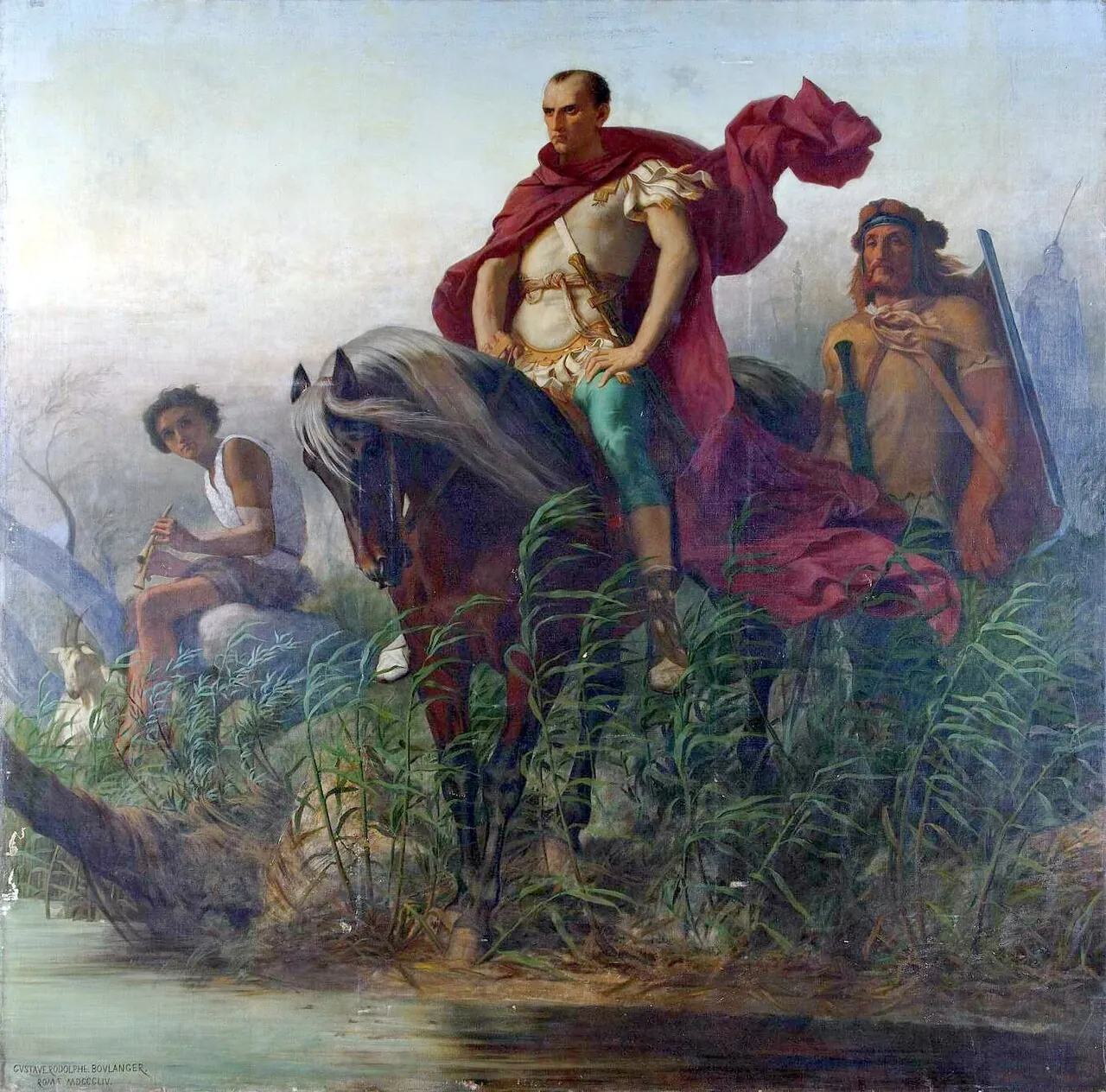
Gustave Boulanger, Julius Caesar Arriving at the Rubicon, 1854. Musée de Picardie, Amiens · Public domain · Source page
A small river. One step.
A shallow river, so small that today no one is sure which one it was. On one bank stands a general with a single legion. On the other bank: Italy.
If he crosses, he becomes an outlaw. If he stays, his career, and perhaps his life, may end right here.
Background
The general Rome feared
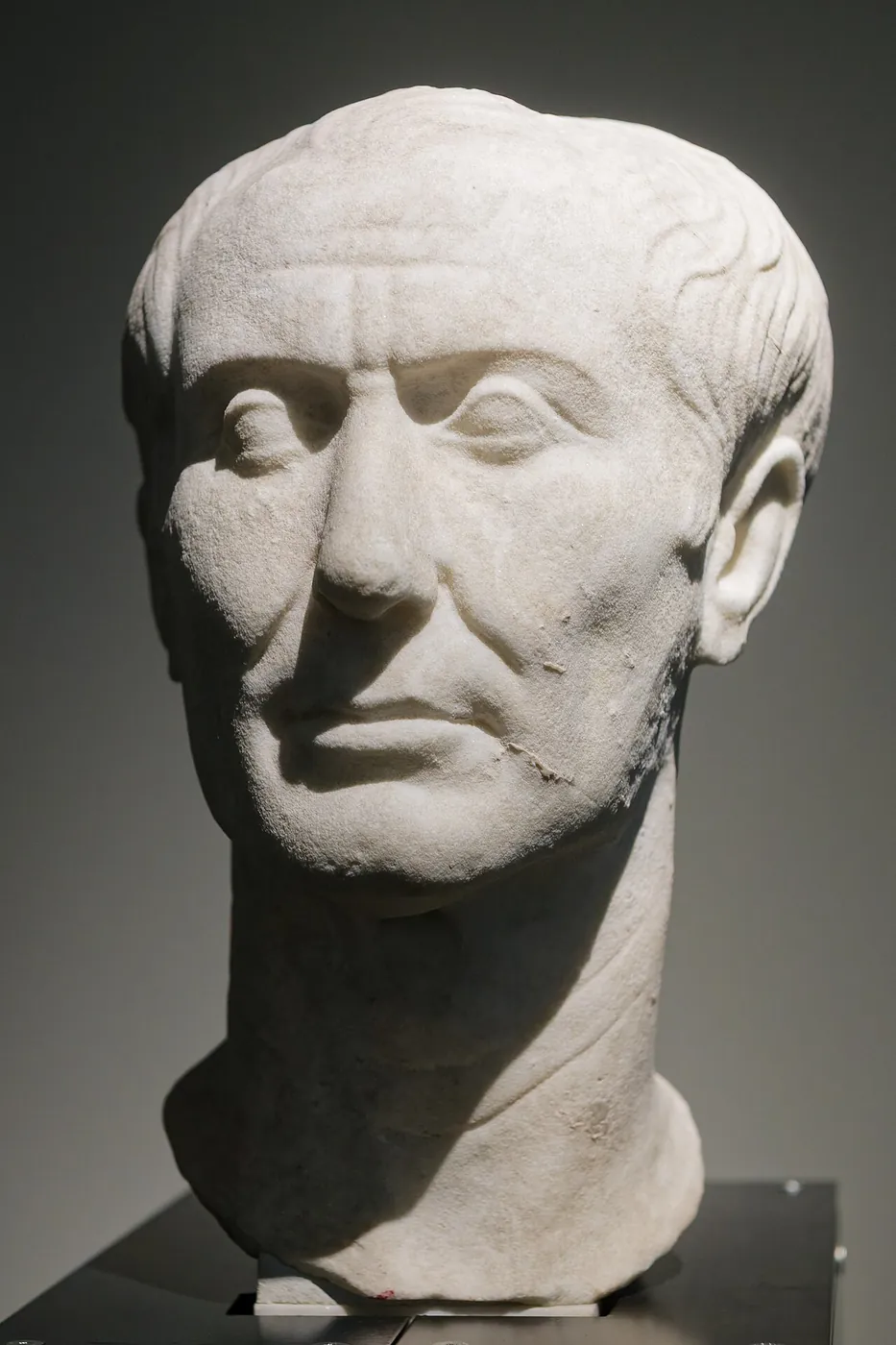
Head of Julius Caesar from Tusculum, 1st century BC. Museo di Antichità, Turin. Photo: Marie-Lan Taÿ Pamart · Public domain · Source page
Julius Caesar is 50. For nine years he has been governor of Gaul, conquering for Rome a territory the size of modern France. His soldiers love him. The crowds in Rome adore him.
The Senate sees a danger. Pompey, once his ally, has moved to his enemies' side. In January 49 BC the Senate orders Caesar to give up his army. Two tribunes who tried to veto the order flee Rome to his camp.
Without an army, Caesar is a private citizen. His enemies have said they will put him on trial.
A decision point
You are Julius Caesar.
January 49 BC, on the bank of the Rubicon
The river marks the edge of your province. Beyond it, the law forbids you to lead soldiers. You have one legion with you, the Thirteenth. The rest of your army is still far away in Gaul.
On the other side are Pompey and the Senate, and the whole weight of the law.
What do you do?
- Cross with your legion and move fast into Italy Civil war. Your advantage is speed: Pompey has not yet raised his army, and the towns on the way may open their gates to you.
- Give up your army and return to Rome as a private citizen Most likely a trial. Your enemies have waited for this moment. Caesar himself later said they would have condemned him "despite all my great deeds". The likely end: exile, as happened to Cicero in 58 BC, and the end of your career.
- Stay in your province with your army and try one more round of bargaining Time works against you. The Senate has already declared an emergency, Pompey has legions in Spain and is recruiting more in Italy. In two months you would face a far bigger army, and still be called a rebel.
What really happened
Cross with your legion and move fast into Italy
Caesar crossed, by tradition on the night of 10 January 49 BC. Within weeks much of Italy had gone over to him, almost without a fight. Pompey and most of the Senate fled Rome, and then fled to Greece.
Caesar wrote that he was fighting for his honour, which he valued more than life, and for the rights of the tribunes who had been driven out. Historians add a simpler reason: going home without an army meant a trial, and probably political death.
What really happened
Five years, one war, one dagger
5,000
That is how many foot soldiers crossed with Caesar, by Plutarch's count, with about 300 cavalry. Not an army: a gamble.
In 48 BC Caesar beat Pompey at Pharsalus in Greece. Pompey fled to Egypt and was murdered there. Caesar was made dictator, and early in 44 BC dictator for life.
On 15 March 44 BC a group of senators stabbed him to death. They wanted to save the Republic. In fact, after more civil wars, it ended: his heir Octavian became Augustus, the first emperor.
Source: A writer 170 years away
“Even yet we may draw back; but once cross yon little bridge, and the whole issue is with the sword.” … “Take we the course which the signs of the gods and the false dealing of our foes point out. The die is cast.”
Between the two lines, Suetonius says a huge and beautiful figure appeared, seized a trumpet from a soldier, blew it and crossed the river.
- Suetonius was not there. How could he know what Caesar said? From earlier books now lost, like that of Asinius Pollio, an officer who stood near Caesar that night. We are reading a memory of a memory.
- Why put a figure sent by the gods into the story? It makes the crossing look like fate, approved by the gods. It is not evidence of what happened, but good evidence of how Romans told the story.
- Caesar wrote his own book about the war. He never mentions the Rubicon at all. Why not? It was the moment he broke the law. In his book he tells of the expelled tribunes and the insult to his honour, then simply arrives in the next town. He casts himself as Rome's defender, not its attacker.
Myth
Caesar cried "Alea iacta est", the die is cast, in Latin, and invaded Italy with a mighty army.
The truth
The sources do not even agree on the words. Suetonius gives them in Latin. Plutarch says Caesar spoke them in Greek, quoting the playwright Menander: "Let the die be cast." And the army? One legion. Most of his troops were still in Gaul.
Check yourself
Why was crossing the Rubicon with soldiers a crime?
Answer: A governor was not allowed to lead his army out of his province into Italy. Right. A governor's authority ended at his province's border. Leading soldiers into Italy without permission counted as treason against Rome.
Check yourself
How many soldiers crossed the Rubicon with Caesar?
Answer: One legion, about 5,000 foot soldiers and 300 cavalry. Right, according to Plutarch. The rest of his army joined him later.
Check yourself
What did Caesar write about the Rubicon in his own book on the civil war?
Answer: Nothing. He never mentions the river. Right. The moment he broke the law is simply missing. He describes the wrongs done to him, and then he is already at Ariminum.
Terms
- legion Rome's main army unit: in Caesar's time about 5,000 foot soldiers, most of them Roman citizens serving for many years.
- the Senate The council of nobles and former officials of the Roman Republic, about 600 members. It did not pass laws, but its advice was hard to ignore.
- governor A Roman politician given charge of a province outside Italy, including command of its army. His authority stopped at the province's border.
- Pompey Gnaeus Pompeius Magnus (106–48 BC), Rome's most famous general before Caesar. Once his ally and son-in-law, by 49 BC his great rival.
- tribune An elected Roman official who protected ordinary citizens. He could veto decisions, and his person was sacred: harming him was forbidden.
- dictator In Rome, a legal emergency office given to one man for six months at most. Caesar made it a post for life, and that is what frightened his enemies.
- Suetonius Roman writer (c. AD 69–122) who wrote the Lives of the Caesars, biographies of Caesar and the eleven rulers after him. He wrote about 170 years after the Rubicon.
- Gaul A large region of Western Europe, most of it modern France. Caesar conquered it for Rome.
- Plutarch An ancient Greek writer who wrote lives of famous people. His stories about Caesar are a main source.
- Appian An ancient Greek historian who wrote about Rome's wars. He is one of the sources for the Senate's vote.
- Curio A Roman tribune and ally of Caesar. He proposed that both generals give up their armies on the same day.
- Cato A Roman senator and leader of Caesar's stubborn enemies. Historians ask whether he pushed Rome into war.
- Menander An ancient Greek playwright who wrote comedies. According to Plutarch, Caesar quoted him at the crossing.
- Pharsalus A town in Greece, where Caesar defeated Pompey in a great battle.
- Fiumicino The name of a stream in Italy. In 1933 the Italian government declared it to be the Rubicon, though scholars still suggest other streams.
- Jean Fouquet A French painter of the 15th century. In a small picture in a manuscript he imagines the crossing.
- Octavian Caesar's heir. After more civil wars he became Augustus, the first emperor of Rome.
- Augustus The title taken by Octavian, who became Rome's first emperor.
- The Republic The system of rule in Rome before there were emperors. The Senate and elected officials ruled, not one man.
- Consuls The two top officials of Rome, elected for one year. In this lesson they ignore the Senate's vote.
- The Thirteenth Legion Legion number 13 in the Roman army. It was the only legion Caesar took with him when he crossed the river.
- Veto The right to block a decision of an official body. Roman tribunes had this right.
- Knights A mounted warrior of the Middle Ages, who wore armour and served a lord.
- Plate armour Armour made of metal plates that cover the body. Medieval knights wore it.
Sources
- Suetonius, Divus Iulius 29–33, trans. J. C. Rolfe (Loeb Classical Library, 1914)
- Plutarch, Life of Caesar 31–33 and Life of Pompey 60, trans. B. Perrin (Loeb Classical Library, 1919)
- Julius Caesar, Commentarii de Bello Civili 1.1–1.11
- Appian, Civil Wars 2.30–35
- Adrian Goldsworthy, Caesar: Life of a Colossus (Yale University Press, 2006)
- Mary Beard, SPQR: A History of Ancient Rome (Profile Books, 2015)
- Tom Holland, Rubicon: The Triumph and Tragedy of the Roman Republic (Little, Brown, 2003)
Image credits
- Gustave Boulanger, Julius Caesar Arriving at the Rubicon, 1854. Musée de Picardie, Amiens · Public domain · Source page
- Head of Julius Caesar from Tusculum, 1st century BC. Museo di Antichità, Turin. Photo: Marie-Lan Taÿ Pamart · Public domain · Source page

