Rome conquers Italy: from the founding to Pyrrhus
A village of shepherds on seven hills becomes master of Italy, and a Greek king learns what a “Pyrrhic victory” costs.
Decisions, questions and your own progress, in the app
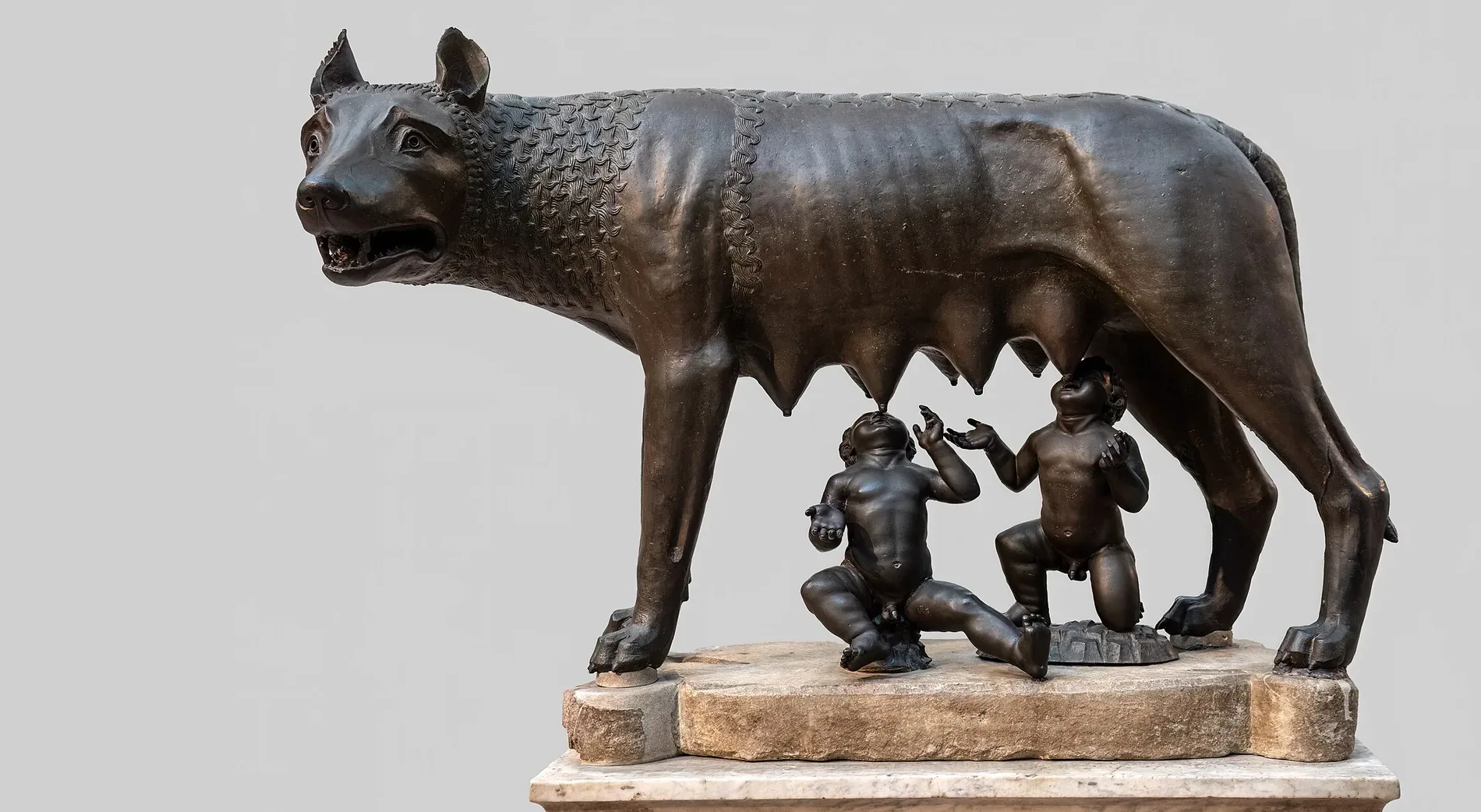
The Capitoline Wolf, bronze. Capitoline Museums, Rome. Photo: Wilfredor (background removed) · CC0 · Source page
The she-wolf
A wolf from the wrong century
On the Capitoline Hill in Rome stands a she-wolf of dark bronze, ears pricked, teeth bared. Beneath her two baby boys reach up to drink: Romulus and Remus, the twins who, the Romans said, were saved by a wolf. Romulus, they said, founded the city in 753 BC.
The boys were added in the late 15th century AD. The wolf was long thought Etruscan work of about 500 BC, but in 2012 a laboratory dated material left inside her by the casting to the 11th or 12th century AD. Rome’s most famous picture of its own birth may be medieval.
Keep that in mind. In less than five centuries a small town on the Tiber became master of Italy and beat a Greek king and his elephants. How? And how far can we trust the story?
Our witnesses
Writers who came late
No Roman wrote history until about 200 BC, more than five centuries after the date given for the founding. Our main guide, Livy, wrote under the emperor Augustus, from about 27 BC: more than 700 years after Romulus, and some 250 after Pyrrhus.
Livy was a patriot and a gifted storyteller who wanted Romans to learn from their ancestors. Greek writers add other views: Polybius, a hostage in Rome in the 2nd century BC; Dionysius of Halicarnassus, Livy’s contemporary; and Plutarch, who wrote a life of Pyrrhus around AD 100. Add a few inscriptions, coins and archaeological finds. At every step, ask: how could they know?
Legend and evidence
753 BC?
Twins on the flooded Tiber
The story, as Livy tells it: a priestess of Alba Longa bears twins and says their father is Mars, god of war. The king, who has stolen the throne, orders the babies drowned. But the Tiber is in flood, their basket is left on the mud, and a she-wolf suckles them. A shepherd raises them. Grown up, Romulus founds a city on the Palatine hill, quarrels with Remus and kills him.
Livy did not swear to any of it. Such tales, he wrote, are “more fitted to adorn the creations of the poet than the authentic records of the historian”. He even suggests the “she-wolf” was the shepherd’s wife, nicknamed for her loose life: in Latin, lupa meant both.
Archaeology tells a slower story. Huts stood on the Palatine and nearby hills from about 1000 BC; over centuries the villages grew together, and by about 600 BC the valley between them was a paved square, the Forum. Rome was not built in a day, nor founded in one.
Myth
Romulus founded Rome on 21 April 753 BC.
The truth
The date is a calculation of the 1st century BC, by the scholar Varro and his friend Atticus; earlier writers put the founding anywhere from 814 to 729 BC. Romulus is almost certainly a name made from the city’s own (Roma, Romulus: “the Roman”), and babies exposed and saved by an animal are a tale told of many founders, Cyrus of Persia among them. The city grew out of hill villages; the legend was shaped centuries later.
The evidence
Dionysius of Halicarnassus 1.74 lists the rival dates. The oldest dated sign that Romans told the wolf story is a statue of the wolf and twins set up in 296 BC (Livy 10.23).
509 BC
No more kings
Tradition gave Rome seven kings. Their number and long reigns are artificial, but kings there were: a 6th-century BC inscription found under the Lapis Niger (“black stone”) in the Forum contains the word for king.
The last, Tarquin the Proud, fell in 509 BC, Livy says, after his son raped Lucretia, a nobleman’s wife, and she killed herself; Lucius Junius Brutus swore on the bloody knife to drive the kings out. It is a moral drama about liberty and honour, and most historians treat it as legend. That the kings fell around 500 BC, most accept.
In their place came a republic: two consuls elected every year to command the army, a Senate of elders, and assemblies of citizens. And almost every year the Republic went to war.
c. 390 BC
“Woe to the vanquished!”
Around 390 BC (387 by the Greek reckoning) a war band of Gauls from northern Italy routed the Roman army by the stream of the Allia, some 16 kilometres north of Rome. Within days they were in the city. Only the Capitol, the citadel hill, held out.
Livy tells how it ended. Starving, the Romans agreed to pay 1,000 pounds of gold. The Gauls brought false weights, and when the Romans protested, their chief, Brennus, threw his sword into the scale “with an exclamation intolerable to Roman ears, ‘Woe to the vanquished!’” At that moment, says Livy, the exiled hero Camillus arrived with an army and drove the Gauls out.
The sack itself was real: Greek writers of the 4th century BC had heard of it. For two centuries Romans feared the Gauls above all other enemies.
Myth
Juno’s sacred geese saved the Capitol, and Camillus saved Rome’s gold.
The truth
Livy says the cackling of the geese woke the defenders when the Gauls climbed the cliff by night. But Polybius, our oldest account, knows nothing of Camillus. In his account the Gauls left because the Veneti had invaded their own land; they made a treaty with the Romans and went home. The rescue by Camillus is probably a patriotic invention, and the geese may be legend too.
The evidence
Livy 5.47–49; Polybius 2.18 and 2.22. No clear layer of burning from this time has been found in Rome, so the damage was probably less than Livy implies.
The Roman machine
A decision point
You are members of the Roman Senate.
338 BC, in Rome
For 150 years the Latins, your neighbours, have been your partners: one language, shared festivals, marriages between families, an old treaty of equals. In 340 BC they rose against you, demanding one of the two consulships and half the Senate. After three years of war every Latin town has surrendered.
The consul Lucius Camillus reminds you that you could “wipe out the whole Latin nation”, or “make Rome greater by conferring her citizenship on those whom she has defeated”. To the south-east, the Samnites are watching.
What do you do with the Latins?
- Destroy them and take their land Latium would be quiet, but empty. You would lose the soldiers you need against the Samnites, and every other people in Italy would learn that surrender to Rome means death.
- Make them all Roman citizens Generous, and it would bind them to you. But tens of thousands of new voters would flood your assemblies at once, and your enemies would see that rebellion pays.
- Restore the old league of equals Peace with old friends, but nothing would change. The Latins would still be one bloc, and the same war could break out again in ten years.
- Treat each town differently: reward, punish, divide No town would have the same interests as its neighbour, and none could easily unite against you. But it is complicated, and the towns you punish will hate you.
What really happened
Treat each town differently: reward, punish, divide
The Senate treated every town differently. Some became full Roman citizens. Velitrae lost its walls and its leaders; Antium lost its warships, whose bronze beaks were fixed to the speakers’ platform in the Forum, the Rostra (“the beaks”). Capua got citizenship without the vote. The other Latins kept their treaties with Rome but lost the right to trade, marry or meet with one another.
Divide and rule, with a reward for loyalty: from now on every town faced Rome alone.
Livy has Camillus say: “That is assuredly the most firmly-based empire, whose subjects take a delight in rendering it their obedience.” The speech is Livy’s, but his list of towns probably rests on records, and historians see 338 BC as the birth of Rome’s system of allies.
321 BC
The trap near Caudium
The Samnites were tough highland peoples of the southern Apennines, as numerous as the Romans and better at war in the mountains. In 328 BC Rome planted a colony at Fregellae, on land the Samnites claimed. War followed, on and off, for almost forty years.
In 321 BC both consuls marched their armies towards Apulia by the short road, through a narrow valley near Caudium. The Samnite general Gaius Pontius had blocked its far end with felled trees and boulders. When the Romans turned back, the way they had come was blocked too, and the heights were full of Samnites. Two Roman armies were trapped.
A decision point
You are Gaius Pontius, general of the Samnites.
321 BC, at the Caudine Forks
Two consular armies, the main strength of Rome, are shut in the valley below you. Without food they cannot last long.
Your old father, Herennius, sent two answers to your question. First: let them all go unharmed, and win “a durable peace and friendship with a most powerful people”. Second: kill them all, and cripple Rome for generations. There is no third course, he says. Your officers want a middle way.
What do you do?
- Let them all go, with no conditions A gamble on Roman gratitude. It might buy a long peace, or Rome might simply come back next year with its armies whole.
- Hold them hostage until Rome signs your peace You would have to feed and guard tens of thousands of men in the mountains, and Rome might abandon them rather than bargain. Holding an army hostage is harder than trapping it.
- Free them on your terms: disarmed, under the yoke, with hostages and a treaty You get your peace and your land, and Rome is humbled before all Italy. But, as Herennius warns, humiliated men may want revenge.
What really happened
Free them on your terms: disarmed, under the yoke, with hostages and a treaty
Pontius took the middle way. The Romans gave up their weapons and, with one garment each, passed under the yoke while the Samnites jeered. Six hundred young horsemen stayed behind as hostages, and the consuls swore to a peace.
Livy says the Senate then rejected the peace and took swift revenge. Many historians doubt it: Rome seems to have kept the peace for about five years.
Herennius’s warning, in Livy, was that the middle course “neither procures friends nor rids us of enemies”, for “the Romans are a nation who know not how to remain quiet under defeat”. The speech is invented, but the defeat was real, and Romans remembered the Caudine Forks as their worst humiliation.
295 BC
Sentinum: a general rides to his death
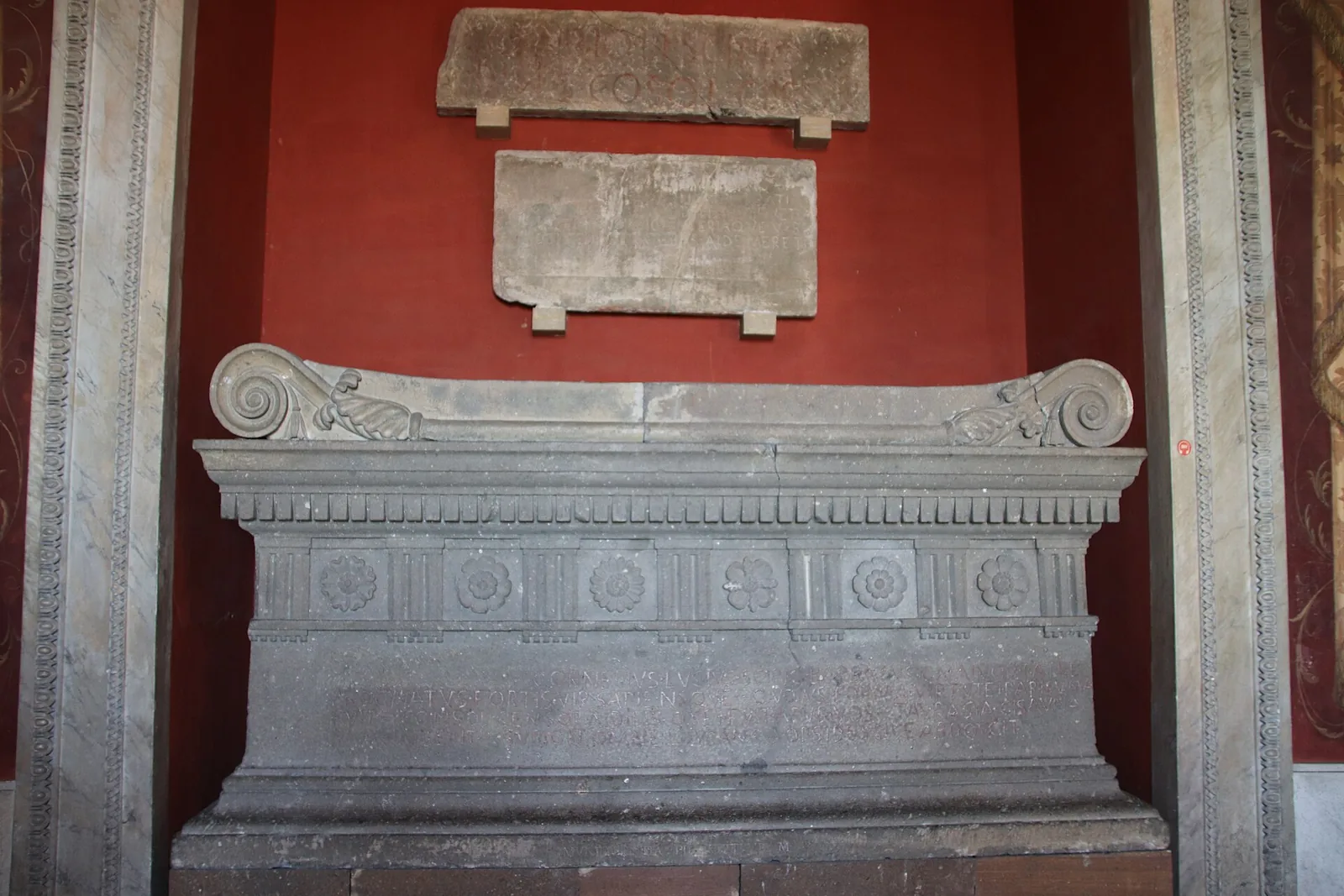
Sarcophagus of Scipio Barbatus, 3rd century BC. Vatican Museums (Museo Pio-Clementino). Photo: Gary Todd · Public domain · Source page
By 296 BC the Samnites had found allies: Etruscans and Umbrians in the north, and Gauls. In 295 BC, near Sentinum in the Apennines, the largest battle yet fought in Italy decided the war. The consul Quintus Fabius held the right wing against the Samnites; his colleague Publius Decius Mus held the left against the Gauls.
Gallic war chariots broke Decius’s cavalry. Then, Livy says, Decius did what his father had done in 340 BC: he made a devotio, vowing himself and the enemy army to the gods of the underworld, and rode alone into the Gauls to die. His men rallied; Fabius turned the Samnite flank and took their camp. The alliance was broken, and in 290 BC the Samnites made peace.
The system
Roads, colonies and allies
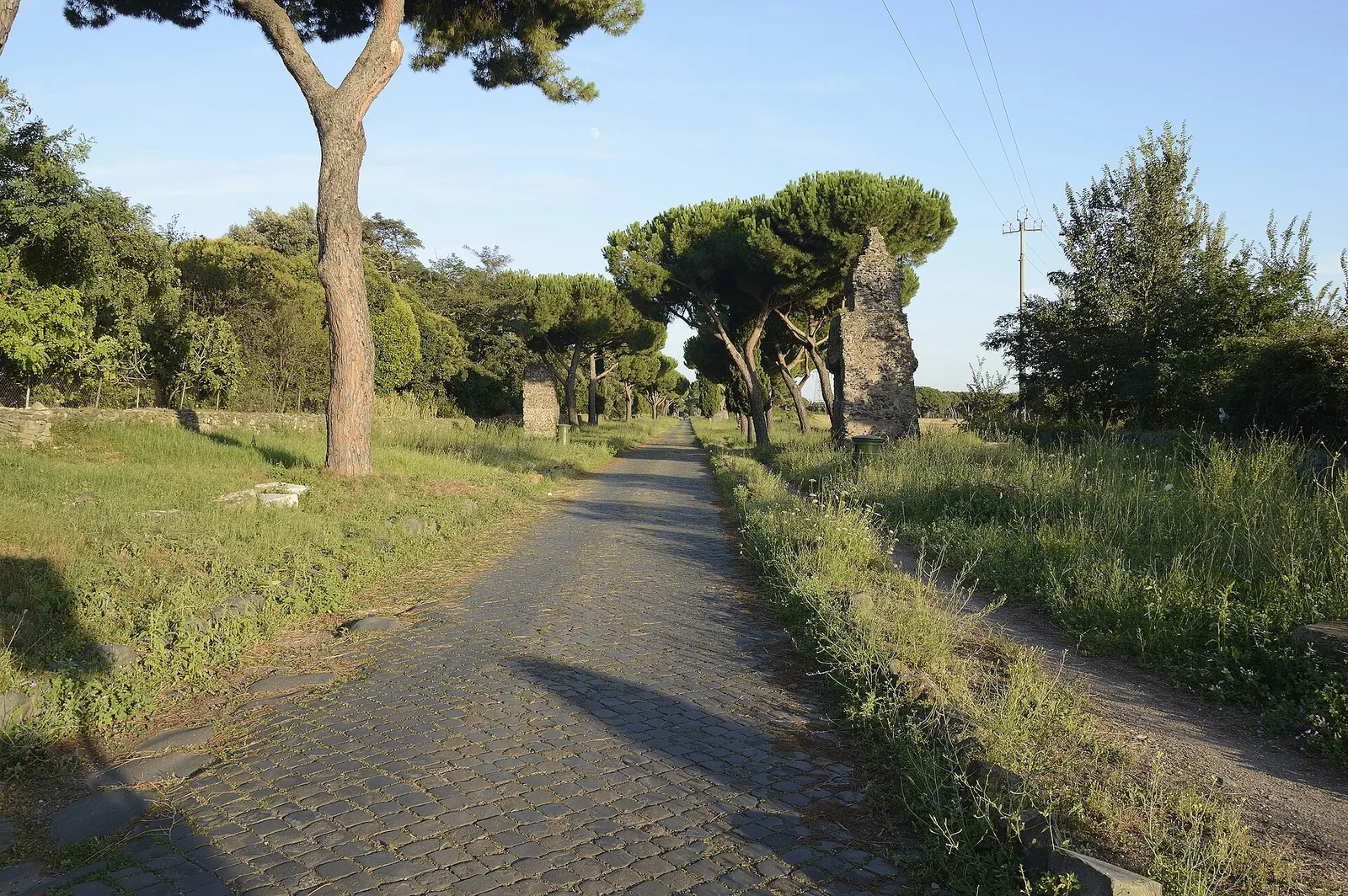
The ancient Via Appia near Casal Rotondo, 2014. Photo: Livioandronico2013 · CC BY-SA 4.0 · Source page
Rome won the Samnite wars with spades as much as with swords. In 312 BC the censor Appius Claudius began a road from Rome to Capua, straight across the Pontine Marshes: the Via Appia, about 195 kilometres long. It was a military road, built to get legions to Campania fast. In the same year he built Rome’s first aqueduct.
Along the roads Rome planted colonies of farmer-soldiers on conquered land: Luceria behind the Samnite lines in 314 BC, Venusia in 291, some twenty in seventy years. Every defeated people got its own treaty and became allies. The allies paid no tribute, but they had to send soldiers. So every war Rome won made its army bigger for the next one.
Appius Claudius Caecus
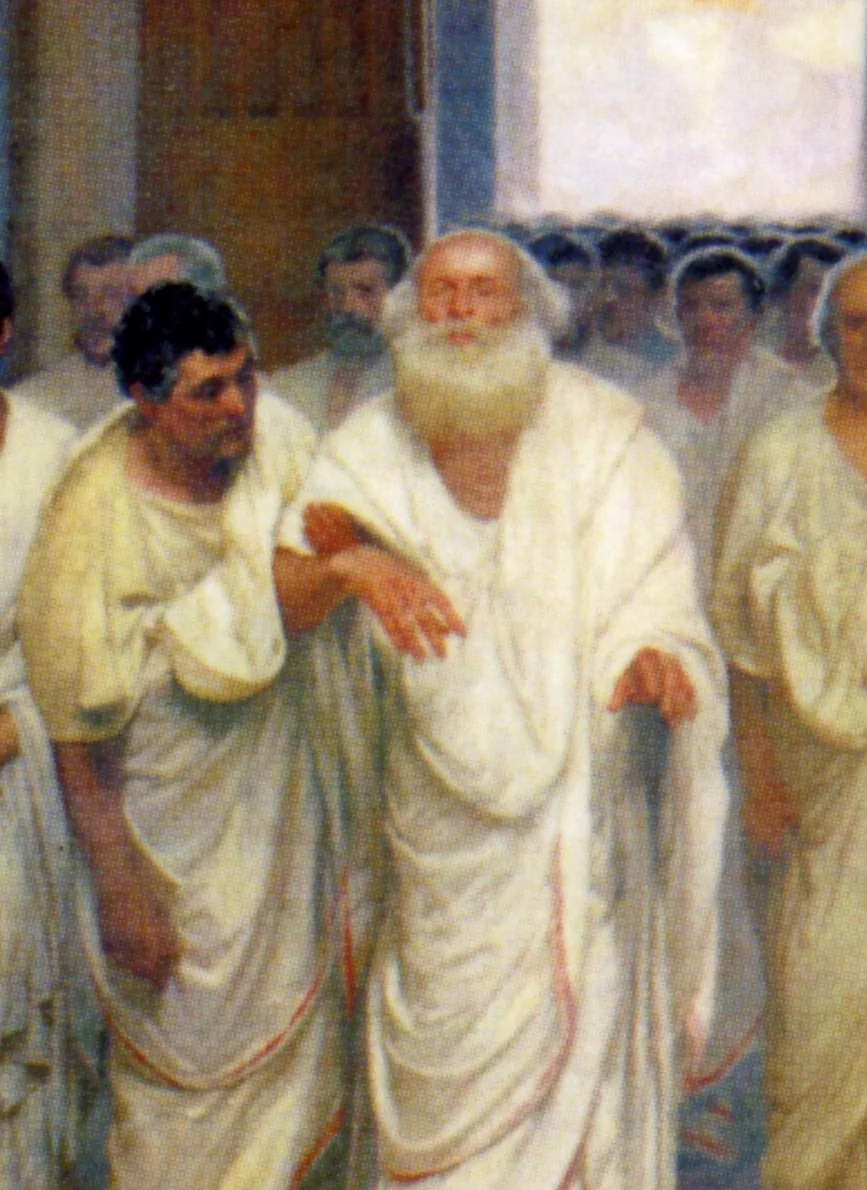
Cesare Maccari, Appius Claudius the Blind in the Senate (detail), 1882–1888. Palazzo Madama (the Italian Senate), Rome · Public domain · Source page
The censor who built Rome’s first highway and its first aqueduct, and who, old and blind, talked the Senate out of peace with Pyrrhus.
- Born: c. 340 BC (an estimate), Rome, into the patrician Claudii
- Died: After 280 BC; the date is not known
- Won: The Via Appia, from 312 BC; The Aqua Appia, Rome’s first aqueduct; Blocked peace with Pyrrhus, 280 or 279 BC
- Lost: Put sons of freed slaves in the Senate; his list was ignored; Stayed censor beyond the legal 18 months
“Every man is the architect of his own fortune.”
The king from Epirus
282–280 BC
Tarentum sends for a king
By 282 BC Rome’s frontier had reached the Greek cities of southern Italy. The richest was Tarentum, a colony of Sparta with a large fleet. When ten Roman warships sailed into its gulf, against an old treaty, the Tarentines sank several and threw the Roman garrison out of nearby Thurii. Rome declared war.
Tarentum, as before, sent to Greece for a general. Pyrrhus, king of Epirus and a kinsman of Alexander the Great, crossed in spring 280 BC with about 25,000 men and 20 war elephants, the first ever seen in Italy. The Romans called them “Lucanian oxen”. Plutarch says the Tarentines had promised him 350,000 foot and 20,000 horse from their Italian allies.
Pyrrhus, king of Epirus
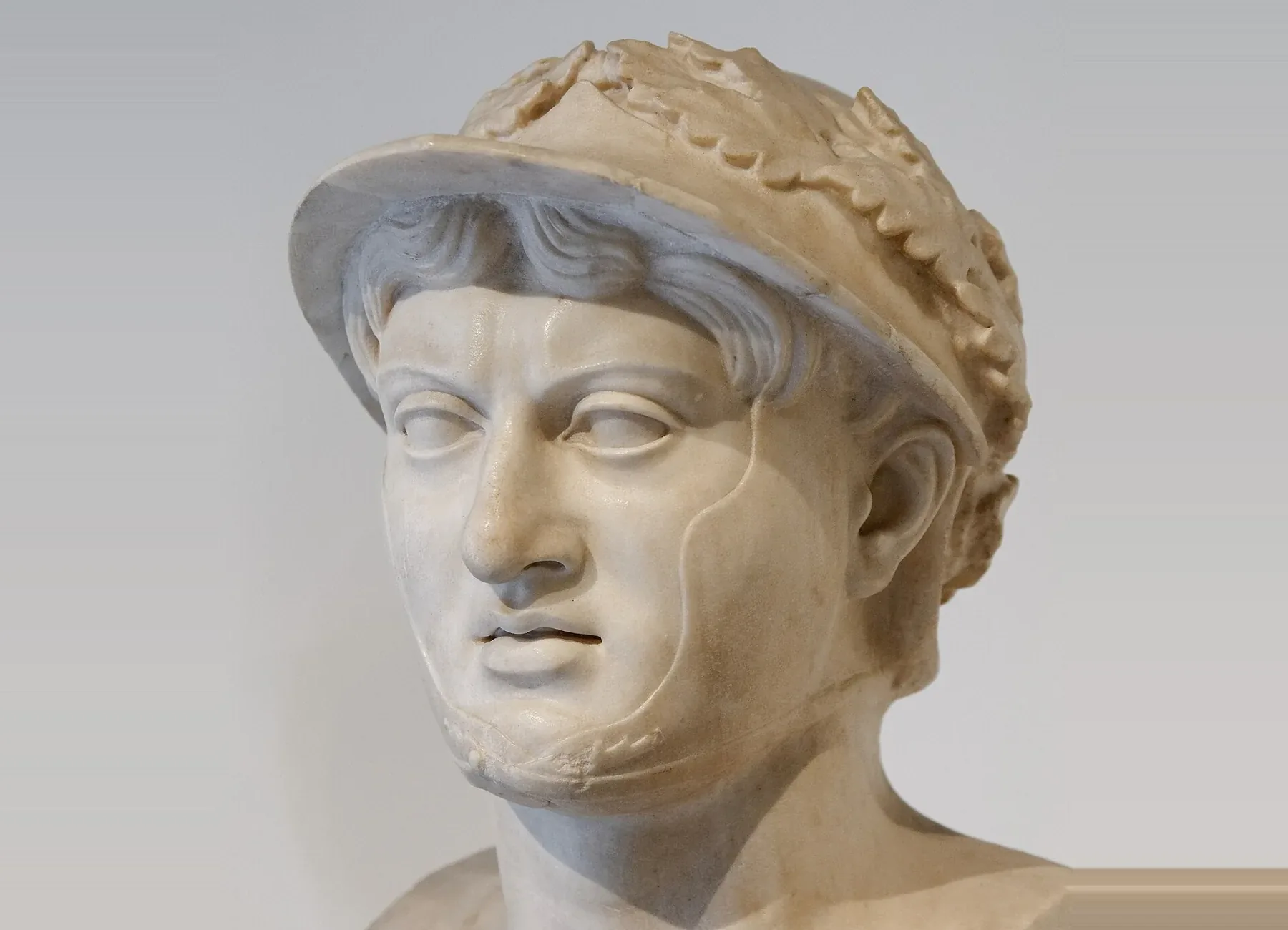
Head identified as Pyrrhus, marble. National Archaeological Museum, Naples (inv. 6150). Photo: Marie-Lan Nguyen · Public domain · Source page
A Greek king who beat Rome twice and still lost the war. In one story, Hannibal ranked him the greatest of all generals.
- Born: 319 or 318 BC, Epirus, into the Molossian royal house, which claimed descent from Achilles
- Died: 272 BC, Argos, in the Peloponnese, in street fighting: stunned by a roof tile a woman threw from a housetop, then beheaded
- Won: Heraclea, 280 BC; Asculum, 279 BC; The storming of Eryx, Sicily, 277 BC; Against Antigonus Gonatas in Macedonia, 274 BC
- Lost: The siege of Lilybaeum, Sicily, 277–276 BC; Beneventum, 275 BC; The assault on Sparta, 272 BC; Argos, 272 BC, where he was killed
“The discipline of these Barbarians is not barbarous; but the result will show us what it amounts to.”
Heraclea: who fought whom
Summer 280 BC
The Siris (today the Sinni), near Heraclea
Rome and its allies
- Commanders: Publius Valerius Laevinus, consul
- Strength: give no figure (Ancient sources); probably 20,000–30,000 (Modern estimate)
- Losses: nearly 15,000 dead (Dionysius (in Plutarch)); 7,000 dead (Hieronymus of Cardia (in Plutarch)); 1,800 taken prisoner (Eutropius)
Hieronymus lived at the time and could read Pyrrhus’s own memoirs; most historians prefer his lower figures.
Pyrrhus and the Tarentines
- Commanders: Pyrrhus, king of Epirus, Megacles, killed in the king’s armour
- Strength: 20,000 foot, 3,000 horse, 2,500 archers and slingers, 20 elephants (Plutarch: the army that sailed); perhaps 25,000–35,000 (Rough modern estimate, with the Tarentines)
- Losses: 13,000 dead (Dionysius (in Plutarch)); fewer than 4,000 dead (Hieronymus (in Plutarch))
Part of the army was lost in a storm on the crossing. Pyrrhus fought “with his own troops and the Tarentines alone”: his Italian allies arrived after the battle.
Outcome: A victory for Pyrrhus. The Romans recross the river and flee, leaving their camp. But Pyrrhus loses many of his best men and officers.
Every figure reaches us through later writers, and even the best of them differ by a factor of two or more.
The battle on the Siris
Heraclea, summer 280 BC, one day until nightfall
Pyrrhus, king of Epirus, is camped on the plain between Heraclea and the river Siris, after the Tarentines called him to help against Rome. Facing him is a Roman army under the consul Publius Valerius Laevinus, and the two armies lie on either side of the river. At stake: the future of the Greek cities of southern Italy.
After Plutarch, Pyrrhus 16–17, and Zonaras 8.3 (an abridgement of Cassius Dio). Only Heraclea (at modern Policoro) and the Siris (today the Sinni) are certain; the camps, the ford and the battle lines are fixed by no find. This map follows one common reconstruction, with the battle in the coastal plain north of the river; another puts Pyrrhus’s camp inland near Pandosia (probably Anglona) and the fighting in the Sinni valley. Which wing the elephants struck is not recorded.
The map is turned so that the river runs across it from left to right: north is to the upper left. The coastline and river courses are today’s, and both have moved since 280 BC; the shore probably lay closer to Heraclea. Positions are approximate, and unit depths are exaggerated so they can be seen.
Phases of the battle
- Across the Siris Pyrrhus is camped in the plain between Heraclea and the river. He rides to the bank, studies the Roman camp and is struck by its order. He decides to wait for his allies, and posts a guard on the bank.
- The Romans cross The Romans do not wait. Their infantry cross at a ford and their cavalry, Plutarch says, “at many points”; in Zonaras they cross upstream to reach the rear. The guard falls back. Pyrrhus rides out with 3,000 horsemen to catch them mid-crossing, and arrives too late.
- Seven turns of fortune In the cavalry fight Pyrrhus’s horse is killed under him. He gives his cloak and armour to an officer, Megacles, and brings up the phalanx. “Seven turns of fortune” follow. Megacles is cut down and the Romans cheer that the king is dead, until Pyrrhus rides along the lines bareheaded.
- The elephants At last Pyrrhus sends in the elephants. Roman horses that have never seen or smelled one panic and bolt with their riders, and the Thessalian cavalry charges into the confusion. Here the elephants strike the horsemen who crossed upstream, as Zonaras suggests; which wing it really was is not known.
- Back across the river A wounded elephant runs wild and throws the pursuit into disorder, and night falls. The Romans recross the Siris and flee to a town in Apulia. Pyrrhus takes their camp, but he has lost many of his best men.
The strategy
- Rome and its allies: The Romans do not wait. Their infantry cross at a ford, and their cavalry at several points, in Zonaras also upstream, to reach Pyrrhus’s rear. The reconstruction does not explain why they did not wait.
- Pyrrhus and the Tarentines: Pyrrhus chooses to wait for his allies and posts a guard on the bank. When the Romans cross, he rides out with 3,000 horsemen to catch them in mid-crossing, then brings up the phalanx and the elephants. The elephants frighten Roman horses that have never seen one.
What decided it: The elephants decided it: Roman horses that had never seen one panicked, and the Thessalian cavalry broke into the confusion. But the victory cost Pyrrhus many of his best men and officers, and the Romans managed to recross the river and flee.
A decision point
You are Pyrrhus, king of Epirus.
Late 280 BC, in Tarentum
You beat a consul on the Siris. Then you marched north, close to Rome, hoping its allies would desert it. Some allies came over, but Capua and Neapolis shut their gates, no Latin city joined you, and when a larger Roman army barred the way, you fell back to Tarentum.
Now Roman envoys have come, but only to ransom their prisoners. Your officer Milo says: give nothing back, make no truce, finish them by war. Your adviser Cineas says: you have lost your best men and cannot replace them; win by skill what you cannot win by force.
What do you do?
- Follow Milo: keep the prisoners and fight on in spring Rome would know you mean to destroy it, and would fight to the last man. You would be betting on more victories with an army you cannot refill.
- Follow Cineas: free the prisoners and send him to Rome to offer peace A generous gesture from a winner. If the Senate agrees, you go home as protector of the Italian Greeks. If it refuses, you have given Rome back its soldiers for nothing.
- Take the ransom, stay in the south and wait Money for your soldiers, and no risk. But Rome gets its men back and time to recover, while you sit in Tarentum.
What really happened
Follow Cineas: free the prisoners and send him to Rome to offer peace
Pyrrhus took Cineas’s advice. He freed the prisoners without ransom (in one version, only on parole) and sent Cineas to Rome with gifts and an offer: the Romans could have their men back and his help in Italy, in return for friendship and peace for Tarentum. Plutarch says the king thought “a friendly settlement with them after a victory would greatly enhance his reputation”.
Many historians, Pierre Lévêque among them, think Pyrrhus never meant to destroy Rome: he wanted a protectorate over the Greek south, and peace would give him that. Plutarch, by contrast, shows him dreaming of Sicily, Carthage and the whole West. What defeated the march north went back to 338 BC: Rome’s allies stayed loyal.
A decision point
You are members of the Roman Senate.
280 BC (or perhaps 279), in Rome
Cineas, the king’s envoy, has won Pyrrhus more cities with words, the king says, than he has won with arms. He offers your prisoners back without ransom and the king’s help in Italy. In return Pyrrhus asks only friendship and “immunity for the Tarentines”.
You have lost one great battle and expect another, now that the Italian Greeks have joined the king. Most of you, says Plutarch, are “plainly inclined towards peace”. Then the sons of the old censor Appius Claudius, blind and long retired, carry him in.
How do you vote?
- Accept: the prisoners come home and the war ends Your men come back and the fighting stops. But a foreign king becomes protector of the south, Tarentum is untouchable, and every ally in Italy learns that Rome can be beaten.
- Bargain first over the Samnite and Lucanian lands You might keep more of what you have won. But bargaining with a king whose army and elephants stand in Italy is bargaining from weakness, and the Samnites are watching to see who wins.
- Refuse to talk while Pyrrhus is in Italy You give up the chance to get your men back, and risk more defeats. But you show your allies and your enemies that Rome does not bargain when it loses.
What really happened
Refuse to talk while Pyrrhus is in Italy
Appius spoke, and the mood turned. In Plutarch’s version he says: “it now distresses me that I am not deaf as well as blind”. He warns that if Pyrrhus goes unpunished, others “will despise you as men whom anybody can easily subdue”.
Cineas was sent back with the answer that Pyrrhus “must first depart out of Italy”. He told the king that the Senate had seemed to him “a council of many kings”.
The words are Plutarch’s. But the moment is unusually well attested: Cicero, some 235 years later, says that “the actual speech of Appius is still extant”, and an inscription of Augustus’s time records that he prevented peace with King Pyrrhus. Peace would have left a foreign king master of the south.
279–275 BC
One victory too many
In 279 BC Pyrrhus beat the Romans again, at Asculum in Apulia, in two days of fighting decided by his elephants. Hieronymus, citing the king’s own notes, counted 6,000 Roman dead and 3,505 of Pyrrhus’s men. The king could not replace his; Rome could. After one of these two victories he made the remark that gave us the “Pyrrhic victory”.
In 278 BC he sailed to Sicily to fight Carthage for the Greeks there. He took almost the whole island but failed before Lilybaeum, and his harshness turned the Sicilian Greeks against him. Leaving in 276 BC, he is said to have looked back and said: “My friends, what a wrestling ground for Carthaginians and Romans we are leaving behind us!”
In 275 BC he met the consul Manius Curius Dentatus near Maleventum. His night march through wooded hills went astray; in the plain, javelins from the Roman camp drove his elephants back into his own ranks. He sailed home with 8,000 foot and 500 horse. The Romans renamed the town Beneventum: “good outcome” instead of “bad”.
How do we know?
Source: A historian who doubts
Preface: “This much license is conceded to the ancients, that by intermingling human actions with divine they may confer a more august dignity on the origins of states.”
6.1: “Written records, which form the only trustworthy memorials of events, were in those times few and scanty, and even what did exist… nearly all perished in the conflagration of the City.”
Livy began writing as Augustus came to power, after a century of civil wars. Book 6 opens after the Gallic sack.
- Does Livy believe the founding stories? Why tell them anyway? He will not vouch for them, but he will not throw them out: legends give a nation “a more august dignity”. He writes to inspire, not only to inform.
- What happened to the records before the sack, and what does that mean for his story of those years? Nearly all burned, so his early books rest on memory, family stories and earlier writers. Archaeologists find no great layer of burning from that time, and suspect the loss was also a convenient excuse.
- Which parts of the early story are most likely to be true? Things that could be written down or seen: magistrates’ names, treaties, laws, temples, colonies. Least reliable are speeches and exact numbers.
Source: “One more such victory”
“If we are victorious in one more battle with the Romans, we shall be utterly ruined.” For he had lost a great part of the forces with which he came, and all his friends and generals except a few… while the army of the Romans, as if from a fountain gushing forth indoors, was easily and speedily filled up again.
Plutarch puts the saying after Asculum, in 279 BC. Cassius Dio, writing around AD 220, puts it after Heraclea; in Zonaras’s summary of Dio: “If we ever conquer again in like fashion, it will be our ruin.” So does Orosius, in AD 417.
- After which battle did Pyrrhus say it? Can we know? We cannot. Good sayings travel to whichever moment suits them best. On the point, the sources agree: his losses could not be replaced.
- Plutarch gives counts from Hieronymus and from Dionysius. Which would you trust more? Hieronymus lived at the time and read the king’s own notes. Dionysius wrote some 270 years later and liked big numbers. Most historians prefer Hieronymus.
- Does a “Pyrrhic victory” mean that Pyrrhus lost? No. He won both battles. The phrase means a win that costs more than the winner can afford, because the loser can refill his ranks and the winner cannot.
Source: A wolf for the Greeks
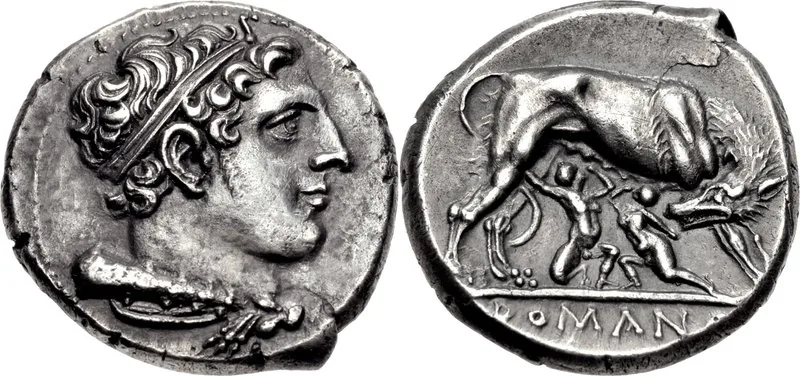
Roman silver didrachm (Crawford 20/1). Sale photograph: Classical Numismatic Group · CC BY-SA 2.5 · Source page
Silver didrachm of Rome, about 269–255 BC (Crawford dates it 269–266; Roman Republican Coinage 20/1)
One of Rome’s first silver coins, struck to the Greek standard of weight and used mostly in the south. One side shows Hercules; the other, the she-wolf suckling the twins, with the word ROMANO, “of the Romans”.
- Why put the founding story on a coin at this moment? Pyrrhus had not long gone, and Rome now ruled Greek cities that used silver coins. The wolf told them who their new masters were, and that Rome too had a noble origin, touched by the gods.
- This coin is some 1,300 to 1,400 years older than the bronze wolf on the first screen, if that is medieval. What is it good evidence for? For what Romans believed, and wanted others to believe, in the years after Pyrrhus left. It shows the legend was official by then; it does not show that Romulus existed.
Master of Italy
264 BC
A peninsula of treaties
By 264 BC Rome ruled Italy south of a line from Pisa to Rimini. It was not one state but a web: Roman citizens on about a fifth of the land, Latin colonies at the key points, and dozens of allied peoples and cities, each bound to Rome by its own treaty and owing it soldiers.
Polybius, whose history begins here, says that before Pyrrhus came the Romans attacked the rest of Italy “not as if it were a foreign country, but as if it rightfully belonged to them”. In 264 BC a quarrel at Messana, across the strait in Sicily, drew Rome into its first war overseas, against Carthage.
How Italy became Roman
- 338 BC The Latin League is broken up; Latins and Campanians are bound to Rome town by town.
- 312 BC Appius Claudius begins the Via Appia and builds Rome’s first aqueduct.
- 295 BC Sentinum: the alliance of Samnites and Gauls is broken.
- 280 BC Heraclea: Rome’s first battle against a Hellenistic king and his elephants.
- 279 BC Asculum; Rome and Carthage renew their treaty, with clauses about Pyrrhus.
- 275 BC Beneventum; Pyrrhus leaves Italy.
- 273 BC Ptolemy II of Egypt sends envoys to make friends with Rome: the Greek world takes notice.
- 272 BC Tarentum surrenders; Pyrrhus is killed at Argos.
- 269–255 BC Rome strikes silver coins with the wolf and twins.
- 264 BC Rome is master of the peninsula; the first war with Carthage begins.
- 91–88 BC The allies, still without Roman citizenship, rise in the Social War, and in the end are granted it.
Why did Rome conquer Italy?
Was Rome more aggressive than its neighbours, or simply better at winning, and at keeping what it won?
- W. V. Harris, War and Imperialism in Republican Rome, 327–70 B.C. (1979) Roman society was built for war. Nobles won office, glory and triumphs only through victories, and ordinary citizens expected land and booty. Rome went to war almost every year, by choice. Its expansion was aggressive and deliberate, whatever Romans later said about defending their allies.
- A. M. Eckstein, Mediterranean Anarchy, Interstate War, and the Arrival of Rome (2006) Every state of the ancient Mediterranean was militarised and aggressive, in a world without international law. Samnites, Gauls, Tarentines and Hellenistic kings were no gentler. Rome was not unusually warlike; it was unusually good at turning beaten enemies into allies.
- T. J. Cornell, The Beginnings of Rome (1995), and N. Rosenstein, Rome and the Mediterranean 290 to 146 BC (2012) The alliance system drove itself. The allies paid Rome only in soldiers, so the only way to profit from them was to fight. Each war brought land, colonies and new allies, and these made the next war possible.
When Rome went to war, it usually said it was defending an ally: Capua, Thurii, and soon Messana. Was that an excuse, or how the system really worked?
What do you know now?
Check yourself
Why do historians doubt that Romulus founded Rome in 753 BC?
Answer: The date is a late calculation, ancient writers disagreed on it, and archaeology shows villages growing together slowly. Right. Varro and Atticus worked out 753 in the 1st century BC, others gave dates from 814 to 729, and huts stood on the hills from about 1000 BC.
Check yourself
Why did each Roman victory make Rome stronger for its next war?
Answer: Beaten peoples became allies who had to send soldiers. Right. Each people got its own treaty, with no tribute but a duty to serve, and colonies were planted on the land taken. So the army grew with every victory.
Check yourself
What finally broke the Romans at Heraclea?
Answer: The elephants panicked their horses, and the Thessalian cavalry charged into the confusion. Right. Roman horses had never seen elephants. Plutarch says they bolted before they even got near, and Pyrrhus brought his Thessalian horse down on them.
Check yourself
What did the Senate answer Cineas, after Appius Claudius spoke?
Answer: That Pyrrhus must first leave Italy, and only then would they talk about friendship. Right. Appius argued that peace with a king winning inside Italy would show everyone that Rome could easily be subdued.
Check yourself
What does a “Pyrrhic victory” mean?
Answer: A win that costs the winner so much that he cannot afford another. Right. Pyrrhus won at Heraclea and Asculum, but could not replace his men, while Rome refilled its ranks “as if from a fountain”.
Check yourself
What can the silver coin with the wolf and twins, from the 260s BC, tell us?
Answer: That by then the founding legend was an official part of how Rome presented itself. Right. A state chose to put the story on its money, just as it began to rule Greeks. That is evidence of what Romans believed and spread.
Terms
- Senate Rome’s council of about 300 men, mostly former magistrates, who sat for life. In law it only gave advice; in practice it ran Rome’s wars and dealings with other states.
- consul One of the two chief magistrates of the Roman Republic, elected every year for one year. The consuls commanded Rome’s armies.
- censor A magistrate elected about every five years to count the citizens, revise the list of senators and let contracts for public works.
- annalists Roman historians of the 2nd and 1st centuries BC who wrote Rome’s history year by year, and often filled the gaps with invented speeches, numbers and details. Livy relied on them.
- allies (socii) Peoples and cities of Italy each bound to Rome by a treaty of their own. They paid Rome no tribute, but had to send soldiers to its wars, and Rome decided their dealings with other states.
- colony A new town of Roman or Latin settlers, planted on conquered land at a key point: a farming village and a garrison at once.
- citizenship without the vote Roman rights in law, trade and marriage, and the duty to serve in the army, but no vote and no office in Rome. Capua received it in 338 BC.
- legion The basic unit of the Roman army, about 4,000 to 5,000 foot soldiers. It was divided into small companies, maniples, set in three lines, so that tired men could be relieved by fresh ones.
- phalanx The Macedonian battle formation: a deep, dense block of men holding pikes about six metres long. Very strong in front, but clumsy on broken ground and weak on its flanks.
- devotio A Roman general’s vow giving himself and the enemy army to the gods of the underworld, after which he rode into the enemy to die.
- the yoke A frame of three spears, two upright and one across them, under which a beaten army had to walk, bent and unarmed, as a sign of submission.
- Brennus The chief of the Gauls who, the story says, threw his sword onto the scale when Rome paid its ransom.
- Livy The Roman historian who wrote under Augustus. He was a patriot and a gifted storyteller, and did not vouch for all his early tales.
- Polybius A Greek historian, a hostage in Rome in the 2nd century BC.
- Dionysius of Halicarnassus A Greek historian who wrote on Rome, a contemporary of Livy.
- Plutarch A Greek writer who wrote a life of Pyrrhus around AD 100.
- Fabius Pictor The first Roman historian, who wrote in Greek around 200 BC.
- Tarentum A Greek city in southern Italy, a colony of Sparta with a large fleet.
- Epirus A kingdom in north-west Greece, ruled by Pyrrhus.
- Siris A river in southern Italy, where Pyrrhus beat a Roman consul.
- Capua A city in Campania, which shut its gates to Pyrrhus.
- Neapolis A city in southern Italy, which shut its gates to Pyrrhus.
- Samnites A tough highland people of the southern Apennines, who fought Rome on and off for almost forty years.
- Etruscans A people of northern Italy who joined the Samnites against Rome.
- Umbrians A people of northern Italy who joined the Samnites against Rome.
- Gauls A war band from northern Italy that routed the Romans at the Allia and took Rome around 390 BC.
- Bruttians A people of southern Italy whose lands Rome took.
- Luceria A Roman colony behind the Samnite lines, founded in 314 BC.
- Venusia A Roman colony, planted in 291 BC along the roads.
- Fregellae A Roman colony founded in 328 BC on land the Samnites claimed.
- Antium A Latin town that lost its warships, whose bronze beaks were fixed to the speakers' platform in the Forum.
- Sentinum A place in the Apennines where Rome beat the Samnites and Gauls in 295 BC.
- Asculum A town in Apulia where Pyrrhus beat the Romans again in 279 BC.
- Heraclea The site of the great battle where Pyrrhus beat the Romans, in 280 BC.
- Cineas Pyrrhus's adviser, who was sent to Rome with an offer of peace and the release of prisoners.
Sources
- Livy, From the Founding of the City, Preface; 1.3–7, 1.57–60; 5.35–49; 6.1; 8.3–14; 9.1–15, 9.29; 10.12, 10.23, 10.27–30; Periochae 11–15. Trans. W. M. Roberts (Everyman’s Library, 1905)
- Polybius, Histories 1.6–7; 2.18–24; 3.22–25. Trans. W. R. Paton (Loeb Classical Library, 1922)
- Plutarch, Life of Pyrrhus 1–34, esp. 8, 10, 13–26 and 34. Trans. B. Perrin, Plutarch’s Lives vol. IX (Loeb Classical Library, 1920)
- Cassius Dio, fragments of books 9–10, with Zonaras, Epitome 8.2–6. Trans. E. Cary, Dio’s Roman History vol. I (Loeb Classical Library, 1914)
- Dionysius of Halicarnassus, Roman Antiquities 1.71–79, 19.4–12, 20.1–3, 20.11–12. Trans. E. Cary (Loeb Classical Library, 1937–1950)
- Cicero, Cato Maior de Senectute 16. Trans. W. A. Falconer (Loeb Classical Library, 1923)
- Eutropius, Breviarium 2.11–15. Trans. J. S. Watson (Bohn, 1853)
- Orosius, Histories against the Pagans 4.1–2 (Latin text)
- [Sallust], Speech to Caesar on the State 1.2. Trans. J. C. Rolfe (Loeb Classical Library, 1921)
- Appian, Samnite History 7–10; Justin, Epitome 18.1–2; Pliny the Elder, Natural History 8.16
- Inscriptions: the Lapis Niger (CIL I² 1); the epitaph of L. Cornelius Scipio Barbatus (CIL I² 6–7 = ILS 1); the elogium of Appius Claudius Caecus (CIL XI 1827 = ILS 54)
- M. H. Crawford, Roman Republican Coinage (Cambridge University Press, 1974), no. 20/1
- T. J. Cornell, The Beginnings of Rome: Italy and Rome from the Bronze Age to the Punic Wars (c. 1000–264 BC) (Routledge, 1995)
- G. Forsythe, A Critical History of Early Rome: From Prehistory to the First Punic War (University of California Press, 2005)
- K. Lomas, The Rise of Rome: From the Iron Age to the Punic Wars, 1000–264 BC (Profile Books, 2017)
- M. Beard, SPQR: A History of Ancient Rome (Profile Books, 2015)
- E. T. Salmon, Samnium and the Samnites (Cambridge University Press, 1967)
- S. P. Oakley, A Commentary on Livy, Books VI–X, 4 vols. (Clarendon Press, 1997–2005)
- W. V. Harris, War and Imperialism in Republican Rome, 327–70 B.C. (Clarendon Press, 1979)
- A. M. Eckstein, Mediterranean Anarchy, Interstate War, and the Arrival of Rome (University of California Press, 2006)
- N. Rosenstein, Rome and the Mediterranean 290 to 146 BC: The Imperial Republic (Edinburgh University Press, 2012)
- P. Lévêque, Pyrrhos (E. de Boccard, 1957)
- J. Champion, Pyrrhus of Epirus (Pen & Sword, 2009)
- P. A. Kent, A History of the Pyrrhic War (Routledge, 2020)
- P. A. Brunt, Italian Manpower 225 B.C.–A.D. 14 (Clarendon Press, 1971)
- H. H. Scullard, The Elephant in the Greek and Roman World (Thames & Hudson, 1974)
- T. P. Wiseman, Remus: A Roman Myth (Cambridge University Press, 1995)
- T. P. Wiseman, “Reading Carandini”, Journal of Roman Studies 91 (2001), 182–193
- A. Carandini, Rome: Day One, trans. S. Sartarelli (Princeton University Press, 2011)
- A. M. Carruba, La Lupa capitolina: un bronzo medievale (De Luca, 2006)
Image credits
- The Capitoline Wolf, bronze. Capitoline Museums, Rome. Photo: Wilfredor (background removed) · CC0 · Source page
- Sarcophagus of Scipio Barbatus, 3rd century BC. Vatican Museums (Museo Pio-Clementino). Photo: Gary Todd · Public domain · Source page
- The ancient Via Appia near Casal Rotondo, 2014. Photo: Livioandronico2013 · CC BY-SA 4.0 · Source page
- Cesare Maccari, Appius Claudius the Blind in the Senate (detail), 1882–1888. Palazzo Madama (the Italian Senate), Rome · Public domain · Source page
- Head identified as Pyrrhus, marble. National Archaeological Museum, Naples (inv. 6150). Photo: Marie-Lan Nguyen · Public domain · Source page
- Roman silver didrachm (Crawford 20/1). Sale photograph: Classical Numismatic Group · CC BY-SA 2.5 · Source page


