One empire becomes two
In 476 a barbarian general sent the imperial regalia to Constantinople: the West, he said, no longer needed an emperor. How did it come to that?
Decisions, questions and your own progress, in the app
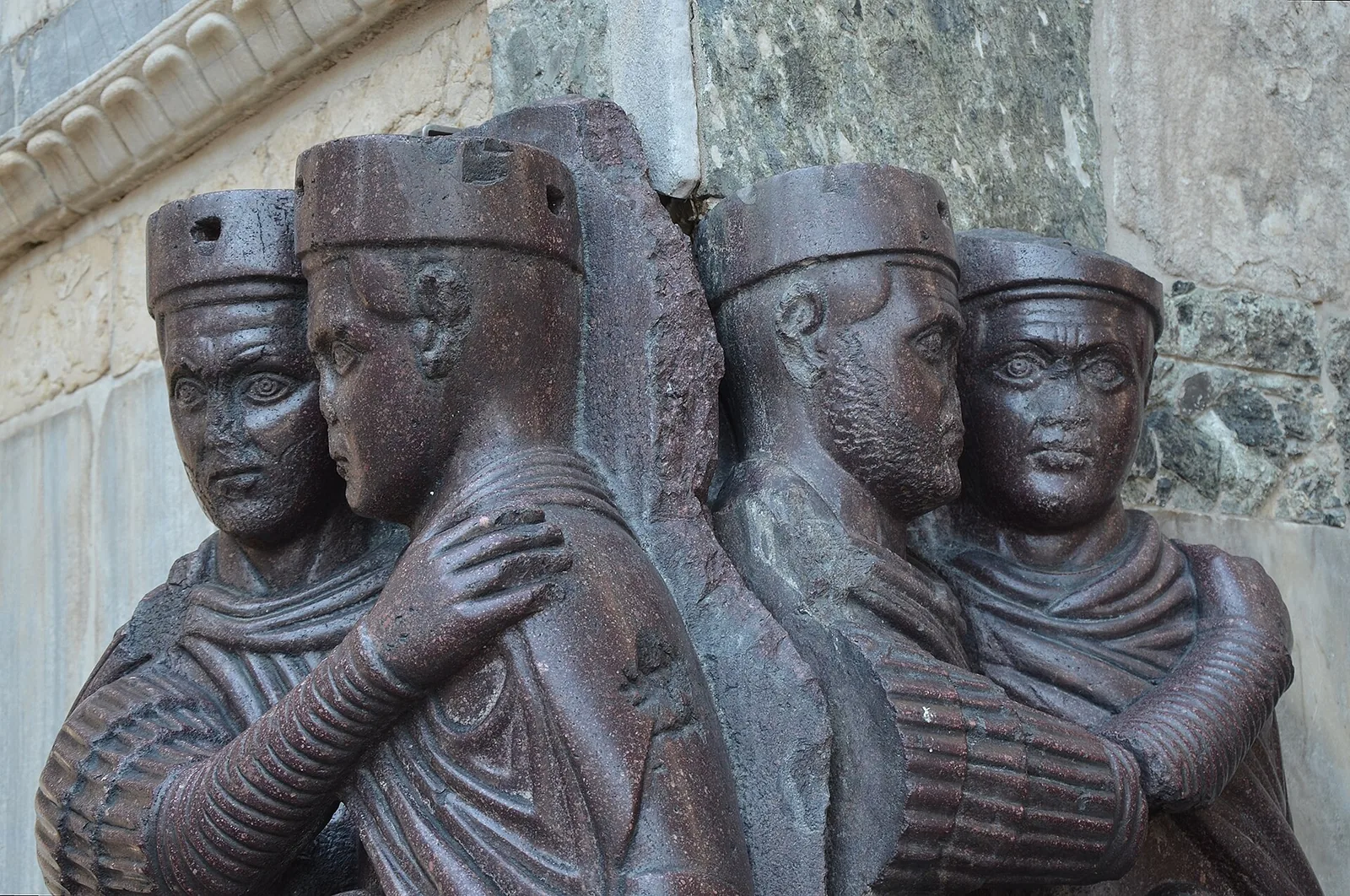
The Tetrarchs, porphyry, c. AD 300. Corner of St Mark's Basilica, Venice. Photo: Carole Raddato · Carole Raddato from FRANKFURT, Germany · CC BY-SA 2.0 · Source page
Crates for Constantinople
One emperor fewer
Ravenna, 476. A purple robe and a diadem are packed for a long journey, to Constantinople. A general named Odoacer is sending the western emperor's regalia to the emperor of the East, with a message: the West no longer needs an emperor of its own.
The boy who wore them, Romulus, is sent to live on a pension near Naples. No battle, no burning city, no last stand. A parcel and a letter.
Less than two hundred years earlier, four emperors had embraced to hold the same empire together. Their statue, in purple stone, now stands in a corner of a church in Venice. How did one empire, ruled from Rome since Augustus, become two, and why did only one of them survive?
Four emperors
Background, 235–284
Fifty years of murdered emperors
For two and a half centuries after Augustus, whom we met at Actium, one emperor ruled some 50 to 70 million people from Rome. Then, in the fifty years before 284, about two dozen emperors were recognised. Most were killed by their own soldiers: armies made emperors, and armies unmade them.
Enemies pressed on two fronts at once. On the Rhine and the Danube, Goths and other peoples raided deep into the provinces; in 251 the Goths killed the emperor Decius in battle. In the East a new Persian dynasty, the Sasanians, captured the emperor Valerian in 260, and he died a prisoner. For a time Gaul broke away as an empire of its own, and Queen Zenobia of Palmyra took the eastern provinces.
To pay their soldiers, emperors mixed less and less silver into the coins, and prices soared. In the 270s even Rome had to be walled. Historians call these years the ‘third-century crisis’.
Diocletian
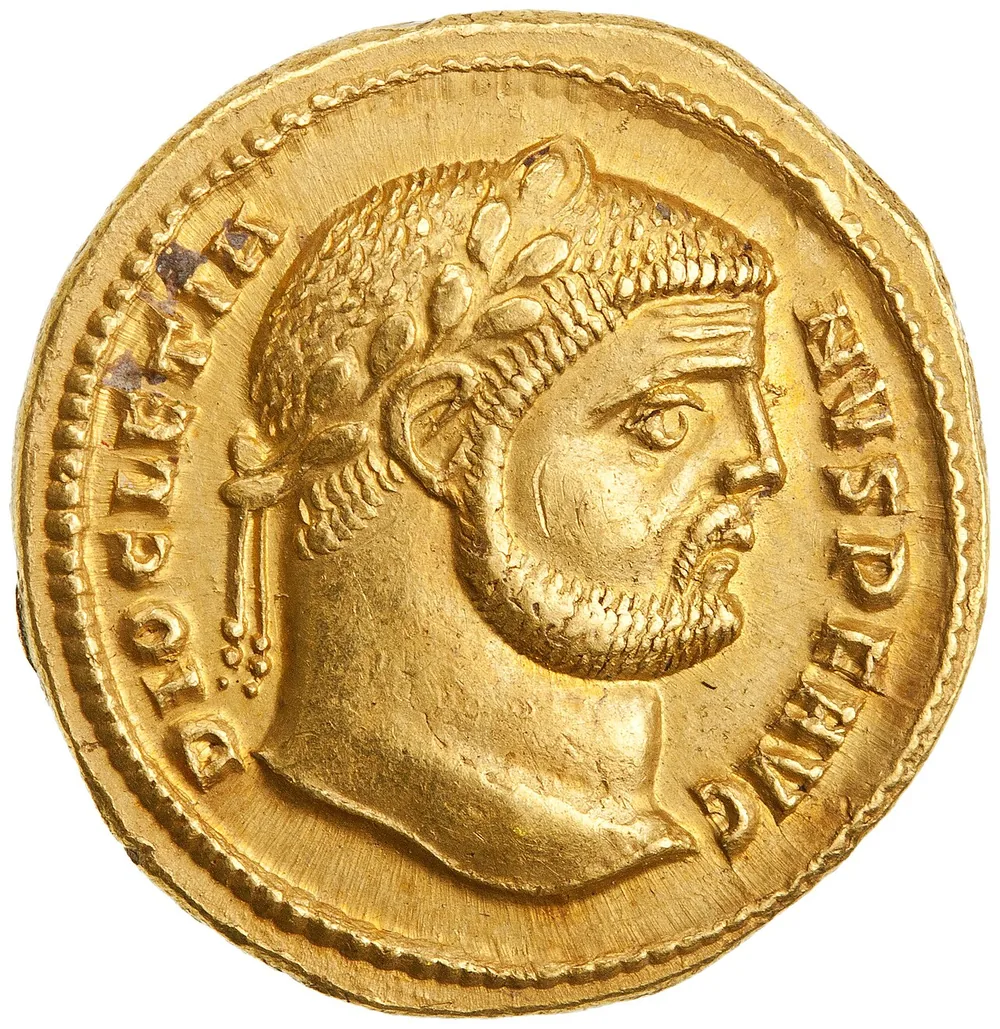
Gold aureus of Diocletian, Nicomedia, c. 294. American Numismatic Society, 1955.191.4 · CC0 · Source page
A soldier of humble birth who saved the empire by sharing its rule, persecuted the Christians, and was the first emperor to retire.
- Born: c. AD 244, Dalmatia, probably near Salona (by Split, Croatia); born Diocles
- Died: c. 311 (the date is disputed), his palace at Split, in retirement; how he died is unclear
- Won: Civil war against Carinus, 285; Revolt in Egypt crushed, 297–298; War with Persia, 298 (won by Galerius)
- Lost: Britain, held by the rebels Carausius and Allectus, 286–296; Galerius's defeat by the Persians, 296 or 297
“nor ought the ancient religion to be subjected to the censure of a new creed. It is indeed highly criminal to discuss doctrines once and for all settled and defined by our forefathers”
A decision point
You are Diocletian, emperor of Rome.
Early 293
Eight years ago the army made you emperor. You were born Diocles, a nobody from Dalmatia. You know exactly how emperors die: their own soldiers kill them, or a general far away is proclaimed in their place.
Since 286 you have shared power with Maximian, an old comrade, as a second Augustus for the West. A rebel admiral, Carausius, rules Britain as emperor. The Persians threaten Syria, Egypt is restless, and raiders cross the Rhine and the Danube. Every frontier needs an emperor on the spot, and every general with an army is a possible rival.
You have no son, only a daughter, Valeria.
How will you rule?
- Keep two emperors, and hand the frontier wars to trusted generals Simple. But the last fifty years show what generals do with big armies far from the emperor, and Carausius is one of them. Probably more usurpers, and more civil wars.
- Add two junior emperors, each with an army and a region, bound to you by adoption and marriage Four rulers in four corners of the empire, each close enough to a frontier to fight. An ambitious general sees a ladder to climb instead of a throne to seize. But four courts and four armies cost a fortune.
- Found a dynasty: raise your colleagues' sons as heirs, and keep power in the family Soldiers were loyal to dynasties, so this might hold the army. But the boys are children, Maximian's son Maxentius barely in his teens, and you need generals now, not in twenty years.
What really happened
Add two junior emperors, each with an army and a region, bound to you by adoption and marriage
On 1 March 293 Diocletian added two Caesars: Constantius in the West, for Gaul and Britain, and Galerius in the East. Each married into the family of one of the Augusti. This was the Tetrarchy: two Augusti, two Caesars, four courts, among them Trier, Milan and Nicomedia. By 298 Britain was recovered, Egypt subdued and Persia beaten.
Diocletian left no explanation that survives. Historians see a practical military answer rather than a grand design: more emperors meant more armies with an emperor at their head. But the habit of an eastern court and a western court, each with its own army, began here.
293–305
Order, prices and persecution
The four rulers rebuilt the state. Provinces were split into about a hundred smaller ones, grouped into twelve regions; governors no longer commanded troops. The army grew, perhaps to 400,000 men or more.
In 301 the emperors tried to stop prices by decree. Their edict, carved on stone in many eastern cities, set maximum prices for more than 1,000 goods, services and wages, with death for anyone who broke it. It failed: goods vanished from the markets, and prices kept rising.
In February 303 the emperors turned on the Christians, perhaps a tenth of the population. Churches were destroyed, scriptures burned, Christians stripped of rank; later everyone was ordered to sacrifice to the gods. This ‘Great Persecution’ lasted in the East until 311, and in the lands of Maximinus Daia until 313. We have no reliable count of the dead.
Then, on 1 May 305, Diocletian did what no emperor had done: he retired, and went home to a vast palace at Split, on the Dalmatian coast. Asked a few years later to come back, he is said to have answered that if they could see the cabbages he grew, they would not ask.
Source: Four men, one face
The Tetrarchs, porphyry, c. AD 300; at St Mark's, Venice, since the 13th century
The group is carved from porphyry, a purple stone quarried in only one place, in Egypt's eastern desert, and reserved for emperors. It once stood in Constantinople; Venetian crusaders took it home after sacking the city in 1204.
- Which of the four is Diocletian? We cannot be sure. The bearded pair are usually taken as the two senior Augusti, the clean-shaven pair as the Caesars. That we have to guess is exactly the point: the sculptor made the individual disappear.
- Why make four rulers look like one? The message is harmony: four bodies, one government. Each pair embraces, and each man grips his sword. Unity and force, the two things a frightened empire wanted to see.
- What does this object leave out? Everything that went wrong: the rivalry between the four, and how quickly their heirs went to war after 305. Official art shows how power wanted to look, not how it worked.
Constantine's sign
305–312
The sons strike back
Diocletian's plan had one flaw: it ignored sons. In 305 the new Caesars were two of Galerius's men. Left out were Constantine, son of Constantius, and Maxentius, son of Maximian: both grown men, with soldiers who knew them.
On 25 July 306 Constantius died at York, in Britain, and his army proclaimed his son Constantine emperor on the spot. In October Maxentius seized Rome. Within two years six men claimed the purple, and old Diocletian, asked to help, stayed with his vegetables. By 312 Constantine ruled Gaul and Britain, and Maxentius held Italy and Africa.
Constantine the Great
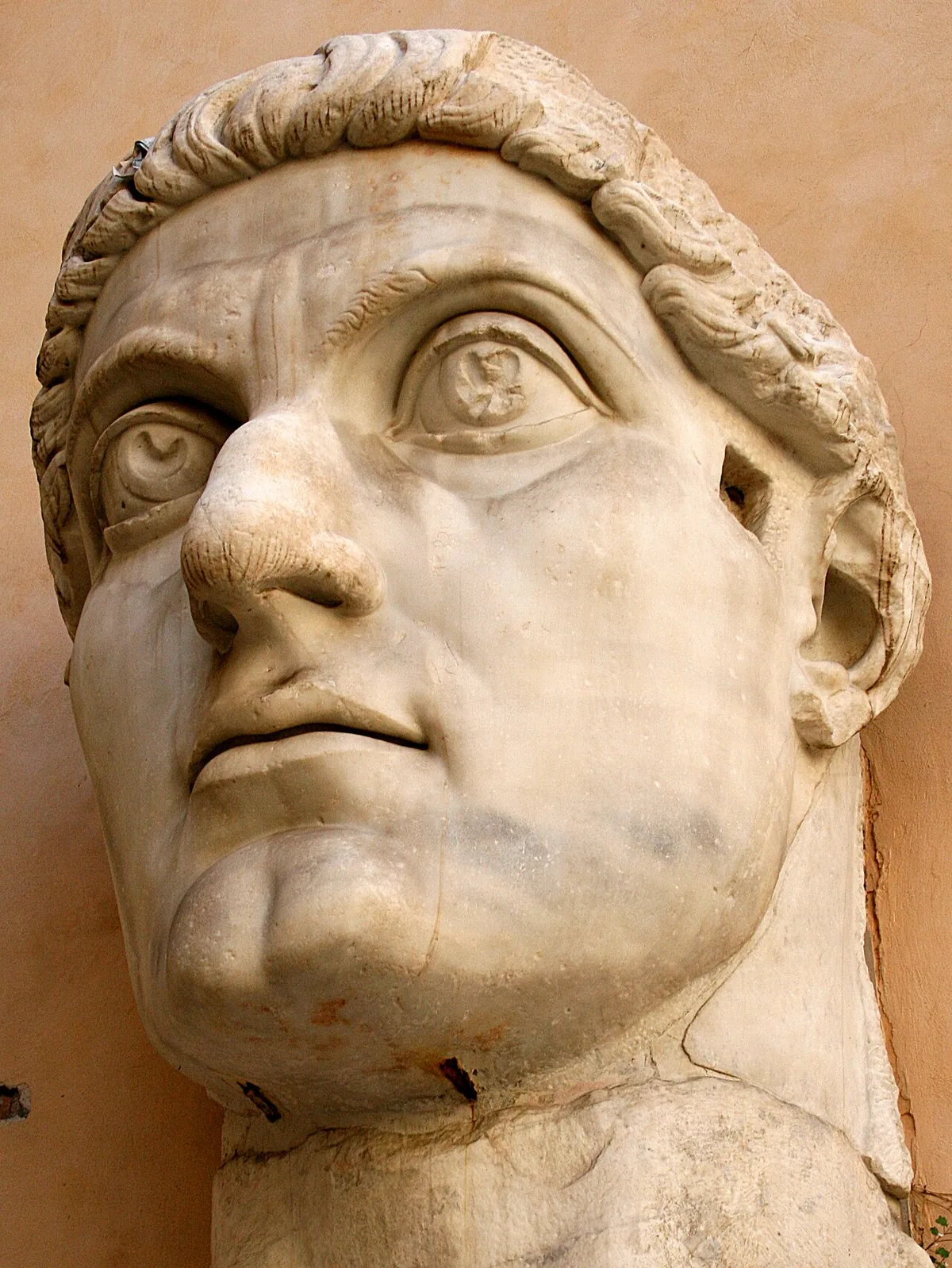
Head of the colossal statue of Constantine, marble, c. 313–324. Capitoline Museums, Rome. Photo: Jean-Pol Grandmont · User:Jean-Pol GRANDMONT (2011) · CC BY-SA 3.0 · Source page
The general who won Rome under a Christian sign, gave the Church its freedom, and founded a new Rome in the East.
- Born: 27 February, c. 272 (the year is disputed), Naissus (today Niš, Serbia)
- Died: 22 May 337, near Nicomedia, of illness, after being baptised on his deathbed
- Won: Turin and Verona, 312; The Milvian Bridge, 312; Adrianople and Chrysopolis, against Licinius, 324
“You are bishops whose jurisdiction is within the Church: I also am a bishop, ordained by God to overlook whatever is external to the Church.”
A decision point
You are Constantine.
Late October 312, on the Flaminian Way, north of Rome
You crossed the Alps in spring with part of your army, perhaps 30,000 to 40,000 men by modern estimates. You won at Turin and at Verona. Now Rome lies ahead, and winter is coming.
Maxentius has more men, and Rome has walls almost 19 kilometres long, which he has made higher. Two emperors before you, Severus and Galerius, marched on this city in 307; both failed, and their soldiers were bribed or deserted.
Maxentius is your brother-in-law. And your army carries, the sources say, something new: a sign on its shields.
What do you do?
- March straight on Rome and offer battle before winter If Maxentius comes out, one day decides everything. If he stays behind his walls, you face a winter siege with an army that could melt away like Severus's.
- Halt in the north for the winter, and win over Italy's cities first Safer for your army. But Maxentius gains months to recruit, ship grain from Africa and buy your officers.
- Offer Maxentius a share: Rome and Italy for him, the rest of the West for you It might end the war without blood. But Maxentius has called you a rebel, and an emperor who stops at the gates of Rome looks weak to his own men.
What really happened
March straight on Rome and offer battle before winter
Constantine came down the Flaminian Way. On 28 October, the sixth anniversary of Maxentius's own rule, Maxentius did not wait behind his walls: he crossed the Tiber by a bridge of boats beside the Milvian Bridge and fought with the river at his back. Constantine's cavalry broke his line. The fleeing army jammed onto the bridge, it gave way, and Maxentius drowned in the Tiber. His head was carried through Rome on a spear.
Why Maxentius came out is still debated: confidence, riots in the city, the anniversary, or an oracle; Lactantius says the Sibylline books promised that ‘the enemy of the Romans’ would die that day. Soon Constantine was telling the world that a god had won it for him. Which god, and how he knew, is the question of the next source.
Source: A dream or a vision?
Lactantius: “Constantine was directed in a dream to cause the heavenly sign to be delineated on the shields of his soldiers, and so to proceed to battle.”
Eusebius: “He said that about noon, when the day was already beginning to decline, he saw with his own eyes the trophy of a cross of light in the heavens, above the sun, and bearing the inscription, Conquer by this.”
Two Christian writers tell the story. Lactantius, the teacher sacked in the persecution, wrote within about three years, to show that God punishes persecutors. Eusebius, the bishop of Caesarea, who knew Constantine, wrote after the emperor's death, a quarter of a century after the battle. He says Constantine told him the story himself, long afterwards, and swore to it.
- Which account is closer to the battle, and how do they differ? Lactantius's, by more than twenty years. He has a dream the night before the battle and a sign painted on shields, probably the chi-rho. Eusebius has a cross of light in the sky in daylight, with words, somewhere on the march, and only then a dream. The story grew.
- Eusebius adds that the whole army saw the sign. Who else mentions it? Nobody: not Lactantius, not the pagan orator who praised the victory in 313, not even Eusebius himself in his earlier Church History. A sight seen by thousands that no one else records should make you suspicious.
- So did Constantine make it up? Not necessarily. The historian Peter Weiss argues that Constantine really saw a halo around the sun in 310, and later came to read it as Christian. Memories get rebuilt. Always ask: who told the story, when, and to whom?
313–337
Milan, Nicaea, Constantinople
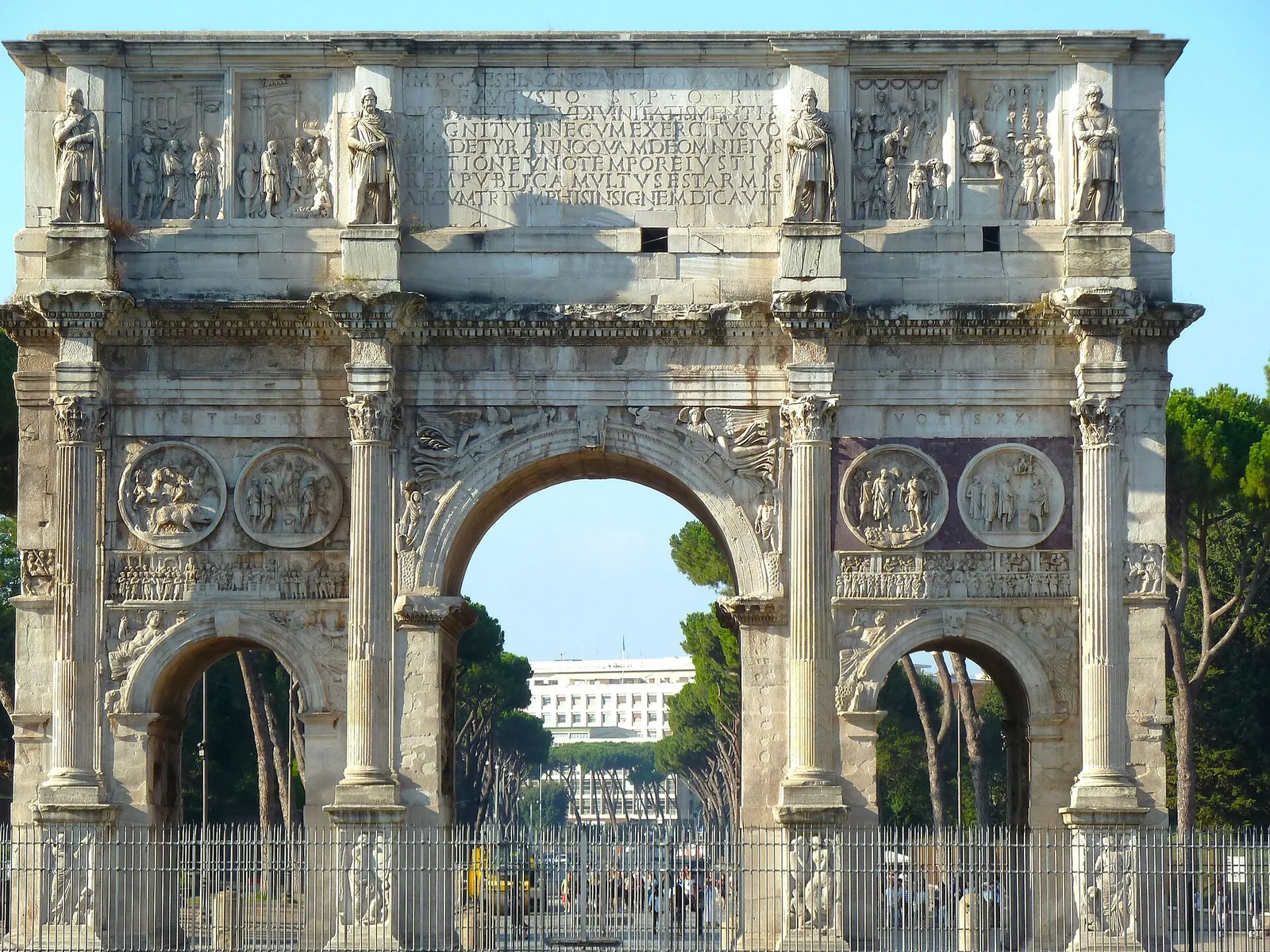
Arch of Constantine, north side, Rome, AD 315. Photo: Hugo DK · CC BY 4.0 · Source page
In February 313 Constantine met his eastern ally Licinius at Milan. Their agreement gave ‘the Christians and all others’ freedom to worship as they chose, and ordered confiscated church property returned. Constantine went further: he paid for great churches, St Peter's in Rome among them. He did not ban the old gods.
In 324 he defeated Licinius and ruled alone. A year later he gathered some 250 to 300 bishops at Nicaea, in Asia Minor. The Council of Nicaea condemned the priest Arius, who taught that Christ was created by the Father and was not his equal, and agreed a creed. The quarrel did not end there: Arianism lived on.
On 11 May 330 he dedicated a new capital on the site of the old Greek city of Byzantium, on the Bosporus: Constantinople, ‘Constantine's city’, a New Rome with its own Senate, close to the Danube and the Persian front. He also gave the empire a new gold coin, the solidus, which kept its value for centuries. Rome stayed the most famous city in the empire. It was no longer its centre.
The Goths at the Danube
337–375
Brothers, an apostate, and two halves
Constantine's death in 337 was followed by a massacre of most of his male relatives; his three sons divided the empire and then fought over it. By 353 only one was left, Constantius II.
His cousin Julian, who had survived the massacre as a child, came to power in 361 and tried to turn the clock back: he reopened temples, restored sacrifices, and even began to rebuild the Temple in Jerusalem, a project abandoned after fire broke out on the site. Christians called him ‘the Apostate’. He was killed in Persia in 363.
In 364 the army chose Valentinian, a tough officer, who at once made his brother Valens emperor of the East. At Naissus the two divided the army and the court between them. From then on there was almost always one emperor in the West and another in the East.
376–377
A people at the river
Around 370 horsemen from the steppe, the Huns, crushed the peoples north of the Black Sea. In 376 tens of thousands of Goths, the Tervingi under Fritigern, appeared on the north bank of the Danube and asked to be let in. Valens, who needed recruits for a war with Persia, agreed.
Ammianus Marcellinus, our best source, describes the crossing: they came “day and night, without ceasing”, on boats, rafts and hollowed tree trunks, and the officers sent to count them gave up. Then the Roman commanders, Lupicinus and Maximus, failed to feed them and sold them food at extortionate prices. A second Gothic group, the Greuthungi, crossed without permission.
At a banquet at Marcianople Lupicinus tried to seize the Gothic leaders. The Goths rose. For two years they roamed Thrace, and no Roman army could pin them down.
A decision point
You are Valens, emperor of the East.
9 August 378, before dawn, in your camp outside Adrianople (today Edirne, in Turkey)
You have come from Antioch to finish the Gothic war yourself. Your scouts report that the Goths, camped some way from the city with their wagons and families, number about 10,000 fighting men.
Your nephew Gratian, emperor of the West, has beaten the Alamanni on the Rhine and is marching to join you. His general Richomeres has brought a letter: wait for me. Gratian is young and already famous; you have spent two years losing Thrace.
In your council of war Sebastianus urges an attack. Victor, your master of cavalry, a Sarmatian by birth and a cautious man, urges you to wait. Meanwhile a Christian priest arrives from Fritigern, the Gothic leader, offering peace if his people are given Thrace to live in.
What do you do?
- Wait a few days for Gratian, and fight with both armies Probably the safer course: twice the men, and the Goths could hardly face both armies. But they might slip away to plunder elsewhere, and the victory would be Gratian's as much as yours.
- Attack today, before the Goths can gather or move If the scouts are right, a quick victory, all your own. If they are wrong, you fight a bigger enemy after a long march in the August heat.
- Accept Fritigern's terms and settle the Goths in Thrace The fighting stops, and you gain soldiers for Persia. But after two years of plunder a treaty now looks like defeat, and you cannot be sure Fritigern speaks for all the Goths.
- Hold Adrianople and the mountain passes, and starve the Goths out Slow, and cheap in lives. But the Goths have lived off Thrace for two years, a long blockade needs supplies you are short of, and meanwhile they threaten your road to Constantinople.
What really happened
Attack today, before the Goths can gather or move
Valens attacked. He left his baggage and treasure in Adrianople and marched from dawn, over rough roads in the heat, until at about two in the afternoon his army sighted the Gothic wagons. The scouts had been wrong: much of the Gothic cavalry was away foraging. Before nightfall the eastern army was destroyed and Valens was dead.
Ammianus blames vanity and jealousy: courtiers urged Valens to hurry, “so that Gratian might have no share in a victory which, as they fancied, was already almost gained” (31.12.7, trans. C. D. Yonge). Modern historians add the false intelligence, the heat, the scattered deployment and Valens's fear that the Goths would cut his supply road. Most think waiting was wiser; some, like Noel Lenski, stress that delay had real risks too.
Adrianople: who fought whom
9 August 378, from early afternoon to nightfall
Near Adrianople (Edirne), in Thrace; the exact field is unknown
The eastern field army
- Commanders: The emperor Valens, Trajanus and Sebastianus (infantry), Victor (cavalry), Richomeres, Gratian's envoy
- Strength: no figure: ‘a numerous force’ (Ammianus); 15,000–30,000 (Modern estimates (Heather; Williams and Friell))
- Losses: ‘scarcely one-third’ escaped; the emperor, two generals and 35 tribunes dead (Ammianus); 10,000–20,000 dead (Modern estimates (Heather; Williams and Friell))
Ammianus was not at the battle, but the list of fallen officers shows the disaster was real.
The Goths and their allies
- Commanders: Fritigern, Alatheus and Saphrax (cavalry), with Alans
- Strength: 10,000, ‘a mistake’ (Roman scouts, as reported by Ammianus); almost 200,000 fighting men crossed the Danube in 376 (Eunapius, c. 400); 10,000–20,000 warriors, plus families (Modern estimates (Delbrück; Williams and Friell))
- Losses: unknown (The sources)
Outcome: A crushing Gothic victory. Valens is killed and perhaps two-thirds of the eastern field army is lost. The Goths fail to take either Adrianople or Constantinople.
Ammianus gives almost no numbers, and Eunapius's figure is impossible. Modern estimates start from the units named and from what Valens could spare from the Persian front, so they differ widely.
The battle of Adrianople
9 August 378, afternoon
On 9 August 378 the eastern field army, under the emperor Valens, marches out from near Adrianople towards the Goths, who are camped with their families and wagons in a circle on a low ridge. Richomeres, Gratian’s envoy, has brought a letter asking Valens to wait for him.
The site is disputed: north of the city near the village of Muratçalı (MacDowall, Potter) or east of it near Demirhanlı (Runkel, Wanke, Lenski). This map follows Simon MacDowall's reconstruction (2001) and Ammianus 31.12–13. Positions, frontages and the direction from which the Gothic cavalry returned are approximate.
Phases of the battle
- Arriving in the heat Around two in the afternoon, after marching since dawn, the Romans sight the Gothic wagon circle on a low ridge. The right-wing cavalry deploys first, with the infantry forming up behind it; the left-wing cavalry is still strung out along the road. The Goths set the fields on fire, and Fritigern sends envoys to talk peace.
- Talks, and an attack without orders While hostages are argued over, and Richomeres volunteers to go to the Goths, a unit of archers and shieldmen under Bacurius and Cassio attacks the wagons without orders, and is thrown back. The left-wing cavalry comes up and takes its place west of the infantry.
- The cavalry returns The Roman left-wing cavalry pushes forward as far as the wagons. Then the Gothic cavalry of Alatheus and Saphrax returns, with Alans, “like a thunderbolt”, as Ammianus put it, and charges into the flank. The rest of the Roman cavalry does not come to help, and the left wing is crushed.
- The crush The Gothic infantry pours out of the wagons, and the horsemen turn on the flank of the Roman infantry, now left uncovered. The right-wing cavalry flees. The soldiers are pressed together until, Ammianus wrote, “a soldier could hardly draw his sword”. Dust, heat and thirst.
- Rout at nightfall As darkness falls the infantry breaks and flees south. Valens vanishes: in one version he is hit by an arrow and dies among his soldiers, in another he is burned in a farmhouse. His body is never found. “Scarcely one-third of the whole army escaped,” wrote Ammianus.
The strategy
- Roman army: Valens came to finish the Gothic war himself. The right-wing cavalry deployed first, with the infantry behind it, towards the wagon circle, while the left-wing cavalry was still strung out on the road.
- Goths: Fritigern held the Goths in the wagon circle with their families, and set the fields alight while sending envoys to talk peace. Alatheus and Saphrax’s cavalry came back and struck the Roman left wing, which had pushed up to the wagons. The sources do not say where the horsemen had been before.
- Alans: What the Alans planned is not known. They rode with Alatheus and Saphrax’s cavalry and charged the Roman left wing alongside them.
What decided it: What decided it was that the Roman left wing was crushed alone, while the rest of the cavalry did not come to help. The packed infantry, now exposed on the flank, broke and fled at nightfall.
Source: ‘His body was never found’
“the emperor being among a crowd of common soldiers, as it was believed—for no one said either that he had seen him, or been near him—was mortally wounded with an arrow, and, very shortly after, died, though his body was never found.”
“Scarcely one-third of the whole army escaped. Nor, except the battle of Cannæ, is so destructive a slaughter recorded in our annals”
Ammianus was a Greek from Antioch and a former staff officer. He finished his history at Rome around 390, some twelve years after the battle. He was a pagan who admired Julian and disliked Valens. He was not at Adrianople.
- Ammianus was not there. How does he show it? ‘As it was believed’, ‘no one said that he had seen him’. He tells us his information is hearsay, and then gives a second version: Valens was carried wounded to a farmhouse that the Goths set on fire. An honest historian marks what he does not know.
- Why compare Adrianople with Cannae? At Cannae, in 216 BC, Hannibal inflicted Rome's worst remembered defeat. The comparison tells readers how big the disaster felt; ‘scarcely one-third escaped’ is an impression, not a count.
- Many later Christian writers told only the farmhouse story. Why? Valens favoured the Arian form of Christianity, and in his reign the Goths became Christians in that form. Writers like Orosius and Jordanes saw death by fire as God's judgement. A source can choose between versions to suit its message.
The West without an emperor
379–395
One faith, two sons
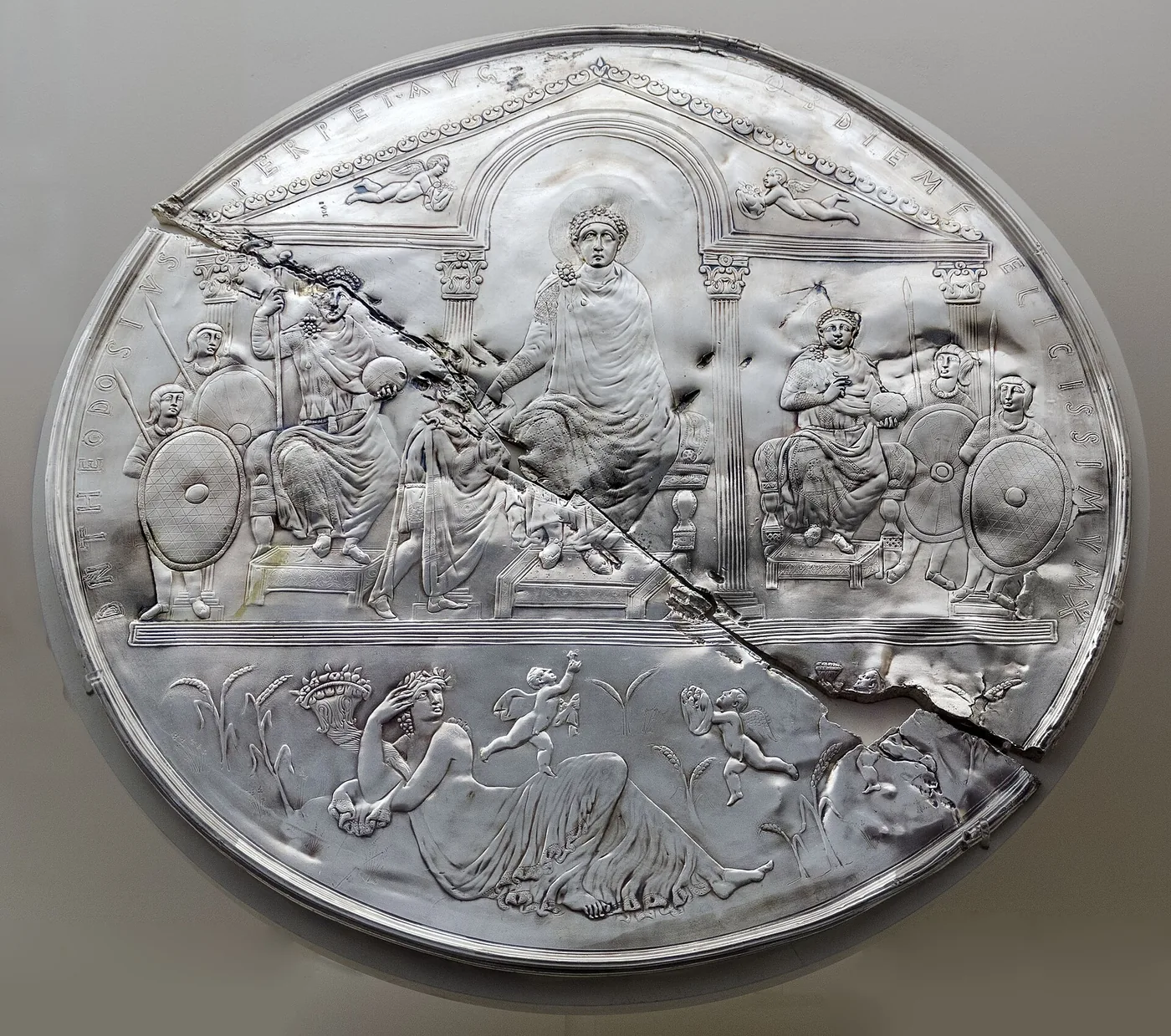
Replica of the Missorium of Theodosius (original: silver, 388, Real Academia de la Historia, Madrid). Museo Nacional de Arte Romano, Mérida. Photo: Ángel M. Felicísimo · CC BY 3.0 · Source page
After Adrianople, Gratian made a Spanish general, Theodosius, emperor of the East. He could not beat the Goths in the field either, so in 382 he settled them inside the empire, probably under their own leaders, as foederati who fought for Rome.
In 380 he ordered all his subjects to hold the faith of Nicaea; in 391–392 he outlawed pagan worship altogether. In 394 he won a civil war and ruled the whole empire, the last man to do so. When he died, in January 395, his sons divided it: Arcadius, about seventeen, took the East; Honorius, ten, the West. Nobody meant to create two empires. The halves never came together again.
395–455
‘The City which had taken the whole world’
Real power in the West now lay with generals, each a magister militum. Stilicho, son of a Vandal officer, ruled for the boy Honorius until he was executed in 408. Alaric, king of the Goths, wanted land, grain and a Roman command for his people. After two years of failed talks, on 24 August 410, his men plundered Rome for three days, sparing the churches and those who sheltered in them.
No enemy had taken Rome for 800 years. In Bethlehem, Jerome wrote: “The City which had taken the whole world was itself taken.” Pagans blamed the desertion of the old gods; Augustine, a bishop in Africa, answered them in The City of God.
Worse followed. In 439 the Vandals took Carthage, and with it the West's richest taxes and grain. In 451 the Roman general Aetius, with an army made up largely of Visigoths and other allies, stopped Attila's Huns in Gaul; in 452 Attila, his army hit by famine and disease, left Italy after meeting Pope Leo. In 455 the Vandals plundered Rome for two weeks.
A decision point
You are Odoacer, a general in Italy.
Early September 476, at Ravenna
For twenty years generals have made and unmade the emperors of the West: nine in twenty-one years. The latest, Orestes, once Attila's secretary, drove out the emperor Julius Nepos in 475 and crowned his own son, Romulus, a boy.
Your father served Attila; you have served Rome. The soldiers in Italy, mostly ‘barbarians’ like you, demanded a third of Italy's land. Orestes refused. They proclaimed you their king, and Orestes has been put to death. The boy is in your hands.
In Constantinople, the emperor Zeno still recognises Nepos, alive in Dalmatia, as emperor of the West.
What do you do with the boy and his throne?
- Put on the purple and rule as emperor yourself No ‘barbarian’ king has ever worn the imperial purple. The Senate would see a usurper, Zeno a rival, and every other general a target. Probably a short reign and a war with the East.
- Keep Romulus, or crown another puppet, and rule from behind the throne The general Ricimer ruled this way, and it works for a while. But every puppet gathers a court that wants to be rid of you, and Constantinople recognises no one but Nepos.
- Bring back Nepos, the emperor Constantinople recognises Lawful in Zeno's eyes. But Nepos owes you nothing, and he may hand your soldiers' new land back to its owners.
- Send the regalia to Constantinople, and rule Italy as king under the eastern emperor No rival emperor in Italy, and Zeno the only emperor, at least in name. You keep the army and the land. Everything depends on whether he accepts you.
What really happened
Send the regalia to Constantinople, and rule Italy as king under the eastern emperor
Odoacer deposed Romulus but spared him: the boy got a pension and an estate near Naples. At Odoacer's bidding the Senate sent envoys and the regalia to Zeno: one emperor, they said, was enough for both halves. Zeno told them to take Nepos back, yet addressed Odoacer as patrician. Odoacer ruled Italy for seventeen years, and struck coins for Nepos until Nepos was murdered in 480.
No word of his own survives. A man of his birth could hardly be emperor, but he could rule as king of his soldiers and as the eastern emperor's deputy. His men got their land, and the Senate and Roman law carried on.
Fall, or change?
Myth
On 4 September 476 a barbarian deposed the last emperor, and the Roman Empire fell.
The truth
In 476 one of two thrones fell empty. The empire went on in the East, ruled from Constantinople, for almost another thousand years. In Italy, Odoacer kept the Senate, the consuls and Roman law. And Romulus, the boy later nicknamed Augustulus, ‘little Augustus’, was not even the emperor Constantinople recognised.
The evidence
No surviving writer of the time treats 476 as an end. The idea first appears around 518 in Constantinople, in the chronicle of Marcellinus Comes, who also served Justinian as a secretary, and Jordanes repeated it there in 551: the western empire ‘perished with this Augustulus’ (Getica 46.243, trans. C. C. Mierow). Historians such as Brian Croke note that a West already ‘lost’ suited Justinian, who reconquered Italy.
Myth
Endless hordes of savage barbarians swept over the empire and destroyed it.
The truth
The invaders came in groups of thousands or tens of thousands, into an empire of tens of millions. Many ‘barbarians’ had long served Rome: Victor and Richomeres at Adrianople, Stilicho, Odoacer. The Goths and Vandals were Christians, and their leaders wanted Roman land, pay and titles, not the end of Rome.
The evidence
Alaric bargained for two years before he sacked Rome, and asked for a Roman command. Still, the violence was real: at Adrianople, in 410 and 455, and in the burned and shrinking towns that archaeologists uncover.
After 476
- 493 Theodoric the Ostrogoth, sent by Zeno, kills Odoacer at Ravenna and rules Italy as king, with a Roman Senate beside him.
- 529–554 Justinian, emperor at Constantinople, has Roman law gathered into one code and wins back Africa and Italy. Within a generation the Lombards take most of Italy.
- 800 The Pope crowns Charlemagne, king of the Franks, emperor in Rome. The West has a ‘Roman’ emperor again.
- 1204 Crusaders sack Constantinople. The porphyry Tetrarchs are carried off to Venice.
- 1453 The Ottoman sultan Mehmed II takes Constantinople, and the last emperor, Constantine XI, falls in the fighting. The Byzantine Empire, as we call it now, is over.
Did Rome fall, or did it change?
Was the end of the Roman West a catastrophe, a slow transformation, or both?
- Edward Gibbon, The History of the Decline and Fall of the Roman Empire (1776–1788) For Gibbon the fall was ‘the natural and inevitable effect of immoderate greatness’: the empire grew too big and collapsed under its own weight. He blamed the barbarians and, notoriously, the Church: the clergy preached ‘patience and pusillanimity’, and ‘the last remains of military spirit were buried in the cloister’. His critics answer that the East was at least as Christian, and lasted another thousand years. Gibbon himself added that Christianity ‘broke the violence of the fall’.
- Peter Brown, The World of Late Antiquity (1971) Brown changed the question. He called the centuries from about 150 to 750 Late Antiquity: not an ending but a creative age, with a new religion, new art, new kinds of leaders such as bishops and holy men, and a world that stretched from the Atlantic to Persia. Walter Goffart (1980) argued that many ‘barbarians’ were settled by agreement, not by conquest. In this view Rome did not fall; it was transformed.
- Bryan Ward-Perkins, The Fall of Rome and the End of Civilization (2005); Peter Heather, The Fall of the Roman Empire (2005) Both brought the word ‘fall’ back. Ward-Perkins looks at the ground: after 400 the West has less and cruder pottery, fewer coins, smaller buildings, even smaller cattle; in Britain, life became simpler than it had been before the Romans came. Heather argues that the empire was not rotten within: it was knocked over from outside, by the Huns driving other peoples across the frontier, and above all by the loss of Africa's taxes to the Vandals in 439.
Still open: how many ‘barbarians’ really migrated; whether climate change and plague mattered, as Kyle Harper argues in The Fate of Rome (2017); and whether ‘fall’ and ‘transformation’ are both true, one for the state and the economy, the other for religion and culture. The historian Arnaldo Momigliano called 476 ‘the fall without a sound’, and in 1984 the German historian Alexander Demandt counted 210 explanations offered for the fall of Rome.
What do you know now?
Check yourself
Why did Diocletian add two junior emperors in 293?
Answer: So that every threatened frontier had an emperor and an army close by, with fewer openings for rebel generals. Right. More emperors meant more armies with an emperor at their head, and an ambitious general saw a ladder to climb instead of a throne to seize.
Check yourself
Lactantius and Eusebius both tell of Constantine's sign. Why do historians trust Lactantius's details more?
Answer: He wrote within about three years of the battle; Eusebius wrote some 25 years later, and the story had grown. Right. A dream and a sign on the shields became a cross of light seen by the whole army, which no one else reports. The source closer in time is usually the safer one.
Check yourself
What did the agreement of Constantine and Licinius in 313, the so-called Edict of Milan, actually do?
Answer: It gave the Christians, and everyone else, freedom of worship, and returned confiscated church property. Right. It was a letter, not an edict, and it made no religion the religion of the state. Only in 380 did Theodosius order everyone to hold the faith of Nicaea.
Check yourself
What mistake did Valens make on the day of Adrianople?
Answer: He attacked before Gratian arrived, trusting scouts who had missed much of the Gothic cavalry. Right. The Gothic horsemen, away foraging, came back in the middle of the battle and struck the Roman left. His courtiers had urged him not to share the glory.
Check yourself
Why is 476 a misleading date for ‘the fall of Rome’?
Answer: The empire went on in the East until 1453, and in Italy Odoacer kept the Senate and Roman law. Right. One of two thrones fell empty. The idea that 476 was the end spread later, in Justinian's Constantinople.
Check yourself
In 439 the Vandals took Carthage. Why did that hurt the West so badly?
Answer: Africa gave the West its richest taxes and much of its grain, which paid and fed the army. Right. Peter Heather sees this as the decisive blow: without Africa's money the West could no longer pay enough soldiers.
Terms
- Tetrarchy Greek for ‘rule of four’: the system Diocletian set up in 293, with two senior and two junior emperors, each with his own army and court.
- Augustus and Caesar In the Tetrarchy, the two ranks of ruler: an Augustus was a senior emperor, a Caesar his junior colleague and chosen heir.
- chi-rho The first two letters of the Greek word Christos, X and P, one on top of the other. The Christian sign Constantine adopted.
- Council of Nicaea The first meeting of bishops from the whole Church, in 325 at Nicaea in Asia Minor. Constantine called it; it rejected the teaching of Arius and set out the Nicene Creed.
- Arianism Named after Arius, a priest of Alexandria: the belief that the Son was created by the Father and is not his equal. Most Goths became Christians in this form.
- foederati Latin for ‘allies by treaty’: ‘barbarian’ peoples bound to Rome by an agreement, who received land or pay and fought for Rome, usually under their own leaders.
- magister militum ‘Master of soldiers’: the title of the top generals of the 4th and 5th centuries. In the 5th-century West they, not the emperors, held real power.
- solidus The gold coin Constantine introduced, struck at 72 to the Roman pound of gold. It held its value for some 700 years.
- regalia The objects that marked an emperor's rule: the purple robe, the diadem and the other insignia.
- Byzantine Empire A modern name, from the 16th century, for the eastern Roman Empire ruled from Constantinople until 1453. Its people called themselves ‘Romans’.
- Late Antiquity The name historians, led by Peter Brown, give to the period from about 150 or 250 to 750, seen as a creative age in its own right and not only as an ending.
- Ammianus Marcellinus A Greek officer from Antioch, a pagan, who wrote a history of Rome in Latin and finished it around 390. The best source for the battle of Adrianople, though he was not there.
- Odoacer A general who deposed Romulus in 476 and sent the western emperor's regalia to Constantinople.
- Romulus The boy later nicknamed Augustulus, the last emperor of the West. Odoacer deposed him and sent him to a pension near Naples.
- Maximian An old comrade of Diocletian, who shared power with him as Augustus of the West from 286.
- Carausius A rebel admiral who ruled Britain as emperor.
- Galerius Caesar in the East from 293. He ended the persecution of Christians with an edict of toleration in 311.
- Maxentius Son of Maximian, who held Rome and Italy. He drowned in the Tiber after the battle at the Milvian Bridge.
- Licinius Constantine's eastern ally, whom Constantine defeated in 324.
- Lactantius A Christian teacher of rhetoric who lost his post in the persecution and wrote On the Deaths of the Persecutors.
- Eusebius The bishop of Caesarea, who knew Constantine and wrote about him after the emperor's death.
- Jacob Burckhardt A Swiss historian who wrote in 1853 that Constantine was a calculating politician who used Christianity.
- Julian An emperor who survived his family's massacre as a child and tried to revive pagan worship. He was killed in Persia.
- Valentinian A tough officer chosen by the army as emperor, who made his brother emperor of the East.
- Fritigern Leader of the Tervingi Goths, who asked in 376 to be let into the empire.
- Stilicho A general, son of a Vandal officer, who ruled for the boy Honorius until he was executed in 408.
- Alaric King of the Goths, who wanted land, grain and a Roman command for his people. In 410 his men plundered Rome.
- Aetius A Roman general who stopped Attila's Huns in Gaul in 451.
- Attila Leader of the Huns. In 452 he left Italy after a meeting with Pope Leo.
- Jerome A Christian writer in Bethlehem who wrote about the sack of Rome, from rumours and refugees.
- Augustine A bishop in Hippo who wrote The City of God in answer to those who said Rome was punished for abandoning its gods.
- Zosimus A pagan historian who blamed Christianity about a century after the sack.
- Orestes A general who had once been Attila's secretary. In 475 he drove out the emperor and crowned his son.
- Zeno The emperor of the East, who still recognised Nepos as emperor of the West.
- Adrianople A city in Thrace, where Valens died in battle against the Goths.
- Nicomedia A city in the eastern empire, one of the four courts of the Tetrarchy.
Sources
- Lactantius, On the Deaths of the Persecutors (De mortibus persecutorum) 7, 44, 48, trans. W. Fletcher, Ante-Nicene Fathers vol. 7 (1886)
- Eusebius of Caesarea, Life of Constantine 1.28, 4.24, trans. E. C. Richardson, Nicene and Post-Nicene Fathers, 2nd series, vol. 1 (1890)
- Ammianus Marcellinus, History 31, trans. C. D. Yonge (Bohn, 1862); trans. J. C. Rolfe, vol. 3 (Loeb Classical Library, 1939)
- Mosaicarum et Romanarum legum collatio 15.3 (Diocletian's edict against the Manichaeans), ed. and trans. M. Hyamson (Oxford University Press, 1913)
- Jerome, Letter 127 (to Principia), trans. W. H. Fremantle, Nicene and Post-Nicene Fathers, 2nd series, vol. 6 (1893)
- Augustine, The City of God 1.1, 1.7, trans. M. Dods (Edinburgh, 1871)
- Malchus, fragment 14, in R. C. Blockley, The Fragmentary Classicising Historians of the Later Roman Empire, vol. 2 (Liverpool: Francis Cairns, 1983); Anonymus Valesianus, part 2, trans. J. C. Rolfe, in Ammianus Marcellinus vol. 3 (Loeb Classical Library, 1939)
- Jordanes, The Gothic History (Getica) 46, trans. C. C. Mierow (Princeton University Press, 1915)
- Edward Gibbon, The History of the Decline and Fall of the Roman Empire, chapters 38 and 71 (London: Strahan and Cadell, 1776–1788)
- Timothy D. Barnes, Constantine and Eusebius (Harvard University Press, 1981)
- Simon Corcoran, The Empire of the Tetrarchs: Imperial Pronouncements and Government, AD 284–324 (Oxford: Clarendon Press, 1996)
- Roger Rees, Diocletian and the Tetrarchy (Edinburgh University Press, 2004)
- Raymond Van Dam, Remembering Constantine at the Milvian Bridge (Cambridge University Press, 2011)
- Peter Weiss, ‘The vision of Constantine’, Journal of Roman Archaeology 16 (2003)
- Noel Lenski, Failure of Empire: Valens and the Roman State in the Fourth Century A.D. (University of California Press, 2002)
- Simon MacDowall, Adrianople AD 378: The Goths Crush Rome's Legions (Osprey, Campaign 84, 2001)
- Michael Kulikowski, Rome's Gothic Wars: From the Third Century to Alaric (Cambridge University Press, 2007)
- Peter Brown, The World of Late Antiquity, AD 150–750 (London: Thames and Hudson, 1971)
- Walter Goffart, Barbarians and Romans, A.D. 418–584: The Techniques of Accommodation (Princeton University Press, 1980)
- Guy Halsall, Barbarian Migrations and the Roman West, 376–568 (Cambridge University Press, 2007)
- Peter Heather, The Fall of the Roman Empire: A New History (London: Macmillan, 2005)
- Bryan Ward-Perkins, The Fall of Rome and the End of Civilization (Oxford University Press, 2005)
- Brian Croke, ‘A.D. 476: The Manufacture of a Turning Point’, Chiron 13 (1983)
- Arnaldo Momigliano, ‘La caduta senza rumore di un impero nel 476 d.C.’, Rivista storica italiana 85 (1973)
- Kyle Harper, The Fate of Rome: Climate, Disease, and the End of an Empire (Princeton University Press, 2017)
- Alexander Demandt, Der Fall Roms: Die Auflösung des römischen Reiches im Urteil der Nachwelt (Munich: C. H. Beck, 1984)
Image credits
- The Tetrarchs, porphyry, c. AD 300. Corner of St Mark's Basilica, Venice. Photo: Carole Raddato · Carole Raddato from FRANKFURT, Germany · CC BY-SA 2.0 · Source page
- Gold aureus of Diocletian, Nicomedia, c. 294. American Numismatic Society, 1955.191.4 · CC0 · Source page
- Head of the colossal statue of Constantine, marble, c. 313–324. Capitoline Museums, Rome. Photo: Jean-Pol Grandmont · User:Jean-Pol GRANDMONT (2011) · CC BY-SA 3.0 · Source page
- Arch of Constantine, north side, Rome, AD 315. Photo: Hugo DK · CC BY 4.0 · Source page
- Replica of the Missorium of Theodosius (original: silver, 388, Real Academia de la Historia, Madrid). Museo Nacional de Arte Romano, Mérida. Photo: Ángel M. Felicísimo · CC BY 3.0 · Source page


