Robert the Bruce and Bannockburn
A killing in a church, years on the run, then the crown: how Robert the Bruce won Scotland at Bannockburn.
Decisions, questions and your own progress, in the app
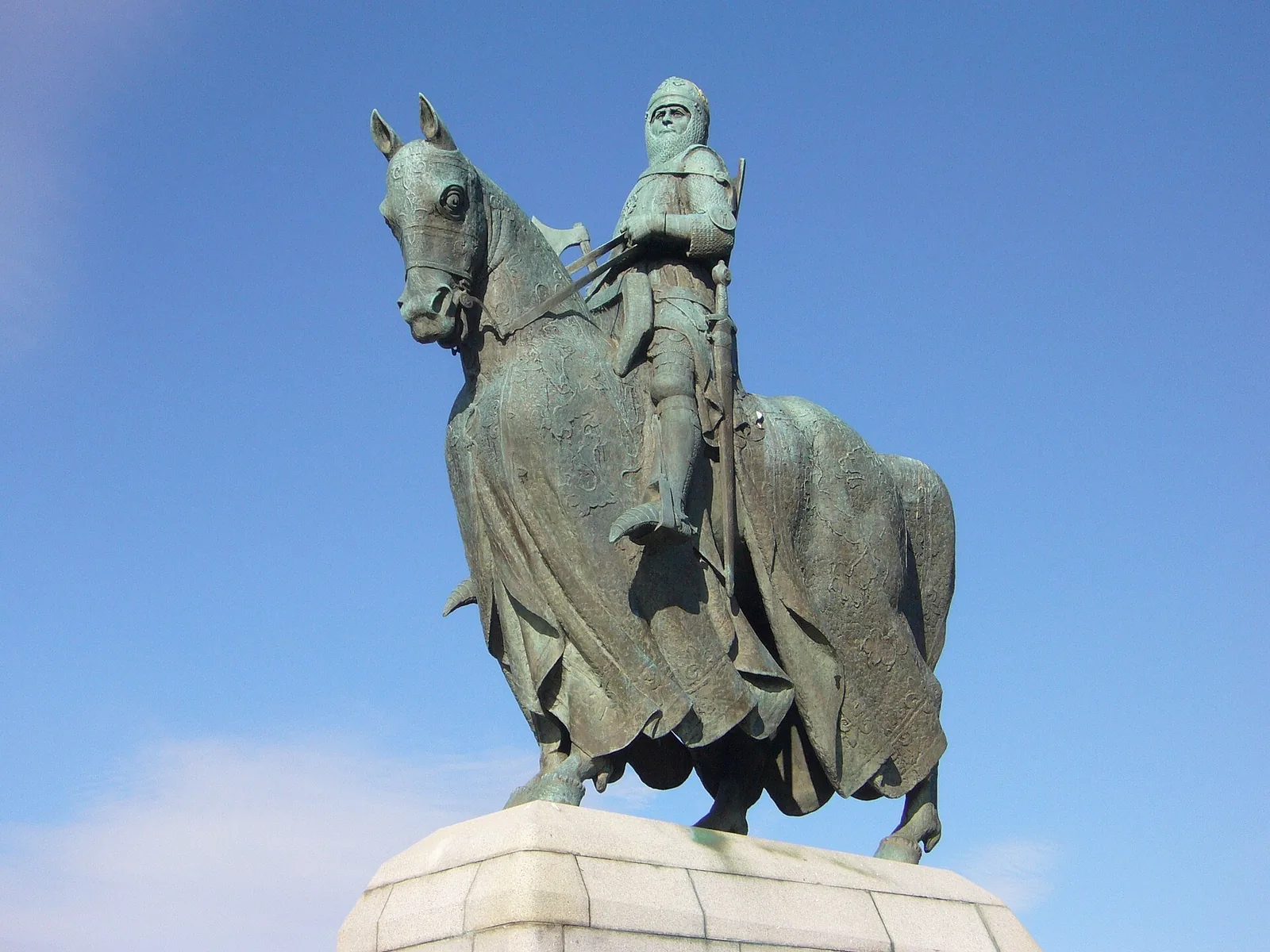
Charles d’Orville Pilkington Jackson, statue of Robert the Bruce, 1964. Bannockburn, Stirling. Photo: Kim Traynor, 2008 · CC BY-SA 2.0 · Source page
Blood before the altar
A meeting in a church
Dumfries, south-west Scotland, 10 February 1306. Two of the most powerful men in the kingdom meet in the church of the Greyfriars. Robert Bruce, Earl of Carrick, is 31. John Comyn, lord of Badenoch, is his long-standing rival.
Words turn to shouting. A dagger comes out. Comyn falls bleeding by the high altar, and Bruce’s men finish him off.
Killing a man in a church is sacrilege. Bruce has made enemies of Comyn’s kin, England’s king and the Pope. Six weeks later he is crowned King of Scots. Eight years later he wins at Bannockburn.
Robert the Bruce (Robert I)
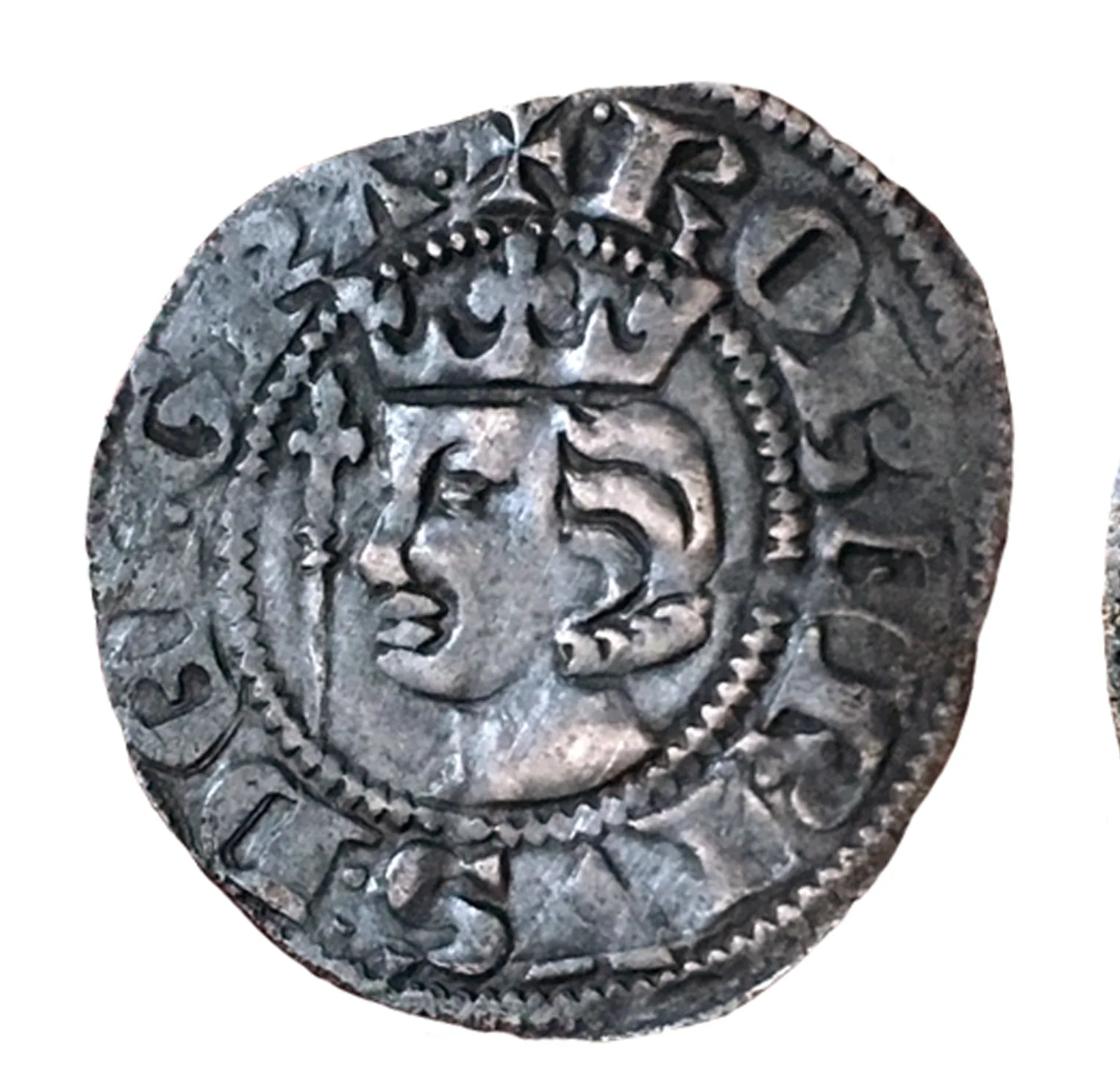
Silver penny of Robert I, c. 1320–1329, found in England (Portable Antiquities Scheme, record 961323). Photo: National Museums Liverpool / Heather Beeton · National Museums Liverpool, Heather Beeton · CC BY-SA 4.0 · Source page
A great lord who changed sides more than once, killed his rival in a church, lost almost everything, and then won a kingdom and its independence.
- Born: 11 July 1274, Probably Turnberry Castle, Carrick
- Died: 7 June 1329, His manor of Cardross, near Dumbarton, after a long illness; English chroniclers said leprosy
- Won: Loudoun Hill, 1307; Inverurie, 1308; Bannockburn, 1314
- Lost: Methven, 1306; Dalrigh, 1306
“For gif yhe think spedfull that we / Fecht, we sall ficht; and gif yhe will, / We leiff.”
Two families, one throne
Background
A claim in the blood
Robert Bruce was born on 11 July 1274, probably at Turnberry Castle in Carrick. His father’s family held Annandale; his mother was Countess of Carrick in her own right. Like many great Scottish lords, they held English lands too.
When the Scottish royal line died out in 1290, his grandfather claimed the throne. As we saw in the previous lesson, Edward I of England judged the case and in 1292 gave the crown to John Balliol, whose closest allies were the Comyns, the strongest family in Scotland. The Bruces never accepted it. Whatever Robert did, he did as heir to that claim.
1296–1304
Whose side are you on?
In 1296 Edward I invaded Scotland and deposed Balliol. The Bruces would not fight for a Balliol king: Robert swore fealty to Edward.
A year later he joined the Scottish rising. In 1298, after William Wallace’s defeat at Falkirk, he became a Guardian of Scotland beside John Comyn, ‘the Red’. It went badly: at one council in 1299 Comyn seized Bruce by the throat.
In 1302, fearing that Balliol would return with French help and disinherit him, Robert submitted to Edward again. Yet in 1304, while serving in Edward’s army, he made a secret bond with William Lamberton, Bishop of St Andrews.
Myth
At Falkirk in 1298, Robert Bruce fought for Edward I and betrayed William Wallace, as the film Braveheart (1995) shows.
The truth
No record puts Bruce at Falkirk on either side. While Edward fought Wallace, Bruce held Carrick; when the English then marched on Ayr, he burned its castle and withdrew. Months later he was a Guardian, leading the resistance.
The evidence
The story begins with John of Fordun, writing in the 1360s or later: ‘it is commonly said’ that Bruce led English troops round a hill into the Scots’ rear. Blind Harry’s poem Wallace (c. 1477) and the film built on it.
Source: A poet’s freedom
“A! fredome is a noble thing! / Fredome mays man to haiff liking; / Fredome all solace to man giffis: / He levys at es that frely levys.”
In modern English: ‘Ah, freedom is a noble thing! Freedom lets a man live as he likes; freedom gives a man every comfort; he lives at ease who lives free.’ Barbour, archdeacon of Aberdeen, wrote this verse life some 60 years after Bannockburn, for the court of Bruce’s grandson, Robert II. It is our fullest account of Bruce, and the most adoring.
- Where could Barbour’s stories come from? From veterans and their sons, hence names and details no one would invent. But he also invents speeches, merges Bruce with his grandfather, the claimant of 1291, into one man, and inflates English numbers.
- Whose freedom does Barbour mean? Mainly the kingdom’s freedom from English lordship, not equal rights for all. And he wrote for a Stewart king whose crown came through Bruce: praising Bruce praised his patron.
The killing, the crown and the cages
10 February 1306
What happened at Greyfriars?
Wallace had been executed in London in August 1305, and Edward I seemed to have won. Then Bruce and Comyn met at Dumfries.
Nobody recorded what they said. The Scottish story, told by John of Fordun decades later, says Comyn had agreed to back Bruce for the crown, then betrayed the plan to Edward. The English chronicler Walter of Guisborough says Bruce accused Comyn of treachery, stabbed him, and left his men to finish him by the altar.
Planned or not, Bruce now had to act fast.
A decision point
You are Robert Bruce, Earl of Carrick.
February 1306, Dumfries, hours after the killing
Comyn is dead, killed in front of the altar by you and your men. His kin, from the Earl of Buchan to Balliol himself, are now your blood enemies. The Church will excommunicate you. Edward I will call it treason: you saw what he did to Wallace.
But you are not alone. Bishop Lamberton is bound to you by the pact of 1304; Robert Wishart, Bishop of Glasgow, hates English rule. Your men of Carrick and Annandale will follow you. Scotland has had no king for ten years.
What do you do?
- Flee abroad, perhaps to your sister, the widowed queen of Norway You would probably save your life. But your lands would be forfeited, and you would become a lord without land or followers, hoping that Edward dies and the Comyns forgive. Exiles rarely come home.
- Ride to Edward, call it a quarrel that went too far, and beg his pardon If he needed you badly enough, Edward might just forgive you. More likely you would end like Wallace: tried as a traitor and executed.
- Seize the south-west’s castles and claim the crown: turn a killing into a war for the kingdom Within weeks you hold several castles, and Bishop Wishart absolves you of the killing. Six weeks later you are crowned at Scone. Now you are at war with England and with half of Scotland at the same time.
- Hide in your own lands, deny everything, and wait for the old king to die Edward is 66 and ailing, so waiting is tempting. But a man who has killed in a church cannot hide for long; every month, your enemies gather and your friends lose heart.
What really happened
Seize the south-west’s castles and claim the crown: turn a killing into a war for the kingdom
Bruce moved within days. His men took Dumfries castle and others nearby, Bishop Wishart absolved him, and on 25 March 1306 he was crowned King of Scots at Scone.
He had little choice: a man who had killed the realm’s leading noble could not go back to being Edward’s loyal earl. Geoffrey Barrow thought the killing unplanned but a rising already prepared; Michael Penman sees a calculated gamble that opened a Scottish civil war. Either way, the crown turned a crime into a cause.
25 March 1306
A crown made for the day
The coronation at Scone was improvised. Edward I had taken the Stone of Scone, on which kings were made, in 1296; the Pope had never let Scottish kings be anointed; a plain gold circlet served as the crown.
Two days later came a second ceremony. By custom the MacDuff earls of Fife set a new king on his throne, but the young earl was in English hands. So Isabella MacDuff, Countess of Buchan, rode to Scone to do it herself, though her husband was a Comyn on Edward’s side.
1306
Everything lost
4 years in a cage
Edward I ordered no quarter. On 19 June 1306 Aymer de Valence surprised Bruce’s camp at Methven, near Perth, as his men were settling for the night, scattering the little royal army. At Dalrigh in the west, Comyn’s kinsmen the MacDougalls beat what was left.
Bruce’s queen, his daughter Marjorie and his sisters fled north and were seized in a church sanctuary at Tain. Three of his brothers were executed by early 1307. Isabella MacDuff and Bruce’s sister Mary spent about four years in cages of timber and iron at Berwick and Roxburgh castles. A cage was ordered for Marjorie, aged about ten, in the Tower of London; she was sent to a nunnery instead.
Myth
Hiding in a cave, Bruce watched a spider fail six times to swing its thread to a beam and succeed on the seventh, and took heart to try again.
The truth
No medieval source tells it, not even Barbour, who loved every heroic detail of Bruce’s life. Even where Bruce spent that winter is unknown: Barbour says Rathlin, off Ireland; many historians think the Hebrides more likely.
The evidence
Walter Scott made it famous in Tales of a Grandfather (1828), a children’s history, setting it in a cabin on Rathlin. He admitted it rested ‘only on tradition in families of the name of Bruce’. It may first have been told of James Douglas.
1307
Back from nowhere
In February 1307 Bruce landed in Carrick with a small band. He fought like a hunted outlaw: ambushes, night raids, narrow glens. On 10 May, at Loudoun Hill in Ayrshire, he met de Valence again, on ground of his own choosing, where ditches dug from the bogs on either side narrowed the front. The English horse could not get round his spearmen, and were beaten.
On 7 July Edward I died at Burgh by Sands, marching north to finish the job. His son, Edward II, turned back.
The war of castles
Edward II
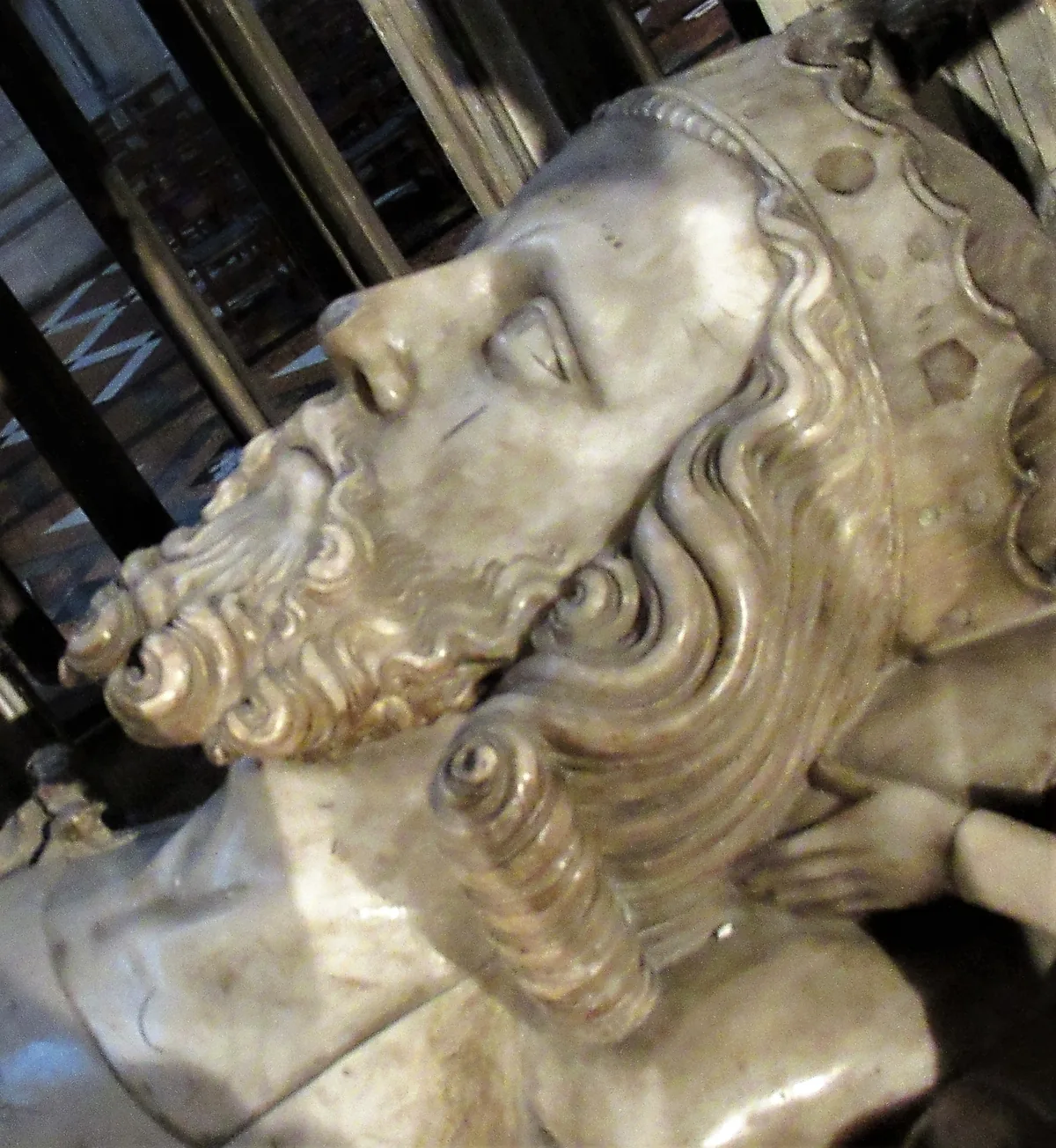
Tomb effigy of Edward II, alabaster, c. 1330–1335. Gloucester Cathedral. Photo: Poliphilo · CC0 · Source page
The conqueror’s son, who lost his father’s war in Scotland, then his crown, and probably his life.
- Born: 25 April 1284, Caernarfon Castle, Wales
- Died: 21 September 1327 (as announced), Berkeley Castle, England, in captivity after his deposition; probably murdered, manner unknown
- Won: Boroughbridge, 1322: his commander Harclay beats rebel barons
- Lost: Bannockburn, 1314; Old Byland, 1322
“Quhat! will yhon Scottis ficht?”
1307–1313
A civil war first
Edward II was not his father. He quarrelled with his barons over his favourite, Piers Gaveston, and apart from one fruitless campaign in 1310–11 left Scotland to his commanders. Bruce used the time to crush his Scottish enemies. In 1308, though gravely ill, he beat Comyn’s cousin, the Earl of Buchan, at Inverurie, then burned Buchan’s lands so thoroughly that the ‘harrying of Buchan’ was remembered for generations.
The MacDougalls were beaten in the west, and in 1309 Bruce held his first parliament. Then he turned on the English garrisons in the great castles.
A decision point
You are Robert I, King of Scots.
1308–1314: one castle after another falls to you
Your men take castles by surprise: rope ladders with iron hooks, night climbs. You have no siege engines, little money and few soldiers.
A king who takes a castle normally keeps it: whoever holds it holds the land around. But every man on a wall is a man missing from your army, and the English have the engines and the money to win castles back.
What do you do about the castles?
- Garrison them, as kings do, and rule the country from them You would look like a real king with real strongholds. But your small army would be spread thin, and each garrison would be a target the English know how to besiege.
- Pull down their walls, so that no one can hold them against you You give up the prestige and the shelter of stone walls. But the English lose the bases from which they rule, and your army stays free to move, raid and choose where to fight.
- Leave the strongest under blockade and let hunger do the work It costs few lives, but it takes months or years, ties down men you need elsewhere, and gives the English time to send a relief army.
What really happened
Pull down their walls, so that no one can hold them against you
Bruce had almost every castle he took slighted. The English Lanercost chronicle saw why: “lest the English should ever hereafter be able to lord it over the land through holding the castles.”
It suited a small, fast army fighting a rich enemy; Barrow and Colm McNamee see it as a deliberate and effective strategy. The cost came later: when the English returned in the 1330s, they rebuilt some of the castles for themselves.
1314
Cattle in the dark, climbers on the rock
In early 1314, on the night before Lent, James Douglas’s men crept up to Roxburgh castle; Barbour says they crawled under dark cloaks, and the guards took them for cattle. Weeks later Thomas Randolph, Earl of Moray, the king’s nephew, led a night climb up the cliff below Edinburgh castle. Both castles were pulled down.
Stirling, the key to the north, still held out. In 1313 or early 1314 its constable, Philip Mowbray, agreed with Edward Bruce, the king’s brother, to surrender if no English army relieved him by midsummer, 24 June 1314. Edward II could not ignore that.
Two days at Bannockburn
June 1314
The road to Stirling
Edward II marched north with the largest English army in years: thousands of men-at-arms on heavy horses, with foot and archers from England and Wales. Bruce had perhaps a third as many men, nearly all on foot.
He chose his ground south of Stirling. The road from Falkirk crossed the Bannock Burn and climbed past a royal hunting park, the New Park, where the Scots could shelter. Beside the road they dug pits, covered with branches, to break a charge. East of the road lay the carse: flat, wet ground by the river Forth, cut by streams and pools, where heavy horse would hate to fight.
23 June
An axe and a broken shaft
On the afternoon of 23 June the English vanguard crossed the burn and rode up the road. Before the Scottish lines rode the king himself, on a small grey pony, axe in hand, a crown on his helmet. An English knight, Henry de Bohun, saw him and charged.
Bruce turned his pony aside at the last moment, stood in his stirrups and split de Bohun’s head with his axe. His captains scolded him for the risk; Barbour says he only regretted his broken axe-shaft.
Meanwhile English horse under Robert Clifford tried to ride round towards the castle. Thomas Randolph’s schiltron, a dense block of spearmen, marched out and stopped them on open ground.
A decision point
You are Robert I.
Evening of 23 June 1314, in the New Park
Your axe killed de Bohun; Randolph’s spearmen broke Clifford’s horse. But the English army is still far stronger than yours, its heavy cavalry and archers almost untouched.
For eight years you have avoided meeting a full English royal army in open battle: you remember Methven. Now the English have left the road and crossed the burn to spend the night on the wet carse, hemmed in by the Bannock and another stream, the Pelstream. After dark Alexander Seton, a Scottish knight in English service, slips into your camp. The English are discouraged, he says: attack in the morning, and you will win.
What do you do?
- Withdraw in the night to the Lennox, a safer country to the west, and keep your army whole Your army would live to fight another day, as it has for eight years. But Stirling would count as relieved and stay English, and Edward would claim a victory.
- Stay in the New Park behind your pits and let the English attack again A strong position, but only if the English attack. They might simply go round you to Stirling, or wait for you to run out of food, now that the castle counts as relieved.
- Attack at dawn, while the English are crammed between the streams At first light your spearmen march down onto the carse, straight at an army that has hardly slept and has no room to manoeuvre. If it fails, you lose everything in a morning.
What really happened
Attack at dawn, while the English are crammed between the streams
Bruce attacked. At dawn on 24 June the Scots came out of the woods in their schiltrons, knelt to pray, and advanced across the open ground.
Gray, whose father was a prisoner in the Scottish camp that night, says the Scots were about to slip away when Seton arrived. Barbour turns it into a council where the men cry out for battle. Many historians now think Bruce had chosen this ground to fight on his own terms, and struck once the English walked into the trap; others take Gray at his word.
Bannockburn: who fought whom
23–24 June 1314
Below Stirling Castle, between the Bannock Burn and the river Forth
Kingdom of Scots
- Commanders: King Robert I, Edward Bruce, Earl of Carrick, Thomas Randolph, Earl of Moray, Walter Stewart and James Douglas, Robert Keith, the Marischal (horse)
- Strength: over 30,000 fighting men, plus nearly 20,000 ‘small folk’ (Barbour (c. 1375)); about 5,000–7,000 spearmen and about 500 light horse (Modern estimates)
- Losses: two knights (Barbour); light; probably a few hundred at most (Modern estimate)
Barbour’s small folk were camp followers and poorly armed locals.
Kingdom of England
- Commanders: King Edward II, Gilbert de Clare, Earl of Gloucester (killed), Humphrey de Bohun, Earl of Hereford (captured), Aymer de Valence, Earl of Pembroke, Robert Clifford (killed)
- Strength: 100,000 and more (Barbour); over 2,000 horse, and many foot (Life of Edward II (contemporary)); 21,540 foot called up from England and Wales (Summons of May 1314); about 15,000–20,000, with 2,000–3,000 heavy cavalry (Modern estimates)
- Losses: 30,000 dead; 200 pairs of gilt spurs from dead knights (Barbour); Gloucester, Clifford and many knights killed; hundreds held for ransom; foot losses unknown (Chronicles and records)
The summons records the men called up, not the men who came.
Outcome: A decisive Scottish victory; Stirling surrendered. But the war still had 14 years to run.
The further a writer stands from the battle, the bigger the armies. Modern figures rest on pay records, supplies and the ground: the carse pocket, about a kilometre wide, could never have held 100,000 men.
The battle of Bannockburn
23–24 June 1314
On 23 June 1314 Edward II marches north towards Stirling with the largest English army in years. Robert I Bruce stands south of Stirling with perhaps a third of the English numbers, nearly all on foot, and the English vanguard is already crossing the Bannock Burn.
One reconstruction, after Barbour’s The Bruce (books XI–XIII), Gray’s Scalacronica and the Lanercost chronicle, following Historic Environment Scotland’s battlefield inventory (2023), which judges the carse between the Bannock Burn and the Pelstream the stronger case for the second day without ruling out the Dryfield, just to the south-west, which many historians prefer; no battle finds have settled the question. The sources disagree on the Scottish order of battle (Barbour gives four divisions, Gray three, Lanercost two and a reserve), on where the English archers stood and on where the small folk appeared. Streams and the road follow modern maps; the woods, the New Park and the banks of the Forth in 1314 are approximate.
Phases of the battle
- 23 June: the road to Stirling The English vanguard crosses the Bannock Burn and rides up the road towards the New Park. Henry de Bohun charges Bruce, who kills him with one blow of his axe. The vanguard falls back across the burn.
- 23 June: Clifford’s ride English horse under Clifford and Beaumont (300 in Gray, 800 in Barbour) ride round the east of the wood towards the castle. Moray’s schiltron marches out from St Ninians and blocks them. Horses impale themselves on the spears; the English are beaten off.
- Night: down into the carse The English leave the road, cross the burn and spend the night on the carse between the Bannock and the Pelstream, bridging pools with doors and thatch. Bruce decides to attack.
- 24 June, dawn: the schiltrons come down The Scots come out of the woods in their schiltrons and advance onto the carse. The Earl of Gloucester charges Edward Bruce’s schiltron and is killed. Keith’s light horse scatter the English archers.
- The English break The king’s division joins the line. Barbour says the small folk now appeared on the hill behind, looking like a fresh army. The English rear gives way; men and horses drown in the Bannock and the Forth. Edward II is led off the field.
The strategy
- Scots: Bruce has fewer men, most of them on foot, so he digs pits to break a charge beside the road. When the English camp on the wet carse, hemmed in between two streams, he decides to attack at dawn on ground where heavy horse struggles to manoeuvre.
- English: Edward II wants to reach the castle at Stirling and relies on his large army, its heavy horse and archers. Clifford’s horsemen try to ride round the wood towards the castle.
What decided it: The English were crammed between two streams on wet ground cut by pools, where their heavy horse could not use its weight. When the schiltrons came down from the woods, the English rear gave way, and men and horses drowned in the Bannock and the Forth.
Source: ‘As it were into a dense forest’
“...when both armies engaged each other, and the great horses of the English charged the pikes of the Scots, as it were into a dense forest, there arose a great and terrible crash of spears broken and of destriers wounded to the death... Now the English in the rear could not reach the Scots because the leading division was in the way... This account I heard from a trustworthy person who was present as eye-witness.”
An English chronicle, written barely a dozen miles from the border by men whose country the Scots raided again and again. It has no good word for Bruce.
- Why would an English chronicle admit the defeat so frankly? The writer lived with its results: Scottish raids, and tribute paid to stop them. And many English writers blamed Edward II and his advisers, not the soldiers.
- How much is a nameless ‘trustworthy person’ worth? Something: the chronicler did not invent the scene. But we cannot tell who the witness was, which side he was on, or how much one man could see. Gray, from a different family memory, describes the same crush.
- What does the ‘dense forest’ tell you about how the Scots fought? That they fought on foot in tight blocks of long spears, the schiltrons, and that the English horse charged them head-on. Gray says the Scots had learnt from the Flemings, who beat French knights on foot at Courtrai in 1302.
24 June and after
A king at the castle gate
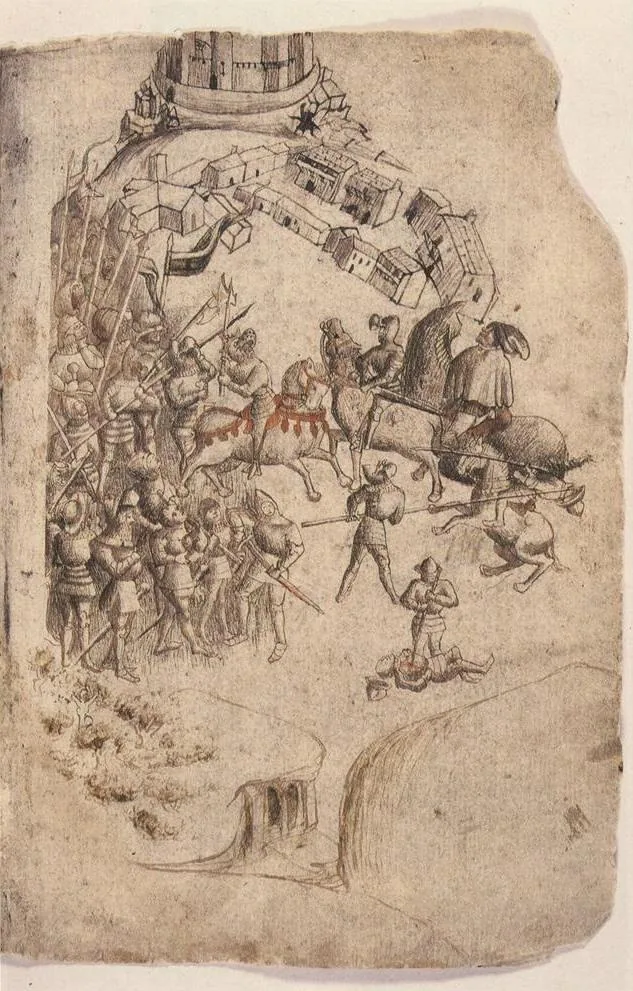
The battle of Bannockburn, drawing in Walter Bower’s Scotichronicon, 1440s. Corpus Christi College, Cambridge (MS 171) · Public domain · Source page
Edward II’s bodyguard dragged him from the field. At Stirling Castle, Mowbray would not open the gate: a king inside would soon be a king besieged. Edward fled round the Scots to Dunbar and escaped by boat.
Stirling surrendered and was pulled down. Hundreds of English lords and knights were held for ransom; the Earl of Hereford alone was exchanged for Bruce’s queen, his daughter, two of his sisters and old Bishop Wishart.
For freedom alone
1314–1320
Bannockburn was not the end
Edward II would not give up his claim, so Bruce took the war to England. Douglas and Randolph raided deep into northern England; towns paid to be spared. In 1318 Berwick, the last English foothold, fell.
In 1315 Edward Bruce landed in Ireland to open a second front, and was crowned High King of Ireland. In a land gripped by famine the war went badly, and in October 1318 he was killed at Faughart, near Dundalk. Bruce’s eldest daughter, Marjorie, had died in 1316 after a fall from her horse; her baby son would one day be king.
A decision point
You are Robert I, with your council.
March 1320: your council, probably at Newbattle Abbey
Pope John XXII, at Avignon, wants Christian kings at peace and on crusade, and sides with England. The Church excommunicated you in 1306 for the killing at Greyfriars; in 1318 he renewed the sentence, because you defied his truce and took Berwick, and laid Scotland under interdict. He will not even call you king: you are ‘the man who governs Scotland’.
Edward II will not make peace. Your victories have not won the one thing you need: to be recognised as a lawful king by Christendom.
How do you answer the Pope?
- Accept papal arbitration and drop your royal title for now The Church might lift its ban. But a king who drops his title invites every rival, from Balliol’s son to Edward II, to claim it, and the war would be decided in Avignon, not in Scotland.
- Send lawyers to argue your right by birth, as your grandfather did A strong legal case, but an old quarrel. The Pope’s court would see a dispute between two noble families, and Edward I’s verdict of 1292 already stands against you.
- Let the nobles write for the whole community of the realm: an ancient, free people who chose you, and would choose again A letter in the name of the community of the realm, sealed by the earls and barons, says this is not one man’s ambition but a nation’s will. It is a gamble with the Pope’s patience, and with your own nobles’ loyalty.
- Ignore the Pope and keep raiding England until Edward gives in It keeps the pressure on Edward, but leaves you an outcast in Christendom, your kingdom under interdict, and no other king able to treat you as his equal.
What really happened
Let the nobles write for the whole community of the realm: an ancient, free people who chose you, and would choose again
The letter we call the Declaration of Arbroath, dated at Arbroath on 6 April 1320, went to Avignon in the name of eight earls, 31 named barons and ‘the whole community of the realm’, sealed by the earls and some forty barons.
It was the strongest answer open to a king the Pope would not call king: an ancient free nation, its chosen champion, and a warning that even he could be replaced. It did not win at once: the Pope urged Edward to make peace, but recognised Bruce as king only in 1324.
Source: A letter to the Pope
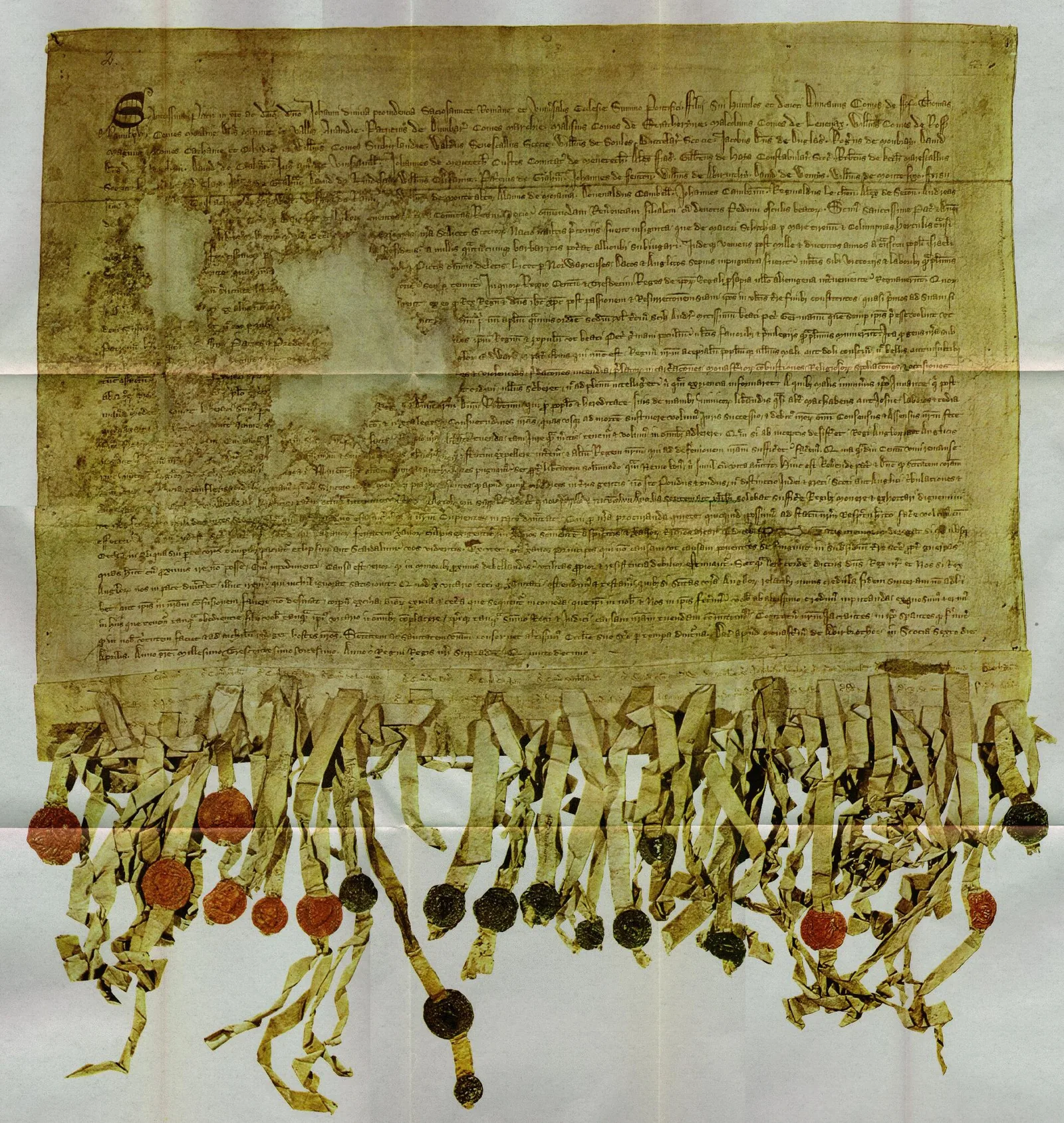
The Declaration of Arbroath (Tyninghame copy), 1320. National Records of Scotland, SP13/7 · Public domain · Source page
“...for, so long as a hundred of us remain alive, never will we be reduced to any sort of subjection to the dominion of the English. For it is not for glory, or riches, or honours, that we contend, but for freedom alone, which no man worthy of the name loses but with his life.”
Just before this, the letter says that if Robert ever submitted to the English, they would drive him out and choose another king. This is the copy kept in Scotland; the one sent to Avignon is lost.
- Who is this letter really for, and what does it want? The Pope. It wants him to lift the excommunication, recognise Robert and press England to make peace. So it calls Robert ‘another Maccabeus or Joshua’, liberators any churchman knew, and warns that the blood of future wars will be charged to the Pope.
- ‘For freedom alone’: a cry from the heart? It is polished Latin by a trained clerk, perhaps Bernard, abbot of Arbroath. The famous line adapts the Roman historian Sallust: learned rhetoric, written to persuade.
- Do the seal tags prove all these nobles stood behind Bruce? Not quite. Clerks may have attached some seals for their owners. And four months later several of these men were caught plotting to kill Bruce. The letter shows the united realm the Pope needed to see.
1320–1329
Peace, and a king’s death
Raids, a truce and papal pressure did the rest. In 1327 Edward II was deposed by his wife and barons. In 1328 his son’s government made the Treaty of Edinburgh–Northampton. England gave up every claim to Scotland and recognised Robert as king of an independent realm; Scotland paid £20,000. Robert’s son David, aged four, married Edward III’s sister Joan, aged seven.
Bruce had been ill for years. He died on 7 June 1329 at Cardross, aged 54, and was buried in Dunfermline Abbey. Six days later the Pope granted Scottish kings the right to be anointed.
1330
A heart on crusade
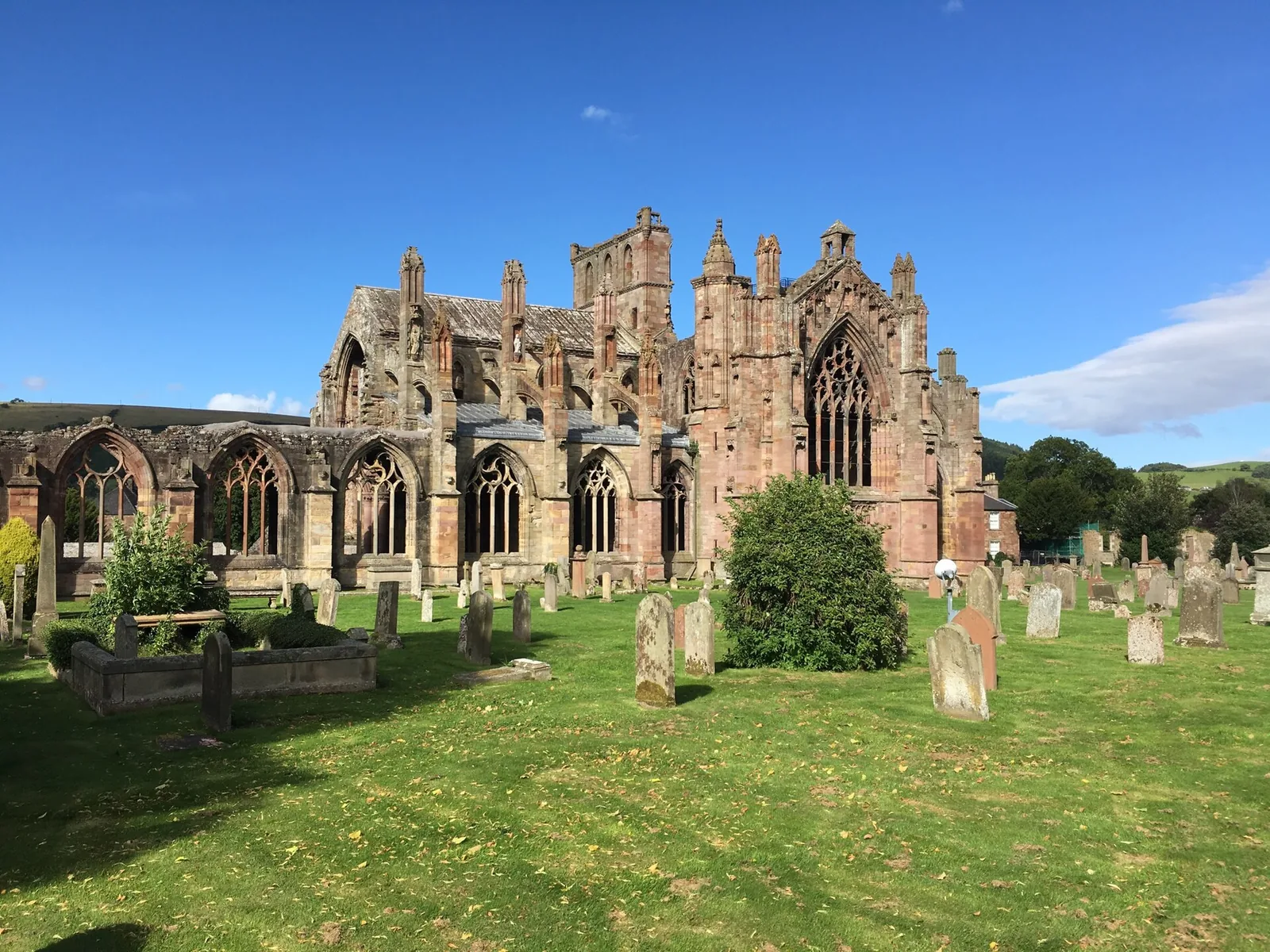
Melrose Abbey ruins, 2016. Photo: Jennifer Petrie · CC BY-SA 2.0 · Source page
Bruce had vowed to go on crusade and never did. On his deathbed, Barbour says, he asked James Douglas to carry his heart against the enemies of Christ. In August 1330, fighting for the king of Castile against the Moors of Granada at Teba, in Andalusia, Douglas was killed with the embalmed heart in his keeping.
The heart was brought home to Melrose Abbey. In 1996 archaeologists lifted a small casket there; tests showed old human tissue, though nothing can prove it is Bruce’s. It was reburied in 1998 under an engraved stone.
What Bruce’s war left behind
- 1314 Bannockburn. English garrisons gone except Berwick; the king’s family comes home. Lords who reject Bruce lose their lands: ‘the Disinherited’.
- 1315–1318 War in Ireland; Edward Bruce killed at Faughart. Berwick taken.
- 1320 Declaration of Arbroath. In August a plot to kill the king is crushed.
- 1324 The Pope recognises Robert as king. His son David is born.
- 1328 Treaty of Edinburgh–Northampton: England recognises Scotland’s independence.
- 1329 Bruce dies; David II is king at five.
- 1332–1333 The Disinherited invade with Edward Balliol; Edward III breaks the treaty and wins at Halidon Hill. A second war of independence binds Scotland to France, its ‘Auld Alliance’ renewed in 1326: the next lesson’s story.
- 1371 Marjorie’s son becomes Robert II, the first Stewart king.
National hero, or ruthless winner?
What was Robert Bruce fighting for?
- Geoffrey Barrow, Robert Bruce and the Community of the Realm of Scotland (1965) Bruce served a cause bigger than himself. The ‘community of the realm’ was a real idea, shared by nobles, churchmen and freeholders: that the kingdom existed apart from its king. Bruce’s genius was to make himself its champion, and the Declaration of Arbroath is its finest statement.
- Michael Penman, Robert the Bruce: King of the Scots (2014) A harder, more political Bruce: ruthless and dynastic, fighting a civil war against Scottish rivals as much as a war against England. His rule rested on confiscated lands, rewards for the loyal and skilful propaganda, including the Declaration; Barbour’s poem kept that image alive after his death. The plot of 1320 shows how fragile it all was.
- Alan Young, Robert the Bruce’s Rivals: The Comyns, 1212–1314 (1997) Look from the losers’ side. The Comyns led the kingdom and its resistance from the 1280s until 1304. Their image as traitors was made by Bruce’s propaganda, after he had killed their leader and broken their family’s power.
All three work from the same sources. They disagree about what they mean: whether Scottish independence was the cause Bruce served, the prize he won for his family, or both.
What do you know now?
Check yourself
Why did the Bruces refuse to fight for King John Balliol in 1296?
Answer: They had their own claim to the throne, and Balliol was allied with their rivals, the Comyns. Right. Robert’s grandfather had claimed the crown in 1291–92 and lost to Balliol. Fighting for Balliol meant keeping a rival family on the throne.
Check yourself
What is the truth about Bruce and the battle of Falkirk (1298)?
Answer: No record puts him there; the story of his betrayal comes from Fordun, writing more than 60 years later. Right. Fordun reports only what ‘is commonly said’, and Blind Harry and Braveheart built on it.
Check yourself
Why did Bruce pull down the castles he captured?
Answer: So that the English could never again use them as bases to rule the land. Right. The Lanercost chronicle saw it too. His small army stayed free to move.
Check yourself
Why were the English in trouble on the morning of 24 June 1314?
Answer: They had spent the night on wet ground between two streams, with no room to manoeuvre against the Scottish spearmen. Right. Packed into the carse between the Bannock Burn and the Pelstream, the front could not deploy and the rear could not reach the fight. Men fleeing drowned in the burn.
Check yourself
Who was the Declaration of Arbroath written for?
Answer: Pope John XXII, to win recognition for Robert and lift the excommunication. Right. It was a diplomatic letter to one reader, the Pope at Avignon, sent in the name of the nobles and the community of the realm.
Check yourself
What does the spider story tell historians?
Answer: Little about Bruce, but a lot about how he was remembered: it became famous through Walter Scott in 1828. Right. No medieval source has it, not even Barbour. A legend is evidence about the generation that loved it.
Terms
- schiltron A tight block of Scottish spearmen, several ranks deep, their long spears pointing out like a hedge. It could stand firm against cavalry or, as at Bannockburn, advance.
- Guardian of Scotland A leader chosen to rule the kingdom when there was no king, or the king was absent. Wallace, Bruce and Comyn all served as Guardians between 1297 and 1304.
- community of the realm In Latin communitas regni: the kingdom’s leading men, nobles, churchmen and landholders, seen as one body that could act for the realm even without a king.
- fealty An oath of loyalty sworn by a vassal to his lord. In 1296 Edward I made Scotland’s nobles and landholders swear it to him; their sealed oaths are known as the Ragman Roll.
- excommunication The Church’s harshest punishment: cutting a person off from the sacraments and from the company of Christians. Bruce was excommunicated for killing Comyn in a church.
- interdict A Church punishment laid on a whole country or town: most church services were forbidden there until it was lifted.
- slighting Deliberately pulling down a castle’s walls and towers so that no enemy could use it again.
- carse In Scots, the low, flat and often wet land along a river. At Bannockburn, the carse of the river Forth, cut by streams and pools.
- burn Scots for a stream. The Bannock Burn gave the battle its name.
- men-at-arms Fully armoured fighting men, knights and squires, who usually fought on heavy war-horses.
- the Disinherited Scottish and English lords whose Scottish lands Bruce confiscated after 1314 because they would not accept him. In 1332 they invaded to win them back.
- Turnberry A castle in Carrick, in south-west Scotland. Robert Bruce was probably born there.
- Annandale An area in south-west Scotland, held by the family of Robert Bruce's father.
- Falkirk A town in Scotland where William Wallace was defeated.
- Ayr A town in south-west Scotland. When the English marched on it, Bruce burned its castle and withdrew.
- Dumfries A town in south-west Scotland, where John Comyn was killed in 1306.
- Scone A place in Scotland where kings were crowned on a special stone. Bruce was crowned there in 1306.
- Lanercost An English chronicle written by friars near Carlisle, hostile to Bruce.
- Barbour The archdeacon of Aberdeen who wrote a long poem about Bruce's life, full of admiration for him.
- Greyfriars A church in Dumfries of Franciscan friars, where Bruce and Comyn met.
- Roslin A place where John Comyn beat an English force in 1303.
- Fordun A Scottish writer who, decades later, made Comyn the traitor.
- Kirkpatrick A Scottish family. A later family tradition says one of Bruce's men went into the church to make sure Comyn was dead.
- Wishart The Bishop of Glasgow, who supported Bruce and absolved him after the killing.
- Lamberton The Bishop of St Andrews, who made a secret pact with Bruce in 1304.
- Alan Young A historian of the Comyn family, who reminds us that John Comyn led the resistance after Falkirk.
- Geoffrey Barrow A historian who showed that almost every Scottish lord changed sides in those years.
- Michael Penman A historian who finds it hard to believe that a leprous king could hold parliaments and receive envoys.
- Roxburgh A castle in southern Scotland, taken and pulled down by James Douglas's men in 1314.
- Stirling A castle and town in central Scotland, seen as the key to the north. After the battle it surrendered and was pulled down.
- Declaration of Arbroath A letter of 1320, sent to Avignon in the name of Scottish nobles, defending Scotland's independence.
- Avignon A city in southern France. At that time the Pope lived there.
- Granada A Muslim kingdom in southern Spain, which the king of Castile fought against.
- Melrose An abbey in southern Scotland, where Bruce's heart was brought home.
- Dunfermline An abbey in Scotland where Bruce was buried.
Sources
- John Barbour, The Bruce (c. 1375), ed. W. M. Mackenzie (London: A. & C. Black, 1909), books I–XX
- The Chronicle of Lanercost, 1272–1346, trans. Sir Herbert Maxwell (Glasgow: James Maclehose, 1913), pp. 203–208, 256, 263
- Sir Thomas Gray, Scalacronica: The Reigns of Edward I, Edward II and Edward III, trans. Sir Herbert Maxwell (Glasgow: James Maclehose, 1907), pp. 52–56
- Vita Edwardi Secundi: The Life of Edward the Second, ed. and trans. Wendy R. Childs (Oxford Medieval Texts; Oxford: Clarendon Press, 2005)
- The Chronicle of Walter of Guisborough, ed. Harry Rothwell (Camden Third Series 89; London: Royal Historical Society, 1957)
- John of Fordun’s Chronicle of the Scottish Nation, trans. F. J. H. Skene, ed. W. F. Skene (Edinburgh: Edmonston & Douglas, 1872), chs. CI, CXIII–CXVIII
- The Declaration of Arbroath, 6 April 1320 (National Records of Scotland, SP13/7), trans. A. F. Murison, King Robert the Bruce (Edinburgh and London: Oliphant, Anderson & Ferrier, 1899), ch. XI
- Walter Scott, Tales of a Grandfather, First Series (Edinburgh: Cadell, 1828), the chapter on Robert Bruce
- G. W. S. Barrow, Robert Bruce and the Community of the Realm of Scotland (London: Eyre & Spottiswoode, 1965; 4th ed. Edinburgh: Edinburgh University Press, 2005)
- Michael Penman, Robert the Bruce: King of the Scots (New Haven and London: Yale University Press, 2014)
- David Cornell, Bannockburn: The Triumph of Robert the Bruce (New Haven and London: Yale University Press, 2009)
- Michael Brown, Bannockburn: The Scottish War and the British Isles, 1307–1323 (Edinburgh: Edinburgh University Press, 2008)
- Colm McNamee, The Wars of the Bruces: Scotland, England and Ireland, 1306–1328 (East Linton: Tuckwell Press, 1997)
- Alan Young, Robert the Bruce’s Rivals: The Comyns, 1212–1314 (East Linton: Tuckwell Press, 1997)
- Fiona Watson, Traitor, Outlaw, King: The Making of Robert Bruce (Edinburgh: Polaris, 2018)
- Edward J. Cowan, ‘For Freedom Alone’: The Declaration of Arbroath, 1320 (East Linton: Tuckwell Press, 2003; 2nd ed. Edinburgh: Birlinn, 2008)
- G. W. S. Barrow (ed.), The Declaration of Arbroath: History, Significance, Setting (Edinburgh: Society of Antiquaries of Scotland, 2003)
- A. A. M. Duncan (ed. and trans.), John Barbour, The Bruce (Edinburgh: Canongate, 1997)
- Seymour Phillips, Edward II (Yale English Monarchs; New Haven and London: Yale University Press, 2010)
- Pete Armstrong, Bannockburn 1314: Robert Bruce’s Great Victory (Oxford: Osprey, Campaign 102, 2002)
- Historic Environment Scotland, Inventory of Historic Battlefields: Battle of Bannockburn (BTL4), updated 2023
Image credits
- Charles d’Orville Pilkington Jackson, statue of Robert the Bruce, 1964. Bannockburn, Stirling. Photo: Kim Traynor, 2008 · CC BY-SA 2.0 · Source page
- Silver penny of Robert I, c. 1320–1329, found in England (Portable Antiquities Scheme, record 961323). Photo: National Museums Liverpool / Heather Beeton · National Museums Liverpool, Heather Beeton · CC BY-SA 4.0 · Source page
- Tomb effigy of Edward II, alabaster, c. 1330–1335. Gloucester Cathedral. Photo: Poliphilo · CC0 · Source page
- The battle of Bannockburn, drawing in Walter Bower’s Scotichronicon, 1440s. Corpus Christi College, Cambridge (MS 171) · Public domain · Source page
- The Declaration of Arbroath (Tyninghame copy), 1320. National Records of Scotland, SP13/7 · Public domain · Source page
- Melrose Abbey ruins, 2016. Photo: Jennifer Petrie · CC BY-SA 2.0 · Source page


