The Revolt of 1857: the greased cartridge and what really lit the fire
In May 1857 Indian soldiers in the British army rose up, and within days they were in Delhi, the Mughal capital. What was the spark, and why is the cartridge story only part of the answer?
Decisions, questions and your own progress, in the app
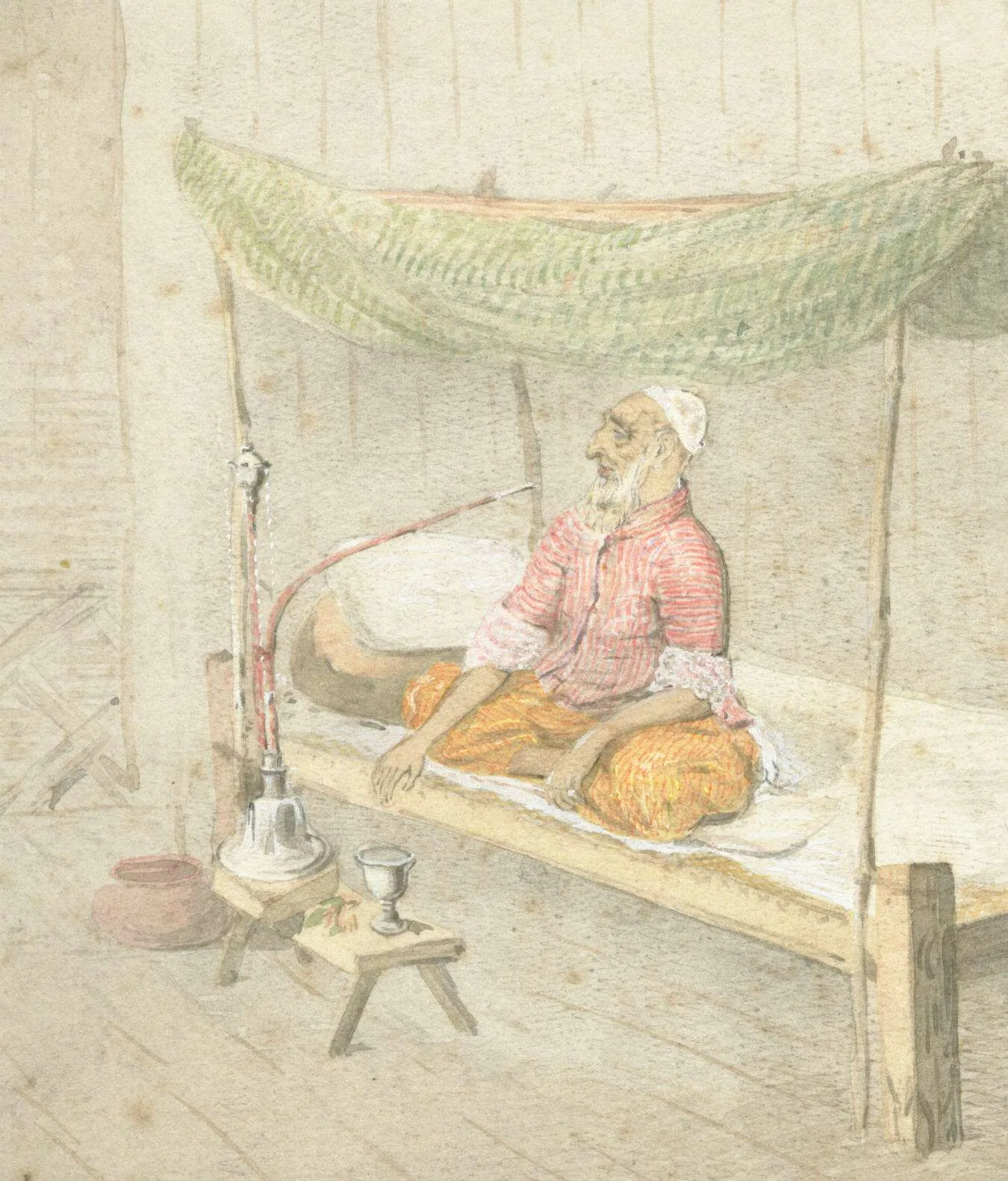
Horatio Gordon Robley, 'The King of Delhi', date unknown · Public domain · Source page
The spark
Delhi, May 1857
In May 1857 Indian soldiers in the British army rose up. Within days they were in Delhi, the Mughal capital, calling on the old ruler in the palace to lead them.
The familiar story starts with greased cartridges. But a spark needs something to catch. What was already burning?
Background
An army of a trading company
The East India Company was a trading firm that had become the ruler of large parts of India. It held that power with an army of its own. Most of its soldiers were sepoys, Indian soldiers paid by the Company. Most of its officers were British.
The rumour
The new cartridge
In 1857 the sepoys were issued new cartridges for their Enfield rifle. The paper had to be torn open with the teeth before loading. A rumour spread that the grease was cow fat, offensive to Hindus, and pig fat, offensive to Muslims.
The officers replied that ungreased cartridges would be issued, and the sepoys could add their own grease. The sepoys believed the rumour. Historians still argue about whether the cartridges were greased with animal fat, and how many were issued before the revolt. The rumour spread faster than the facts.
Source: A drawing from 1859
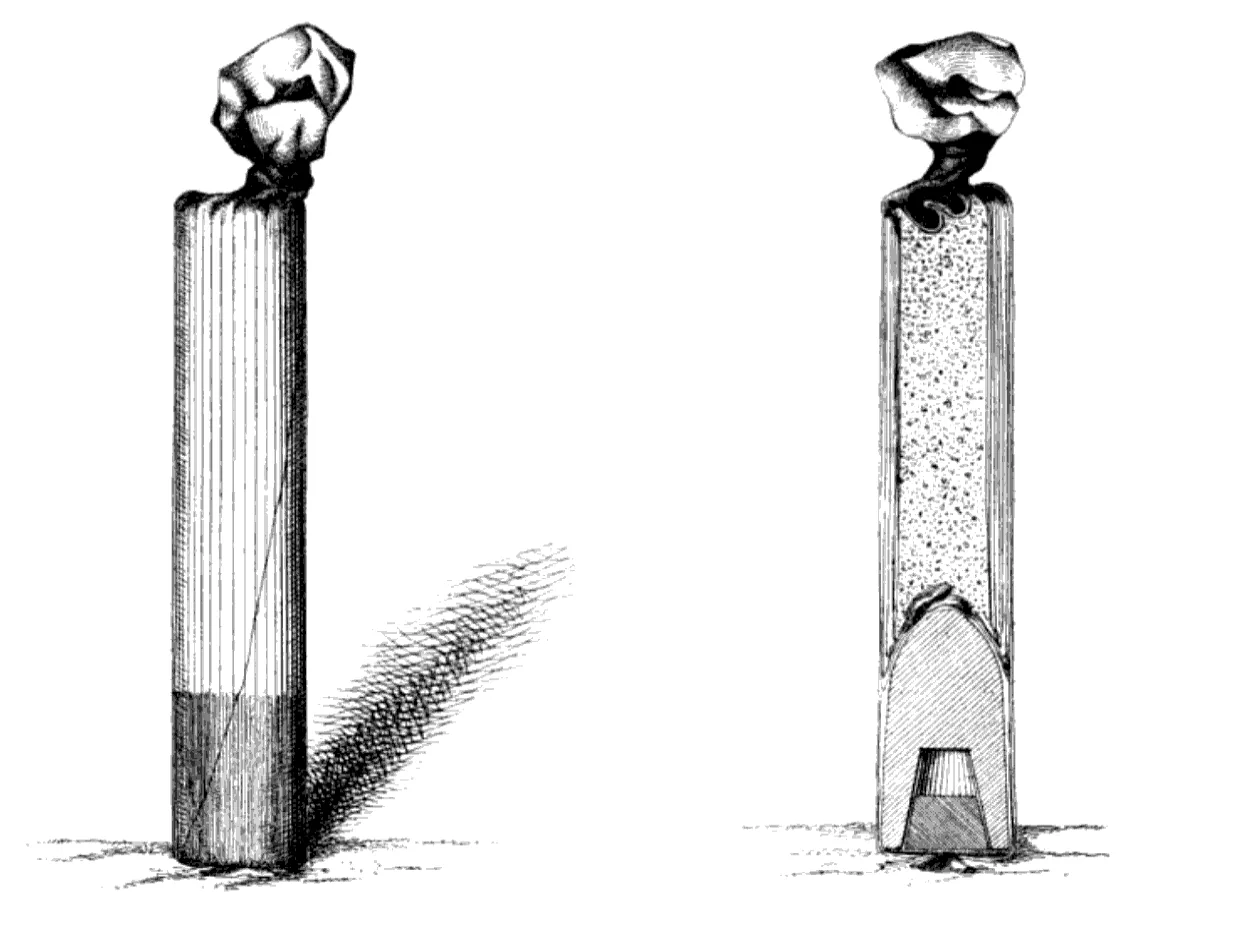
Arthur Briscoe Hawes, Rifle Ammunition, 1859 · Public domain · Source page
Arthur Briscoe Hawes, Rifle Ammunition, 1859
The drawing was made in 1859, two years after the revolt, for a technical book on ammunition made at the Royal Arsenal, Woolwich, in London.
- Who drew this, when, and why? A British technical book from 1859, written for people who made ammunition. It came after the revolt, not during the rumour.
- What does the drawing show, and what does it leave out? It shows how the cartridge is built inside: paper, powder and bullet. Nothing about grease, the rumour, or soldiers tearing the paper with their teeth.
Barrackpore and Meerut
March 1857
A musket at Barrackpore
On 29 March 1857, at Barrackpore near Calcutta, a sepoy named Mangal Pandey of the 34th Bengal Native Infantry came out with a loaded musket. He confronted the regiment's officers and urged his comrades to rise. He was hanged on 8 April, a date brought forward from 18 April. The 34th was disbanded after the incident.
Meerut, April
Eighty-five refuse
On 24 April 1857, at Meerut near Delhi, 85 of the 90 sepoys of the 3rd Native Cavalry refused the new cartridges. On 8 May they faced a court martial. On 9 May the punishment was carried out in public: long terms of hard labour.
A decision point
You are a sepoy in the 3rd Native Cavalry at Meerut. It is April 1857.
24 April 1857, a parade
The officers have called a parade. Each man must take a new cartridge, tear it with his teeth and load his rifle.
You have heard the rumour about the grease. You do not know whether it is true. The officers say the cartridges are being changed. Your comrades are watching you.
What do you do?
- Take the cartridge, tear it and load. Probably you keep your place and your pay. Many comrades will remember who tore the first one.
- Refuse in front of the officers. Probably a court martial and prison, as officers would likely treat an open refusal.
- Ask that the question go to the commanding officer before the parade goes on. Probably delay and tension. The officers may listen, or may call it mutiny.
What really happened
Refuse in front of the officers.
On 24 April 85 of the 90 sepoys refused. A court martial sat on 8 May, and the punishment was carried out in public on 9 May.
The choice had to be made on a rumour nobody could check, and on what each man believed. Historians have studied the Meerut events closely and still disagree on some details.
Delhi
10 May
Out of Meerut
On 10 May the revolt broke out at Meerut. The sepoys freed their comrades from the jail there and began marching on Delhi.
11 May
Under the palace windows
On 11 May the rebels reached Delhi, and Europeans and Christians were killed in the city that day. Under the palace windows, sepoys called on the old Mughal ruler, Bahadur Shah Zafar, who was about 82.
A decision point
You are Bahadur Shah Zafar, the Mughal ruler in Delhi. It is 11 May 1857.
11 May 1857, the palace in Delhi
Your dynasty still carries the title of emperor, but the real power lies with the British. You are an old man, and you did not plan this revolt.
Armed sepoys stand under your windows and demand that you lead them. If you agree, the city will change. If you refuse, they will go on without you.
What do you answer?
- Accept at once and lead them. The revolt gains a flag and a figure that everyone can follow. The British will likely treat you as a target.
- Send them away and stay out of it. Probably the sepoys go on without you, and you have no say in what happens next.
- Receive the sepoys formally, ask for time, and decide only after a few days. Probably the sepoys hold the city while you deliberate, and your eventual answer matters more than any first reaction.
What really happened
Receive the sepoys formally, ask for time, and decide only after a few days.
Bahadur Shah hesitated. The next day he held a formal audience, and after a few days he accepted the sepoys' allegiance. Historians describe him as a reluctant leader, pushed into the role.
We cannot read his mind. Historians rebuild his reasons from what he did next. He was old, and real power in the city had long been in other hands.
Myth
The greased cartridges alone caused the revolt.
The truth
The rumour mattered, but it was not the only cause. Historians also point to older anger at Company rule, and to fury over the punishment at Meerut.
The evidence
The historian Kim Wagner, in his book on the rumours of 1857, asks how a rumour could spark a mutiny if no greased cartridges reached the sepoys at all. The belief in the rumour seems to have counted for more than the grease.
Mercy or revenge?
September 1857
Delhi taken back
In September 1857 British forces retook Delhi. Rebels had killed Europeans and Christians in Delhi on 11 May, and in the days after the recapture British forces killed many rebels, including princes of the royal family.
A decision point
You are Charles Canning, the Governor-General of India.
Late 1857
Delhi is back in British hands, but the revolt is still going on elsewhere. Many British people, in India and at home, want revenge.
What policy do you set?
- Order a harsh response: hang the leaders and make an example of the revolt. Probably more hangings and more anger, and the impression that the British understand only force.
- Pardon those who lay down their arms, except those involved in killings. Probably less bloodshed and a slower return to order. Many in Britain will call it weakness.
- Leave each case to the local officers. Probably a patchwork: each officer does what seems right to him, and the result cannot be predicted.
What really happened
Pardon those who lay down their arms, except those involved in killings.
Canning chose moderation and mercy. The nickname 'Clemency Canning' came from a Punch cartoon, 'The Clemency of Canning', of 24 October 1857. It was meant as an insult. Later it became a term of honour.
Historians disagree about his motives: humanity, or a cold calculation to end the revolt sooner. Either explanation fits the same decision.
Aftermath and names
What came after
- 1858 Rule of India passes from the East India Company to the British Crown. Canning becomes the first Viceroy.
- 1 November 1858 A proclamation in the name of Queen Victoria is read in India. It promises not to force religion on her subjects, and offers an amnesty to rebels not involved in murder.
- 8 July 1859 Hostilities are formally declared over.
- November 1862 Bahadur Shah Zafar dies in exile in Rangoon (now Yangon), after his trial and banishment.
Source: The house where the king was held
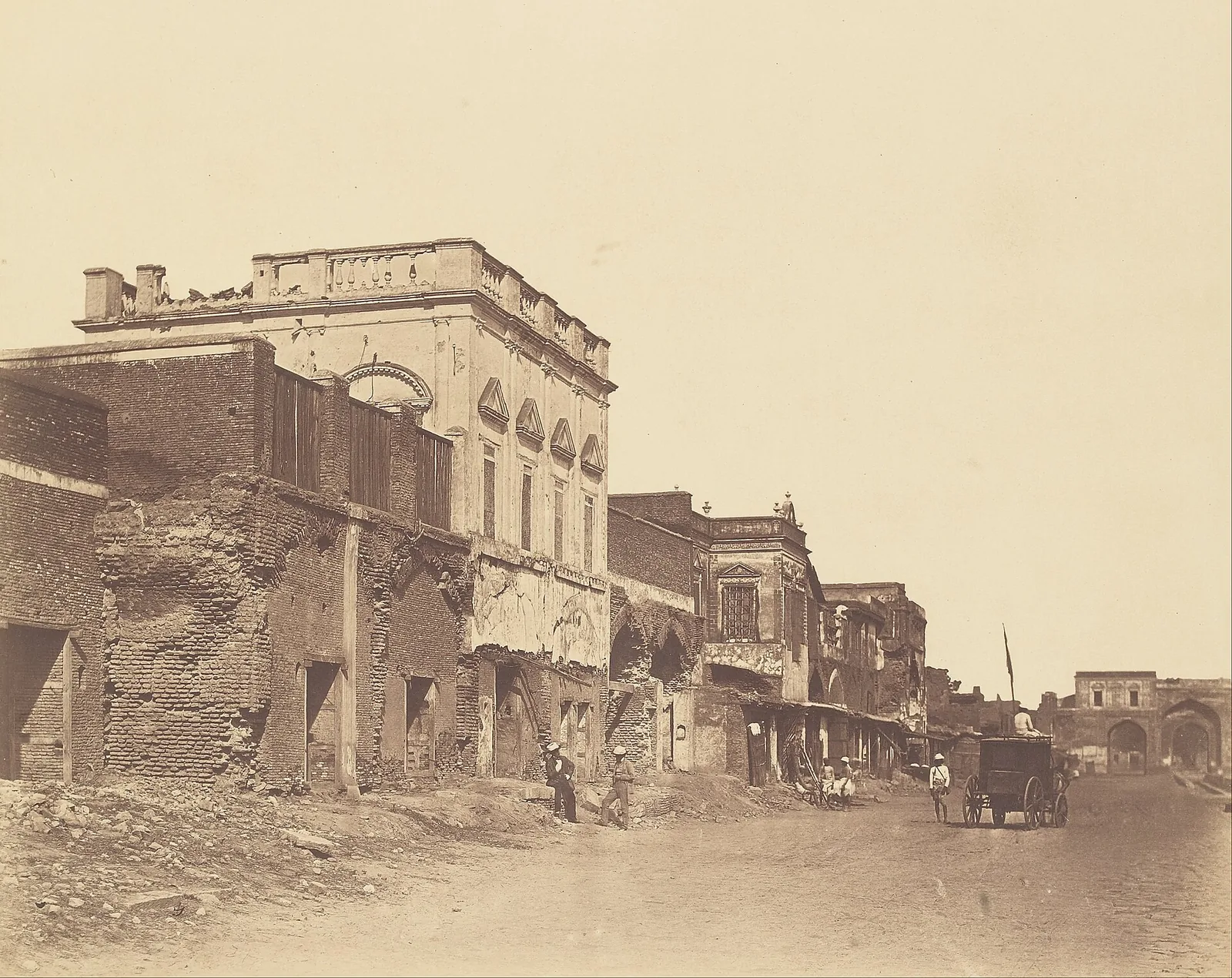
Felice Beato, 'House in Which the King was Confined in the Palace', c. 1858. Via Google Arts & Culture · Public domain · Source page
Felice Beato, photograph, c. 1858
The photograph is titled after the house, not the king. Pictures like this were made after the fighting, and some reached viewers in Britain.
- Who took it, when, and why? Felice Beato, probably in 1858, after the British took the city. It was made by one side in the war, after the fighting.
- Why photograph a house rather than the king? A building stays still for a slow camera, and the picture tells a story of conquest without showing the conquered man's face.
- What is missing from the picture? The king himself, the people of the city, and the fighting before the takeover. The picture shows what was left, not how it happened.
What do we call it?
Which name is right, and what does the name say about the person using it?
- British officials and the colonial press 'Sepoy Mutiny' or 'Indian Mutiny': a revolt inside the army, with no national feeling. Some early British historians wrote it that way.
- Indian nationalists, such as Savarkar 'The First War of Independence'. Savarkar's 1909 book on 1857, written in Marathi, called it the War of Independence. The word 'First' was added in a 1945 edition.
- Historians who want a neutral name 'Indian Rebellion': a middle term that does not settle whether it was only soldiers or a wider uprising.
The Hebrew article on the revolt is titled 'The Great Indian Mutiny'. Which name would you choose, and what would you need to explain to justify it?
Check yourself
Which statement about the cartridge rumour is accurate?
Answer: The rumour was disproved at once by the officers, and nobody among the sepoys believed it.. Wrong. The sepoys believed it, and it spread faster than the facts.
Check yourself
On 24 April, how many of the 90 sepoys at Meerut refused the cartridges?
Answer: About 500. Wrong. The unit was far smaller, and the answer is in the Meerut step.
Check yourself
What did Bahadur Shah do on 11 May, when the sepoys called on him?
Answer: He refused and left the city that day.. Wrong. He stayed in Delhi, and in the end accepted the sepoys' allegiance.
Check yourself
Where did the nickname 'Clemency Canning' come from?
Answer: A mocking name from a Punch cartoon, later treated as an honour.. Right. The nickname came from a satirical cartoon of 24 October 1857, and later became an honour.
Check yourself
Which statement is a sound reading of the 1858 photograph?
Answer: It shows the king sitting alone in his cell, looking out through the window.. Wrong. The picture shows a street and damaged buildings, not the king.
Check yourself
What did Savarkar call the revolt in his 1909 book on 1857?
Answer: The War of Independence. Right. In the 1909 book in Marathi, this is the name, without the word 'First'.
Terms
- sepoy An Indian soldier who served in the army of the East India Company and was paid by it. Most senior officers were British.
- East India Company A British trading firm that became the ruler of large parts of India and kept its own army. After the revolt its rule passed to the British Crown.
- cartridge A ready-made round for a rifle: bullet, gunpowder and a paper wrapper, loaded into the barrel as one piece. Soldiers tore the paper open with their teeth before loading.
- court martial A trial held by army officers rather than by civilian courts.
- Mughal The Muslim dynasty that ruled much of India from Delhi. By the 1800s its rulers held power in name only.
- Governor-General The most senior British official in India. Charles Canning held the post during the revolt.
- amnesty A decision to stop prosecuting a group of people for what they did. It often excludes some crimes, such as murder.
- viceroy A governor who represents a king or emperor in a distant country. After 1858 the Governor-General of India was called the Viceroy.
- Delhi A city in northern India, the capital of the Mughals. In 1857 it was at the center of the revolt.
- Enfield rifle The rifle issued to the British army, whose paper cartridges had to be torn open with the teeth before loading.
- Royal Arsenal A weapons store and factory in Woolwich, London, where ammunition was made.
- Barrackpore A town near Calcutta where the sepoy Mangal Pandey rebelled in 1857.
- Calcutta A large city in eastern India that was the center of British rule.
- Mangal Pandey A sepoy who rose up at Barrackpore and urged his comrades to revolt. He was hanged afterwards.
- 34th Bengal Native Infantry An Indian infantry regiment in the British army. It was disbanded after the incident at Barrackpore.
- musket An old rifle with a smooth barrel, loaded through the muzzle.
- 3rd Native Cavalry An Indian cavalry regiment in the British army. In it 85 of 90 sepoys refused the new cartridges.
- Meerut A city near Delhi where the revolt broke out in 1857.
- Bahadur Shah Zafar The old Mughal ruler in Delhi. The rebels called on him to lead them, and he later accepted their allegiance.
- Canning Britain's governor-general in India during the revolt. He chose moderation and mercy.
- Punch A British humor magazine that published political cartoons.
- dynasty A family that rules a country for many generations in a row. Here, the Mughal dynasty in Delhi.
- hard labour Exhausting, heavy work that prisoners were made to do as punishment.
- parade A formation of soldiers lined up on the officers' orders, for inspection or an announcement.
- regiment A large military unit of several hundred soldiers, under officers.
- Hindus People who follow Hinduism, the main religion of India.
Sources
- Arthur Briscoe Hawes, Rifle Ammunition: notes on the manufactures connected therewith, as conducted in the Royal Arsenal, Woolwich (1859)
- Felice Beato, House in Which the King was Confined in the Palace, Delhi, c. 1858 (via Google Arts & Culture)
- V. D. Savarkar, a book on the 1857 revolt written in Marathi (1909)
- John William Kaye and George Bruce Malleson, History of the Indian Mutiny of 1857-8 (1888 edition)
- J. A. B. Palmer, The Mutiny Outbreak at Meerut in 1857 (Cambridge, 1966)
- William Dalrymple, The Last Mughal: The Fall of a Dynasty, Delhi, 1857 (London, 2006)
- Kim A. Wagner, The Great Fear of 1857: Rumours, Conspiracies and the Making of the Indian Mutiny (2010)

_-_Google_Art_Project.jpg)
Image credits
- Horatio Gordon Robley, 'The King of Delhi', date unknown · Public domain · Source page
- Arthur Briscoe Hawes, Rifle Ammunition, 1859 · Public domain · Source page
- Felice Beato, 'House in Which the King was Confined in the Palace', c. 1858. Via Google Arts & Culture · Public domain · Source page
