Qin Shi Huang: the first emperor and the terracotta army
He united the warring states into one empire, fixed one script and one set of weights, and was buried with an army of thousands of clay figures. What in the story of the first emperor is true, and what did later historians add?
Decisions, questions and your own progress, in the app
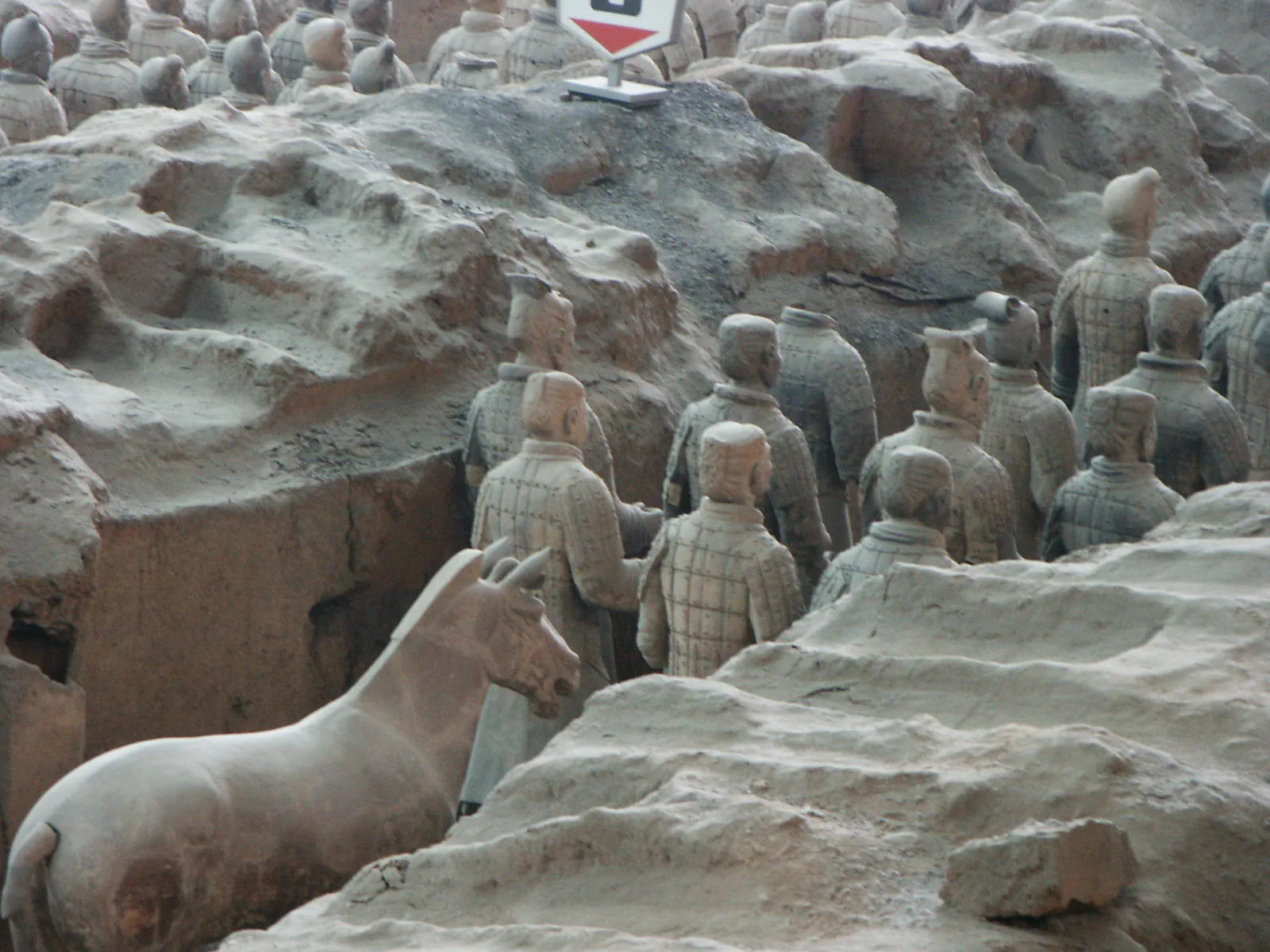
Gary Todd, Pit 1, Lintong, 2001. CC0. · CC0 · Source page
A king of thirteen
A well, and an army under the fields
In March 1974, farmers digging a well near Xi'an, in north-western China, dug up fragments of baked clay. Under the field lay an army.
Thousands of life-size soldiers stand in rows under the earth, as if in battle. They were made to guard a dead man. Why would a king need an army after he died? And who was the man?
Qin Shi Huang
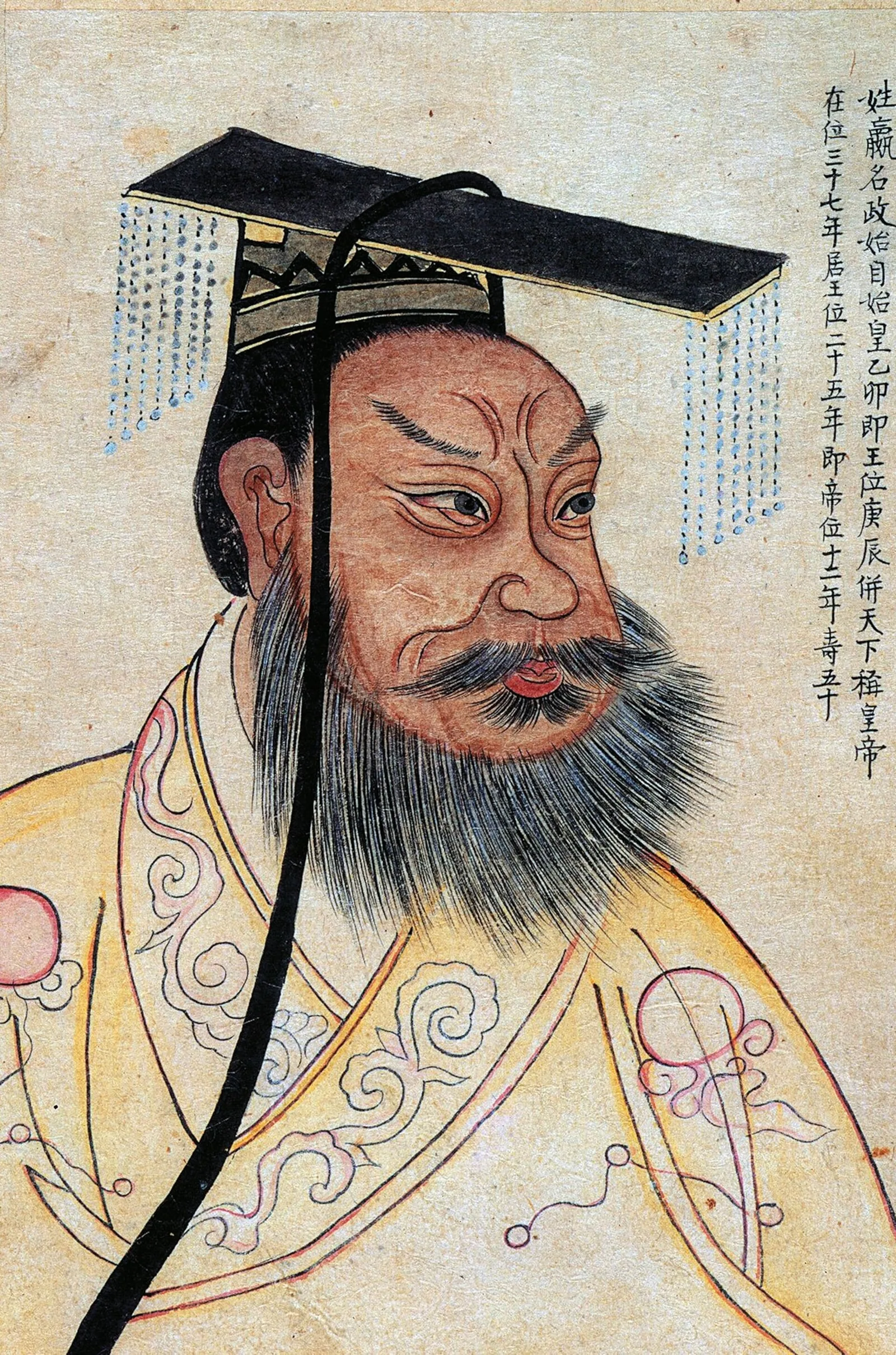
Unknown painter, a nineteenth-century album copy of a Chinese portrait of 1609. Wikimedia Commons, public domain. The scan is credited there to National Geographic. · Public domain · Source page
The king who conquered six rival states, took the title of emperor, and was buried with a clay army.
- Born: c. 259 BC, Handan
- Died: –, –
- Won: The six rival states, 230–221 BC
- Lost: The dynasty he founded lasted only fifteen years
The text says he took the title of emperor and called himself the First Emperor.
Background
A hostage's son
The boy was born at Handan, capital of the state of Zhao, about 259 BC. His father was a prince of Qin, living there as a hostage. A hostage was a royal son sent to a rival court, so that his family would keep the peace.
The Shiji tells a scandal about his birth. It says that the prince took a concubine of Lü Buwei, a rich merchant who had helped him, and that she bore the boy. Historians do not take this as fact. It is gossip that the text chose to record, and it shows what the court was willing to say.
A young king
A king at thirteen
13
His father died, and the text says the boy became king of Qin at thirteen. His name was Zheng (政). By the count of the Shiji this happened in 246 BC, the usual date. Other books give 245 or 247 BC, so the exact year is not certain. Almost every date in this lesson rests on the Shiji alone. Read the years as the best count, not as a certainty.
A boy-king did not rule alone. Power lay with his ministers and with Lü Buwei, the merchant who had been his father's patron and now ran the court.
Palace rebellion
A rebel in the palace
238 BC
In the ninth year of his reign, the text says, a courtier named Lao Ai rebelled. He had won the favour of the king's mother, and used it to gain power. The king's men defeated him. The Shiji names twenty of his followers who were put to death, and says that Lao Ai's whole clan was destroyed and that more than four thousand households were sent away to Shu, the region now called Sichuan.
The text then turns to Lü Buwei. The king removed him from office the next year, in 237 BC. Lü Buwei died in 235 BC, and the text says he was buried in secret. The boy who had been a child in his ministers' hands now ran his own court.
The order to expel
Event
A spy at the canal
237 BC
In 237 BC the court found a spy. Zheng Guo, a man from the state of Han, had come to Qin to build an irrigation canal. He was exposed, and the court was alarmed. Men born outside Qin served the king: advisers, engineers and officials from the six other states.
Some courtiers wanted every foreigner out. The text calls them “guests”. The king was about twenty-two. The question reached his desk as an order: expel all the guests from the court.
A decision point
You are King Zheng of Qin, about twenty-two years old.
Qin, about 237 BC
A spy from Han was caught while building a canal for the state. The court's first thought is that foreigners cannot be trusted. Many of your best advisers were born in other states.
Your ministers propose one order: expel from the court every man born outside Qin. You must decide before the order goes out.
What do you decide?
- Expel every man born outside Qin, as your ministers propose. Probably the court loses experienced advisers and engineers. Some leave for rival states, and public works slow down.
- Keep them all. A state that wants talent cannot choose by birthplace. Probably the court keeps its best men. But a real spy may stay close to power, and rivals will keep raising the issue.
- Keep the useful men, and investigate each suspected spy one by one. Probably slower and fairer, but it needs careful officials. Suspicion may linger among the courtiers.
What really happened
Keep them all. A state that wants talent cannot choose by birthplace.
The king stopped the order. In a single line the text says that it was halted after a memorial from Li Si, and that the king kept his foreign advisers. Li Si, whose own name was on the list, later rose to be minister of justice and then chancellor.
The reason the text gives is Li Si's memorial, quoted below. It argues that a great state gains by taking in people from everywhere. Historians note two things: the argument suited a state that needed skilled men, and it also protected the man who made it. The king's own reasoning is not recorded.
Source: A minister's memorial against the order
A great mountain refuses no earth, and a great river refuses no stream. A wide land grows much grain, a large state holds many people, and a strong army has brave men. So, Li Si says, a ruler who turns no one away is the one whose deeds shine.
The memorial is Li Si's own argument, written while his name was also on the expulsion list. It reached us through Sima Qian's Shiji, written more than a century later.
- Who wrote this, and who kept it? Li Si wrote it. Sima Qian, a court historian of the Han, copied it into the Shiji more than a century later. The words reached us through two hands and a long gap in time.
- What does the memorial want the king to believe? That a ruler gains by welcoming people from everywhere, and that turning people away weakens the state. The picture of the mountain is an argument, not a survey of facts. It is written to persuade.
- What does it leave out? The spy himself. It argues about talent in general, not about the man who was caught. And, as the story has it, Li Si had a personal stake: his own name was on the expulsion list.
Six kingdoms
Conquest
Six kingdoms, one after another
221 BC
For more than two centuries the seven states of the age had fought one another. Qin, in the west, was the strongest, and its rulers governed by the strict laws of Legalism. Between 230 and 221 BC it conquered the other six, one after another. The Shiji dates each conquest by the king's regnal year: the state of Han (not the later Han dynasty) fell in 230 BC, Zhao in 228, Wei in 225, Chu in the early 220s, Yan in 222 and Qi in 221.
The entries are short, a line or two for each state. The text names the kings taken or the states won, and moves on.
Myth
He was the first man to unify China.
The truth
Partly true. The Shiji says that in 221 BC he first brought the whole realm under one rule. Whether that makes him the first to unify “China” depends on what the word means. “China” is a later name for these lands, and historians disagree about how far the Qin empire was “China”. We return to that in the last chapter.
The evidence
Shiji, ch. 6, year 26 (221 BC): the text says he first brought the realm together.
A decision point
You are the First Emperor, who has just conquered the last of the six states.
Xianyang, 221 BC
The king of Qi has been taken, and the whole land is in your hands. It is a huge territory, and parts of it were until recently independent states with their own rulers.
Your chief minister, Wang Wan, proposes giving the new lands to your sons, as lords on their own fiefs. The minister of justice, Li Si, disagrees. You must decide.
What do you decide for the new lands?
- Give fiefs to your sons, as lords who rule lands of their own. Probably the old problem returns. Princes with armies and tax rights could quarrel, as the Zhou kin did when central power weakened.
- Divide the empire into commanderies, run by officials you appoint and can recall. Probably a state the centre can steer. But distant officials may breed resentment, and the system needs a loyal court to keep working.
- Fiefs for your sons alone, and commanderies for the rest. Probably a compromise. It keeps some family power at home, and leaves an open question for the next reign.
What really happened
Divide the empire into commanderies, run by officials you appoint and can recall.
The king accepted Li Si's view. The text says the empire was divided into thirty-six commanderies, each with a governor, a military officer and an inspector, all appointed from the centre. The sons received no fiefs of their own.
Li Si argued from the Zhou past. Zhou kings had given land to many relatives, who grew apart and fought one another, and the Zhou king could not stop them. Historians see this as a reading of the past, chosen to fit the present.
A new title
The First Emperor
221 BC
According to the text he gave up the title of king and took the title huangdi, which we render as emperor, adding “first” to mark the start of a new line. In an edict, as the text records it, he calls himself the First Emperor.
The title carried weight for everything that followed. The dynasty bore it, and it set the terms for central rule. Historians still argue how far the title was a claim and how far it was a fact.
One script, one axle
Standards
One script, one measure
The Shiji lists what the new empire did in a few phrases. The writing was made one: a single script for the whole empire. Measures and weights were given one standard. The axles of carts were made the same width, so that carts could run on the same roads.
These were practical changes, and also a claim: one state, one law, one way of doing things. Historians still argue over how fully they were carried out in each district. The text tells us what the court intended.
Name and time
The black-headed
In the same year, the text says, the common people were renamed “the black-headed”. The start of the year was moved to the tenth month, and the court made black the colour of official dress, banners and flags.
Roads and walls
Straight roads and long walls
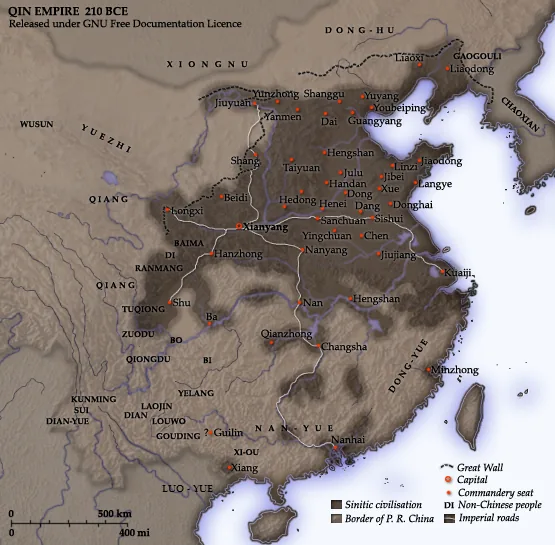
Itsmine, map of the Qin dynasty, c. 210 BC (2006). Wikimedia Commons, CC BY-SA 3.0. · CC BY-SA 3.0 · Source page
The text says that in 220 BC the king ordered wide imperial roads built, along which the court's carriages ran. In 213 BC walls were built along the northern frontier. A Han essay quoted at the end of the same chapter of the Shiji credits the general Meng Tian with building them.
Myth
The Great Wall is visible from space.
The truth
Not as a rule. Most of the wall that visitors see was built centuries later, under the Ming dynasty (1368–1644). The Qin walls lay far to the north, were built largely of earth and stone, and wore away over time. From low orbit the wall is generally not visible to the naked eye, as NASA's own 2005 feature explains. In 2003 Yang Liwei, China's first astronaut, said he could not pick it out. Some American astronauts have said they saw it from low orbit, so the question is not closed.
The evidence
NASA, “China's Wall Less Great in View from Space” (feature dated 2005; archived copy). Al Jazeera, 17 October 2003, on Yang Liwei's remarks.
A decision point
You are the First Emperor, in 213 BC.
Xianyang, in the palace, 213 BC
A banquet is held at the palace. Among the guests are seventy erudites, learned men who teach and advise you and read the old books. One praises your reforms. Another argues that earlier dynasties ruled well when they gave land to their sons, and that you endanger the state by ignoring the past.
Li Si replies that scholars use old books to criticise the present and stir the people. He proposes an order: the histories of other states, private copies of the Odes and Documents and of the writings of the “hundred schools” are to be burned. Anyone holding them must hand them in within thirty days. Books on medicine, divination and tree-planting are allowed.
What do you decide?
- Approve Li Si's order: burn the histories of the other states and the private copies of the old books, with a deadline. Probably the old books vanish from private hands within a month. Scholars who quote the past lose their voice, and the court's libraries become the only place to read them.
- Limit the order: burn only books that criticise the present, and keep the classics in official libraries. Probably the most dangerous books go, and the classics survive in state hands. But someone must decide what counts as criticism, and that decision is open to abuse.
- Reject the order. Keep the books, and deal with disorder through the ordinary courts. Probably the old learning survives in private hands. The critics stay, and the court keeps facing quarrels that no decree can end.
What really happened
Approve Li Si's order: burn the histories of the other states and the private copies of the old books, with a deadline.
You approved. The text records the reply in a single word of assent. People had thirty days to hand in books for burning. The histories of Qin, and works on medicine, divination and tree-planting, were exempt. The next year men who had broken the ban were executed, as the next chapter shows.
The text gives Li Si's reasons. Scholars who praise the past criticise the present, he says, and they make the people doubt the court. Historians disagree about how far the order was a tool of control, and how far a real fear that old learning would split the new empire. Both readings fit the text, and neither can be proved from it.
The pit and the mountain
The year after
Men who broke the ban
212 BC
The next year, the Shiji reports, scholars informed on one another. More than four hundred and sixty men who had broken the ban were put to death at Xianyang, so that the whole empire would know and take warning.
The text uses one word for the killing: keng (阬). It is often rendered “buried alive”, but its exact meaning here is debated. What matters for us is the number, the place and the purpose the text gives.
Source: The Shiji on the executions of 212 BC
Scholars informed on one another, and more than four hundred and sixty men who had broken the ban were executed at Xianyang, by a method the text calls keng, so that the whole empire would know and take warning.
Sima Qian wrote this more than a century after the events. As far as historians have found, no text written before the Shiji mentions these executions.
- Who wrote this, and what should we remember about him? Sima Qian, a court historian of the Han, more than a century later. The Han had its own reasons to criticise Qin, and a historian writing then had reason to present Qin as cruel.
- What do the words say about the men? The text calls them “students” (zhusheng, 諸生), and in this passage it does not call them Confucians. Confucius appears only in the warning of Fusu, in the same entry: he says the scholars all recite and follow Confucius.
- What is missing? A list of names, any account from a witness or a family, and any detail of how the men died. The number is given with a purpose attached: a warning. Ask who counted, and who checked.
Labour
The palace and the mountain
700,000+
The text gives further figures. For the palace and the tomb at Mount Li, it says, more than 700,000 forced labourers were put to work. Later, when the emperor travelled east in 210 BC, it says another 700,000 were sent to Mount Li.
The text gives no death toll. It counts the labourers, not the dead. Any figure for deaths would be an estimate, and we do not have the evidence to make one.
The tomb
A tomb built as a world
The Shiji describes the tomb as a copy of the world. According to the text, mercury flowed like rivers and seas. The mound was planted with trees and grasses so that it would look like a natural mountain. Traps are described too: crossbows were set to shoot anyone who came close.
In 2020 a team of researchers in China and Sweden measured mercury in the air above the mound: a peak of about 27 nanograms per cubic metre, against a regional background of about 5 to 10. The authors suggest that the vapour seeps out through cracks in the structure. That does not prove the rivers the text describes.
Myth
He burned all the books, and buried 460 scholars alive.
The truth
Partly true, and the details matter. The Shiji records a book order in 213 BC, with exemptions for Qin's histories and for technical books, and a thirty-day deadline. It records more than 460 men executed in 212 BC. Historians doubt who those men were and how they died. Some also doubt that the burning destroyed as much as the story says.
The evidence
Scholars who study surviving writings from the Qin and early Han find that they quote the Classics. That suggests the books survived, at least in part (see the debate in the last chapter).
Death at Shaqiu
The road east
A search for the elixir
210 BC
In 210 BC the emperor travelled east, to the coast. The Shiji says he was seeking a medicine for long life, and sent a man called Xu Fu out to sea to find it. Xu Fu came back empty-handed. The text reports this plainly, as one more failure.
Among the men on the road were the chancellor Li Si, and Zhao Gao, who ran the palace carriages and kept the seals. The emperor's youngest son, Hu Hai, was also with the court.
Shaqiu
The death at Shaqiu
Seventh month
In the seventh month, the text says, the emperor died on the road, at Shaqiu, on a flat stage of raised ground. The Shiji reports it in one short line, and gives no cause of death.
A decision point
You are Li Si, the left chancellor, travelling with the emperor.
Shaqiu, in the seventh month, 210 BC
The emperor is dead, and only a few men around the carriage know it. The centre of power is far away. The eldest son, Fusu, is on the northern frontier with the general Meng Tian. The youngest son, Hu Hai, is here. So is Zhao Gao, who runs the palace carriages and keeps the seals.
The text says the emperor had sealed a letter for Fusu, and it has not yet reached him. What is done in the next few hours will decide who inherits the throne.
What do you do?
- Announce the death now, send the sealed letter as it was written, and call Fusu to the capital. Probably Fusu reaches the capital and takes the throne, as his father wished. Hu Hai and Zhao Gao lose their place, and Li Si is bound to the new emperor.
- Announce the death and let the court choose the heir in the open. Probably a public quarrel among the sons and generals, in an empire barely eleven years old. Rivals who have waited for this moment will act.
- Keep the death secret, and back Zhao Gao's plan to write a new edict in the emperor's name. Probably Hu Hai takes the throne, with the court's help. Fusu and Meng Tian are removed from power, and you are tied to the new rulers.
What really happened
Keep the death secret, and back Zhao Gao's plan to write a new edict in the emperor's name.
You chose to keep the death secret. The text says the chancellor hid the death for fear that the emperor's sons and the empire would rise if it became known. Zhao Gao and Hu Hai then wrote a new edict in the emperor's name. It named Hu Hai heir. A second letter, in the same name, ordered Fusu to die, and Meng Tian was held in prison. The sealed letter for Fusu was destroyed.
The coffin rode in a closed carriage. Officials went on sending in their reports as if the emperor were alive, and a cart of salted fish was loaded beside the coffin to hide the smell.
The text gives the reason: fear of the emperor's other sons and of the unrest that would spread through the empire. Historians differ on his motives. He may have been protecting the state from a succession war, protecting his own place, or both. The sources do not record what he thought. They show him acting with the men who had most to gain.
Source: The army as it lies in the ground
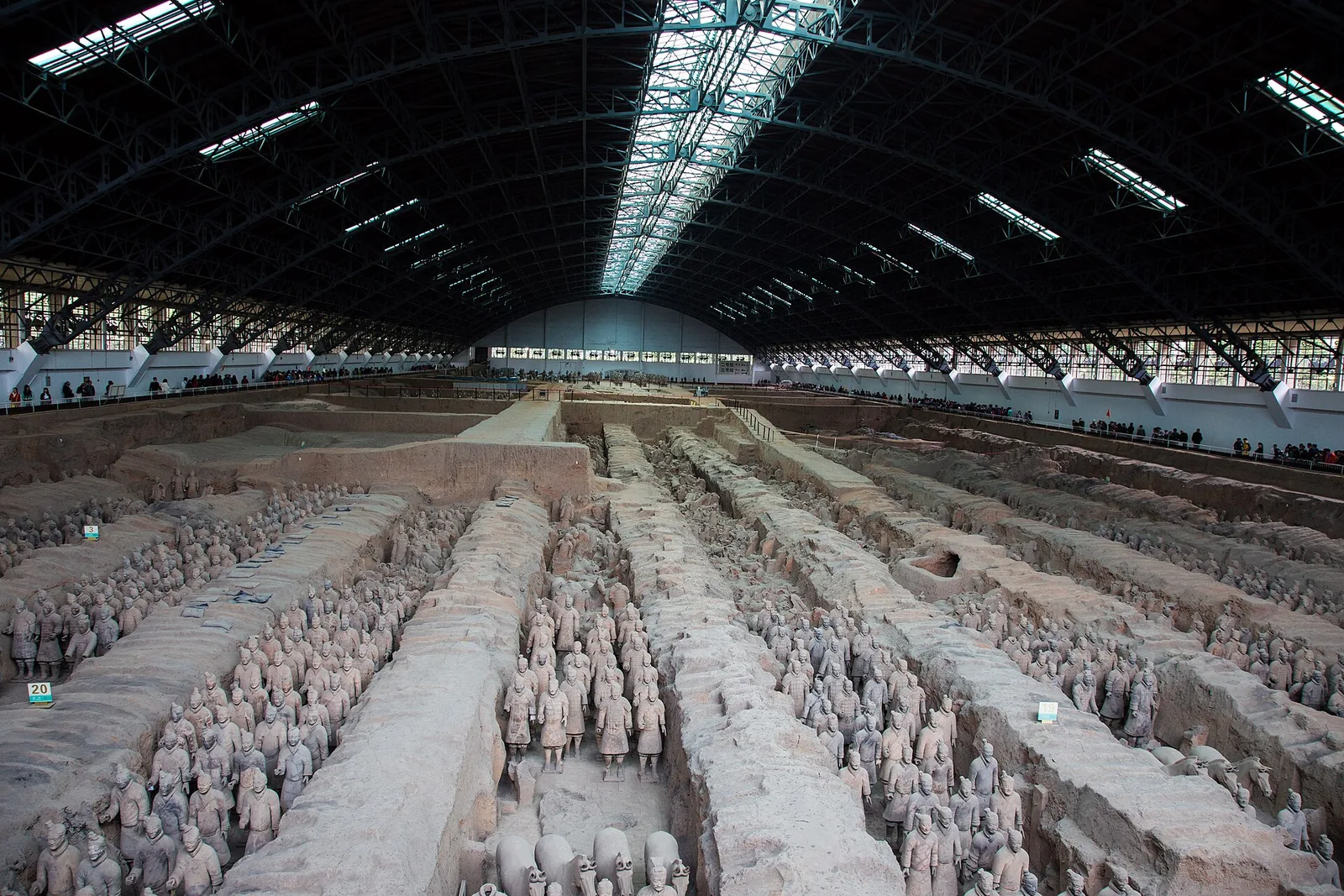
Jmhullot, View of Pit 1, Terracotta Army, 2015. Wikimedia Commons, CC BY 3.0. · CC BY 3.0 · Source page
Pit 1 of the Terracotta Army at Lintong, photograph by Jmhullot, 2015 (CC BY 3.0).
The army was found in March 1974 by farmers digging a well at Lintong, about 1.5 km from the mound. The mound itself has not been excavated.
- What does the photograph show, and what does it not show? Rows of figures in trenches, some still in the earth and some restored. It does not show the unexcavated mound, and it cannot date the army or name its makers.
- Who made the figures, and when? The usual view is that state workshops made them, in the years the tomb was built, from parts moulded, assembled and fired. The faces differ from one another, which suggests many moulds and many hands. The photograph shows the result, not the process.
- Why would the Shiji leave the army out? The Shiji describes the mound, the mercury rivers and the traps, but not the figures. Silence in one text does not prove absence, but the main written source gives no help here.
Fusu
A son who did not ask again
The forged letter reached Fusu on the northern frontier. The Shiji says he wept and at once wanted to kill himself. Meng Tian urged him to ask again, and to make sure. Fusu replied that when a father gives his son a death order, there is nothing left to ask. He killed himself.
Meng Tian refused to die and was held in prison. The text says no more about his fate in this passage.
Five years and a deer
The court
A deer called a horse
Hu Hai took the throne as the Second Emperor, called Er Shi in the text. He was young, and real power passed to Zhao Gao. The Shiji describes a test Zhao Gao set for the court. He brought a deer to the young ruler and called it a horse.
Some courtiers agreed with him. The text says that the courtiers feared Zhao Gao afterwards.
Revolt
Garrison soldiers rise
209 BC
In the seventh month of 209 BC, garrison soldiers led by Chen Sheng rose in revolt. The Shiji records the rising in one line. Within a few years the empire had become a war between rebels and the court.
Notice how the text frames it: a revolt of soldiers on the frontier, not a movement of the people. Historians still ask how far the forced labour, the executions and the succession crisis explain how fast the rising spread.
The fall
Li Si's end
208 or 207 BC
Li Si had served two rulers since the expulsion order. He had been minister of justice and then chancellor, and his name had been on the list in 237 BC. Now he was tried and sentenced. The Shiji says he was executed in public at Xianyang, and that his kin were put to death with him.
The text gives two different years for his death, a year apart: 208 BC in one place and 207 BC in another. The Shiji does not reconcile them.
The end
Xianyang falls
206 BC
In 206 BC rebel forces led by Xiang Yu entered Xianyang, and the city was sacked. The Qin dynasty came to its end.
Near the end of its chapter on the First Emperor, the Shiji notes that five years later the empire was settled under the Han. The usual date for the Han victory is 202 BC.
What came after, in order
- 210 BC The emperor dies at Shaqiu. Hu Hai becomes the Second Emperor. Fusu dies, and Meng Tian is held in prison.
- 209 BC Garrison soldiers led by Chen Sheng rise in revolt.
- 208 or 207 BC Li Si is executed in public at Xianyang.
- 206 BC Forces led by Xiang Yu enter Xianyang, and the dynasty ends.
- 202 BC The Han win, by the usual date. Later rulers returned some land to princes, which Qin had refused to do.
Did the First Emperor try to end the old learning?
Did the book order and the executions really aim to end the old learning, and how much of the story can we trust?
- Martin Kern (2010) Texts written in the Qin and early Han quote the Classics. If the order had destroyed the old books entirely, those quotations could not have survived. On this view the order cannot have wiped out the old books completely.
- Ulrich Neininger (1983) The story of scholars buried alive grew up later, as a legend of Confucian martyrs. On this view the details were added over time, and not all of them rest on early evidence.
How much of this is a question about Qin, and how much about the Han who wrote the history? And can we speak of one “China” in 221 BC, when the word and the idea came later?
Check yourself
Who was Zheng Guo, whose exposure led to the expulsion order of 237 BC?
Answer: A man from Han, exposed as a spy on a canal project.. Right. The text says Zheng Guo, a man of Han, came to Qin as a spy and was exposed while building the canal.
Check yourself
The 221 BC reform divided the empire into how many commanderies?
Answer: Thirty-six, each run by appointed officials.. Right. The text says the land was divided into thirty-six commanderies, each with a governor, a military officer and an inspector.
Check yourself
Where and when did the First Emperor die?
Answer: At Shaqiu, in the seventh month of 210 BC.. Right. The text says he died at Shaqiu in the seventh month of 210 BC, during his tour of the empire.
Check yourself
Who was Fusu, and how did he die?
Answer: The eldest son, who killed himself on a forged order.. Right. According to the text, Fusu received an order written in his father's name by Zhao Gao and Li Si, which was not genuine, and he killed himself.
Check yourself
Who found the Terracotta Army, and when?
Answer: Farmers digging a well near Xi'an, in 1974.. Right. Farmers digging a well near Xi'an came across the clay in spring 1974.
Check yourself
What does the Shiji say about the more than 460 men executed in 212 BC?
Answer: Men who had broken the ban, executed as a warning to others.. Right. The text says men who had broken the ban, and had informed on one another, were executed as a warning. Historians still doubt who they were.
Terms
- Qin A state in the west of China, which conquered the other six between 230 and 221 BC. It gave its name to the Qin dynasty (221–206 BC).
- Legalism A school of thought that argued a state should rule by clear laws, strict rewards and punishments, not by ritual or family loyalty. The rulers of Qin adopted its ideas.
- commandery An administrative district of the empire, run by officials appointed from the centre: a governor, a military officer and an inspector. Under Qin, commanderies replaced inherited fiefs.
- fief A land grant, usually inherited, in which a lord ruled the people and collected taxes on behalf of the king. Fiefs were the old way of governing a large state.
- memorial A formal written report or request sent to the ruler by an official. A memorial could persuade, warn or accuse.
- erudite A learned man who served at court as an adviser and expert on the old books. In 213 BC seventy erudites attended the banquet.
- Shiji “Records of the Grand Historian”, written by Sima Qian, a court historian of the Han, more than a century after the events it describes.
- Han dynasty The dynasty that followed Qin. Its victory is usually dated to 202 BC. Not to be confused with the state of Han, one of the six that Qin conquered.
- seal A carved stamp used to make an order official. Whoever held the imperial seals could issue orders in the ruler's name.
- Confucian A follower of Confucius, who lived, by tradition, from 551 to 479 BC, or of his teaching. It stressed ritual, learning and loyalty to the past.
- chancellor The most senior minister, who ran the government under the ruler. Qin had a left and a right chancellor.
- Handan Capital of the state of Zhao. The boy was born there, to a prince of Qin who lived there as a hostage.
- Sichuan A region in south-west China, called Shu at the time. The Shiji says over four thousand households were sent there after Lao Ai's revolt.
- Xianyang Capital of Qin. Men who broke the book ban were executed there, and so was Li Si.
- Mount Li The mountain where the emperor's palace and tomb were built. The text says many forced labourers worked there.
- Shaqiu A place on the road where the emperor died, according to the text. The Shiji gives no cause of death.
- Lintong A place about 1.5 km from the burial mound. Farmers digging a well there found the clay army.
- hostage A royal family member sent to the court of another state, so that his family would keep the peace.
- huangdi The title the emperor took instead of king. We translate it as 'emperor'.
- hundred schools The many schools of thought of the age, such as the Confucians and the Legalists. The text mentions their writings in the book-burning order.
- Odes An ancient Chinese anthology of poems. The text says the court wanted private copies of it burned.
- forced labourers People made to work by force, without choice. The text says over 700,000 worked on the palace and the tomb.
- mercury A metal that is liquid at room temperature and very poisonous. The text describes rivers of mercury in the tomb.
- Ming dynasty A Chinese dynasty that ruled centuries after Qin. Most of the wall visitors see was built in its time.
- Xiang Yu A rebel leader whose forces entered Xianyang and sacked it. The Qin dynasty came to its end.
- Lü Buwei A rich merchant who had been his father's patron, and who ran the court while the king was a boy. The king removed him from office, and he was buried in secret after he died.
- Li Si Minister of justice, later chancellor, of Qin. He proposed burning books, and was later executed in public.
- Wang Wan The emperor's chief minister, who proposed giving the new lands to his sons as fiefs of their own.
- Meng Tian A Qin general in the north. A Han-period essay credits him with building the wall. After the emperor's death he was imprisoned.
- Yang Liwei China's first astronaut. In 2003 he said he could not make out the wall from space.
- Sima Qian The historian who wrote the Shiji, more than a century after the events of Qin.
- Xu Fu A man the emperor sent to sea to find a medicine for long life. He came back empty-handed.
- Hu Hai The emperor's youngest son. After his death he became emperor, with Zhao Gao's help.
- Fusu The emperor's eldest son, on the northern frontier. A forged letter ordered him to die, and he killed himself.
- Zhao Gao Ran the palace carriages and kept the seals. After the emperor died, he wrote an edict in his name that named Hu Hai heir.
- Lao Ai A courtier who rebelled in the ninth year of the king's reign. He had won the favour of the king's mother, but the king's men defeated him.
Sources
- Sima Qian, Shiji (Records of the Grand Historian), ch. 6, Basic Annals of the First Emperor. Chinese text on Wikisource.
- Sima Qian, Shiji, ch. 87, Biography of Li Si, including his memorial against the expulsion of foreigners. Chinese text on Wikisource.
- Martin Kern, “Early Chinese Literature: Beginnings through Western Han”, in Kang-i Sun Chang and Stephen Owen (eds), The Cambridge History of Chinese Literature, vol. 1 (Cambridge University Press, 2010).
- Ulrich Neininger (1983), “Burying the Scholars Alive: On the Origin of a Confucian Martyrs' Legend”, as cited in the Wikipedia article below; the essay itself was not read.
- Wikipedia, “Burning of books and burying of scholars”, which summarises the historians' arguments above.
- Al Jazeera, “China's spaceman shatters a myth”, 17 October 2003 (Yang Liwei's 2003 remarks).
- NASA, “China's Wall Less Great in View from Space” (feature dated 2005; archived copy).
- Guangyu Zhao, Weixing Zhang et al., “Mercury as a Geophysical Tracer Gas: Emissions from the Emperor Qin Tomb in Xi'an Studied by Laser Radar”, Scientific Reports 10 (2020).
- History.co.uk, “The Terracotta Army”.
- Hebrew Wikipedia, article on Qin Shi Huang (for the Hebrew spellings of names).
Image credits
- Gary Todd, Pit 1, Lintong, 2001. CC0. · CC0 · Source page
- Unknown painter, a nineteenth-century album copy of a Chinese portrait of 1609. Wikimedia Commons, public domain. The scan is credited there to National Geographic. · Public domain · Source page
- Itsmine, map of the Qin dynasty, c. 210 BC (2006). Wikimedia Commons, CC BY-SA 3.0. · CC BY-SA 3.0 · Source page
- Jmhullot, View of Pit 1, Terracotta Army, 2015. Wikimedia Commons, CC BY 3.0. · CC BY 3.0 · Source page


