The First Punic War and Hamilcar Barca
Rome has no war fleet. Carthage rules the sea. Twenty-three years later, Rome wins at sea.
Decisions, questions and your own progress, in the app
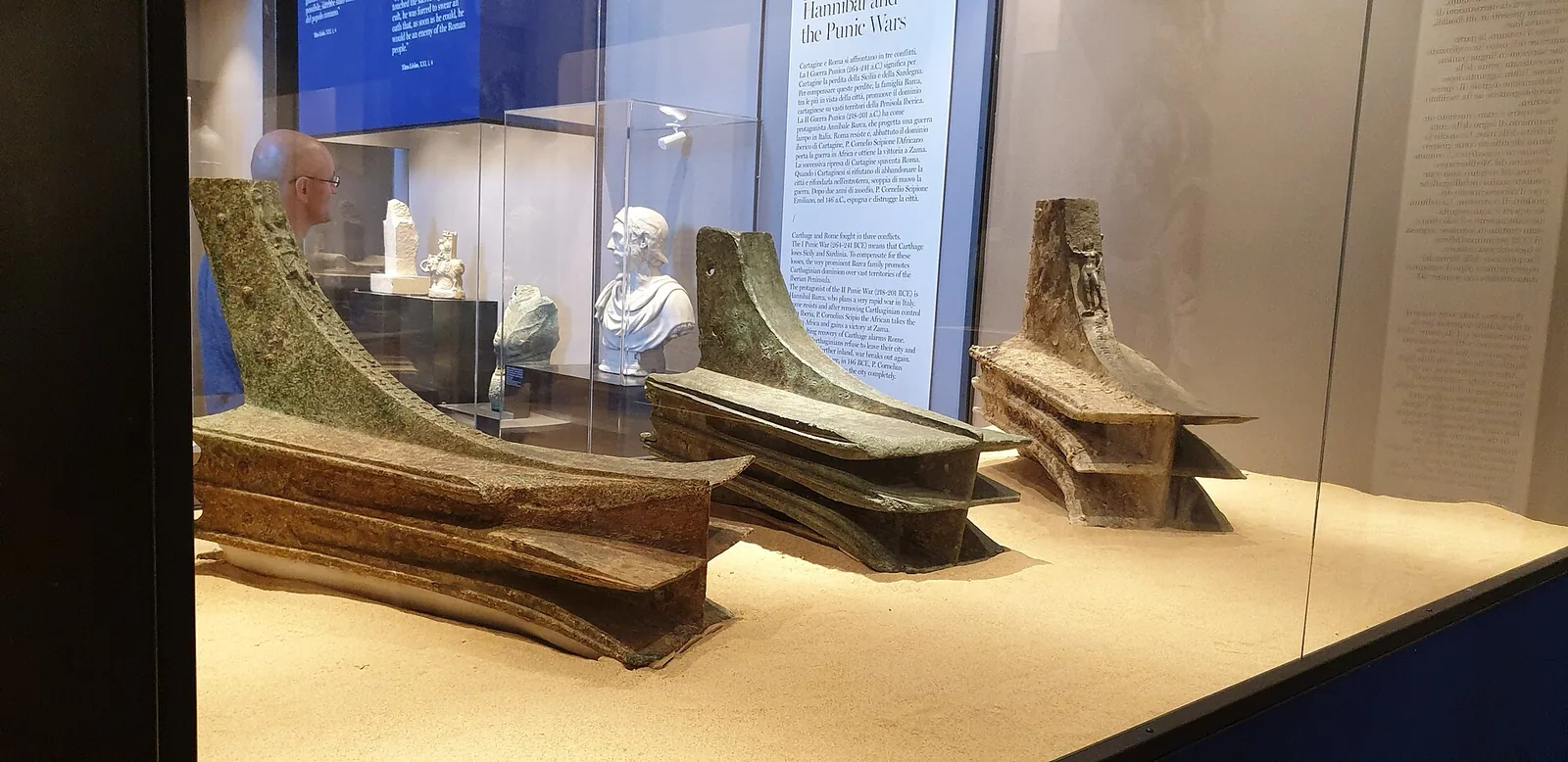
Bronze rams from the Aegates battle, at the exhibition “Carthago: il mito immortale”, Colosseum, Rome, 2019. Rams: Soprintendenza del Mare, Regione Siciliana. Photo: Jamie Heath · CC BY-SA 2.0 · Source page
Two powers, one strait
Beaks on the sea floor
Seventy to ninety metres down, off the island of Levanzo west of Sicily, divers and underwater robots keep finding bronze beaks that once sheathed the bows of war galleys. More than 25 have been raised since 2004, with helmets, swords and hundreds of jars. All sank on one morning in 241 BC.
That morning decided a 23-year war between Rome and Carthage. When it began, Rome had almost no warships and Carthage ruled the western sea. Rome lost about 700 large ships, and still won, at sea.
How? And why did the best general of the war, Hamilcar Barca, unbeaten in Sicily, have to ask for peace?
Our witness
One historian and two “lovers”
Our main source is Polybius, a Greek taken to Rome as a hostage in 167 BC, who became a friend of the great Scipio family. He wrote about a century after this war.
Polybius read two writers who had lived through it: Philinus, a Greek from Sicily who favoured Carthage, and Fabius Pictor, a Roman senator. He trusted neither: they were, he says, “much in the case of lovers”, each seeing only his own side's virtues. No Carthaginian account survives.
Background
The New City
Carthage, Qart-ḥadasht or “New City”, was founded by settlers from Tyre on the coast of modern Tunisia, by tradition in 814 BC. The Romans called its people Poeni, Phoenicians: hence “Punic”. Their language was very close to Hebrew, and each year they elected two chief magistrates, suffetes: the same word as the Hebrew shofetim, “judges”.
By 264 BC Carthage ruled the coast of North Africa, western Sicily and Sardinia, and its fleet ruled the western sea. Its armies were mostly mercenaries under Carthaginian generals, whom a court of 104 judges watched closely. Some who failed were crucified.
Background
Rome reaches the strait
Rome had just conquered Italy, as we saw in the last lesson, and ruled it down to the Strait of Messina through allies who owed it soldiers. Its Greek allies had ships; Rome itself had no real war fleet.
Three kilometres across the strait lay Messana. About 288 BC former mercenaries from Campania had seized it, killing or driving out its men. They called themselves Mamertines, “sons of Mars”. Now Hiero, the new king of Syracuse, had beaten them, and they wanted a protector.
A decision point
You are a Roman citizen in the people's assembly.
Rome, 264 BC
The Mamertines have split. One party has let a Carthaginian garrison into Messana's citadel; the other asks Rome for protection.
The Senate will not approve. Six years ago Rome beheaded in the Forum 300 of its own Campanian soldiers for doing to Rhegium exactly what the Mamertines did to Messana.
But the consuls warn you: if Carthage holds Messana, it holds the bridge to Italy. They also mention plunder. You are tired of wars, and poorer for them.
How do you vote?
- Take the Mamertines under Rome's protection and send a consul across Rome gains a foothold in Sicily and keeps Carthage away from the strait. But Carthage and Syracuse will hardly take it quietly, and Rome has never fought outside Italy, let alone against a sea power.
- Refuse: Rome cannot protect men like those it punished at Rhegium Rome keeps its good name. Carthage probably takes Messana, and its ships sit three kilometres from Italy; the southern allies will wonder whether Rome can protect them.
- Leave Messana to Carthage, if it promises by treaty never to cross to Italy If Carthage agrees, this might keep the peace for years. But everything rests on Carthage's word, and the old treaties between the two cities are already disputed.
- Wait, and let Carthage and Hiero fight over Messana Rome risks nothing for now. But whoever wins will hold the strait, and an invitation once refused may not come again.
What really happened
Take the Mamertines under Rome's protection and send a consul across
The people voted to help. The Mamertines threw out the Carthaginian commander, whom Carthage crucified; then the consul Appius Claudius crossed the strait by night. Carthage and Hiero joined forces against Rome, and a local quarrel became a war.
Polybius says the Senate refused from shame, and the people voted from fear and greed. His Roman source, Fabius Pictor, was a senator, and may have shifted the blame. And probably nobody voted for a 23-year war: Rome thought it was making a limited alliance; Carthage, that it could scare Rome off.
Rome goes to sea
261–260 BC
A fleet in sixty days
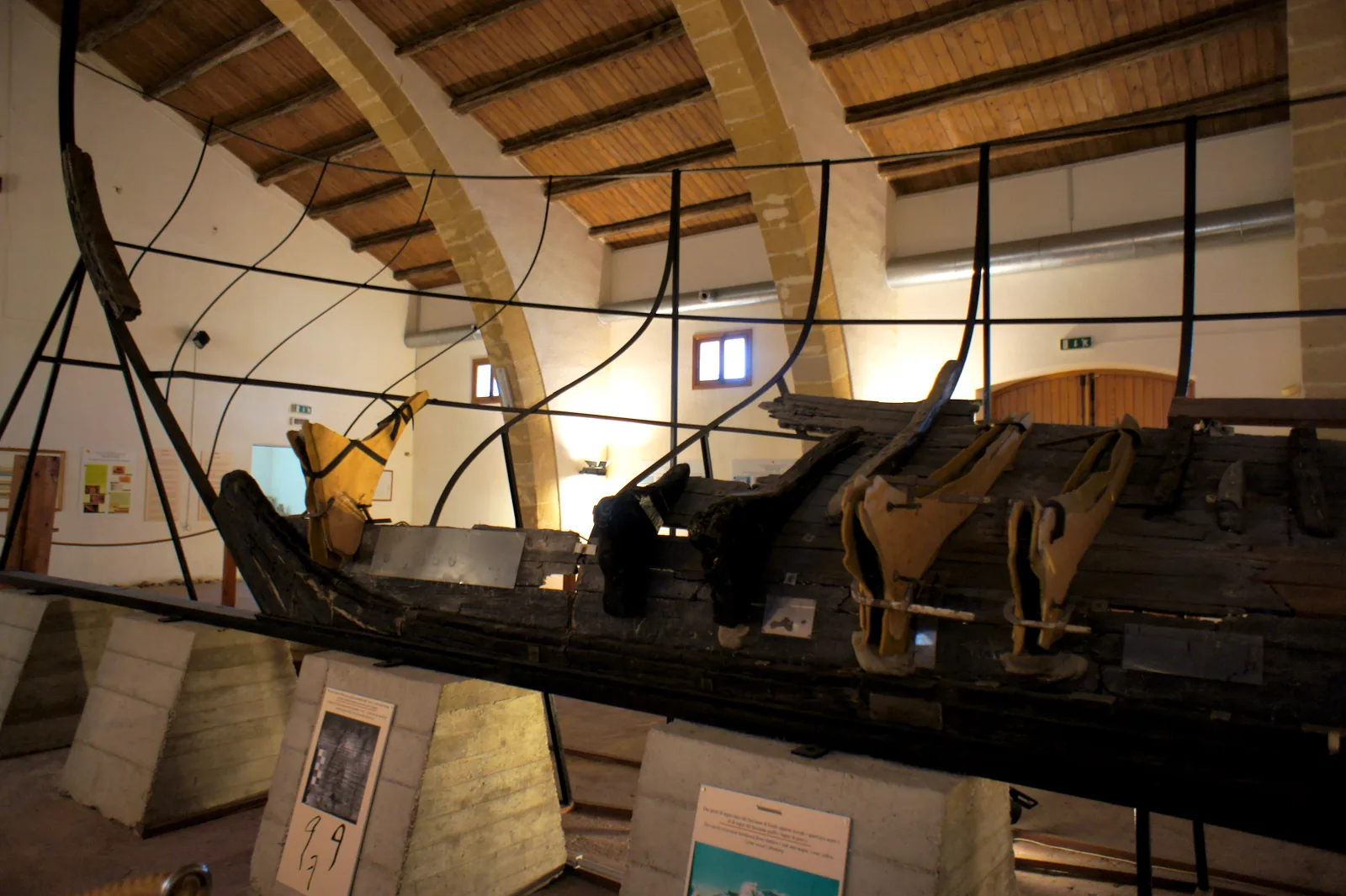
The Punic ship, Museo Archeologico Baglio Anselmi, Marsala. Photo: sarah_c_murray · CC BY 2.0 · Source page
Hiero soon changed sides, and in 261 BC Rome sacked Agrigentum, the great Greek city of the south coast. But Carthage's fleet raided Italy at will. To win, Rome had to fight at sea.
So it built 100 quinqueremes and 20 triremes, afloat, later writers claimed, 60 days after the trees were felled. Rowers practised on benches on dry land. The model, says Polybius, was a Carthaginian warship that had run aground in the strait in 264: “This ship they now used as a model, and built their whole fleet on its pattern.”
Myth
Rome had never had “a single boat”, and learned to build warships by copying one stranded Carthaginian galley.
The truth
So Polybius tells it. But Rome had elected naval officers since 311 BC, its treaties with Carthage said where Roman ships might sail, and Polybius himself says it borrowed its Greek allies' ships in 264. What was new in 260 was a state battle fleet of big quinqueremes. The copying itself is probably true: Rome did it again in 242.
The evidence
Polybius 1.20 and 1.59; Livy 9.30.4; Polybius 3.22–24; Christa Steinby, The Roman Republican Navy (2007).
Source: The raven, in Polybius's words
“On the prow stood a round pole four fathoms in height… round it was put a gangway made of cross planks attached by nails, four feet in width and six fathoms in length… At its extremity was fastened an iron object like a pestle pointed at one end… they raised the ravens by means of the pulley on the pole and let them down on the enemy's deck…”
Polybius describes the machine fitted before Rome's first sea battle, in 260 BC. Six fathoms is about 11 metres: a gangway as long as a bus.
- What does the machine turn a sea battle into? A land battle on planks: at Mylae, says Polybius, “just like a fight on land”. Rome could not out-row Carthage, so it changed the game.
- Sketch it from the text. What can't you draw? How far it swung, how exactly it was hoisted, and what an 11-metre bridge on the bow did to a ship in a swell. That is why reconstructions differ.
Mylae, 260 BC
A land battle at sea
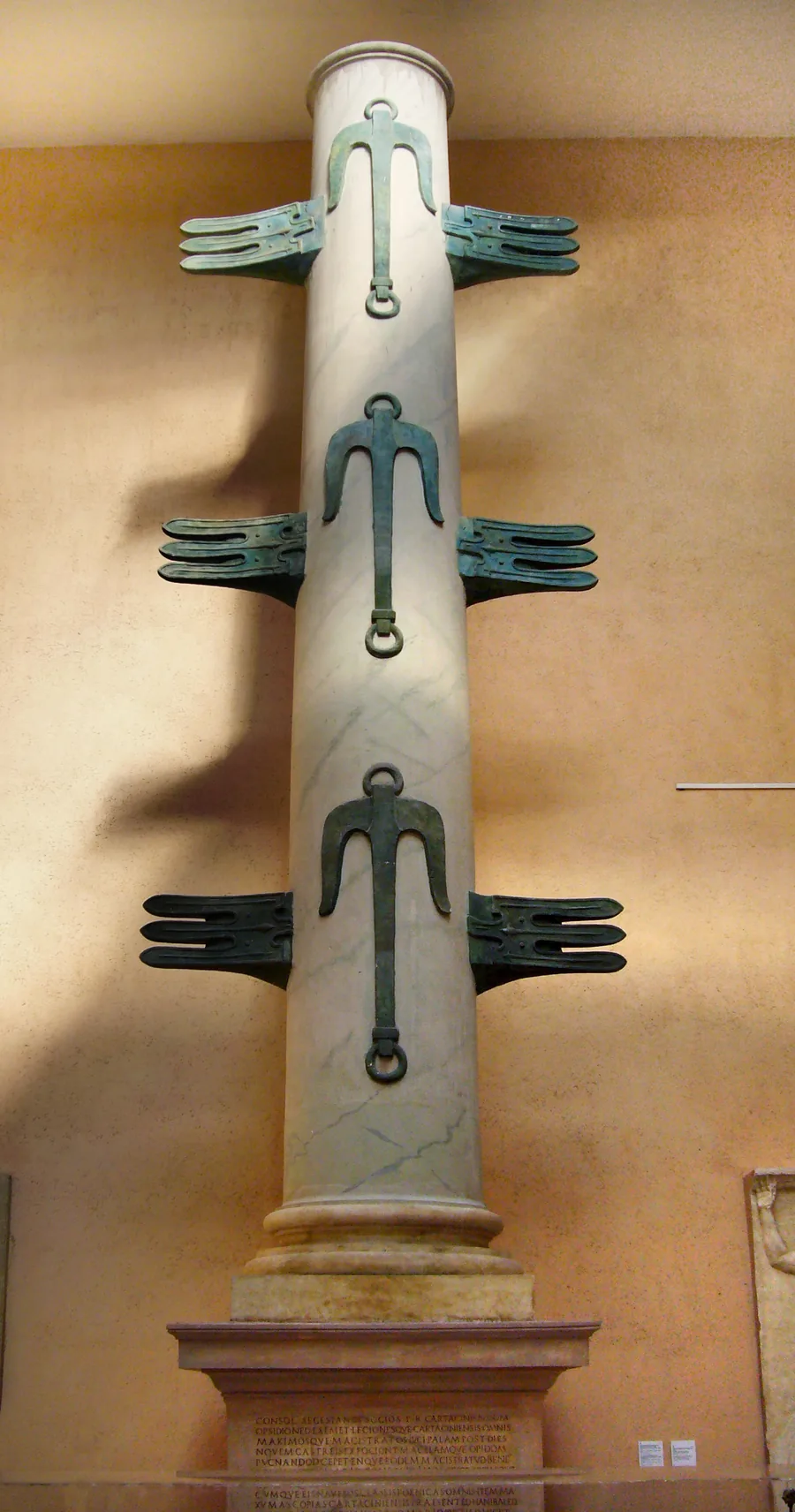
Reconstruction of the rostral column of Gaius Duilius, Museo della Civiltà Romana, Rome. Photo: Lalupa · CC BY-SA 3.0 · Source page
The first Roman squadron to sail, 17 ships under the consul Scipio, was trapped at Lipara and Scipio captured; his family name Asina, “she-ass”, was later explained as a jibe at this blunder, perhaps wrongly. His colleague Gaius Duilius took over the fleet.
Off Mylae, on Sicily's north coast, 130 Carthaginian ships came on in no order. Every ship that closed with a Roman was held fast by a raven and boarded. The first 30 were taken, the flagship among them; the rest tried to strike at the Roman sides, but the ravens swung round too. Carthage lost about 50 ships. Duilius celebrated Rome's first naval triumph, and a column studded with captured rams rose in the Forum.
A decision point
You sit on the council of elders at Carthage.
Carthage, 260 BC, after Mylae
Your fleet, unbeaten for generations, has lost about 50 ships to Roman beginners with a strange machine.
On land things look better: your army in Sicily is intact and your western fortresses are strong. You still build ships faster than Rome, and row them better.
But nobody yet knows how to beat the raven, and Rome, Polybius says, is now twice as determined to fight on.
What do you advise?
- Seek peace now, giving up eastern Sicily Carthage keeps its western fortresses, its fleet and its pride, if Rome agrees. But after Mylae Rome is in no mood to stop, and an offer now may look like weakness.
- Fight on at sea, but never let a Roman ship come alongside Your rowers' skill is your best weapon, and Rome's fleet is new. But every battle must now be fought on your terms, and one mistake puts your crews within reach of the ravens.
- Avoid sea battles: hold the western fortresses and raid Italy Rome may wear itself out in sieges. But it would be free to sail wherever it liked, even to Africa, last invaded fifty years ago by Agathocles of Syracuse.
- Strike where Rome is weak: Sardinia, Corsica, the Italian coast It could draw Roman ships and men away from Sicily. But it spreads your own fleet thin, and Sardinia is your island to lose.
What really happened
Fight on at sea, but never let a Roman ship come alongside
Carthage did not seek peace. It rebuilt its fleet, held western Sicily, and fought in Sardinia, where the beaten admiral of Mylae, Hannibal son of Gisco, was crucified by his own men in 258. At sea its captains learned to keep clear of the ravens.
Carthage lived by the sea: its trade, its supplies to Sicily and its safety at home rested on the fleet. Historians such as J. F. Lazenby and Adrian Goldsworthy see its strategy as defensive: hold on until Rome tired, in what Carthage saw as a limited war.
The great sea battle
256 BC
To Africa
In 256 BC Rome sailed to invade Africa, to make Carthage fight for its own fields, and Carthage's fleet came out to stop it. The two consuls in command were Lucius Manlius and Marcus Atilius Regulus.
Marcus Atilius Regulus
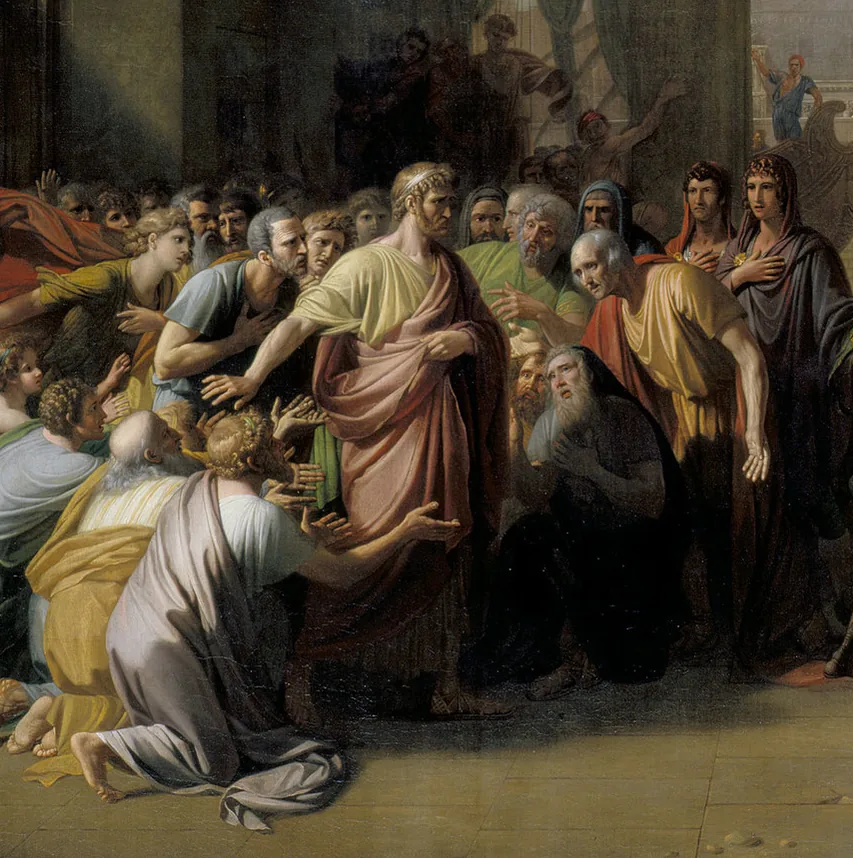
Benjamin West, The Departure of Regulus, 1769. Royal Collection Trust (RCIN 405416) · Public domain · Source page
The consul who won the war's greatest sea battle and nearly took Carthage, then lost his army and his freedom, and became the hero of a legend.
- Born: Unknown, Probably Rome; of the plebeian Atilius family
- Died: c. 250 BC, Carthage, as a prisoner, disputed: of neglect, or under torture in the legend
- Won: Ecnomus, 256 BC (with Manlius); Adys, 256 BC; Tunis taken, 256 BC
- Lost: The battle near Tunis, 255 BC: his army destroyed, himself captured
“…he said that it was not expedient that the prisoners should be returned; for they were young men and gallant officers, while he was already bowed with age.”
Ecnomus: who fought whom
Summer 256 BC
Off the south coast of Sicily, between Ecnomus and Heraclea Minoa; the exact place is unknown
Rome
- Commanders: Lucius Manlius Vulso, consul, Marcus Atilius Regulus, consul
- Strength: 330 warships, plus horse transports (Polybius); about 140,000 men (Polybius, by his own sum); accept roughly 330 ships (Most historians today)
- Losses: 24 ships sunk, none captured (Polybius); 22 ships (Eutropius (4th century AD))
Polybius's manpower figure is arithmetic, not a count: ships times 420 men.
Carthage
- Commanders: Hamilcar (not Barca), in the centre, Hanno, on the right wing
- Strength: 350 warships (Polybius); over 150,000 men (Polybius)
- Losses: over 30 sunk, 64 captured with their crews (Polybius); 64 ships (Eutropius)
The 350 is less certain: it requires every Carthaginian squadron in Sicily to have joined the main fleet.
Outcome: A Roman victory. The Carthaginian fleet broke and fled, and the invasion of Africa went ahead.
If Polybius's figures are near the truth, nearly 300,000 men took part, perhaps more than in any other sea battle. Some historians think the fleets were smaller, but most now accept his order of magnitude.
The battle of Ecnomus
Summer 256 BC, a single day
In summer 256 BC Rome sends a fleet to invade Africa, and Carthage's fleet has come out to stop it. The Romans sail west in a hollow wedge, and one of their squadrons tows horse transports. The Carthaginians wait in one long line, its left wing angled towards the shore.
One reconstruction, after Polybius 1.25–28 and the studies of G. K. Tipps (1985) and J. F. Lazenby (1996). The coastline is today's, from Heraclea Minoa to San Leone; the map is turned so that the coast runs across the top, and north points up and to the left.
The place of the battle is not known. Polybius names only the starting points, Ecnomus (Licata) for the Romans and Heraclea Minoa for the Carthaginians; Zonaras says “the opposing forces met near Heraclea”. Squadron sizes, distances and the exact shape of both formations are schematic, and whether Hamilcar's flight was a plan or a later explanation is debated.
Phases of the battle
- Two fleets meet Bound for Africa, the Romans sail west in a hollow wedge: the consuls at the point, I and II fanning back, III towing the horse transports, IV, the triarii, behind. The Carthaginians wait in one long line, its left wing angled towards the shore.
- The feigned flight The Romans strike at the thin Carthaginian centre. On Hamilcar's orders it flees, drawing I and II after it. III, slowed by its tow, and IV fall behind.
- Three battles at once At a signal the centre turns and fights. Hanno's fast ships sweep round by the open sea onto the triarii; the shore wing attacks III, which casts off its tow. “Three sea-battles were going on at a wide distance from each other.”
- The centre breaks Hamilcar's ships break first and flee west. Manlius takes prizes in tow; Regulus turns back to help the triarii, and Hanno escapes to the open sea.
- Trapped against the shore The Carthaginian left has pinned III against the coast but, afraid of the ravens, will not close. Both consuls come up and surround it: 50 ships are taken. In all Rome lost 24 ships; Carthage over 30 sunk and 64 captured.
The strategy
- Roman fleet: Rome sends the fleet to invade Africa, to make Carthage fight for its own fields. It sails in a hollow wedge, with the consuls at the point, and aims its attack at the thin Carthaginian centre.
- Carthaginian fleet: Carthage waits in one long line. According to the account, Hamilcar's centre flees to draw the Romans after it, then turns and fights at a signal. Hanno's fast ships are to sweep round by the open sea, and the shore wing attacks squadron III. Whether the flight was planned from the start is disputed.
What decided it: The battle had split into three fights far apart, but Regulus turned back to help the triarii, and both consuls surrounded the trapped Carthaginian wing, which was too afraid of the ravens to close in.
Africa, 256–255 BC
One man and one brain
The Romans landed at Aspis, east of Carthage. Regulus stayed with 15,500 men and 40 ships, beat the Carthaginians at Adys, took Tunis, and offered peace on terms so harsh that Carthage refused.
Then a Spartan mercenary officer, Xanthippus, drilled the Carthaginian army and led it onto level ground, where its 4,000 horsemen and nearly 100 elephants could work. In the spring of 255 the Roman army was trampled and surrounded. About 2,000 escaped; Regulus and 500 others were captured. Polybius drew the moral: “one man and one brain laid low that host which seemed so invincible and efficient…”
Hamilcar on the mountain
255–249 BC
The sea strikes back
Now the sea did what Carthage could not. In 255 a Roman fleet returning from Africa sailed along Sicily's harbourless south coast in the stormy season, against its pilots' advice. Off Camarina only 80 of its 364 ships survived. “History tells of no greater catastrophe at sea taking place at one time,” writes Polybius.
Rome rebuilt, and lost over 150 ships in another storm in 253. In 249 the consul Publius Claudius Pulcher attacked the Carthaginian fleet at Drepana and lost 93 ships. For six years Rome all but gave up the sea, and the war in Sicily became a war of sieges.
Hamilcar Barca
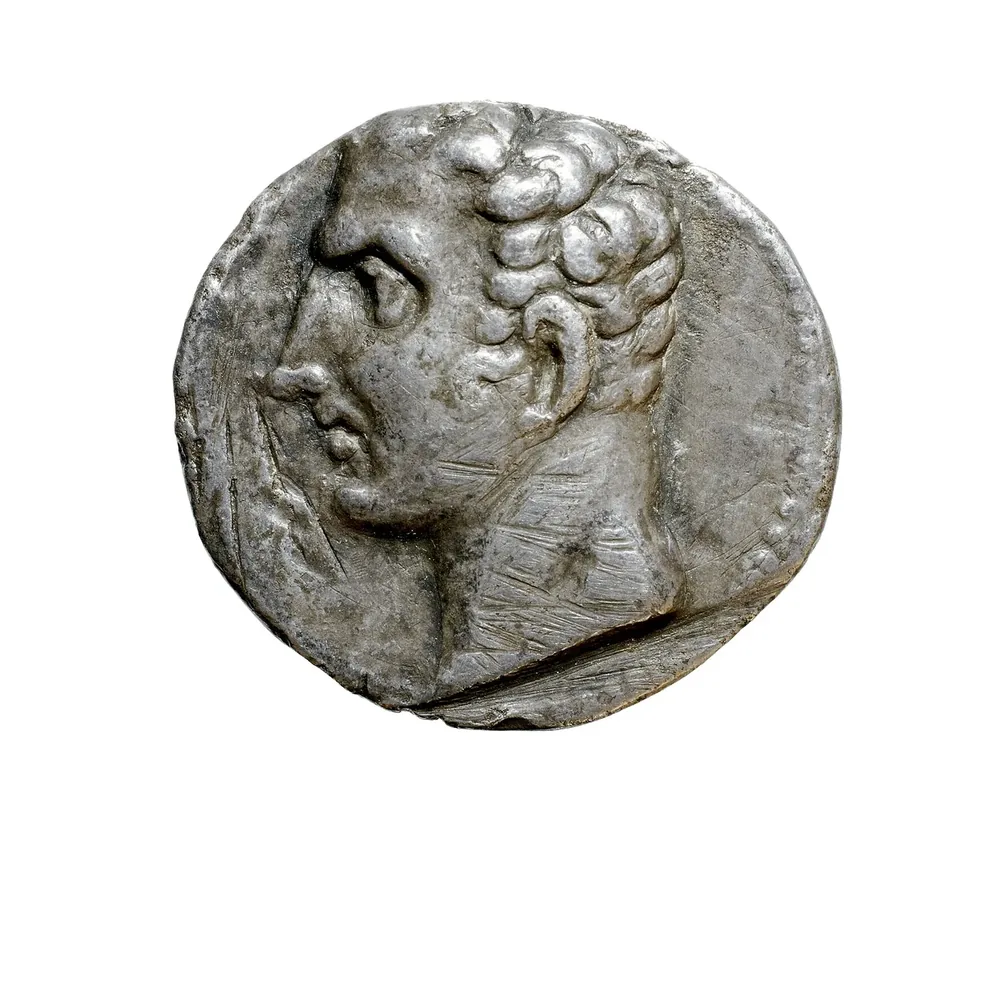
Silver shekel of the Barcids, from an unknown Punic mint in Spain. Bibliothèque nationale de France, Département des Monnaies, médailles et antiques · Public domain · Source page
The general Carthage found too late: undefeated in Sicily, he made the peace, saved his city from its own mercenaries, and took his son Hannibal to Spain.
- Born: c. 275 BC (an estimate), Probably Carthage; son of a Hannibal of whom nothing else is known
- Died: 229 or 228 BC, Spain, in battle against an Iberian tribe; the sources tell it differently
- Won: Heircte, held against Rome, 247–244 BC; Eryx, held to the end of the war, 244–241 BC; “The Saw”, against the rebels, c. 238 BC
- Lost: The war for Sicily: forced to make peace after the Aegates, 241 BC; His last battle in Spain, 229 or 228 BC: killed
“…though his country submitted, he himself would rather perish on the spot than return home under such disgrace…”
247–241 BC
Six years on two mountains
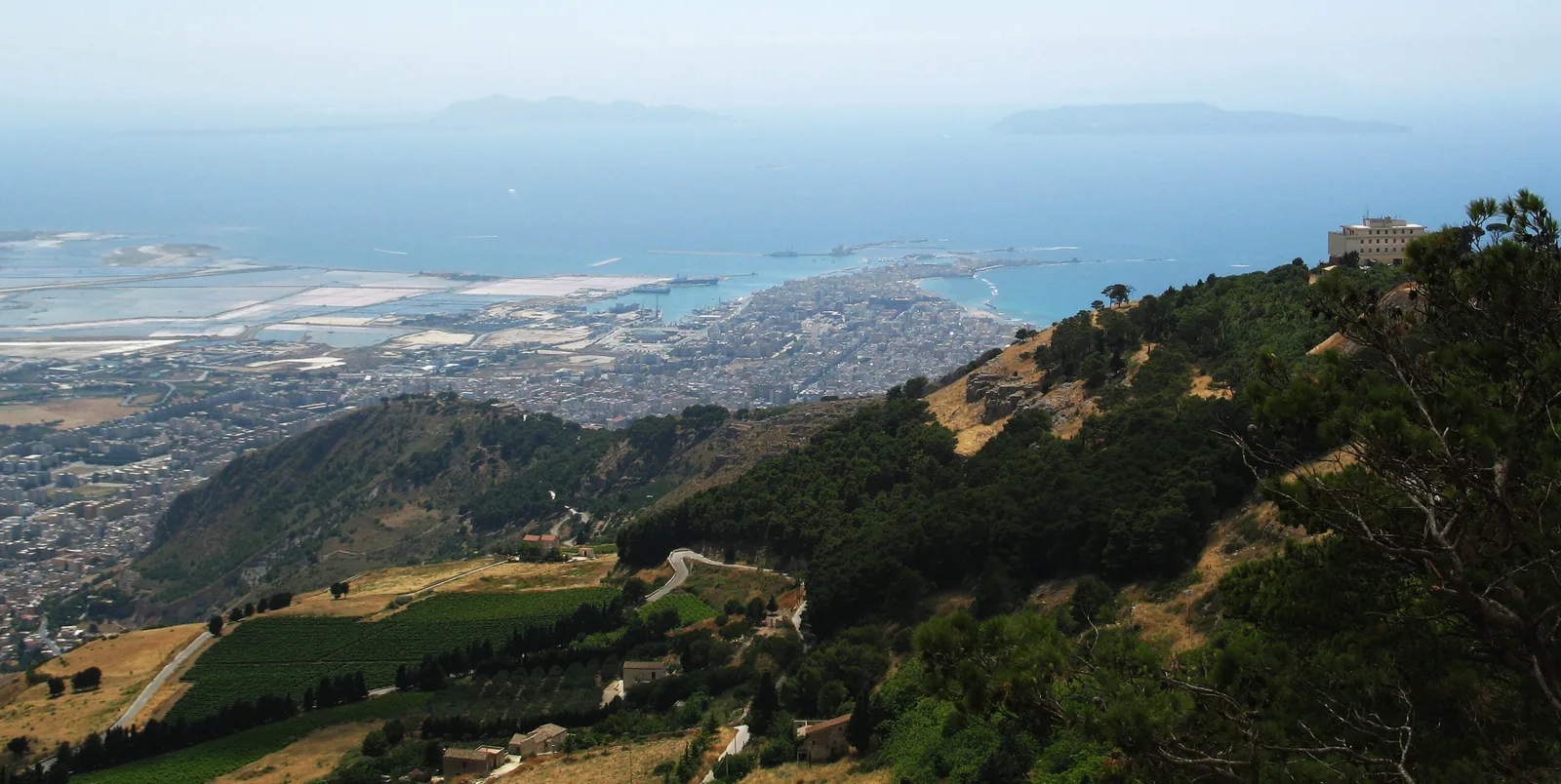
View from Erice over Trapani to the Egadi Islands, 2009. Photo: Marie Čcheidzeová · CC BY-SA 4.0 · Source page
In 247 Carthage sent to Sicily a very young general: Hamilcar, surnamed Barca, probably “lightning”. Too weak to face the Romans in the open, he seized Heircte, a steep hill with a harbour near Panormus, and for three years raided Italy and skirmished almost daily. In 244 he took the town of Eryx, on a mountain above Drepana, between a Roman garrison on the summit and a Roman camp below.
He held it to the end. Polybius rejects Fabius Pictor's claim that both sides ended exhausted: “like two uninjured and invincible champions, they left the contest drawn.” But a draw on a mountain could not save besieged Lilybaeum and Drepana.
243–242 BC
A fleet paid for by citizens
By 243 Rome's treasury was empty. So rich citizens, alone or in twos and threes, each paid for a fully equipped quinquereme, as a loan to be repaid after victory. The 200 ships copied a fast Carthaginian blockade-runner captured off Lilybaeum.
In 242 the consul Gaius Lutatius Catulus seized Drepana's harbour and drilled his crews daily. Carthage, caught off guard, hurriedly loaded a fleet with grain for Hamilcar.
The Aegates Islands: who fought whom
10 March 241 BC (Roman calendar)
North-west of the island of Levanzo, off western Sicily
Rome
- Commanders: Gaius Lutatius Catulus, consul, Quintus Valerius Falto, praetor
- Strength: 200 new quinqueremes (Polybius); 300 warships and 700 transports (Diodorus); 300 ships (Eutropius)
- Losses: not given (Polybius); 80 ships: 30 lost outright, 50 damaged (Diodorus); 12 ships sunk (Eutropius)
Polybius probably follows Fabius and plays down Roman losses; Diodorus may follow Philinus.
Carthage
- Commanders: Hanno, admiral (crucified on his return, Zonaras says)
- Strength: no total; laden ships, untrained crews (Polybius); 250 warships, plus cargo ships (Diodorus); 400 ships (Eutropius)
- Losses: 50 sunk, 70 captured; nearly 10,000 prisoners (Polybius); 117 ships; 6,000 prisoners (after Philinus) (Diodorus); 125 sunk, 73 captured; 32,000 prisoners (Eutropius)
Outcome: A decisive Roman victory. Carthage could no longer supply its armies in Sicily, and gave Hamilcar full powers to make peace.
The wreck field lies on the route from Marettimo to Eryx, and its hundreds of jars fit a laden supply fleet. But all the rams measured so far are of a similar, modest size: were these really Polybius's great quinqueremes?
The battle of the Aegates Islands
10 March 241 BC, one morning
On 10 March 241 BC Hanno's grain fleet waits at Hiera for a west wind to carry it past Levanzo to Eryx, where Hamilcar is. The Roman consul Lutatius has come to Aegusa with 200 ships and picked soldiers.
A reconstruction after Polybius 1.59–61 and the finds on the sea bed recorded by Sebastiano Tusa, Jeffrey Royal and their colleagues (2012, 2019, 2021). The coastline is today's; north is up.
The place is fixed more firmly than for any other ancient sea battle: the wreck field, 70 to 90 metres down, lies some 6 to 7 km north-west of Levanzo. Older maps put it further south, between Favignana and Marettimo; the finds moved it north. Disputed: where the Roman fleet set out from (Aegusa, as Polybius says, or a shelter in the lee of Levanzo), whether the Carthaginians were already in battle order, and the size of the fleets. The courses shown are approximate.
Phases of the battle
- The night before Hanno's fleet, laden with grain, waits at Hiera for a west wind to carry it past Levanzo to Eryx, to unload and take on Hamilcar and his best men before fighting. Lutatius has moved 200 ships and picked soldiers to Aegusa.
- Dawn: into the wind At dawn a strong westerly blows behind the Carthaginians, and the sea is rough. Lutatius weighs the risk and attacks: his trained crews row round Levanzo into the wind and form “a single line with their prows to the enemy.”
- The clash The Carthaginians lower their masts and close: ships heavy with cargo, untrained rowers, new recruits as marines. The Romans have stripped their ships for battle and carry picked legionaries.
- Rout and escape Fifty Carthaginian ships are sunk and seventy captured; nearly 10,000 men are taken. Then the wind swings round and the survivors run back to Hiera. Lutatius takes his prizes to Lilybaeum.
The strategy
- Lutatius's fleet: Lutatius means to stop the grain fleet before it reaches Eryx, so he attacks at dawn, into the wind. His trained crews row round Levanzo in one line. The ships have been stripped of everything not needed for battle, and the fighters are picked from the legions.
- Carthage: Hanno waits at Hiera for a west wind, to reach Eryx, unload there and take on Hamilcar and his best men, and only then fight. When the Romans attack, the Carthaginians lower their masts and close in.
What decided it: The crews decided it. The Romans fought in ships stripped of everything not needed for battle, with trained rowers and picked fighters. The Carthaginians were in ships heavy with grain, with untrained rowers and new recruits as marines, and so they broke.
A decision point
You are Hamilcar Barca, commander of Carthage's army in Sicily.
Mount Eryx, March 241 BC
The supply fleet is gone: 120 ships lost, nearly 10,000 men captured. Your army on Eryx and the garrisons of Lilybaeum and Drepana can no longer be fed by sea.
No one has beaten you in six years. But Carthage has no money, no fleet and no other army, and its council has given you full powers.
You know that Rome is exhausted too: its last fleet was paid for by private citizens.
What do you do?
- Fight on: hold Eryx and Lilybaeum and wait for Rome to tire Rome has quit the sea before, and might again. But without supplies your garrisons will starve or surrender one by one, and the sea around them is now Rome's.
- Break out and fight one last battle on land, for better terms A victory might buy a softer peace. But you would face the legions on open ground with hungry mercenaries, and a defeat would cost the army as well as the war.
- Make the best peace you can, and save the army Carthage loses Sicily and pays dearly, but keeps its army, its city and its future. Your men may not forgive you, and nor may you.
What really happened
Make the best peace you can, and save the army
Hamilcar sent envoys, and Lutatius agreed: Carthage would leave Sicily and pay 2,200 talents over 20 years. The Roman people found this too mild, raised it to 3,200 talents in ten years and added the islands between Sicily and Italy. One thing Hamilcar would not accept: he “succeeded merely in having the disgrace of passing under the yoke omitted”, says Zonaras.
Polybius admired him for exactly this: “a general ought to be qualified to discern both when he is victorious and when he is beaten.” Hamilcar then resigned at once and left Gisco to ship the army home, perhaps to keep his name off the surrender.
How do we know?
Source: A hero's death, or a family's crime?
“He was sent to the senate on parole, sworn to return to Carthage himself… he himself returned to Carthage… when he was being slowly put to death by enforced wakefulness…” (Cicero)
“…believing that he had died of neglect she made her sons maltreat the prisoners.” (Diodorus)
Polybius says nothing of an embassy, an oath or torture. The story first appears over a century later.
- Cicero wrote this in a book on moral duty for his son. What did he need Regulus to be? A model of a man who keeps his oath even to an enemy. When a story serves a lesson, ask whether the lesson shaped the story.
- In the same passage Cicero says Xanthippus served under Hamilcar, Hannibal's father. Is that right? No. A Hamilcar did command in Africa in 255, but not Hannibal's father: Hamilcar Barca reached Sicily only in 247. Cicero confused two men of the same name while retelling a famous tale.
- In Diodorus, how did the widow believe her husband died? Why does it matter? Of neglect, not torture. Her sons' cruelty to two Carthaginian prisoners nearly brought them to trial, and a family accused of torture needs a story of torture done to it first.
Myth
Regulus went back to Carthage to keep his oath, and the Carthaginians tortured him to death.
The truth
Polybius, our earliest and best source, knows nothing of it: for him Regulus is a proud man humbled by fortune. Later writers add an embassy to Rome around 250 BC and ever-growing tortures: sleeplessness, eyelids cut off, a box lined with spikes. Regulus probably died a prisoner in Carthage; how, we do not know.
The evidence
Polybius 1.34–35; Cicero, De Officiis 3.99–100; Horace, Odes 3.5; Gellius 7.4; Diodorus 24.12; E. R. Mix (1970).
Source: Bad seamanship, or angry gods?
“They much surpassed the Romans in speed, owing to the superior build of their ships and the better training of the rowers…” (Polybius)
“Claudius Pulcher began a sea-fight off Sicily, though the sacred chickens would not eat… throwing them into the sea in defiance of the omen, and saying that they might drink, since they would not eat.” (Suetonius)
At Drepana in 249 BC the consul Publius Claudius Pulcher lost 93 ships. Suetonius was writing about the family of the emperor Tiberius, the Claudii.
- What does each writer blame for the defeat? Polybius blames ships and training; Suetonius blames a man who mocked the gods. One explains a battle; the other tells a moral tale about a proud family.
- Polybius, writing much closer to the event, never mentions the chickens. What might that mean? Perhaps the story grew later to explain a disaster; perhaps Polybius did not think it worth telling. Silence in a good source is evidence, not proof.
- Could both be true? Yes: a consul could defy a bad omen and still be outsailed. But a story in which the gods punish pride gave Romans a reason they understood. Claudius was tried and heavily fined.
Source: A bronze witness
Rams Egadi 18, 13 and 4, raised off Capo Grosso, Levanzo; lost in the battle of 241 BC
A ram sheathed a galley's bow at the waterline. These lay 70 to 90 metres down, north-west of Levanzo. Many carry Latin inscriptions naming the official, a quaestor, who “approved” the casting; two carry a short Punic one.
- What can a ram tell us that Polybius cannot? Where the battle was: on the route from Marettimo to Eryx, not between the islands as older maps showed. And how big the ships were.
- A ram has a Latin inscription. Does that prove it came from a Roman ship? No. Carthage captured 93 Roman ships at Drepana in 249 and could have used them in 241. An object tells you who made it, not always who used it.
- The rams measured so far all fit ships smaller than Polybius's quinqueremes. Why might that be? Mixed fleets, “quinqueremes” smaller than we assume, or one group of lighter ships sunk together. Archaeologists such as William Murray still debate it: new evidence raises questions too.
The price of peace
A decision point
You sit on the council of Carthage again.
Carthage, 241–240 BC
About 20,000 mercenaries are coming home from Sicily, men of a dozen languages. They are owed years of pay, and remember every promise their generals made them.
Your treasury is empty after 23 years of war, and the first 1,000 talents for Rome are due. Your Libyan subjects are bitter: in the war you took half their crops.
Gisco, at Lilybaeum, is shipping the men over in small groups, so that each can be paid and sent home before the next arrives.
What do you do?
- Pay each group in full as it lands, even if you must borrow Expensive, and it empties what little is left. But each group goes home content before the next arrives, and no army gathers near the city.
- Wait until all have arrived, then ask them to accept less You might save a great deal of silver. But you will have 20,000 armed, angry men in one place, close to a city with few soldiers of its own.
- Pay part now, and the rest in land or places in the army It could turn a danger into settlers and soldiers. But it needs land taken from someone, and men who trust you.
What really happened
Wait until all have arrived, then ask them to accept less
The council waited until all had landed, moved them inland to Sicca, and asked them to give up part of their pay. They marched on Tunis, 22 kilometres from Carthage, and radicals took over: Spendius, a runaway Roman slave, and Mathos, a Libyan. Some 70,000 Libyans rose with them.
Polybius blames the council's meanness: it saved money when spending it was cheapest. He calls what followed a “truceless war” that “far excelled all wars we know of in cruelty and defiance of principle”. Dexter Hoyos sees the Libyan rising as its real heart.
240–237 BC
A truceless war
For more than three years Carthage fought for its life; the rebels even besieged the city. When Hanno the Great failed, the council turned to Hamilcar. The rebels mutilated Gisco and some 700 prisoners and threw them alive into a trench; after that neither side took prisoners. Hamilcar won, trapping the main rebel army near a place called “the Saw”, where more than 40,000 died.
Rome at first behaved correctly. But in 238 or 237 BC it accepted an invitation from rebel mercenaries in Sardinia, and threatened war when Carthage tried to win the island back. Carthage gave up Sardinia and paid 1,200 talents more: “contrary to all justice”, wrote even Polybius, Rome's friend.
237 BC
A hand on the sacrifice
In 237 Carthage sent Hamilcar to Spain. Before sailing he sacrificed to the gods, and called his nine-year-old son Hannibal to the altar. Hannibal himself told the story more than 40 years later: his father “bade him lay his hand on the victim and swear never to be the friend of the Romans.”
For about nine years Hamilcar conquered Spanish tribes “either by force of arms or by diplomacy”, winning silver and soldiers. He was killed in battle in 229 or 228 BC. In 221 his son Hannibal took command: the subject of the next lesson.
After the war
- 241 BC The peace of Lutatius: western Sicily becomes Rome's first territory overseas. Hiero's Syracuse stays an ally.
- 240–237 BC The Mercenary War nearly destroys Carthage. Hamilcar wins it.
- 238/237 BC Rome takes Sardinia, and soon Corsica.
- 237 BC Hamilcar sails for Spain with Hannibal, aged nine.
- 229/228 BC Hamilcar is killed. His son-in-law Hasdrubal succeeds him and later founds New Carthage, today's Cartagena.
- 227 BC Rome adds two praetors to govern Sicily and Sardinia with Corsica: its first overseas provinces.
- 221 BC Hasdrubal is murdered. Hannibal, about 26, takes command in Spain.
- 218 BC Hannibal crosses the Alps into Italy: the Second Punic War begins.
Why did Rome cross to Sicily?
Was the war of 264 BC the work of an aggressive Rome, of a dangerous world, or of a mistake on both sides?
- W. V. Harris, War and Imperialism in Republican Rome (1979) Rome was a society built for war. Every year its aristocrats needed commands, glory and booty, and its farmers plunder; its assemblies voted for war again and again. Polybius's own account, with commanders promising plunder to a weary people, fits that pattern: Messana was an opportunity Rome chose to take.
- A. M. Eckstein, Senate and General (1987) and Mediterranean Anarchy (2006) Rome was not unusually aggressive. In a Mediterranean without international law, Carthage, Syracuse and the Hellenistic kings all expanded and feared their neighbours. Rome acted as any power would to keep a rival off its doorstep, and men in the field, such as Appius Claudius, pushed events further than the Senate planned.
- Dexter Hoyos, Unplanned Wars (1998) Neither side wanted a great war. Rome thought it was taking a small city under its protection; Carthage thought a show of force would make Rome back down. Misjudgements on both sides turned a local quarrel into 23 years of war. J. F. Lazenby and Adrian Goldsworthy lean the same way.
Polybius, writing a century later for Greek readers, wanted to show how Rome came to rule the world. Did that purpose make the first step look more deliberate than it was, or less?
What do you know now?
Check yourself
Why did the Roman Senate hesitate to help the Mamertines in 264 BC?
Answer: Rome had just executed its own soldiers for the same crime at Rhegium. Right. In 270 BC 300 Campanian soldiers who had seized Rhegium, just as the Mamertines seized Messana, were executed in the Forum. Helping the Mamertines looked hypocritical.
Check yourself
What was the Roman “raven” for?
Answer: To hold an enemy ship fast so that soldiers could board it. Right. The iron spike bit into the deck and the soldiers crossed the bridge two abreast. The sea battle became “just like a fight on land”.
Check yourself
Why is the exact place of the battle of Ecnomus unknown?
Answer: Polybius names only where the two fleets set out from, not where they met. Right. The Romans set out from Ecnomus and the Carthaginians from Heraclea Minoa. Only Zonaras, centuries later, says the fleets met “near Heraclea”, and no wrecks from the battle have been found.
Check yourself
A ram from the Aegates carries a Latin inscription. What does that prove?
Answer: That a Roman official approved its casting; not necessarily that a Roman ship carried it in the battle. Right. Carthage captured 93 Roman ships at Drepana in 249, and some may have fought on its side in 241.
Check yourself
Why did Hamilcar make peace in 241, though no one had beaten him in Sicily?
Answer: Without a fleet his army could not be supplied, and Carthage had no money, ships or other army. Right. Polybius praises him for being able to discern “both when he is victorious and when he is beaten”.
Check yourself
Why do many historians doubt that Regulus was tortured to death in Carthage?
Answer: Polybius says nothing of it, and Diodorus shows Regulus's own family torturing Carthaginian prisoners, a story the legend may have been invented to cover. Right. In Diodorus the widow believed her husband died of neglect, and her sons abused Carthaginian prisoners until the magistrates stepped in.
Terms
- Punic From Latin Poenus, “Phoenician”: the Romans' word for Carthage and its people. Their language, Punic, was a Canaanite language very close to Hebrew.
- suffete One of the two chief magistrates elected each year at Carthage. The Punic word is the same as the Hebrew shofet, “judge”.
- consul One of the two chief magistrates elected each year at Rome. Consuls led its armies and, in this war, its fleets.
- quinquereme “A five”, the main battleship of the war: probably three levels of oars, with five men to each vertical set of oars. About 300 rowers in all, and room for 120 marines.
- ram A heavy bronze beak fitted to a galley's bow at the waterline, used to smash holes in enemy hulls. The Latin word is rostrum.
- corvus “Raven”: a Roman boarding bridge about 11 metres long, with an iron spike that dropped onto an enemy deck and held the ship fast. Described by Polybius; used from 260 to 256 BC.
- rostral column A victory column decorated with the rams of captured ships. Rome's speakers' platform, the Rostra, was named after rams fixed to it too.
- Mamertines “Sons of Mars”: former mercenaries from Campania in Italy who seized the Sicilian city of Messana in about 288 BC.
- talent A weight of silver, about 26 kilograms. The peace of 241 BC cost Carthage 3,200 talents, over 80 tonnes of silver.
- auspices Roman divination before a public act, such as a battle: watching birds, or whether the sacred chickens ate their grain. If they would not eat, the omen was bad.
- mercenary A professional soldier who fights for pay. Most of Carthage's land armies were mercenaries from Africa, Spain, Gaul, the Balearic Islands and Greece.
- Philinus A Greek from Sicily who wrote about the war and favoured Carthage. Polybius did not trust him.
- Fabius Pictor A Roman senator who wrote about the war. Polybius rejected his claim that both sides ended exhausted.
- Diodorus A Greek from Sicily who wrote a history, drawing partly on Philinus. Only fragments of his books survive.
- Cassius Dio A Roman senator who wrote a history. His work survives mostly in a summary by Zonaras.
- Zonaras A Byzantine monk who wrote a summary of Cassius Dio's history. Most of Dio's work we have comes from it.
- Livy A Roman historian whose books on the war are lost, except for short summaries.
- Hiero King of Syracuse in Sicily. He beat the Mamertines, joined Carthage against Rome, and soon changed sides.
- Xanthippus A Spartan mercenary officer who trained the Carthaginian army and led it onto flat ground, where the Roman army was trampled.
- Hannibal son of Gisco The Carthaginian admiral beaten at Mylae. The story says he saved his life by a trick, and he was later crucified by his own men.
- Spendius A runaway Roman slave who was one of the radical leaders of the rebels against Carthage.
- Mathos A Libyan and one of the radical leaders of the revolt against Carthage.
- Hanno the Great A Carthaginian general who failed against the rebels. After him the council turned to Hamilcar.
- Levanzo An island west of Sicily. Bronze rams from warships that sank have been found under the sea off it.
- Lipara A place near Sicily where Rome's first squadron was trapped, and the consul Scipio was captured.
- Mylae A place on Sicily's north coast, where Rome won its first naval triumph against the Carthaginian fleet.
- Drepana A harbour in Sicily where the consul Publius Claudius Pulcher attacked the Carthaginian fleet and lost 93 ships.
- Lilybaeum A fortified town in Sicily, held by a Carthaginian garrison against a Roman siege.
- Eryx A town on a mountain in Sicily, above Drepana. Hamilcar seized it and held it to the end of the war.
- Messana A city in Sicily, across the strait from Italy. The Mamertines seized it, and the quarrel over it became the war.
- Syracuse A large Greek city in Sicily. Its king, Hiero, beat the Mamertines.
- quaestor A Roman official who approved the casting of the rams. His name is inscribed on rams found under the sea.
- Carabinieri The Italian police, who recovered the first ram from a fisherman.
- trireme An ancient warship with three banks of rowers, smaller than the quinquereme.
- denarius A Roman silver coin. According to Livy, the men of Eryx were released for 18 denarii a head.
- Roman Forum The central public square of Rome. Soldiers were beheaded there, and a column decorated with captured rams rose there.
Sources
- Polybius, Histories 1.7–88, 2.1, 3.9–11 and 3.26–28, trans. W. R. Paton, Polybius: The Histories vols. I–II (Loeb Classical Library, 1922)
- Diodorus Siculus, Library of History, fragments of Books 23–24 (esp. 24.11–12), trans. F. R. Walton, Diodorus vol. XI (Loeb Classical Library, 1957)
- Cassius Dio, Roman History, fragments of Books 11–12, with Zonaras, Epitome 8.8–19, trans. E. Cary, Dio's Roman History vol. I (Loeb Classical Library, 1914)
- Cornelius Nepos, Hamilcar 1–4, trans. J. S. Watson (Bohn's Classical Library, 1886)
- Cicero, De Officiis 3.99–100, trans. W. Miller (Loeb Classical Library, 1913)
- Suetonius, Tiberius 2.2–3, trans. J. C. Rolfe, Suetonius vol. I (Loeb Classical Library, 1914)
- Livy, Periochae 16–20; 21.1.4 (Hannibal's oath); 21.40.11 and 21.41.9 (the men of Eryx)
- Eutropius, Breviarium 2.18–27, trans. J. S. Watson (Bohn, 1853; reprinted 1886)
- The inscription of the rostral column of C. Duilius, CIL I² 25 (a copy of the imperial period), Capitoline Museums, Rome
- J. F. Lazenby, The First Punic War: A Military History (London: UCL Press, 1996)
- Adrian Goldsworthy, The Punic Wars (London: Cassell, 2000)
- Dexter Hoyos, Unplanned Wars: The Origins of the First and Second Punic Wars (Berlin and New York: Walter de Gruyter, 1998)
- Dexter Hoyos, Hannibal's Dynasty: Power and Politics in the Western Mediterranean, 247–183 BC (London and New York: Routledge, 2003)
- Dexter Hoyos, Truceless War: Carthage's Fight for Survival, 241 to 237 BC (Leiden and Boston: Brill, 2007)
- Richard Miles, Carthage Must Be Destroyed: The Rise and Fall of an Ancient Civilization (London: Allen Lane, 2010)
- Serge Lancel, Carthage: A History, trans. A. Nevill (Oxford: Blackwell, 1995)
- W. V. Harris, War and Imperialism in Republican Rome, 327–70 B.C. (Oxford: Clarendon Press, 1979)
- A. M. Eckstein, Senate and General: Individual Decision-Making and Roman Foreign Relations, 264–194 B.C. (Berkeley: University of California Press, 1987)
- A. M. Eckstein, Mediterranean Anarchy, Interstate War, and the Rise of Rome (Berkeley: University of California Press, 2006)
- J. H. Thiel, A History of Roman Sea-Power before the Second Punic War (Amsterdam: North-Holland, 1954)
- Christa Steinby, The Roman Republican Navy: From the Sixth Century to 167 B.C. (Helsinki: Societas Scientiarum Fennica, 2007)
- E. R. Mix, Marcus Atilius Regulus: Exemplum Historicum (The Hague: Mouton, 1970)
- G. K. Tipps, “The Battle of Ecnomus”, Historia 34 (1985) 432–465
- S. Tusa and J. Royal, “The landscape of the naval battle at the Egadi Islands (241 B.C.)”, Journal of Roman Archaeology 25 (2012) 7–48
- J. R. W. Prag, “Bronze rostra from the Egadi Islands off NW Sicily: the Latin inscriptions”, Journal of Roman Archaeology 27 (2014) 33–59
- J. G. Royal and S. Tusa (eds), The Site of the Battle of the Aegates Islands at the End of the First Punic War: Fieldwork, Analyses and Perspectives, 2005–2015 (Rome: L'Erma di Bretschneider, 2019)
- S. Tusa, P. Campbell, M. Polakowski, W. M. Murray and others, “The Battle of the Aegates Islands, 241 BC: mapping a naval encounter, 2005–2019”, in C. Prescott and others (eds), Trinacria, ‘an island outside time’: International Archaeology in Sicily (Oxford: Oxbow, 2021) 167–180
- William M. Murray, The Age of Titans: The Rise and Fall of the Great Hellenistic Navies (Oxford and New York: Oxford University Press, 2012)
Image credits
- Bronze rams from the Aegates battle, at the exhibition “Carthago: il mito immortale”, Colosseum, Rome, 2019. Rams: Soprintendenza del Mare, Regione Siciliana. Photo: Jamie Heath · CC BY-SA 2.0 · Source page
- The Punic ship, Museo Archeologico Baglio Anselmi, Marsala. Photo: sarah_c_murray · CC BY 2.0 · Source page
- Reconstruction of the rostral column of Gaius Duilius, Museo della Civiltà Romana, Rome. Photo: Lalupa · CC BY-SA 3.0 · Source page
- Benjamin West, The Departure of Regulus, 1769. Royal Collection Trust (RCIN 405416) · Public domain · Source page
- Silver shekel of the Barcids, from an unknown Punic mint in Spain. Bibliothèque nationale de France, Département des Monnaies, médailles et antiques · Public domain · Source page
- View from Erice over Trapani to the Egadi Islands, 2009. Photo: Marie Čcheidzeová · CC BY-SA 4.0 · Source page


