Plassey, 1757: a company takes a kingdom
At dawn on 23 June 1757, a few thousand soldiers of a trading company face an army that most accounts put at many times their size. Some of the nawab’s generals are already in secret talks with the British. What happened at Plassey, and what do we really know?
Decisions, questions and your own progress, in the app
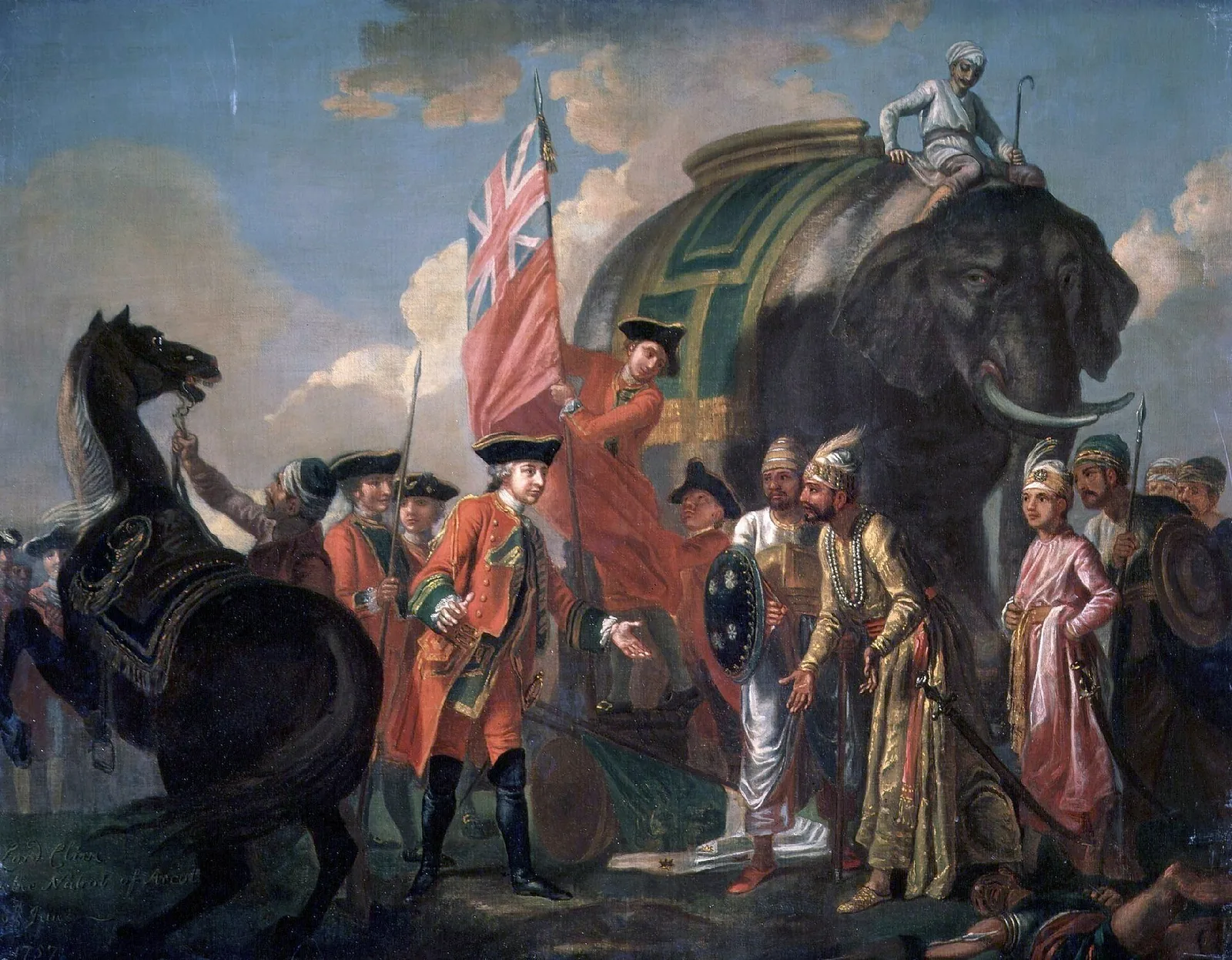
Francis Hayman, ‘Robert Clive and Mir Jafar after the Battle of Plassey’, about 1760. Commons links it to the National Portrait Gallery, London. · Public domain · Source page
The scene
Dawn, 23 June 1757
At dawn on 23 June 1757, a small army of soldiers from a trading company stands in the fields near Plassey, a village in Bengal, in eastern India. Facing them is the army of the nawab, the ruler of the province.
Most accounts give that army many times their size. Some of its generals are already in secret talks with the British. Who will win, and why?
Background
Traders with forts
The East India Company was a trading company, based in London. Its men came to India to buy and sell goods. By the 1750s it had trading posts, forts and soldiers of its own. Its main post in Bengal was Calcutta, on the Hooghly river, where the Company had built Fort William.
Bengal was ruled by a nawab, a governor who held the province in the name of the Mughal emperor. So a trading company with forts sat inside a province run by a governor. That tension is the heart of this story.
Robert Clive
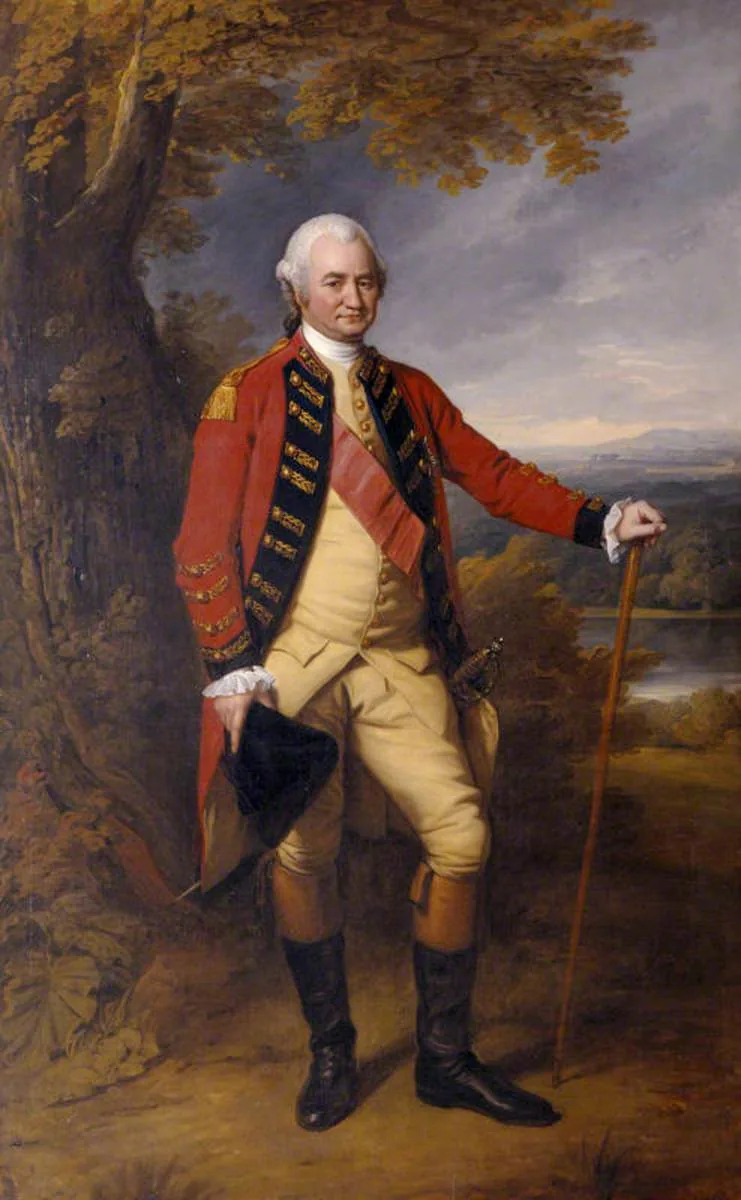
Nathaniel Dance-Holland, portrait of Robert Clive, 1770. National Trust collection (via Art UK). · Public domain · Source page
The Company’s commander at Plassey. He had sailed to Bengal from Madras.
- Born: 1725
- Died: 1774
- Won: Plassey, 1757
“By God, Mr. Chairman, at this moment I stand astonished at my own moderation!”
The road to it
Background
A young nawab and a rival town
By June 1756, Siraj ud-Daulah was nawab of Bengal. He was still a young man.
The Company had fortified Calcutta. To the nawab, its men were trading rivals who had built a fort inside his province. Each side watched the other closely.
A decision point
You are Siraj ud-Daulah, nawab of Bengal.
June 1756, near Calcutta.
The Company has fortified its town of Calcutta, and its men are your trading rivals. Your army is large, and you could take the town by force.
You do not know that a Company force is coming from Madras, under Robert Clive and Admiral Watson.
What do you do?
- Send envoys and negotiate. Demand that the Company keep to trade and accept your authority. Probably the Company agrees for a while and keeps its fort. The rivalry stays, and the next quarrel is only a matter of time.
- Take Calcutta by force now, before the Company can bring in more men and guns. Probably the town falls quickly. But the Company will not forget it, and its answer may be bigger than your attack.
- Wait and watch. Keep your army near the town and see what the Company does next. Probably the Company keeps strengthening its fort, and you lose the choice of when to act.
What really happened
Take Calcutta by force now, before the Company can bring in more men and guns.
Siraj chose the second. His army took Calcutta, and Fort William fell on 20 June 1756. The sources do not record his reasons in his own words.
We cannot be sure why he chose it. The sources come from others, and all were written afterwards, so they show what happened more clearly than what he thought.
The night
A small room in the fort
123 dead, by Holwell’s count
The prisoners were shut in a small room in Fort William for the night. Later the British called it the Black Hole.
Holwell, a Company official who survived, said after returning to England that 146 people had been shut in, and that 123 died. He blamed the nawab’s order for the confinement.
These figures were widely accepted in Europe. Remember them: we will come back to them.
The event
Winter 1756–57
Back from Madras
In October 1756, Clive and Admiral Watson sailed from Madras for Bengal. Clive’s squadron reached the Hooghly in late December.
Calcutta was retaken in early January 1757. In February the nawab agreed to the Treaty of Alinagar, which restored the Company’s rights.
The peace was short. By June, the Company was in secret talks with Mir Jafar.
The plot
A secret offer
Mir Jafar was Siraj’s senior general and paymaster. Clive and the Jagat Seth bankers secretly offered him the nawabship. If he turned against Siraj, he would rule in his place.
Omichand, a merchant in Calcutta, threatened to expose the plot unless he was paid. The British prepared two treaties. The white one was the real treaty. The red one promised Omichand a large payment, and it was forged.
Admiral Watson had refused to sign the red treaty, but his name was added anyway. The Dictionary of National Biography calls the red treaty a fraud.
June 1757
The march north
In mid-June 1757, Clive moved north towards the nawab’s army. He had about 3,000 men, and roughly 800 to 1,100 of them were European. Most of the rest were sepoys, Indian soldiers in the Company’s service.
Mir Jafar had not come over as promised. The monsoon rains were coming, and the nawab’s army was far bigger, by most accounts.
By 21 June the British were near Plassey. Clive called his officers to a council of war to decide what to do.
A decision point
You are Robert Clive.
21 June 1757, a council of war near Plassey.
Your officers are gathered in a tent by the river. Across the water, most accounts put the nawab’s camp at tens of thousands of men.
Mir Jafar has not moved, and the rains are coming. Most of your officers speak against attacking at once.
What do you do?
- Hold your position by the river, wait for Mir Jafar to move, and open talks with the nawab. Probably the rains arrive, the nawab’s large army stays across the water, and the plot has more time to fail.
- Fall back towards Calcutta, give up the advance for now, and regroup there. Probably the Company stays safe, but the men who turned to you in secret are exposed, and Calcutta is open to a new attack.
- Cross the river at once and attack the nawab’s camp, before the rains come. Probably a hard fight against a much larger army, with heavy losses. If the nawab’s men break, the Company wins Bengal.
What really happened
Cross the river at once and attack the nawab’s camp, before the rains come.
Clive changed his mind and ordered the crossing. A majority of the council, Clive included, had spoken against an attack at once. The fighting came on 23 June.
The sources give different reasons for the change. In Macaulay’s essay, Clive sits alone under trees for about an hour. The sources also disagree on the vote, so we leave out the count.
23 June 1757
The day of the guns
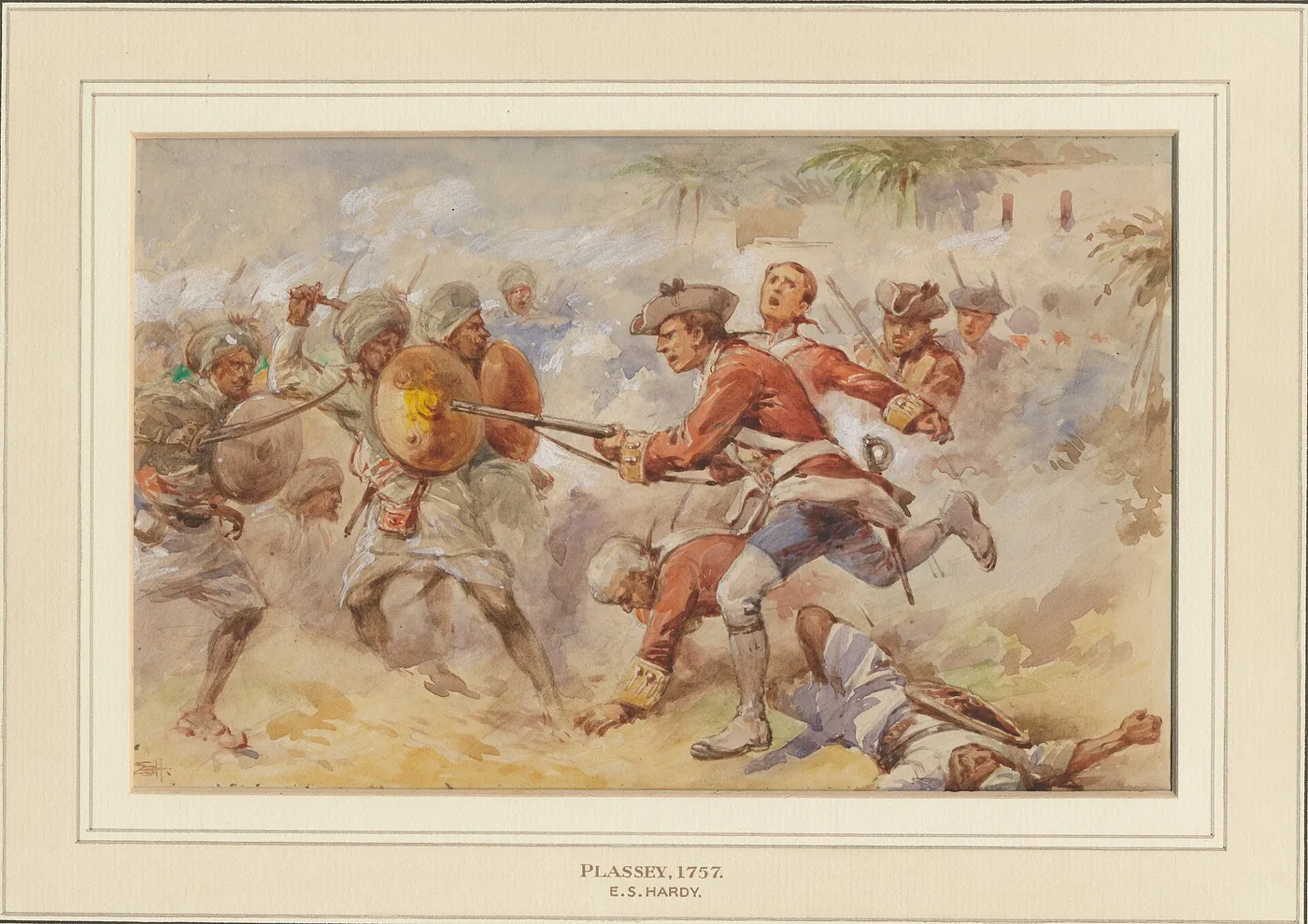
E. S. Hardy, ‘Plassey, 1757’, watercolour. Anne S. K. Brown Military Collection, Brown University Library. · Public domain · Source page
22 killed, by Clive’s count
The fighting began in the early morning. By Clive’s account, his men were attacking by about six o’clock.
The National Army Museum says a heavy downpour silenced the nawab’s guns, and that the British had covered their gunpowder. Clive’s letter does not mention rain.
By about noon the nawab’s guns were drawn back. Siraj left the field on 23 or 24 June. The battle was over in a single day. By Clive’s own count, the Company lost 22 men killed and 50 wounded.
Plassey: who fought whom
23 June 1757
Near the village of Plassey, about 90 to 100 miles north of Calcutta
The Company’s force
- Commanders: Robert Clive
- Strength: About 3,000 men, fewer than 1,000 of them European (Dictionary of National Biography); About 800 Europeans and 2,100 sepoys (National Army Museum); Eight guns (Clive’s letter)
- Losses: 22 killed, 50 wounded (Clive’s letter); About 70 men in all (Innes, 1912)
The figures for European soldiers differ, and some later estimates go higher. Eight guns is Clive’s own count.
The nawab’s army
- Commanders: Siraj ud-Daulah, the nawab, Mir Jafar, senior general and paymaster
- Strength: “Upwards of forty pieces of cannon” (Clive’s letter); About 50,000, including 16,000 cavalry (National Army Museum); 40,000 infantry, 15,000 cavalry (Dictionary of National Biography; Macaulay); About 60,000 (Innes, 1912); 5,000 soldiers and 53 guns, probably a partial count (FIBIS, a family-history website)
- Losses: About 500 killed (Clive’s letter)
The sources disagree widely: from 5,000 to about 60,000 men. The main figures are shown here, and none is chosen.
Outcome: A victory for the Company. The nawab’s guns drew back about noon, and Siraj left the field on 23 or 24 June.
The numbers come from different writers, and the sources disagree widely.
What we really know
Source: Clive writes to the Company
“… a large body of troops hovering on our right, which proved to be our friends.”
Clive wrote to the East India Company about a month after the battle, and he wrote about his own part in the victory.
- Who wrote this, and for whom? Clive, the commander, writing for the Company and for his own reputation. Self-justification is the obvious risk.
- What is missing? The council of war, the forged treaty, and any name for the troops that ‘proved to be our friends’.
- Can we trust the numbers? Only in part. The Company’s losses (22 killed, 50 wounded) and the enemy dead (about 500) are Clive’s own count, and other sources give other figures.
Myth
“The Black Hole killed 123 prisoners, and that number is a proven fact.”
The truth
The figure of 123 deaths is Holwell’s. It was widely accepted in Europe, but it is disputed, and modern historians do not treat it as proven.
The evidence
Banglapedia, the national encyclopedia of Bangladesh, calls the death toll an exaggeration. It argues that, after deaths in battle, escapes and desertions, 146 men could not all have been held in the room three hours after the surrender. A test with bamboo poles suggests that far fewer people could fit. No list or head count was made. One modern estimate gives 64 prisoners and 21 survivors.
Source: A German picture of 1762
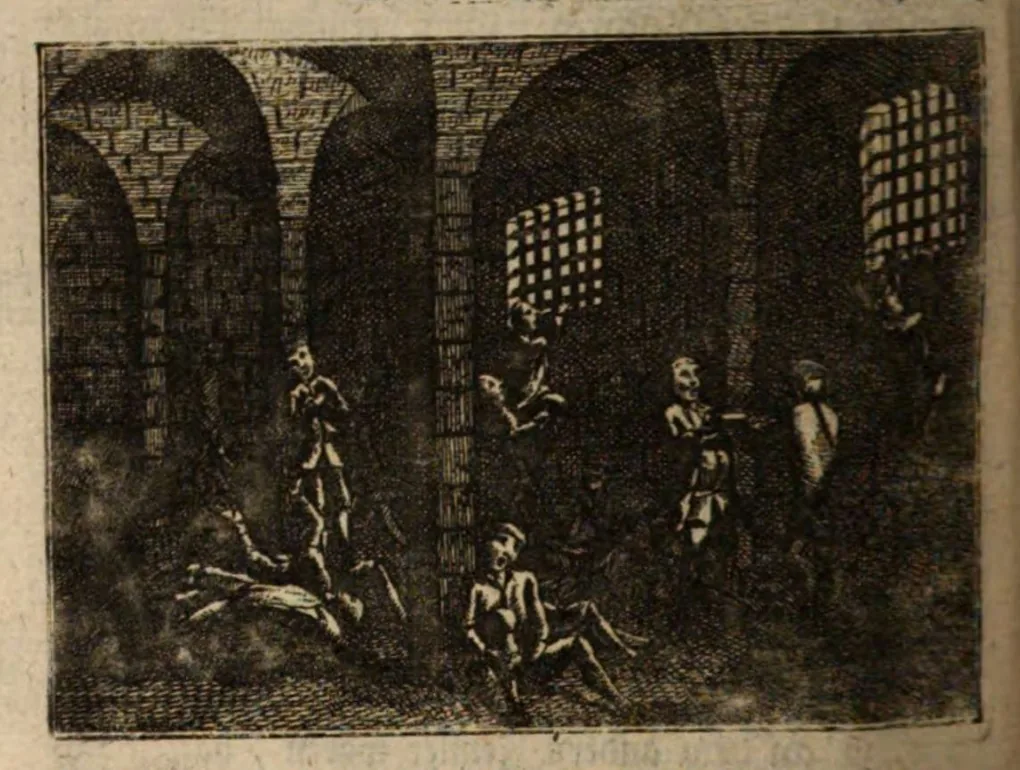
Engraving in Des Neu eröffneten Historischen Bilder-Saals, 13th part (1762), p. 822. Bavarian State Library (BSB), Munich. · BSB München · CC BY-SA 4.0 · Source page
Engraving in a German illustrated history book printed in 1762. The engraver is not named.
The picture reached readers in Europe more than five years after the event, and it shows the story as Europeans were told it.
- Who made it, and when? The engraver is not named. It was printed in Germany in 1762, more than five years after the event and far from Bengal.
- What does it want the reader to feel? Pity and horror. The men are crowded in the dark, some lie on the floor, and the bars on the windows make the room look like a trap.
- What is missing? Any number or name. A picture shows a crowd, not a count, so it cannot settle the question of the 123.
Witnesses
Who tells us?
Our witnesses are few, and almost all wrote afterwards. Clive wrote for his employers. Holwell wrote after going home, and his figures became the accepted ones. A later essay by Macaulay tells the story as Clive’s triumph.
Each witness had a reason to tell the story a certain way. Keep that in mind for the next choice.
A decision point
You are Mir Jafar, the nawab’s senior general.
23 June 1757, early morning, before the fighting.
The nawab trusts you as his senior general and paymaster. Your troops are in his camp, and his army is ready for battle.
Through the Jagat Seth bankers, the British have secretly offered you the nawabship. The fighting is about to begin.
What do you do?
- Lead your troops against the British, and show the nawab your loyalty. Probably the fighting goes on longer and costs the Company more. You keep the nawab’s trust, but the British would have no reason to make you nawab.
- Keep your troops out of the fighting, and wait to see who wins. Probably the nawab fights without you, and you keep both doors open. If he loses, the British may need you; if he wins, you can say you never fought.
- Ride across to Clive now and declare for the British. Probably the nawab’s army loses its senior general on the eve of battle. His men would see you as a traitor, whatever the British promised.
What really happened
Keep your troops out of the fighting, and wait to see who wins.
According to the National Army Museum and an older British history (Innes, 1912), the cavalry linked to Mir Jafar did not join the fighting. Clive’s letter speaks of troops that ‘proved to be our friends’, but it does not name them.
The sources do not record his reasons. We know what he was offered, not what he weighed.
What followed, and the quiz
Afterwards
A new nawab, a new fortune
Siraj fled north, towards Rajmahal. He was caught near Rajmahal and brought back to Murshidabad, his capital.
Most accounts say he was killed at Murshidabad on 2 July, on the orders of Miran, Mir Jafar’s son. The National Army Museum credits Mir Jafar instead.
Mir Jafar was made nawab. The National Army Museum calls him a largely puppet ruler. Clive received gifts. The Dictionary of National Biography gives two sums for Clive’s personal gift, 200,000 pounds and 300,000 pounds, and a jagir, a grant of land income of nearly 30,000 pounds a year.
What followed, in order
- 23 June 1757 The battle of Plassey. By Clive’s count, 22 of his men are killed and 50 wounded.
- Late June or early July 1757 Mir Jafar is declared nawab. Siraj is caught near Rajmahal and brought back.
- 2 July 1757, according to most accounts Siraj is killed at Murshidabad, on Miran’s orders, according to most accounts.
- 1757, after the battle Clive receives large gifts from Mir Jafar. Sources give different sums.
- 1774 Robert Clive dies, aged 49.
Plassey: a battle, a coup or a plot?
Was Plassey won by the sword, or was it settled by secret deals before the battle?
- Sushil Chaudhury, The Prelude to Empire (2000) The plot was designed by British agents, who kept their Indian partners committed to the end. Their aim was to recover the private trading fortunes of Company servants, which had collapsed in the late 1740s and early 1750s. This is how the book’s publisher describes it.
- William Dalrymple, The Anarchy (2019) Plassey was a palace coup, won by bribery and betrayal, including the bankers’ offer to Mir Jafar. He places the Company’s rise in the disorder that followed the decline of Mughal power. This is how reviewers describe the book.
- Macaulay’s essay, with Smith’s notes (1911) The battle was Clive’s triumph, won by his own decision to cross the river. Smith’s 1911 notes present this as one interpretation.
Which evidence would most change your view: the bankers’ letters, Mir Jafar’s own account, or the records of that day?
Check yourself
What status does the figure of 123 deaths have in this lesson?
Answer: Holwell’s figure, accepted in Europe and disputed by modern historians. Right: the figure comes from Holwell, was widely accepted in Europe, and is disputed by modern historians.
Check yourself
At the council of 21 June, what did most of the officers first think?
Answer: That they should not attack at once, Clive included. Right: the majority spoke against an immediate attack, and Clive was among them at first.
Check yourself
What is the main weakness of Clive’s letter as a source?
Answer: It is Clive’s own account, written for his employers, and it leaves things out.. Right: Clive wrote about his own part, for the Company, and the letter does not record the council, the forged treaty, or the troops that ‘proved to be our friends’.
Check yourself
What do the sources say about the size of the nawab’s army?
Answer: They disagree: estimates range from about 5,000 to about 60,000. Right: the sources differ widely, and the lesson shows them side by side rather than choosing one.
Check yourself
According to most accounts, who ordered Siraj’s killing?
Answer: Miran, Mir Jafar’s son. Right: most accounts name Miran, Mir Jafar’s son, as the one who gave the order.
Check yourself
By Clive’s own count, how many men did the Company lose at Plassey?
Answer: 22 killed and 50 wounded. Right: this is Clive’s own count in his letter, given in the battle story and the forces card.
Terms
- East India Company A trading company based in London. By the 1750s it had trading posts, forts and its own soldiers in India.
- nawab A governor of a province under the Mughal empire. In Bengal, the nawab was the most powerful ruler of the province.
- Mughal Of the Mughal empire, which ruled most of India from the 1500s. Its provinces, such as Bengal, were run by governors called nawabs.
- sepoy An Indian soldier in the Company’s army, under European officers.
- jagir A grant of the income from a piece of land, given to a person as a reward.
- Black Hole of Calcutta The small room in Fort William where prisoners were held on the night of 20 June 1756. How many died is disputed.
- Jagat Seth A powerful banking house in Bengal. Its bankers joined Clive’s secret talks with Mir Jafar in 1757.
- council of war A meeting of a commander and his officers to decide what to do before a battle.
- monsoon The seasonal wind and rain of South Asia, which brings heavy rain in summer.
- Omichand A merchant in Calcutta who threatened to expose the plot unless he was paid. The British promised him a large sum in a forged treaty.
- Holwell A Company official who survived the confinement in the Black Hole. He said 123 of the 146 shut in had died. The figures were widely accepted in Europe but are disputed.
- Admiral Watson A British naval officer who sailed with Clive from Madras to Bengal. He refused to sign the red treaty.
- Macaulay A British historian whose later essay tells the battle as Clive's triumph.
- Innes The author of an older British history. The text cites him on the cavalry that did not join the fighting.
- Ghulam Husain Khan An Indian Muslim writer who wrote a history of his own times in Persian. Read him as a witness with motives of his own.
- Miran Mir Jafar's son. Most accounts say he gave the order to kill Siraj at Murshidabad.
- Murshidabad The capital of the nawab Siraj, in Bengal. Most accounts say Siraj was killed there.
- Rajmahal A town Siraj fled towards, to the north, after the battle. He was caught near it.
- Chandernagar A town that fugitives reached. They reported 200 people shut in, a different figure from Holwell's.
- Madras A city in India, from which the British sailed to Bengal. Today it is called Chennai.
- Calcutta The Company's main town in Bengal, on the Hooghly river. Today it is called Kolkata.
- Hooghly A river in eastern India, on which Calcutta lay. Clive's squadron reached it.
- Bengal A province in eastern India, ruled by a nawab on behalf of the Mughal emperor.
- Fort William The fort the Company built in Calcutta. It fell to the nawab's army and was retaken later.
- Treaty of Alinagar An agreement the nawab agreed to in February, which restored the Company's rights. The peace that followed was short.
- Dictionary of National Biography A British reference book of biographies of notable people. The text cites it on the red treaty and on the council of war.
- National Army Museum A British army museum. The text takes from it the account of a downpour that silenced the nawab's guns.
- trading post A place where foreign traders buy and sell goods, often with forts and soldiers of their own.
- squadron A group of warships, or aircraft, that act together under one commander.
- paymaster The officer in charge of paying an army's soldiers.
- puppet ruler A ruler who serves only as a figurehead, while real power lies with others.
- red treaty A forged treaty written on red paper. It promised Omichand a large payment. The white treaty was the real one.
- gunpowder An explosive powder that must stay dry for guns to fire. In rain it becomes useless.
Sources
- Robert Clive, letter to the East India Company, 1757 (dated 26 July in one printed copy), in Sir John Malcolm, Memoirs of Lord Clive, vol. 1
- Ghulam Husain Khan, Seir Mutaqherin, trans. Hajee Mustapha (M. Raymond), Calcutta: James White, 1789
- ‘Clive, Robert’, Dictionary of National Biography (1885–1900), on Wikisource
- Macaulay, essay on Robert Clive, with notes by Vincent A. Smith (1911)
- Britain Express, Battle of Plassey page (reproduces A. D. Innes, A History of the British Nation, 1912)
- Sushil Chaudhury, The Prelude to Empire: Plassey Revolution of 1757 (New Delhi: Manohar, 2000)
- William Dalrymple, The Anarchy: The Relentless Rise of the East India Company (Bloomsbury, 2019)
- Peter Harrington, Plassey 1757: Clive of India’s Finest Hour (Osprey Campaign 35, 1994)
- Banglapedia, ‘Black Hole Incident’
- National Army Museum, online article on the battle of Plassey
- FIBIS, ‘Battle of Plassey’ (family-history wiki)
Image credits
- Francis Hayman, ‘Robert Clive and Mir Jafar after the Battle of Plassey’, about 1760. Commons links it to the National Portrait Gallery, London. · Public domain · Source page
- Nathaniel Dance-Holland, portrait of Robert Clive, 1770. National Trust collection (via Art UK). · Public domain · Source page
- E. S. Hardy, ‘Plassey, 1757’, watercolour. Anne S. K. Brown Military Collection, Brown University Library. · Public domain · Source page
- Engraving in Des Neu eröffneten Historischen Bilder-Saals, 13th part (1762), p. 822. Bavarian State Library (BSB), Munich. · BSB München · CC BY-SA 4.0 · Source page


