The 38th parallel: a line drawn in half an hour?
On the night of 10-11 August 1945 two American officers were told to propose a dividing line for Korea. A later story says it took about half an hour. How did a line on a map become a border that is still there?
Decisions, questions and your own progress, in the app
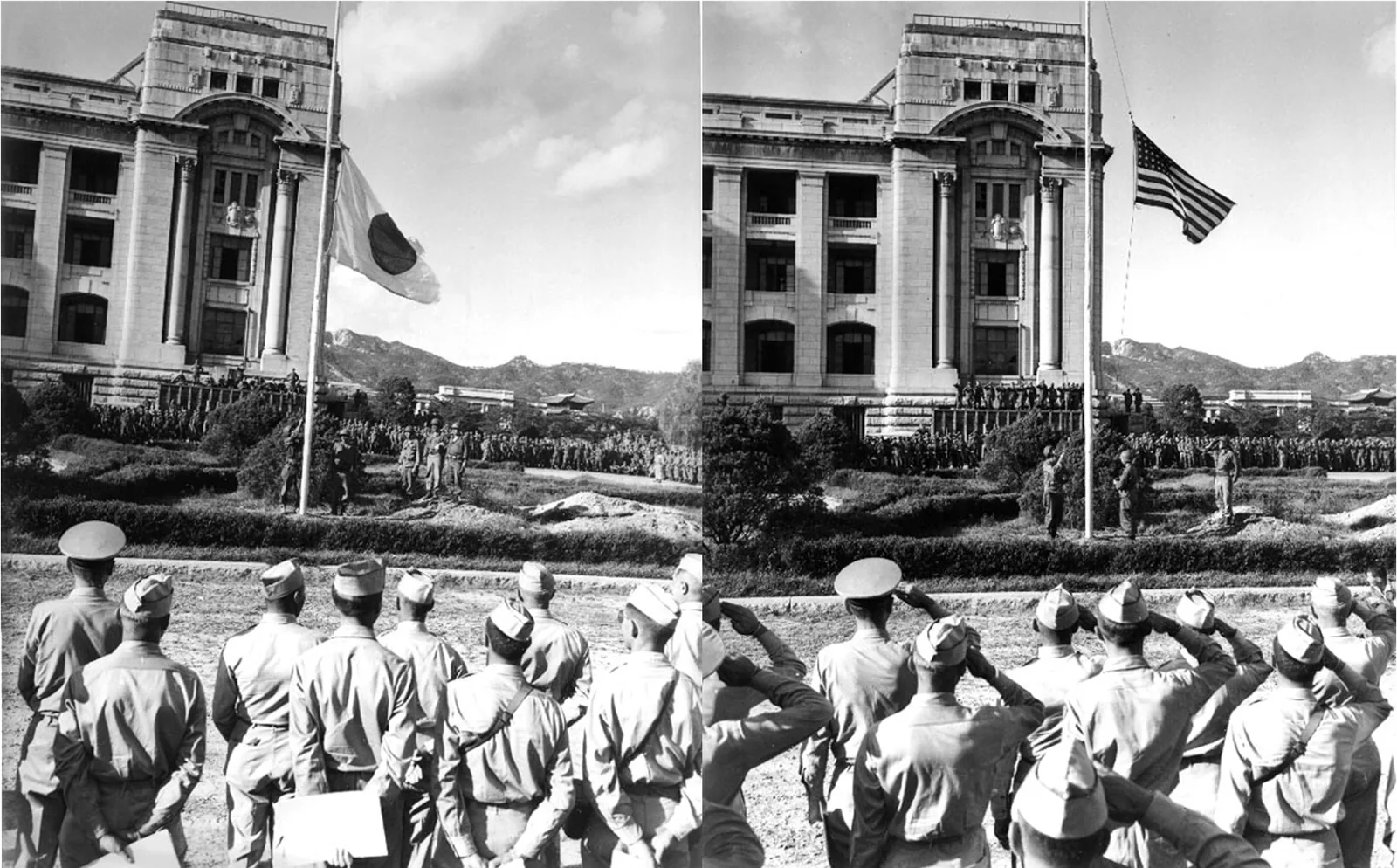
US Navy, flag change in Seoul, September 1945 (photo 80-G-391464/5). Public domain. · Public domain · Source page
A promise on paper
One line on paper
On the night of 10 to 11 August 1945, two American colonels sat in the Pentagon and were asked to propose a dividing line for Korea.
A later retelling says it took about half an hour. Is that true? And how does a line on paper become a border that still divides a country?
Background
A promise from 1943
1943
Korea had been under Japanese rule for decades. In 1943 the leaders of the United States, Britain and China met in Cairo and declared that Korea would become free and independent.
The promise set no date and no method.
Source: The Cairo Declaration
“mindful of the enslavement of the people of Korea, are determined that in due course Korea shall become free and independent.”
A statement by three Allied powers, made during the war. No Korean took part in drafting it.
- Who issued this, and when? Three Allied powers, in November 1943, in the middle of the war.
- What does the promise leave out? When, and how. ‘In due course’ gives no date.
The night in the Pentagon
The armies
An army enters from the north
On 8 August 1945 the Soviet Union declared war on Japan. Within days, Soviet forces were moving into northern Korea.
American forces had not yet reached Korea.
A decision point
You are Dean Rusk, a colonel in the US Army.
The night of 10 to 11 August 1945, the Pentagon.
Soviet forces are entering northern Korea. Soon it must be clear which army takes the Japanese surrender in each part of the country.
You and another colonel, Charles Bonesteel, are asked to draft a parallel that divides Korea into two zones. Time is short, and American forces have not yet reached Korea.
Which line do you propose?
- The 38th parallel. It keeps the capital, Seoul, in the American zone, even though American troops could not reach that far north quickly. Probably the United States would get a zone it could not yet hold quickly. If the Soviet Union agreed, the capital would stay in American hands.
- A line well to the south, so the American zone is small and Seoul falls to the Soviet side. Probably the Soviet Union would gain the capital and the larger area. The United States could reach its smaller zone faster, but would lose the capital.
- No line at all. Ask for joint occupation of the whole peninsula. Probably the Soviet Union would not agree quickly. Each army would move as far as it could, and whoever arrived first would decide.
What really happened
The 38th parallel. It keeps the capital, Seoul, in the American zone, even though American troops could not reach that far north quickly.
The line chosen was the 38th parallel. A memorandum by Rusk of July 1950 says the drafters recommended a line further north than American forces could realistically reach. English-language accounts usually credit Bonesteel with proposing it, and say both men worked on the draft.
They wanted Seoul inside the American zone, as Rusk's note says. No reliable source gives exactly how long the discussion took.
Moscow
Moscow agrees
The proposal went to Moscow on 15 August, and the Soviets agreed on 16 August, according to accounts citing Chong-sik Lee's 1985 article.
Who speaks for Korea?
Source: Dean Rusk's note, 1950
“We recommended the 38th parallel even though it was further north than could be realistically reached by U.S. forces.”
“…we felt it important to include the capital of Korea in the area of responsibility of American troops.”
Rusk wrote it about five years later, as one of the two drafters.
- When was this written, and by whom? In 1950, by one of the two colonels: a late source with one point of view.
- What does the note admit? That the line lay further north than American forces could realistically reach. The proposal went beyond what they could hold quickly.
- What is missing? A time. The note names the night, but not how long the discussion took.
A decision point
You are Lyuh Woon-hyung, a well-known Korean politician.
Mid-August 1945.
Japan is about to surrender. Korea is still run by the governor-general.
Many Koreans have waited for independence, and the Cairo promise says it will come ‘in due course’. Foreign armies are already moving in, and more will arrive. You can set up a Korean body now, or wait.
What do you do?
- Form a Korean committee now, to take over government from the governor-general. Probably you would win quick support from many Koreans. But the foreign armies that arrive may not accept your committee as a legitimate government.
- Wait for the foreign armies to arrive, then ask them to hand power to Korean leaders. Probably the arriving armies would bring plans of their own, and Koreans would have less say in them.
- Ask the governor-general for a quiet handover of power, with no committee. Probably the governor-general would delay or refuse. Meanwhile a power vacuum could form, and someone else might fill it.
What really happened
Form a Korean committee now, to take over government from the governor-general.
Lyuh set up the Committee for the Preparation of Korean Independence in mid-August. Sources give 15, 16 or 17 August. It aimed to take executive power from the governor-general. On 6 September its communist and socialist wings declared a People's Republic of Korea, after the nationalists withdrew. The American military government did not recognise it.
Many Koreans wanted to run their own affairs at once. But the committee held groups far apart. When the nationalists withdrew, the communist and socialist wings declared the republic on their own.
Myth
At Yalta or Potsdam, the Allies split Korea in two.
The truth
At Yalta, in February 1945, Roosevelt and Stalin discussed a trusteeship for Korea, not a division. Stalin wanted it to be short. Potsdam made no decision to divide Korea. The division was set only in August 1945.
The evidence
Rusk's note dates the line to August 1945, not to Yalta. The idea of a trusteeship had already come up at Tehran in 1943.
Two zones, one order
The order
General Order No. 1
17 August
President Truman approved General Order No. 1 on 17 August 1945. For Korea it said that Japanese forces north of the 38th parallel would surrender to the Soviets, and those south of it to the Americans.
In the south
John R. Hodge lands
On 8 or 9 September 1945, American troops under John R. Hodge landed at Incheon; sources differ on the day. Local People's Committees were already active in the south, and a People's Republic had been declared days earlier.
A decision point
You are John R. Hodge, commander of the American forces in Korea.
September 1945, after the landing at Incheon.
A few days ago, in Seoul, communist and socialist groups declared a People's Republic of Korea. The nationalists had already withdrawn from the committee.
Local People's Committees are active across the south, and you now hold authority there. What will you do about the republic that was declared?
How do you treat the declaration?
- Recognise the republic as Korea's government and work with it. Probably you would get quick calm in the south. But you would tie yourself to a group your own government had not chosen, and clash with Korean politicians who want something else.
- Do not recognise it. Rule the south directly through an American military government. Probably you would keep full control and block the immediate problem. But Koreans would see you as occupiers, and opposition would grow.
- Call all the groups to talks and build a provisional council before deciding on recognition. Probably it would take time, and the groups might not agree. But a council representing more currents could win wider support.
What really happened
Do not recognise it. Rule the south directly through an American military government.
Hodge did not recognise the republic or the People's Committees. Historians describe the American military government as the only authority in the south from then on.
The sources record what Hodge did more clearly than why. Recognising the republic would have meant sharing power with a group the American side had not chosen.
What followed, and the quiz
Trusteeship
The Moscow Conference, December 1945
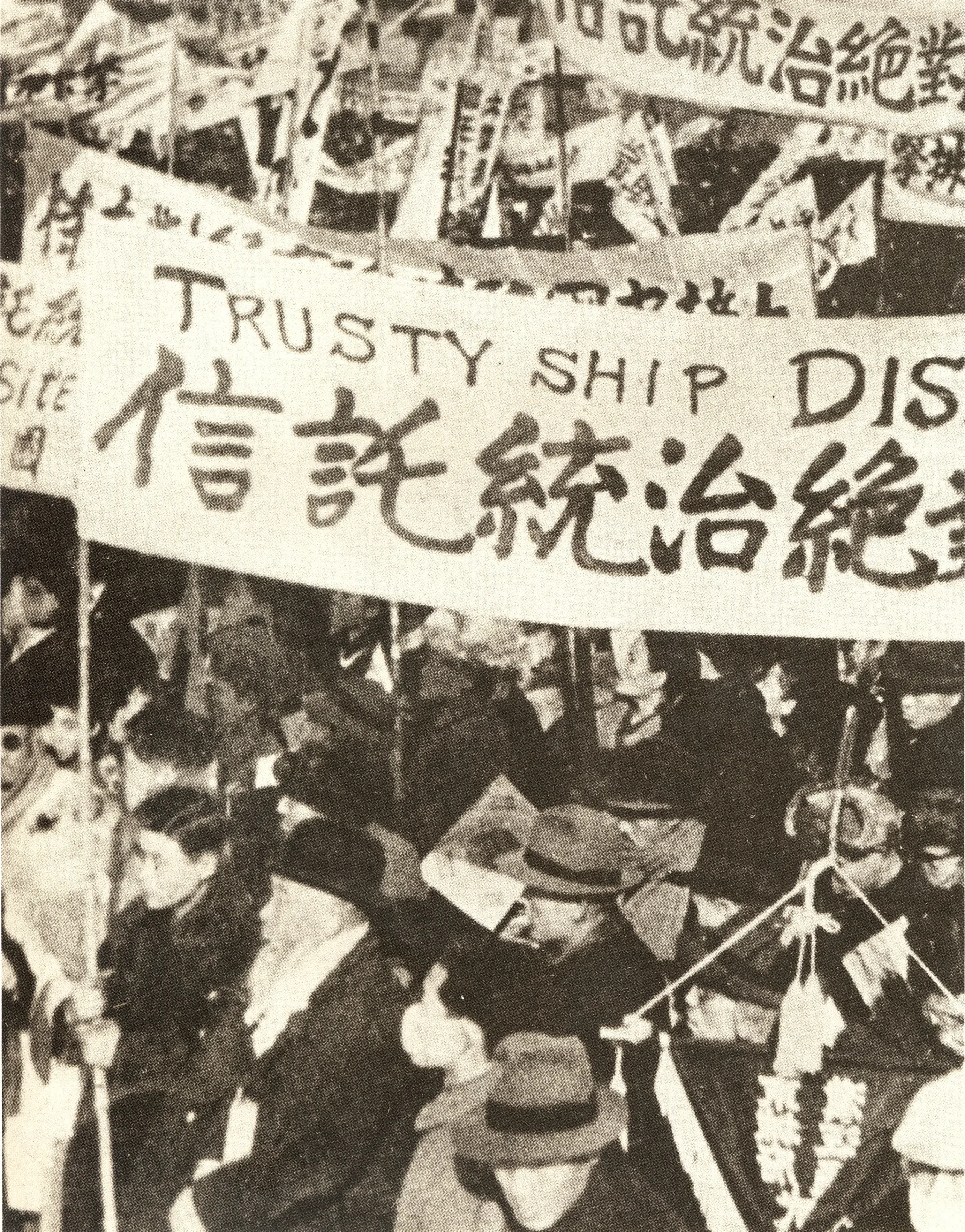
Photograph of the anti-trusteeship campaign in Korea, December 1945. Unknown photographer. Public domain. · Public domain · Source page
At the Moscow Conference, 16 to 26 December 1945, the foreign ministers of the United States, Britain and the Soviet Union agreed on a four-power trusteeship over Korea, for up to five years. The four powers were those three plus China, which did not attend the conference.
In Korea, an anti-trusteeship campaign was under way.
What the line left behind
- August 1945 The proposal goes to Moscow, and the Soviets agree within a day. On 17 August General Order No. 1 is approved.
- 2 September 1945 The Japanese surrender is signed, and the order is handed to the Japanese.
- December 1945 The Moscow Conference agrees on a trusteeship of up to five years. Koreans campaign against it.
- 1948 Two separate governments form: the Republic of Korea on 15 August, and North Korea on 9 September.
- 27 July 1953 The armistice is signed at Panmunjom. The line it sets is close to the 38th parallel but not the same. The DMZ follows the positions where the armies stood.
Planned, or improvised?
Was the 38th parallel the product of earlier planning, or of a single night?
- Historians who date the proposal to 10 August Most accounts date the proposal to the night of 10 August, after the task was set. On this view the line was drafted under time pressure, not chosen from a long plan.
- Those who argue the idea was discussed in July Some argue the idea came up as early as July. If so, that night was only when the wording was written down. The claim is disputed, so read it with care.
This lesson cannot settle it. Which document, if found, would change the picture?
Check yourself
What did the Cairo Declaration promise Korea?
Answer: That Korea would become free and independent, in due course.. Right. The declaration promised independence but did not say when.
Check yourself
What did General Order No. 1 set for the Japanese surrender in Korea?
Answer: The north would surrender to the Soviet Union, and the south to the United States.. Right. The line decides which army takes the surrender on each side of it.
Check yourself
Why should Rusk's 1950 note be checked against other sources?
Answer: Because it is a later account by one drafter, with one point of view.. Right. It is worth asking what it admits, and what it leaves out.
Check yourself
In what order did these events happen?
Answer: The line went to Moscow, then the general order was approved, then US troops landed.. Right. The proposal was sent on 15 August, the order was approved on 17 August, and the landing was on 8 or 9 September.
Check yourself
Why is the claim that the Allies split Korea at Yalta inaccurate?
Answer: Because Yalta discussed a trusteeship, not a division.. Right. At Yalta the idea raised was trusteeship, not a division into occupation zones.
Check yourself
According to this lesson, why does the 38th parallel matter?
Answer: Because a line set for surrender later divided two governments.. Right. The line was drafted to divide surrender and occupation, and later two separate states emerged along that region.
Terms
- parallel An imaginary line around the Earth, parallel to the equator. The 38th parallel north crosses the Korean peninsula.
- governor-general The top official of the Japanese government in Korea, who ran the country for Japan.
- trusteeship An arrangement in which one or more countries run a territory until it is ready for independence.
- General Order No. 1 A US military order of August 1945. For Korea it set which army would take the Japanese surrender on each side of the line.
- military government Rule by military officers over an occupied area, in place of the local administration.
- Committee for the Preparation of Korean Independence A Korean body founded in August 1945 that aimed to take power from the governor-general.
- DMZ A strip of land between the two sides, created by the 1953 armistice. It follows the positions where the armies stood, and lies close to the 38th parallel.
- Pentagon The headquarters of the US Department of Defense, in Washington. Two colonels there were asked to propose a dividing line for Korea.
- colonel A senior army officer rank, below general.
- Cairo The capital of Egypt. In 1943 the leaders of the United States, Britain and China met there and declared that Korea would become free and independent.
- Soviet Union A huge state ruled by the Communist Party, with Russia at its core. In 1945 it declared war on Japan.
- Charles Bonesteel An American colonel. Many accounts credit him with proposing the 38th parallel, and say both men worked on the draft.
- Rusk An American official, one of the two drafters of the line. Years later he wrote a note about that night.
- Lyuh Woon-hyung A Korean politician. In mid-August he set up the Committee for the Preparation of Korean Independence.
- John R. Hodge The commander of the American troops who landed at Incheon. He recognised neither the People's Republic nor the People's Committees.
- Incheon A port city in southern Korea, near Seoul. American troops landed there in September 1945.
- Seoul Today the capital of South Korea. There communist and socialist groups declared a People's Republic.
- Yalta A resort town on the Crimean peninsula. There Roosevelt and Stalin discussed a trusteeship for Korea.
- Potsdam A city near Berlin. A conference held there made no decision to divide Korea.
- Moscow Conference A meeting of the foreign ministers of the United States, Britain and the Soviet Union, held in Moscow. They agreed there on a four-power trusteeship for Korea.
- Truman The US president. On 17 August 1945 he approved the order that decided who would accept Japan's surrender in Korea.
- Roosevelt The US president. At Yalta he discussed a trusteeship for Korea with Stalin, not a division.
- Stalin The leader of the Soviet Union. He wanted the trusteeship over Korea to be short.
- People's Republic of Korea A state declared by the communist and socialist wings of the committee, after the nationalists had left it. The American military government did not recognise it.
- People's Committees Local committees that were active across the south after Japan's surrender. The American military government did not recognise them.
Sources
- The Cairo Declaration, 1943. Text as published by the USC US-China Institute.
- Dean Rusk, memorandum of 12 July 1950, in Foreign Relations of the United States, 1945, vol. VI, doc. 771.
- General Order No. 1, approved 17 August 1945. The order's own text was not read; its Korea clause is summarised in note 3 of FRUS 1945, vol. VI, doc. 771.
- Chong-sik Lee, 'Why did Stalin accept the 38th Parallel?', Journal of Northeast Asian Studies 4, no. 4 (1985), pp. 67–74.
- Moscow Conference communique, 27 December 1945, as summarised in the Wikipedia article "Moscow Agreement".
Image credits
- US Navy, flag change in Seoul, September 1945 (photo 80-G-391464/5). Public domain. · Public domain · Source page
- Photograph of the anti-trusteeship campaign in Korea, December 1945. Unknown photographer. Public domain. · Public domain · Source page

