Otto the Great and the crown at Rome, 962
2 February 962: the pope places an imperial crown on a Saxon king's head. Now he can claim to be Charlemagne's heir.
Decisions, questions and your own progress, in the app
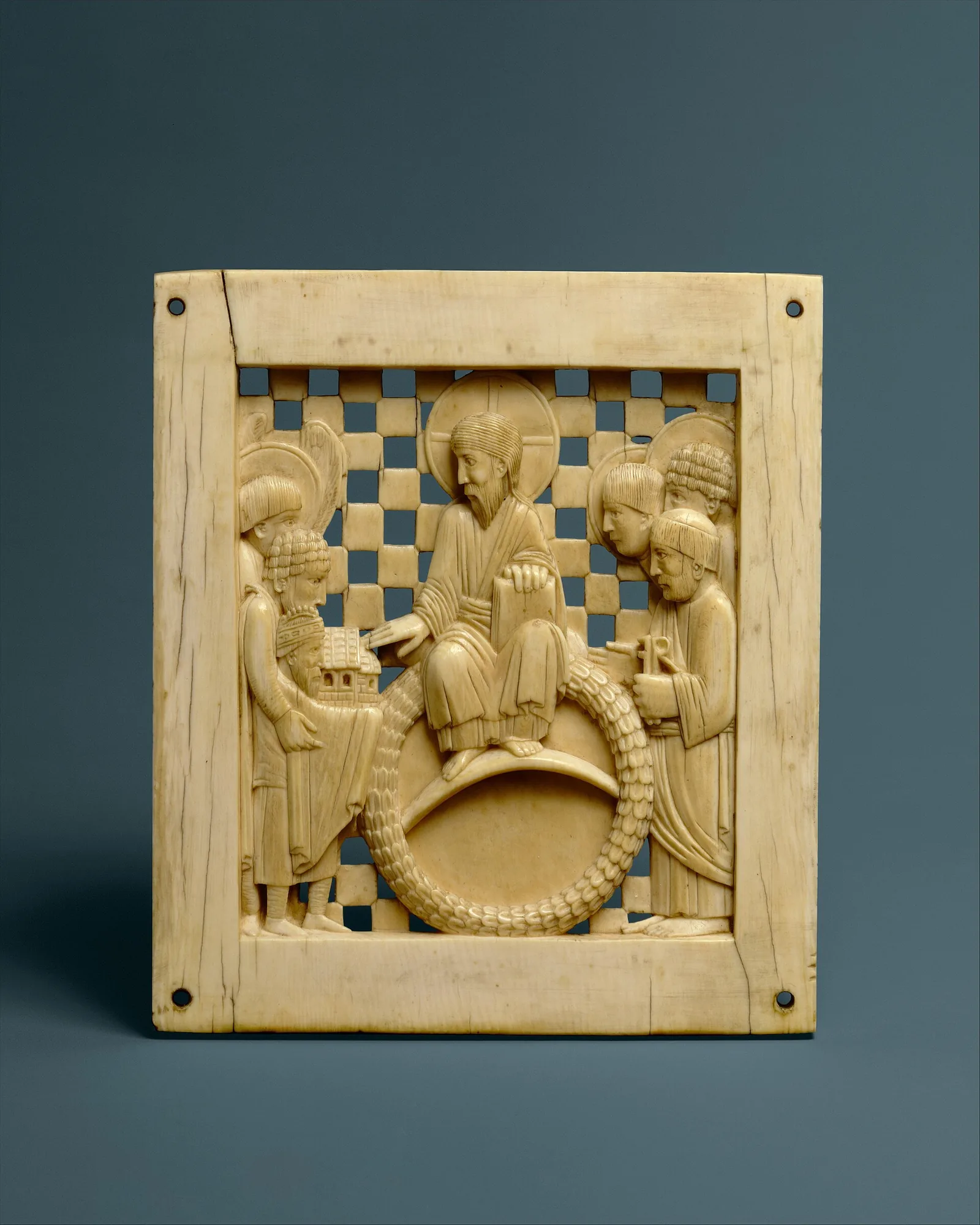
Ottonian plaque, ivory, c. 962–968. Metropolitan Museum of Art, New York (41.100.157) · CC0 · Source page
Rome in 962, and what came before
An emperor from Saxony
Rome, 2 February 962. In St Peter’s basilica, Pope John XII places an imperial crown on the head of Otto, king of the East Franks. No emperor had ruled in the West for almost forty years, since 924.
The man who receives the crown grew up in the wooded and farmed country of Saxony, in what is now northern Germany. Twenty-six years earlier he had been made king at Aachen, the city of Charlemagne. He had claimed Charlemagne’s inheritance ever since. Now the claim was sealed with a crown. What the people in the basilica understood by it is less clear to us than it was to them: was this a fresh beginning, or the direct continuation of an old empire?
Otto I
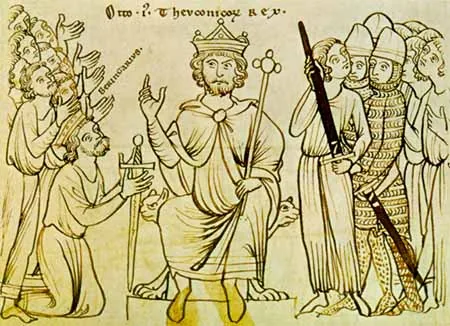
Miniature from the Manuscriptum Mediolanense of the Chronicle of Bishop Otto of Freising, c. 1200. Photo: Andreas Praefcke · Public domain · Source page
The son of a Saxon duke, who became king of the East Franks, king of Italy and emperor, and who ruled through bishops, abbots and his own army.
- Born: 23 November 912, Probably Wallhausen, Saxony
- Died: 7 May 973, Memleben, Saxony
- Won: Andernach, 939; Lechfeld, 955
In Widukind’s account, the Franks and Saxons chose his son Otto as their prince, after his father had already designated him king.
The first crown
A crown in Charlemagne’s city
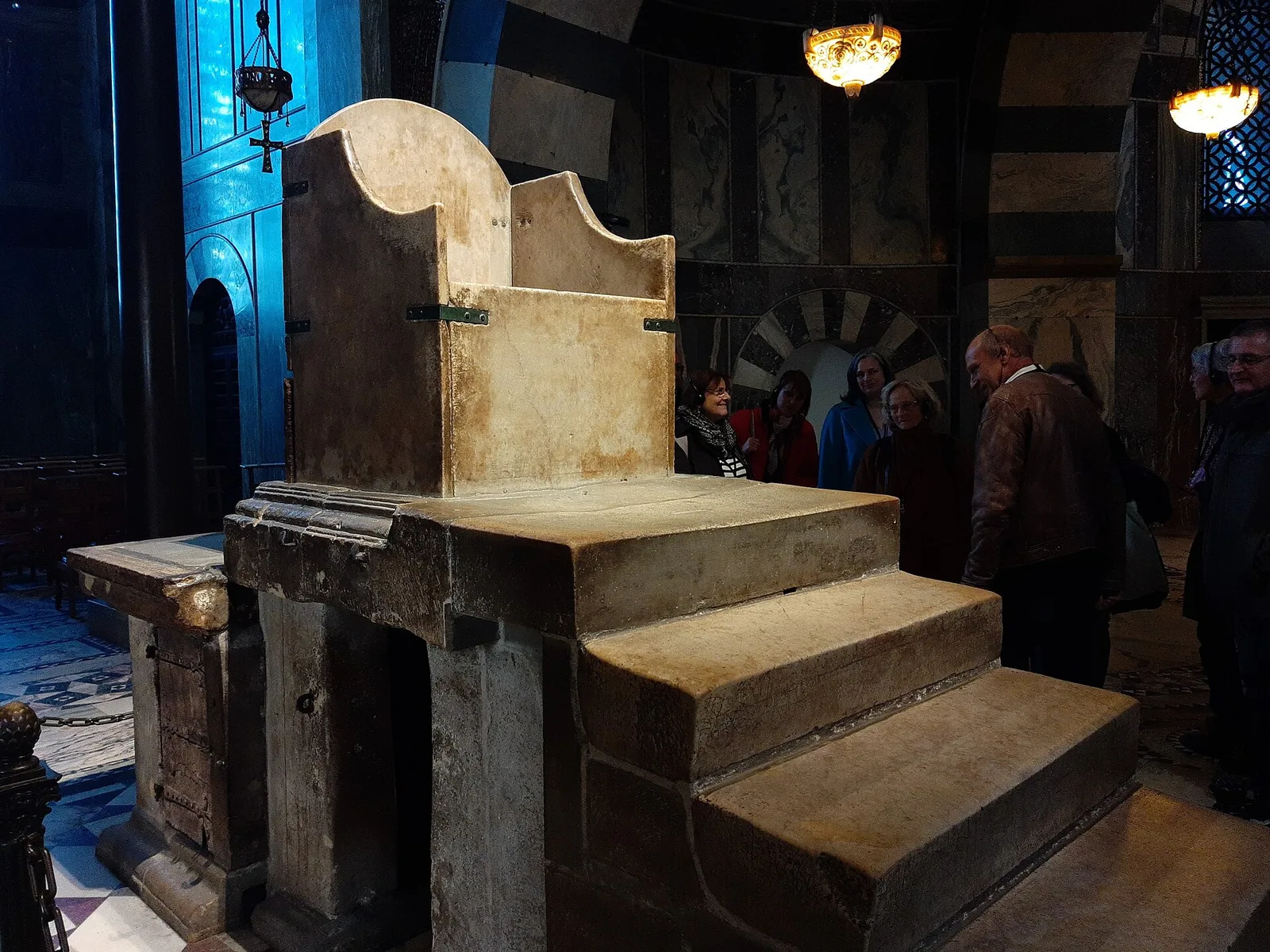
Throne of Charlemagne, Aachen Cathedral. Photo: Gerda Arendt, 2023 · CC0 · Source page
936
King Henry I, called the Fowler, died at Memleben on 2 July 936. Before his death he had named his eldest son Otto as his heir, and had presented him to the nobles at an assembly in Erfurt. The Saxon family had won the kingship by election, not by right of birth.
On 7 August 936 Otto was crowned at Aachen, in the palace chapel that Charlemagne had built. The archbishops of Mainz and Cologne officiated: Mainz anointed him, and both set a golden diadem on his head. Otto dressed in the Frankish style, not in the fashion of his Saxon fathers. The message was clear: he wanted to be seen as Charlemagne’s true successor, not merely as a Saxon duke who had been elected king.
Dukes, brothers and a son
Background
Five peoples, one crown
5
In the East Frankish kingdom, the land that later became Germany, the king did not rule every region directly. It was made up of five stem duchies: Franconia, Saxony, Bavaria, Swabia and Lorraine. Each had its own duke, who often spoke for the people and nobles of the region as well as for himself.
The Saxon dynasty had been chosen king by the nobles of Franconia and Saxony, not inherited the crown. Henry I was elected in 919. Saxony was also a frontier against the Slavic peoples to its east, so its duke was a warlord. That was the dynasty’s strength. It was also a weakness: when Otto succeeded, the other dukes did not automatically see him as their natural master.
The first revolts
Brothers and dukes, 937–941
In the first years of his reign Otto fought inside his own family and among the dukes. In 938 Eberhard, duke of Franconia, joined Thankmar, Otto’s half-brother, together with Wichmann. Thankmar was killed at Eresburg. On 2 October 939 the rebels met Otto’s army at Andernach, on the Rhine. Eberhard was killed. Gilbert, duke of Lorraine, drowned in the river. Otto’s younger brother Henry then submitted.
The most dangerous moment came at Easter 941. Henry and the archbishop Frederick plotted to murder Otto at Quedlinburg, where the Saxon royal family kept its abbey. The plot failed. The conspirators were pardoned after public penance on Christmas Day 941. Otto spared his brother, but he made clear that disloyalty had a price.
The son’s revolt
Liudolf against his father
953–954
Liudolf was Otto’s son by his first wife, Eadgyth, and duke of Swabia. In 953 he rose against his father together with Conrad the Red, duke of Lorraine, who was his brother-in-law. Historians link the revolt to Liudolf’s fear of losing his place after Otto married Adelaide in 951, and perhaps to the fear of losing the inheritance to children born of that marriage. This was a fight inside one family over what came next, more than an attack on the crown.
Otto besieged Mainz for two months in the summer of 953. In 954 Liudolf was stripped of his duchy. He was reconciled with his father but never got Swabia back. He died of fever at Pombia, near Novara in northern Italy, on 6 September 957, during a campaign there. He was about 27.
The Lechfeld, 955
Background
Horsemen who kept coming back

The Lechfeld south of Augsburg. Photo: Flodur63, 2021 · CC BY-SA 4.0 · Source page
In the first half of the 10th century the Magyars raided Europe again and again. They were mounted archers from the Carpathian basin, and their raids reached as far as Italy, France and Germany. They plundered, took prisoners, and rode away before a king could reach them.
In the summer of 955 they had a new target. They besieged Augsburg, in southern Germany. The town’s defence was led by its bishop, Ulrich, and held out for days until Otto came. This is the moment when Otto had to choose.
A decision point
You are Otto, king of the East Franks.
Early August 955, outside Augsburg
The Magyars are besieging Augsburg. The defence is holding, but the walls and the men are wearing thin, and the bishop leads the defence himself. The town is old and important to the whole region of Swabia, and its fall would be a heavy blow.
Your army is made up of horsemen and foot soldiers from Bavaria, Franconia, Swabia, Bohemia and Lorraine. Few Saxons came, because Slavic peoples to the east threatened Saxony. You have fewer men than you would like, and you cannot wait for all of them to arrive.
Two other options are unpleasant. You could buy off the Magyars with silver and send them home, but everyone who heard of it would know that the king of Germany can be bought. Or you could wait for reinforcements, but the town may not hold that long.
What do you do?
- March to the Lech and attack with what you have. Probably a battle in the open against mounted archers, which is dangerous for either side. If you win, the raids may stop for years. If you lose, southern Germany stays open to plunder.
- Offer the Magyars silver and a free road home. Probably quiet for a few years, and then the Magyars would return, believing that a German king pays. The silver would not restore the damaged town or the authority that the king needs to hold his dukes together.
- Wait until every contingent has come, even if the town falls in the meantime. The army would have been larger, but the town would probably have fallen or burned. The Magyars would have withdrawn with booty and captives, and Otto would have appeared as a king who failed to protect a major southern city.
What really happened
March to the Lech and attack with what you have.
Otto marched to the Lech with what he had. The fighting lasted three days, from 10 to 12 August 955. The Magyar army was destroyed, and captured leaders were executed. The raids on Western Europe stopped, at least for the time being.
Otto could not give up the town without losing the trust of the dukes. A king who does not defend his people loses his authority. He probably judged that a decisive battle now was better than living with repeated raids. Historians still argue over how far he also wanted a victory that would make him famous: later writers presented him as the leader who had saved Christendom from the Magyars.
The battle of the Lechfeld
10–12 August 955
The Lechfeld plain, near Augsburg
Otto and his allies
- Commanders: Otto I, Conrad the Red, duke of Lorraine (killed), Burchard III, duke of Swabia
- Strength: Eight legions, no total given (Widukind of Corvey); Disputed; no checkable total (Modern estimate)
- Losses: No total given; Conrad killed (The sources)
Duke Conrad was killed in the battle. Modern reconstructions say the Bohemian legion broke at the start. Widukind’s eight legions are a clue to the army’s size, but the size of a legion is not known, so every modern figure rests on an assumption.
The Magyars
- Commanders: Bulcsú (harka), Lél and Súr
- Strength: Disputed; no checkable total (Modern studies)
- Losses: Most of the army killed; no total given (Sources and modern studies)
Three leaders were captured and executed. The sources disagree about where: Augsburg or Regensburg.
Outcome: The Magyar army was destroyed, and the raids on Western Europe came to an end. Later writers say the army hailed Otto as ‘father of the fatherland’ and as emperor. That is a later tradition, not a record from 955.
All the figures are estimates. Widukind, the Saxon writer and a monk of Corvey, describes the battle in Book III. No figure can be checked, so this card is marked disputed.
The Lechfeld: three days on the plain
10–12 August 955
In August 955 the Magyars are besieging Augsburg, and Bishop Ulrich leads a defence that has held out for days. Otto has come with horsemen and foot from several duchies, but with fewer men than he wanted. The Magyars wait for him to the west, near the town.
A schematic plan, after Widukind’s account (Book III) and modern reconstructions, not an exact map of the ground. The positions of the units are approximate, and north is not shown. The Bohemian legion is not named in Widukind’s text, so that part follows modern reconstructions. The course of the fighting is uncertain.
Phases of the battle
- Two armies face each other On the morning of 10 August Otto’s army stands on the plain. The Magyars wait for it to the west, near Augsburg.
- The Bohemian legion breaks The Magyars send a light band round the flank and fall on the Bohemian legion. The legion breaks, and the battle looks dangerous for Otto.
- The Magyars stop to plunder While the horse archers stop to plunder the German camp, Otto’s horse wait. That is their chance.
- Conrad counter-attacks Duke Conrad of Lorraine leads his horse against the plundering Magyars. He is killed in the charge.
- The Magyars break and withdraw Three days after the battle began, the Magyar army breaks. The survivors withdraw westward, and three leaders are captured.
The strategy
- Otto and his allies: Otto will not wait for every contingent, nor pay the Magyars, since that would show that the king of Germany can be bought. So he marches to the Lech and attacks with what he has, and his horsemen wait for their chance.
- Magyars: The Magyars fight as they raid: horse archers who plunder and ride off before a king can reach them. A light band is sent round the flank to fall on the Bohemian legion, and then the horse archers stop to plunder the German camp.
What decided it: As the sources tell it, what decided it was the Magyars' habit of plundering. When their horse archers stopped to loot the German camp, Conrad, duke of Lorraine, led a counter-attack and was killed in it. The Magyar army broke only three days after the battle began.
After the battle
Father of the fatherland
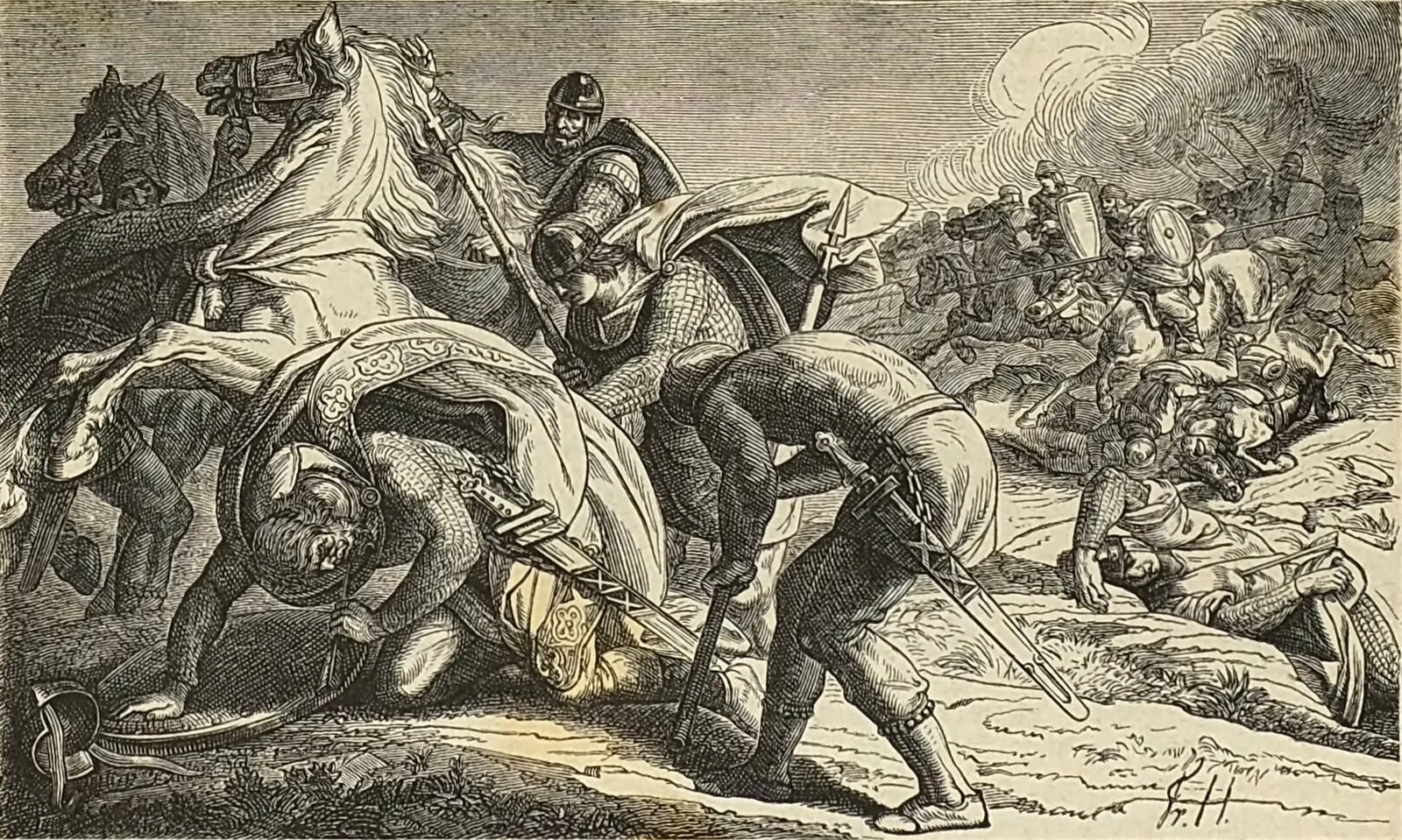
Friedrich Hottenroth, c. 1875, in Wilhelm Zimmermann, Illustrirte Geschichte des deutschen Volkes, vol. 2 (Stuttgart, 1875) · Public domain · Source page
955
The large raids on Western Europe did not return, and the attention of the German rulers moved on to Italy and to the crown.
But we must be precise. Most of the writing about Lechfeld was produced later, and the numbers are not certain. Some of the accounts that describe the battle were written after Otto’s death, when writers wanted to link him with the defence of Christendom.
Italy and the crown
Italy, 951
King of the Lombards
951
In the early 10th century Italy was ruled by competing Italian families, and the north was the richest and most powerful part of the peninsula. Whoever held it could be called king of Italy, and from there try to reach Rome.
Otto entered Italy in the autumn of 951. On 23 September he entered Pavia, where he was crowned king of the Lombards. In the same year he married Adelaide, the widow of the Italian king Lothair, who had been held prisoner by Berengar II, a rival claimant to the crown. In August 952, at a diet in Augsburg, Berengar swore to hold Italy from Otto as his vassal. Everything seemed settled. It was not to last.
A decision point
You are Otto, king of Germany and king of Italy.
Autumn 960, far from Italy
Around 960 envoys from Pope John XII reach you. He asks for help against Berengar II, who threatens Rome, and against plots by the Roman nobility. The pope is the greatest spiritual figure in the West, and he cannot protect himself without a strong king.
You know that the Italian crown may bring something more than one city. Charlemagne had been crowned emperor in Rome, and you have claimed his inheritance since 936. Against that, Italy is far away, and Germany needs you. Your young son has only just been crowned king.
Two other paths are open. You could send an army under someone else’s command, or you could answer the pope with letters and leave Italy to the Italians.
What do you do?
- Go to Italy yourself and accept the claim on Rome. Probably a long war against Berengar and the Roman nobility, but you would also gain the title you seek. The pope would owe you, and your position in northern Italy would be stronger.
- Send an army under another commander, and stay in Germany. The army would probably fail, since no one else could hold the Italian nobility. The pope might turn to Berengar or to the Byzantines, and German authority in the south would weaken.
- Answer with letters, promise help later, and wait. Relations with the pope would probably cool, and John would be more likely to ally with Berengar’s son Adalbert. Any German king who came later would start from scratch.
What really happened
Go to Italy yourself and accept the claim on Rome.
Otto went to Italy in the autumn of 961 and reached Rome on 31 January 962. On 2 February he was crowned emperor in St Peter’s by Pope John XII.
Otto had already established himself in northern Italy, and he wanted to turn that control into a title. Historians ask how far he thought about Rome in the light of Charlemagne, and how far about what the pope could give him. The decision was not obvious: it meant a long war, while Germany still needed his presence.
The crown
Oaths in the basilica
2.2.962
Otto reached Rome on 31 January 962. According to the sources both sides swore oaths. Otto swore to honour the Church and the pope, not to harm the pope’s life, limbs or honour, not to hold a court in Rome without his consent, and to return St Peter’s lands that he had taken. The pope and the Roman nobility swore to be faithful to Otto, and not to help Berengar or his son Adalbert.
After the oaths, Otto was crowned emperor on 2 February. About eleven days later the Diploma Ottonianum, also called the Ottonian Privilege, was issued. It confirmed the possessions of the Roman Church, above all the gifts of Pepin and Charlemagne. It said that a pope must be elected canonically, and that his consecration would wait until he had given pledges to the emperor or his envoys. The surviving copy may be only a duplicate of the original. Most scholars accept its authenticity, but they disagree about whether its final form was written in 962 or in 963.
Myth
In 962 a new state was born: the Holy Roman Empire, which lasted until 1806.
The truth
The people of the time did not record the event as the birth of a new state. Otto was crowned emperor, and the title was understood as a continuation of the Roman and Carolingian one, tied to Rome and to the king of Italy. Widukind, the Saxon writer of Otto’s deeds, does not describe the 962 coronation, and mentions Otto’s visits to Italy only briefly.
The name ‘Holy Roman Empire’ came later. The word ‘holy’ was first attached to the empire in 1157, in the time of Frederick I Barbarossa, and the full form is attested from 1254.
The evidence
Historians still read the coronation in different ways: some see it as a continuation of 800, others as a beginning in 962.
A king’s church, and a pope on trial
How the realm worked
Bishops as officials
Otto ruled with the help of a strong Church, many of whose leaders he appointed or approved. Bishops and abbots received from him lands, rights of justice and powers that were usually held by counts and dukes. In return they served him: they supplied soldiers, administrators and advisers, and they shared the burden of government. Historians call this system the ‘Reichskirche’, the church of the realm, using the German term Reichskirche.
The system worked because bishops had no children to inherit their lands. When a bishop died, the office and its property went back to the king, who could appoint a successor. In 967 a synod at Ravenna set up an archbishopric there, and in 968 Adalbert, a former monk, became its first archbishop. The new province had suffragan bishoprics on the eastern frontier: Brandenburg, Havelberg, Merseburg, Zeitz and Meissen.
Source: An ivory plaque from Magdeburg
Ottonian ivory plaque, c. 962–968. Metropolitan Museum of Art, New York (41.100.157)
A carved ivory plaque, which the museum links with Otto and Magdeburg. The seated figure in the centre is Christ, enthroned. On the left a crowned figure holds up a small building, a model of a church. The museum’s title describes this as the emperor giving Magdeburg Cathedral to Christ. It is not a written document but a religious and political image.
- Who is the crowned figure on the left, and what is he holding? The museum’s title names him as Otto. He holds a small building, a model of a church, and offers it to Christ. It is a message about a gift, not a portrait.
- Why would a king want to appear in an image like this? To show that the church, and the power to found and protect it, came from the king. It strengthened his standing in the eyes of anyone who saw the plaque, so it is good evidence for how rulers wanted to be seen.
- What is missing from this plaque? We do not know who commissioned it, who carved it or who used it. The museum’s title is a later interpretation, so it should be checked against written sources.
A decision point
You are Otto, the emperor.
November–December 963, Rome
Pope John XII has fled from Rome to Tivoli with the papal treasury and with Adalbert, the son of Berengar. Reports reaching you say that he has broken the oath he swore to you in 962, and that he has sent envoys to the Byzantines and the Magyars to build an alliance against you. Other reports describe a court of scandal and vice.
You can summon a synod of your German and Roman clergy and decide the pope’s fate. You can negotiate, restore John in return for new promises, and leave a garrison in the city. Or you can drop the whole matter and go back north, accepting John’s promise of new loyalty.
Remember that you cannot hold Rome without a pope, and that whatever you decide will affect the whole western Church.
What do you do?
- Call a synod that deposes John and chooses a new pope. You would probably get a pope who owed you his office, but the legitimacy of the choice would remain disputed. The Romans might resist, and such a decision is easy to reverse once a rival returns to the city.
- Restore John in return for new oaths, and leave a garrison. John would probably agree and repeat the oaths, and then break them again. The garrison would be a constant source of tension, and you would depend on the Roman nobility.
- Go back north and accept John’s promise of new loyalty. John would probably stay in office and return to his alliance with Adalbert. The crown of 962 would lose its value, and in the eyes of the Roman nobility the emperor would look unable to enforce his commitments.
What really happened
Call a synod that deposes John and chooses a new pope.
Otto convened a synod in early December 963. John did not appear, and the synod declared him deposed and chose Leo VIII in his place. Leo was a layman who was ordained in great haste. The synod’s decisions were annulled in February 964, after John returned to Rome.
Otto believed John had broken his word and that the papal court was a danger to his rule. He needed a stable pope to govern Rome. Historians note that the charges rest largely on Liudprand of Cremona, who was Otto’s partisan, and that the accused was absent when the synod deposed him.
The charges
A charge sheet from the winning side
963–964
The charges against John come mainly from Liudprand of Cremona, a writer from northern Italy who was on Otto’s side. According to him, John said Mass without taking communion, sold ordinations, including one for a ten-year-old bishop, and committed adultery and games of dice in which he toasted the devil.
John returned to Rome in February 964. A new synod annulled the decisions of 963. He died on 14 May 964. Liudprand gives two accounts of his death: a stroke during an adulterous encounter outside Rome, or the revenge of an outraged husband.
Constantinople, Rome and two emperors
Two emperors
Who was the true Roman?
In Constantinople sat an emperor who saw himself as the direct heir of Rome. He was styled basileus, and in his own eyes he was the only lawful ruler with the Roman imperial title. When Otto was called imperator by the pope, the title sounded to the Byzantines like a challenge to their status.
There were practical reasons too. The Byzantines held towns in Apulia and Calabria in the south of Italy, and Lombard princes ruled others, such as Benevento and Capua. Byzantine and Ottonian forces had clashed at Bari, and both sides wanted the south.
The envoy
A mission to Constantinople, 968
968
Otto sent Liudprand, bishop of Cremona, to Constantinople. His task was to ask for the hand of Anna Porphyrogenita, daughter of the Byzantine emperor Romanus II, for Otto’s son, the younger Otto.
The mission failed. Liudprand describes a humiliating reception, in which the Byzantine court would not call Otto ‘emperor’. His own text is full of anger: he does not like the Byzantines, and he does not hide it.
Source: An envoy’s report
“For he called you not emperor, which is Basileus in his tongue, but, to insult you, Rex, which is king in ours.”
This is from Liudprand’s own report on the mission, written after it failed. The words were spoken in the argument over the title with Leo, the emperor’s brother, who called Otto ‘king’. He stresses the insult; we do not know how the Byzantines themselves phrased the exchange.
- Who wrote this, when, and for whom? Liudprand, bishop of Cremona, Otto’s envoy. He wrote a report some years after the coronation, after the mission. Who the text was for matters: a report of this kind is written to persuade the man who sent the envoy.
- What is he trying to show? That the Byzantine court insulted Otto, and that the Byzantines were dishonest. He calls the emperor lying, crafty and without pity, and says he came to the throne through perjury and adultery. This is the picture of an opponent, not of a neutral witness.
- What is missing? The text gives no Byzantine version of the meeting. We have to infer what the Byzantines thought from the report of a man who lost the negotiation and was offended by it.
A decision point
You are Otto, the emperor, and the father of an heir.
After the failure of 968
Your son, Otto II, is your heir, and he needs a bride who matches his rank. The Byzantines still hold parts of the south, and you want to end the quarrel over the title. But they will want you to treat them as equals, and they expect a bride raised at the imperial court.
Three options lie before you. You can insist on a Byzantine bride on your own terms; look for a bride outside Byzantium and keep the title you have in Italy; or open a war in the south to force the matter.
What do you do?
- Seek a Byzantine princess on your own terms. You would probably secure a bride and some peace for a time, but full recognition of the title would not come easily. The Byzantines would insist on their protocol, and you would have to concede something in return.
- Look for a bride outside Byzantium and keep the title as it is. There would probably be no further quarrel over the title, but the south would remain contested. The Byzantines might strengthen their ties with the Lombard princes, and your position in the south would depend on your military strength.
- Open a war in the south to force the marriage. Probably a costly war with uncertain results. The capture of towns might be valuable, but it is not clear that it would bring a bride, and your army would be far from its base in Germany.
What really happened
Seek a Byzantine princess on your own terms.
Otto negotiated for a Byzantine bride for his son. The result was Theophanu, who married Otto II in Rome on 14 April 972.
The marriage gave Otto prestige in the Christian world and connected the Saxon dynasty with an old empire. Byzantine recognition of Otto’s title was a sensitive point in the talks, and the dispute was settled by sharing sovereignty over southern Italy.
The bride
Rome, 14 April 972
972
Theophanu came to Italy as a Byzantine princess. The marriage document calls her a niece, or granddaughter, of the emperor John I Tzimiskes. On 14 April 972 she married Otto II in Rome. Pope John XIII performed the marriage, and she was crowned empress the same day.
The marriage did not solve every question. Byzantine recognition of the title stayed contested, and the south remained a battleground. But Theophanu brought to Otto’s court a direct link with Constantinople, and later she would govern as regent for her son.
Death, legacy and a test
The end
Memleben, May 973
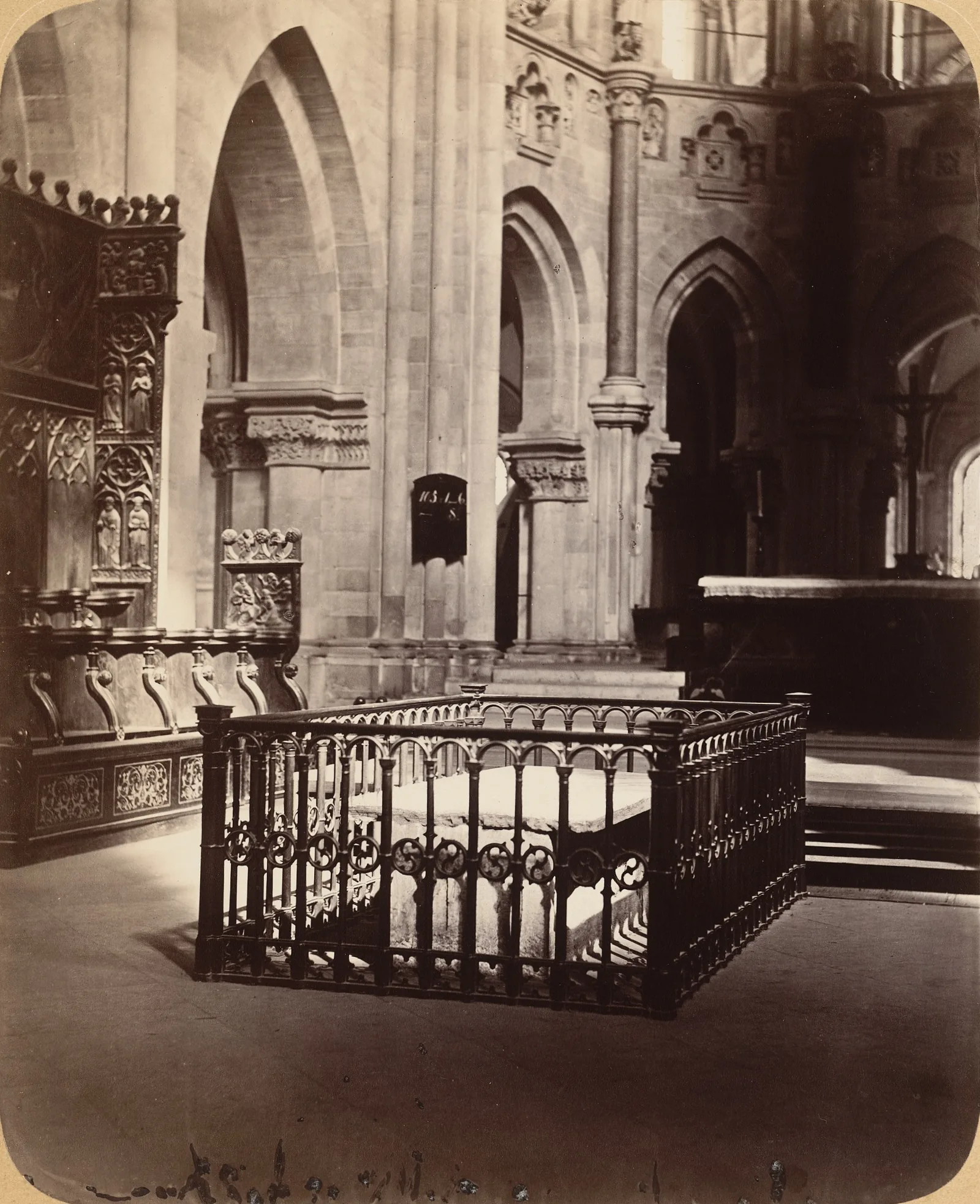
Albert Ochs (attributed), photograph, c. 1878. Architekturmuseum der Technischen Universität Berlin (inv. F 9749) · Public domain · Source page
37
Otto died at Memleben on 7 May 973, aged 60. He had reigned for 37 years as king of the East Franks, and for eleven of them as emperor. He was buried in Magdeburg Cathedral.
His son Otto II succeeded him. Widukind, whose history ends with Otto’s death, gives us the Saxon view of the king. The question that remains is what Otto really intended to do with the Roman title.
What he left behind
- 936 Crowned at Aachen, in Frankish dress
- 937–941 Revolts of brothers and dukes; the plot at Quedlinburg
- 951 Pavia, and marriage to Adelaide
- 953–954 Liudolf’s revolt, and the loss of his duchy
- 955 The battle of the Lechfeld against the Magyars
- 962 Crowned in Rome; the Ottonian Privilege
- 968 The archbishopric of Magdeburg; Liudprand’s mission fails
- 972 Marriage of Otto II and Theophanu in Rome
Myth
The Holy Roman Empire began when Charlemagne was made emperor in 800, and Otto simply carried on that empire.
The truth
On 25 December 800 Pope Leo III crowned Charlemagne as Roman emperor. That was an important beginning, but the realm was not called ‘holy’, and the name ‘Holy Roman Empire’ did not exist then.
Many historians date the beginning to 800, others to 962. So there is a debate, not a single answer. The full name ‘Holy Roman Empire’ is attested from 1254, and ‘holy’ was first attached to the empire in 1157.
The evidence
The first mention of ‘holy’ in connection with the empire dates from 1157. The name cannot be found in the time of Charlemagne or of Otto.
A new beginning, or a continuation?
Was the coronation of 962 the start of something new, or a deliberate revival of Charlemagne’s empire?
- Antoni Grabowski, The Construction of Ottonian Kingship (2018) According to Grabowski, Ottonian kingship was built up through the stories its chroniclers told about it, and older accounts of the beginnings of the German kingdom need reappraisal.
- Peter H. Wilson, The Holy Roman Empire (2016) Wilson writes a long-term history of the institution, from Charlemagne to Napoleon. On that reading, Otto continues a tradition that already existed, so 962 is part of a continuity rather than a birth.
Both sides agree on what Otto did. They disagree about what rulers and advisers thought the title meant, and we do not always have direct evidence for that. Otto had claimed Charlemagne’s inheritance already in 936. The question is whether this makes 962 a continuation, or whether the claim stayed without institutional content until that coronation.
Check yourself
Why does Liudprand’s account of the 968 mission need care?
Answer: Because it was written by an envoy who lost the negotiation and had good reason to paint the Byzantines in a bad light.. Right. Liudprand calls the emperor a liar and presents himself as the one insulted. It is a partisan report, not a neutral witness.
Check yourself
What actually happened at the synod of December 963?
Answer: John XII was deposed and Leo VIII was chosen in his place, in a procedure later regarded as flawed.. Right. The accused was absent, and Leo was a layman ordained in haste. The decisions were annulled in 964.
Check yourself
Which statement about the numbers at Lechfeld is correct?
Answer: Modern estimates of the army sizes are disputed and rest on reasoning from the evidence, while the sources themselves give no figure that can be checked.. Right. The modern estimate tries to reconstruct the size from the surviving evidence, and no source gives a checkable number.
Check yourself
What is the correct order of these events?
Answer: Liudolf’s revolt, the Lechfeld, the coronation in Rome, the archbishopric of Magdeburg.. Right. Liudolf rose in 953, the Lechfeld was fought in 955, the coronation came in 962, and the archbishopric of Magdeburg was set up in 968.
Check yourself
Which statement about Theophanu is supported by this lesson?
Answer: The marriage document calls her a niece or granddaughter of the emperor John I Tzimiskes.. Right. That is the source for her rank, which is why historians still debate her exact family.
Check yourself
What did the Ottonian Privilege of 962 do?
Answer: It confirmed the Roman Church’s property, and provided that a pope’s consecration would wait until he had pledged loyalty to the emperor or his envoys.. Right. This is the core content of the Diploma, and the debate over its meaning continues.
Terms
- stem duchy One of the five duchies of the East Frankish kingdom: Franconia, Saxony, Bavaria, Swabia and Lorraine. Each had its own duke, who spoke for the nobles and people of the region.
- Carolingian The dynasty of Charlemagne, who ruled the Frankish kingdom from 768 and was crowned emperor in 800. When his realm was divided in the 9th century, the East Frankish kingdom emerged, which became the core of Otto’s Germany.
- imperator A Latin word meaning commander, which under Rome became a title of the supreme military ruler. In the 10th century it was one of the titles of an emperor, and the Byzantines saw it as a challenge to their own.
- Magyars A people of mounted archers who settled in the Carpathian basin and raided Europe through the 10th century. Their raids reached Italy, France and Germany.
- synod An assembly of bishops and senior clergy that decides Church business. The synod of 963 was called by Otto to judge Pope John XII.
- basileus The Greek word for ‘king’, and the title of the Byzantine emperor. The Byzantines saw it as the lawful Roman title, so any title given to Otto looked to them like a challenge.
- vassal A man who swore loyalty to a lord and received land or rank in return for service. In 952 Berengar II swore at Augsburg to hold Italy as Otto’s vassal.
- Reichskirche The system in which the king appointed bishops and abbots and gave them lands and rights in return for service. It was the backbone of Ottonian rule, and bishops could not pass their office on to children.
- legion A unit of an army. Widukind describes Otto’s army in eight legions, but the strength of a legion is not known, so the total is an estimate.
- Ottonian Privilege The charter Otto issued in 962, after his coronation. It confirmed the property of the Roman Church and set rules for papal elections. The text we have depends on a copy, which may be a duplicate of the original.
- Charlemagne King of the Franks, crowned emperor in Rome. Otto claimed to be his heir and presented himself as his successor.
- Aachen A city in western Germany today. Charlemagne built a palace chapel there, and Otto was made king and crowned there.
- Saxony A region in what is now northern Germany. It was home to the Saxon dynasty and a frontier against the Slavic peoples.
- Magdeburg A city on the river Elbe, in eastern Germany today. Otto was buried in its cathedral, and the city was a centre of Christian mission.
- Ravenna A city in Italy. A synod held there set up a new archbishopric at Magdeburg.
- Erfurt A city in Germany, where an assembly of nobles was held. Henry I presented Otto there as his heir.
- Memleben A place where two kings died: Henry I, Otto's father, and Otto himself.
- Quedlinburg A town in Germany where the Saxon royal family kept an abbey. Henry and Frederick plotted to murder Otto there.
- Augsburg A city in southern Germany today. The Magyars besieged it, and Otto came to its aid.
- Liudolf Otto's son by his first wife, and duke of Swabia. He rose against his father together with Conrad the Red.
- Thankmar Otto's half-brother. He joined the rebels against Otto and was killed during the revolt.
- Eberhard Duke of Franconia, who joined the rebels against Otto. He was killed in the battle at Andernach, on the Rhine.
- Conrad the Red Duke of Lorraine and brother-in-law of Liudolf. He joined Liudolf in the revolt against Otto.
- Liudprand A bishop of Cremona in northern Italy and a writer who sided with Otto. His writings are important but not neutral.
- Widukind A Saxon writer who wrote about Otto's deeds. His history ends with Otto's death, so it gives the Saxon view of the king.
- Ulrich The bishop of Augsburg who led the town's defence when the Magyars besieged it, until Otto came.
- Berengar II A rival king of Italy. He swore to hold Italy from Otto as his vassal, but it did not last long.
- Adelaide The widow of the Italian king Lothair, who had been held prisoner by Berengar II. Otto married her, and she was his second wife.
- Theophanu A Byzantine princess who married Otto II in Rome. Later she governed as regent for her son.
- Byzantium The Byzantine Empire, ruled from Constantinople. Its rulers saw themselves as heirs of Rome, and held towns in southern Italy.
- Constantinople The capital of the Byzantine Empire, where the emperor sat who saw himself as the direct heir of Rome.
- Lombards A Germanic people who took over northern Italy. The north was called the land of the Lombards after them.
- Historia Ottonis A book by Liudprand about the years around Otto's coronation, written as a supporter of the emperor.
Sources
- Widukind of Corvey, Res gestae Saxonicae (Deeds of the Saxons), Books II–III, trans. Bernard S. Bachrach and David S. Bachrach (Washington, D.C.: Catholic University of America Press, 2014)
- Liudprand of Cremona, Relatio de legatione Constantinopolitana (968–969), trans. Ernest F. Henderson
- Liudprand of Cremona, Antapodosis (1950s) and Historia Ottonis (960–964), Latin texts
- Diploma Ottonianum (Privilegium Ottonianum), 962, ed. Theodor Sickel, Das Privilegium Ottos I. für die römische Kirche (Innsbruck, 1883)
- Antoni Grabowski, The Construction of Ottonian Kingship: Narratives and Myth in Tenth-Century Germany (Amsterdam: Amsterdam University Press, 2018)
- Peter H. Wilson, The Holy Roman Empire: A Thousand Years of Europe’s History (London: Allen Lane, 2016)
- Charles R. Bowlus, The Battle of Lechfeld and Its Aftermath, August 955: The End of the Age of Migrations in the Latin West (Aldershot: Ashgate, 2006)
- Timothy Reuter, Germany in the Early Middle Ages, 800–1056 (London: Longman, 1991)
- Karl Leyser, Rule and Conflict in an Early Medieval Society: Ottonian Saxony (London: Edward Arnold, 1979)
- Benjamin Arnold, Medieval Germany, 500–1300: A Political Interpretation (Basingstoke: Macmillan, 1997)
Image credits
- Ottonian plaque, ivory, c. 962–968. Metropolitan Museum of Art, New York (41.100.157) · CC0 · Source page
- Miniature from the Manuscriptum Mediolanense of the Chronicle of Bishop Otto of Freising, c. 1200. Photo: Andreas Praefcke · Public domain · Source page
- Throne of Charlemagne, Aachen Cathedral. Photo: Gerda Arendt, 2023 · CC0 · Source page
- The Lechfeld south of Augsburg. Photo: Flodur63, 2021 · CC BY-SA 4.0 · Source page
- Friedrich Hottenroth, c. 1875, in Wilhelm Zimmermann, Illustrirte Geschichte des deutschen Volkes, vol. 2 (Stuttgart, 1875) · Public domain · Source page
- Albert Ochs (attributed), photograph, c. 1878. Architekturmuseum der Technischen Universität Berlin (inv. F 9749) · Public domain · Source page


