Dragon bones: the first Chinese writing
The story goes that in 1899 "dragon bones" were bought in a Beijing pharmacy to be ground into medicine, and someone noticed they were carved. What do they say, and how did they prove that kings once thought legendary were real?
Decisions, questions and your own progress, in the app
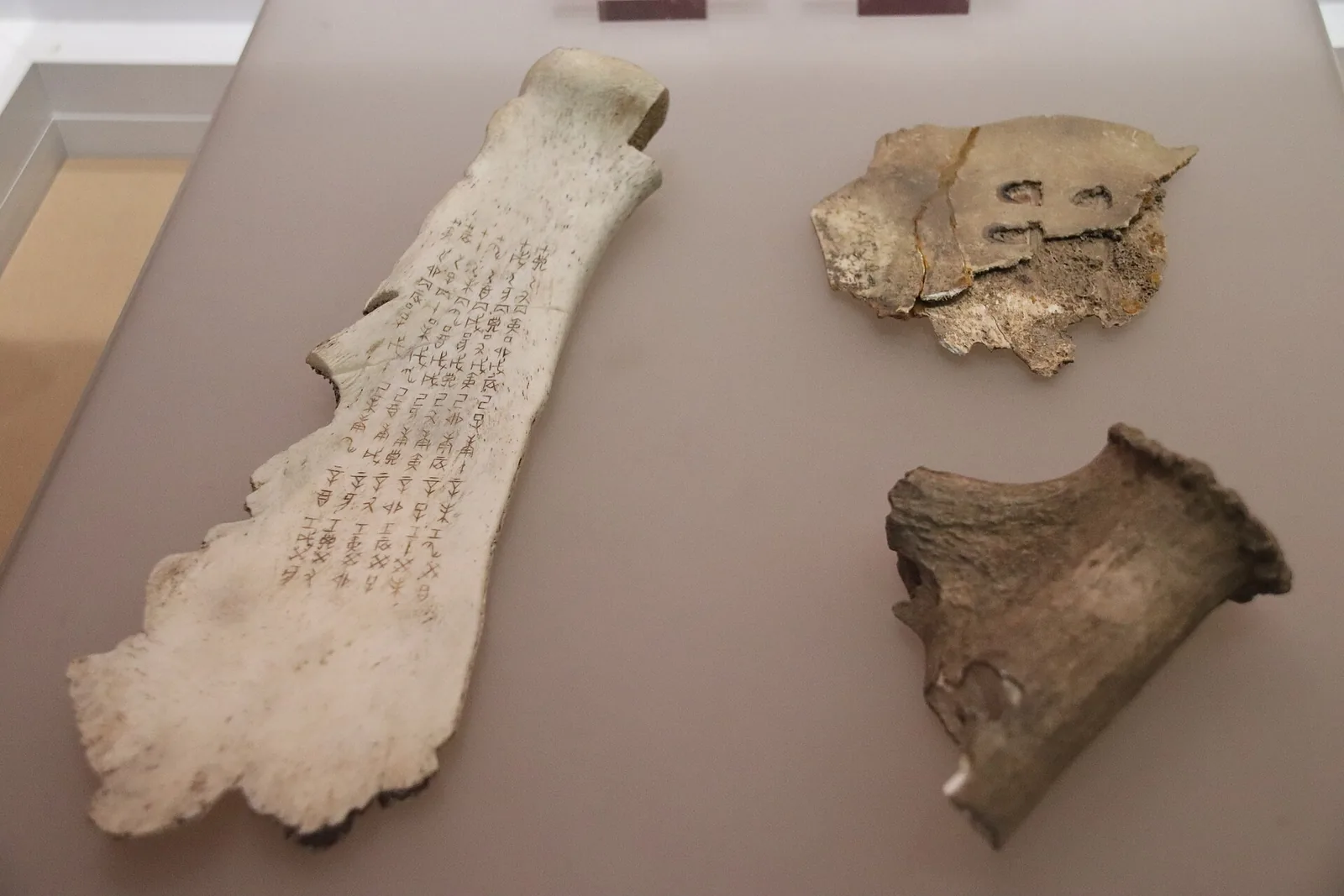
Gary Lee Todd, Ph.D., 2018 (WorldHistoryPics.com, via Wikimedia Commons) · CC0 · Source page
The scene
Dragon bones
Someone heats the shoulder bone of an ox, or the shell of a turtle, until it cracks. They read the crack, and the question and the answer are written on the same bone. This happened in China some 3,000 to 3,300 years ago.
Much later, these bones were sold as medicine. The story goes that someone noticed the writing on them. What was written there, and why does it matter?
Background
The last capital
The bones are dated to the Shang dynasty. Its last capital was called Yin, and most of the inscribed bones were found at its ruins, Yinxu, near modern Anyang in Henan.
The best known of the kings named on the bones is Wu Ding. The dates are estimates: radiocarbon dates for his reign fall around 1254 to 1197 BC.
How it worked
Heat, crack, read
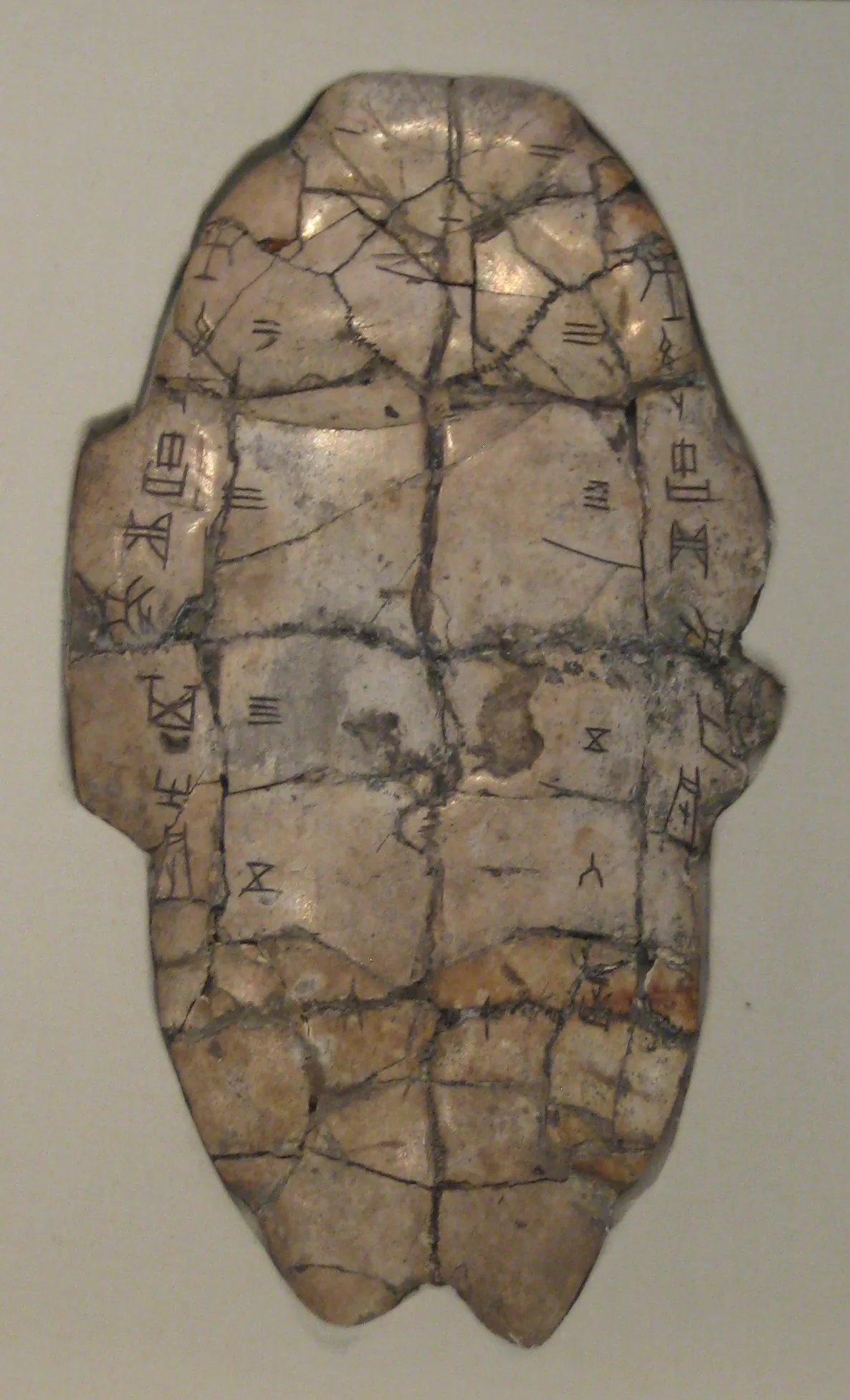
BabelStone, tortoise plastron with divination inscription, via Wikimedia Commons. National Museum of China, Beijing · CC BY-SA 3.0 · Source page
The bones were used for divination: asking gods and ancestors about a question. The material was a shoulder blade of an ox or a turtle plastron. It was heated from the back until it cracked, and the diviner read the cracks. Then the question, and the reading, were written on the bone itself.
The surviving questions cover war, sacrifice, farming, hunting, births, illnesses in the royal family, and the weather.
Look at the shell in the picture: the cracks are numbered.
Dragon bones
1899, the story goes
A pharmacy in Beijing
Much later, the bones were sold as medicine. They were called dragon bones.
The best-known story begins in 1899. A Qing official named Wang Yirong was ill. He bought "dragon bones" from a pharmacy in Beijing, and saw signs carved on them. Or so the legend goes.
The essay says we cannot know whether the bones cured him. The malaria and the pharmacy belong to the legend.
A decision point
You are a farmer who lives near Yinxu.
Before 1903. The sources give no exact date.
You work your field. Your spade has turned up pieces of bone and shell with marks on them.
A dealer offers money for them, and some of your neighbours have already sold theirs.
What do you do with the pieces?
- Sell them to the dealer. Probably you get money quickly. The pieces leave the field, and no one records exactly where each one lay.
- Keep them at home and say nothing. Probably the pieces stay with you, unread and unrecorded, and may be lost over time.
- Bury them again in the field. Probably the pieces stay in the ground for a later, careful dig, but you give up the money.
What really happened
Sell them to the dealer.
The sources say that local people sold bone pieces for profit. The sales came before any careful digging, so, as far as the sources show, nothing recorded where each piece lay.
The sources describe the sales as being for profit. Nothing more about this farmer's reasons is known. The seat is a reconstruction.
Collectors and a catalogue
The collecting
The collecting rush
Wang Yirong and others bought over a thousand specimens in the rush. Liu E (1857 to 1909) later acquired about 5,000 pieces, many of them Wang's.
Wang died in 1900, not long after his discovery, as the Qing faced defeat by the allied forces.
A decision point
You are Liu E, a collector.
1903.
You have bought about 5,000 pieces, many from the collection of Wang Yirong, who died in 1900. You have made rubbings of the carved surfaces. Scholars would like to read them.
What do you do with the collection?
- Publish a catalogue of the rubbings. Probably scholars get a shared record to work from, and the writing becomes public, though only in part.
- Keep the collection private. Probably scholars cannot reach it, and only you know what the pieces say.
- Sell the whole collection to one dealer. Probably the collection scatters, and it becomes much harder to study the pieces together.
What really happened
Publish a catalogue of the rubbings.
In 1903 Liu E published a catalogue of rubbings. It was partial, with 1,058 rubbings by one count, and Luo Zhenyu wrote the preface. It was the first published collection of rubbings.
We do not know all his reasons. Publishing made the writing readable to scholars who never handled the pieces.
Myth
Chinese writing is pictures: each character is a little drawing of what it means.
The truth
It is not true of most characters. About 58% of the frequent modern characters are phono-semantic compounds: one part hints at the meaning, another part at the sound.
The Shang script looks pictographic, but even its graphs are no longer pictographs in function. By one count, about 23% of Shang signs are pictographs.
The evidence
The 58% figure comes from a 2008 study of modern characters, as summarised on Wikipedia. The 23% figure is a 1968 count, reported in 1987.
The dig and who wrote
A decision point
You lead the new dig at Yinxu in 1928.
1928
For years villagers have sold bones from the fields. Your institute can fund a dig: buy from sellers, or dig yourselves.
What is your plan?
- Buy finds from villagers, and dig nothing yourselves. Probably cheap, quick bones, but without the place where each piece lay.
- Dig the site yourselves, and record where each piece lies. Probably slower and more costly, but each piece keeps its place and is recorded.
- Stop the trade and the digging, since the bones are being sold as medicine. Probably the trade continues elsewhere, and the bones stay in the ground unstudied.
What really happened
Dig the site yourselves, and record where each piece lies.
The institute did dig. Academia Sinica excavations at Yinxu ran from 1928 to 1937, and the sources name Li Ji as leader. In 1936, pit YH127 yielded 17,096 inscribed pieces, by the museum's count.
The team's full reasons are not in the sources. The record shows the choice to dig.
Source: A museum's claim about handwriting
the earliest records of human handwriting found in Chinese history
Brushed glyphs on tortoise shell, from pit YH127, opened in 1936. Not all glyphs from the pit are brushed.
- Who is speaking, and when? A museum, in a 2006 exhibition. It explains its own collection, so check it against other sources.
- What exactly is claimed? That these records are the earliest handwriting found in Chinese history. The claim covers what has been found so far, and a later find could change it.
- What is left out? Only some glyphs are brush-written, and the claim covers those. It says nothing about the other glyphs from the pit.
Source: Who wrote on this bone?
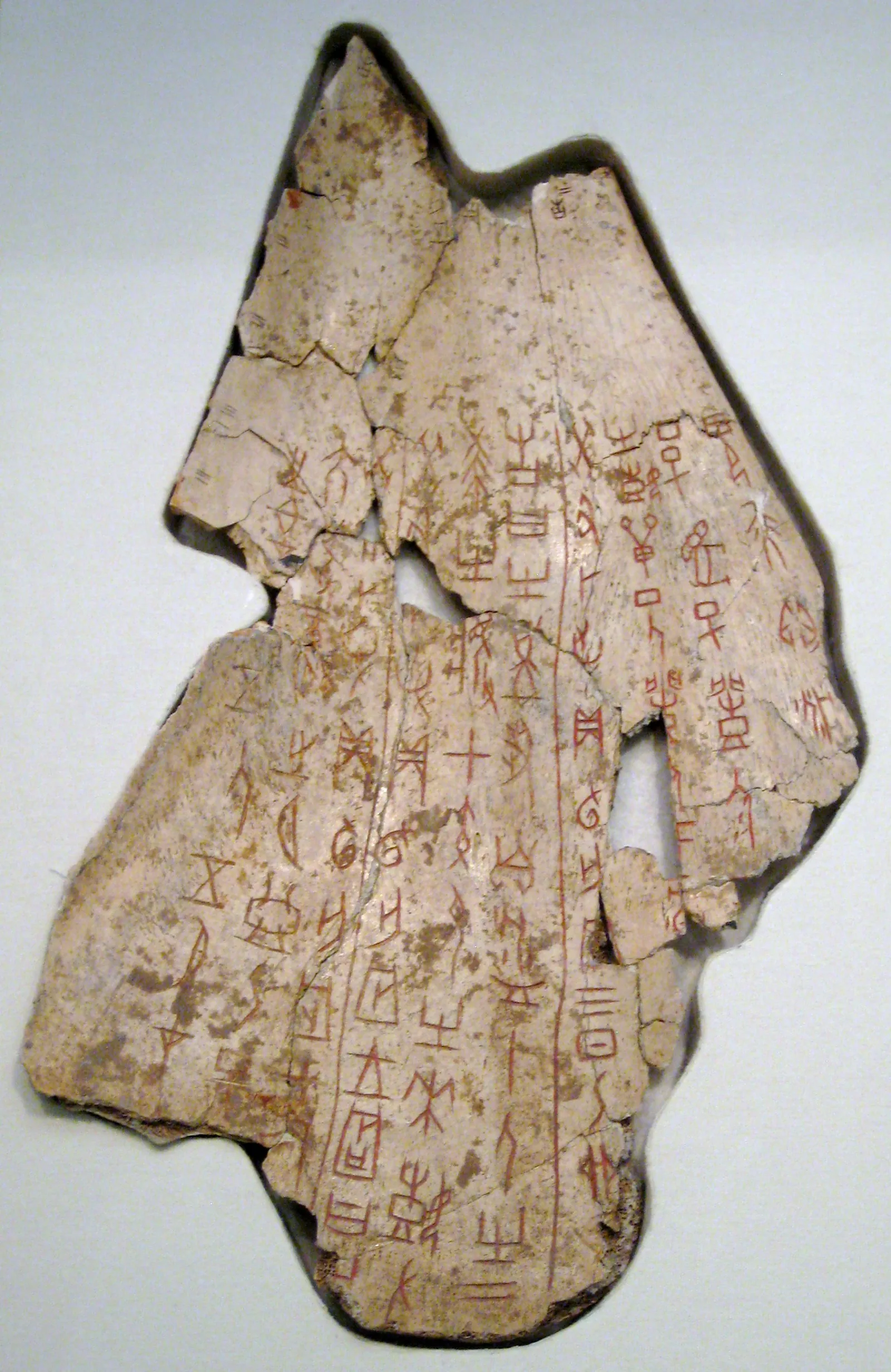
BabelStone, inscribed scapula, via Wikimedia Commons. National Museum of China, Beijing · CC BY-SA 3.0 · Source page
Ox shoulder blade in the National Museum of China, Beijing. Photo: BabelStone
- Who wrote the record? The bone names the diviner Zheng, of the Bin group, in the reign of Wu Ding. It is a diviner's record, not an outside observer's.
- Why was it written down? Probably to keep the question and the answer. This is an inference, not a stated aim.
- What is missing? The reasoning. The bone gives the question and reading, not why the diviner read the crack that way.
After the bones
Kings
Kings checked against a book
The bones name the kings. On the old question of whether the early kings were real, this is early evidence.
Sima Qian wrote his history long after the Shang had fallen, and lists its kings. Wang Guowei argued that the order of kings on the bones matches that list. It is a scholarly argument, not a proof. Still, the names come from records written close to the kings' own time.
A woman in the records
Fu Hao
Fu Hao was one of King Wu Ding's three consorts, and the mother of Prince Zu Ji. Bronzes in her tomb carry inscriptions that identify her.
Her tomb was excavated at Yinxu in 1976. Reports describe it as largely undisturbed.
Later accounts say she led troops, with a figure of up to 13,000 soldiers. That figure is reported, not read from a specific inscription, so treat it with care.
What came after
- 1899 (legend) Wang Yirong is said to find carved bones in a Beijing pharmacy.
- 1900 Wang Yirong dies, not long after his discovery.
- 1903 Liu E publishes a partial catalogue of rubbings.
- 1928 Academia Sinica begins excavations at Yinxu. They run until 1937.
- 1976 Fu Hao's tomb is excavated at Yinxu.
Did the bones prove the kings?
How far do the bones confirm the kings in Sima Qian's list?
- Wang Guowei and scholars who followed him The order of kings on the bones matches Sima Qian's list. For them, that match shows the early list has real memory behind it.
- Cautious readers A match is an argument, not a proof. The bones help confirm that the named kings were real, but they do not confirm every detail of Sima Qian's account.
What would convince you: one inscription that names a king, or a match across many inscriptions? Why?
Check yourself
How were the questions on the Shang bones answered?
Answer: Heat cracked a bone, and the question and the reading were written on it.. Right. The heat, the cracks and the writing on the same bone are the core of the practice.
Check yourself
What is the status of the 1899 pharmacy story?
Answer: A tradition told as legend, whose details are disputed.. Right. The essay tells it as 'or so the legend goes', and the details are not verified.
Check yourself
What did Liu E's 1903 catalogue do?
Answer: It published partial rubbings, with a preface by Luo Zhenyu.. Right. The catalogue was partial, and Luo Zhenyu wrote its preface.
Check yourself
Which statement about Chinese characters does the lesson support?
Answer: About 58% of frequent modern characters mix meaning and sound parts.. Right: this is the 2008 figure the lesson cites, for about 3,500 frequent modern characters.
Check yourself
The museum says the brushed records are the earliest handwriting found in Chinese history. How should a reader treat that?
Answer: As a claim about finds so far, which a later find could change.. Right. That is the honest reading: the claim is about finds, and a museum explaining its own collection is still a source to check.
Check yourself
The lesson reports that Fu Hao led up to 13,000 soldiers. How should you treat that figure?
Answer: As a reported number, not tied to one inscription.. Right. The figure is reported, and the lesson treats it with care.
Terms
- Shang dynasty The dynasty whose kings are named on the bones. Its last capital was Yin. In traditional chronology the dynasty ended around 1046 BC.
- Yin The last Shang capital, at the site now called Yinxu, near modern Anyang in Henan. Most of the inscribed bones were found there.
- divination An attempt to learn what gods or ancestors want, about a particular question. In Shang China it was done by heating a bone and reading the cracks.
- shoulder blade The flat bone of the shoulder. Shang diviners used the shoulder blades of oxen.
- turtle plastron The flat lower shell of a turtle. Shang diviners used these too.
- dragon bones The name under which bones were sold in China as medicine. The story uses the sellers' name.
- rubbing A copy of an inscribed surface, made by pressing damp paper onto it and rubbing ink over the top.
- consort A wife of a king. A consort could also command troops.
- phono-semantic character A Chinese character with two parts: one hints at the meaning, the other at the sound. Many Chinese characters are built this way.
- Wu Ding A Shang king, the best known of the kings named on the bones.
- Anyang A modern city in Henan province, in central China. The ruins of Yinxu lie nearby.
- Yinxu The ruins of Yin, the last capital of the Shang. Most inscribed bones were found here.
- Henan A province in central China. Anyang and the ruins of Yinxu lie there.
- Sima Qian A Chinese historian who wrote his history long after the Shang fell, and listed its kings.
- Wang Yirong A Qing official. By legend, he bought dragon bones in a Beijing pharmacy in 1899, and died in 1900.
- Liu E A collector who gathered about 5,000 pieces, many from Wang Yirong's collection. In 1903 he published a catalogue of rubbings.
- Luo Zhenyu A scholar who wrote the preface to Liu E's catalogue of rubbings, published in 1903.
- Li Ji Named in the sources as the leader of the Academia Sinica digs at Yinxu.
- Zheng Zhenxiang Led the team that excavated Fu Hao's tomb at Yinxu in 1976.
- Fu Hao One of King Wu Ding's three consorts. Her tomb was excavated at Yinxu in 1976.
- Zu Ji A prince, son of Fu Hao.
- Academia Sinica A Chinese research institute that ran the excavations at Yinxu from 1928 to 1937.
- Radiocarbon dating A method for dating once-living material by how much carbon-14 remains in it.
- Qing dynasty The ruling imperial dynasty of China when the bones were sold and found. It faced defeat in 1900.
- Beijing China's capital today. In a pharmacy here, Wang Yirong is said to have bought dragon bones.
- Wang Guowei A Chinese scholar who argued that the order of kings on the bones matches Sima Qian's list. It is an argument, not a proof.
- Pit YH127 An excavation pit at Yinxu, opened in 1936, where many inscribed pieces were found.
- Shang script The writing on the bones. It looks pictographic, but it no longer works as pictures.
- Pictograph A sign that looks like the thing it stands for, such as a small picture of the sun.
Sources
- Oracle-bone inscriptions from Yinxu, Shang dynasty, c. 1250 to 1050 BC, as held in the National Museum of China and the Yinxu museum (photographs cited above)
- Academia Sinica Museum, exhibition page on the Yinxu excavations, 2006
- China Heritage (chinaheritage.net), essay 'Oracle Bones: That Dangerous Supplement' (author not confirmed)
- David N. Keightley, Sources of Shang History: The Oracle-Bone Inscriptions of Bronze Age China, Berkeley: University of California Press, 1978
- Wikipedia, 'Oracle bone script', 'Chinese characters' and 'Fu Hao' (used for sign counts, deciphering estimates and dating; each figure there traces to the works it cites)
Image credits
- Gary Lee Todd, Ph.D., 2018 (WorldHistoryPics.com, via Wikimedia Commons) · CC0 · Source page
- BabelStone, tortoise plastron with divination inscription, via Wikimedia Commons. National Museum of China, Beijing · CC BY-SA 3.0 · Source page
- BabelStone, inscribed scapula, via Wikimedia Commons. National Museum of China, Beijing · CC BY-SA 3.0 · Source page


